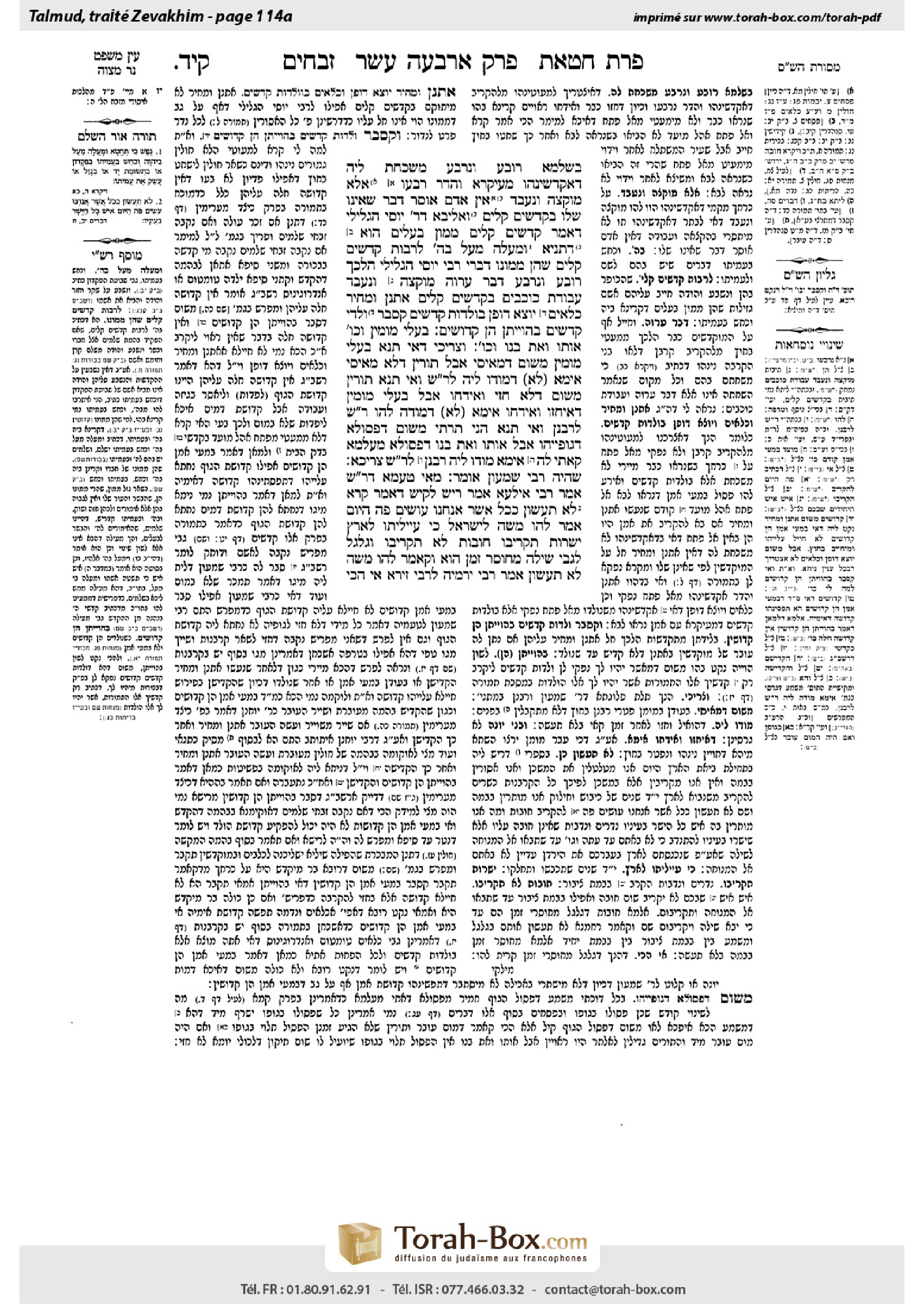
Zevachim 114a: Talmud study for Daf Yomi
Daf Yomi is the daily study of one Talmud folio. Explore 37 tractates with scans, Hebrew text, Sefaria English and AI-generated French translations where annotated.
Passage selection and English or AI-generated French translation are available where the scan has annotations. Daf Study is independent of Torah-Box and Sefaria.
Browse Zevachim · זבחים · All tractatesZevachim 114a text and translations
This page of Zevachim includes the Aramaic text, an English translation and an AI-generated French translation, alongside the scan above.
זבחים קי״ד א · Aramaic and Hebrew text
בִּשְׁלָמָא רוֹבֵעַ וְנִרְבָּע – מַשְׁכַּחַתְּ לֵיהּ דְּאַקְדְּשִׁינְהוּ מֵעִיקָּרָא, וַהֲדַר (רבעו) [אִירְבַעוּ].
אֶלָּא מוּקְצֶה וְנֶעֱבָד – אֵין אָדָם אוֹסֵר דָּבָר שֶׁאֵינוֹ שֶׁלּוֹ! בְּקָדָשִׁים קַלִּים, וְאַלִּיבָּא דְּרַבִּי יוֹסֵי הַגְּלִילִי – דְּאָמַר: קָדָשִׁים קַלִּים מָמוֹן בְּעָלִים הוּא.
דְּתַנְיָא: ״וּמָעֲלָה מַעַל בַּה׳״ – לְרַבּוֹת קֳדָשִׁים קַלִּים, שֶׁהֵן מָמוֹנוֹ. דִּבְרֵי רַבִּי יוֹסֵי הַגְּלִילִי.
הִלְכָּךְ, רוֹבֵעַ וְנִרְבָּע – דְּבַר עֶרְוָה. מוּקְצֶה וְנֶעֱבָד – עֲבוֹדָה זָרָה, בְּקָדָשִׁים קַלִּים.
אֶתְנַן, וּמְחִיר, כִּלְאַיִם, יוֹצֵא דּוֹפֶן – בִּוְלָדוֹת קָדָשִׁים.
קָסָבַר: וַלְדֵי קָדָשִׁים – בַּהֲוָיָיתָן הֵן קְדוֹשִׁים.
בַּעֲלֵי מוּמִין וְכוּ׳, אוֹתוֹ וְאֶת בְּנוֹ וְכוּ׳.
וּצְרִיכִי; דְּאִי תְּנָא בַּעֲלֵי מוּמִין – מִשּׁוּם דִּמְאִיסִי; אֲבָל תּוֹרִין, דְּלָא מְאִיסִי – אֵימָא לָא, דְּמוֹדוּ לֵיהּ לְרַבִּי שִׁמְעוֹן;
וְאִי תְּנָא תּוֹרִין – מִשּׁוּם דְּלָא (חזו) [אִיחֲזוֹ] וְאִידְּחוֹ; אֲבָל בַּעֲלֵי מוּמִין, דְּאִיחֲזוֹ וְאִידְּחוֹ – אֵימָא לָא, דְּמוֹדֵה לְהוּ רַבִּי שִׁמְעוֹן לְרַבָּנַן;
וְאִי תְּנָא הָנֵי תַּרְתֵּי – מִשּׁוּם דִּפְסוּלָא דְּגוּפַיְיהוּ; אֲבָל אוֹתוֹ וְאֶת בְּנוֹ, דִּפְסוּלָא מֵעָלְמָא קָאָתֵי לַהּ – אֵימָא מוֹדוּ לֵיהּ רַבָּנַן לְרַבִּי שִׁמְעוֹן; צְרִיכָא.
שֶׁהָיָה רַבִּי שִׁמְעוֹן אוֹמֵר: מַאי טַעְמָא דְּרַבִּי שִׁמְעוֹן?
אָמַר רַבִּי אִילְעָא אָמַר רֵישׁ לָקִישׁ, דְּאָמַר קְרָא: ״לֹא תַעֲשׂוּן כְּכֹל אֲשֶׁר אֲנַחְנוּ עוֹשִׂים פֹּה הַיּוֹם״ – אֲמַר לְהוּ מֹשֶׁה לְיִשְׂרָאֵל: כִּי עָיְילִיתוּ לָאָרֶץ – יְשָׁרוֹת תַּקְרִיבוּ, חוֹבוֹת לֹא תַּקְרִיבוּ.
וְגִלְגָּל לְגַבֵּי שִׁילֹה מְחוּסַּר זְמַן הוּא, וְקָאָמַר לְהוּ מֹשֶׁה: ״לֹא תַעֲשׂוּן״.
אָמַר רַבִּי יִרְמְיָה לְרַבִּי זֵירָא: אִי הָכִי,
Zevachim 114a · English translation
Granted, with regard to an animal that actively copulated with a person or an animal that was the object of bestiality, you find circumstances in which the exemption for one who slaughters it outside the Temple courtyard cannot be based on the fact that it is not fit to be brought to the entrance of the Tent of Meeting, e.g., a case where one initially consecrated it, at which point it was fit to be brought to the Temple courtyard, and then engaged in bestiality with it. Since it was initially fit to be brought to the Temple courtyard, another verse is needed to exclude it.
But with regard to an animal that was set aside for idol worship or one that was worshipped, this explanation is not tenable, since an animal that was already consecrated would not become disqualified because a person does not render forbidden an item that is not his. The Gemara responds that it is possible to disqualify a consecrated item in the case of offerings of lesser sanctity, such as a peace offering, and in accordance with the opinion of Rabbi Yosei HaGelili, who says: An offering of lesser sanctity is the property of the owner.
This is as it is taught in a baraita that the verse states with regard to the obligation to bring a guilt offering for robbery for taking a false oath concerning unlawful possession of the property of another: “If anyone sin, and commit a trespass against the Lord, and deal falsely with his neighbor in a matter of deposit, or of pledge, or of robbery, or have oppressed his neighbor” (Leviticus 5:21). The term “against the Lord” serves to include one who takes an oath with regard to another’s offerings of lesser sanctity, since they are the property of their owner. This is the statement of Rabbi Yosei HaGelili.
The Gemara summarizes: Therefore, all of the cases listed in the mishna are cases in which the animal was initially fit to be brought to the entrance of the Tent of Meeting but was subsequently disqualified as an offering. An animal that actively copulated with a person and an animal that was the object of bestiality are disqualified after having been consecrated, due to a matter of forbidden sexual intercourse. An animal that was set aside for idol worship or one that was worshipped as an object of idol worship becomes forbidden after it was consecrated in the case of an offering of lesser sanctity, which according to Rabbi Yosei HaGelili is the property of its owner.
In the case of an animal that was given as payment to a prostitute or as the price of a dog, or an animal born of a mixture of diverse kinds, or an animal born by caesarean section, none of which could have occured at a time that the animal was fit to be sacrificed, the mishna is referring to the offspring of sacrificial animals that were given as payment to a prostitute or as the price of a dog while in utero. These animals were fit to be brought as a sacrifice while they were still part of a consecrated animal, and only following birth are they considered to be unfit for sacrifice.
Although these offspring are still part of a consecrated animal while in utero, and as such one might say that the status of payment to a prostitute or the price of a dog should not take effect with regard to them, the tanna of the mishna holds that with regard to the offspring of sacrificial animals, they are sanctified only as they are from the time of birth, but not in utero. Therefore, they can be disqualified by serving as payment to a prostitute or as the price of a dog.
§ The mishna cites a disagreement between the Rabbis and Rabbi Shimon with regard to temporarily blemished animals: Rabbi Shimon holds that one who sacrifices them outside the Temple courtyard violates a prohibition, as they will be fit for sacrifice after the passage of time, whereas the Rabbis hold that one is exempt. The mishna cites two similar disagreements: With regard to doves whose time of fitness has not yet arrived that are slaughtered outside the Temple courtyard, and with regard to one who slaughters an animal itself and its offspring on one day, where the latter, which is not fit for being sacrificed until the next day, is slaughtered outside the Temple courtyard.
The Gemara comments: And all of these cases are necessary. As, if the mishna had taught the disagreement only in the case of temporarily blemished animals, one would think that the Rabbis deem exempt one who sacrifices outside the Temple courtyard only in that case, because they are repulsive; but with regard to doves whose time of fitness has not yet arrived, which are not repulsive and which will be fit when their time arrives, I will say that this is not the halakha, and that the Rabbis concede to Rabbi Shimon that one does violate a prohibition.
And if the mishna had taught the disagreement only in the case of doves whose time of fitness has not yet arrived, one could say that it is only in this case that Rabbi Shimon holds that one who sacrifices them outside violates a prohibition, because they are not defined as: Fit for sacrifice and rejected; their time of fitness simply has not arrived. But with regard to temporarily blemished animals, which were fit for sacrifice and then disqualified, I will say that this is not the halakha, as Rabbi Shimon concedes to the Rabbis that one who sacrifices them outside the Temple courtyard does not violate a prohibition, since they are not fit to be sacrificed as offerings.
And if the mishna had taught only these two cases, i.e., temporarily blemished animals and doves whose time of fitness has not yet arrived, I would say that the Rabbis hold that one who slaughters them outside the Temple courtyard is not liable because their disqualification is inherent. But in the case of the animal itself and its offspring, where the disqualification comes to the offspring from an external factor, i.e., that its parent was slaughtered that day, I will say that the Rabbis concede to Rabbi Shimon that one who slaughters an animal and its offspring outside the Temple courtyard does violate the prohibition. Therefore, it is necessary for the mishna to teach the disagreement in each case.
§ The mishna teaches that Rabbi Shimon says: In the case of any sacrificial animal that is fit to be sacrificed after the passage of time, if one sacrificed it outside the courtyard, he is in violation of a prohibition but there is no liability for karet. Rabbi Shimon did not specify what prohibition is violated. The Gemara therefore asks: What is the reasoning of Rabbi Shimon?
Rabbi Ile’a says that Reish Lakish says that the verse states: “You shall not do all that we do here this day, every man whatsoever is right in his own eyes. For you have not as yet come to the rest and to the inheritance, which the Lord your God gives you” (Deuteronomy 12:8–9). Moses said the following to the Jewish people: When you enter Eretz Yisrael, upright offerings, i.e., offerings that one believes are proper to bring due to one’s own generosity, such as vow offerings and gift offerings, you may sacrifice, but obligatory offerings you may not sacrifice, even in the Tabernacle in Gilgal, until you arrive at “the rest,” i.e., Shiloh, at which point you may sacrifice them.
And since obligatory offerings during the period of Gilgal, in relation to the period of Shiloh, are considered offerings whose time has not yet arrived, and Moses said to the Jewish people concerning them: “You shall not do,” during that period, it follows that one who sacrifices an offering whose time has not yet arrived is in violation of the prohibition: “You shall not do.”
Rabbi Yirmeya said to Rabbi Zeira: Therefore, it is prohibited to sacrifice offerings whose time has not yet arrived, even if they are sacrificed in the Tabernacle as was the case in Gilgal. If so, anyone who sacrifices an offering whose time has not yet arrived, even if he sacrifices it inside the Temple courtyard,
Zevachim 114a · Traduction française (IA)
Certes, dans le cas d’un animal qui s’est accouplé avec une personne ou d’un animal qui a été l’objet d’un acte de bestialité, il existe des situations où l’exemption de celui qui l’abat en dehors du parvis du Temple ne peut s’expliquer par le fait qu’il n’est pas apte à être amené à l’entrée de la Tente d’assignation. C’est le cas, par exemple, lorsqu’on l’a d’abord consacré, alors qu’il était apte à être amené au parvis du Temple, puis qu’on a commis un acte de bestialité avec lui. Puisqu’il était initialement apte à être amené au parvis du Temple, un autre verset est nécessaire pour l’exclure.
Mais dans le cas d’un animal réservé au culte des idoles ou d’un animal qui a été adoré, cette explication ne tient pas, car un animal déjà consacré ne serait pas disqualifié : une personne ne peut pas rendre interdit un bien qui ne lui appartient pas. La Guemara répond qu’il est possible de disqualifier un objet consacré dans le cas d’offrandes de moindre sainteté, comme un sacrifice de paix, conformément à l’opinion de Rabbi Yossei HaGelili, qui dit qu’une offrande de moindre sainteté appartient à son propriétaire.
C’est ce qu’enseigne une baraïta : au sujet de l’obligation d’apporter un sacrifice de culpabilité pour un vol, en raison d’un faux serment concernant la détention illicite du bien d’autrui, le verset dit : « Si quelqu’un commet une faute et se rend coupable d’un manquement envers l’Éternel en trompant son prochain au sujet d’un dépôt, d’un gage, d’un vol ou en opprimant son prochain » (Lévitique 5,21). L’expression « envers l’Éternel » inclut celui qui prête serment au sujet des offrandes de moindre sainteté d’autrui, puisqu’elles appartiennent à leur propriétaire. Telle est l’opinion de Rabbi Yossei HaGelili.
La Guemara résume : tous les cas énumérés dans la Michna sont donc des cas où l’animal était initialement apte à être amené à l’entrée de la Tente d’assignation, mais a ensuite été disqualifié comme offrande. L’animal qui s’est accouplé avec une personne et celui qui a été l’objet d’un acte de bestialité sont disqualifiés après leur consécration en raison d’une interdiction sexuelle. Un animal réservé au culte des idoles ou adoré comme une idole devient interdit après sa consécration, dans le cas d’une offrande de moindre sainteté qui, selon Rabbi Yossei HaGelili, appartient à son propriétaire.
Dans le cas d’un animal donné en paiement à une prostituée ou comme prix d’un chien, d’un animal issu d’un croisement d’espèces différentes ou d’un animal né par césarienne — situations qui ne peuvent se produire alors que l’animal est apte à être offert en sacrifice —, la Michna parle des petits d’animaux consacrés qui ont été donnés en paiement à une prostituée ou comme prix d’un chien alors qu’ils étaient encore dans le ventre de leur mère. Tant qu’ils faisaient partie d’un animal consacré, ces petits étaient aptes à être amenés comme sacrifices ; ce n’est qu’après leur naissance qu’ils sont considérés comme inaptes au sacrifice.
Bien que ces petits fassent encore partie d’un animal consacré lorsqu’ils sont dans le ventre de leur mère, et que l’on puisse donc penser que le statut de paiement à une prostituée ou de prix d’un chien ne devrait pas s’appliquer à eux, le tanna de la Michna considère que les petits d’animaux consacrés ne sont sanctifiés qu’à partir de leur naissance, et non lorsqu’ils sont encore dans le ventre de leur mère. Ils peuvent donc être disqualifiés en servant de paiement à une prostituée ou de prix d’un chien.
§ La Michna rapporte un désaccord entre les Rabbins et Rabbi Shimon au sujet des animaux temporairement atteints d’un défaut : Rabbi Shimon considère que celui qui les sacrifie en dehors du parvis du Temple transgresse une interdiction, puisqu’ils seront aptes au sacrifice une fois le temps écoulé, tandis que les Rabbins considèrent qu’il est exempt. La Michna rapporte deux désaccords similaires : l’un au sujet de colombes abattues en dehors du parvis du Temple avant qu’elles ne soient aptes au sacrifice, et l’autre au sujet de celui qui abat un animal et son petit le même jour, lorsque le petit, qui ne sera apte au sacrifice que le lendemain, est abattu en dehors du parvis du Temple.
La Guemara fait remarquer que tous ces cas sont nécessaires. En effet, si la Michna avait rapporté le désaccord uniquement à propos des animaux temporairement atteints d’un défaut, on aurait pu penser que les Rabbins exemptent celui qui les sacrifie en dehors du parvis du Temple uniquement dans ce cas, parce qu’ils sont repoussants. Mais, au sujet des colombes qui ne sont pas encore aptes au sacrifice, qui ne sont pas repoussantes et qui le deviendront lorsque leur temps sera venu, on aurait dit que telle n’est pas la halakha et que les Rabbins reconnaissent à Rabbi Shimon que l’on transgresse une interdiction.
Et si la Michna avait rapporté le désaccord uniquement à propos des colombes qui ne sont pas encore aptes au sacrifice, on aurait pu dire que Rabbi Shimon considère que celui qui les sacrifie en dehors du Temple transgresse une interdiction uniquement dans ce cas, car elles ne sont pas définies comme « aptes au sacrifice puis disqualifiées » : leur temps n’est tout simplement pas encore venu. Mais, au sujet des animaux temporairement atteints d’un défaut, qui étaient aptes au sacrifice puis ont été disqualifiés, on aurait dit que telle n’est pas la halakha et que Rabbi Shimon concède aux Rabbins que celui qui les sacrifie en dehors du parvis du Temple ne transgresse aucune interdiction, puisqu’ils ne sont pas aptes à être offerts en sacrifice.
Et si la Michna n’avait enseigné que ces deux cas, c’est-à-dire celui des animaux temporairement atteints d’un défaut et celui des colombes qui ne sont pas encore aptes au sacrifice, on aurait dit que les Rabbins considèrent que celui qui les abat en dehors du parvis du Temple n’est pas passible, car leur disqualification leur est inhérente. Mais, dans le cas de l’animal et de son petit, où la disqualification du petit provient d’un facteur extérieur, à savoir que son parent a été abattu ce jour-là, on aurait dit que les Rabbins reconnaissent à Rabbi Shimon que celui qui abat un animal et son petit en dehors du parvis du Temple transgresse l’interdiction. Il est donc nécessaire que la Michna rapporte le désaccord dans chacun des cas.
§ La Michna enseigne que Rabbi Shimon dit : pour tout animal destiné au sacrifice qui sera apte à être offert une fois le temps écoulé, si on l’a sacrifié en dehors du parvis, on transgresse une interdiction, mais on n’est pas passible de karet. Rabbi Shimon n’a pas précisé quelle interdiction est transgressée. La Guemara demande donc : quel est le raisonnement de Rabbi Shimon ?
Rabbi Ile’a dit que Reish Lakish dit que le verset énonce : « Vous n’agirez pas comme nous le faisons ici aujourd’hui, chacun faisant ce qui lui semble bon. Car vous n’êtes pas encore arrivés au repos et à l’héritage que l’Éternel, votre Dieu, vous donne » (Deutéronome 12,8-9). Moïse dit ceci au peuple juif : lorsque vous entrerez en Eretz Yisrael, vous pourrez offrir les sacrifices volontaires, c’est-à-dire ceux que l’on estime appropriés en raison de sa propre générosité, comme les sacrifices votifs et les offrandes volontaires ; mais vous ne pourrez pas offrir les sacrifices obligatoires, même dans le Tabernacle de Guilgal, avant d’être arrivés au « repos », c’est-à-dire à Silo. À partir de là, vous pourrez les offrir.
Puisque, par rapport à la période de Silo, les sacrifices obligatoires de la période de Guilgal sont considérés comme des sacrifices dont le temps n’est pas encore venu, et que Moïse dit à leur sujet au peuple juif : « Vous n’agirez pas » pendant cette période, il s’ensuit que celui qui offre un sacrifice avant que son temps ne soit venu transgresse l’interdiction : « Vous n’agirez pas ».
Rabbi Yirmeya dit à Rabbi Zeira : Il est donc interdit d’offrir des sacrifices avant que leur temps ne soit venu, même s’ils sont offerts dans le Tabernacle, comme c’était le cas à Guilgal. Dans ce cas, quiconque offre un sacrifice avant que son temps ne soit venu, même s’il l’offre à l’intérieur du parvis du Temple,
Traduction française générée par IA à partir de l’édition anglaise de Sefaria. Vérifie toujours un passage avec le texte source.
Text from Sefaria: William Davidson Edition - Vocalized Aramaic (CC BY NC); William Davidson Edition - English (CC BY NC).