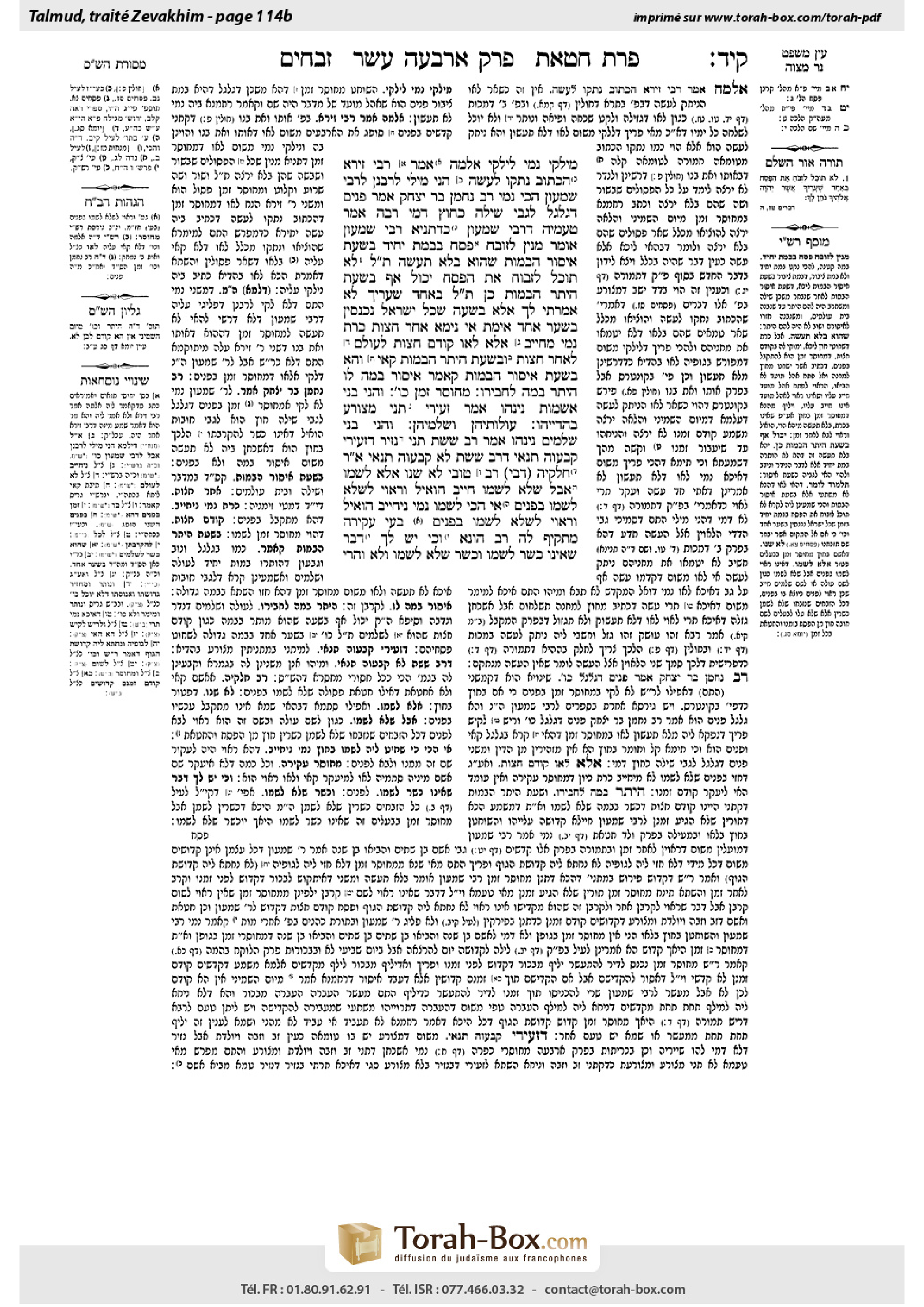
Zevachim 114b: Talmud study for Daf Yomi
Daf Yomi is the daily study of one Talmud folio. Explore 37 tractates with scans, Hebrew text, Sefaria English and AI-generated French translations where annotated.
Passage selection and English or AI-generated French translation are available where the scan has annotations. Daf Study is independent of Torah-Box and Sefaria.
Browse Zevachim · זבחים · All tractatesZevachim 114b text and translations
This page of Zevachim includes the Aramaic text, an English translation and an AI-generated French translation, alongside the scan above.
זבחים קי״ד ב · Aramaic and Hebrew text
מִילְקֵי נָמֵי לִילְקֵי! אַלְּמָה אָמַר רַבִּי זֵירָא: הַכָּתוּב נִתְּקוֹ לַעֲשֵׂה?
הָנֵי מִילֵּי לְרַבָּנַן, לְרַבִּי שִׁמְעוֹן הָכִי נָמֵי.
רַב נַחְמָן בַּר יִצְחָק אָמַר: פְּנִים דְּגִלְגָּל לְגַבֵּי שִׁילֹה – כְּחוּץ דָּמֵי.
רַבָּה אָמַר: טַעְמֵיהּ דְּרַבִּי שִׁמְעוֹן – כִּדְתַנְיָא, רַבִּי שִׁמְעוֹן אוֹמֵר: מִנַּיִן לַזּוֹבֵחַ פֶּסַח בְּבָמַת יָחִיד בִּשְׁעַת אִיסּוּר הַבָּמוֹת, שֶׁהוּא בְּלֹא תַעֲשֶׂה? תַּלְמוּד לוֹמַר: ״לֹא תוּכַל לִזְבֹּחַ אֶת הַפָּסַח״.
יָכוֹל אַף בִּשְׁעַת הֶיתֵּר הַבָּמוֹת כֵּן? תַּלְמוּד לוֹמַר: ״בְּאַחַד שְׁעָרֶיךָ״ – לֹא אָמַרְתִּי לְךָ אֶלָּא בְּשָׁעָה שֶׁכׇּל יִשְׂרָאֵל נִכְנָסִין בְּשַׁעַר אֶחָד.
אֵימַת? אִי נֵימָא אַחַר חֲצוֹת – כָּרֵת נָמֵי מִחַיַּיב! אֶלָּא לָאו קוֹדֶם חֲצוֹת?
לְעוֹלָם לְאַחַר חֲצוֹת, וּבִשְׁעַת הֶיתֵּר הַבָּמוֹת קָאֵי.
וְהָא בִּשְׁעַת אִיסּוּר הַבָּמוֹת קָאָמַר! אִיסּוּר בָּמָה לוֹ, הֶיתֵּר בָּמָה לַחֲבֵירוֹ.
מְחוּסַּר זְמַן כּוּ׳. וְהָנֵי בְּנֵי אֲשָׁמוֹת נִינְהוּ?! אָמַר זְעֵירִי: תְּנִי מְצוֹרָע בַּהֲדַיְיהוּ.
עוֹלוֹתֵיהֶן וְשַׁלְמֵיהֶן. וְהָנֵי בְּנֵי שְׁלָמִים נִינְהוּ?! אָמַר רַב שֵׁשֶׁת: תְּנִי נָזִיר. דִּזְעֵירִי קַבְעוּהָ תַּנָּאֵי, דְּרַב שֵׁשֶׁת לָא קַבְעוּהָ תַּנָּאֵי.
אָמַר רַבִּי חִלְקִיָּה (דְּבֵי) רַב טוֹבִי: לֹא שָׁנוּ אֶלָּא לִשְׁמוֹ; אֲבָל שֶׁלֹּא לִשְׁמוֹ – חַיָּיב, הוֹאִיל וְרָאוּי לְשֶׁלֹּא לִשְׁמוֹ בִּפְנִים.
אִי הָכִי, לִשְׁמוֹ נָמֵי נִיחַיַּיב – הוֹאִיל וְרָאוּי לְשֶׁלֹּא לִשְׁמוֹ בִּפְנִים! בָּעֵי עֲקִירָה.
מַתְקֵיף לַהּ רַב הוּנָא: וְכִי יֵשׁ לְךָ דָּבָר שֶׁאֵינוֹ כָּשֵׁר לִשְׁמוֹ, וְכָשֵׁר שֶׁלֹּא לִשְׁמוֹ?! וְלֹא?! וַהֲרֵי
Zevachim 114b · English translation
should also receive lashes for sacrificing it, just as one would for violating other Torah prohibitions. Why did Rabbi Zeira say elsewhere that one who slaughters, inside the Temple courtyard, an offering whose time has not yet arrived does not receive lashes for having violated the prohibition of: “It shall not be accepted” (Leviticus 22:23), which is the general prohibition against sacrificing animals that are not fit to be sacrificed. Rabbi Zeira explains that he does not receive lashes because the verse has transmuted the negative precept into a prohibition that is stated as a positive mitzva, in the verse: “But from the eighth day forward it may be accepted” (Leviticus 22:27). There is no punishment of lashes for violating such a prohibition. Rabbi Yirmeya is asking that one should still receive lashes for having violated the prohibition of: “You shall not do.”
The Gemara responds: That statement of Rabbi Zeira applies only according to the opinion of the Rabbis, who disagree with Rabbi Shimon in the mishna and hold that the verse that states: “You shall not do,” does not indicate that one who slaughters an animal whose time has not yet arrived is in violation of a prohibition. But according to the opinion of Rabbi Shimon, one would indeed receive lashes for slaughtering an animal whose time has not yet arrived inside the Temple.
Rav Naḥman bar Yitzḥak said: Rabbi Zeira’s statement is even in accordance with the opinion of Rabbi Shimon, who also holds that one would not receive lashes for slaughtering inside the Temple courtyard an offering whose time has not yet arrived. A prohibition cannot be derived from the prohibition stated with regard to the Tabernacle in Gilgal, since inside the Tabernacle in Gilgal, in relation to the Tabernacle in Shiloh, is considered like outside, and the prohibition: “You shall not do,” pertains only to sacrificing an offering whose time has not yet arrived outside the Temple courtyard.
Rabba said: The reason of Rabbi Shimon is not based upon: “You shall not do,” as Reish Lakish claims, but upon another verse. As it is taught in a baraita that Rabbi Shimon says: From where is it derived that one who slaughters his Paschal offering on a private altar at a time when it is prohibited to sacrifice offerings on private altars violates a prohibition? The verse states: “You may not sacrifice the Paschal offering within any of your gates; but at the place that the Lord your God shall choose to cause His name to dwell in, there you shall sacrifice the Paschal offering” (Deuteronomy 16:5–6).
One might have thought that even at a time when it is permitted to sacrifice offerings on private altars this is so. Therefore, the verse states: “Within any [be’aḥad] of your gates,” which indicates that I said this prohibition to you only when all of the Jewish people enter the Temple through one [eḥad] gate in order to sacrifice their offerings. When there is no permanent communal altar, it is permitted to slaughter the Paschal offering on a private altar.
Rabba analyzes the baraita: When was this Paschal offering, for which one violates a prohibition for slaughtering it during a time when it is forbidden to sacrifice on private altars, slaughtered? If we say that it was after midday on the fourteenth of Nisan, which is the proper time for sacrificing the Paschal offering in the Temple, then one who sacrifices it then violates not only a prohibition, he should also be deemed liable to receive karet as well, as would anyone who slaughters a fit offering outside the Temple courtyard. Rather, is it not discussing one who slaughtered the Paschal offering on a private altar on the fourteenth of Nisan before midday, when its time had not yet arrived?
The Gemara rejects Rabba’s explanation: Actually, the Paschal offering may have been sacrificed on a private altar after midday of the fourteenth of Nisan, and it is referring to a time when it is permitted to sacrifice on private altars, i.e., the periods of Gilgal, Nov, and Gibeon. The verse teaches that although it was permitted to sacrifice voluntary vow offerings and gift offerings on a private altar, the Paschal offering may be sacrificed only on a great public altar.
The Gemara asks: But doesn’t the baraita state: At a time when it is prohibited to sacrifice offerings on private altars? The Gemara responds: The baraita means that it is prohibited for one to sacrifice the Paschal offering on a private altar, but it is permitted to use a private altar for another offering, i.e., a voluntary vow offering or gift offering.
§ The mishna teaches that with regard to an offering whose time has not yet arrived because it is premature for its owner, one who sacrifices it outside the Temple courtyard is exempt. This category includes a zav, a zava, and a woman after childbirth, any of whom sacrificed a sin offering or guilt offering outside the Temple courtyard during the days that they are counting toward purification. The Gemara asks: And are these individuals subject to the obligation to bring guilt offerings? Ze’eiri said: The text of the mishna should teach: Leper, together with the zav, zava, and woman after childbirth. A leper brings a guilt offering as part of his purification process.
The mishna also teaches that if those whose time has not yet arrived sacrifice their burnt offerings or their peace offerings outside the Temple courtyard, they are liable. The Gemara asks: And are these individuals subject to the obligation to bring peace offerings? Rav Sheshet said: Teach the case of a Nazirite as part of the list in the mishna. A nazirite brings a peace offering at the conclusion of his term of naziriteship. The Gemara notes that the addition of Ze’eiri to the text of the mishna, i.e., the case of a leper, was fixed by the tanna’im in the version of the mishna that they would teach, while the addition of Rav Sheshet, i.e., the case of a nazirite, was not fixed by the tanna’im in the mishna that they would teach.
§ The mishna teaches that if one whose days of purification are not complete, e.g., a leper, slaughters his guilt offering outside the courtyard, he is exempt, since the offering is not fit for sacrifice at that time. With regard to this, Rabbi Ḥilkiya, a Sage from the school of Rav Tovi, says: They taught this only with regard to one who slaughters a guilt offering outside the Temple courtyard for its own sake. But if he slaughtered it outside the Temple courtyard not for its own sake but for the sake of a different offering, he is liable for having sacrificed outside the courtyard. This is because it was fit to be sacrificed not for its own sake inside the Temple courtyard, as a guilt offering that was slaughtered not for its own sake is fit for sacrifice (see 2a).
The Gemara asks: If so, one who slaughtered the guilt offering for its own sake should also be liable for having slaughtered it outside the Temple courtyard, since it was fit to be slaughtered not for its sake inside the Temple courtyard. The Gemara answers: In order for a guilt offering that was slaughtered outside the Temple courtyard to be considered fit to be sacrificed inside it, it first requires uprooting of its status, i.e., the one who slaughters it should intend explicitly that it be a different sacrifice. If its status as a guilt offering has not been uprooted, it is not considered fit to be sacrificed inside.
Rav Huna objects to Rabbi Ḥilkiya’s statement that a guilt offering whose time has not yet arrived is fit to be sacrificed inside if it is slaughtered not for its own sake: And is there anything that is not fit if its action is performed for its own sake, but is fit if its action is performed not for its sake? The Gemara replies: And is there not? But there is
Zevachim 114b · Traduction française (IA)
Il devrait également recevoir la flagellation pour l’avoir sacrifié, comme pour la transgression des autres interdits de la Torah. Pourquoi Rabbi Zeïra a-t-il dit ailleurs que celui qui égorge dans le parvis du Temple un sacrifice dont le moment n’est pas encore venu ne reçoit pas la flagellation pour avoir transgressé l’interdit : « Il ne sera pas agréé » (Lévitique 22,23), qui constitue l’interdit général de sacrifier des animaux inaptes au sacrifice ? Rabbi Zeïra explique qu’il ne reçoit pas la flagellation, car le verset a transformé le précepte négatif en un interdit formulé comme une mitsva positive, dans le verset : « Mais à partir du huitième jour, il pourra être agréé » (Lévitique 22,27). La transgression d’un tel interdit n’est pas punie de la flagellation. Rabbi Yirmeya demande qu’il reçoive tout de même la flagellation pour avoir transgressé l’interdit : « Tu ne feras pas. »
La Guemara répond : la déclaration de Rabbi Zeïra ne vaut que selon l’opinion des Rabbins, qui sont en désaccord avec Rabbi Shimon dans la Michna et considèrent que le verset qui énonce : « Tu ne feras pas » n’indique pas que celui qui égorge un animal dont le moment n’est pas encore venu transgresse un interdit. Mais selon l’opinion de Rabbi Shimon, on recevrait effectivement la flagellation pour avoir égorgé dans le Temple un animal dont le moment n’est pas encore venu.
Rav Naḥman bar Yitzḥak dit : la déclaration de Rabbi Zeïra est même conforme à l’opinion de Rabbi Shimon, qui considère lui aussi qu’on ne reçoit pas la flagellation pour avoir égorgé dans le parvis du Temple un sacrifice dont le moment n’est pas encore venu. On ne peut pas déduire un interdit de celui énoncé à propos du Tabernacle de Guilgal, car, par rapport au Tabernacle de Shilo, l’intérieur du Tabernacle de Guilgal est considéré comme l’extérieur ; or, l’interdit « Tu ne feras pas » ne concerne que le sacrifice, à l’extérieur du parvis du Temple, d’un sacrifice dont le moment n’est pas encore venu.
Rabba dit : la raison de Rabbi Shimon ne repose pas sur « Tu ne feras pas », comme le soutient Reish Lakish, mais sur un autre verset. En effet, une baraïta enseigne que Rabbi Shimon dit : D’où déduit-on que celui qui égorge son sacrifice pascal sur un autel privé, à une époque où il est interdit de sacrifier sur les autels privés, transgresse un interdit ? Le verset dit : « Tu ne pourras pas sacrifier le sacrifice pascal dans l’une quelconque de tes portes ; mais au lieu que l’Éternel, ton Dieu, choisira pour y faire résider Son nom, c’est là que tu sacrifieras le sacrifice pascal » (Deutéronome 16,5-6).
On aurait pu penser que cela vaut même à une époque où il est permis de sacrifier sur les autels privés. Le verset précise donc : « Dans l’une [be’aḥad] quelconque de tes portes », ce qui indique que je ne vous ai énoncé cet interdit que lorsque tout le peuple juif entre dans le Temple par une seule [eḥad] porte afin d’y sacrifier ses offrandes. Lorsqu’il n’existe pas d’autel communautaire permanent, il est permis d’égorger le sacrifice pascal sur un autel privé.
Rabba analyse la baraïta : À quel moment ce sacrifice pascal, dont l’égorgement entraîne la transgression d’un interdit lorsqu’il est interdit de sacrifier sur les autels privés, a-t-il été égorgé ? Si l’on dit qu’il l’a été après midi le quatorze Nissan, qui est le moment prévu pour sacrifier le sacrifice pascal dans le Temple, celui qui le sacrifie alors transgresse non seulement un interdit, mais devrait aussi être passible de retranchement, comme quiconque égorge à l’extérieur du parvis du Temple un sacrifice apte au sacrifice. Ne parle-t-on pas plutôt de quelqu’un qui a égorgé le sacrifice pascal sur un autel privé le quatorze Nissan avant midi, alors que son moment n’était pas encore venu ?
La Guemara rejette l’explication de Rabba : en réalité, le sacrifice pascal a pu être sacrifié sur un autel privé après midi le quatorze Nissan, et il s’agit d’une époque où il est permis de sacrifier sur les autels privés, à savoir les périodes de Guilgal, de Nov et de Gabaon. Le verset enseigne que, bien qu’il fût permis de sacrifier sur un autel privé des offrandes volontaires liées à un vœu et des offrandes volontaires, le sacrifice pascal ne peut être sacrifié que sur un grand autel public.
La Guemara demande : Mais la baraïta ne dit-elle pas : « À une époque où il est interdit de sacrifier sur les autels privés » ? La Guemara répond : la baraïta veut dire qu’il est interdit de sacrifier le sacrifice pascal sur un autel privé, mais qu’il est permis d’utiliser un autel privé pour une autre offrande, c’est-à-dire une offrande volontaire liée à un vœu ou une offrande volontaire.
§ La Michna enseigne qu’en ce qui concerne un sacrifice dont le moment n’est pas encore venu parce qu’il est prématuré pour son propriétaire, celui qui le sacrifie à l’extérieur du parvis du Temple est exempt. Cette catégorie comprend un zav, une zava et une femme après l’accouchement, si l’un d’eux sacrifie un sacrifice expiatoire ou un sacrifice de culpabilité à l’extérieur du parvis du Temple pendant les jours où il compte les jours précédant sa purification. La Guemara demande : Ces personnes sont-elles tenues d’apporter des sacrifices de culpabilité ? Ze’eiri dit : Le texte de la Michna devrait enseigner : « Lépreux », avec le zav, la zava et la femme après l’accouchement. Un lépreux apporte un sacrifice de culpabilité dans le cadre de son processus de purification.
La Michna enseigne aussi que si ceux dont le moment n’est pas encore venu sacrifient leurs holocaustes ou leurs sacrifices de paix à l’extérieur du parvis du Temple, ils sont passibles. La Guemara demande : Ces personnes sont-elles tenues d’apporter des sacrifices de paix ? Rav Sheshet dit : Il faut ajouter le cas d’un nazir à la liste de la Michna. Un nazir apporte un sacrifice de paix à la fin de sa période de naziréat. La Guemara relève que l’ajout de Ze’eiri au texte de la Michna, c’est-à-dire le cas du lépreux, a été fixé par les tannaïm dans la version de la Michna qu’ils enseignaient, tandis que l’ajout de Rav Sheshet, c’est-à-dire le cas du nazir, n’a pas été fixé par les tannaïm dans la Michna qu’ils enseignaient.
§ La Michna enseigne que si quelqu’un dont les jours de purification ne sont pas achevés, par exemple un lépreux, égorge son sacrifice de culpabilité à l’extérieur du parvis, il est exempt, car le sacrifice n’est alors pas apte à être offert. À ce sujet, Rabbi Ḥilkiya, un Sage de l’école de Rav Tovi, dit : cet enseignement ne concerne que celui qui égorge à l’extérieur du parvis du Temple un sacrifice de culpabilité pour lui-même. Mais s’il l’égorge à l’extérieur du parvis du Temple non pour lui-même, mais en vue d’un autre sacrifice, il est passible pour l’avoir sacrifié à l’extérieur du parvis. En effet, à l’intérieur du parvis du Temple, ce sacrifice était apte à être offert non pour lui-même, car un sacrifice de culpabilité égorgé non pour lui-même est apte à être offert (voir 2a).
La Guemara demande : Si tel est le cas, celui qui a égorgé le sacrifice de culpabilité pour lui-même devrait également être passible pour l’avoir égorgé à l’extérieur du parvis du Temple, puisqu’il était apte à être égorgé à l’intérieur du parvis du Temple non pour lui-même. La Guemara répond : pour qu’un sacrifice de culpabilité égorgé à l’extérieur du parvis du Temple soit considéré comme apte à être offert à l’intérieur, il faut d’abord que son statut soit aboli, c’est-à-dire que celui qui l’égorge ait explicitement l’intention qu’il soit destiné à un autre sacrifice. Si son statut de sacrifice de culpabilité n’a pas été aboli, il n’est pas considéré comme apte à être offert à l’intérieur.
Rav Houna objecte à la déclaration de Rabbi Ḥilkiya selon laquelle un sacrifice de culpabilité dont le moment n’est pas encore venu est apte à être offert à l’intérieur s’il est égorgé non pour lui-même : existe-t-il donc quelque chose qui ne soit pas apte lorsque l’acte est accompli pour lui-même, mais qui le soit lorsque l’acte est accompli non pour lui-même ? La Guemara répond : N’en existe-t-il pas ? Mais si, il y en a
Traduction française générée par IA à partir de l’édition anglaise de Sefaria. Vérifie toujours un passage avec le texte source.
Text from Sefaria: William Davidson Edition - Vocalized Aramaic (CC BY NC); William Davidson Edition - English (CC BY NC).