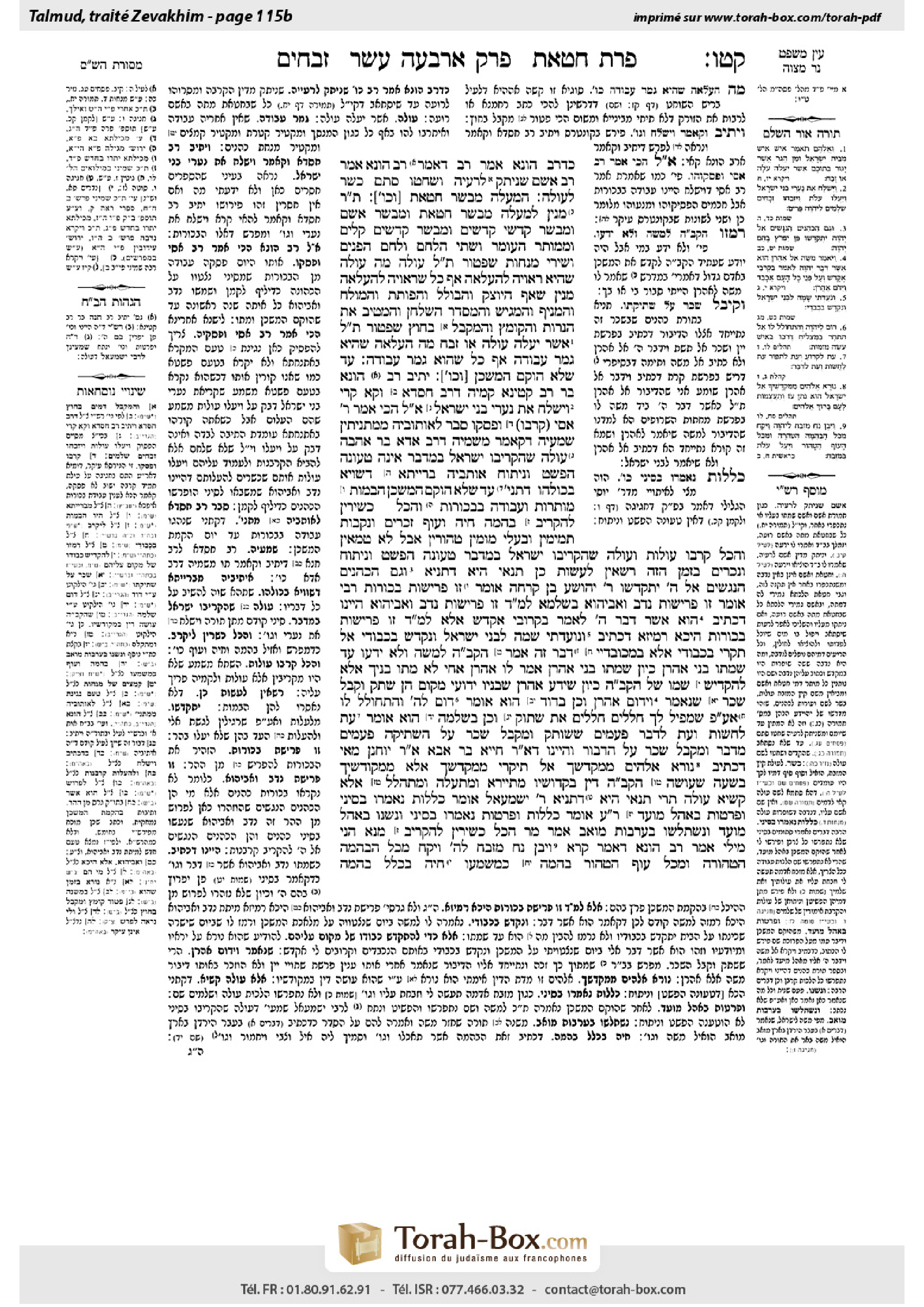
Zevachim 115b: Talmud study for Daf Yomi
Daf Yomi is the daily study of one Talmud folio. Explore 37 tractates with scans, Hebrew text, Sefaria English and AI-generated French translations where annotated.
Passage selection and English or AI-generated French translation are available where the scan has annotations. Daf Study is independent of Torah-Box and Sefaria.
Browse Zevachim · זבחים · All tractatesZevachim 115b text and translations
This page of Zevachim includes the Aramaic text, an English translation and an AI-generated French translation, alongside the scan above.
זבחים קי״ה ב · Aramaic and Hebrew text
כִּדְרַב הוּנָא אָמַר רַב. דְּאָמַר רַב הוּנָא אָמַר רַב: אָשָׁם שֶׁנִּיתַּק לִרְעִיָּה, וּשְׁחָטוֹ סְתָם – כָּשֵׁר לָעוֹלָה.
הַמַּעֲלֶה מִבְּשַׂר חַטָּאת [וְכוּ׳]. תָּנוּ רַבָּנַן: מִנַּיִן לַמַּעֲלֶה מִבְּשַׂר חַטָּאת, וּמִבְּשַׂר אָשָׁם, וּמִבְּשַׂר קׇדְשֵׁי קָדָשִׁים, וּמִבְּשַׂר קָדָשִׁים קַלִּים, וּמִמּוֹתַר הָעוֹמֶר, וּשְׁתֵּי הַלֶּחֶם, וְלֶחֶם הַפָּנִים, וּשְׁיָרֵי מְנָחוֹת – שֶׁפָּטוּר?
תַּלְמוּד לוֹמַר: ״עוֹלָה״ – מָה עוֹלָה שֶׁהִיא רְאוּיָה לְהַעֲלָאָה, אַף כֹּל שֶׁרְאוּיָה לְהַעֲלָאָה.
מִנַּיִן שֶׁאַף הַיּוֹצֵק, וְהַבּוֹלֵל, וְהַפּוֹתֵת, וְהַמּוֹלֵחַ, וְהַמֵּנִיף, וְהַמַּגִּישׁ, וְהַמְסַדֵּר הַשֻּׁלְחָן, וְהַמֵּטִיב אֶת הַנֵּרוֹת, וְהַקּוֹמֵץ, וְהַמְקַבֵּל בַּחוּץ – שֶׁפָּטוּר?
תַּלְמוּד לוֹמַר: ״אֲשֶׁר יַעֲלֶה עוֹלָה אוֹ זָבַח״ – מָה הַעֲלָאָה שֶׁהִיא גְּמַר עֲבוֹדָה, אַף כֹּל שֶׁהוּא גְּמַר עֲבוֹדָה.
עַד שֶׁלֹּא הוּקַם הַמִּשְׁכָּן [וְכוּ׳]. יָתֵיב רַב הוּנָא בַּר רַב קַטִּינָא קַמֵּיהּ דְּרַב חִסְדָּא, וְקָא קָרֵי: ״וַיִּשְׁלַח אֶת נַעֲרֵי בְּנֵי יִשְׂרָאֵל״. אֲמַר לֵיהּ, הָכִי אָמַר רַבִּי אַסִּי: קָרְבוּ וּפָסְקוּ.
סְבַר לְאוֹתוֹבֵיהּ מִמַּתְנִיתִין; שַׁמְעֵיהּ דְּקָאָמַר מִשְּׁמֵיהּ דְּרַב אַדָּא בַּר אַהֲבָה: עוֹלָה שֶׁהִקְרִיבוּ יִשְׂרָאֵל בַּמִּדְבָּר – אֵינָהּ טְעוּנָה הֶפְשֵׁט וְנִיתּוּחַ; אוֹתְבֵיהּ בָּרַיְיתָא דְּשָׁוְיָא בְּכוּלְּהוּ.
דְּתַנְיָא: עַד שֶׁלֹּא הוּקַם הַמִּשְׁכָּן – הַבָּמוֹת מוּתָּרוֹת, וַעֲבוֹדָה בִּבְכוֹרוֹת, וְהַכֹּל כְּשֵׁירִין לְהִקָּרֵיב; בְּהֵמָה, חַיָּה וָעוֹף, זְכָרִים וּנְקֵבוֹת, תְּמִימִין וּבַעֲלֵי מוּמִין, טְהוֹרִין אֲבָל לֹא טְמֵאִין.
וְהַכֹּל קָרְבוּ עוֹלוֹת. וְעוֹלָה שֶׁהִקְרִיבוּ יִשְׂרָאֵל בַּמִּדְבָּר – טְעוּנָה הֶפְשֵׁט וְנִיתּוּחַ. וְגוֹיִם בִּזְמַן הַזֶּה רַשָּׁאִין לַעֲשׂוֹת כֵּן.
תַּנָּאֵי הִיא; דְּתַנְיָא: ״וְגַם הַכֹּהֲנִים הַנִּגָּשִׁים אֶל ה׳ יִתְקַדָּשׁוּ״ – רַבִּי יְהוֹשֻׁעַ בֶּן קׇרְחָה אוֹמֵר: זוֹ פְּרִישׁוּת בְּכוֹרוֹת. רַבִּי אוֹמֵר: זוֹ פְּרִישׁוּת נָדָב וַאֲבִיהוּא.
בִּשְׁלָמָא לְמַאן דְּאָמַר זוֹ פְּרִישׁוּת נָדָב וַאֲבִיהוּא – הַיְינוּ דִּכְתִיב: ״הוּא אֲשֶׁר דִּבֶּר ה׳ לֵאמֹר בִּקְרֹבַי אֶקָּדֵשׁ״.
אֶלָּא לְמַאן דְּאָמַר זוֹ פְּרִישׁוּת בְּכוֹרוֹת – הֵיכָא רְמִיזָא? דִּכְתִיב: ״וְנֹעַדְתִּי שָׁמָּה לִבְנֵי יִשְׂרָאֵל וְנִקְדַּשׁ בִּכְבֹדִי״ – אַל תִּקְרֵי ״בִּכְבוֹדִי״, אֶלָּא ״(בִּמְכוּבָּדַיי) [בִּכְבוּדַיי]״.
דָּבָר זֶה אָמַר הַקָּדוֹשׁ בָּרוּךְ הוּא לְמֹשֶׁה וְלֹא יָדְעוּ, עַד שֶׁמֵּתוּ בְּנֵי אַהֲרֹן. כֵּיוָן שֶׁמֵּתוּ בְּנֵי אַהֲרֹן, אָמַר לוֹ: אַהֲרֹן אָחִי, לֹא מֵתוּ בָּנֶיךָ אֶלָּא לְהַקְדִּישׁ שְׁמוֹ שֶׁל הַקָּדוֹשׁ בָּרוּךְ הוּא. כֵּיוָן שֶׁיָּדַע אַהֲרֹן שֶׁבָּנָיו יְדוּעֵי מָקוֹם הֵן, שָׁתַק וְקִבֵּל שָׂכָר; שֶׁנֶּאֱמַר: ״וַיִּדֹּם אַהֲרֹן״.
וְכֵן בְּדָוִד הוּא אוֹמֵר: ״דּוֹם לַה׳ וְהִתְחוֹלֵל לוֹ״ – אַף עַל פִּי שֶׁמַּפִּיל לְךָ חֲלָלִים חֲלָלִים, אַתְּ שְׁתוֹק. וְכֵן בִּשְׁלֹמֹה הוּא אוֹמֵר: ״עֵת לַחֲשׁוֹת וְעֵת לְדַבֵּר״ – פְּעָמִים שֶׁשּׁוֹתֵק וּמְקַבֵּל שָׂכָר עַל הַשְּׁתִיקָה, פְּעָמִים מְדַבֵּר וּמְקַבֵּל שָׂכָר עַל הַדִּבּוּר.
וְהַיְינוּ דְּאָמַר רַבִּי חִיָּיא בַּר אַבָּא אָמַר רַבִּי יוֹחָנָן, מַאי דִּכְתִיב: ״נוֹרָא אֱלֹהִים מִמִּקְדָּשֶׁךָ״? אַל תִּיקְרֵי ״מִמִּקְדָּשֶׁךָ״ אֶלָּא ״מִמְּקוּדָּשֶׁיךָ״ – בְּשָׁעָה שֶׁעוֹשֶׂה הַקָּדוֹשׁ בָּרוּךְ הוּא דִּין בִּקְדוֹשָׁיו, מִתְיָירֵא וּמִתְעַלֶּה וּמִתְהַלֵּל.
אֶלָּא קַשְׁיָא עוֹלָה! תְּרֵי תַּנָּאֵי הִיא; דְּתַנְיָא, רַבִּי יִשְׁמָעֵאל אוֹמֵר: כְּלָלוֹת נֶאֶמְרוּ בְּסִינַי, וּפְרָטוֹת בְּאֹהֶל מוֹעֵד.
רַבִּי עֲקִיבָא אוֹמֵר: כְּלָלוֹת וּפְרָטוֹת נֶאֶמְרוּ בְּסִינַי, וְנִשְׁנוּ בְּאֹהֶל מוֹעֵד, וְנִשְׁתַּלְּשׁוּ בְּעַרְבוֹת מוֹאָב.
אָמַר מָר: הַכֹּל כְּשֵׁירִין לְהַקְרִיב. מְנָא הָנֵי מִילֵּי? אָמַר רַב הוּנָא, דְּאָמַר קְרָא: ״וַיִּבֶן נֹחַ מִזְבֵּחַ לַה׳ וַיִּקַּח מִכֹּל הַבְּהֵמָה הַטְּהוֹרָה וּמִכׇּל עוֹף הַטָּהוֹר״; בְּהֵמָה – כְּמַשְׁמָעוֹ. חַיָּה – בִּכְלַל בְּהֵמָה.
Zevachim 115b · English translation
This is in accordance with the statement that Rav Huna says that Rav says. As Rav Huna says that Rav says: With regard to a guilt offering whose owner died or achieved atonement through a different guilt offering and which was consigned to grazing in the field until it develops a blemish, and prior to its being consigned one slaughtered it without specification of its purpose, it is fit as a burnt offering.
§ The mishna teaches: One who offers up outside the Temple courtyard a portion of the meat of a sin offering that is eaten, or who offers up a portion of several other items, is exempt. With regard to the reasoning behind this halakha, the Sages taught in a baraita: From where is it derived that one who offers up outside the Temple courtyard a portion of the meat of a sin offering, or a portion of the meat of a guilt offering, or a portion of the meat of offerings of the most sacred order, or a portion of the meat of offerings of lesser sanctity, or a portion of the surplus of the omer offering, or the two loaves, or the shewbread, or the remainder of meal offerings is exempt, as all these are eaten by the priests and not sacrificed on the altar?
The verse states with regard to the prohibition against sacrificing outside the Temple courtyard: “Whatever man…that sacrifices a burnt offering or sacrifice, and brings it not to the entrance of the Tent of Meeting, to sacrifice it to the Lord, that man shall be cut off from his people” (Leviticus 17:8–9). The term “burnt offering” teaches: Just as a burnt offering is fit for offering up upon the altar, so too, anything that is fit for offering up is included in the prohibition. All of the offerings listed in the baraita are not sacrificed upon the altar but given to the priests.
From where is it derived that even with regard to one who pours oil onto the meal offering, and one who mixes the oil into the flour of the meal offering, and one who breaks the loaves of the meal offering into pieces, and one who salts the meal offering or other offerings, and one who waves the meal offering, and one who brings the meal offering to the corner of an altar that he constructs outside the courtyard, and one who arranges the shewbread on the table outside the Sanctuary, and one who removes the ashes from the lamps of the Candelabrum, and one who removes a handful from a meal offering, and one who collects the blood of an offering in a vessel, if he did so outside the Temple courtyard he is exempt.
The verse states: “That sacrifices a burnt offering or sacrifice” (Leviticus 17:8). Just as sacrificing is the conclusion of the sacrificial service, so too, any rite that is the conclusion of a sacrificial service is included. All of these are excluded from the prohibition, as there are rites that follow them.
§ The mishna teaches: Until the Tabernacle was established, private altars were permitted and the sacrificial service was performed by the firstborn. The Gemara relates that Rav Huna bar Rav Ketina was sitting before Rav Ḥisda and was reading this verse with regard to the revelation at Sinai: “And he sent the young men of the children of Israel, who offered burnt offerings and sacrificed peace offerings of oxen to the Lord” (Exodus 24:5). The young men referred to in the verse were the firstborn of the Jewish people. Rav Ḥisda said to him: This is what Rabbi Asi said: They sacrificed the offerings and then ceased to serve; after that day, the firstborn no longer performed the sacrificial service.
Rav Huna thought to raise a contradiction from the mishna, which states that the firstborn performed not only the sacrificial service on that day, but also did so until the Tabernacle was established the following year. In the meanwhile, he heard Rav Ḥisda say in the name of Rav Adda bar Ahava that the burnt offering that the children of Israel sacrificed in the wilderness before the establishment of the Tabernacle did not require flaying of the skin and cutting into pieces; it was sacrificed as it was. He therefore raised the contradiction from a baraita that is equal with regard to both of them, i.e., from which Rav Huna could raise a contradiction to both of Rav Ḥisda’s statements.
As it is taught in a baraita: Until the Tabernacle was established, private altars were permitted, the sacrificial service was performed by the firstborn, and all animals were fit to be sacrificed: A domesticated animal, an undomesticated animal, or a bird; males and females; unblemished and blemished animals. All animal sacrifices were brought from animals and birds that were kosher, but not from non-kosher species.
And all offerings brought before the construction of the Tabernacle were sacrificed as burnt offerings. And the burnt offering that the Jewish people sacrificed in the wilderness before the Tabernacle was established required flaying of the skin and cutting into pieces. And today, gentiles are permitted to sacrifice offerings on private altars. The baraita states explicitly that until the Tabernacle was constructed, the sacrificial service was performed by the firstborn, and the burnt offering required flaying and cutting.
Rav Ḥisda replied that with regard to the firstborn, it is a dispute between tanna’im, as it is taught in a baraita: God said to Moses on Mount Sinai: “And let the priests also that come near to the Lord sanctify themselves, lest the Lord break forth upon them” (Exodus 19:22). In other words, they should separate themselves and not approach the mountain. This command was given one day after the burnt offerings and peace offerings were sacrificed in anticipation of the revelation at Sinai. With regard to this command, Rabbi Yehoshua ben Korḥa says: This command is a reference to the separation of the firstborn, as they functioned as priests. Rabbi Yehuda HaNasi says: This command is a reference to the separation of Nadav and Avihu, who were priests.
The Gemara asks: Granted, according to the one who says that the command for the priests to sanctify themselves is referring to the separation of Nadav and Avihu, this is the meaning of that which is written after their death on the eighth day of the inauguration of the Tabernacle: “Then Moses said to Aaron: This is it that the Lord spoke, saying: Through them that are near to Me I will be sanctified…and Aaron held his peace” (Leviticus 10:3). Nadav and Avihu had already been warned not to draw too close: “Lest the Lord break forth upon them.”
But according to the one who says that the command for the priests to sanctify themselves is referring to the separation of the firstborn, where is the allusion to the fact that God would be sanctified through Nadav and Avihu? The Gemara replies: As it is written: “And there I will meet with the children of Israel; and it shall be sanctified by My glory” (Exodus 29:43). Do not read it as “by My glory [bikhvodi]”; rather, read it as: By My honored ones [bimekhubadai]. God will be sanctified by those considered honored by God when He reveals Himself in the Tabernacle.
The Holy One, Blessed be He, said this statement to Moses, but Moses did not know its meaning until the sons of Aaron died. Once the sons of Aaron died, Moses said to him: Aaron, my brother, your sons died only to sanctify the name of the Holy One, Blessed be He. When Aaron knew that his sons were beloved by the Omnipresent, he was silent and received a reward, as it is stated: “And Aaron held his peace [vayidom].”
And likewise in a verse written by David it states: “Resign yourself [dom] to the Lord, and wait patiently [vehitḥolel] for Him” (Psalms 37:7). Although He strikes down many corpses [ḥalalim] around you, you be silent and do not complain. And likewise in a verse written by Solomon it states: “A time to keep silence, and a time to speak” (Ecclesiastes 3:7). There are times that one is silent and receives reward for the silence, and at times one speaks and receives reward for the speech.
And this is what Rabbi Ḥiyya bar Abba says that Rabbi Yoḥanan says: What is the meaning of that which is written: “Awesome is God out of your holy places” (Psalms 68:36)? Do not read it as: “From your holy places [mimikdashekha]”; rather, read it as: From your holy ones [mimekudashekha]. When the Holy One, Blessed be He, carries out judgment upon His holy ones, He is feared, and exalted, and praised by all. In any event, there is no contradiction from the baraita which teaches that the firstborns perform the sacrificial service before the Tabernacle was established, as this matter is the subject of a dispute between tanna’im.
But there is still a difficulty with regard to the burnt offering, as it was stated in the name of Rav Adda bar Ahava that the burnt offering that the Jewish people sacrificed in the wilderness did not require flaying of the skin or cutting into pieces, while the baraita states that it did. The Gemara replies: This is a dispute between the opinions of two tanna’im. As it is taught in a baraita that Rabbi Yishmael says: The general statements, i.e., the principles of the Torah, were said at Sinai, and the details of the mitzvot that are explicated in Leviticus were said to Moses in the Tent of Meeting. This includes the halakha that the burnt offering must be flayed and cut into pieces. Consequently, it could not have been in effect before the construction of the Tabernacle.
Rabbi Akiva says: Both general statements and the details of mitzvot were said at Sinai and later taught again in the Tent of Meeting, and taught a third time by Moses to the Jewish people in the plains of Moab, when he taught the Torah to the people (see Deuteronomy 1:1). According to Rabbi Akiva’s opinion, the halakha of flaying and cutting into pieces was in effect when the Torah was given, even before the construction of the Tabernacle.
§ The Master said in the baraita: Before the Tabernacle was established, all animals were fit to be sacrificed: A domesticated animal, an undomesticated animal, or a bird. The Gemara asks: From where are these matters derived? Rav Huna said: As the verse states with regard to the offering that was sacrificed after the flood: “And Noah built an altar to the Lord, and took of every pure animal, and of every pure fowl, and offered burnt offerings on the altar” (Genesis 8:20). The Gemara explains: “Animal [behema],” is understood in accordance with its plain meaning, a domesticated animal, and the same is true of fowl; an undomesticated animal [ḥayya] is included in the term “behema” that is stated in the verse.
Zevachim 115b · Traduction française (IA)
Cela correspond à l’opinion rapportée par Rav Houna au nom de Rav. En effet, Rav Houna rapporte au nom de Rav : lorsqu’un sacrifice de culpabilité, dont le propriétaire est mort ou a obtenu l’expiation au moyen d’un autre sacrifice de culpabilité, a été destiné à paître dans un champ jusqu’à ce qu’il présente un défaut, et qu’on l’a égorgé sans préciser sa destination avant de le destiner ainsi, il est apte à être offert comme holocauste.
§ La Michna enseigne : Celui qui offre à l’extérieur de la cour du Temple une partie de la viande d’un sacrifice expiatoire qui est consommée, ou une partie de plusieurs autres éléments, est exempt. À propos du raisonnement qui sous-tend cette halakha, les Sages ont enseigné dans une baraïta : D’où sait-on que celui qui offre à l’extérieur de la cour du Temple une partie de la viande d’un sacrifice expiatoire, une partie de la viande d’un sacrifice de culpabilité, une partie de la viande d’offrandes de sainteté suprême, une partie de la viande d’offrandes de moindre sainteté, une partie du surplus de l’offrande de l’omer, les deux pains, les pains de proposition ou le reste des offrandes de farine est exempt, puisque tous ces éléments sont consommés par les prêtres et ne sont pas offerts sur l’autel ?
Au sujet de l’interdiction d’offrir des sacrifices à l’extérieur de la cour du Temple, le verset dit : « Tout homme […] qui offre un holocauste ou un sacrifice et ne l’amène pas à l’entrée de la Tente d’assignation pour l’offrir à l’Éternel, cet homme sera retranché de son peuple » (Lévitique 17:8-9). Le terme « holocauste » enseigne : de même qu’un holocauste peut être offert sur l’autel, de même tout ce qui peut être offert est inclus dans l’interdiction. Or, aucun des sacrifices énumérés dans la baraïta n’est offert sur l’autel : ils sont remis aux prêtres.
D’où sait-on que celui qui verse de l’huile sur l’offrande de farine, celui qui mélange l’huile à la farine de l’offrande, celui qui rompt les pains de l’offrande en morceaux, celui qui sale l’offrande de farine ou d’autres sacrifices, celui qui agite l’offrande de farine, celui qui apporte l’offrande de farine à l’angle d’un autel qu’il a construit à l’extérieur de la cour, celui qui dispose les pains de proposition sur la table à l’extérieur du Sanctuaire, celui qui retire les cendres des lampes du candélabre, celui qui prélève une poignée sur une offrande de farine et celui qui recueille le sang d’un sacrifice dans un récipient sont exemptés s’ils accomplissent ces actes à l’extérieur de la cour du Temple ?
Le verset dit : « Qui offre un holocauste ou un sacrifice » (Lévitique 17:8). De même que l’offrande est l’étape finale du service sacrificiel, de même tout rite qui constitue l’étape finale d’un service sacrificiel est inclus. Tous ces actes sont exclus de l’interdiction, car d’autres rites leur succèdent.
§ La Michna enseigne : Jusqu’à l’établissement du Tabernacle, les autels privés étaient permis et le service sacrificiel était accompli par les premiers-nés. La Guemara rapporte que Rav Houna bar Rav Ketina était assis devant Rav Ḥisda et lisait ce verset à propos de la révélation au Sinaï : « Il envoya les jeunes gens des enfants d’Israël, qui offrirent des holocaustes et sacrifièrent des taureaux en sacrifices de paix à l’Éternel » (Exode 24:5). Les jeunes gens mentionnés dans le verset étaient les premiers-nés du peuple juif. Rav Ḥisda lui dit : Voici ce que Rabbi Assi a dit : Ils offrirent les sacrifices, puis cessèrent d’assurer le service ; après ce jour, les premiers-nés n’accomplirent plus le service sacrificiel.
Rav Houna pensa soulever une contradiction à partir de la Michna, qui enseigne que les premiers-nés accomplirent le service sacrificiel non seulement ce jour-là, mais aussi jusqu’à l’établissement du Tabernacle l’année suivante. Entre-temps, il entendit Rav Ḥisda dire au nom de Rav Adda bar Ahava que l’holocauste offert par les enfants d’Israël dans le désert avant l’établissement du Tabernacle ne nécessitait ni dépouillement de la peau ni découpe en morceaux : il était offert tel quel. Il souleva donc la contradiction à partir d’une baraïta qui concerne les deux points, c’est-à-dire d’une baraïta qui permettait à Rav Houna de soulever une contradiction contre les deux affirmations de Rav Ḥisda.
Car il est enseigné dans une baraïta : jusqu’à l’établissement du Tabernacle, les autels privés étaient permis, le service sacrificiel était accompli par les premiers-nés et tous les animaux pouvaient être offerts : les animaux domestiques, les animaux sauvages ou les oiseaux, mâles et femelles, sans défaut ou présentant un défaut. Tous les sacrifices animaux provenaient d’animaux et d’oiseaux cacher, et non d’espèces non cacher.
Toutes les offrandes apportées avant la construction du Tabernacle étaient offertes en holocauste. L’holocauste offert par le peuple juif dans le désert avant l’établissement du Tabernacle nécessitait le dépouillement de la peau et la découpe en morceaux. De plus, les non-Juifs sont aujourd’hui autorisés à offrir des sacrifices sur des autels privés. La baraïta affirme explicitement que, jusqu’à la construction du Tabernacle, les premiers-nés accomplissaient le service sacrificiel et que l’holocauste nécessitait le dépouillement et la découpe.
Rav Ḥisda répondit qu’au sujet des premiers-nés, il existe une controverse entre tannaïm, comme il est enseigné dans une baraïta : Dieu dit à Moïse au mont Sinaï : « Que les prêtres aussi, qui s’approchent de l’Éternel, se sanctifient, de peur que l’Éternel ne fasse irruption contre eux » (Exode 19:22). Autrement dit, ils devaient se tenir à l’écart et ne pas s’approcher de la montagne. Cet ordre fut donné un jour après que les holocaustes et les sacrifices de paix eurent été offerts en prévision de la révélation au Sinaï. À propos de cet ordre, Rabbi Yehoshua ben Korḥa dit : cet ordre concerne la mise à l’écart des premiers-nés, puisqu’ils exerçaient la fonction de prêtres. Rabbi Yehuda HaNasi dit : cet ordre concerne la mise à l’écart de Nadav et Avihou, qui étaient prêtres.
La Guemara demande : Certes, selon celui qui dit que l’ordre enjoignant aux prêtres de se sanctifier concerne la mise à l’écart de Nadav et Avihou, voici le sens de ce qui est écrit après leur mort, le huitième jour de l’inauguration du Tabernacle : « Moïse dit alors à Aaron : C’est là ce qu’a dit l’Éternel : Je serai sanctifié par ceux qui s’approchent de Moi […] Et Aaron garda le silence » (Lévitique 10:3). Nadav et Avihou avaient déjà été avertis de ne pas trop s’approcher : « de peur que l’Éternel ne fasse irruption contre eux ».
Mais selon celui qui dit que l’ordre enjoignant aux prêtres de se sanctifier concerne la mise à l’écart des premiers-nés, où trouve-t-on une allusion au fait que Dieu serait sanctifié par Nadav et Avihou ? La Guemara répond : il est écrit : « C’est là que Je rencontrerai les enfants d’Israël, et le lieu sera sanctifié par Ma gloire » (Exode 29:43). Ne lis pas « par Ma gloire [bikhvodi] », mais plutôt : « par ceux qui Me sont chers [bimekhubadai] ». Dieu sera sanctifié par ceux qu’Il considère comme honorés lorsqu’Il se révélera dans le Tabernacle.
Le Saint, béni soit-Il, adressa ces paroles à Moïse, mais Moïse n’en comprit pas le sens avant la mort des fils d’Aaron. Après leur mort, Moïse lui dit : « Aaron, mon frère, tes fils ne sont morts que pour sanctifier le nom du Saint, béni soit-Il. » Quand Aaron sut que ses fils étaient chers au Tout-Puissant, il garda le silence et reçut une récompense, comme il est dit : « Et Aaron garda le silence [vayidom]. »
De même, un verset écrit par David dit : « Garde le silence [dom] devant l’Éternel et attends patiemment [vehitḥolel] en Lui » (Psaumes 37:7). Même s’Il fait tomber de nombreux cadavres [ḥalalim] autour de toi, garde le silence et ne te plains pas. De même, un verset écrit par Salomon dit : « Un temps pour se taire et un temps pour parler » (Ecclésiaste 3:7). Il est des moments où l’on se tait et reçoit une récompense pour son silence, et d’autres où l’on parle et reçoit une récompense pour sa parole.
Et voici ce que Rabbi Ḥiyya bar Abba rapporte au nom de Rabbi Yoḥanan : Quel est le sens de ce qui est écrit : « Dieu est redoutable depuis tes sanctuaires » (Psaumes 68:36) ? Ne lis pas « depuis tes sanctuaires [mimikdashekha] », mais plutôt : « depuis tes saints [mimekudashekha] ». Lorsque le Saint, béni soit-Il, exerce le jugement contre Ses saints, Il est craint, exalté et loué par tous. Quoi qu’il en soit, la baraïta qui enseigne que les premiers-nés accomplissaient le service sacrificiel avant l’établissement du Tabernacle ne crée aucune contradiction, car cette question fait l’objet d’une controverse entre les tannaïm.
Mais une difficulté subsiste au sujet de l’holocauste : Rav Adda bar Ahava a rapporté que l’holocauste offert par le peuple juif dans le désert ne nécessitait ni le dépouillement de la peau ni la découpe en morceaux, tandis que la baraïta affirme le contraire. La Guemara répond : il s’agit d’une controverse entre les opinions de deux tannaïm. Car il est enseigné dans une baraïta que Rabbi Yishmael dit : les principes généraux de la Torah ont été énoncés au Sinaï, et les détails des mitsvot exposés dans le Lévitique ont été enseignés à Moïse dans la Tente d’assignation. Cela inclut la halakha selon laquelle l’holocauste doit être dépouillé et découpé en morceaux. Par conséquent, cette halakha ne pouvait pas être en vigueur avant la construction du Tabernacle.
Rabbi Akiva dit : les principes généraux comme les détails des mitsvot ont été énoncés au Sinaï, puis enseignés de nouveau dans la Tente d’assignation, et une troisième fois par Moïse au peuple juif dans les plaines de Moab, lorsqu’il enseigna la Torah au peuple (voir Deutéronome 1:1). Selon l’opinion de Rabbi Akiva, la halakha du dépouillement et de la découpe en morceaux était en vigueur au moment du don de la Torah, avant même la construction du Tabernacle.
Le Maître a dit dans la baraïta : avant l’établissement du Tabernacle, tous les animaux pouvaient être offerts : les animaux domestiques, les animaux sauvages ou les oiseaux. La Guemara demande : D’où tire-t-on ces règles ? Rav Houna dit : comme l’indique le verset concernant l’offrande faite après le déluge : « Noé construisit un autel à l’Éternel, prit de tout animal pur et de tout oiseau pur, et offrit des holocaustes sur l’autel » (Genèse 8:20). La Guemara explique : « Animal [behema] » s’entend au sens simple, c’est-à-dire un animal domestique, et il en va de même pour les oiseaux ; les animaux sauvages [ḥayya] sont inclus dans le terme « behema » employé dans le verset.
Traduction française générée par IA à partir de l’édition anglaise de Sefaria. Vérifie toujours un passage avec le texte source.
Text from Sefaria: William Davidson Edition - Vocalized Aramaic (CC BY NC); William Davidson Edition - English (CC BY NC).