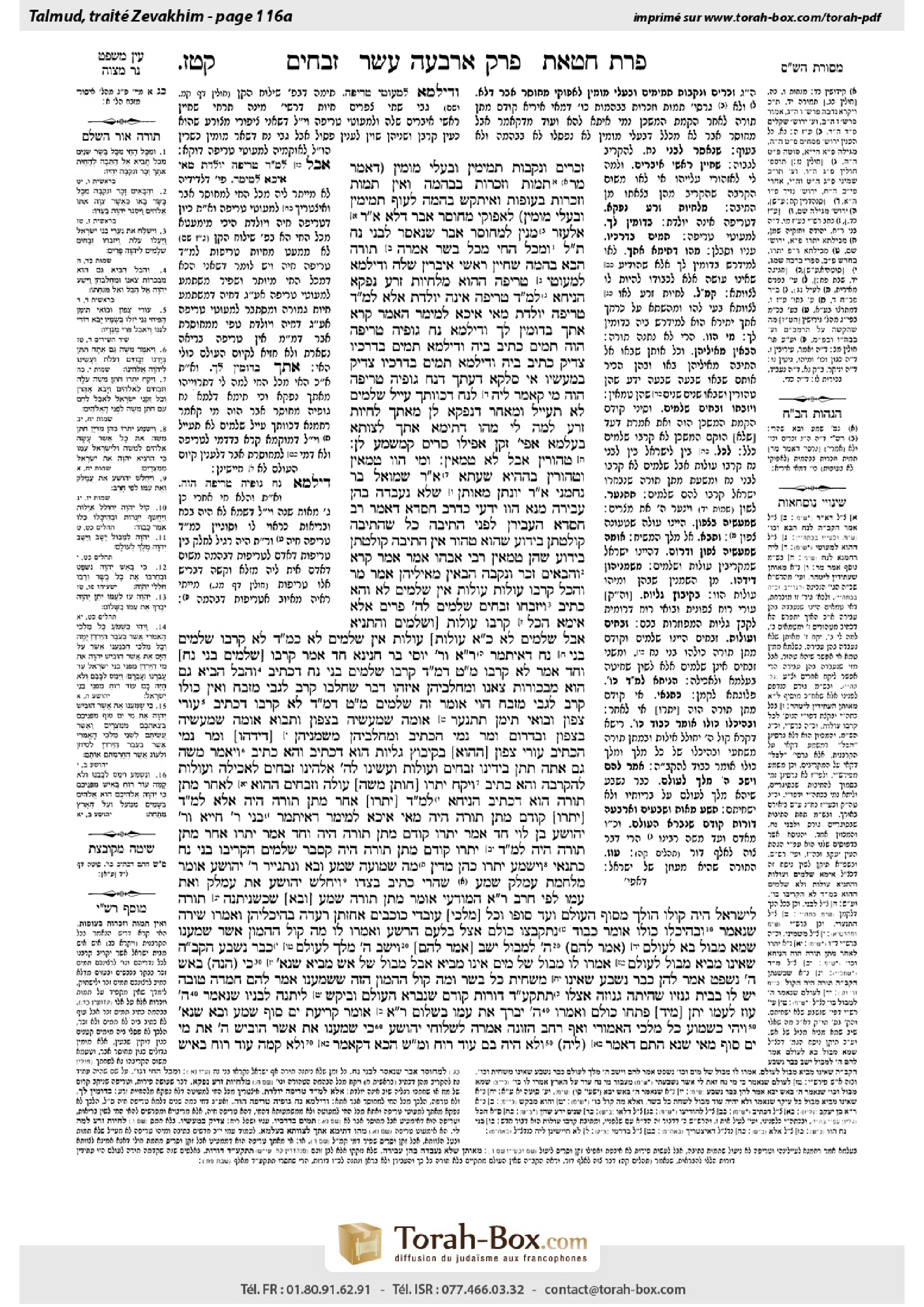
Zevachim 116a: Talmud study for Daf Yomi
Daf Yomi is the daily study of one Talmud folio. Explore 37 tractates with scans, Hebrew text, Sefaria English and AI-generated French translations where annotated.
Passage selection and English or AI-generated French translation are available where the scan has annotations. Daf Study is independent of Torah-Box and Sefaria.
Browse Zevachim · זבחים · All tractatesZevachim 116a text and translations
This page of Zevachim includes the Aramaic text, an English translation and an AI-generated French translation, alongside the scan above.
זבחים קי״ו א · Aramaic and Hebrew text
זְכָרִים וּנְקֵבוֹת, תְּמִימִין וּבַעֲלֵי מוּמִין – דְּאָמַר מָר: תַּמּוּת וְזַכְרוּת בִּבְהֵמָה, וְאֵין תַּמּוּת וְזַכְרוּת בְּעוֹפוֹת.
וְאִיתַּקַּשׁ בְּהֵמָה לְעוֹף.
תְּמִימִין וּבַעֲלֵי מוּמִין – לְאַפּוֹקֵי מְחוּסַּר אֵבֶר, דְּלָא. אָמַר רַבִּי אֶלְעָזָר: מִנַּיִן לִמְחוּסַּר אֵבֶר שֶׁנֶּאֱסַר לִבְנֵי נֹחַ? תַּלְמוּד לוֹמַר: ״וּמִכׇּל הָחַי מִכׇּל בָּשָׂר״ – אָמְרָה תּוֹרָה: הָבֵא בְּהֵמָה שֶׁחַיִּין רָאשֵׁי אֵיבָרִין שֶׁלָּהּ.
וְדִילְמָא לְמַעוֹטֵי טְרֵיפָה? הָהוּא מִ״לְּחַיּוֹת זֶרַע״ נָפְקָא.
הָנִיחָא לְמַאן דְּאָמַר טְרֵיפָה אֵינָהּ יוֹלֶדֶת, אֶלָּא לְמַאן דְּאָמַר טְרֵיפָה יוֹלֶדֶת – מַאי אִיכָּא לְמֵימַר? הָאָמַר קְרָא: ״אִתָּךְ״ – בְּדוֹמִין לָךְ.
וְדִילְמָא נֹחַ גּוּפֵיהּ טְרֵיפָה הֲוָה? ״תָּמִים״ כְּתִיב בֵּיהּ. וְדִילְמָא תָּמִים בִּדְרָכָיו? ״צַדִּיק״ כְּתִיב בֵּיהּ.
וְדִילְמָא ״תָּמִים״ – בִּדְרָכָיו, ״צַדִּיק״ – בְּמַעֲשָׂיו? אִי סָלְקָא דַּעְתָּךְ דְּנֹחַ גּוּפֵיהּ טְרֵיפָה הֲוָה, מִי קָאָמַר לֵיהּ לְנֹחַ: דִּכְוָותָךְ עַיֵּיל, שְׁלֵמִים לָא תְּעַיֵּיל?!
וּמֵאַחַר דְּנָפְקָא לַן מֵ״אִתָּךְ״, ״לְחַיּוֹת זֶרַע״ לְמָה לִי? מַהוּ דְּתֵימָא: ״אִתָּךְ״ – לְצַוְתָּא בְּעָלְמָא, אֲפִילּוּ זָקֵן אֲפִילּוּ סָרִיס; קָמַשְׁמַע לַן.
טְהוֹרִין אֲבָל לֹא טְמֵאִין. וּמִי הֲווֹ טְמֵאִין וּטְהוֹרִין בְּהַהִיא שַׁעְתָּא?! אָמַר רַבִּי שְׁמוּאֵל בַּר נַחְמָנִי אָמַר רַבִּי יוֹנָתָן: מֵאוֹתָן שֶׁלֹּא נֶעֶבְדָה בָּהֶן עֲבֵירָה.
מְנָא הֲווֹ יָדְעִי? כִּדְרַב חִסְדָּא. דְּאָמַר רַב חִסְדָּא: הֶעֱבִירָן לִפְנֵי הַתֵּיבָה; כֹּל שֶׁהַתֵּיבָה קוֹלַטְתָּן – בְּיָדוּעַ שֶׁהוּא טָהוֹר, אֵין הַתֵּיבָה קוֹלַטְתָּן – בְּיָדוּעַ שֶׁהֵן טְמֵאִין.
רַבִּי אֲבָהוּ אָמַר, אָמַר קְרָא: ״וְהַבָּאִים זָכָר וּנְקֵבָה״ – הַבָּאִין מֵאֲלֵיהֶן.
אָמַר מָר: וְהַכֹּל קָרְבוּ עוֹלוֹת. עוֹלוֹת אִין, שְׁלָמִים לָא. וְהָא כְּתִיב: ״וַיִּזְבְּחוּ זְבָחִים שְׁלָמִים לַה׳ פָּרִים״! אֶלָּא אֵימָא: הַכֹּל קָרְבוּ עוֹלוֹת [וּשְׁלָמִים.
וְהָתַנְיָא: אֲבָל שְׁלָמִים לָא, כִּי אִם עוֹלוֹת.] עוֹלוֹת אִין, שְׁלָמִים לָא! כְּמַאן דְּאָמַר לֹא קֵרְבוּ שְׁלָמִים בְּנֵי נֹחַ – דְּאִיתְּמַר: רַבִּי אֶלְעָזָר וְרַבִּי יוֹסֵי בַּר חֲנִינָא, חַד אָמַר: קֵרְבוּ שְׁלָמִים בְּנֵי נֹחַ, וְחַד אָמַר: לֹא קֵרְבוּ.
מַאי טַעְמָא דְּמַאן דְּאָמַר קֵרְבוּ שְׁלָמִים בְּנֵי נֹחַ? דִּכְתִיב: ״וְהֶבֶל הֵבִיא גַם הוּא מִבְּכוֹרוֹת צֹאנוֹ וּמֵחֶלְבֵהֶן״ – אֵיזֶהוּ דָּבָר שֶׁחֶלְבּוֹ קָרֵב לְגַבֵּי מִזְבֵּחַ, וְאֵין כּוּלּוֹ קָרֵב לְגַבֵּי מִזְבֵּחַ? הֱוֵי אוֹמֵר: זֶה שְׁלָמִים.
מַאי טַעְמָא דְּמַאן דְּאָמַר לֹא קֵרְבוּ? דִּכְתִיב: ״עוּרִי צָפוֹן וּבוֹאִי תֵימָן״ – תִּתְנַעֵר אוּמָּה שֶׁמַּעֲשֶׂיהָ בַּצָּפוֹן, וְתָבוֹא אוּמָּה שֶׁמַּעֲשֶׂיהָ בַּצָּפוֹן וּבַדָּרוֹם.
וּמָר נָמֵי, הָכְתִיב: ״וּמֵחֶלְבֵיהֶן״! מִשַּׁמִּנֵיהוֹן [דִּידְהוּ].
וּמָר נָמֵי, הָכְתִיב: ״עוּרִי צָפוֹן״! [הָהוּא] בְּקִיבּוּץ גָּלִיּוֹת הוּא דִּכְתִיב.
וְהָא כְּתִיב: ״וַיֹּאמֶר מֹשֶׁה גַּם אַתָּה תִּתֵּן בְּיָדֵינוּ זְבָחִים וְעֹלֹת וְעָשִׂינוּ לַה׳ אֱלֹהֵינוּ״! זְבָחִים לַאֲכִילָה, וְעוֹלוֹת לְהַקְרָבָה.
וְהָא כְּתִיב: ״וַיִּקַּח יִתְרוֹ [חֹתֵן מֹשֶׁה] עוֹלָה וּזְבָחִים״! הַהוּא לְאַחַר מַתַּן תּוֹרָה הוּא דִּכְתִיב.
הָנִיחָא לְמַאן דְּאָמַר: [יִתְרוֹ] אַחַר מַתַּן תּוֹרָה הָיָה; אֶלָּא לְמַאן דְּאָמַר: [יִתְרוֹ] קוֹדֶם מַתַּן תּוֹרָה הָיָה – מַאי אִיכָּא לְמֵימַר? דְּאִיתְּמַר: בְּנֵי רַבִּי חִיָּיא וְרַבִּי יְהוֹשֻׁעַ בֶּן לֵוִי; חַד אָמַר: יִתְרוֹ קוֹדֶם מַתַּן תּוֹרָה הָיָה, וְחַד אָמַר: יִתְרוֹ אַחַר מַתַּן תּוֹרָה הָיָה. לְמַאן דְּאָמַר יִתְרוֹ קוֹדֶם מַתַּן תּוֹרָה הָיָה – קָסָבַר שְׁלָמִים הִקְרִיבוּ בְּנֵי נֹחַ.
כְּתַנָּאֵי: ״וַיִּשְׁמַע יִתְרוֹ כֹהֵן מִדְיָן״ – מָה שְׁמוּעָה שָׁמַע, וּבָא וְנִתְגַּיֵּיר? רַבִּי יְהוֹשֻׁעַ אוֹמֵר: מִלְחֶמֶת עֲמָלֵק שָׁמַע, שֶׁהֲרֵי כְּתִיב בְּצִדּוֹ: ״וַיַּחֲלֹשׁ יְהוֹשֻׁעַ אֶת עֲמָלֵק וְאֶת עַמּוֹ לְפִי חָרֶב״.
רַבִּי אֶלְעָזָר הַמּוֹדָעִי אוֹמֵר: מַתַּן תּוֹרָה שָׁמַע [וּבָא], שֶׁכְּשֶׁנִּיתְּנָה תּוֹרָה לְיִשְׂרָאֵל הָיָה קוֹלוֹ הוֹלֵךְ מִסּוֹף הָעוֹלָם וְעַד סוֹפוֹ, וְכׇל [מַלְכֵי] אוּמּוֹת הָעוֹלָם אֲחָזָתַן רְעָדָה בְּהֵיכְלֵיהֶן וְאָמְרוּ שִׁירָה, שֶׁנֶּאֱמַר: ״וּבְהֵיכָלוֹ כּוּלּוֹ אוֹמֵר כָּבוֹד״.
נִתְקַבְּצוּ כּוּלָּם אֵצֶל בִּלְעָם הָרָשָׁע, וְאָמְרוּ לוֹ: מָה קוֹל הֶהָמוֹן אֲשֶׁר שָׁמַעְנוּ? שֶׁמָּא מַבּוּל בָּא לָעוֹלָם (אָמַר לָהֶם) – ״ה׳ לַמַּבּוּל יָשָׁב״? [אָמַר לָהֶם]: ״וַיֵּשֶׁב ה׳ מֶלֶךְ לְעוֹלָם״ – כְּבָר נִשְׁבַּע הַקָּדוֹשׁ בָּרוּךְ הוּא שֶׁאֵינוֹ מֵבִיא מַבּוּל לָעוֹלָם.
אָמְרוּ לוֹ: מַבּוּל שֶׁל מַיִם אֵינוֹ מֵבִיא, אֲבָל מַבּוּל שֶׁל אֵשׁ מֵבִיא – שֶׁנֶּאֱמַר: ״כִּי (הִנֵּה) בָּאֵשׁ ה׳ נִשְׁפָּט״. אָמַר לָהֶן: כְּבָר נִשְׁבַּע שֶׁאֵינוֹ מַשְׁחִית כׇּל בָּשָׂר.
וּמֶה קוֹל הֶהָמוֹן הַזֶּה שֶׁשָּׁמַעְנוּ? אָמַר לָהֶם: חֶמְדָּה טוֹבָה יֵשׁ לוֹ בְּבֵית גְּנָזָיו, שֶׁהָיְתָה גְּנוּזָה אֶצְלוֹ תְּשַׁע מֵאוֹת שִׁבְעִים וְאַרְבָּעָה דּוֹרוֹת קוֹדֶם שֶׁנִּבְרָא הָעוֹלָם; וּבִיקֵּשׁ לִיתְּנָהּ לְבָנָיו, שֶׁנֶּאֱמַר: ״ה׳ עוֹז לְעַמּוֹ יִתֵּן״. [מִיָּד] פָּתְחוּ כּוּלָּם וְאָמְרוּ: ״ה׳ יְבָרֵךְ אֶת עַמּוֹ בַשָּׁלוֹם״.
רַבִּי אֱלִיעֶזֶר אוֹמֵר: קְרִיעַת יַם סוּף שָׁמַע וּבָא, שֶׁנֶּאֱמַר: ״וַיְהִי כִשְׁמֹעַ כׇּל מַלְכֵי הָאֱמֹרִי״. וְאַף רָחָב הַזּוֹנָה אָמְרָה לִשְׁלוּחֵי יְהוֹשֻׁעַ: ״כִּי שָׁמַעְנוּ אֵת אֲשֶׁר הוֹבִישׁ ה׳ אֶת מֵי יַם סוּף״.
מַאי שְׁנָא הָתָם, דַּאֲמַר (לֵיהּ) ״וְלֹא הָיָה בָם עוֹד רוּחַ״; וּמַאי שְׁנָא הָכָא, דְּקָאָמַר: ״וְלֹא קָמָה עוֹד רוּחַ בְּאִישׁ״?
Zevachim 116a · English translation
That which was taught in the baraita: All animals were fit to be sacrificed: Males and females, unblemished and blemished animals, pertains to that which the Master said as a principle concerning the halakhot of sacrifices: The requirements that an offering must have unblemished status and that a burnt offering must have male status apply to animal offerings, but the requirements of unblemished status and male status do not apply to birds.
And in the verses that recount Noah’s sacrifices upon exiting the ark, a domesticated animal is juxtaposed with a bird, in the verse: “Of every pure animal, and of every pure fowl” (Genesis 8:20), which teaches that kosher animals had a status identical to that of birds, and could be sacrificed whether male or female, unblemished or blemished.
The Gemara adds: That which was taught in the baraita: Unblemished and blemished animals, serves to exclude animals that are lacking a limb, which were not fit for sacrifice. As Rabbi Elazar says: From where is it derived that an animal that is lacking a limb is forbidden to the descendants of Noah, i.e., gentiles, to be used as a sacrifice? The verse states with regard to Noah: “And of every living being of all flesh, two of every sort shall you bring into the ark” (Genesis 6:19). With regard to the phrase: “And of every living being,” which is superfluous, the Torah stated: Bring an animal whose limbs are all living, not one lacking a limb, as that animal is disqualified from sacrifice.
The Gemara challenges: But perhaps this phrase: “And of every living being,” serves to exclude an animal with a wound that will cause it to die within twelve months [tereifa] from being fit as a sacrifice. The Gemara explains: The disqualification of a tereifa is derived from the phrase: “To keep seed alive” (Genesis 7:3), as a tereifa cannot propagate.
The Gemara challenges: This works out well according to the one who says that a tereifa cannot give birth. In this case the disqualification of the tereifa is derived from the verse: “To keep seed alive,” while the disqualification of the animal lacking a limb is derived from the verse: “And of every living being.” But according to the one who says that a tereifa can give birth, what can be said? According to this opinion, a tereifa cannot be excluded by the phrase: “To keep seed alive.” The Gemara explains: Doesn’t the verse state with regard to the animals that were brought by Noah into the ark: “You shall bring into the ark, to keep them alive with you” (Genesis 6:19)? The term “with you” indicates that the verse is stated with regard to animals that are similar to you, not a tereifa.
The Gemara asks: But perhaps Noah himself was a tereifa. If so, one cannot exclude a tereifa from the comparison of animals to Noah. The Gemara answers: It is written about Noah that he was “complete” (Genesis 6:9), which indicates that he was physically whole and unblemished. The Gemara challenges: But perhaps the verse means that his ways were complete, and it is not referring to Noah’s physical attributes. The Gemara explains: It is already written about him that he was “righteous” (Genesis 6:9), which means that his actions were perfect. Consequently, when the verse says that he was also complete, it must be referring to his body.
The Gemara challenges: But perhaps the verse means that Noah was complete in his manner, and he was righteous in his good deeds. Accordingly, the verse would not exclude the possibility that Noah himself was a tereifa. The Gemara responds: If it enters your mind to say that Noah himself was a tereifa, would the Merciful One have said to him: Bring in tereifot like you to the ark, but do not bring in whole and perfect animals? It is not reasonable to say that there would be a preference for him to bring tereifot. Rather, Noah was certainly not a tereifa, and the fact that a tereifa is disqualified for sacrifice is derived from “with you.”
The Gemara asks: And once we derive the disqualification of a tereifa from the term “with you,” why do I need the phrase “to keep seed alive”? The Gemara answers: If one could derive only from “with you,” you would say that Noah brought the animals to the ark only for the purpose of companionship, and therefore even an animal that is old or even one who is castrated can come into the ark, provided that it is not a tereifa. Therefore, the Merciful One writes: “To keep seed alive,” which teaches us that only animals that can bear offspring were allowed to be brought into the ark.
§ The baraita also teaches that before the Tabernacle was constructed, sacrifices were brought from animals and birds that were kosher, but not from non-kosher species. This is based on the verse that describes what Noah sacrificed when he exited the ark: “And he took of every pure animal and of every pure fowl and offered burnt offerings on the altar” (Genesis 8:20). The Gemara asks: And were there pure and impure species at that time, during the period of Noah? The distinction between pure, i.e., kosher species, and impure, i.e., non-kosher species, was introduced only after the Torah was given (see Leviticus, chapter 11). Rabbi Shmuel bar Naḥmani says that Rabbi Yonatan says: The pure animals that Noah took were from those that had not been used in the performance of sin.
The Gemara asks: From where did Noah and his sons know which animals had been used in the performance of a sin, in order to prevent them from entering the ark? The Gemara answers that it is in accordance with the statement of Rav Ḥisda. As Rav Ḥisda says: Noah caused all of the animals to pass before the ark. All animals that the ark accepted, i.e., drew in, were known to be pure; if the ark did not accept them, it was known that they were impure.
Rabbi Abbahu says there is a different explanation as to how Noah knew which animals were pure or impure. The verse states: “And they that went in, went in male and female of all flesh” (Genesis 7:16), which means: Those that went in on their own. Consequently, Noah did not need to distinguish between pure and impure animals, as only the pure ones approached.
§ In describing the sacrificial service before the Tabernacle was constructed, the Master said: And all offerings brought before the construction of the Tabernacle were sacrificed as burnt offerings. The Gemara infers: Burnt offerings, yes, were sacrificed, but peace offerings were not sacrificed. The Gemara challenges: But with regard to the offerings that were sacrificed at Mount Sinai at the time of the giving of the Torah, it is written: “And they offered burnt offerings, and sacrificed peace offerings of oxen to the Lord” (Exodus 24:5). This event occurred prior to the construction of the Tabernacle. Rather, say that the baraita means: All offerings sacrificed were either burnt offerings or peace offerings.
The Gemara challenges: And isn’t it taught in another baraita: But peace offerings were not sacrificed before the construction of the Tabernacle; rather, only burnt offerings were sacrificed? Clearly, burnt offerings, yes, were sacrificed, but peace offerings were not sacrificed. The Gemara answers that this baraita is in accordance with the opinion of the one who says that peace offerings were not sacrificed by the descendants of Noah. As it was stated that there is a dispute between Rabbi Elazar and Rabbi Yosei bar Ḥanina with regard to this: One says that the descendants of Noah sacrificed peace offerings, and one says that they did not sacrifice peace offerings.
The Gemara explains the two opinions: What is the reasoning of the one who says that the descendants of Noah sacrificed peace offerings? As it is written: “And Abel, he also brought of the firstborn of his flock and of the fat thereof” (Genesis 4:4). Abel, like all gentiles, is categorized as a descendant of Noah. The verse emphasizes that the fat was sacrificed. The Gemara analyzes: What is an item, i.e., an offering, the fat of which is sacrificed upon the altar, but that is not sacrificed in its entirety upon the altar? You must say: This is the peace offering, the meat of which is consumed.
What is the reasoning of the one who says that they did not sacrifice peace offerings? As it is written: “Awake [uri], O north; and come, south…Let my beloved come into his garden, and eat his precious fruits” (Song of Songs 4:16). The Gemara interprets this homiletically: The nation, i.e., the nations of the world, who are the descendants of Noah, whose acts, i.e., sacrifices, are only in the north, i.e., they sacrifice only burnt offerings, which are slaughtered and their blood collected in the north of the Temple courtyard, shall be removed [titna’er], and in its place shall come the Jewish nation, whose acts, i.e., sacrifices, are in the north and in the south, as they sacrifice burnt offerings, whose rites are performed in the north, and peace offerings, whose rites may also be performed in the south, as the entire courtyard is fit for their rites.
The Gemara asks: And also according to the Master who holds that the descendants of Noah did not sacrifice peace offerings, isn’t it written: “And of the fat thereof,” from which it may be derived that Abel sacrificed a peace offering? The Gemara answers: “The fat thereof,” does not mean that Abel sacrificed only the fats of his offerings; rather, it means that he sacrificed the fattest of them, i.e., the fattest and choicest of his animals.
The Gemara asks: And also according to the Master who holds that the descendants of Noah did sacrifice peace offerings, isn’t it written: “Awake, O north,” from which it may be derived that the nations of the world do not sacrifice peace offerings? The Gemara answers: In his opinion, that verse is written with regard to the ingathering of the exiles, i.e., the Jewish exiles will come from the north and the south.
With regard to the opinion that the descendants of Noah did not sacrifice peace offerings, the Gemara asks: But isn’t it written: “And Moses said: You must also give into our hand sacrifices [zevaḥim] and burnt offerings, that we may sacrifice to the Lord our God” (Exodus 10:25)? This indicates that sacrifices [zevaḥim], i.e., peace offerings, were sacrificed before the Torah was given. The Gemara answers: In this context, “zevaḥim” is referring to animals to be used for consumption, as the word zevaḥ can also be translated as an animal for slaughter, and “burnt offerings” is referring to animals to be used for sacrifice.
The Gemara asks: But isn’t it written before the giving of the Torah: “And Yitro, Moses’ father-in-law, took a burnt offering and sacrifices [zevaḥim] for God” (Exodus 18:12)? Since the word zevaḥim there is referring to sacrifices, as the verse clearly states that Yitro took them for God, evidently peace offerings were sacrificed before the giving of the Torah. The Gemara answers: That verse was written with regard to the period after the giving of the Torah, when the Jewish people were permitted to sacrifice peace offerings.
The Gemara notes: This works out well according to the one who says that the episode with Yitro was after the giving of the Torah. But according to the one who says that the episode with Yitro was before the giving of the Torah, what can be said? As it was stated: The sons of Rabbi Ḥiyya and Rabbi Yehoshua ben Levi engage in a dispute concerning this issue. One says that the episode with Yitro was before the giving of the Torah, and one says that the episode with Yitro was after the giving of the Torah. The Gemara answers: The one who says that the episode with Yitro was before the giving of the Torah maintains that the descendants of Noah did sacrifice peace offerings.
§ The Gemara notes that the disagreement between amora’im with regard to when Yitro came to Mount Sinai is like a dispute between tanna’im: The Torah states with regard to Yitro, before he came to Mount Sinai: “Now Yitro, the priest of Midian, Moses’ father-in-law, heard of all that God had done for Moses, and for Israel His people, how the Lord had brought Israel out of Egypt” (Exodus 18:1). What tiding did he hear that he came and converted? Rabbi Yehoshua says: He heard about the war with Amalek, as it is written adjacent to the verses that state that Yitro came: “And Joshua weakened Amalek and his people with the edge of the sword” (Exodus 17:13).
Rabbi Elazar HaModa’i says: He heard about the giving of the Torah and came. As when the Torah was given to the Jewish people, the voice of the Holy One, Blessed be He, went from one end of the world to the other end, and all of the kings of the nations of the world were overcome with trembling in their palaces and recited a song of praise, as it is stated: “The voice of the Lord makes the hinds to calve…and in his palace all say: Glory” (Psalms 29:9), i.e., each king in his own palace recited songs of praise to God.
At that time, all of the kings gathered around Balaam the wicked, who was the greatest gentile prophet, and said to him: What is the tumultuous sound, i.e., the loud noise, that we have heard? Perhaps a flood is coming to destroy the world, as it is stated: “The Lord sat enthroned at the flood” (Psalms 29:10)? Balaam said to them: “The Lord sits as King forever” (Psalms 29:10), which means that the Holy One, Blessed be He, already took an oath after the flood never to bring a flood to the world, as it is stated: “And the waters shall no more become a flood” (Genesis 9:15).
The kings said to him: He will not bring a flood of water, as he vowed, but perhaps He will bring a flood of fire, as in the future the Lord will punish the nations with fire, as it is stated: “For by fire will the Lord contend, and by His sword with all flesh; and the slain of the Lord shall be many” (Isaiah 66:16). Balaam said to them: He already took an oath that He will not destroy all flesh in any manner, as it is stated: “To destroy all flesh” (Genesis 9:15). Therefore, there will not be a flood of fire.
They asked: And if so, what is this tumultuous sound that we have heard? Balaam said to them: He has a good and precious item in His treasury, that was hidden away with Him for 974 generations before the world was created, and He seeks to give it to his children, as it is stated: “The Lord will give strength to His people” (Psalms 29:11). “Strength” is a reference to the Torah, which is the strength of the Jewish people. Immediately, they all began to say: “The Lord will bless His people with peace” (Psalms 29:11).
The Gemara offers another explanation of what Yitro heard: Rabbi Eliezer says: He heard about the splitting of the Red Sea and came, as it is stated in a similar context with regard to the splitting of the Jordan in the days of Joshua: “And it came to pass, when all the kings of the Amorites, that were beyond the Jordan westward, and all the kings of the Canaanites, that were by the sea, heard how the Lord had dried up the waters of the Jordan from before the children of Israel, until they were passed over, that their heart melted, neither was there spirit in them anymore, because of the children of Israel” (Joshua 5:1). And even Rahab the prostitute said to Joshua’s messengers: “For we have heard how the Lord dried up the water of the Red Sea before you” (Joshua 2:10).
The Gemara asks: What is different there, i.e., with regard to the splitting of the Jordan, where the verse states: “Neither was there spirit in them anymore,” and what is different here, i.e., in the statement of Rahab, where the verse states: “Neither did there remain [kama] any more spirit in any man” (Joshua 2:11)?
Zevachim 116a · Traduction française (IA)
Ce qui a été enseigné dans la baraïta — tous les animaux pouvaient être offerts en sacrifice, mâles et femelles, sans défaut ou atteints d’un défaut — concerne le principe énoncé par le Maître au sujet des halakhot des sacrifices : l’exigence qu’une offrande soit sans défaut et celle qu’un holocauste soit de sexe mâle s’appliquent aux offrandes animales, mais les exigences d’absence de défaut et de sexe mâle ne s’appliquent pas aux oiseaux.
Dans les versets qui relatent les sacrifices de Noé à sa sortie de l’arche, un animal domestique est juxtaposé à un oiseau dans le verset : « De tout animal pur et de tout oiseau pur » (Genèse 8:20). Cela enseigne que les animaux casher avaient le même statut que les oiseaux et pouvaient être offerts en sacrifice, qu’ils soient mâles ou femelles, sans défaut ou atteints d’un défaut.
La Guemara ajoute : ce qui a été enseigné dans la baraïta — les animaux sans défaut et ceux qui en sont atteints — sert à exclure les animaux auxquels il manque un membre, qui ne pouvaient pas être offerts en sacrifice. Car Rabbi Elazar dit : D’où déduit-on qu’il est interdit aux descendants de Noé, c’est-à-dire aux non-Juifs, d’offrir en sacrifice un animal auquel il manque un membre ? Le verset dit à propos de Noé : « De tout être vivant, de toute chair, tu en feras entrer deux de chaque espèce dans l’arche » (Genèse 6:19). À propos de l’expression superflue « de tout être vivant », la Torah enseigne : fais entrer un animal dont tous les membres sont vivants, et non un animal auquel il manque un membre, car celui-ci est impropre au sacrifice.
La Guemara objecte : Mais peut-être l’expression « de tout être vivant » sert-elle à exclure du statut d’offrande un animal atteint d’une blessure qui le fera mourir dans les douze mois [tereifa]. La Guemara explique : l’inaptitude du tereifa se déduit de l’expression « pour maintenir en vie une descendance » (Genèse 7:3), car un tereifa ne peut pas se reproduire.
La Guemara objecte : Cela convient selon celui qui affirme qu’un tereifa ne peut pas mettre bas. Dans ce cas, son inaptitude se déduit du verset « pour maintenir en vie une descendance », tandis que celle de l’animal auquel il manque un membre se déduit du verset « de tout être vivant ». Mais, selon celui qui affirme qu’un tereifa peut mettre bas, que peut-on dire ? Selon cette opinion, un tereifa ne peut pas être exclu par l’expression « pour maintenir en vie une descendance ». La Guemara explique : Le verset ne dit-il pas, à propos des animaux que Noé fit entrer dans l’arche : « Tu les feras entrer dans l’arche pour les maintenir en vie avec toi » (Genèse 6:19) ? L’expression « avec toi » indique que le verset parle d’animaux semblables à toi, et non d’un tereifa.
La Guemara demande : Mais peut-être Noé lui-même était-il un tereifa. Dans ce cas, on ne peut pas exclure un tereifa en comparant les animaux à Noé. La Guemara répond : Il est écrit à propos de Noé qu’il était « intègre » (Genèse 6:9), ce qui indique qu’il était physiquement entier et sans défaut. La Guemara objecte : Mais peut-être le verset signifie-t-il que sa conduite était intègre et ne fait-il pas référence à ses attributs physiques. La Guemara explique : Il est déjà écrit à son sujet qu’il était « juste » (Genèse 6:9), ce qui signifie que ses actes étaient parfaits. Par conséquent, lorsque le verset dit qu’il était aussi intègre, cela doit faire référence à son corps.
La Guemara objecte : Mais peut-être le verset signifie-t-il que Noé était intègre dans sa conduite et juste dans ses bonnes actions. Ainsi, le verset n’exclurait pas la possibilité que Noé lui-même ait été un tereifa. La Guemara répond : S’il te venait à l’esprit de dire que Noé lui-même était un tereifa, le Miséricordieux lui aurait-il dit : « Fais entrer dans l’arche des tereifot comme toi, mais n’y fais pas entrer des animaux entiers et parfaits » ? Il n’est pas raisonnable de dire qu’il aurait préféré qu’il fasse entrer des tereifot. Noé n’était donc certainement pas un tereifa, et l’inaptitude d’un tereifa au sacrifice se déduit de l’expression « avec toi ».
La Guemara demande : Et puisque nous déduisons l’inaptitude d’un tereifa de l’expression « avec toi », à quoi sert l’expression « pour les maintenir en vie » ? La Guemara répond : Si l’on ne pouvait déduire cela que de l’expression « avec toi », on pourrait dire que Noé fit entrer les animaux dans l’arche uniquement pour avoir de la compagnie ; même un animal âgé, ou même un animal castré, pourrait alors entrer dans l’arche, pourvu que ce ne soit pas un tereifa. C’est pourquoi le Miséricordieux écrit : « pour les maintenir en vie », ce qui nous enseigne que seuls les animaux capables d’avoir une descendance pouvaient être amenés dans l’arche.
§ La baraïta enseigne également qu’avant la construction du Tabernacle, on offrait en sacrifice des animaux et des oiseaux d’espèces pures, mais pas d’espèces impures. Cela se fonde sur le verset décrivant ce que Noé sacrifia à sa sortie de l’arche : « Il prit de tout animal pur et de tout oiseau pur, et offrit des holocaustes sur l’autel » (Genèse 8:20). La Guemara demande : Existait-il des espèces pures et impures à cette époque, au temps de Noé ? La distinction entre les espèces pures, c’est-à-dire casher, et les espèces impures, c’est-à-dire non casher, ne fut introduite qu’après le don de la Torah (voir Lévitique, chapitre 11). Rabbi Shmuel bar Naḥmani dit au nom de Rabbi Yonatan : les animaux purs que Noé prit étaient ceux qui n’avaient pas été utilisés pour commettre une faute.
La Guemara demande : Comment Noé et ses fils savaient-ils quels animaux avaient été utilisés pour commettre une faute, afin de les empêcher d’entrer dans l’arche ? La Guemara répond que cela concorde avec l’enseignement de Rav Ḥisda. Car Rav Ḥisda dit : Noé fit passer tous les animaux devant l’arche. Tous ceux que l’arche acceptait, c’est-à-dire qu’elle attirait à elle, étaient réputés purs ; si elle ne les acceptait pas, ils étaient réputés impurs.
Rabbi Abbahu donne une autre explication de la manière dont Noé savait quels animaux étaient purs ou impurs. Le verset dit : « Ceux qui entrèrent, entrèrent mâle et femelle, de toute chair » (Genèse 7:16), c’est-à-dire : ceux qui entrèrent de leur propre initiative. Par conséquent, Noé n’avait pas besoin de distinguer les animaux purs des animaux impurs, car seuls les animaux purs s’approchaient.
§ En décrivant le service sacrificiel avant la construction du Tabernacle, le Maître a dit : toutes les offrandes apportées avant la construction du Tabernacle étaient offertes en holocaustes. La Guemara en déduit : des holocaustes, oui, étaient offerts, mais pas des sacrifices de paix. La Guemara objecte : Pourtant, à propos des offrandes sacrifiées au mont Sinaï lors du don de la Torah, il est écrit : « Ils offrirent des holocaustes et sacrifièrent des sacrifices de paix de jeunes taureaux au Seigneur » (Exode 24:5). Cet événement eut lieu avant la construction du Tabernacle. Il faut plutôt dire que la baraïta signifie : toutes les offrandes sacrifiées étaient soit des holocaustes, soit des sacrifices de paix.
La Guemara objecte : N’est-il pas enseigné dans une autre baraïta : « Mais on n’offrait pas de sacrifices de paix avant la construction du Tabernacle ; seuls des holocaustes étaient offerts » ? Il est donc clair que des holocaustes, oui, étaient offerts, mais pas des sacrifices de paix. La Guemara répond que cette baraïta suit l’opinion de celui qui affirme que les descendants de Noé n’offraient pas de sacrifices de paix. En effet, il a été rapporté qu’il existe à ce sujet une controverse entre Rabbi Elazar et Rabbi Yosei bar Ḥanina : l’un dit que les descendants de Noé offraient des sacrifices de paix, et l’autre dit qu’ils n’en offraient pas.
La Guemara expose le raisonnement des deux opinions : quel est le raisonnement de celui qui affirme que les descendants de Noé offraient des sacrifices de paix ? Il est écrit : « Abel apporta lui aussi des premiers-nés de son troupeau et de leur graisse » (Genèse 4:4). Abel, comme tous les non-Juifs, est considéré comme un descendant de Noé. Le verset souligne que la graisse fut offerte en sacrifice. La Guemara analyse : Quel est l’élément, c’est-à-dire l’offrande, dont la graisse est sacrifiée sur l’autel, mais qui n’est pas sacrifié entièrement sur l’autel ? Il faut répondre : le sacrifice de paix, dont la viande est consommée.
Quel est le raisonnement de celui qui affirme qu’ils n’offraient pas de sacrifices de paix ? Il est écrit : « Éveille-toi [uri], nord ; viens, sud… Que mon bien-aimé entre dans son jardin et mange ses fruits précieux » (Cantique des Cantiques 4:16). La Guemara interprète ce verset de manière homilétique : que la nation — c’est-à-dire les nations du monde, qui sont les descendants de Noé — dont les actes, c’est-à-dire les sacrifices, ne se déroulent qu’au nord, autrement dit qui n’offre que des holocaustes, abattus et dont le sang est recueilli au nord de la cour du Temple, soit chassée [titna’er] ; et qu’à sa place vienne la nation juive, dont les actes, c’est-à-dire les sacrifices, se déroulent au nord et au sud, puisqu’elle offre des holocaustes, dont les rites s’accomplissent au nord, et des sacrifices de paix, dont les rites peuvent également s’accomplir au sud, car toute la cour convient à leurs rites.
La Guemara demande : Même selon le Maître qui soutient que les descendants de Noé n’offraient pas de sacrifices de paix, n’est-il pas écrit « de leur graisse », d’où l’on peut déduire qu’Abel offrit un sacrifice de paix ? La Guemara répond que « de leur graisse » ne signifie pas qu’Abel n’offrit que la graisse de ses offrandes ; cela signifie qu’il offrit les plus gras d’entre eux, c’est-à-dire les animaux les plus gras et les meilleurs.
La Guemara demande : Même selon le Maître qui soutient que les descendants de Noé offraient des sacrifices de paix, n’est-il pas écrit « Éveille-toi, nord », d’où l’on peut déduire que les nations du monde n’offrent pas de sacrifices de paix ? La Guemara répond que, selon lui, ce verset parle du rassemblement des exilés, c’est-à-dire que les exilés juifs viendront du nord et du sud.
Concernant l’opinion selon laquelle les descendants de Noé n’offraient pas de sacrifices de paix, la Guemara demande : N’est-il pas écrit : « Moïse dit : Vous devrez aussi nous remettre des sacrifices [zevaḥim] et des holocaustes, afin que nous les offrions au Seigneur notre Dieu » (Exode 10:25) ? Cela indique que des sacrifices [zevaḥim], c’est-à-dire des sacrifices de paix, étaient offerts avant le don de la Torah. La Guemara répond que, dans ce contexte, « zevaḥim » désigne des animaux destinés à la consommation, car le mot zevaḥ peut également désigner un animal destiné à l’abattage, tandis que « holocaustes » désigne des animaux destinés au sacrifice.
La Guemara demande : Mais n’est-il pas écrit, avant le don de la Torah : « Yitro, beau-père de Moïse, prit un holocauste et des sacrifices [zevaḥim] pour Dieu » (Exode 18:12) ? Puisque le mot zevaḥim désigne ici des sacrifices — le verset précise clairement que Yitro les prit pour Dieu —, cela montre que des sacrifices de paix étaient offerts avant le don de la Torah. La Guemara répond que ce verset se rapporte à la période postérieure au don de la Torah, lorsque le peuple juif fut autorisé à offrir des sacrifices de paix.
La Guemara remarque : Cela convient selon celui qui affirme que l’épisode de Yitro eut lieu après le don de la Torah. Mais, selon celui qui affirme que cet épisode eut lieu avant le don de la Torah, que peut-on dire ? En effet, il a été rapporté que les fils de Rabbi Ḥiyya et Rabbi Yehoshua ben Levi sont en désaccord sur cette question. L’un dit que l’épisode de Yitro eut lieu avant le don de la Torah, et l’autre dit qu’il eut lieu après le don de la Torah. La Guemara répond que celui qui affirme que l’épisode de Yitro eut lieu avant le don de la Torah soutient que les descendants de Noé offraient des sacrifices de paix.
§ La Guemara remarque que le désaccord entre amoraïm sur le moment où Yitro vint au mont Sinaï correspond à une controverse entre tannaïm. À propos de Yitro, avant qu’il ne vienne au mont Sinaï, la Torah dit : « Yitro, prêtre de Midian, beau-père de Moïse, apprit tout ce que Dieu avait fait pour Moïse et pour Israël, son peuple, comment le Seigneur avait fait sortir Israël d’Égypte » (Exode 18:1). Quelle nouvelle apprit-il qui le poussa à venir et à se convertir ? Rabbi Yehoshua dit : il apprit la guerre contre Amalek, comme l’indiquent les versets qui précèdent immédiatement le récit de l’arrivée de Yitro : « Josué affaiblit Amalek et son peuple par le tranchant de l’épée » (Exode 17:13).
Rabbi Elazar HaModa’i dit : il apprit le don de la Torah et vint. Car, lorsque la Torah fut donnée au peuple juif, la voix du Saint, béni soit-Il, résonna d’un bout du monde à l’autre ; tous les rois des nations du monde furent saisis de tremblement dans leurs palais et entonnèrent un chant de louange, comme il est dit : « La voix du Seigneur fait mettre bas les biches… et, dans son palais, tous disent : Gloire ! » (Psaumes 29:9), c’est-à-dire que chaque roi, dans son propre palais, entonna des chants de louange à Dieu.
À ce moment-là, tous les rois se rassemblèrent auprès de Balaam le méchant, qui était le plus grand prophète non juif, et lui dirent : Quel est ce grondement, c’est-à-dire ce bruit puissant, que nous avons entendu ? Se pourrait-il qu’un déluge vienne détruire le monde, comme il est dit : « Le Seigneur siégeait en roi lors du déluge » (Psaumes 29:10) ? Balaam leur dit : « Le Seigneur siège en roi à jamais » (Psaumes 29:10), ce qui signifie que le Saint, béni soit-Il, avait déjà juré après le déluge de ne plus jamais faire venir un déluge sur le monde, comme il est dit : « Les eaux ne deviendront plus un déluge » (Genèse 9:15).
Les rois lui dirent : Il ne fera pas venir un déluge d’eau, puisqu’Il l’a juré, mais peut-être fera-t-Il venir un déluge de feu, car à l’avenir le Seigneur punira les nations par le feu, comme il est dit : « Car le Seigneur jugera par le feu et par son épée toute chair ; nombreux seront ceux que le Seigneur aura frappés à mort » (Isaïe 66:16). Balaam leur dit : Il a déjà juré qu’Il ne détruirait en aucune manière toute chair, comme il est dit : « Pour détruire toute chair » (Genèse 9:15). Il n’y aura donc pas de déluge de feu.
Ils demandèrent : Si tel est le cas, quel est donc ce grondement que nous avons entendu ? Balaam leur dit : Il possède dans son trésor une chose bonne et précieuse, qui y a été cachée auprès de Lui pendant 974 générations avant la création du monde, et Il souhaite la donner à Ses enfants, comme il est dit : « Le Seigneur donnera la force à son peuple » (Psaumes 29:11). La « force » fait référence à la Torah, qui est la force du peuple juif. Aussitôt, ils se mirent tous à dire : « Le Seigneur bénira son peuple par la paix » (Psaumes 29:11).
La Guemara donne une autre explication de ce que Yitro avait appris : Rabbi Eliezer dit qu’il apprit la division de la mer Rouge et vint, comme il est dit, dans un contexte similaire, à propos de la division du Jourdain au temps de Josué : « Lorsque tous les rois des Amoréens qui étaient au-delà du Jourdain, à l’ouest, et tous les rois des Cananéens qui étaient près de la mer, apprirent que le Seigneur avait asséché les eaux du Jourdain devant les enfants d’Israël jusqu’à ce qu’ils aient traversé, leur cœur se liquéfia et leur courage les abandonna, à cause des enfants d’Israël » (Josué 5:1). Même Rahab la prostituée dit aux messagers de Josué : « Car nous avons appris comment le Seigneur avait asséché devant vous les eaux de la mer Rouge » (Josué 2:10).
La Guemara demande : Quelle différence y a-t-il là, c’est-à-dire à propos de la division du Jourdain, où le verset dit : « Leur courage les abandonna », et ici, c’est-à-dire dans les paroles de Rahab, où le verset dit : « Il ne resta [kama] plus de courage chez aucun homme » (Josué 2:11) ?
Traduction française générée par IA à partir de l’édition anglaise de Sefaria. Vérifie toujours un passage avec le texte source.
Text from Sefaria: William Davidson Edition - Vocalized Aramaic (CC BY NC); William Davidson Edition - English (CC BY NC).