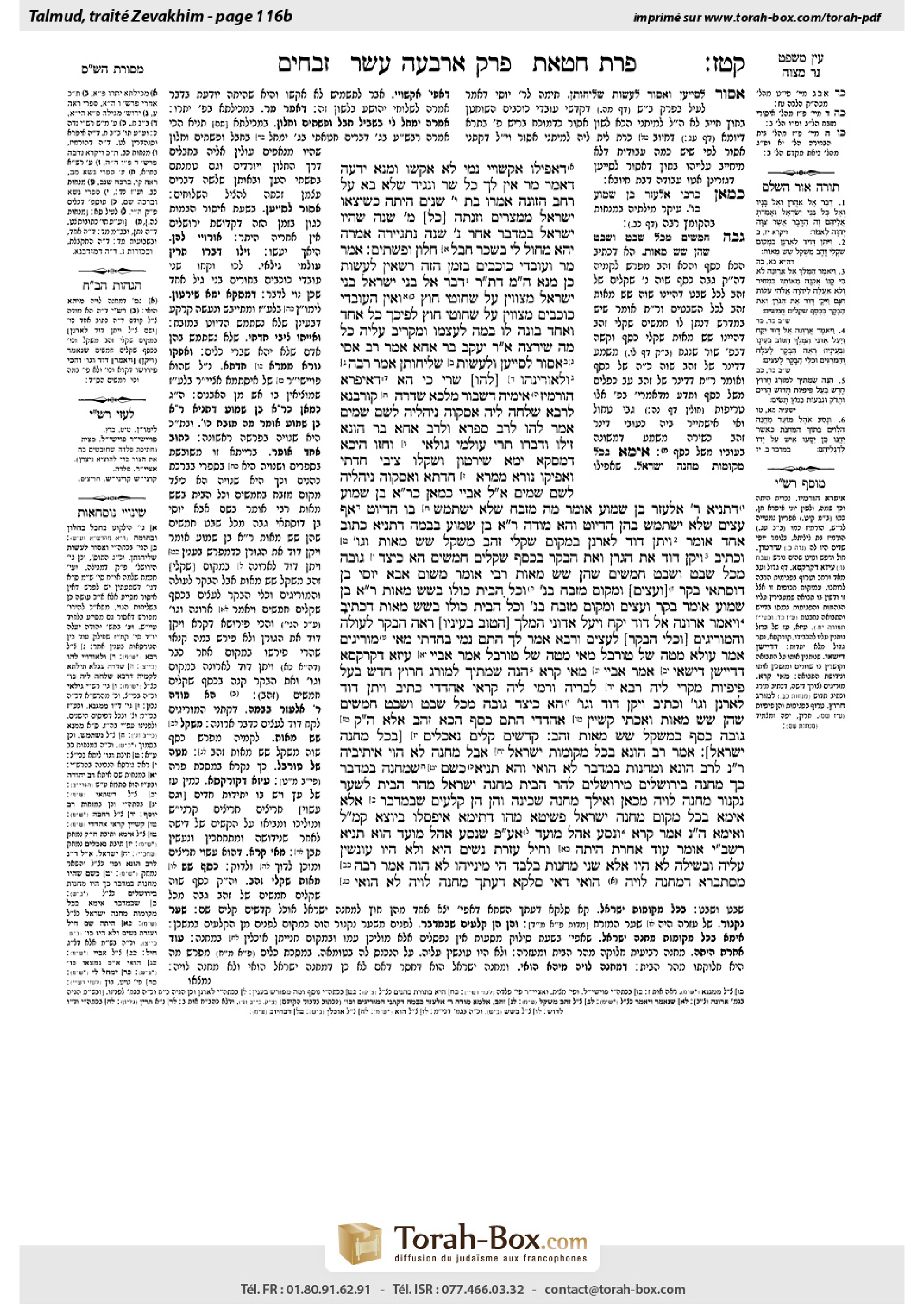
Zevachim 116b: Talmud study for Daf Yomi
Daf Yomi is the daily study of one Talmud folio. Explore 37 tractates with scans, Hebrew text, Sefaria English and AI-generated French translations where annotated.
Passage selection and English or AI-generated French translation are available where the scan has annotations. Daf Study is independent of Torah-Box and Sefaria.
Browse Zevachim · זבחים · All tractatesZevachim 116b text and translations
This page of Zevachim includes the Aramaic text, an English translation and an AI-generated French translation, alongside the scan above.
זבחים קי״ו ב · Aramaic and Hebrew text
דַּאֲפִילּוּ אִקַּשּׁוֹיֵי נָמֵי לָא אִקַּשּׁוּ. וּמְנָא יָדְעָה? דְּאָמַר מָר: אֵין לָךְ כׇּל שַׂר וְנָגִיד שֶׁלֹּא בָּא עַל רָחָב הַזּוֹנָה.
אָמְרוּ: בַּת עֶשֶׂר שָׁנִים הָיְתָה כְּשֶׁיָּצְאוּ יִשְׂרָאֵל מִמִּצְרַיִם, וְזִנְּתָה [כׇּל] אַרְבָּעִים שָׁנָה שֶׁהָיוּ יִשְׂרָאֵל בַּמִּדְבָּר. אַחַר חֲמִישִּׁים שָׁנָה נִתְגַּיְּירָה, אָמְרָה: ״יְהֵא מָחוּל לִי בִּשְׂכַר חֶבֶל חַלּוֹן וּפִשְׁתִּים״.
אָמַר מָר: וְגוֹיִם בִּזְמַן הַזֶּה רַשָּׁאִין לַעֲשׂוֹת כֵּן. מְנָא הָנֵי מִילֵּי? דְּתָנוּ רַבָּנַן: ״דַּבֵּר אֶל בְּנֵי יִשְׂרָאֵל״ – בְּנֵי יִשְׂרָאֵל מְצוּוִין עַל שְׁחוּטֵי חוּץ, וְאֵין הַגּוֹיִם מְצוּוִין עַל שְׁחוּטֵי חוּץ.
לְפִיכָךְ כָּל אֶחָד וְאֶחָד בּוֹנֶה לוֹ בָּמָה לְעַצְמוֹ, וּמַקְרִיב עָלֶיהָ כׇּל מַה שֶּׁיִּרְצֶה. אָמַר רַבִּי יַעֲקֹב בַּר אַחָא אָמַר רַב אַסִּי: אָסוּר לְסַיְּיעָן וְלַעֲשׂוֹת שְׁלִיחוּתָן. אָמַר רַבָּה: וּלְאוֹרֹיִנְהוּ שְׁרֵי.
כִּי הָא דְּאִיפְרָא הוֹרְמִיז אִימֵּיהּ דְּשַׁבּוּר מַלְכָּא שַׁדַּרָה קוּרְבָּנָא לְרָבָא, שְׁלַחָה לֵיהּ: ״אַסְּקוּהּ נִיהֲלֵיהּ לְשֵׁם שָׁמַיִם״. אֲמַר לְהוּ לְרַב סָפְרָא וּלְרַב אַחָא בַּר הוּנָא: זִילוּ וּדְבַרוּ תְּרֵי עוּלֵמֵי גּוּלָאֵי, וַחֲזוֹ הֵיכָא דְּמַסְּקָא יַמָּא שִׂירְטוֹן; וּשְׁקֻלוּ צִיבֵי חַדְתֵי, וְאַפִּיקוּ נוּרָא מִמָּרָא חַדְתָּא, וְאַסְּקוּהּ נִיהֲלֵיהּ לְשֵׁם שָׁמַיִם.
אֲמַר לֵיהּ אַבָּיֵי: כְּמַאן – כְּרַבִּי אֶלְעָזָר בֶּן שַׁמּוּעַ. דְּתַנְיָא, רַבִּי אֶלְעָזָר בֶּן שַׁמּוּעַ אוֹמֵר: מָה מִזְבֵּחַ – שֶׁלֹּא יִשְׁתַּמֵּשׁ בּוֹ הֶדְיוֹט, אַף עֵצִים – שֶׁלֹּא יִשְׁתַּמֵּשׁ בָּהֶן הֶדְיוֹט. וְהָא מוֹדֶה רַבִּי אֶלְעָזָר בֶּן שַׁמּוּעַ בְּבָמָה!
דְּתַנְיָא, כָּתוּב אֶחָד אוֹמֵר: ״וַיִּתֵּן דָּוִד לְאׇרְנָן בַּמָּקוֹם שִׁקְלֵי זָהָב מִשְׁקָל שֵׁשׁ מֵאוֹת וְגוֹ׳״, וּכְתִיב: ״וַיִּקֶן דָּוִד אֶת הַגֹּרֶן וְאֶת הַבָּקָר בְּכֶסֶף שְׁקָלִים חֲמִשִּׁים״; הָא כֵּיצַד?
גּוֹבֶה מִכׇּל שֵׁבֶט וָשֵׁבֶט חֲמִשִּׁים, שֶׁהֵן שֵׁשׁ מֵאוֹת. רַבִּי אוֹמֵר מִשּׁוּם אַבָּא יוֹסֵי בֶּן דּוֹסְתַּאי: בָּקָר [וְעֵצִים] וּמְקוֹם מִזְבֵּחַ בַּחֲמִשִּׁים, וְכׇל הַבַּיִת כּוּלּוֹ בְּשֵׁשׁ מֵאוֹת.
רַבִּי אֶלְעָזָר בֶּן שַׁמּוּעַ אוֹמֵר: בָּקָר וְעֵצִים וּמְקוֹם מִזְבֵּחַ בַּחֲמִשִּׁים, וְכׇל הַבַּיִת כּוּלּוֹ בְּשֵׁשׁ מֵאוֹת; דִּכְתִיב: ״וַיֹּאמֶר אֲרַוְנָה אֶל דָּוִד: יִקַּח וְיַעַל אֲדוֹנִי הַמֶּלֶךְ [הַטּוֹב בְּעֵינָיו], רְאֵה הַבָּקָר לָעֹלָה וְהַמֹּרִגִּים [וּכְלֵי הַבָּקָר] לָעֵצִים״. וְרָבָא אָמַר לָךְ: הָתָם נָמֵי בְּחַדְתֵי.
מַאי מוֹרִיגִּים? אָמַר עוּלָּא: מִטָּה שֶׁל טוּרְבֵּל. מַאי מִטָּה שֶׁל טוּרְבֵּל? אָמַר אַבָּיֵי: עִיזָּא דְּקֻרְקְסָא דְּדָיְישָׁן דִּישָׁאֵי. אָמַר אַבָּיֵי: מַאי קְרָא? ״הִנֵּה שַׂמְתִּיךְ לְמוֹרַג חָרוּץ חָדָשׁ בַּעַל פִּיפִיּוֹת״.
מַקְרֵי לֵיהּ רָבָא לִבְרֵיהּ, וְרָמֵי לֵיהּ קְרָאֵי אַהֲדָדֵי; כְּתִיב: ״וַיִּתֵּן דָּוִד לְאׇרְנָן וְגוֹ׳״, וּכְתִיב: ״וַיִּקֶן דָּוִד וְגוֹ׳״; הָא כֵּיצַד? גּוֹבֶה מִכׇּל שֵׁבֶט וָשֵׁבֶט חֲמִשִּׁים, שֶׁהֵן שֵׁשׁ מֵאוֹת.
וְאַכַּתִּי קַשְׁיָין אַהֲדָדֵי – הָתָם כֶּסֶף, הָכָא זָהָב! אֶלָּא הָכִי קָאָמַר: גּוֹבֶה כֶּסֶף בְּמִשְׁקַל שֵׁשׁ מֵאוֹת זָהָב.
קָדָשִׁים קַלִּים נֶאֱכָלִים [בְּכׇל מַחֲנֵה יִשְׂרָאֵל]. אָמַר רַב הוּנָא: בְּכׇל מְקוֹמוֹת יִשְׂרָאֵל, אֲבָל מַחֲנֶה לָא הָוֵי.
אֵיתִיבֵיהּ רַב נַחְמָן לְרַב הוּנָא: וּמַחֲנוֹת בְּמִדְבָּר לָא הֲוַאי?! וְהָא תַּנְיָא: כְּשֵׁם שֶׁמַּחֲנֶה בַּמִּדְבָּר, כָּךְ מַחֲנֶה בִּירוּשָׁלַיִם; מִירוּשָׁלַיִם לְהַר הַבַּיִת – מַחֲנֵה יִשְׂרָאֵל, מֵהַר הַבַּיִת לְשַׁעַר נִקָּנוֹר – מַחֲנֵה לְוִיָּה,
מִכָּאן וְאֵילָךְ – מַחֲנֵה שְׁכִינָה, וְהֵן הֵן קְלָעִים שֶׁבַּמִּדְבָּר.
אֶלָּא אֵימָא: בְּכׇל מְקוֹם מַחֲנֵה יִשְׂרָאֵל. פְּשִׁיטָא! מַהוּ דְּתֵימָא: אִיפְּסִלוּ בְּיוֹצֵא; קָא מַשְׁמַע לַן.
וְאֵימָא הָכִי נָמֵי! אָמַר קְרָא: ״וְנָסַע אֹהֶל מוֹעֵד״ – אַף עַל פִּי שֶׁנָּסַע, אֹהֶל מוֹעֵד הוּא.
תַּנְיָא, רַבִּי שִׁמְעוֹן בֶּן יוֹחַאי אוֹמֵר: עוֹד אַחֶרֶת הָיְתָה, וְחֵיל עֶזְרַת נָשִׁים הִיא, וְלֹא הָיוּ עוֹנְשִׁין עָלֶיהָ. וּבְשִׁילֹה לֹא הָיוּ אֶלָּא שְׁנֵי מַחֲנוֹת בִּלְבַד.
הֵי מִינַּיְיהוּ לָא הֲוָה? אָמַר רַבָּה: מִסְתַּבְּרָא דְּמַחֲנֵה לְוִיָּה הֲוַאי; דְּאִי סָלְקָא דַעְתָּךְ מַחֲנֵה לְוִיָּה לָא הֲוַאי –
Zevachim 116b · English translation
The Gemara replies that Rahab used this phrase euphemistically, to say that their fear was so great that their male organs were not even able to become erect, as “kama” also means rise. The Gemara asks: And how did Rahab know this? The Gemara replies: As the Master said: You do not have any prince or ruler at that time who did not engage in intercourse with Rahab the prostitute.
The Gemara adds that the Sages said with regard to Rahab: She was ten years old when the Jewish people left Egypt, and she engaged in prostitution all forty years that the Jewish people were in the wilderness. After that, when she was fifty years old, she converted when the two spies visited her. She said: May all of my sins of prostitution be forgiven me as a reward for having endangered myself with the rope, window, and flax, by means of which I saved Joshua’s two spies. Rahab first concealed the spies in stalks of flax, and later assisted them in exiting her home by lowering them from the window with a rope (see Joshua 2:6 and 2:15).
§ The Master said in the baraita that discussed the sacrifice of offerings before the construction of the Tabernacle: And today gentiles are permitted to do so, i.e., to sacrifice offerings outside the Temple courtyard, despite the fact that this is forbidden for the Jews. The Gemara asks: From where are these matters derived? As the Sages taught with regard to the verses that prohibit the slaughter of offerings outside the Temple: “Speak to Aaron, and to his sons, and to all the children of Israel” (Leviticus 17:2). This indicates that only Jews are commanded with regard to offerings slaughtered outside the Temple, but gentiles are not commanded with regard to offerings slaughtered outside the Temple.
Therefore, each and every gentile may, if he desires, construct a private altar for himself, and sacrifice upon it whatever he desires. Rabbi Ya’akov bar Aḥa says that Rav Asi says: Although it is permitted for gentiles to sacrifice offerings outside the Temple courtyard, it is prohibited for a Jew to assist them or to fulfill their agency in this matter, as sacrificing in this manner is forbidden for a Jew. Rabba said: But to instruct them how to sacrifice outside the Temple is permitted.
This is similar to that incident in which Ifera Hurmiz, the mother of King Shapur of Persia, sent an offering to Rava, with which she sent this message to him: Sacrifice this for me, for the sake of Heaven. Rava said to Rav Safra and to Rav Aḥa bar Huna: Go, take two gentile youths of the same age, i.e., similar to one another, so that the sacrifice will be performed with maximal beauty, and see where the sea currently raises silt [sirton], which is a place that no one has used before. And take new wood and bring out fire from new vessels, and the two youths will sacrifice the offering for her, for the sake of Heaven.
Abaye said to Rava: In accordance with whose opinion was the instruction to sacrifice exclusively with new wood? Was it in accordance with the opinion of Rabbi Elazar ben Shammua? As it is taught in a baraita that Rabbi Elazar ben Shammua says: Just as the altar is a place that is not used by an ordinary person, so too, the wood that will be used must not be used by an ordinary person. The Gemara asks: But doesn’t Rabbi Elazar ben Shammua concede that in the case of a private altar the wood need not be new?
As it is taught in a baraita: With regard to David’s purchase of the site of the Temple, when he wished to build an altar there at God’s instruction, one verse states: “So David gave to Ornan for the place six hundred shekels of gold by weight. And David built there an altar to the Lord, and offered burnt offerings and peace offerings” (I Chronicles 21:25–26). And it is written elsewhere: “So David bought the threshing floor and the oxen for fifty shekels of silver. And David built there an altar to the Lord, and offered burnt offerings and peace offerings” (II Samuel 24:24–25). How can these texts be reconciled?
David would collect from each tribe of the twelve tribes fifty shekels, which are a sum of six hundred shekels. Rabbi Yehuda HaNasi says in the name of Abba Yosei ben Dostai that there is another explanation: David purchased the cattle and the wood and the site of the altar for fifty shekels, and he purchased the site of the entire Temple for six hundred shekels.
Rabbi Elazar ben Shammua says likewise: David purchased the cattle and the wood and the site of the altar for fifty shekels, and the site of the entire Temple for six hundred shekels, as it is written: “And Araunah said to David: Let my lord the king take and offer that which is good in his eyes; see the cattle for the burnt offering, and the threshing tools, and the implements of the cattle for the wood” (II Samuel 24:22), to which David replied: “No, but I will buy it from you at a price” (II Samuel 24:24). Consequently, according to the opinion of Rabbi Elazar ben Shammua, David purchased the threshing instruments and the furniture of the oxen for use as wood. And Rava could have said to you in response: There too, in the case of David, the verse is dealing with new vessels that had not yet been used.
The Gemara asks: What are “the threshing instruments [morigim]” mentioned in the verse? Ulla said: It is a turbal bed. The Gemara asks: What is a turbal bed? Abaye said: It is a heavy, serrated board [dekurkesa], used for threshing. Abaye said: What is the verse from which the meaning of morigim is derived? “Behold, I have made you a new threshing board [morag] having sharp teeth; you shall thresh the mountains, and beat them small, and shall make the hills as chaff” (Isaiah 41:15). This verse indicates that a morag has grooves and teeth, and is used for threshing.
With regard to the contradiction between the verses that relate the sum of shekels paid by David, the Gemara says that Rava was teaching these verses to his son, and raised a contradiction between verses: It is written: “So David gave to Ornan…six hundred shekels of gold by weight” (I Chronicles 21:25), and it is written: “So David bought…fifty shekels of silver” (II Samuel 24:24). How can these texts be reconciled? David would collect from each tribe of the twelve tribes fifty shekels, which are a sum of six hundred shekels.
The Gemara asks: But these verses are still difficult, as they contradict one another, since there in the book of Samuel it is stated that David paid silver shekels, while here in Chronicles it is stated that he paid gold shekels. The Gemara replies: Rather, this is what the verses are saying: David would collect from each tribe silver shekels that had the value of fifty gold shekels in weight, so that the value of the final sum was equal to six hundred gold shekels.
§ The mishna teaches that once the Tabernacle was established in the wilderness, offerings of lesser sanctity were eaten throughout the camp of Israel. Rav Huna says: This means that offerings of lesser sanctity were eaten in any of the places that an Israelite would be found. But there was no actual camp, outside of which it was prohibited to eat the offerings.
Rav Naḥman raised an objection to Rav Huna: And were there not camps when the Jews were in the wilderness? But isn’t it taught in a baraita (see Tosefta, Kelim Bava Kamma 1:12): Just as there was a camp in the wilderness that was divided into different sections, with each section having particular halakhot pertaining to the consumption of offerings and to the ritually impure individuals who were prohibited from entering there, so too, there is a corresponding camp in Jerusalem: The area from the walls of Jerusalem to the Temple Mount has the status of the Israelite camp. The area from the Temple Mount to Nicanor’s Gate at the entrance to the Temple courtyard has the status of the Levite camp.
From that point onward, i.e., from the entrance to the Temple courtyard, the area has the status of the camp of the Divine Presence; and the Temple courtyard has the same status as the area within the curtains surrounding the courtyard of the Tabernacle in the wilderness.
The Gemara replies: Rather, say that Rav Huna meant that when the Tabernacle was in the wilderness, offerings of lesser sanctity could be consumed wherever the Israelite camp was located. The Gemara asks: Isn’t that obvious? Wherever the Jews were located in the wilderness was where the Israelite camp was. The Gemara responds: Lest you say that during the periods of travel between encampments the offerings were taken outside the Israelite camp, and were thereby disqualified due to the meat’s leaving the area within the partitions, Rav Huna teaches us that the meat is not disqualified.
The Gemara asks: But why not say that this is indeed so, i.e., that the meat is disqualified because it left the camp? The Gemara answers that the verse states: “Then the Tent of Meeting, with the camp of the Levites, shall travel in the midst of the camps; as they encamp, so shall they travel” (Numbers 2:17), which indicates that although it traveled from its place it is still the Tent of Meeting. Similarly, the Israelite camp retains its status even while traveling.
§ With regard to the division of Jerusalem into three camps, it is taught in a baraita that Rabbi Shimon ben Yoḥai says: There was an additional camp in Jerusalem, within the area of the Temple Mount, and it was the rampart of the women’s courtyard. The Sages rendered it prohibited for certain ritually impure individuals to enter that area, but they would not punish them for entering it, as by Torah law it does not constitute a distinct section of the Temple Mount but has the status of the Levite camp. The baraita adds: And when the Tabernacle was in Shiloh there were only two camps.
The Gemara asks: Which of the three camps that were present in the wilderness was not present in Shiloh? Rabba said: It stands to reason that the Levite camp was present, but the Israelite camp was not. As, if it enters your mind to say that the Levite camp was not present in Shiloh,
Zevachim 116b · Traduction française (IA)
La Guemara répond que Rahab employait cette expression par euphémisme pour dire que leur peur était si grande que leurs organes sexuels n’étaient même pas capables de se dresser, car « kama » signifie aussi « se dresser ». La Guemara demande : Et comment Rahab le savait-elle ? La Guemara répond : Comme l’a dit le Maître, il n’y avait alors aucun prince ni dirigeant qui n’ait eu de relations sexuelles avec Rahab la prostituée.
La Guemara ajoute que les Sages ont dit au sujet de Rahab : elle avait dix ans lorsque le peuple juif sortit d’Égypte et se prostitua pendant les quarante années où le peuple juif séjourna dans le désert. Ensuite, à l’âge de cinquante ans, elle se convertit lorsque les deux espions lui rendirent visite. Elle dit : Que tous mes péchés de prostitution me soient pardonnés en récompense du fait que j’ai risqué ma vie avec la corde, la fenêtre et le lin, grâce auxquels j’ai sauvé les deux espions de Josué. Rahab cacha d’abord les espions dans des tiges de lin, puis les aida à quitter sa maison en les faisant descendre par la fenêtre à l’aide d’une corde (voir Josué 2,6 et 2,15).
§ Le Maître a dit dans la baraïta qui traite des sacrifices offerts avant la construction du Tabernacle : aujourd’hui, les non-Juifs sont autorisés à le faire, c’est-à-dire à offrir des sacrifices en dehors du parvis du Temple, bien que cela soit interdit aux Juifs. La Guemara demande : De quoi déduit-on ces règles ? Les Sages ont enseigné, au sujet des versets qui interdisent d’abattre des sacrifices en dehors du Temple : « Parle à Aaron, à ses fils et à tous les enfants d’Israël » (Lévitique 17,2). Cela indique que seuls les Juifs sont soumis à l’interdiction d’abattre des sacrifices en dehors du Temple, tandis que les non-Juifs ne le sont pas.
Par conséquent, chaque non-Juif peut, s’il le désire, construire pour lui-même un autel privé et y offrir ce qu’il veut. Rabbi Ya’akov bar Aḥa dit au nom de Rav Asi : bien qu’il soit permis aux non-Juifs d’offrir des sacrifices en dehors du parvis du Temple, il est interdit à un Juif de les aider ou d’agir comme leur mandataire dans cette affaire, car offrir des sacrifices de cette manière est interdit à un Juif. Rabba dit : En revanche, il est permis de leur expliquer comment offrir des sacrifices en dehors du Temple.
Cela rappelle l’incident où Ifera Hurmiz, la mère du roi Shapur de Perse, envoya une offrande à Rava, accompagnée de ce message : « Offre ceci pour moi, pour l’amour du Ciel. » Rava dit à Rav Safra et à Rav Aḥa bar Huna : « Allez prendre deux jeunes non-Juifs du même âge, c’est-à-dire semblables l’un à l’autre, afin que l’offrande soit accomplie avec le plus grand soin. Voyez où la mer dépose actuellement du limon [sirton], un endroit où personne n’est jamais allé auparavant. Prenez du bois neuf et faites jaillir du feu de récipients neufs ; les deux jeunes hommes offriront l’offrande pour elle, pour l’amour du Ciel. »
Abaye dit à Rava : Selon quelle opinion l’instruction d’offrir l’offrande exclusivement avec du bois neuf a-t-elle été donnée ? Était-ce selon l’opinion de Rabbi Elazar ben Shammua ? Car il est enseigné dans une baraïta que Rabbi Elazar ben Shammua dit : De même que l’autel est un endroit dont une personne ordinaire ne se sert pas, de même le bois qui sera utilisé ne doit pas avoir servi à une personne ordinaire. La Guemara demande : Mais Rabbi Elazar ben Shammua ne reconnaît-il pas que, dans le cas d’un autel privé, le bois n’a pas besoin d’être neuf ?
Car il est enseigné dans une baraïta : au sujet de l’achat par David du site du Temple, lorsqu’il voulut y construire un autel sur l’ordre de Dieu, un verset dit : « David donna à Ornan, pour le lieu, six cents sicles d’or au poids. David bâtit là un autel pour le Seigneur, et offrit des holocaustes et des sacrifices de paix » (I Chroniques 21,25–26). Et il est écrit ailleurs : « David acheta l’aire et les bœufs pour cinquante sicles d’argent. David bâtit là un autel pour le Seigneur, et offrit des holocaustes et des sacrifices de paix » (II Samuel 24,24–25). Comment concilier ces textes ?
David prélevait cinquante sicles auprès de chacune des douze tribus, soit un total de six cents sicles. Rabbi Yehuda HaNasi dit au nom d’Abba Yosei ben Dostai qu’il existe une autre explication : David acheta le bétail, le bois et le site de l’autel pour cinquante sicles, et le site de l’ensemble du Temple pour six cents sicles.
Rabbi Elazar ben Shammua dit également : David acheta le bétail, le bois et le site de l’autel pour cinquante sicles, et le site de l’ensemble du Temple pour six cents sicles, comme il est écrit : « Araunah dit à David : Que mon seigneur le roi prenne et offre ce qui lui semble bon ; voici les bœufs pour l’holocauste, les instruments de battage et les outils des bœufs pour le bois » (II Samuel 24,22). David répondit : « Non, je te l’achèterai à son prix » (II Samuel 24,24). Par conséquent, selon l’opinion de Rabbi Elazar ben Shammua, David acheta les instruments de battage et les outils des bœufs pour les utiliser comme bois. Rava aurait pu te répondre : Là aussi, dans le cas de David, le verset parle d’outils neufs qui n’avaient pas encore servi.
La Guemara demande : Que sont les « instruments de battage [morigim] » mentionnés dans le verset ? Ulla dit : C’est un lit turbal. La Guemara demande : Qu’est-ce qu’un lit turbal ? Abaye dit : C’est une lourde planche dentelée [dekurkesa], utilisée pour le battage. Abaye dit : De quel verset déduit-on le sens de morigim ? « Voici, je fais de toi une herse neuve [morag], armée de dents aiguës ; tu écraseras les montagnes et tu les réduiras en poussière, tu rendras les collines semblables à la paille » (Isaïe 41,15). Ce verset indique qu’un morag est muni de rainures et de dents et sert au battage.
À propos de la contradiction entre les versets qui rapportent la somme payée par David, la Guemara dit que Rava enseignait ces versets à son fils et souleva une contradiction entre eux : il est écrit : « David donna à Ornan… six cents sicles d’or au poids » (I Chroniques 21,25), et il est écrit : « David acheta… cinquante sicles d’argent » (II Samuel 24,24). Comment concilier ces textes ? David prélevait cinquante sicles auprès de chacune des douze tribus, soit un total de six cents sicles.
La Guemara demande : Mais ces versets restent difficiles, car ils se contredisent : dans le livre de Samuel, il est dit que David paya en sicles d’argent, tandis qu’ici, dans les Chroniques, il est dit qu’il paya en sicles d’or. La Guemara répond : En réalité, voici ce que disent les versets : David prélevait auprès de chaque tribu des sicles d’argent dont la valeur équivalait à celle de cinquante sicles d’or au poids, de sorte que la valeur totale équivalait à six cents sicles d’or.
§ La Michna enseigne qu’une fois le Tabernacle établi dans le désert, les sacrifices de sainteté moindre étaient consommés dans tout le camp d’Israël. Rav Huna dit : cela signifie que les sacrifices de sainteté moindre étaient consommés partout où pouvait se trouver un Israélite. Mais il n’y avait pas de camp à proprement parler, en dehors duquel il aurait été interdit de consommer ces sacrifices.
Rav Naḥman objecta à Rav Huna : N’y avait-il donc pas de camps lorsque les Juifs étaient dans le désert ? N’est-il pas enseigné dans une baraïta (voir Tosefta, Kelim, Baba Kama 1,12) : De même qu’il y avait dans le désert un camp divisé en différentes zones, chacune soumise à des halakhot particulières concernant la consommation des sacrifices et les personnes rituellement impures auxquelles l’accès y était interdit, de même il existe des camps correspondants à Jérusalem : le secteur allant des remparts de Jérusalem au mont du Temple a le statut du camp d’Israël ; le secteur allant du mont du Temple à la porte de Nicanor, à l’entrée du parvis du Temple, a le statut du camp des Lévites.
À partir de là, c’est-à-dire depuis l’entrée du parvis du Temple, le secteur a le statut du camp de la Présence divine ; et le parvis du Temple a le même statut que la zone située à l’intérieur des tentures qui entouraient le parvis du Tabernacle dans le désert.
La Guemara répond : Il faut plutôt dire que Rav Huna voulait dire que, lorsque le Tabernacle se trouvait dans le désert, les sacrifices de sainteté moindre pouvaient être consommés partout où se trouvait le camp d’Israël. La Guemara demande : N’est-ce pas évident ? Là où se trouvaient les Juifs dans le désert, là se trouvait le camp d’Israël. La Guemara répond : De peur que tu ne dises que, pendant les déplacements entre deux campements, les sacrifices étaient emportés hors du camp d’Israël et devenaient ainsi invalides parce que la viande avait quitté l’espace délimité par les cloisons, Rav Huna nous enseigne que la viande n’est pas invalidée.
La Guemara demande : Mais pourquoi ne pas dire que c’est effectivement le cas, c’est-à-dire que la viande est invalidée parce qu’elle a quitté le camp ? La Guemara répond que le verset dit : « Alors la Tente de la Rencontre, avec le camp des Lévites, se mettra en marche au milieu des camps ; comme ils campent, ainsi se mettront-ils en marche » (Nombres 2,17), ce qui indique que, bien qu’elle se soit déplacée, elle demeure la Tente de la Rencontre. De même, le camp d’Israël conserve son statut même lorsqu’il est en déplacement.
§ À propos de la division de Jérusalem en trois camps, une baraïta enseigne que Rabbi Shimon ben Yoḥai dit : il y avait à Jérusalem un camp supplémentaire, à l’intérieur du mont du Temple : le parapet de la cour des femmes. Les Sages en interdirent l’accès à certaines personnes rituellement impures, mais ne les punissaient pas si elles y entraient, car, selon la Torah, cette zone ne constitue pas une section distincte du mont du Temple, mais a le statut du camp des Lévites. La baraïta ajoute : lorsque le Tabernacle se trouvait à Shiloh, il n’y avait que deux camps.
La Guemara demande : Lequel des trois camps qui existaient dans le désert n’existait pas à Shiloh ? Rabba dit : Il est logique de supposer que le camp des Lévites existait, mais pas le camp d’Israël. En effet, si tu penses que le camp des Lévites n’existait pas à Shiloh,
Traduction française générée par IA à partir de l’édition anglaise de Sefaria. Vérifie toujours un passage avec le texte source.
Text from Sefaria: William Davidson Edition - Vocalized Aramaic (CC BY NC); William Davidson Edition - English (CC BY NC).