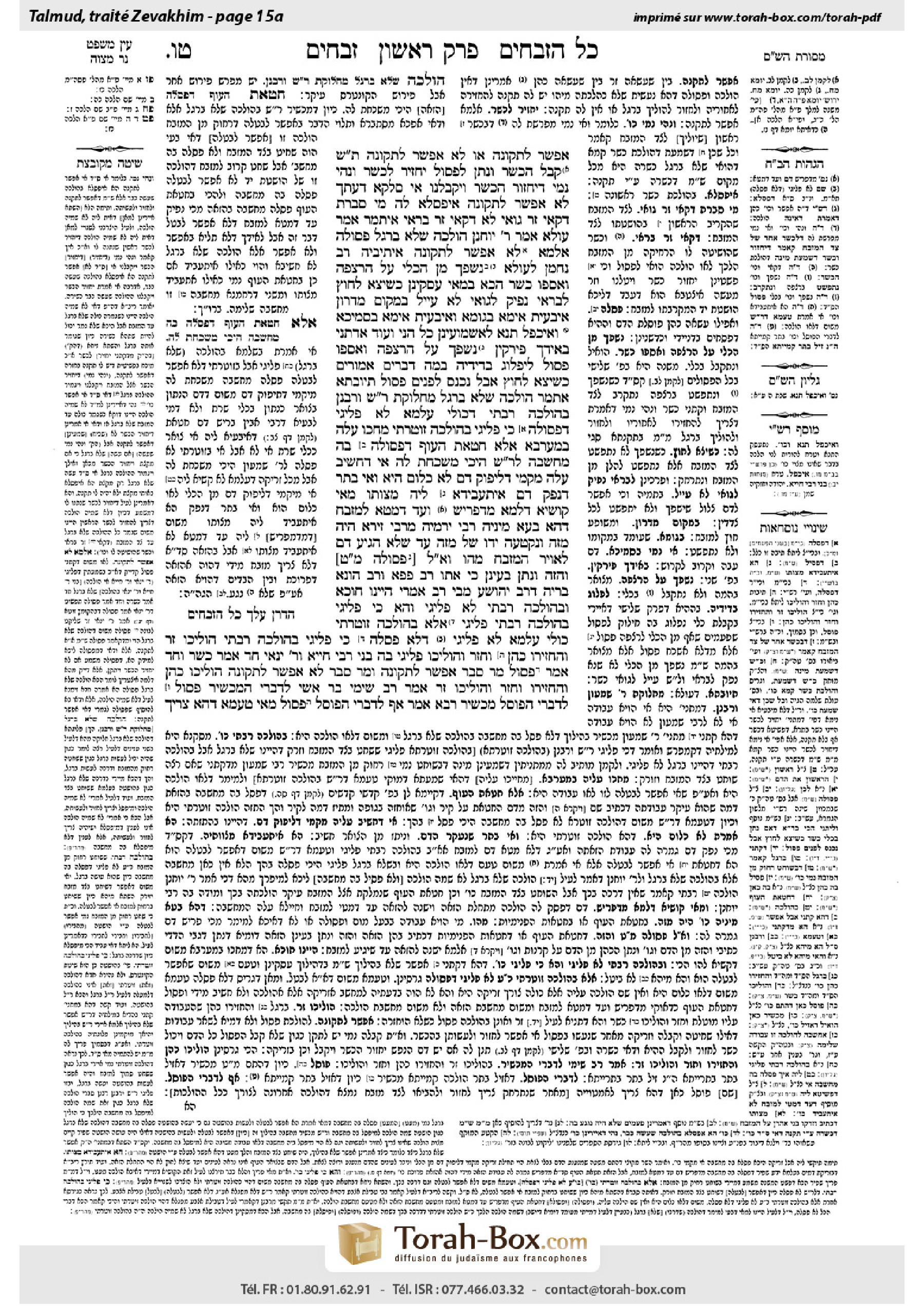
Zevachim 15a: Talmud study for Daf Yomi
Daf Yomi is the daily study of one Talmud folio. Explore 37 tractates with scans, Hebrew text, Sefaria English and AI-generated French translations where annotated.
Passage selection and English or AI-generated French translation are available where the scan has annotations. Daf Study is independent of Torah-Box and Sefaria.
Browse Zevachim · זבחים · All tractatesZevachim 15a text and translations
This page of Zevachim includes the Aramaic text, an English translation and an AI-generated French translation, alongside the scan above.
זבחים י״ה א · Aramaic and Hebrew text
אֶפְשָׁר לְתַקּוֹנַהּ אוֹ לָא אֶפְשָׁר לְתַקּוֹנַהּ?
תָּא שְׁמַע: קִבֵּל הַכָּשֵׁר וְנָתַן לַפָּסוּל – יַחְזִיר לַכָּשֵׁר;
וּנְהִי נָמֵי דְּיַחְזוֹר הַכָּשֵׁר וִיקַבְּלֶנּוּ, אִי סָלְקָא דַּעְתָּךְ לָא אֶפְשָׁר לְתַקּוֹנַהּ – אִיפְּסַלָא לַהּ!
מִי סָבְרַתְּ דְּקָאֵי זָר גַּוַּאי?! לָא; דְּקָאֵי זָר בָּרַאי.
אִיתְּמַר, אָמַר עוּלָּא אָמַר רַבִּי יוֹחָנָן: הוֹלָכָה שֶׁלֹּא בָּרֶגֶל – פְּסוּלָה. אַלְמָא לָא אֶפְשָׁר לְתַקּוֹנַהּ.
אֵיתִיבֵיהּ רַב נַחְמָן לְעוּלָּא: נִשְׁפַּךְ מִן הַכְּלִי עַל הָרִצְפָּה וַאֲסָפוֹ – כָּשֵׁר!
הָכָא בְּמַאי עָסְקִינַן – כְּשֶׁיָּצָא לַחוּץ.
לְבָרַאי נָפֵיק לְגַוַּאי לָא עָיֵיל?! בִּמְקוֹם מִדְרוֹן. אִיבָּעֵית אֵימָא: בְּגוּמָּא. וְאִיבָּעֵית אֵימָא: בִּסְמִיכָא.
וְאִיכְּפַל תַּנָּא לְאַשְׁמוֹעִינַן כֹּל הָנֵי?! וְעוֹד, אַדְּתָנֵי בְּאִידַּךְ פִּירְקִין: נִשְׁפַּךְ עַל הָרִצְפָּה וַאֲסָפוֹ – פָּסוּל; לִיפְלוֹג בְּדִידֵיהּ: בַּמֶּה דְּבָרִים אֲמוּרִים – כְּשֶׁיָּצָא לַחוּץ, אֲבָל נִכְנַס לִפְנִים – פָּסוּל! תְּיוּבְתָּא.
אִתְּמַר: הוֹלָכָה שֶׁלֹּא בָּרֶגֶל – מַחְלוֹקֶת רַבִּי שִׁמְעוֹן וְרַבָּנַן. בְּהוֹלָכָה רַבָּתִי – דְּכוּלֵּי עָלְמָא לָא פְּלִיגִי דִּפְסוּלָה, כִּי פְּלִיגִי – בְּהוֹלָכָה זוּטַרְתִּי.
מַחֲכוּ עֲלַהּ בְּמַעְרְבָא: אֶלָּא חַטַּאת הָעוֹף, דִּפְסוּלָה בָּהּ מַחְשָׁבָה – לְרַבִּי שִׁמְעוֹן הֵיכִי מַשְׁכַּחַתְּ לַהּ? אִי דְּחַשֵּׁיב עֲלַהּ מִקַּמֵּי דְּלִיפּוֹק דָּם – לָא כְּלוּם הִיא; וְאִי בָּתַר דִּנְפַק דָּם – אִיתְעֲבִידָא לֵיהּ מִצְוָתוֹ!
מַאי קוּשְׁיָא? דִּלְמָא מִדְּפָרֵישׁ וְעַד דִּמְטָא לְמִזְבֵּחַ –
דְּהָא בְּעָא מִינֵּיהּ רַבִּי יִרְמְיָה מֵרַבִּי זֵירָא: הָיָה מַזֶּה, וְנִקְטְעָה יָדוֹ שֶׁל מַזֶּה עַד שֶׁלֹּא הִגִּיעַ דָּם לַאֲוִיר הַמִּזְבֵּחַ, מַהוּ? וַאֲמַר לֵיהּ: פְּסוּלָה. מַאי טַעְמָא? ״וְהִזָּה... וְנָתַן״ בָּעֵינַן.
כִּי אֲתוֹ רַב פָּפָּא וְרַב הוּנָא בְּרֵיהּ דְּרַב יְהוֹשֻׁעַ מִבֵּי רַב, אָמְרִי, הַיְינוּ חוּכָא: וּבְהוֹלָכָה רַבָּתִי לָא פְּלִיגִי?! וְהָא כִּי פְּלִיגִי – בְּהוֹלָכָה רַבָּתִי פְּלִיגִי!
אֶלָּא בְּהוֹלָכָה זוּטַרְתִּי – כּוּלֵּי עָלְמָא לָא פְּלִיגִי דְּלָא פָּסְלָה; כִּי פְּלִיגִי – בְּהוֹלָכָה רַבָּתִי.
הוֹלִיכוֹ זָר, וְהֶחְזִירוֹ כֹּהֵן וְחָזַר וְהוֹלִיכוֹ – פְּלִיגִי בַּהּ בְּנֵי רַבִּי חִיָּיא וְרַבִּי יַנַּאי; חַד אָמַר כָּשֵׁר, וְחַד אָמַר פָּסוּל. מָר סָבַר: אֶפְשָׁר לְתַקּוֹנַהּ, וּמָר סָבַר: לָא אֶפְשָׁר לְתַקּוֹנַהּ.
הוֹלִיכוֹ כֹּהֵן וְהֶחְזִירוֹ, וְחָזַר וְהוֹלִיכוֹ זָר – אָמַר רַב שִׁימִי בַּר אָשֵׁי: לְדִבְרֵי הַמַּכְשִׁיר – פָּסוּל, לְדִבְרֵי הַפּוֹסֵל – מַכְשִׁיר.
רָבָא אָמַר: אַף לְדִבְרֵי הַפּוֹסֵל פָּסוּל; מַאי טַעְמָא? דְּהָא צָרִיךְ
Zevachim 15a · English translation
The Gemara asks: If the blood was conveyed by hand, is it possible to correct it by conveying it again properly, or is it not possible to correct it, and the offering is disqualified permanently?
The Gemara suggests: Come and hear proof from the aforementioned mishna: If a priest fit for Temple service collected the blood in a vessel and gave the vessel to an unfit person standing next to the altar, the latter should return it to the fit priest. Apparently, even after the blood is conveyed in an inappropriate manner, it can be corrected.
And though one can indeed explain that the fit priest should then receive it from him, as posited above, if it enters your mind that if the blood is conveyed incorrectly it is not possible to correct it, the offering was already disqualified when the priest gave the blood to the unfit person. Taking it back is of no consequence.
The Gemara rejects this inference: Do you maintain that this is referring to a case where the non-priest is standing inside, between the fit priest and the altar? No, it is a case where the non-priest is standing outside, farther away from the altar than the priest. Therefore, when the priest gave him the blood, he was not conveying it toward the altar at all; he was moving it farther away from the altar.
It was stated: Ulla says that Rabbi Yoḥanan says: Conveying the blood not by foot renders the offering unfit. Apparently, it is not possible to correct it, as otherwise Rabbi Yoḥanan would have merely stated that it is not considered conveying, as in his earlier statement (14b).
Rav Naḥman raised an objection to Ulla from a mishna (32a): If the blood spilled from the vessel onto the floor and one collected it from the floor, it is fit for sacrifice. Apparently, although spilling the blood on the floor constitutes a not valid conveying toward the altar, it can still be corrected after the fact.
The Gemara explains: Here we are dealing with a case where the blood that spilled went outward, i.e., away from the altar, so it did not constitute conveying at all.
The Gemara asks: Can spilled blood go outward and not come inward? Clearly, spilled blood spreads to all sides. The Gemara answers: It is a case where the blood spilled on an inclined plane, and it therefore spilled only outward, away from the altar. And if you wish, say instead that it spilled into a hole in the ground, so it did not spread in any direction. And if you wish, say instead that it is a case where the blood is thick, so it did not spread in all directions.
The Gemara asks: But did the tanna go to all that trouble [ikhpal] just to teach us all these unlikely cases? And furthermore, rather than teaching in another chapter (see 25a) that if the blood spilled from the animal’s neck onto the floor and one collected it in a vessel from the floor it is unfit, let the mishna teach a distinction within the case where the blood spilled from the vessel itself: In what case is this statement, that the blood is fit, said? In a case where the spilled blood went outward, away from the altar, but if it came inward it is unfit. The Gemara concludes: This is a conclusive refutation; if the blood is conveyed in a not valid manner, it can be corrected.
§ It was stated: The dispute in the mishna (13a) between Rabbi Shimon and the Rabbis as to whether improper intent while conveying the blood disqualifies the offering is only with regard to conveying the blood not by foot. With regard to greater conveying, i.e., conveying the blood by moving the feet, everyone agrees that if one performs it with prohibited intent, the offering is unfit. When they disagree, it is with regard to lesser conveying, i.e., conveying the blood by hand without moving the feet, in a case where the offering was slaughtered next to the altar.
They laughed at this statement in the West, Eretz Yisrael, saying: But if so, one encounters difficulty with regard to a bird sin offering, which is killed through pinching its nape on the altar and whose blood is sprinkled directly from its neck. It is known that if one sprinkled its blood with prohibited intent, the offering is unfit. And according to Rabbi Shimon, who holds that prohibited intent while conveying the blood by hand does not disqualify the offering, how can you find these circumstances? If the priest has prohibited intent with regard to the offering before the blood comes out of the bird, this intent is nothing, since his waving it is like conveying by hand. And if he has such intent after the blood came out, its mitzva was already performed, as the blood already reached the altar.
The Gemara asks: What is the difficulty? Perhaps the offering is disqualified due to prohibited intent from the moment the blood leaves the bird until the moment it reaches the altar.
This is as Rabbi Yirmeya asked Rabbi Zeira: If the priest was sprinkling the blood, and the hand of the one sprinkling was severed before the blood reached the airspace of the altar, what is the halakha? Is the sprinkling not valid since it was performed by a blemished priest, or is it valid because the blood left the bird before he was blemished? And Rabbi Zeira said to him: It is not valid. What is the reason? We require that the verse: “And sprinkle of the blood” (Leviticus 4:6), be fulfilled in the same manner as the verse that follows it: “And the priest shall place of the blood upon the corners of the altar” (Leviticus 4:7), namely, that the blood reach the altar. Therefore, the blood can be disqualified anytime until it reaches the altar, whether through the priest becoming blemished or through prohibited intent.
When Rav Pappa and Rav Huna, son of Rav Yehoshua, came from the study hall, they said: This is the reason for the laughter of the scholars of Eretz Yisrael: With regard to greater conveying, i.e., conveying by foot, can one say Rabbi Shimon and the Rabbis do not disagree? Clearly, when they disagree in the mishna, they disagree with regard to greater conveying, as Rabbi Shimon reasons that conveying is a dispensable rite. Only conveying by foot is dispensable, since even if the offering is slaughtered next to the altar, the priest will need to move its blood somewhat with his hand.
Rather, the statement under discussion should be emended to say: With regard to lesser conveying, i.e., conveying the blood by hand, everyone agrees that it does not disqualify the offering due to prohibited intent. When they disagree, it is with regard to greater conveying, i.e., conveying the blood for a distance by foot. Rabbi Shimon holds that improper intent even then does not disqualify the offering, as the rite is dispensable, and the Rabbis maintain that it does disqualify it.
§ If a non-priest conveyed the blood to the altar, and a priest returned it to its original location, and a priest then conveyed it again to the altar, the sons of Rabbi Ḥiyya and Rabbi Yannai disagree with regard to the halakha. One says that the offering is fit, and one says it is unfit. This is because one Sage holds that if the blood is conveyed improperly, it is possible to correct it, and one Sage holds that it is not possible to correct it.
If a priest conveyed it to the altar, and then returned it, and a non-priest then conveyed it again, Rav Shimi bar Ashi says: According to the statement of the one who deems the offering fit in the previous case, where a non-priest conveyed it the first time and a priest conveyed it the second time, in this case the offering is unfit, as a non-priest conveyed it the second time. According to the statement of the one who deems the offering unfit in the previous case, as a non-priest conveyed it the first time, in this case, where a priest conveyed it the first time, he deems the offering fit.
Rava says: Even according to the statement of the one who deems the offering unfit in a case where a non-priest conveyed it the first time, it is unfit in this case as well, where a priest conveyed it the first time and a non-priest conveyed it the second time. What is the reason? Because after the blood is returned to its original location, it is necessary
Zevachim 15a · Traduction française (IA)
La Guemara demande : Si le sang a été transporté à la main, peut-on réparer la situation en le transportant de nouveau de manière appropriée, ou est-il impossible de la réparer et l’offrande est-elle définitivement invalidée ?
La Guemara propose : Viens et entends une preuve de la Michna précitée : Si un prêtre apte au service du Temple a recueilli le sang dans un récipient et l’a remis à une personne inapte qui se tenait près de l’autel, cette dernière doit le rendre au prêtre apte. Apparemment, même après que le sang a été transporté de manière inappropriée, la situation peut être réparée.
Et bien qu’on puisse effectivement expliquer que le prêtre apte doit ensuite le recevoir de ses mains, comme cela a été avancé plus haut, si tu envisages qu’un transport incorrect du sang ne peut pas être réparé, l’offrande était déjà invalidée lorsque le prêtre a remis le sang à la personne inapte. Le reprendre n’y change rien.
La Guemara rejette cette déduction : Penses-tu qu’il s’agit d’un cas où le non-prêtre se tient à l’intérieur, entre le prêtre apte et l’autel ? Non, il s’agit d’un cas où le non-prêtre se tient à l’extérieur, plus loin de l’autel que le prêtre. Par conséquent, lorsque le prêtre lui a remis le sang, il ne le transportait pas du tout vers l’autel ; il l’en éloignait.
Il a été enseigné : Oulla rapporte au nom de Rabbi Yoḥanan : Transporter le sang sans se déplacer à pied rend l’offrande invalide. Apparemment, la situation ne peut pas être réparée ; sinon, Rabbi Yoḥanan aurait simplement dit que cela n’est pas considéré comme un transport, comme dans son enseignement précédent (14b).
Rav Naḥman objecta à Oulla en citant une Michna (32a) : Si le sang s’est répandu du récipient sur le sol et qu’on l’a recueilli sur le sol, il est apte au sacrifice. Apparemment, bien que répandre le sang sur le sol constitue un transport invalide vers l’autel, la situation peut encore être réparée après coup.
La Guemara explique : Ici, il s’agit d’un cas où le sang répandu est allé vers l’extérieur, c’est-à-dire en s’éloignant de l’autel ; cela ne constituait donc pas du tout un transport.
La Guemara demande : Le sang répandu peut-il aller vers l’extérieur sans aller vers l’intérieur ? De toute évidence, le sang répandu se propage dans toutes les directions. La Guemara répond : Il s’agit d’un cas où le sang s’est répandu sur un plan incliné ; il s’est donc écoulé uniquement vers l’extérieur, loin de l’autel. Et si tu le souhaites, dis plutôt qu’il s’est écoulé dans un trou du sol, de sorte qu’il ne s’est répandu dans aucune direction. Et si tu le souhaites, dis plutôt qu’il s’agit d’un sang épais, qui ne s’est donc pas répandu dans toutes les directions.
La Guemara demande : Mais le tanna s’est-il donné tout ce mal [ikhpal] uniquement pour nous enseigner tous ces cas improbables ? Et en outre, au lieu d’enseigner dans un autre chapitre (voir 25a) que si le sang s’est répandu du cou de l’animal sur le sol et qu’on l’a recueilli dans un récipient, il est invalide, que la Michna enseigne une distinction dans le cas où le sang s’est répandu du récipient lui-même : Dans quel cas cette affirmation, selon laquelle le sang est apte, s’applique-t-elle ? Dans le cas où le sang répandu est allé vers l’extérieur, loin de l’autel ; mais s’il est allé vers l’intérieur, il est invalide. La Guemara conclut : C’est une réfutation définitive ; si le sang est transporté de manière invalide, la situation peut être réparée.
§ Il a été enseigné : Le désaccord entre Rabbi Shimon et les Rabbins dans la Michna (13a), sur la question de savoir si une intention inadéquate pendant le transport du sang invalide l’offrande, ne concerne que le transport du sang sans déplacement à pied. Quant au transport majeur, c’est-à-dire le transport du sang en se déplaçant à pied, tous conviennent que si on l’effectue avec une intention interdite, l’offrande est invalide. Leur désaccord porte sur le transport mineur, c’est-à-dire le transport du sang à la main sans déplacer les pieds, dans le cas où l’offrande a été égorgée près de l’autel.
En Occident, c’est-à-dire en Terre d’Israël, on se moqua de cet enseignement en disant : Mais alors, une difficulté se pose à propos du sacrifice expiatoire d’un oiseau, qui est mis à mort par mélika, en lui pinçant la nuque sur l’autel, et dont le sang est aspergé directement depuis son cou. On sait que si l’on asperge son sang avec une intention interdite, l’offrande est invalide. Or, selon Rabbi Shimon, qui estime qu’une intention interdite lors du transport du sang à la main n’invalide pas l’offrande, comment peut-on trouver ces circonstances ? Si le prêtre a une intention interdite à l’égard de l’offrande avant que le sang ne sorte de l’oiseau, cette intention est sans effet, puisque le fait de brandir l’oiseau équivaut à un transport à la main. Et s’il a cette intention après que le sang est sorti, sa mitsva a déjà été accomplie, puisque le sang a déjà atteint l’autel.
La Guemara demande : Où est la difficulté ? Peut-être l’offrande est-elle invalidée par une intention interdite à partir du moment où le sang quitte l’oiseau jusqu’au moment où il atteint l’autel.
C’est ce que Rabbi Yirmeya demanda à Rabbi Zeira : Si le prêtre aspergeait le sang et que la main de celui qui aspergeait était sectionnée avant que le sang n’atteigne l’espace aérien de l’autel, quelle est la halakha ? L’aspersion est-elle invalide parce qu’elle a été accomplie par un prêtre atteint d’un défaut, ou est-elle valide parce que le sang a quitté l’oiseau avant qu’il ne soit atteint d’un défaut ? Rabbi Zeira lui répondit : Elle est invalide. Pour quelle raison ? Nous exigeons que le verset « et qu’il asperge du sang » (Lévitique 4:6) soit accompli de la même manière que le verset qui le suit : « Et le prêtre mettra du sang sur les cornes de l’autel » (Lévitique 4:7), à savoir que le sang atteigne l’autel. Par conséquent, le sang peut être invalidé à tout moment jusqu’à ce qu’il atteigne l’autel, que ce soit parce que le prêtre devient atteint d’un défaut ou en raison d’une intention interdite.
Lorsque Rav Pappa et Rav Houna, fils de Rav Yehoshua, revinrent de la maison d’étude, ils dirent : Voici la raison des moqueries des sages de Terre d’Israël : Concernant le transport majeur, c’est-à-dire le transport à pied, peut-on dire que Rabbi Shimon et les Rabbins ne sont pas en désaccord ? De toute évidence, lorsqu’ils sont en désaccord dans la Michna, leur désaccord porte sur le transport majeur, puisque Rabbi Shimon estime que le transport est un rite dispensable. Seul le transport à pied est dispensable, car même si l’offrande est égorgée près de l’autel, le prêtre devra déplacer quelque peu son sang avec la main.
Il faut plutôt corriger l’énoncé examiné et dire : Concernant le transport mineur, c’est-à-dire le transport du sang à la main, tous conviennent qu’une intention interdite ne rend pas l’offrande invalide. Leur désaccord porte sur le transport majeur, c’est-à-dire le transport du sang sur une certaine distance à pied. Rabbi Shimon estime que même dans ce cas, une intention inadéquate n’invalide pas l’offrande, car le rite est dispensable ; les Rabbins, eux, soutiennent qu’elle l’invalide.
§ Si un non-prêtre a transporté le sang jusqu’à l’autel, qu’un prêtre l’a ramené à son emplacement initial, puis qu’un prêtre l’a de nouveau transporté jusqu’à l’autel, les fils de Rabbi Ḥiyya et de Rabbi Yannai sont en désaccord sur la halakha. L’un dit que l’offrande est apte, l’autre qu’elle est invalide. Cela tient au fait que l’un des Sages estime que si le sang est transporté de manière inappropriée, la situation peut être réparée, tandis que l’autre estime qu’elle ne peut pas l’être.
Si un prêtre l’a transporté jusqu’à l’autel, puis l’a ramené, et qu’un non-prêtre l’a ensuite transporté de nouveau, Rav Shimi bar Ashi dit : Selon l’avis de celui qui juge l’offrande apte dans le cas précédent, où un non-prêtre l’a transporté la première fois et un prêtre la seconde, dans ce cas l’offrande est invalide, car c’est un non-prêtre qui l’a transporté la seconde fois. Selon l’avis de celui qui juge l’offrande invalide dans le cas précédent, parce qu’un non-prêtre l’a transporté la première fois, dans ce cas-ci, où un prêtre l’a transporté la première fois, il juge l’offrande apte.
Rava dit : Même selon l’avis de celui qui juge l’offrande invalide dans le cas où un non-prêtre l’a transporté la première fois, elle est également invalide dans ce cas, où un prêtre l’a transporté la première fois et un non-prêtre la seconde. Pour quelle raison ? Parce qu’après que le sang a été ramené à son emplacement initial, il faut
Traduction française générée par IA à partir de l’édition anglaise de Sefaria. Vérifie toujours un passage avec le texte source.
Text from Sefaria: William Davidson Edition - Vocalized Aramaic (CC BY NC); William Davidson Edition - English (CC BY NC).