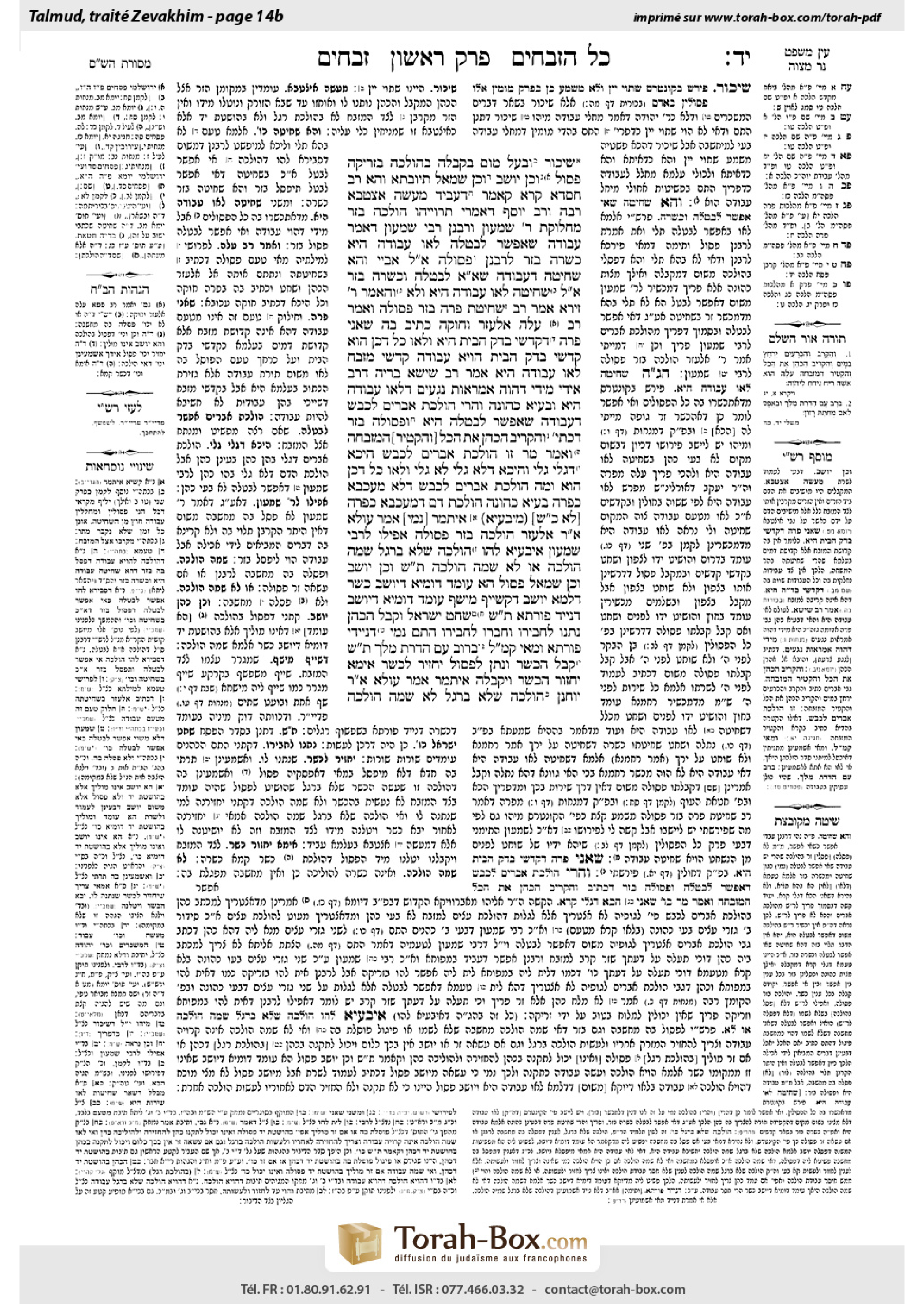
Zevachim 14b: Talmud study for Daf Yomi
Daf Yomi is the daily study of one Talmud folio. Explore 37 tractates with scans, Hebrew text, Sefaria English and AI-generated French translations where annotated.
Passage selection and English or AI-generated French translation are available where the scan has annotations. Daf Study is independent of Torah-Box and Sefaria.
Browse Zevachim · זבחים · All tractatesZevachim 14b text and translations
This page of Zevachim includes the Aramaic text, an English translation and an AI-generated French translation, alongside the scan above.
זבחים י״ד ב · Aramaic and Hebrew text
שִׁיכּוֹר, וּבַעַל מוּם; בְּקַבָּלָה בְּהוֹלָכָה בִּזְרִיקָה – פָּסוּל. וְכֵן יוֹשֵׁב, וְכֵן שְׂמֹאל! תְּיוּבְתָּא.
וְהָא רַב חִסְדָּא קְרָא קָאָמַר!
דְּעָבֵיד מַעֲשֶׂה אִצְטְבָא.
רַבָּה וְרַב יוֹסֵף דְּאָמְרִי תַּרְוַיְיהוּ: הוֹלָכָה בְּזָר – מַחְלוֹקֶת רַבִּי שִׁמְעוֹן וְרַבָּנַן; רַבִּי שִׁמְעוֹן דְּאָמַר: עֲבוֹדָה שֶׁאֶפְשָׁר לְבַטְּלָהּ, לָאו עֲבוֹדָה הִיא – כְּשֵׁרָה בְּזָר. לְרַבָּנַן – פְּסוּלָה.
אֲמַר לֵיהּ אַבָּיֵי: וְהָא שְׁחִיטָה, דַּעֲבוֹדָה שֶׁאִי אֶפְשָׁר לְבַטְּלָהּ – וּכְשֵׁרָה בְּזָר! אֲמַר לֵיהּ: שְׁחִיטָה לָאו עֲבוֹדָה הִיא.
וְלָא?! וְהָאָמַר רַבִּי זֵירָא אָמַר רַב: שְׁחִיטַת פָּרָה בְּזָר – פְּסוּלָה; וְאָמַר רַב עֲלַהּ: ״אֶלְעָזָר״ וְ״חוּקָּה״ כְּתִיב בַּהּ!
שָׁאנֵי פָּרָה, דְּקׇדְשֵׁי בֶּדֶק הַבַּיִת הִיא.
וְלָאו כָּל דְּכֵן הוּא – קׇדְשֵׁי בֶּדֶק הַבַּיִת הָוְיָא עֲבוֹדָה, קׇדְשֵׁי מִזְבֵּחַ לָאו עֲבוֹדָה הִיא?!
אָמַר רַב שִׁישָׁא בְּרֵיהּ דְּרַב אִידִי: מִידֵּי דְּהָוֵה אַמַּרְאוֹת נְגָעִים; דְּלָאו עֲבוֹדָה הִיא, וּבָעֲיָא כְּהוּנָּה.
וַהֲרֵי הוֹלָכַת אֵבָרִים לַכֶּבֶשׁ, דַּעֲבוֹדָה שֶׁאֶפְשָׁר לְבַטְּלָהּ הִיא – וּפְסוּלָה בְּזָר; דִּכְתִיב: ״וְהִקְרִיב הַכֹּהֵן אֶת הַכֹּל וְהִקְטִיר הַמִּזְבֵּחָה״ – וְאָמַר מָר: זוֹ הוֹלָכַת אֵבָרִים לַכֶּבֶשׁ!
הֵיכָא דְּגַלִּי גַּלִּי, וְהֵיכָא דְּלָא גַּלִּי לָא גַּלִּי.
וְלָאו כָּל דְּכֵן הוּא? וּמָה הוֹלָכַת אֵבָרִים לַכֶּבֶשׁ, דְּלָא מְעַכְּבָא כַּפָּרָה – בָּעֲיָא כְּהוּנָּה; הוֹלָכַת דָּם, דִּמְעַכְּבָא כַּפָּרָה – [לֹא כׇּל שֶׁכֵּן] (מִיבַּעְיָא)?!
אִיתְּמַר נָמֵי, אָמַר עוּלָּא אָמַר רַבִּי אֶלְעָזָר: הוֹלָכָה בְּזָר פְּסוּלָה, אֲפִילּוּ לְרַבִּי שִׁמְעוֹן.
אִיבַּעְיָא לְהוּ: הוֹלָכָה שֶׁלֹּא בָּרֶגֶל, שְׁמָהּ הוֹלָכָה אוֹ לֹא שְׁמָהּ הוֹלָכָה?
תָּא שְׁמַע: וְכֵן יוֹשֵׁב, וְכֵן שְׂמֹאל – פָּסוּל; הָא עוֹמֵד דּוּמְיָא דְּיוֹשֵׁב – כָּשֵׁר!
דִּלְמָא יוֹשֵׁב – דְּקָשָׁיֵיף מֵישָׁף, עוֹמֵד דּוּמְיָא דְּיוֹשֵׁב – דְּנָיֵיד פּוּרְתָּא.
תָּא שְׁמַע: שָׁחַט יִשְׂרָאֵל וְקִבֵּל הַכֹּהֵן, נְתָנוֹ לַחֲבֵירוֹ, וַחֲבֵרוֹ לַחֲבֵירוֹ!
הָתָם נָמֵי דְּנָיְידִי פּוּרְתָּא. וּמַאי קָא מַשְׁמַע לַן? ״בְּרׇב עָם הַדְרַת מֶלֶךְ״.
תָּא שְׁמַע: קִבֵּל הַכָּשֵׁר וְנָתַן לַפָּסוּל – יַחְזִיר לַכָּשֵׁר!
אֵימָא: יַחְזוֹר הַכָּשֵׁר וִיקַבְּלָהּ.
אִיתְּמַר, אָמַר עוּלָּא אָמַר רַבִּי יוֹחָנָן: הוֹלָכָה שֶׁלֹּא בָּרֶגֶל – לֹא שְׁמָהּ הוֹלָכָה.
Zevachim 14b · English translation
a drunk priest, or a blemished priest performs the rites of collection, conveying or sprinkling the blood, the offering is disqualified. And likewise, it is disqualified if a priest performs any of these rites while sitting. And this is likewise the halakha if a priest performs any of these rites with his left hand. The Gemara concludes: This is a conclusive refutation of Rav Ḥisda’s ruling; if a non-priest conveys the blood, it is disqualified.
The Gemara asks: But didn’t Rav Ḥisda state a verse as proof that the offering is not disqualified? The verse states that the priests sprinkled the blood after receiving it from non-priests.
The Gemara answers: The verse described a case where the non-priests served as a bench [itztaba]. The priests would give the blood to the non-priests to hold it for them and would then take it and sprinkle the blood. The non-priests would not convey the blood to the altar.
Rabba and Rav Yosef both say that the case of a non-priest conveying the blood is subject to a dispute between Rabbi Shimon and the Rabbis. According to Rabbi Shimon, who says that a dispensable rite is not classified as a true rite and therefore does not disqualify the offering if performed with prohibited intent, the offering is fit even if the conveying of the blood is performed by a non-priest. According to the Rabbis, who hold that a dispensable rite is classified as a true rite, the conveying of the blood is not valid if performed by a non-priest.
Abaye said to him: But what about slaughter, which is an indispensable rite, and yet the offering is fit even if it is performed by a non-priest? He said to Abaye: Slaughter, though indispensable, is not classified as a sacrificial rite at all. Therefore it need not be performed by a priest.
The Gemara asks: And is it not? But doesn’t Rabbi Zeira say that Rav says: If the slaughter of a red heifer is performed by a non-priest, it is not valid? And Rav said about this halakha: It is derived from the phrases: “Elazar the priest” (Numbers 19:3), and: “Statute” (Numbers 19:2), which are written with regard to the red heifer. The mention of Elazar indicates that slaughter must be performed by a priest, and the term “statute” indicates that one may not deviate from any of the details of the service as delineated in the verses. If one does, the heifer is disqualified.
The Gemara answers: The red heifer is different, as it is not an offering; it has the sanctity of items consecrated for Temple maintenance. The halakhot that govern its service therefore differ from those of offerings proper.
The Gemara asks: But does this not prove the point all the more? If slaughtering an animal consecrated for Temple maintenance is tantamount to a sacrificial rite, can slaughtering offerings, which are sacrificed on the altar, not be considered a sacrificial rite?
Rav Sheisha, son of Rav Idi, said: The slaughter of a red heifer is considered just as it is in the case of shades of leprous marks, which are deemed ritually pure or impure by a priest. Although this is not a sacrificial rite, it still requires a member of the priesthood to perform it. Therefore, the requirement that the red heifer be slaughtered by a priest does not prove that it is classified as a sacrificial rite.
The Gemara further challenges the premise of Rabba and Rav Yosef that a dispensable rite can be performed by a non-priest: But what about conveying the limbs of the offering to the ramp, which is a dispensable rite, as the offering can be slaughtered next to the ramp? And nevertheless, if it is performed by a non-priest, the offering is disqualified, as it is written: “And the priest shall sacrifice the whole, and make it smoke upon the altar” (Leviticus 1:13); and the Master says: This is referring to conveying the limbs to the ramp.
The Gemara answers: In a case where the verse explicitly revealed that a rite must be performed by a priest, it revealed it; but in a case where the Torah did not reveal it, it did not reveal it. With regard to conveying the blood, the Torah does not state explicitly that a priest is required.
The Gemara challenges: But is it not all the more so obvious? Just as conveying the limbs to the ramp requires that the conveyor be a member of the priesthood, even though it does not prevent atonement if not performed at all, since atonement was already effected by sprinkling the blood, all the more so is it not clear that concerning conveying the blood and sprinkling it on the altar, where the failure to convey it and sprinkle it on the altar prevents atonement, it must be that the conveyor be a member of the priesthood? This difficulty remains unresolved.
It was also stated that Ulla says that Rabbi Elazar says: In a case where conveying the blood is performed by a non-priest, the offering is disqualified, even according to Rabbi Shimon.
§ A dilemma was raised before the Sages: Is conveying the blood not by foot but rather by passing it by hand to another priest considered conveying, or is it not considered conveying? Can the rite be performed in this manner?
The Gemara suggests: Come and hear evidence from the baraita: And likewise, if the priest collected, conveyed, or sprinkled the blood while sitting, and likewise, if he performed any of these rites with his left hand, the offering is disqualified. Since only sitting is listed, one consequently infers that if the priest conveyed the blood while standing but in a manner similar to sitting, i.e., by outstretching his hand without walking, the offering is fit. Evidently, conveying the blood does not require walking.
The Gemara rejects this inference: Perhaps when the baraita states: Sitting, it is referring to one who conveys the blood by moving toward the altar while sitting on the ground in such a manner that he rubs himself against the floor of the courtyard as he pulls himself forward. If so, the parallel case of standing in a manner similar to sitting is a case where the priest moves forward a bit. Perhaps if he does not move at all and merely outstretches his hand, the rite is not valid.
The Gemara suggests: Come and hear a proof from a mishna (Pesaḥim 64a): An Israelite would slaughter the Paschal offering, and a priest would collect the blood. The priests would be lined up from the place where the lamb was slaughtered until the altar. The priest who collected the blood would immediately hand it to another priest standing next to him, and the other priest would pass it to another, and so forth, until it would reach the altar. Evidently, the blood can be passed from hand to hand; it need not be conveyed by foot.
The Gemara answers: There, too, the priests would move a bit with their feet while passing the blood forward. The Gemara asks: But what is the mishna teaching us in this description, if not that the blood need not be conveyed by foot? The Gemara answers: It teaches that: “In the multitude of people is the king’s glory” (Proverbs 14:28). It honors God when the Temple service is performed by a multitude of priests.
The Gemara suggests: Come and hear another resolution from a mishna (32a): If a priest who is fit for Temple service collected the blood in a vessel and gave it to an unfit individual standing next to the altar, that individual should return it to the fit priest, so that he may perform a complete act of conveying the blood to the altar. Evidently, the blood must be conveyed to the altar by foot. If conveying by hand were valid, another priest could simply take the blood from the unfit person and complete the conveying of the blood to the altar.
The Gemara rejects this inference: Say that the wording of the mishna should be emended; instead of stating that the unfit person should return the vessel to the fit priest, it should state that the fit priest, even another priest, should then receive it from the unfit person. If so, the mishna proves nothing about conveying by hand.
It was stated: Ulla says that Rabbi Yoḥanan says: Conveying the blood not by foot is not considered conveying.
Zevachim 14b · Traduction française (IA)
Si un prêtre ivre ou présentant un défaut accomplit l’un des rites de recueil, de transport ou d’aspersion du sang, l’offrande est invalidée. De même, elle est invalidée si un prêtre accomplit l’un de ces rites assis ou de la main gauche. La Guemara conclut : C’est une réfutation définitive de l’avis de Rav Ḥisda : si un non-prêtre transporte le sang, l’offrande est invalidée.
La Guemara demande : Mais Rav Ḥisda n’a-t-il pas cité un verset pour prouver que l’offrande n’est pas invalidée ? Le verset indique que les prêtres ont aspergé le sang après l’avoir reçu de non-prêtres.
La Guemara répond : Le verset décrit un cas où les non-prêtres servaient de banc [itztaba]. Les prêtres leur remettaient le sang pour qu’ils le tiennent, puis le reprenaient et l’aspergeaient. Les non-prêtres ne transportaient pas le sang jusqu’à l’autel.
Rabba et Rav Yossef disent tous deux que la question du transport du sang par un non-prêtre fait l’objet d’un désaccord entre Rabbi Shimon et les Sages. Selon Rabbi Shimon, qui affirme qu’un rite dont on peut se passer n’est pas considéré comme un véritable rite et que, par conséquent, l’offrande n’est pas invalidée si ce rite est accompli avec une intention interdite, l’offrande reste valide même si le sang est transporté par un non-prêtre. Selon les Sages, qui considèrent qu’un rite dont on peut se passer est bien un véritable rite, le transport du sang n’est pas valide s’il est effectué par un non-prêtre.
Abayé lui dit : Mais qu’en est-il de l’abattage, qui est un rite indispensable, et pourtant l’offrande reste valide même s’il est effectué par un non-prêtre ? Il répondit à Abayé : L’abattage, bien qu’indispensable, n’est pas considéré comme un rite sacrificiel. Il n’a donc pas à être effectué par un prêtre.
La Guemara demande : N’en est-il pas ainsi ? Rabbi Zeira ne dit-il pas au nom de Rav que si l’abattage d’une vache rousse est effectué par un non-prêtre, il n’est pas valide ? Et Rav dit à propos de cette halakha qu’elle se déduit des expressions « Éléazar le prêtre » (Nombres 19:3) et « statut » (Nombres 19:2), écrites au sujet de la vache rousse. La mention d’Éléazar indique que l’abattage doit être effectué par un prêtre, et le terme « statut » indique qu’on ne peut déroger à aucun des détails du service tels qu’ils sont exposés dans les versets. Si l’on y déroge, la vache est invalidée.
La Guemara répond : Le cas de la vache rousse est différent, car ce n’est pas une offrande ; elle possède la sainteté des biens consacrés à l’entretien du Temple. Les halakhot régissant son service diffèrent donc de celles qui s’appliquent aux offrandes proprement dites.
La Guemara demande : Mais cela ne prouve-t-il pas d’autant plus la thèse ? Si l’abattage d’un animal consacré à l’entretien du Temple équivaut à un rite sacrificiel, l’abattage d’offrandes, qui sont sacrifiées sur l’autel, ne peut-il pas être considéré comme un rite sacrificiel ?
Rav Cheicha, fils de Rav Idi, dit : L’abattage de la vache rousse est comparable à l’examen des marques de tsaraat, qu’un prêtre déclare rituellement pures ou impures. Bien qu’il ne s’agisse pas d’un rite sacrificiel, cet examen doit néanmoins être accompli par un membre de la prêtrise. Par conséquent, l’obligation de faire abattre la vache rousse par un prêtre ne prouve pas qu’il s’agit d’un rite sacrificiel.
La Guemara conteste encore la prémisse de Rabba et Rav Yossef selon laquelle un rite dont on peut se passer peut être accompli par un non-prêtre : Mais qu’en est-il du transport des membres de l’offrande jusqu’à la rampe, qui est un rite dont on peut se passer, puisque l’offrande peut être abattue près de la rampe ? Pourtant, si ce transport est effectué par un non-prêtre, l’offrande est invalidée, comme il est écrit : « Le prêtre offrira le tout et le fera fumer sur l’autel » (Lévitique 1:13). Et le Maître dit que cela désigne le transport des membres jusqu’à la rampe.
La Guemara répond : Lorsque le verset a explicitement indiqué qu’un rite doit être accompli par un prêtre, il l’a indiqué ; mais lorsqu’il ne l’a pas indiqué, il ne l’a pas indiqué. Concernant le transport du sang, la Torah ne précise pas explicitement qu’un prêtre est requis.
La Guemara objecte : Mais cela ne va-t-il pas de soi à plus forte raison ? De même que le transport des membres jusqu’à la rampe exige que celui qui les transporte soit membre de la prêtrise, bien que son omission n’empêche pas l’expiation, puisque celle-ci a déjà été obtenue par l’aspersion du sang, n’est-il pas d’autant plus évident que, pour le transport du sang et son aspersion sur l’autel, où l’omission de le transporter et de l’asperger sur l’autel empêche l’expiation, celui qui le transporte doit être membre de la prêtrise ? Cette difficulté reste sans réponse.
Il a également été enseigné qu’Oulla dit au nom de Rabbi Elazar : Si le sang est transporté par un non-prêtre, l’offrande est invalidée, même selon Rabbi Shimon.
§ Une question fut posée aux Sages : Le fait de transporter le sang non pas à pied, mais en le passant de main en main à un autre prêtre, est-il considéré comme un transport ou non ? Le rite peut-il être accompli de cette manière ?
La Guemara propose : Venez et entendez une preuve tirée de la baraïta : De même, si le prêtre a recueilli, transporté ou aspergé le sang alors qu’il était assis, ou s’il a accompli l’un de ces rites de la main gauche, l’offrande est invalidée. Puisque seule la position assise est mentionnée, on en déduit que si le prêtre a transporté le sang debout, mais d’une manière analogue à la position assise, c’est-à-dire en tendant le bras sans marcher, l’offrande reste valide. Il est donc manifeste que le transport du sang n’exige pas de marcher.
La Guemara rejette cette déduction : Peut-être que, lorsque la baraïta parle d’être assis, elle désigne celui qui transporte le sang vers l’autel assis à même le sol, de sorte qu’il frotte son corps contre le sol de la cour en se tirant vers l’avant. Si c’est le cas, la situation analogue où il est debout serait celle où le prêtre avance un peu. Peut-être que, s’il ne bouge pas du tout et tend simplement le bras, le rite n’est pas valide.
La Guemara propose : Venez et entendez une preuve tirée d’une Michna (Pessaḥim 64a) : Un Israélite abattait l’agneau pascal, et un prêtre recueillait le sang. Les prêtres étaient alignés depuis l’endroit où l’agneau avait été abattu jusqu’à l’autel. Le prêtre qui avait recueilli le sang le remettait aussitôt à un autre prêtre placé à côté de lui, qui le passait à un autre, et ainsi de suite, jusqu’à ce qu’il parvienne à l’autel. Il est donc manifeste que le sang peut être passé de main en main ; il n’est pas nécessaire de le transporter à pied.
La Guemara répond : Là aussi, les prêtres avançaient un peu à pied en passant le sang vers l’avant. La Guemara demande : Mais que nous enseigne la Michna par cette description, sinon que le sang n’a pas besoin d’être transporté à pied ? La Guemara répond : Elle enseigne que « La gloire du roi est dans la multitude du peuple » (Proverbes 14:28). Le service du Temple accompli par une multitude de prêtres honore Dieu.
La Guemara propose : Venez et entendez une autre preuve tirée d’une Michna (32a) : Si un prêtre apte au service du Temple a recueilli le sang dans un récipient et l’a remis à un individu inapte qui se tenait près de l’autel, cet individu doit le rendre au prêtre apte, afin que celui-ci accomplisse intégralement le transport du sang jusqu’à l’autel. Il est donc manifeste que le sang doit être transporté jusqu’à l’autel à pied. Si le transport de main en main était valide, un autre prêtre pourrait simplement prendre le sang à l’individu inapte et achever de le transporter jusqu’à l’autel.
La Guemara rejette cette déduction : Disons que le libellé de la Michna doit être corrigé : au lieu d’indiquer que l’individu inapte doit rendre le récipient au prêtre apte, elle devrait indiquer que le prêtre apte, même s’il s’agit d’un autre prêtre, doit alors le recevoir de l’individu inapte. Dans ce cas, la Michna ne prouve rien concernant le transport de main en main.
Il a été enseigné qu’Oulla dit au nom de Rabbi Yoḥanan : Le transport du sang qui n’est pas effectué à pied n’est pas considéré comme un transport.
Traduction française générée par IA à partir de l’édition anglaise de Sefaria. Vérifie toujours un passage avec le texte source.
Text from Sefaria: William Davidson Edition - Vocalized Aramaic (CC BY NC); William Davidson Edition - English (CC BY NC).