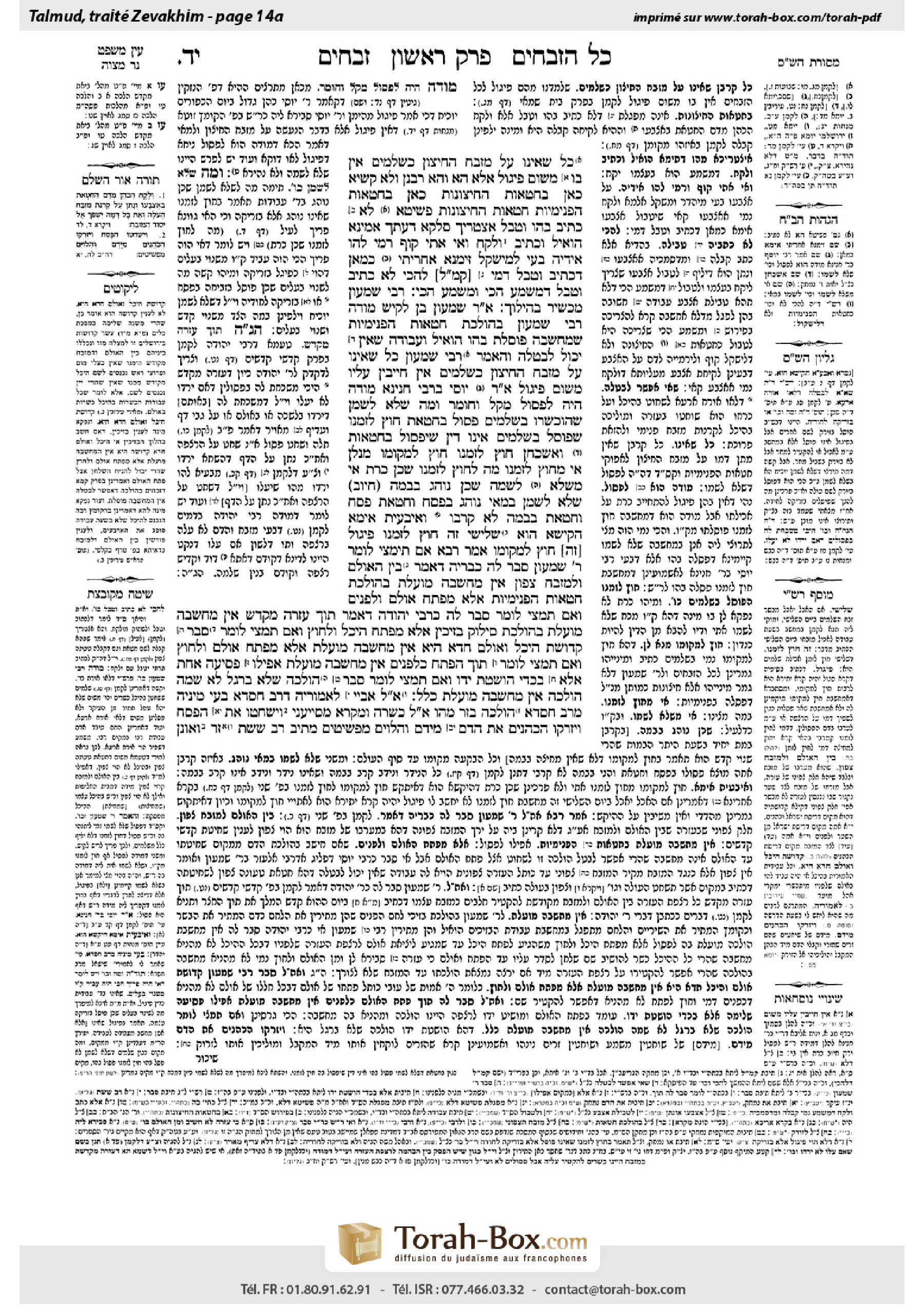
Zevachim 14a: Talmud study for Daf Yomi
Daf Yomi is the daily study of one Talmud folio. Explore 37 tractates with scans, Hebrew text, Sefaria English and AI-generated French translations where annotated.
Passage selection and English or AI-generated French translation are available where the scan has annotations. Daf Study is independent of Torah-Box and Sefaria.
Browse Zevachim · זבחים · All tractatesZevachim 14a text and translations
This page of Zevachim includes the Aramaic text, an English translation and an AI-generated French translation, alongside the scan above.
זבחים י״ד א · Aramaic and Hebrew text
כֹּל שֶׁאֵינוֹ עַל מִזְבֵּחַ הַחִיצוֹן כִּשְׁלָמִים – אֵין בּוֹ מִשּׁוּם פִּיגּוּל!
אֶלָּא הָא וְהָא רַבָּנַן, וְלָא קַשְׁיָא; כָּאן בְּחַטָּאוֹת הַחִיצוֹנוֹת, כָּאן בְּחַטָּאוֹת הַפְּנִימִיּוֹת.
חַטָּאוֹת הַחִיצוֹנוֹת – פְּשִׁיטָא, לָא כְּתִיב בְּהוּ ״וְטָבַל״!
אִצְטְרִיךְ; סָלְקָא דַּעְתָּךְ אָמֵינָא: הוֹאִיל וּכְתִיב ״וְלָקַח״ – וְאִי אָתֵי קוֹף רָמֵי לְהוּ אַיְּדֵיהּ בָּעֵי לְמִישְׁקַל זִימְנָא אַחֲרִיתִי – כְּמַאן דִּכְתִיב ״וְטָבַל״ דָּמֵי;
קָא מַשְׁמַע לַן: לְהָכִי לָא כְּתִיב ״וְטָבַל״ – דְּמַשְׁמַע הָכִי וּמַשְׁמַע הָכִי.
רַבִּי שִׁמְעוֹן מַכְשִׁיר בְּהִילּוּךְ. אָמַר רַבִּי שִׁמְעוֹן בֶּן לָקִישׁ: מוֹדֶה רַבִּי שִׁמְעוֹן בְּהוֹלָכַת חַטָּאוֹת הַפְּנִימִיּוֹת שֶׁמַּחְשָׁבָה פּוֹסֶלֶת בָּהּ, הוֹאִיל וַעֲבוֹדָה שֶׁאֵין יָכוֹל לְבַטְּלָהּ.
וְהָאָמַר רַבִּי שִׁמְעוֹן: כׇּל שֶׁאֵינוֹ עַל מִזְבֵּחַ הַחִיצוֹן כִּשְׁלָמִים, אֵין חַיָּיבִין עָלָיו מִשּׁוּם פִּיגּוּל!
אָמַר רַבִּי יוֹסֵי בְּרַבִּי חֲנִינָא: מוֹדֶה הָיָה לִפְסוֹל מִקַּל וָחוֹמֶר – וּמָה שֶׁלֹּא לִשְׁמָן, שֶׁהוּכְשְׁרוּ בִּשְׁלָמִים – פָּסוּל בְּחַטָּאת; חוּץ לִזְמַנּוֹ, שֶׁפּוֹסֵל בִּשְׁלָמִים – אֵינוֹ דִּין שֶׁיִּפְסוֹל בְּחַטָּאוֹת?
וְאַשְׁכְּחַן חוּץ לִזְמַנּוֹ, חוּץ לִמְקוֹמוֹ מְנָלַן?
אִי מִחוּץ לִזְמַנּוֹ – מָה לְחוּץ לִזְמַנּוֹ, שֶׁכֵּן כָּרֵת!
אִי מִשֶּׁלֹּא לִשְׁמָהּ – שֶׁכֵּן נוֹהֵג בְּבָמָה!
(חִיּוּב) שֶׁלֹּא לִשְׁמָן בְּמַאי נוֹהֵג – בְּפֶסַח וְחַטָּאת; פֶּסַח וְחַטָּאת בְּבָמָה לֹא קָרְבוּ.
וְאִיבָּעֵית אֵימָא: הֶקֵּישָׁא הוּא; ״שְׁלִישִׁי״ – זֶה חוּץ לִזְמַנּוֹ, ״פִּיגּוּל״ – זֶה חוּץ לִמְקוֹמוֹ.
אָמַר רָבָא: אִם תִּימְצֵי לוֹמַר רַבִּי שִׁמְעוֹן סָבַר לַהּ כִּבְרֵיהּ, דְּאָמַר: בֵּין הָאוּלָם וְלַמִּזְבֵּחַ – צָפוֹן; אֵין מַחְשָׁבָה מוֹעֶלֶת בְּהוֹלָכַת חַטָּאוֹת הַפְּנִימִיּוֹת, אֶלָּא מִפֶּתַח אוּלָם וְלִפְנִים.
וְאִם תִּמְצֵי לוֹמַר סָבַר לַהּ כְּרַבִּי יְהוּדָה, דְּאָמַר: תּוֹךְ עֲזָרָה מְקַדֵּשׁ; אֵין מַחְשָׁבָה מוֹעֶלֶת בְּהוֹלָכַת סִילּוּק בָּזִיכִין, אֶלָּא מִפֶּתַח הֵיכָל וְלַחוּץ.
וְאִם תִּמְצֵי לוֹמַר, סָבַר: קְדוּשַּׁת הֵיכָל וְאוּלָם – חֲדָא הִיא; אֵין מַחְשָׁבָה מוֹעֶלֶת אֶלָּא מִפֶּתַח אוּלָם וְלַחוּץ.
וְאִם תִּמְצֵי לוֹמַר תּוֹךְ הַפֶּתַח כְּלִפְנִים; אֵין מַחְשָׁבָה מוֹעֶלֶת אֲפִילּוּ פְּסִיעָה אַחַת, אֶלָּא בִּכְדֵי הוֹשָׁטַת יָדוֹ.
וְאִם תִּמְצֵי לוֹמַר, סָבַר: הוֹלָכָה שֶׁלֹּא בָּרֶגֶל – לֹא שְׁמָהּ הוֹלָכָה; אֵין מַחְשָׁבָה מוֹעֶלֶת כְּלָל.
אֲמַר לֵיהּ אַבָּיֵי לְאָמוֹרֵיהּ דְּרַב חִסְדָּא, בְּעִי מִינֵּיהּ מֵרַב חִסְדָּא: הוֹלָכָה בְּזָר – מַהוּ?
אֲמַר לֵיהּ: כְּשֵׁרָה, וּמִקְרָא מְסַיְּיעֵנִי – ״וַיִּשְׁחֲטוּ אֶת הַפֶּסַח, וַיִּזְרְקוּ הַכֹּהֲנִים אֶת הַדָּם מִיָּדָם, וְהַלְוִיִּם מַפְשִׁיטִים״.
מֵתִיב רַב שֵׁשֶׁת: זָר, וְאוֹנֵן,
Zevachim 14a · English translation
that any offering whose blood is not sprinkled on the external altar like a peace offering is not subject to the halakhot of piggul? If so, piggul does not apply to inner sin offerings at all.
Rather, both this baraita and that baraita are in accordance with the opinion of the Rabbis; and the apparent contradiction between them is not difficult. Here, the baraita that maintains that one cannot render the offering piggul while dipping his finger in the blood is referring to the external sin offerings, since dipping one’s finger in order to sprinkle the blood on the external altar is not considered an essential rite. There, the baraita that maintains that one can render the offering piggul while performing this rite is referring to the inner sin offerings.
The Gemara asks: Isn’t it obvious that one cannot render the offering piggul while dipping his finger in the blood of the external sin offerings? The statement: “And the priest shall dip his finger in the blood” (Leviticus 4:6), is not written with regard to these offerings. Since it is clearly not an essential rite, why was it necessary for the baraita to teach that improper intent while performing it cannot render the offering piggul?
The Gemara answers: It was necessary for the baraita to teach this, as otherwise it might enter your mind to say that since it is written with regard to an external sin offering: “And the priest shall take of the blood of the sin offering with his finger” (Leviticus 4:34), and therefore if a monkey comes and places blood on the hand of the priest the priest must take blood from the vessel again to perform the mitzva as stated in the verse, it is considered as though the statement: And the priest shall dip his finger in the blood, is written with regard to an external sin offering as well.
Therefore, the baraita teaches us that dipping one’s finger in the blood of an external sin offering is an inessential rite and one cannot render the offering piggul while performing it. As it is for this reason that the phrase: And the priest shall dip his finger in the blood, is not written with regard to this offering, but rather: And the priest shall take of the blood of the sin offering with his finger, which indicates this halakha, that the priest must actively take the blood in his hand, and also indicates that halakha, that dipping one’s finger in the blood is not an essential rite and cannot render the offering piggul.
§ The mishna teaches that Rabbi Shimon deems the offering fit if the prohibited intent was during the rite of conveying the blood to the altar. Rabbi Shimon ben Lakish says: Rabbi Shimon concedes that prohibited intent during the conveying of the blood of the inner sin offerings disqualifies them, since with regard to those offerings, it is an indispensable rite. Because the blood must be sprinkled inside the Sanctuary and the offering cannot be slaughtered inside the Sanctuary, conveying the blood into the Sanctuary is always necessary for such offerings.
The Gemara asks: But doesn’t Rabbi Shimon say that with regard to any offering whose blood is not sprinkled on the external altar like a peace offering, one is not liable to be punished with karet for eating it, due to the prohibition of piggul? In other words, the halakha of piggul does not apply to inner sin offerings at all.
Rabbi Yosei, son of Rabbi Ḥanina, says: Rabbi Shimon concedes that although intent to consume an inner sin offering after its designated time does not render it piggul, it disqualifies the offering, due to an a fortiori inference: Just as sacrifice not for its sake, which is valid in the case of a peace offering, is nevertheless not valid in the case of a sin offering, as stated in the mishna (2a), so too, isn’t it logical that sacrifice with intent to consume it beyond its designated time, which disqualifies peace offerings, should disqualify sin offerings?
The Gemara asks: And we found a source for the halakha that intent to consume an inner sin offering beyond its designated time disqualifies it according to Rabbi Shimon. From where do we derive that intent to consume it outside its designated area also disqualifies it?
If we derive it from the case of intent to consume it beyond its designated time, one may respond: What is notable about intent to consume it beyond its designated time? It is notable in that it can render an offering piggul, for partaking of which one is liable to receive karet.
If we derive it from the case of intent not for its sake, one may respond: What is notable about sacrifice not for its sake? It is notable in that this disqualification applies even to sacrifice on a private altar during the era when such altars were permitted. By contrast, intent to consume the offering outside its designated area is irrelevant to sacrifice on a private altar, which has no designated area.
The Gemara answers: With regard to what offering does disqualification due to intent not for its sake apply? It applies to a Paschal offering and a sin offering. Since a Paschal offering and a sin offering may not be sacrificed on a private altar, this factor is irrelevant. One may therefore derive from the case of intent not for its sake that intent to consume the offering outside its designated area disqualifies it.
And if you wish, say that it is derived from the juxtaposition of the halakha of intent to consume the offering beyond its designated time with the halakha of intent to consume it outside its designated area. The verse states: “And if any of the flesh of the sacrifice of his peace offerings is at all eaten on the third day, it shall not be accepted, neither shall it be imputed to the one who offers it; it shall be an abhorred thing [piggul]” (Leviticus 7:18). This statement: “On the third day, it shall not be accepted,” is referring to intent to consume the offering beyond its designated time; and this seemingly superfluous statement: “Neither shall it be imputed to the one who offers it; it shall be piggul,” is referring to intent to consume it outside its designated area. Such juxtaposition indicates that there are parallel halakhot in the two cases even if they are dissimilar.
§ Rava says: If you say that Rabbi Shimon holds in accordance with the opinion of his son Rabbi Elazar, who says that the area between the Entrance Hall and the altar is considered part of the north of the Temple courtyard, the only place where a sin offering may be slaughtered, he must also hold that prohibited intent while conveying the blood of the inner sin offerings is effective to disqualify them only from the doorway of the Entrance Hall inward. Prohibited intent before the priest reaches the doorway of the Entrance Hall does not disqualify the offering, as conveying the blood to the doorway is not necessary; the offering could have been slaughtered at the doorway in the first place.
And if you say that Rabbi Shimon holds in accordance with the opinion of Rabbi Yehuda, who says that the interior of the Temple courtyard sanctifies offerings, i.e., that offerings can be sacrificed on the courtyard floor as if it were part of the altar, prohibited intent while conveying the removed bowls of frankincense from the table in the Sanctuary to burn them on the external altar is effective to disqualify them only while conveying them from the doorway of the Sanctuary outward to the Entrance Hall. Since the table can be placed anywhere in the Sanctuary, conveying the bowls of frankincense in the Sanctuary itself is unnecessary, and once the priest exits the Entrance Hall to the Temple courtyard, the frankincense could theoretically be burned immediately.
Rava continues: And if you say that Rabbi Shimon also holds that the sanctity of the Sanctuary and the Entrance Hall are one and the same, and the table can be placed in the Entrance Hall as well, prohibited intent is effective only while conveying the frankincense from the doorway of the Entrance Hall outward, i.e., in the doorway of the Entrance Hall itself.
And if you say that he also holds that inside the doorway is considered like inside the Entrance Hall, then the table can be placed in the doorway too, and prohibited intent is not effective while conveying the frankincense even one step. Rather, it is effective only during the moment when the frankincense is taken out of the doorway to the courtyard, the time it takes the priest to stretch out his hand to place the bowls on the courtyard floor.
And if you say that he also holds that conveying an offering not by foot is not considered conveying, prohibited intent is not effective at all while conveying the bowls of frankincense.
§ Abaye said to Rav Ḥisda’s interpreter: Ask Rav Ḥisda for me: What is the halakha with regard to a non-priest conveying the blood? Is the offering disqualified, as in a case where a non-priest performs any other sacrificial rite that may performed only by priests?
Rav Ḥisda said to him: The offering remains fit, and a verse supports my ruling: “And they slaughtered the Paschal offering, and the priests sprinkled the blood, which they received of their hand, and the Levites flayed them” (II Chronicles 35:11). Apparently, priests are required only for the sprinkling of the blood on the altar and later rites. Just as slaughter may be performed by non-priests, so can the collection and conveying of the blood be performed by them.
Rav Sheshet raises an objection from a baraita: If a non-priest, or an acute mourner,
Zevachim 14a · Traduction française (IA)
qu’une offrande dont le sang n’est pas aspergé sur l’autel extérieur, comme celui d’une offrande de paix, n’est pas soumise aux règles du piggul ? Si tel est le cas, le piggul ne s’applique pas du tout aux sacrifices expiatoires intérieurs.
Mais les deux baraïtot suivent l’opinion des Rabbins, et la contradiction apparente entre elles n’est pas difficile à résoudre. Ici, la baraïta qui affirme qu’on ne peut pas rendre l’offrande piggul en trempant son doigt dans le sang concerne les sacrifices expiatoires extérieurs, car tremper son doigt pour asperger le sang sur l’autel extérieur n’est pas considéré comme un rite indispensable. Là, la baraïta qui affirme qu’on peut rendre l’offrande piggul en accomplissant ce rite concerne les sacrifices expiatoires intérieurs.
La Guemara demande : N’est-il pas évident qu’on ne peut pas rendre l’offrande piggul en trempant son doigt dans le sang des sacrifices expiatoires extérieurs ? La formule « Le prêtre trempera son doigt dans le sang » (Lévitique 4, 6) n’est pas écrite à propos de ces offrandes. Puisqu’il ne s’agit manifestement pas d’un rite indispensable, pourquoi la baraïta devait-elle enseigner qu’une intention incorrecte pendant son accomplissement ne peut pas rendre l’offrande piggul ?
La Guemara répond : La baraïta devait l’enseigner, car autrement, on aurait pu penser que, puisqu’il est écrit à propos d’un sacrifice expiatoire extérieur : « Le prêtre prendra avec son doigt du sang du sacrifice expiatoire » (Lévitique 4, 34), et que, par conséquent, si un singe vient déposer du sang sur la main du prêtre, celui-ci doit reprendre du sang dans le récipient afin d’accomplir la mitsva comme l’indique le verset, c’est comme si la formule « Le prêtre trempera son doigt dans le sang » était également écrite à propos d’un sacrifice expiatoire extérieur.
La baraïta nous enseigne donc que tremper son doigt dans le sang d’un sacrifice expiatoire extérieur est un rite non indispensable, et qu’on ne peut pas rendre l’offrande piggul en l’accomplissant. C’est pourquoi la formule « Le prêtre trempera son doigt dans le sang » n’est pas écrite à propos de cette offrande ; il est écrit plutôt : « Le prêtre prendra avec son doigt du sang du sacrifice expiatoire », ce qui indique cette halakha : le prêtre doit prendre lui-même le sang dans sa main ; cela indique aussi cette halakha : tremper son doigt dans le sang n’est pas un rite indispensable et ne peut pas rendre l’offrande piggul.
§ La Michna enseigne que Rabbi Shimon considère l’offrande comme valide si l’intention interdite est présente pendant le rite du transport du sang jusqu’à l’autel. Rabbi Shimon ben Lakish dit : Rabbi Shimon reconnaît qu’une intention interdite pendant le transport du sang des sacrifices expiatoires intérieurs les disqualifie, car, pour ces offrandes, il s’agit d’un rite indispensable. Puisque le sang doit être aspergé à l’intérieur du Sanctuaire et que l’offrande ne peut pas y être égorgée, le transport du sang jusque dans le Sanctuaire est toujours nécessaire pour ces offrandes.
La Guemara demande : Mais Rabbi Shimon ne dit-il pas que, pour toute offrande dont le sang n’est pas aspergé sur l’autel extérieur, comme celui d’une offrande de paix, on n’encourt pas la peine de retranchement pour l’avoir consommée en raison de l’interdiction du piggul ? Autrement dit, la halakha du piggul ne s’applique pas du tout aux sacrifices expiatoires intérieurs.
Rabbi Yosei, fils de Rabbi Ḥanina, dit : Rabbi Shimon reconnaît que, même si l’intention de consommer un sacrifice expiatoire intérieur après le délai qui lui est prescrit ne le rend pas piggul, elle disqualifie l’offrande, par raisonnement a fortiori : de même qu’un sacrifice accompli sans l’intention requise, bien que valide dans le cas d’une offrande de paix, ne l’est pas dans le cas d’un sacrifice expiatoire, comme l’enseigne la Michna (2a), n’est-il pas logique qu’un sacrifice avec l’intention de le consommer après le délai qui lui est prescrit — intention qui disqualifie les offrandes de paix — disqualifie aussi les sacrifices expiatoires ?
La Guemara demande : Nous avons donc trouvé une source à la halakha selon laquelle, d’après Rabbi Shimon, l’intention de consommer un sacrifice expiatoire intérieur après le délai qui lui est prescrit le disqualifie. D’où déduisons-nous que l’intention de le consommer hors de l’endroit qui lui est prescrit le disqualifie également ?
Si nous le déduisons du cas de l’intention de le consommer après le délai qui lui est prescrit, on peut répondre : Qu’a de particulier cette intention ? C’est qu’elle peut rendre une offrande piggul, dont la consommation expose à la peine de retranchement.
Si nous le déduisons du cas de l’intention de ne pas accomplir le sacrifice pour lui-même, on peut répondre : Qu’a de particulier le sacrifice accompli sans l’intention requise ? C’est que cette disqualification s’applique même à un sacrifice offert sur un autel privé, à l’époque où de tels autels étaient autorisés. En revanche, l’intention de consommer l’offrande hors de l’endroit qui lui est prescrit ne concerne pas les sacrifices offerts sur un autel privé, qui n’ont pas d’endroit prescrit.
La Guemara répond : À quelles offrandes s’applique la disqualification due à l’intention de ne pas les accomplir pour elles-mêmes ? À l’offrande pascale et au sacrifice expiatoire. Puisqu’une offrande pascale et un sacrifice expiatoire ne peuvent pas être offerts sur un autel privé, cet élément n’est pas pertinent. On peut donc déduire du cas de l’intention de ne pas l’accomplir pour lui-même que l’intention de consommer l’offrande hors de l’endroit qui lui est prescrit la disqualifie.
Et si tu le souhaites, dis que cela se déduit du rapprochement entre la halakha de l’intention de consommer l’offrande après le délai qui lui est prescrit et celle de l’intention de la consommer hors de l’endroit qui lui est prescrit. Le verset dit : « Si l’on mange effectivement, le troisième jour, de la chair du sacrifice de ses offrandes de paix, il ne sera pas agréé et cela ne sera pas porté au compte de celui qui l’offre ; ce sera une chose abominable [piggul] » (Lévitique 7, 18). La formule « Le troisième jour, il ne sera pas agréé » se rapporte à l’intention de consommer l’offrande après le délai qui lui est prescrit ; et la formule apparemment superflue « Cela ne sera pas porté au compte de celui qui l’offre ; ce sera du piggul » se rapporte à l’intention de la consommer hors de l’endroit qui lui est prescrit. Ce rapprochement indique que les deux cas sont soumis à des halakhot parallèles, même s’ils diffèrent.
§ Rava dit : Si tu dis que Rabbi Shimon suit l’opinion de son fils Rabbi Elazar, qui affirme que l’espace entre le vestibule et l’autel est considéré comme faisant partie du côté nord de la cour du Temple, seul endroit où un sacrifice expiatoire peut être égorgé, il doit également soutenir qu’une intention interdite pendant le transport du sang des sacrifices expiatoires intérieurs ne les disqualifie qu’à partir de l’entrée du vestibule vers l’intérieur. Une intention interdite avant que le prêtre n’atteigne l’entrée du vestibule ne disqualifie pas l’offrande, car il n’est pas nécessaire de transporter le sang jusqu’à cette entrée : l’offrande aurait pu être égorgée à cet endroit dès le départ.
Et si tu dis que Rabbi Shimon suit l’opinion de Rabbi Yehuda, qui affirme que l’intérieur de la cour du Temple sanctifie les offrandes, c’est-à-dire qu’elles peuvent être offertes sur le sol de la cour comme si celui-ci faisait partie de l’autel, une intention interdite pendant le transport des bols d’encens prélevés sur la table du Sanctuaire afin de les brûler sur l’autel extérieur ne les disqualifie que pendant leur transport de l’entrée du Sanctuaire vers l’extérieur, en direction du vestibule. Puisque la table peut être placée n’importe où dans le Sanctuaire, le transport des bols d’encens à l’intérieur même du Sanctuaire n’est pas nécessaire ; et, une fois que le prêtre a quitté le vestibule pour entrer dans la cour du Temple, l’encens pourrait théoriquement être brûlé immédiatement.
Rava poursuit : Et si tu dis que Rabbi Shimon soutient aussi que la sainteté du Sanctuaire et celle du vestibule sont une seule et même chose, et que la table peut également être placée dans le vestibule, l’intention interdite n’est opérante que pendant le transport de l’encens de l’entrée du vestibule vers l’extérieur, c’est-à-dire à l’entrée même du vestibule.
Et si tu dis qu’il soutient aussi que l’intérieur de l’entrée est considéré comme faisant partie du vestibule, alors la table peut également être placée dans l’entrée, et l’intention interdite n’est opérante pendant aucun déplacement des bols d’encens, pas même d’un seul pas. Elle n’est opérante que pendant l’instant où l’encens est sorti de l’entrée pour être amené dans la cour, le temps qu’il faut au prêtre pour tendre la main et poser les bols sur le sol de la cour.
Et si tu dis qu’il soutient aussi que transporter une offrande autrement qu’à pied n’est pas considéré comme un transport, alors l’intention interdite n’est pas opérante du tout pendant le transport des bols d’encens.
§ Abaye dit à l’interprète de Rav Ḥisda : Demande à Rav Ḥisda pour moi : quelle est la halakha concernant le transport du sang par un non-prêtre ? L’offrande est-elle disqualifiée, comme lorsqu’un non-prêtre accomplit un autre rite sacrificiel réservé aux prêtres ?
Rav Ḥisda lui dit : L’offrande reste valide, et un verset appuie ma décision : « Ils égorgèrent l’offrande pascale, les prêtres aspergèrent le sang qu’ils reçurent de leurs mains, et les Lévites écorchèrent les bêtes » (II Chroniques 35, 11). Il apparaît que seuls l’aspersion du sang sur l’autel et les rites ultérieurs exigent la présence de prêtres. De même que l’égorgement peut être effectué par des non-prêtres, la collecte et le transport du sang peuvent également être effectués par eux.
Rav Sheshet soulève une objection à partir d’une baraïta : Si un non-prêtre ou un endeuillé durant la première période du deuil,
Traduction française générée par IA à partir de l’édition anglaise de Sefaria. Vérifie toujours un passage avec le texte source.
Text from Sefaria: William Davidson Edition - Vocalized Aramaic (CC BY NC); William Davidson Edition - English (CC BY NC).