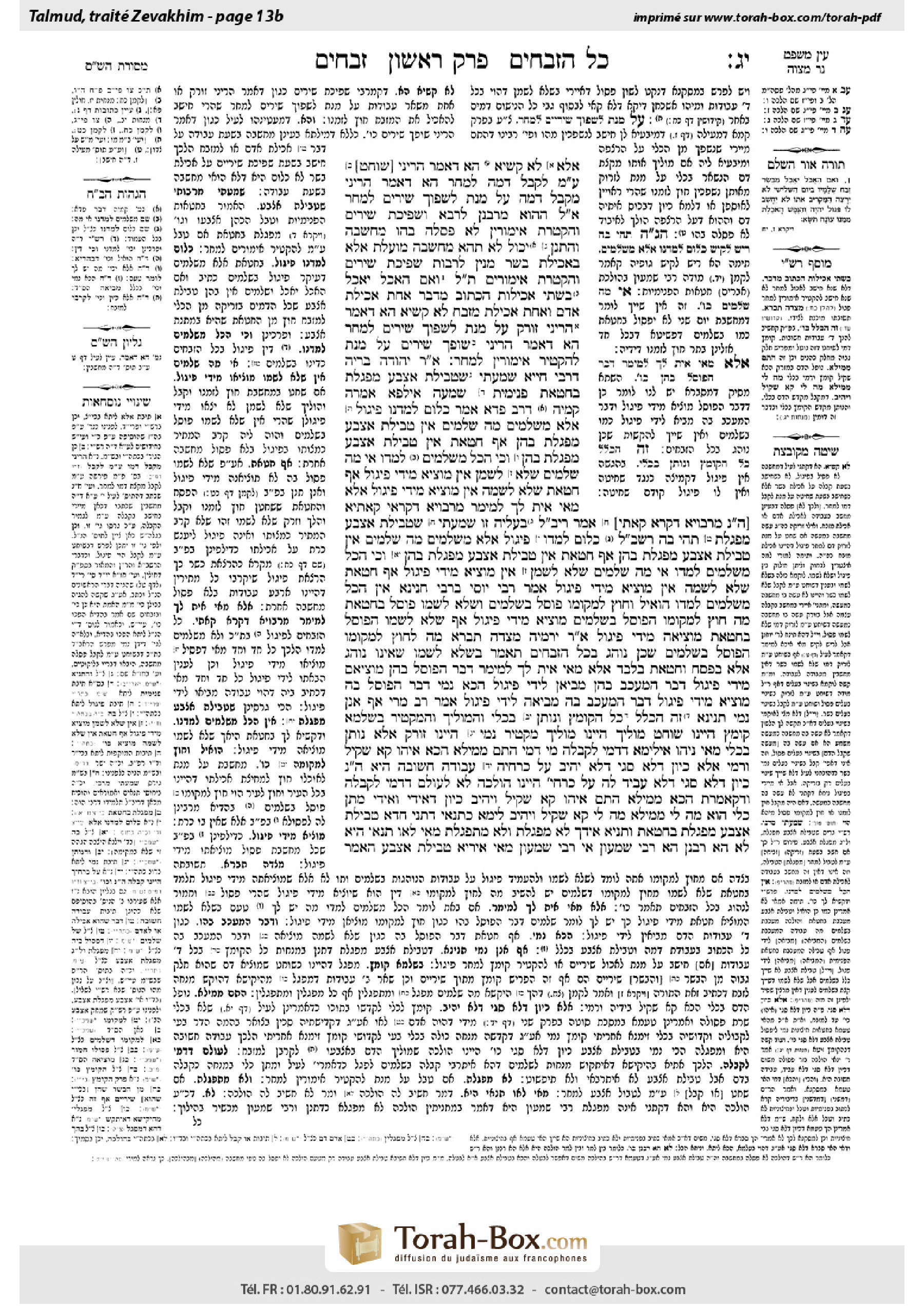
Zevachim 13b: Talmud study for Daf Yomi
Daf Yomi is the daily study of one Talmud folio. Explore 37 tractates with scans, Hebrew text, Sefaria English and AI-generated French translations where annotated.
Passage selection and English or AI-generated French translation are available where the scan has annotations. Daf Study is independent of Torah-Box and Sefaria.
Browse Zevachim · זבחים · All tractatesZevachim 13b text and translations
This page of Zevachim includes the Aramaic text, an English translation and an AI-generated French translation, alongside the scan above.
זבחים י״ג ב · Aramaic and Hebrew text
אֶלָּא לָא קַשְׁיָא; הָא דְּאָמַר: ״הֲרֵינִי שׁוֹחֵט עַל מְנָת לְקַבֵּל דָּמָהּ לְמָחָר״, הָא דְּאָמַר: ״הֲרֵינִי מְקַבֵּל דָּמָהּ עַל מְנָת לִשְׁפּוֹךְ שִׁירַיִם לְמָחָר״.
אֲמַר לֵיהּ הָהוּא מֵרַבָּנַן לְרָבָא: וּשְׁפִיכַת שִׁירַיִם וְהַקְטָרַת אֵימוּרִין – לָא פָּסְלָה בְּהוּ מַחְשָׁבָה?!
וְהָתְנַן: יָכוֹל לֹא תְּהֵא מַחְשָׁבָה מוֹעֶלֶת אֶלָּא בַּאֲכִילַת בָּשָׂר, מִנַּיִן לְרַבּוֹת שְׁפִיכַת שִׁירַיִם וְהַקְטָרַת אֵימוּרִים? תַּלְמוּד לוֹמַר: ״וְאִם הֵאָכֹל יֵאָכֵל״ – בִּשְׁתֵּי אֲכִילוֹת הַכָּתוּב מְדַבֵּר: אַחַת אֲכִילַת אָדָם, וְאַחַת אֲכִילַת מִזְבֵּחַ.
לָא קַשְׁיָא; הָא דְּאָמַר: ״הֲרֵינִי זוֹרֵק עַל מְנָת לִשְׁפּוֹךְ שִׁירַיִם לְמָחָר״, הָא דְּאָמַר: ״הֲרֵינִי שׁוֹפֵךְ שִׁירַיִם עַל מְנָת לְהַקְטִיר אֵימוּרִין לְמָחָר״.
אָמַר רַבִּי יְהוּדָה בְּרֵיהּ דְּרַבִּי חִיָּיא: שָׁמַעְתִּי שֶׁטְּבִילַת אֶצְבַּע מְפַגֶּלֶת בְּחַטָּאת פְּנִימִית.
שַׁמְעַהּ אִילְפָא, אַמְרַהּ קַמֵּיהּ דְּרַב פְּדָא. אֲמַר: כְּלוּם לָמַדְנוּ פִּיגּוּל – אֶלָּא מִשְּׁלָמִים; מָה שְׁלָמִים – אֵין טְבִילַת אֶצְבַּע מְפַגֶּלֶת בָּהֶן, אַף חַטָּאת – אֵין טְבִילַת אֶצְבַּע מְפַגֶּלֶת (בהן) [בָּהּ].
וְכִי הַכֹּל מִשְּׁלָמִים לָמְדוּ?! אִי, מָה שְׁלָמִים – שֶׁלֹּא לִשְׁמָן אֵין מוֹצִיא מִידֵי פִּיגּוּל, אַף חַטָּאת – שֶׁלֹּא לִשְׁמָהּ אֵין מוֹצִיא מִידֵי פִּיגּוּל!
אֶלָּא מַאי אִית לָךְ לְמֵימַר – מֵרִבּוּיָא דִּקְרָאֵי קָאָתְיָא; הָכָא נָמֵי, מֵרִבּוּיָא דִּקְרָא קָאָתֵי.
אָמַר רַבִּי יְהוֹשֻׁעַ בֶּן לֵוִי: בַּעֲלִיָּה זוֹ שָׁמַעְתִּי, שֶׁטְּבִילַת אֶצְבַּע מְפַגֶּלֶת. תָּהֵי בַּהּ רַבִּי שִׁמְעוֹן בֶּן לָקִישׁ: כְּלוּם לָמְדוּ פִּיגּוּל – אֶלָּא מִשְּׁלָמִים; מָה שְׁלָמִים – אֵין טְבִילַת אֶצְבַּע מְפַגֶּלֶת בָּהֶן, אַף חַטָּאת – אֵין טְבִילַת אֶצְבַּע מְפַגֶּלֶת (בהן) [בָּהּ]!
וְכִי הַכֹּל מִשְּׁלָמִים לָמְדוּ?! אִי, מָה שְׁלָמִים – שֶׁלֹּא לִשְׁמָן אֵין מוֹצִיא מִידֵי פִּיגּוּל, אַף חַטָּאת – שֶׁלֹּא לִשְׁמָהּ אֵין מוֹצִיא מִידֵי פִּיגּוּל!
אָמַר רַבִּי יוֹסֵי בְּרַבִּי חֲנִינָא: אִין, הַכֹּל מִשְּׁלָמִים לָמְדוּ. הוֹאִיל וְחוּץ לִמְקוֹמוֹ פּוֹסֵל בִּשְׁלָמִים, וְשֶׁלֹּא לִשְׁמוֹ פּוֹסֵל בְּחַטָּאת; מָה חוּץ לִמְקוֹמוֹ הַפּוֹסֵל בִּשְׁלָמִים – מוֹצִיא מִידֵי פִּיגּוּל, אַף שֶׁלֹּא לִשְׁמוֹ הַפּוֹסֵל בְּחַטָּאת – מוֹצִיאָהּ מִידֵי פִּיגּוּל.
אָמַר רַבִּי יִרְמְיָה: מִצִּדַּהּ תְּבָרַאּ! מָה לְחוּץ לִמְקוֹמוֹ הַפּוֹסֵל בִּשְׁלָמִים – שֶׁכֵּן נוֹהֵג בְּכׇל הַזְּבָחִים; תֹּאמַר בְּשֶׁלֹּא לִשְׁמוֹ – שֶׁאֵינוֹ נוֹהֵג אֶלָּא בְּפֶסַח וְחַטָּאת בִּלְבַד?!
אֶלָּא מַאי אִית לָךְ לְמֵימַר – דָּבָר הַפּוֹסֵל בָּהֶן מוֹצִיאָם מִידֵי פִּיגּוּל, דָּבָר הַמְעַכֵּב בָּהֶן מְבִיאָן לִידֵי פִּיגּוּל;
הָכָא נָמֵי – דָּבָר הַפּוֹסֵל בָּהּ מוֹצִיא מִידֵי פִּיגּוּל, דָּבָר הַמְעַכֵּב בָּהּ מְבִיאָה לִידֵי פִּיגּוּל.
אָמַר רַב מָרִי: אַף אֲנַן נָמֵי תְּנֵינָא – זֶה הַכְּלָל: כׇּל הַקּוֹמֵץ, וְנוֹתֵן בִּכְלִי, וְהַמּוֹלִיךְ, וְהַמַּקְטִיר.
בִּשְׁלָמָא קוֹמֵץ – הַיְינוּ שׁוֹחֵט; מוֹלִיךְ – הַיְינוּ מוֹלִיךְ; מַקְטִיר נָמֵי – הַיְינוּ זוֹרֵק; אֶלָּא נוֹתֵן בִּכְלִי מַאי נִיהוּ?
אִילֵּימָא דְּדָמֵי לְקַבָּלָה – מִי דָּמֵי?! הָתָם מִמֵּילָא, הָכָא אִיהוּ קָא שָׁקֵיל וְרָמֵי!
אֶלָּא כֵּיוָן דְּלָא סַגִּי דְּלָא יָהֵיב – עַל כָּרְחֵיהּ עֲבוֹדָה חֲשׁוּבָה הִיא; הָכָא נָמֵי, כֵּיוָן דְּלָא סַגִּי דְּלָא עָבֵיד לַהּ – עַל כָּרְחֵיהּ הַיְינוּ הוֹלָכָה.
לָא, לְעוֹלָם דְּדָמֵי לְקַבָּלָה; וּדְקָאָמְרַתְּ: הָכָא מִמֵּילָא, הָתָם אִיהוּ קָא שָׁקֵיל וְיָהֵיב – כֵּיוָן דְּאִידֵּי וְאִידֵּי מַתַּן כְּלִי הוּא, מָה לִי מִמֵּילָא מָה לִי קָא שָׁקֵיל וְיָהֵיב.
לֵימָא כְּתַנָּאֵי – דְּתָנֵי חֲדָא: טְבִילַת אֶצְבַּע מְפַגֶּלֶת בְּחַטָּאת, וְתַנְיָא אִידַּךְ: לֹא מְפַגֶּלֶת וְלֹא מִתְפַּגֶּלֶת; מַאי, לָאו תַּנָּאֵי הִיא?
לָא; הָא רַבָּנַן, הָא רַבִּי שִׁמְעוֹן.
אִי רַבִּי שִׁמְעוֹן, מַאי אִירְיָא טְבִילַת אֶצְבַּע? הָאָמַר:
Zevachim 13b · English translation
The Gemara answers: Rather, it is not difficult. This statement of Rava, that intent of piggul does not apply to collection, is referring to a case where the one slaughtering the offering says: I am hereby slaughtering this offering in order to collect its blood tomorrow. Because the collection of the blood is not considered consumption, such intent does not render the offering piggul. That statement of the baraita is referring to a case where the one collecting the blood says: I am hereby collecting its blood in order to pour the remainder of the blood on the base of the altar tomorrow. Since pouring the remains is considered consumption of the blood on the altar, such intent renders the offering piggul.
One of the Sages said to Rava: And does prohibited intent with regard to the pouring of the remainder of the blood and the burning of the sacrificial portions not disqualify the offering, as this explanation of the baraita seems to indicate?
But didn’t we learn in a baraita: One might have thought that only prohibited intent with regard to consumption of the meat is effective to render the offering piggul. From where is it derived to include the pouring of the remainder of the blood and the burning of the sacrificial portions? The verse states: “And if any of the flesh of the sacrifice of his peace offerings is at all eaten [he’akhol ye’akhel ] on the third day, it shall not be accepted” (Leviticus 7:18). It is derived from the repeated verb that the verse speaks of two types of consumption: One is consumption of the meat by man, i.e., by the priests or the owner of the offering, and the other one is consumption of the blood and the sacrificial portions on the altar.
The Gemara answers: It is not difficult. This case, where intent renders the offering piggul, is where the one sprinkling the blood says: I am hereby sprinkling the blood in order to pour the remainder tomorrow. Since sprinkling the blood is necessary for atonement, if it is performed with the intent that consumption occur beyond its designated time, the offering is rendered piggul. That case, where intent does not render the offering piggul, is where he says: I am hereby pouring the remainder in order to burn the sacrificial portions tomorrow. Although burning the portions is considered consumption, pouring the remainder of the blood is not indispensable for atonement, and therefore the offering is not rendered piggul.
§ Rabbi Yehuda, son of Rabbi Ḥiyya, says: I heard that with regard to an inner sin offering, whose blood is sprinkled on the curtain separating the Sanctuary and Holy of Holies, dipping one’s finger in the blood in order to sprinkle it, if he does so with the intent of burning the offering on the altar the following day, renders the offering piggul.
Ilfa heard this statement and said it before Rav Padda. Rav Padda said in response: Did we derive the halakha of piggul with regard to all offerings from anything but a peace offering? The source for the halakha of piggul is the verse stated with regard to peace offerings (Leviticus 7:18). Therefore, just as with regard to a peace offering, prohibited intent while dipping one’s finger in the blood to sprinkle it on the altar does not render it piggul, as there is no requirement to sprinkle the blood of a peace offering with one’s finger rather than the containing vessel, so too, with regard to a sin offering, prohibited intent while dipping one’s finger in the blood does not render it piggul.
The Gemara challenges: But are all of the halakhot of piggul derived from the halakha of a peace offering? If that is so, then just as sacrifice of a peace offering not for its sake does not preclude its being rendered piggul, as it is still fit, so too, the halakha should be that sacrifice of a sin offering not for its sake does not preclude its being rendered piggul. In fact, the halakha is that a sin offering sacrificed not for its sake cannot become piggul.
Rather, what have you to say to explain this halakha? You must say that it is derived from an amplification of the verse. Here too, the halakha that prohibited intent while dipping one’s finger in the blood of an inner sin offering renders it piggul is derived from an amplification of the verse.
Similarly, Rabbi Yehoshua ben Levi says: I heard in this upper story that prohibited intent while dipping one’s finger in the blood of an inner sin offering renders it piggul. Rabbi Shimon ben Lakish wondered [tahei] at this halakha: Did the Sages derive the halakha of piggul from anything but a peace offering? Just as with regard to a peace offering, prohibited intent while dipping one’s finger in the blood does not render it piggul, so too, with regard to a sin offering, the halakha should be that prohibited intent while dipping one’s finger in the blood does not render it piggul.
The Gemara responds: But are all of the halakhot of piggul derived from those of a peace offering? If so, just as sacrifice of a peace offering not for its sake does not preclude its being rendered piggul, so too, the halakha should be that sacrifice of a sin offering not for its sake does not preclude its being rendered piggul.
Rabbi Yosei, son of Rabbi Ḥanina, said: Indeed, all of the halakhot of piggul, even this one, are derived from a peace offering. Since in the case of a peace offering, intent to consume it outside its designated area disqualifies it, and in the case of a sin offering, sacrifice not for its sake disqualifies it, one can infer that just as intent to consume the offering outside its designated area, which disqualifies a peace offering, precludes its being rendered piggul, so too, sacrifice not for its sake, which disqualifies a sin offering, precludes its being rendered piggul. By contrast, dipping one’s finger in the blood of an inner sin offering with intent to consume it after its designated time does not render it piggul, as there is no parallel halakha with regard to a peace offering.
Rabbi Yirmeya says: This inference is inherently disjointed: What is notable about intent to consume the offering outside its designated area, which disqualifies a peace offering? It is notable in that its disqualification applies to all slaughtered offerings. This is why it precludes the offering from becoming piggul. Need you say the same with regard to disqualification by sacrifice not for its sake, which applies only to a Paschal offering and a sin offering?
Rather, what have you to say to explain this derivation? One must say that it is not based on a case-to-case comparison, but on a principle that is derived from a peace offering, namely: Any matter that disqualifies a peace offering, e.g., intent to consume it outside its designated area, precludes its being rendered piggul, and any matter that prevents atonement if not performed renders the offering piggul if performed with intent to consume it beyond its designated time.
One infers therefore that here too, with regard to an inner sin offering, any matter that disqualifies it, e.g., sacrifice not for its sake, precludes its being rendered piggul, and any matter that prevents atonement if not performed renders it piggul if it is performed with intent to consume it beyond its designated time. Accordingly, dipping one’s finger in the blood with intent to consume the offering beyond its designated time renders it piggul, as this rite is indispensable.
Rav Mari says: We learn in a mishna as well that dipping one’s finger in the blood of an inner sin offering with intent to consume it beyond its designated time renders the offering piggul (Menaḥot 12a): This is the principle: With regard to anyone who removes a handful from a meal offering, or who places the handful in a vessel, or who conveys the handful to the altar, or who burns it on the altar, if he does so with intent that the offering will be consumed after its designated time the offering is piggul.
Since the halakhot of piggul are derived from those of a peace offering, one can ask: Granted, the one who removes a handful of a meal offering can render the offering piggul, as he is considered equivalent to the one who slaughters a peace offering. Just as the blood is the essential part of an animal offering, and it is removed by slaughter, so too, the handful of a meal offering is its essential part. Likewise, the one who conveys the handful is equivalent to the one who conveys the blood of a peace offering, and the one who burns the handful is equivalent to the one who sprinkles the blood too. But to what is the one who places the handful in a vessel equivalent? From where is it derived that he, too, can render the offering piggul?
If we say that placing the handful in a vessel is comparable to collection of the blood, as both rites involve placing the essential part of the offering in a vessel, one may respond: Are these rites actually comparable? There, in the case of a peace offering, the collection of the blood is performed passively. The blood spills into the vessel by itself. Here, in the case of a meal offering, the priest takes the handful himself and places it in a vessel. Clearly, placing the handful in a vessel is not equivalent to any specific rite in the sacrifice of a peace offering.
Rather, since it is not sufficient for the handful to be sacrificed without first placing it in a service vessel, it is, perforce, an important rite. One who performs it can therefore render the offering piggul like those who perform other essential rites. Here too, with regard to dipping one’s finger in the blood of an inner sin offering, although it has no equivalent in the sacrifice of a peace offering, since it is not sufficient if the priest does not perform it, it is perforce considered part of the conveying of the blood, and the priest can render the offering piggul while performing it.
The Gemara responds: No, actually, placing the handful in a vessel is comparable to the collection of the blood. And despite the distinction that you say, namely, that here, in the case of a peace offering, the blood spills by itself, while there, in the case of a meal offering, the priest takes the handful himself and places it in the vessel, nevertheless, since both this rite and that rite involve placement of the essential part of the offering in a vessel, they are equivalent. What difference is it to me if the blood spills into the vessel by itself, and what difference is it to me if the priest takes the handful himself and places it in the vessel? By contrast, dipping one’s finger in the blood of an inner sin offering has no equivalent in a peace offering. Therefore, piggul does not apply to it.
The Gemara suggests: Let us say that the principle that dipping one’s finger in the blood is considered part of conveying it to the curtain is the subject of a dispute between tanna’im. As it is taught in one baraita: With regard to an inner sin offering, dipping one’s finger in the blood with intent that it be consumed beyond its designated time renders it piggul. And it is taught in another baraita: Dipping one’s finger in the blood with intent that it be consumed beyond its designated time does not render it piggul, and neither does slaughtering the animal with the intent to dip his finger in the blood the next day render it piggul. What, is it not that this matter is a dispute between tanna’im?
The Gemara responds: No, both tanna’im agree that dipping one’s finger in the blood of an inner sin offering is part of conveying it to the curtain. Rather, this baraita, which states that a priest can render the offering piggul while dipping his finger in its blood, is in accordance with the opinion of the Rabbis in the mishna (13a), who hold that one can render the offering piggul while conveying the blood to the altar. That baraita, which states the opposite, is in accordance with the opinion of Rabbi Shimon in the mishna, who holds that one cannot render the offering piggul while conveying the blood.
The Gemara asks: If the latter baraita is in accordance with the opinion of Rabbi Shimon, why is it referring specifically to dipping one’s finger? Doesn’t he say
Zevachim 13b · Traduction française (IA)
La Guemara répond : En réalité, il n’y a pas de difficulté. La déclaration de Rava, selon laquelle l’intention de pigoul ne s’applique pas au recueil du sang, concerne le cas où celui qui égorge l’offrande dit : « J’égorge cette offrande afin d’en recueillir le sang demain. » Puisque le recueil du sang n’est pas considéré comme une consommation, une telle intention ne rend pas l’offrande pigoul. La déclaration de la baraïta concerne le cas où celui qui recueille le sang dit : « Je recueille son sang afin de verser demain le reste du sang sur le socle de l’autel. » Puisque verser le reste est considéré comme une consommation du sang sur l’autel, une telle intention rend l’offrande pigoul.
L’un des Sages dit à Rava : Une intention interdite concernant le versement du reste du sang et la combustion des parties sacrificielles ne disqualifie-t-elle donc pas l’offrande, comme semble l’indiquer cette explication de la baraïta ?
Mais n’avons-nous pas appris dans une baraïta : On aurait pu penser que seule une intention interdite concernant la consommation de la viande suffit à rendre l’offrande pigoul. D’où sait-on qu’il faut inclure le versement du reste du sang et la combustion des parties sacrificielles ? Le verset dit : « Si l’on mange, oui, si l’on mange [he’akhol ye’akhel] de la chair du sacrifice de ses offrandes de paix le troisième jour, il ne sera pas agréé » (Lévitique 7,18). On déduit de la répétition du verbe que le verset parle de deux sortes de consommation : l’une est la consommation de la viande par l’homme, c’est-à-dire par les prêtres ou le propriétaire de l’offrande, et l’autre, la consommation du sang et des parties sacrificielles sur l’autel.
La Guemara répond : Il n’y a pas de difficulté. Le cas où l’intention rend l’offrande pigoul est celui où celui qui fait l’aspersion du sang dit : « Je fais l’aspersion du sang afin de verser le reste demain. » Puisque l’aspersion du sang est nécessaire à l’expiation, si elle est faite avec l’intention que la consommation ait lieu après le délai prescrit, l’offrande devient pigoul. Le cas où l’intention ne rend pas l’offrande pigoul est celui où il dit : « Je verse le reste afin de brûler les parties sacrificielles demain. » Bien que la combustion des parties soit considérée comme une consommation, le versement du reste du sang n’est pas indispensable à l’expiation ; l’offrande ne devient donc pas pigoul.
§ Rabbi Yehouda, fils de Rabbi Ḥiyya, dit : J’ai entendu dire que, dans le cas d’un sacrifice expiatoire intérieur, dont le sang est aspergé sur le rideau séparant le Sanctuaire du Saint des Saints, le fait de tremper son doigt dans le sang afin de l’asperger rend l’offrande pigoul si l’on a l’intention de brûler l’offrande sur l’autel le lendemain.
Ilfa entendit cette déclaration et la rapporta à Rav Padda. Rav Padda répondit : Avons-nous déduit la halakha du pigoul concernant toutes les offrandes d’une autre source que l’offrande de paix ? La source de la halakha du pigoul est le verset énoncé au sujet des offrandes de paix (Lévitique 7,18). Par conséquent, de même que, pour une offrande de paix, une intention interdite lorsqu’on trempe son doigt dans le sang pour l’asperger sur l’autel ne la rend pas pigoul, puisqu’il n’est pas nécessaire d’asperger le sang d’une offrande de paix avec le doigt plutôt qu’avec le récipient qui le contient, de même, pour un sacrifice expiatoire, une intention interdite lorsqu’on trempe son doigt dans le sang ne le rend pas pigoul.
La Guemara objecte : Mais toutes les halakhot du pigoul sont-elles déduites de celle de l’offrande de paix ? Si tel était le cas, de même que le fait de sacrifier une offrande de paix sans l’intention requise n’empêche pas qu’elle devienne pigoul, puisqu’elle reste apte, le fait de sacrifier un sacrifice expiatoire sans l’intention requise ne devrait pas non plus empêcher qu’il devienne pigoul. Or, la halakha est qu’un sacrifice expiatoire sacrifié sans l’intention requise ne peut pas devenir pigoul.
En réalité, que diras-tu pour expliquer cette halakha ? Tu dois dire qu’elle est déduite d’une amplification du verset. Ici aussi, la halakha selon laquelle une intention interdite lorsqu’on trempe son doigt dans le sang d’un sacrifice expiatoire intérieur le rend pigoul est déduite d’une amplification du verset.
De même, Rabbi Yehoshoua ben Lévi dit : J’ai entendu, dans cette salle située à l’étage supérieur, qu’une intention interdite lorsqu’on trempe son doigt dans le sang d’un sacrifice expiatoire intérieur le rend pigoul. Rabbi Shimon ben Lakish s’étonna [tahei] de cette halakha : Les Sages ont-ils déduit la halakha du pigoul d’une autre source que l’offrande de paix ? De même que, pour une offrande de paix, une intention interdite lorsqu’on trempe son doigt dans le sang ne la rend pas pigoul, de même, pour un sacrifice expiatoire, une intention interdite lorsqu’on trempe son doigt dans le sang ne devrait pas le rendre pigoul.
La Guemara répond : Mais toutes les halakhot du pigoul sont-elles déduites de celles de l’offrande de paix ? Si tel était le cas, de même que le fait de sacrifier une offrande de paix sans l’intention requise n’empêche pas qu’elle devienne pigoul, le fait de sacrifier un sacrifice expiatoire sans l’intention requise ne devrait pas non plus empêcher qu’il devienne pigoul.
Rabbi Yossei, fils de Rabbi Ḥanina, dit : En effet, toutes les halakhot du pigoul, y compris celle-ci, sont déduites de l’offrande de paix. Puisque, dans le cas d’une offrande de paix, l’intention de la consommer hors de l’endroit prescrit la disqualifie, et que, dans le cas d’un sacrifice expiatoire, le fait de le sacrifier sans l’intention requise le disqualifie, on peut déduire que, de même que l’intention de consommer l’offrande hors de l’endroit prescrit, qui disqualifie une offrande de paix, empêche qu’elle devienne pigoul, de même, le fait de sacrifier un sacrifice expiatoire sans l’intention requise, qui le disqualifie, empêche qu’il devienne pigoul. En revanche, tremper son doigt dans le sang d’un sacrifice expiatoire intérieur avec l’intention de consommer l’offrande après le délai prescrit ne la rend pas pigoul, car il n’existe pas de halakha parallèle pour une offrande de paix.
Rabbi Yirmeya dit : Cette déduction est intrinsèquement bancale. Qu’y a-t-il de particulier dans l’intention de consommer l’offrande hors de l’endroit prescrit, qui disqualifie une offrande de paix ? C’est que cette disqualification s’applique à toutes les offrandes abattues. Voilà pourquoi elle empêche l’offrande de devenir pigoul. Faut-il en dire autant de la disqualification résultant d’un sacrifice accompli sans l’intention requise, qui ne s’applique qu’à l’offrande pascale et au sacrifice expiatoire ?
En réalité, que diras-tu pour expliquer cette déduction ? Il faut dire qu’elle ne repose pas sur une comparaison entre des cas particuliers, mais sur un principe déduit de l’offrande de paix, à savoir : tout ce qui disqualifie une offrande de paix, par exemple l’intention de la consommer hors de l’endroit prescrit, empêche qu’elle devienne pigoul ; et tout acte dont l’omission empêche l’expiation rend l’offrande pigoul s’il est accompli avec l’intention de la consommer après le délai prescrit.
On en déduit donc qu’ici aussi, dans le cas d’un sacrifice expiatoire intérieur, tout ce qui le disqualifie, par exemple le fait de le sacrifier sans l’intention requise, empêche qu’il devienne pigoul ; et tout acte dont l’omission empêche l’expiation le rend pigoul s’il est accompli avec l’intention de le consommer après le délai prescrit. Par conséquent, tremper son doigt dans le sang avec l’intention de consommer l’offrande après le délai prescrit la rend pigoul, puisque ce rite est indispensable.
Rav Mari dit : Nous apprenons aussi dans une Michna que tremper son doigt dans le sang d’un sacrifice expiatoire intérieur avec l’intention de consommer l’offrande après le délai prescrit la rend pigoul (Menaḥot 12a) : Voici le principe : quiconque prélève une poignée d’une offrande de farine, place la poignée dans un récipient, la transporte jusqu’à l’autel ou la brûle sur l’autel rend l’offrande pigoul s’il agit avec l’intention que l’offrande soit consommée après le délai prescrit.
Puisque les halakhot du pigoul sont déduites de celles d’une offrande de paix, on peut demander : Il est logique que celui qui prélève une poignée d’une offrande de farine puisse rendre l’offrande pigoul, car il est considéré comme l’équivalent de celui qui égorge une offrande de paix. De même que le sang est l’élément essentiel d’une offrande animale et qu’il est recueilli au moment de l’égorgement, de même, la poignée est l’élément essentiel d’une offrande de farine. De même, celui qui transporte la poignée équivaut à celui qui transporte le sang d’une offrande de paix, et celui qui brûle la poignée équivaut également à celui qui fait l’aspersion du sang. Mais à quoi équivaut celui qui place la poignée dans un récipient ? D’où déduit-on que lui aussi peut rendre l’offrande pigoul ?
Si l’on dit que le fait de placer la poignée dans un récipient est comparable au recueil du sang, puisque les deux rites consistent à placer l’élément essentiel de l’offrande dans un récipient, on peut répondre : Ces rites sont-ils réellement comparables ? Dans le cas d’une offrande de paix, le recueil du sang s’effectue passivement : le sang s’écoule de lui-même dans le récipient. Ici, dans le cas d’une offrande de farine, le prêtre prend lui-même la poignée et la place dans un récipient. Il est clair que le fait de placer la poignée dans un récipient ne correspond à aucun rite particulier du sacrifice d’une offrande de paix.
En réalité, puisque la poignée ne peut être offerte sans avoir d’abord été placée dans un récipient de service, il s’agit nécessairement d’un rite important. Celui qui l’accomplit peut donc rendre l’offrande pigoul, comme ceux qui accomplissent les autres rites essentiels. Ici aussi, dans le cas où l’on trempe son doigt dans le sang d’un sacrifice expiatoire intérieur, bien que ce rite n’ait pas d’équivalent dans le sacrifice d’une offrande de paix, puisqu’il n’est pas possible de s’en dispenser et que le prêtre doit l’accomplir, il est nécessairement considéré comme faisant partie du transport du sang ; le prêtre peut donc rendre l’offrande pigoul en l’accomplissant.
La Guemara répond : Non, en réalité, le fait de placer la poignée dans un récipient est comparable au recueil du sang. Malgré la distinction que tu avances — ici, dans le cas d’une offrande de paix, le sang s’écoule de lui-même, tandis que là, dans le cas d’une offrande de farine, le prêtre prend lui-même la poignée et la place dans le récipient — les deux rites sont néanmoins équivalents, puisqu’ils consistent tous deux à placer l’élément essentiel de l’offrande dans un récipient. Quelle différence cela fait-il que le sang s’écoule de lui-même dans le récipient ou que le prêtre prenne lui-même la poignée et la place dans le récipient ? En revanche, le fait de tremper son doigt dans le sang d’un sacrifice expiatoire intérieur n’a pas d’équivalent dans une offrande de paix. Par conséquent, le pigoul ne s’y applique pas.
La Guemara propose : Disons que le principe selon lequel le fait de tremper son doigt dans le sang est considéré comme faisant partie de son transport jusqu’au rideau fait l’objet d’un désaccord entre tannaïm. En effet, une baraïta enseigne : dans le cas d’un sacrifice expiatoire intérieur, tremper son doigt dans le sang avec l’intention que l’offrande soit consommée après le délai prescrit la rend pigoul. Une autre baraïta enseigne : tremper son doigt dans le sang avec l’intention que l’offrande soit consommée après le délai prescrit ne la rend pas pigoul ; de même, égorger l’animal avec l’intention de tremper son doigt dans le sang le lendemain ne la rend pas pigoul. N’est-ce pas là un désaccord entre tannaïm ?
La Guemara répond : Non, les deux tannaïm s’accordent à dire que tremper son doigt dans le sang d’un sacrifice expiatoire intérieur fait partie de son transport jusqu’au rideau. En revanche, la baraïta qui affirme qu’un prêtre peut rendre l’offrande pigoul en trempant son doigt dans son sang suit l’opinion des Sages dans la Michna (13a), selon laquelle on peut rendre l’offrande pigoul pendant le transport du sang jusqu’à l’autel. L’autre baraïta, qui affirme le contraire, suit l’opinion de Rabbi Shimon dans la Michna, selon laquelle on ne peut pas rendre l’offrande pigoul pendant le transport du sang.
La Guemara demande : Si la dernière baraïta suit l’opinion de Rabbi Shimon, pourquoi parle-t-elle spécifiquement du fait de tremper son doigt ? Ne dit-il pas
Traduction française générée par IA à partir de l’édition anglaise de Sefaria. Vérifie toujours un passage avec le texte source.
Text from Sefaria: William Davidson Edition - Vocalized Aramaic (CC BY NC); William Davidson Edition - English (CC BY NC).