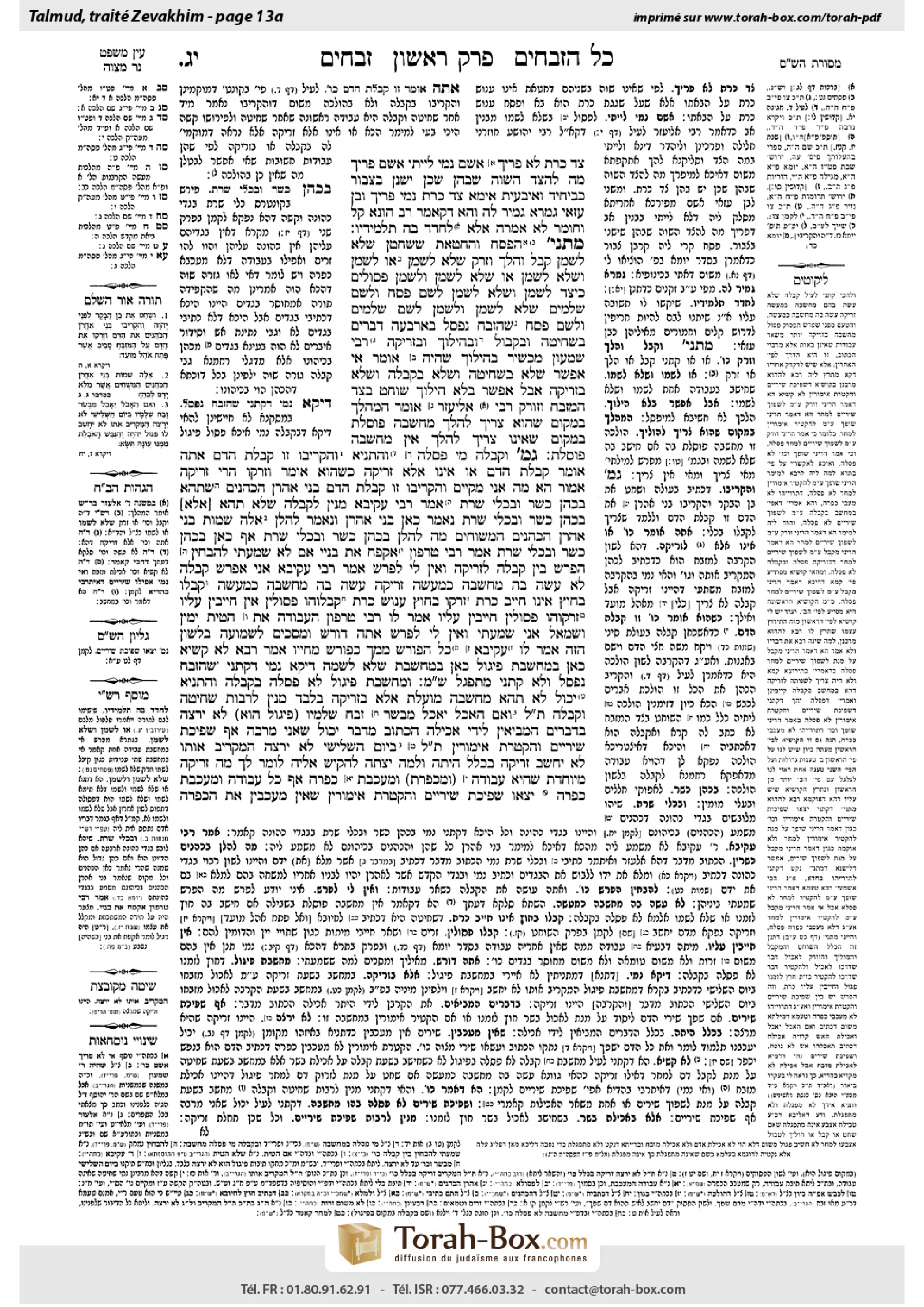
Zevachim 13a: Talmud study for Daf Yomi
Daf Yomi is the daily study of one Talmud folio. Explore 37 tractates with scans, Hebrew text, Sefaria English and AI-generated French translations where annotated.
Passage selection and English or AI-generated French translation are available where the scan has annotations. Daf Study is independent of Torah-Box and Sefaria.
Browse Zevachim · זבחים · All tractatesZevachim 13a text and translations
This page of Zevachim includes the Aramaic text, an English translation and an AI-generated French translation, alongside the scan above.
זבחים י״ג א · Aramaic and Hebrew text
צַד כָּרֵת לָא פָּרֵיךְ.
אָשָׁם נָמֵי לַיְיתֵי!
אָשָׁם – פָּרֵיךְ: מָה לְהַצַּד הַשָּׁוֶה שֶׁבָּהֶן, שֶׁכֵּן יֶשְׁנָן בְּצִבּוּר כִּבְיָחִיד.
וְאִיבָּעֵית אֵימָא: צַד כָּרֵת נָמֵי פָּרֵיךְ, וּבֶן עַזַּאי גְּמָרָא גְּמִיר לַהּ. וְהָא דְּקָאָמַר רַב הוּנָא קַל וָחוֹמֶר – לֹא אֲמָרָהּ אֶלָּא לְחַדֵּד בָּהּ תַּלְמִידָיו.
מַתְנִי׳ הַפֶּסַח וְהַחַטָּאת שֶׁשְּׁחָטָן שֶׁלֹּא לִשְׁמָן, קִבֵּל וְהִלֵּךְ וְזָרַק שֶׁלֹּא לִשְׁמָן; אוֹ לִשְׁמָן וְשֶׁלֹּא לִשְׁמָן, אוֹ שֶׁלֹּא לִשְׁמָן וְלִשְׁמָן – פְּסוּלִים.
כֵּיצַד לִשְׁמָן וְשֶׁלֹּא לִשְׁמָן? לְשֵׁם פֶּסַח וּלְשֵׁם שְׁלָמִים. שֶׁלֹּא לִשְׁמָן וְלִשְׁמָן? לְשֵׁם שְׁלָמִים וּלְשֵׁם פֶּסַח.
שֶׁהַזֶּבַח נִפְסָל בְּאַרְבָּעָה דְּבָרִים: בִּשְׁחִיטָה, וּבְקִבּוּל, וּבְהִילּוּךְ, וּבִזְרִיקָה.
רַבִּי שִׁמְעוֹן מַכְשִׁיר בְּהִילּוּךְ, שֶׁהָיָה אוֹמֵר: אִי אֶפְשָׁר שֶׁלֹּא בִּשְׁחִיטָה וְשֶׁלֹּא בְּקַבָּלָה וְשֶׁלֹּא בִּזְרִיקָה, אֲבָל אֶפְשָׁר בְּלֹא הִילּוּךְ – שׁוֹחֵט בְּצַד הַמִּזְבֵּחַ וְזוֹרֵק.
רַבִּי אֶלְיעָזָר אוֹמֵר: הַמְהַלֵּךְ בִּמְקוֹם שֶׁהוּא צָרִיךְ לְהַלֵּךְ – מַחְשָׁבָה פּוֹסֶלֶת; בִּמְקוֹם שֶׁאֵינוֹ צָרִיךְ לְהַלֵּךְ – אֵין מַחְשָׁבָה פּוֹסֶלֶת.
גְּמָ׳ וְקַבָּלָה מִי פָּסְלָה?!
וְהָתַנְיָא: ״וְהִקְרִיבוּ״ – זוֹ קַבָּלַת הַדָּם. אַתָּה אוֹמֵר קַבָּלַת הַדָּם, אוֹ אֵינוֹ אֶלָּא זְרִיקָה? כְּשֶׁהוּא אוֹמֵר ״וְזָרְקוּ״ – הֲרֵי זְרִיקָה אָמוּר; הָא מָה אֲנִי מְקַיֵּים ״וְהִקְרִיבוּ״? זוֹ קַבָּלַת הַדָּם. ״בְּנֵי אַהֲרֹן הַכֹּהֲנִים״ – שֶׁתְּהֵא בְּכֹהֵן כָּשֵׁר וּבִכְלִי שָׁרֵת.
אָמַר רַבִּי עֲקִיבָא: מִנַּיִן לְקַבָּלָה שֶׁלֹּא תְּהֵא אֶלָּא בְּכֹהֵן כָּשֵׁר וּבִכְלִי שָׁרֵת? נֶאֱמַר כָּאן: ״בְּנֵי אַהֲרֹן״, וְנֶאֱמַר לְהַלָּן: ״אֵלֶּה שְׁמוֹת בְּנֵי אַהֲרֹן הַכֹּהֲנִים הַמְּשֻׁחִים״; מָה לְהַלָּן – בְּכֹהֵן כָּשֵׁר וּבִכְלִי שָׁרֵת, אַף כָּאן – בְּכֹהֵן כָּשֵׁר וּבִכְלִי שָׁרֵת.
אָמַר רַבִּי טַרְפוֹן: אֲקַפֵּחַ אֶת בָּנַיי, אִם לֹא שָׁמַעְתִּי לְהַבְחִין הֶפְרֵשׁ בֵּין קַבָּלָה לִזְרִיקָה. וְאֵין לִי לְפָרֵשׁ.
אָמַר רַבִּי עֲקִיבָא, אֲנִי אֲפָרֵשׁ: קַבָּלָה – לֹא עָשָׂה בָּהּ מַחְשָׁבָה כְּמַעֲשֶׂה, זְרִיקָה – עָשָׂה בָּהּ מַחְשָׁבָה כְּמַעֲשֶׂה. קִבְּלוֹ בַּחוּץ – אֵינוֹ חַיָּיב כָּרֵת, זְרָקוֹ בַּחוּץ – עָנוּשׁ כָּרֵת. קִבְּלוּהוּ פְּסוּלִין – אֵין חַיָּיבִין עָלָיו, זְרָקוּהוּ פְּסוּלִין – חַיָּיבִין עָלָיו.
אָמַר לוֹ רַבִּי טַרְפוֹן: הָעֲבוֹדָה אִם הִטֵּיתָ יָמִין וּשְׂמֹאל! אֲנִי שָׁמַעְתִּי וְאֵין לִי לְפָרֵשׁ, אַתָּה דּוֹרֵשׁ וּמַסְכִּים לַשְּׁמוּעָה! בַּלָּשׁוֹן הַזֶּה אָמַר לוֹ: עֲקִיבָא, כׇּל הַפּוֹרֵשׁ מִמְּךָ כְּפוֹרֵשׁ מֵחַיָּיו.
אָמַר רָבָא: לָא קַשְׁיָא; כָּאן בְּמַחְשֶׁבֶת פִּיגּוּל, כָּאן בְּמַחְשֶׁבֶת שֶׁלֹּא לִשְׁמָהּ.
דַּיְקָא נָמֵי, דְּקָתָנֵי ״שֶׁהַזֶּבַח נִפְסָל״, וְלָא קָתָנֵי ״מִתְפַּגֵּל״; שְׁמַע מִינַּהּ.
וּמַחְשֶׁבֶת פִּיגּוּל לָא פָּסְלָה בְּקַבָּלָה?!
וְהָתַנְיָא: יָכוֹל לֹא תְּהֵא מַחְשָׁבָה מוֹעֶלֶת אֶלָּא בִּזְרִיקָה בִּלְבָד; מִנַּיִן לְרַבּוֹת שְׁחִיטָה וְקַבָּלָה? תַּלְמוּד לוֹמַר: ״וְאִם הֵאָכֹל יֵאָכֵל מִבְּשַׂר זֶבַח שְׁלָמָיו (פִּיגּוּל הוּא) בַּיּוֹם הַשְּׁלִישִׁי לֹא יֵרָצֶה״ – בִּדְבָרִים הַמְּבִיאִין לִידֵי אֲכִילָה הַכָּתוּב מְדַבֵּר.
יָכוֹל שֶׁאֲנִי מְרַבֶּה אַף שְׁפִיכַת שִׁירַיִים וְהַקְטָרַת אֵימוּרִין?
תַּלְמוּד לוֹמַר: ״בַּיּוֹם הַשְּׁלִישִׁי לֹא יֵרָצֶה, הַמַּקְרִיב אוֹתוֹ לֹא יֵחָשֵׁב״ – זְרִיקָה בַּכְּלָל הָיְתָה, וְלָמָּה יָצְתָה? לְהַקִּישׁ אֵלֶיהָ. לוֹמַר לְךָ: מָה זְרִיקָה מְיוּחֶדֶת – שֶׁהִיא עֲבוֹדָה (וּמְכַפֶּרֶת), וּמְעַכֶּבֶת כַּפָּרָה; אַף כׇּל – עֲבוֹדָה, וּמְעַכֶּבֶת כַּפָּרָה. יָצְאוּ שְׁפִיכַת שִׁירַיִים וְהַקְטָרַת אֵימוּרִין – שֶׁאֵין מְעַכְּבִין אֶת הַכַּפָּרָה.
Zevachim 13a · English translation
does not refute the inference by citing a common element of karet, as the elements of karet in a sin offering and in a Paschal offering are not parallel.
The Gemara asks: If so, let it be derived from this inference that a guilt offering is also disqualified if sacrificed not for its sake.
The Gemara answers: With regard to a guilt offering, ben Azzai refutes the inference as follows: What is notable about the common element of a sin offering and a Paschal offering? It is notable in that there are communal offerings as well as individual offerings of these types, as well as communal burnt offerings, whereas there is no communal guilt offering.
And if you wish, say instead that actually, ben Azzai also refutes the entire inference, because a sin offering and a Paschal offering uniquely share an element of karet. And the reason ben Azzai maintains that a burnt offering sacrificed not for its sake is disqualified is that he learned it as a tradition. And as for the fact that Rav Huna cites an a fortiori inference, he does not believe it to be the true source for ben Azzai’s halakha; he said it only to sharpen the minds of his students with it, challenging them to refute it.
MISHNA: With regard to the Paschal offering and the sin offering, where one slaughtered them not for their sake, or where he collected their blood in a vessel, conveyed this blood to the altar, or sprinkled this blood on the altar not for their sake, or where he performed one of these sacrificial rites for their sake and not for their sake, or not for their sake and for their sake, in all these cases the offerings are unfit.
How are these rites performed for their sake and not for their sake? In a case where one slaughtered the Paschal offering for the sake of a Paschal offering and for the sake of a peace offering. How are these rites performed not for their sake and for their sake? In a case where one slaughtered the Paschal offering for the sake of a peace offering and for the sake of a Paschal offering.
The offering is unfit because a slaughtered offering is disqualified due to prohibited intent in four matters: In the performance of the sacrificial rites of slaughtering the animal, in collecting the blood, in conveying the blood, and in sprinkling the blood.
Rabbi Shimon deems the offering fit if the prohibited intent was during the rite of conveying the blood, as he would say: It is impossible to sacrifice an offering without slaughtering the animal, or without collection of the blood, or without sprinkling the blood, but it is possible to sacrifice an offering without conveying the blood to the altar. How so? If one slaughters the animal alongside the altar and sprinkles the blood, the blood does not need to be conveyed. Therefore, the rite of conveying the blood is not significant enough to cause the offering to be disqualified due to prohibited intent while performing it.
Rabbi Eliezer says: With regard to one who conveys the blood in a situation where he is required to convey it, prohibited intent while conveying it disqualifies the offering. If he conveys the blood in a situation where he is not required to convey it, prohibited intent while conveying it does not disqualify the offering.
GEMARA: The mishna teaches that a slaughtered offering is disqualified due to prohibited intent while performing four rites, including collection of the blood. The Gemara asks: And does collection of the blood with prohibited intent disqualify the offering?
But isn’t it taught in a baraita: The verse states: “And the sons of Aaron, the priests, shall present the blood” (Leviticus 1:5); this is referring to collection of the blood. Do you say it is referring to collection of the blood, or is it referring to only sprinkling the blood? When it states immediately afterward: “And sprinkle the blood roundabout against the altar,” sprinkling the blood is thereby stated. If so, how do I realize the meaning of: “And the sons of Aaron, the priests, shall present”? This is referring to collection of the blood. And the phrase “the sons of Aaron, the priests” teaches that collection of the blood must be performed by a fit priest, i.e., one who has no blemish and who was not disqualified due to flawed lineage, and that he must do so while he is wearing priestly service vestments.
The baraita continues: Rabbi Akiva said: From where is it derived that collection of the blood may be performed only by a fit priest and while he is wearing service vestments? The expression “the sons of Aaron” is stated here in the verse in Leviticus, and it is stated there: “These are the names of the sons of Aaron, the priests that were anointed, whom he consecrated to minister in the priest’s office” (Numbers 3:3). Just as there, in the verse in Numbers, it mentions the word “priests” with regard to fit priests, i.e., Aaron’s sons, and with regard to priests who were consecrated to serve by being dressed with service vestments (see Exodus 29:30), so too here, the reference is to a fit priest and with regard to one who is wearing service vestments.
Rabbi Tarfon said: I will bury my sons if I did not hear a halakha from my teachers discerning a distinction between collection of and sprinkling the blood, but I cannot explicate the distinction, as I do not remember what it was.
The baraita continues: Rabbi Akiva said: I will explicate: With regard to collection, the Torah does not render intent like action. Collecting the blood with prohibited intent does not disqualify the offering. But with regard to sprinkling, the Torah does render intent like action. Furthermore, if one collected the blood outside the Temple, he is not liable to be punished with karet. But if one sprinkled the blood outside the Temple, he is punished with karet. Moreover, if those who are unfit for the Temple service collected the blood, they are not liable for that action. But if those who are unfit for the Temple service sprinkled the blood, they are liable to receive the penalty of death at the hand of Heaven for that action.
Rabbi Tarfon said to him excitedly: I take an oath by the Temple service that you have not deviated left or right from what I heard from my teachers. I myself heard them and I cannot explicate what they taught, whereas you teach this halakha on your own in concurrence with the halakha I heard. He said to Rabbi Akiva, using this language: Akiva, anyone who leaves you is like one who leaves his life. In any event, Rabbi Akiva’s statement in the baraita apparently contradicts the mishna with regard to the matter of whether the collection of the blood with prohibited intent disqualifies the offering.
Rava said: It is not difficult. The baraita here is referring to intent of piggul, i.e., intent to consume or burn the offering after its appointed time. The mishna there is referring to intent not for the sake of the offering.
The Gemara adds: The language of the mishna is also precise, as it teaches that a slaughtered offering is disqualified in this manner, and it does not teach that an offering is rendered piggul in this manner. Apparently, the mishna is referring to intent that merely disqualifies the offering without rendering it piggul, one who partakes of which is liable to receive karet. The Gemara concludes: Conclude from the mishna’s language that this interpretation is correct.
The Gemara asks: And does intent of piggul during the collection of the blood not disqualify the offering?
But isn’t it taught in a baraita: One might have thought that intent to consume an offering after its designated time is effective to render the offering piggul only when one has that intent during sprinkling. From where is it derived to include slaughter and collection of the blood in this halakha? The verse states: “And if any of the flesh of the sacrifice of his peace offerings is at all eaten on the third day, it shall not be accepted, neither shall it be imputed to the one who offers it; it shall be an abhorred thing [piggul ]” (Leviticus 7:18). As derived on 29a, the verse is referring to performance of the sacrificial rites with intent to consume the offering after its designated time. The phrase “is at all eaten” teaches that the verse speaks of matters that lead to consumption, i.e., those sacrificial rites that enable consumption of the offering, including slaughter of the animal and collecting the blood.
The baraita continues: One might have thought that I should include even the pouring of the remainder of the blood on the base of the altar, after its sprinkling, and the burning of the sacrificial portions on the altar.
Therefore, the verse states: “On the third day, it shall not be accepted, neither shall it be imputed to the one who offers it” (Leviticus 7:18). The phrase “the one who offers it” indicates the sprinkling of the blood. Sprinkling was included in the general category of rites that enable consumption. And for what purpose was it singled out? To compare other halakhot to it, i.e., to say to you: Just as sprinkling is unique, as it is a rite and if not performed it prevents atonement, so too, any rite that prevents atonement if not performed is included in the halakha of piggul. Pouring the remainder of the blood and burning the sacrificial portions are therefore excluded, as they do not prevent atonement if not performed. Evidently, intent of piggul applies to the collection of the blood, contrary to Rava’s resolution of the contradiction between the mishna and the baraita.
Zevachim 13a · Traduction française (IA)
ne réfute pas l’inférence en invoquant un élément commun lié au karet, car les éléments liés au karet dans le sacrifice expiatoire et dans l’offrande pascale ne sont pas parallèles.
La Guemara demande : Si tel est le cas, déduisons de cette inférence qu’un sacrifice de culpabilité est lui aussi invalidé s’il est offert sans que ce soit pour lui-même.
La Guemara répond : À propos du sacrifice de culpabilité, ben Azzai réfute l’inférence de la manière suivante : Qu’est-ce qui distingue l’élément commun au sacrifice expiatoire et à l’offrande pascale ? C’est qu’il existe, parmi ces types de sacrifices, des offrandes communautaires aussi bien qu’individuelles, ainsi que des holocaustes communautaires, alors qu’il n’existe pas de sacrifice de culpabilité communautaire.
Et si tu le souhaites, dis plutôt qu’en réalité, ben Azzai réfute lui aussi toute l’inférence, car le sacrifice expiatoire et l’offrande pascale ont en commun un élément lié au karet qui leur est propre. Si ben Azzai estime qu’un holocauste offert sans que ce soit pour lui-même est invalidé, c’est parce qu’il l’a appris par tradition. Quant au fait que Rav Houna invoque un raisonnement a fortiori, il ne pense pas que celui-ci soit la véritable source de la halakha de ben Azzai ; il ne l’a énoncé que pour aiguiser l’esprit de ses élèves, en les mettant au défi de le réfuter.
MICHNA : Dans le cas de l’offrande pascale et du sacrifice expiatoire, si quelqu’un les a égorgés sans que ce soit pour eux-mêmes, ou s’il a recueilli leur sang dans un récipient, transporté ce sang jusqu’à l’autel ou aspergé ce sang sur l’autel sans que ce soit pour eux-mêmes, ou s’il a accompli l’un de ces rites sacrificiels pour eux-mêmes puis sans que ce soit pour eux-mêmes, ou sans que ce soit pour eux-mêmes puis pour eux-mêmes, dans tous ces cas, les offrandes sont invalides.
Comment ces rites sont-ils accomplis pour elles-mêmes puis sans que ce soit pour elles-mêmes ? C’est le cas où quelqu’un a égorgé l’offrande pascale en vue d’une offrande pascale puis d’un sacrifice de paix. Comment ces rites sont-ils accomplis sans que ce soit pour elles-mêmes puis pour elles-mêmes ? C’est le cas où quelqu’un a égorgé l’offrande pascale en vue d’un sacrifice de paix puis d’une offrande pascale.
L’offrande est invalide, car une offrande égorgée est invalidée par une intention interdite lors de quatre rites sacrificiels : l’égorgement de l’animal, le recueil du sang, son transport et son aspersion.
Rabbi Shimon considère l’offrande comme valide si l’intention interdite intervient lors du rite du transport du sang. En effet, il dit : Il est impossible d’offrir un sacrifice sans égorger l’animal, sans recueillir le sang ou sans asperger celui-ci, mais il est possible d’offrir un sacrifice sans transporter le sang jusqu’à l’autel. Comment cela ? Si l’on égorge l’animal près de l’autel et qu’on asperge le sang, il n’est pas nécessaire de le transporter. Par conséquent, le rite du transport du sang n’est pas assez déterminant pour invalider l’offrande en raison d’une intention interdite lors de son accomplissement.
Rabbi Eliezer dit : Si quelqu’un transporte le sang alors qu’il est tenu de le faire, une intention interdite pendant ce transport invalide l’offrande. S’il transporte le sang alors qu’il n’est pas tenu de le faire, une intention interdite pendant ce transport n’invalide pas l’offrande.
GUEMARA : La Michna enseigne qu’une offrande égorgée est invalidée par une intention interdite lors de quatre rites, dont le recueil du sang. La Guemara demande : Une intention interdite lors du recueil du sang invalide-t-elle l’offrande ?
Mais n’est-il pas enseigné dans une baraïta : Le verset dit : « Et les fils d’Aaron, les prêtres, présenteront le sang » (Lévitique 1, 5) ; cela désigne le recueil du sang. Dis-tu que cela désigne le recueil du sang, ou bien cela désigne-t-il uniquement l’aspersion du sang ? Puisque le verset dit immédiatement après : « Et ils aspergeront le sang tout autour, contre l’autel », l’aspersion du sang est ainsi explicitement mentionnée. Comment faut-il donc comprendre les mots : « Et les fils d’Aaron, les prêtres, présenteront » ? Ils désignent le recueil du sang. Et l’expression « les fils d’Aaron, les prêtres » enseigne que le recueil du sang doit être effectué par un prêtre apte, c’est-à-dire qui n’a pas de défaut physique et n’a pas été disqualifié en raison d’une ascendance irrégulière, et qu’il doit le faire vêtu des habits sacerdotaux de service.
La baraïta poursuit : Rabbi Akiva dit : D’où déduit-on que le recueil du sang ne peut être effectué que par un prêtre apte et vêtu des habits de service ? L’expression « les fils d’Aaron » figure ici, dans le verset du Lévitique, et figure là : « Voici les noms des fils d’Aaron, les prêtres qui furent oints et qu’il investit pour exercer le sacerdoce » (Nombres 3, 3). De même que là, dans le verset des Nombres, le mot « prêtres » se rapporte à des prêtres aptes, c’est-à-dire aux fils d’Aaron, et à des prêtres consacrés au service par le port des habits de service (voir Exode 29, 30), de même ici, il s’agit d’un prêtre apte et vêtu des habits de service.
Rabbi Tarfon dit : Que mes fils soient enterrés si je n’ai pas entendu de mes maîtres une halakha établissant une distinction entre le recueil et l’aspersion du sang ; mais je ne peux pas exposer cette distinction, car je ne me souviens pas de ce qu’elle était.
La baraïta poursuit : Rabbi Akiva dit : Je vais l’exposer. Pour le recueil, la Torah ne considère pas l’intention comme un acte. Recueillir le sang avec une intention interdite n’invalide pas l’offrande. En revanche, pour l’aspersion, la Torah considère l’intention comme un acte. De plus, si quelqu’un a recueilli le sang hors du Temple, il n’encourt pas le karet. Mais s’il a aspergé le sang hors du Temple, il encourt le karet. En outre, si des personnes inaptes au service du Temple ont recueilli le sang, elles ne sont pas passibles de peine pour cet acte. Mais si des personnes inaptes au service du Temple ont aspergé le sang, elles sont passibles de la mort par la main du Ciel pour cet acte.
Rabbi Tarfon lui dit avec émotion : J’en prends le service du Temple à témoin : tu ne t’es écarté ni à gauche ni à droite de ce que j’ai entendu de mes maîtres. Moi-même, je les ai entendus et je ne peux pas exposer ce qu’ils ont enseigné, tandis que toi, tu enseignes cette halakha de toi-même, en accord avec celle que j’ai entendue. Il dit à Rabbi Akiva, en ces termes : Akiva, quiconque te quitte est comme s’il quittait la vie. Quoi qu’il en soit, la déclaration de Rabbi Akiva dans la baraïta semble contredire la Michna sur la question de savoir si le recueil du sang avec une intention interdite invalide l’offrande.
Rava dit : Il n’y a pas de difficulté. La baraïta se rapporte ici à l’intention de piggul, c’est-à-dire à l’intention de consommer ou de brûler l’offrande après le délai qui lui est imparti. La Michna, elle, se rapporte à l’intention de ne pas agir pour l’offrande elle-même.
La Guemara ajoute : La formulation de la Michna est également précise, car elle enseigne qu’une offrande égorgée est invalidée de cette manière, et non qu’une offrande devient piggul de cette manière. Il semble donc que la Michna se rapporte à une intention qui invalide simplement l’offrande, sans la rendre piggul, état dans lequel celui qui en mange encourt le karet. La Guemara conclut : Déduis de la formulation de la Michna que cette interprétation est correcte.
La Guemara demande : Une intention de piggul lors du recueil du sang n’invalide-t-elle pas l’offrande ?
Mais n’est-il pas enseigné dans une baraïta : On aurait pu penser que l’intention de consommer une offrande après le délai qui lui est imparti ne rend l’offrande piggul que si l’on a cette intention lors de l’aspersion. D’où déduit-on qu’il faut inclure l’égorgement et le recueil du sang dans cette halakha ? Le verset dit : « Si l’on mange de la chair du sacrifice de ses sacrifices de paix le troisième jour, il ne sera pas agréé et ne sera pas imputé à celui qui l’offre ; ce sera une chose abominable [piggul] » (Lévitique 7, 18). Comme cela est déduit en 29a, le verset se rapporte à l’accomplissement des rites sacrificiels avec l’intention de consommer l’offrande après le délai qui lui est imparti. L’expression « si l’on mange » enseigne que le verset parle des actes qui conduisent à la consommation, c’est-à-dire des rites sacrificiels qui permettent de consommer l’offrande, notamment l’égorgement de l’animal et le recueil du sang.
La baraïta poursuit : On aurait pu penser qu’il fallait inclure même le versement du reste du sang au pied de l’autel, après son aspersion, ainsi que la combustion des portions sacrificielles sur l’autel.
C’est pourquoi le verset dit : « Le troisième jour, il ne sera pas agréé et ne sera pas imputé à celui qui l’offre » (Lévitique 7, 18). L’expression « celui qui l’offre » désigne l’aspersion du sang. L’aspersion faisait déjà partie de la catégorie générale des rites qui permettent la consommation. Dans quel but a-t-elle donc été distinguée ? Pour la comparer à d’autres halakhot, c’est-à-dire pour t’indiquer que, de même que l’aspersion est particulière en ce qu’elle est un rite dont l’omission empêche l’expiation, de même tout rite dont l’omission empêche l’expiation est inclus dans la halakha du piggul. Le versement du reste du sang et la combustion des portions sacrificielles sont donc exclus, car leur omission n’empêche pas l’expiation. Il apparaît ainsi que l’intention de piggul s’applique au recueil du sang, contrairement à la résolution proposée par Rava pour la contradiction entre la Michna et la baraïta.
Traduction française générée par IA à partir de l’édition anglaise de Sefaria. Vérifie toujours un passage avec le texte source.
Text from Sefaria: William Davidson Edition - Vocalized Aramaic (CC BY NC); William Davidson Edition - English (CC BY NC).