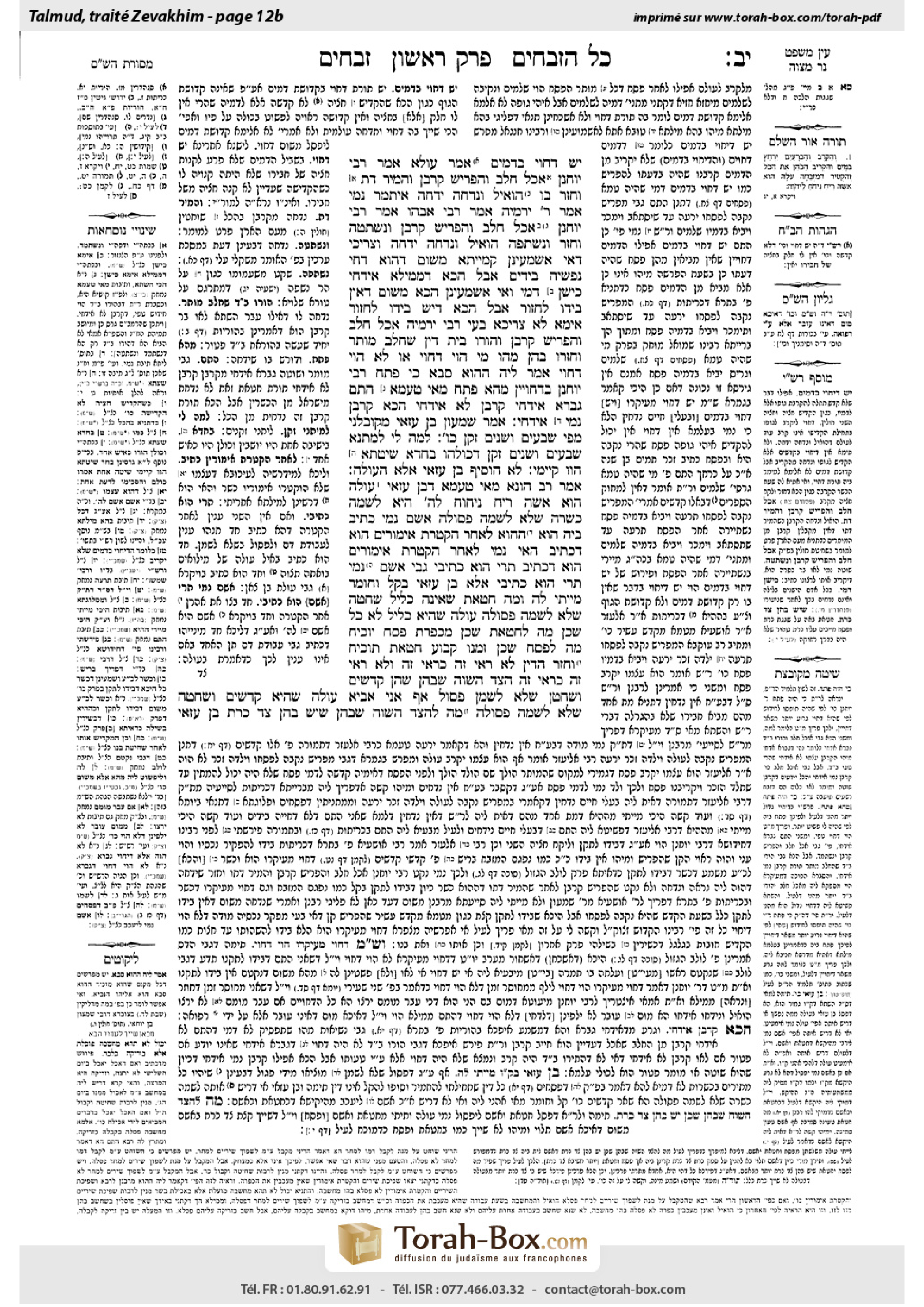
Zevachim 12b: Talmud study for Daf Yomi
Daf Yomi is the daily study of one Talmud folio. Explore 37 tractates with scans, Hebrew text, Sefaria English and AI-generated French translations where annotated.
Passage selection and English or AI-generated French translation are available where the scan has annotations. Daf Study is independent of Torah-Box and Sefaria.
Browse Zevachim · זבחים · All tractatesZevachim 12b text and translations
This page of Zevachim includes the Aramaic text, an English translation and an AI-generated French translation, alongside the scan above.
זבחים י״ב ב · Aramaic and Hebrew text
יֵשׁ דִּחוּי בְּדָמִים.
אָמַר עוּלָּא אָמַר רַבִּי יוֹחָנָן: אָכַל חֵלֶב וְהִפְרִישׁ קׇרְבָּן, וְנִשְׁתַּמֵּד, וְחָזַר בּוֹ – הוֹאִיל וְנִדְחָה, יִדָּחֶה.
אִיתְּמַר נָמֵי, אָמַר רַבִּי יִרְמְיָה אָמַר רַבִּי אֲבָהוּ אָמַר רַבִּי יוֹחָנָן: אָכַל חֵלֶב וְהִפְרִישׁ קׇרְבָּן, וְנִשְׁתַּטָּה, וְחָזַר וְנִשְׁתַּפָּה – הוֹאִיל וְנִדְחָה, יִדָּחֶה.
וּצְרִיכִי; דְּאִי אַשְׁמְעִינַן קַמַּיְיתָא – מִשּׁוּם דְּהוּא דָּחֵי נַפְשֵׁיהּ בְּיָדַיִם; אֲבָל הָכָא דְּמִמֵּילָא אִידְּחִי – כְּיָשֵׁן דָּמֵי.
וְאִי אַשְׁמְעִינַן הָכָא – מִשּׁוּם דְּאֵין בְּיָדוֹ לַחֲזוֹר; אֲבָל הָכָא דְּיֵשׁ בְּיָדוֹ לַחֲזוֹר – אֵימָא לָא; צְרִיכָא.
בָּעֵי רַבִּי יִרְמְיָה: אָכַל חֵלֶב וְהִפְרִישׁ קׇרְבָּן, וְהוֹרוּ בֵּית דִּין שֶׁחֵלֶב מוּתָּר, וְחָזְרוּ בָּהֶן, מַהוּ? מִי הָוֵי דָּחוּי, אוֹ לָא הָוֵי דָּחוּי?
אֲמַר לֵיהּ הָהוּא סָבָא: כִּי פָּתַח רַבִּי יוֹחָנָן בִּדְחוּיִין – מֵהָא פָּתַח. מַאי טַעְמָא? הָתָם – גַּבְרָא אִידְּחִי, קׇרְבָּן לָא אִידְּחִי; הָכָא – קׇרְבָּן נָמֵי אִידְּחִי.
אָמַר שִׁמְעוֹן בֶּן עַזַּאי: מְקוּבְּלַנִי מִפִּי שִׁבְעִים וּשְׁנַיִם זָקֵן כּוּ׳. לְמָה לִי לְמִתְנָא ״שִׁבְעִים וּשְׁנַיִם זָקֵן״? דְּכוּלְּהוּ בַּחֲדָא שִׁיטְתָא הֲווֹ קָיְימִי.
לֹא הוֹסִיף בֶּן עַזַּאי אֶלָּא הָעוֹלָה.
אָמַר רַב הוּנָא: מַאי טַעְמָא דְּבֶן עַזַּאי? ״עוֹלָה הוּא אִשֵּׁה רֵיחַ נִיחֹחַ לַה׳״ – הִיא לִשְׁמָהּ כְּשֵׁרָה, שֶׁלֹּא לִשְׁמָהּ פְּסוּלָה.
אָשָׁם נָמֵי כְּתִיב בֵּיהּ ״הוּא״!
הָהוּא לְאַחַר הַקְטָרַת אֵימוּרִים הוּא דִּכְתִיב.
הַאי נָמֵי לְאַחַר הַקְטָרַת אֵימוּרִים הוּא דִּכְתִיב!
תְּרֵי ״הוּא״ כְּתִיבִי.
גַּבֵּי אָשָׁם נָמֵי תְּרֵי ״הוּא״ כְּתִיבִי!
אֶלָּא בֶּן עַזַּאי בְּקַל וָחוֹמֶר מַיְיתֵי לַהּ: וּמָה חַטָּאת שֶׁאֵינָהּ כָּלִיל, שְׁחָטָהּ שֶׁלֹּא לִשְׁמָהּ – פְּסוּלָה, עוֹלָה שֶׁהִיא כָּלִיל – לֹא כׇּל שֶׁכֵּן?!
מָה לְחַטָּאת, שֶׁכֵּן מְכַפֶּרֶת!
פֶּסַח יוֹכִיחַ.
מָה לְפֶסַח, שֶׁכֵּן זְמַנּוֹ קָבוּעַ!
חַטָּאת תּוֹכִיחַ. וְחָזַר הַדִּין; לֹא רְאִי זֶה כִּרְאִי זֶה, וְלֹא רְאִי זֶה כִּרְאִי זֶה; הַצַּד הַשָּׁוֶה שֶׁבָּהֶן – שֶׁהֵן קֳדָשִׁים, וּשְׁחָטָן שֶׁלֹּא לִשְׁמָן פָּסוּל; אַף אֲנִי אָבִיא עוֹלָה – שֶׁהִיא קָדָשִׁים, וּשְׁחָטָהּ שֶׁלֹּא לִשְׁמָהּ פְּסוּלָה.
מָה לְהַצַּד הַשָּׁוֶה שֶׁבָּהֶן, שֶׁיֵּשׁ בָּהֶן צַד כָּרֵת!
בֶּן עַזַּאי,
Zevachim 12b · English translation
there is permanent disqualification even in a case where the animal possesses sanctity that inheres in its monetary value, rather than inherent sanctity.
§ Ulla says that Rabbi Yoḥanan says: If one ate forbidden fat and designated an offering to atone for the transgression, and then apostatized, thereby disqualifying himself from bringing an offering, and later recanted his apostasy, since the offering was already disqualified, it shall be disqualified permanently.
It was also stated that Rabbi Yirmeya says that Rabbi Abbahu says that Rabbi Yoḥanan says: If one ate forbidden fat and designated an offering to atone for his transgression, and then became an imbecile, who is unfit to bring an offering, and then again became halakhically competent, since the offering was already disqualified, it shall be disqualified permanently.
The Gemara notes: And both statements are necessary. As, if Rabbi Yoḥanan had taught us only the first statement, concerning an apostate, one might have reasoned that the offering is permanently disqualified because he disqualified himself by his own action, but here, in the case of one who became an imbecile, where he was disqualified through a process that occurs by itself, when he becomes competent again he may bring his sacrifice, as it is considered as though he were asleep. If one designated an offering and fell asleep, this certainly does not disqualify it.
And if Rabbi Yoḥanan had taught us only the statement here, with regard to one who became an imbecile, one might have reasoned that the offering is permanently disqualified because it is not in his power to return to competence, but here, in the case of an apostate, since it is in his power to recant his apostasy, I would say that the offering is not permanently disqualified. Therefore, both statements are necessary.
Rabbi Yirmeya raises a dilemma: If one ate forbidden fat and designated an offering for the transgression, and then the court ruled that the type of fat he ate is permitted, thereby rendering the offering unnecessary, and the court subsequently retracted its ruling, in this case, what is the halakha? Is the offering permanently disqualified, or is it not permanently disqualified?
A certain elder [hahu sava] said to Rabbi Yirmeya: When Rabbi Yoḥanan introduced the topic of permanently disqualified offerings, he introduced it with this case. What is the reason? There, in the case of one who apostatized or became an imbecile, although the person was disqualified, the offering itself was not disqualified. Consequently, it is less evident that the offering will be disqualified permanently. But here, in a case where the court ruled that the fat is permitted, the offering itself was also disqualified, as it was rendered unnecessary. Therefore, this is a more obvious example.
§ The mishna teaches: Shimon ben Azzai said: I received a tradition from seventy-two elders [zaken] that all slaughtered offerings that are eaten, if slaughtered not for their sake, are fit. The Gemara asks: Why do I need to teach the phrase seventy-two elders using the singular form: Zaken, rather than the plural form: Zekenim? The Gemara answers: Because they all maintained one opinion, i.e., they all agreed with this halakha.
The mishna continues: Ben Azzai added only the burnt offering to the sin offering and the Paschal offering, which are mentioned in the first mishna as disqualified when sacrificed not for their sake.
Rav Huna said: What is the reason for the opinion of ben Azzai? The verse states: “It is a burnt offering, an offering made by fire, of a pleasing aroma unto the Lord” (Leviticus 1:13). The word “it” teaches that if it is sacrificed for its sake, it is fit; if sacrificed not for its sake, it is unfit.
The Gemara asks: Isn’t the word “it” written with regard to a guilt offering as well, in the verse: “It is a guilt offering” (Leviticus 7:5)? Nevertheless, a guilt offering sacrificed not for its sake is not disqualified.
The Gemara answers: That verse is written after the burning of the sacrificial portions on the altar. Since the offering is fit even if these portions are not burned at all, it is certainly fit if they are burned not for the sake of a guilt offering.
The Gemara asks: Isn’t this mention of the word “it” with regard to a burnt offering also written after the burning of the sacrificial portions on the altar?
The Gemara answers: The word “it” is written with regard to a burnt offering in two places, both in Leviticus 1:13 and in Exodus 29:18. Although both are written after the burning of the portions consumed on the altar, one of them is superfluous, and is therefore interpreted in reference to the main sacrificial rites, performed before the burning of the portions. The verse therefore teaches that the offering is fit only if these rites are performed for its sake.
The Gemara asks: With regard to a guilt offering as well, isn’t the word “it” written in two places, Leviticus 5:9 and Leviticus 7:5?
Rather, ben Azzai derives his halakha not from a verse, but by an a fortiori inference: Just as with regard to a sin offering, which is not totally consumed on the altar but partially eaten by priests, if one slaughtered it not for its sake it is disqualified, so too, with regard to a burnt offering, which is treated more strictly in that it is totally consumed on the altar, all the more so is it not clear that if it is slaughtered not for its sake it is disqualified?
The Gemara rejects this inference: What is notable about a sin offering? It is notable in that it atones for sin, in contrast to a burnt offering, which is not brought for atonement. Therefore, only a sin offering is disqualified when sacrificed not for its sake.
The Gemara suggests: A Paschal offering can prove the point, as it is not brought for atonement, yet it is disqualified if sacrificed not for its sake.
The Gemara rejects this as well: What is notable about a Paschal offering? It is notable in that its time is set at Passover eve, in contrast to a burnt offering, which does not have a designated time.
The Gemara suggests: If so, a sin offering can prove the point, since it has no set time. And the inference has reverted to its starting point. The halakha is derived from the common element of the two sources: The aspect of this case is not like the aspect of that case and the aspect of that case is not like the aspect of this case. Their common element is that they are offerings, and if one slaughtered them not for their sake, they are disqualified. So too, I shall include a burnt offering in this halakha, as it is an offering, and therefore if one slaughtered it not for its sake, it is disqualified.
The Gemara rejects this as well: What is notable about their common element? It is notable in that they both have an element of karet. A sin offering is brought for a transgression punishable by karet when committed intentionally, and one who refrains intentionally from bringing a Paschal offering is liable to be punished with karet. A burnt offering does not have an element of karet.
The Gemara answers: Ben Azzai
Zevachim 12b · Traduction française (IA)
Il existe une invalidation permanente même lorsque l’animal possède une sainteté portant sur sa valeur monétaire, et non une sainteté intrinsèque.
§ Oulla dit au nom de Rabbi Yoḥanan : Si quelqu’un a consommé de la graisse interdite et a désigné une offrande pour expier sa transgression, puis a apostasié, se rendant ainsi inapte à apporter une offrande, et a ensuite renoncé à son apostasie, l’offrande ayant déjà été invalidée, elle le reste définitivement.
Il a également été enseigné que Rabbi Yirmeya dit au nom de Rabbi Abbahou, qui dit au nom de Rabbi Yoḥanan : Si quelqu’un a consommé de la graisse interdite et a désigné une offrande pour expier sa transgression, puis est devenu déficient mentalement, ce qui le rend inapte à apporter une offrande, et a ensuite recouvré sa capacité juridique, l’offrande ayant déjà été invalidée, elle le reste définitivement.
La Guemara fait remarquer que ces deux enseignements sont nécessaires. En effet, si Rabbi Yoḥanan ne nous avait enseigné que le premier, au sujet d’un apostat, on aurait pu penser que l’offrande est invalidée définitivement parce qu’il s’est rendu inapte par ses propres actes. Mais ici, dans le cas de celui qui est devenu déficient mentalement, où l’inaptitude est survenue d’elle-même, il pourrait apporter son sacrifice après avoir recouvré sa capacité, car on le considère comme s’il avait dormi. Or, si quelqu’un désigne une offrande puis s’endort, cela ne l’invalide certainement pas.
Et si Rabbi Yoḥanan ne nous avait enseigné que le cas de celui qui est devenu déficient mentalement, on aurait pu penser que l’offrande est invalidée définitivement parce qu’il ne peut pas recouvrer sa capacité juridique. Mais ici, dans le cas d’un apostat, puisqu’il peut renoncer à son apostasie, j’aurais dit que l’offrande n’est pas invalidée définitivement. Les deux enseignements sont donc nécessaires.
Rabbi Yirmeya soulève une question : Si quelqu’un a consommé de la graisse interdite et a désigné une offrande pour cette transgression, puis que le tribunal a statué que le type de graisse qu’il avait consommé était permis, rendant ainsi l’offrande inutile, avant de revenir sur sa décision, quelle est la halakha dans ce cas ? L’offrande est-elle invalidée définitivement, ou ne l’est-elle pas ?
Un certain ancien [hahu sava] dit à Rabbi Yirmeya : Lorsque Rabbi Yoḥanan a abordé la question des offrandes invalidées définitivement, il a commencé par ce cas. Pourquoi ? Dans le cas de celui qui a apostasié ou est devenu déficient mentalement, la personne a été rendue inapte, mais l’offrande elle-même n’a pas été invalidée. Il est donc moins évident que l’offrande le soit définitivement. Mais ici, lorsque le tribunal a statué que la graisse était permise, l’offrande elle-même a également été invalidée, puisqu’elle est devenue inutile. C’est donc un exemple plus évident.
§ La Michna enseigne : Shimon ben Azzai a dit : J’ai reçu une tradition de soixante-douze anciens [zaken] selon laquelle toutes les offrandes égorgées qui sont consommées sont valides si elles ont été égorgées sans que ce soit pour leur propre compte. La Guemara demande : Pourquoi l’expression « soixante-douze anciens » est-elle au singulier, zaken, plutôt qu’au pluriel, zekenim ? La Guemara répond : Parce qu’ils avaient tous la même opinion, c’est-à-dire qu’ils étaient tous d’accord avec cette halakha.
La Michna poursuit : Ben Azzai a ajouté uniquement l’holocauste au sacrifice expiatoire et à l’offrande pascale, mentionnés dans la première Michna comme invalides lorsqu’ils sont sacrifiés sans que ce soit pour leur propre compte.
Rav Houna dit : Quel est le fondement de l’opinion de ben Azzai ? Le verset dit : « C’est un holocauste, une offrande consumée par le feu, d’une odeur agréable pour le Seigneur » (Lévitique 1,13). Le mot « c’est » enseigne que, si l’offrande est sacrifiée pour son propre compte, elle est valide ; si elle est sacrifiée sans que ce soit pour son propre compte, elle est invalide.
La Guemara demande : Le mot « c’est » ne figure-t-il pas aussi à propos d’un sacrifice de culpabilité, dans le verset : « C’est un sacrifice de culpabilité » (Lévitique 7,5) ? Pourtant, un sacrifice de culpabilité sacrifié sans que ce soit pour son propre compte n’est pas invalidé.
La Guemara répond : Ce verset vient après la combustion des parties sacrificielles sur l’autel. Puisque l’offrande reste valide même si ces parties ne sont pas brûlées du tout, elle l’est à plus forte raison si elles sont brûlées sans que ce soit pour un sacrifice de culpabilité.
La Guemara demande : Cette mention du mot « c’est » au sujet d’un holocauste ne vient-elle pas, elle aussi, après la combustion des parties sacrificielles sur l’autel ?
La Guemara répond : Le mot « c’est » figure à propos d’un holocauste à deux endroits, en Lévitique 1,13 et en Exode 29,18. Bien que les deux versets viennent après la combustion des parties consumées sur l’autel, l’un d’eux est superflu et est donc interprété comme se rapportant aux principaux rites sacrificiels, accomplis avant la combustion des parties. Le verset enseigne donc que l’offrande n’est valide que si ces rites sont accomplis pour son propre compte.
La Guemara demande : Le mot « c’est » ne figure-t-il pas aussi à deux endroits à propos d’un sacrifice de culpabilité, en Lévitique 5,9 et en Lévitique 7,5 ?
Ben Azzai déduit plutôt sa halakha non pas d’un verset, mais d’un raisonnement a fortiori : De même qu’un sacrifice expiatoire, qui n’est pas entièrement consumé sur l’autel puisque les prêtres en mangent une partie, est invalidé lorsqu’on l’égorge sans que ce soit pour son propre compte, à plus forte raison un holocauste, qui est traité plus strictement en ce qu’il est entièrement consumé sur l’autel, n’est-il pas évident qu’il est invalidé lorsqu’on l’égorge sans que ce soit pour son propre compte ?
La Guemara rejette ce raisonnement : Qu’a de particulier le sacrifice expiatoire ? Il expie une faute, contrairement à l’holocauste, qui n’est pas apporté à des fins d’expiation. Seul le sacrifice expiatoire est donc invalidé lorsqu’il est sacrifié sans que ce soit pour son propre compte.
La Guemara suggère : L’offrande pascale peut servir de preuve, car elle n’est pas apportée à des fins d’expiation et est pourtant invalidée si elle est sacrifiée sans que ce soit pour son propre compte.
La Guemara rejette également cet argument : Qu’a de particulier l’offrande pascale ? Son moment est fixé à la veille de Pessaḥ, contrairement à l’holocauste, qui n’a pas de moment déterminé.
La Guemara suggère : Dans ce cas, le sacrifice expiatoire peut servir de preuve, puisqu’il n’a pas de moment déterminé. Le raisonnement revient alors à son point de départ. La halakha est déduite de l’élément commun aux deux sources : le cas de l’une diffère de celui de l’autre, et celui de l’autre diffère de celui de l’une. Leur élément commun est qu’il s’agit d’offrandes qui sont invalidées si on les égorge sans que ce soit pour leur propre compte. De même, j’inclus l’holocauste dans cette halakha, car c’est une offrande ; par conséquent, si on l’égorge sans que ce soit pour son propre compte, il est invalidé.
La Guemara rejette également cet argument : Qu’a de particulier leur élément commun ? Ces deux offrandes comportent un aspect de karet. Le sacrifice expiatoire est apporté pour une transgression passible de karet lorsqu’elle est commise intentionnellement, et celui qui s’abstient intentionnellement d’apporter une offrande pascale est passible de karet. L’holocauste, lui, ne comporte aucun aspect de karet.
La Guemara répond : Ben Azzai
Traduction française générée par IA à partir de l’édition anglaise de Sefaria. Vérifie toujours un passage avec le texte source.
Text from Sefaria: William Davidson Edition - Vocalized Aramaic (CC BY NC); William Davidson Edition - English (CC BY NC).