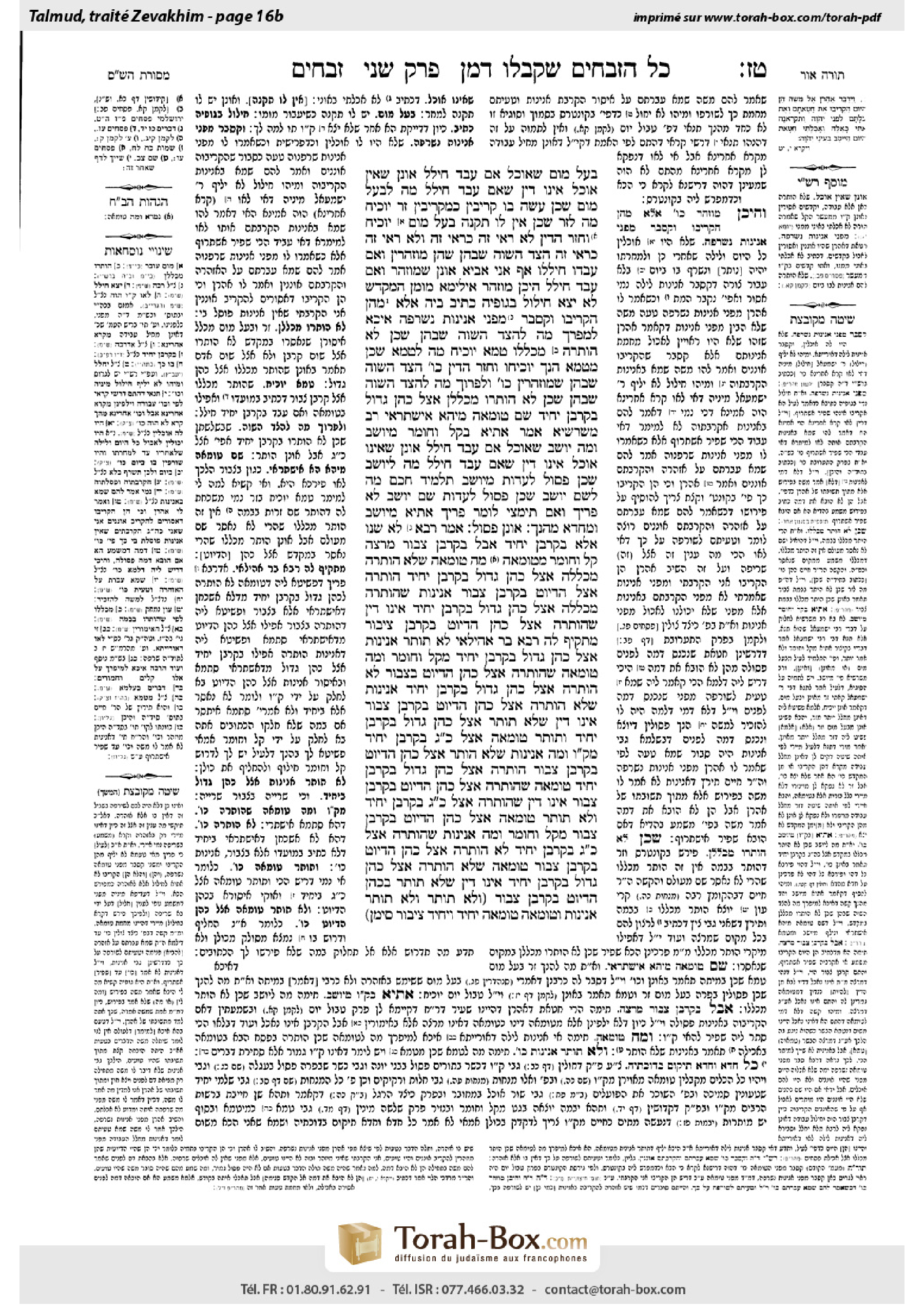
Zevachim 16b: Talmud study for Daf Yomi
Daf Yomi is the daily study of one Talmud folio. Explore 37 tractates with scans, Hebrew text, Sefaria English and AI-generated French translations where annotated.
Passage selection and English or AI-generated French translation are available where the scan has annotations. Daf Study is independent of Torah-Box and Sefaria.
Browse Zevachim · זבחים · All tractatesZevachim 16b text and translations
This page of Zevachim includes the Aramaic text, an English translation and an AI-generated French translation, alongside the scan above.
זבחים י״ו ב · Aramaic and Hebrew text
בַּעַל מוּם, שֶׁאוֹכֵל – אִם עָבַד חִילֵּל; אוֹנֵן, שֶׁאֵין אוֹכֵל – אֵינוֹ דִּין שֶׁאִם עָבַד חִילֵּל?!
מָה לְבַעַל מוּם, שֶׁכֵּן עָשָׂה בּוֹ קְרֵיבִין כְּמַקְרִיבִין!
זָר יוֹכִיחַ. מָה לְזָר, שֶׁכֵּן אֵין לוֹ תַּקָּנָה!
בַּעַל מוּם יוֹכִיחַ. וְחָזַר הַדִּין. לֹא רְאִי זֶה כִרְאִי זֶה, וְלֹא רְאִי זֶה כִּרְאִי זֶה; הַצַּד הַשָּׁוֶה שֶׁבָּהֶן – שֶׁהֵן מוּזְהָרִין, וְאִם עָבְדוּ חִילְּלוּ; אַף אֲנִי אָבִיא אוֹנֵן – שֶׁמּוּזְהָר, וְאִם עָבַד חִילֵּל.
הֵיכָן מוּזְהָר? אִילֵּימָא מִ״וּמִן הַמִּקְדָּשׁ לֹא יֵצֵא״, חִילּוּל בְּגוּפֵיהּ כְּתִיב בֵּיהּ! אֶלָּא מֵ״הֵן הִקְרִיבוּ״ – וְקָסָבַר מִפְּנֵי אֲנִינוּת נִשְׂרְפָה.
אִיכָּא לְמִפְרַךְ: מָה לְהַצַּד הַשָּׁוֶה שֶׁבָּהֶן, שֶׁכֵּן לֹא הוּתְּרָה מִכְּלָלוֹ!
טָמֵא יוֹכִיחַ.
מָה לְטָמֵא, שֶׁכֵּן מְטַמֵּא! הָנָךְ יוֹכִיחוּ. וְחָזַר הַדִּין כּוּ׳, הַצַּד הַשָּׁוֶה שֶׁבָּהֶן שֶׁמּוּזְהָרִין כּוּ׳.
וְלִפְרוֹךְ: מָה לְהַצַּד הַשָּׁוֶה שֶׁבָּהֶן – שֶׁכֵּן לֹא הוּתְּרוּ מִכְּלָלָן אֵצֶל כֹּהֵן גָּדוֹל בְּקׇרְבַּן יָחִיד! שֵׁם טוּמְאָה מִיהָא אִישְׁתְּרַאי.
רַב מְשַׁרְשְׁיָא אָמַר: אָתְיָא בְּקַל וָחוֹמֶר מִיּוֹשֵׁב; וּמָה יוֹשֵׁב, שֶׁאוֹכֵל – אִם עָבַד חִילֵּל; אוֹנֵן, שֶׁאֵינוֹ אוֹכֶל – אֵינוֹ דִּין שֶׁאִם עָבַד חִילֵּל?!
מָה לְיוֹשֵׁב, שֶׁכֵּן פָּסוּל לְעֵדוּת! מִיּוֹשֵׁב תַּלְמִיד חָכָם.
מָה לְשֵׁם יוֹשֵׁב, שֶׁכֵּן פָּסוּל לְעֵדוּת! שֵׁם יוֹשֵׁב לָא פָּרֵיךְ. וְאִם תִּימְצֵי לוֹמַר פָּרֵיךְ – אָתְיָא מִיּוֹשֵׁב וּמֵחֲדָא מֵהָנָךְ.
אוֹנֵן פָּסוּל. אָמַר רָבָא: לֹא שָׁנוּ אֶלָּא בְּקׇרְבַּן יָחִיד, אֲבָל בְּקׇרְבַּן צִבּוּר – מְרַצֶּה, קַל וָחוֹמֶר מִטּוּמְאָה;
מָה טוּמְאָה, שֶׁלֹּא הוּתְּרָה מִכְּלָלָהּ אֵצֶל כֹּהֵן גָּדוֹל בְּקׇרְבַּן יָחִיד – הוּתְּרָה אֵצֶל הֶדְיוֹט בְּקׇרְבַּן צִבּוּר; אֲנִינוּת, שֶׁהוּתְּרָה מִכְּלָלָהּ אֵצֶל כֹּהֵן גָּדוֹל בְּקָרְבַּן יָחִיד – אֵינוֹ דִּין שֶׁהוּתְּרָה אֵצֶל כֹּהֵן הֶדְיוֹט בְּקׇרְבַּן צִיבּוּר?!
מַתְקֵיף לַהּ רָבָא בַּר אֲהִילַאי: לֹא תּוּתַּר אֲנִינוּת אֵצֶל כֹּהֵן גָּדוֹל בְּקׇרְבַּן יָחִיד, מִקַּל וְחוֹמֶר: וּמָה טוּמְאָה, שֶׁהוּתְּרָה אֵצֶל כֹּהֵן הֶדְיוֹט בְּצִבּוּר – לֹא הוּתְּרָה אֵצֶל כֹּהֵן גָּדוֹל בְּקׇרְבַּן יָחִיד; אֲנִינוּת, שֶׁלֹּא הוּתְּרָה אֵצֶל כֹּהֵן הֶדְיוֹט בְּקׇרְבַּן צִבּוּר – אֵינוֹ דִּין שֶׁלֹּא תּוּתַּר אֵצֶל כֹּהֵן גָּדוֹל בְּקׇרְבַּן יָחִיד?!
וְתוּתַּר טוּמְאָה אֵצֶל כֹּהֵן גָּדוֹל בְּקׇרְבַּן יָחִיד, מִקַּל וְחוֹמֶר: וּמָה אֲנִינוּת, שֶׁלֹּא הוּתַּר אֵצֶל כֹּהֵן הֶדְיוֹט בְּקׇרְבַּן צִבּוּר – הוּתְּרָה אֵצֶל כֹּהֵן גָּדוֹל בְּקׇרְבַּן יָחִיד; טוּמְאָה, שֶׁהוּתְּרָה אֵצֶל כֹּהֵן הֶדְיוֹט בְּקׇרְבַּן צִבּוּר – אֵינוֹ דִּין שֶׁהוּתְּרָה אֵצֶל כֹּהֵן גָּדוֹל בְּקׇרְבַּן יָחִיד?!
וְלֹא תּוּתַּר טוּמְאָה אֵצֶל כֹּהֵן הֶדְיוֹט בְּקׇרְבַּן צִבּוּר, מִקַּל וְחוֹמֶר: וּמָה אֲנִינוּת, שֶׁהוּתְּרָה אֵצֶל כֹּהֵן גָּדוֹל בְּקׇרְבַּן יָחִיד – לֹא הוּתְּרָה אֵצֶל כֹּהֵן הֶדְיוֹט בְּקׇרְבַּן צִבּוּר; טוּמְאָה, שֶׁלֹּא הוּתְּרָה אֵצֶל כֹּהֵן גָּדוֹל בְּקָרְבַּן יָחִיד – אֵינוֹ דִּין שֶׁלֹּא תּוּתַּר בְּכֹהֵן הֶדְיוֹט בְּקׇרְבַּן צִבּוּר?!
(וְלֹא תּוּתַּר, וְלֹא תּוּתַּר, אֲנִינוּת, וְטוּמְאָה, טוּמְאָה, יָחִיד, וְיָחִיד, צִבּוּר – סִימָן)
Zevachim 16b · English translation
with regard to a blemished priest, who may partake of the meat of offerings, if he performed sacrificial rites he has desecrated the service, then with regard to an acute mourner, who may not partake of the meat of offerings, is it not right that if he performed sacrificial rites he has desecrated the service?
The Gemara rejects the inference: One cannot derive this halakha from the case of a blemished priest, as what is notable about a blemished priest? It is notable in that the Torah rendered animals that are sacrificed like the priests who sacrifice them. Since this stringency does not exist with regard to acute mourning, perhaps an acute mourner may perform sacrificial rites as well.
The Gemara responds: The case of a non-priest will prove that this is no reason to reject the a fortiori inference, since there is no equivalence between priest and sacrifice in this regard, yet a non-priest desecrates the service. The Gemara rejects this as well: One cannot cite a proof from the case of a non-priest, as what is notable about the case of a non-priest? It is notable in that he has no remedy, i.e., a non-priest may never perform the sacrificial rites. By contrast, an acute mourner will eventually become permitted to perform the service.
The Gemara responds: A blemished priest will prove that this is no reason to reject the inference, as even though the priest may perform the service if the blemish is healed, he desecrates the service so long as he remains blemished. And the inference has reverted to its starting point. Therefore, one learns the halakha from the combination of the cases of a blemished priest and a non-priest: The aspect of this case is not like the aspect of that case, and the aspect of that case is not like the aspect of this case. Their common element is that they are prohibited from performing sacrificial rites, and if they performed such rites they have desecrated the service. Therefore, I will also include an acute mourner, who is prohibited from performing sacrificial rites, and conclude that if he performed sacrificial rites he has desecrated the service.
The Gemara clarifies: Where is an acute mourner prohibited from performing sacrificial rites, as asserted in the inference? If we say that it is derived from the verse: “And he shall not leave the Sanctuary, and he will not profane the Sanctuary of his God” (Leviticus 21:12), then the above a fortiori inference is unnecessary, since profanation itself is written in the verse. Rather, it must be that it is derived from the verse: “This day have they offered their sin offering?” (Leviticus 10:19), and this tanna holds that the sin offering brought by Aaron was burned because Aaron and his sons were in acute mourning.
The Gemara challenges: The inference from the common element of the cases of a blemished priest and a non-priest can be refuted: What is notable about their common element? It is notable in that there are no circumstances in which its general prohibition was permitted. There is an exception to the prohibition against an acute mourner performing the Temple service, namely the High Priest, who may perform the sacrificial rites while an acute mourner.
The Gemara responds: The case of an impure priest will prove that this is no reason to reject the inference, as there is an exception to the prohibition against performing the service while impure, namely that the prohibition against performing the Temple service in a state of impurity is permitted in cases involving the public, yet an impure priest desecrates the service.
The Gemara asks: What is notable about the case of an impure priest? It is notable in that he imparts impurity to others. Perhaps it is only for this reason that an impure priest desecrates the service. The Gemara responds: Those other cases, i.e., a blemished priest and a non-priest, will prove that this does not reject the inference, since they do not impart their status to others. And the inference has reverted to its starting point. Therefore, one can derive the halakha from the combination of the cases of an impure priest, a blemished priest, and a non-priest: The aspect of this case is not like the aspect of that case; their common element is that they are prohibited from performing sacrificial rites and they desecrate the service. Therefore, I will also conclude that since an acute mourner is prohibited from performing sacrificial rites, he desecrates the service.
The Gemara asks: But let one refute this as well: What is notable about their common element? It is notable in that its general prohibition was not permitted, even in the case of a High Priest performing rites for an individual’s offering. By contrast, a High Priest in acute mourning may perform rites even for individual offerings. The Gemara responds: The category of impurity, at least, is permitted in the case of communal offerings. Therefore, one cannot claim that an impure priest, a non-priest, and a blemished priest all share a lack of exemptions.
Rav Mesharshiyya says: The halakha with regard to an acute mourner is derived by a fortiori inference from the case of a sitting priest: And just as with regard to a sitting priest, who may partake of the meat of offerings, if he performed sacrificial rites he has desecrated the service, then with regard to an acute mourner, who may not partake of the meat of offerings, is it not right that if he performed sacrificial rites he has desecrated the service?
The Gemara rejects this: What is notable about the case of a sitting priest? It is notable in that one who sits is disqualified from bearing witness, as witnesses must stand when testifying. The Gemara responds: Learn instead from the halakha of a sitting Torah scholar, as the court may allow a Torah scholar to sit while testifying.
The Gemara challenges: Still, one cannot derive from this, as what is notable about the category of a sitting priest? It is notable in that generally speaking, one who sits is disqualified from bearing witness, even though there are exceptions. The Gemara responds: The category of a sitting priest cannot refute the derivation. One can refute a derivation only from concrete cases, not general concepts. And even if you say it can refute the derivation, the halakha with regard to a non-priest can be derived from the case of a sitting priest and from one of those other cases, i.e., a non-priest, an impure priest, or a blemished priest, through their common element.
§ The mishna teaches that if an acute mourner collects the blood of an offering, the offering is disqualified. Rava says: They taught this only with regard to an individual’s offering. But with regard to a communal offering, a rite performed by an acute mourner does effect acceptance. One can derive this by a fortiori inference from ritual impurity.
Just as the prohibition against performing rites in a state of ritual impurity, whose general prohibition was not permitted in the case of a High Priest performing rites for an individual’s offering, as no individual offering may be sacrificed in a state of impurity, was nevertheless permitted in the case of an ordinary [hedyot] priest performing rites for a communal offering, as communal offerings may be sacrificed by an impure priest when necessary; then so too, with regard to the prohibition against performing rites while in a period of acute mourning, whose general prohibition was permitted in the case of a High Priest performing rites for an individual’s offering, as the High Priest may perform all rites while an acute mourner, is it not right that this prohibition was permitted in the case of an ordinary priest performing rites for a communal offering?
Rava bar Ahilai objects to this: On the contrary, if such an inference can be made, then perhaps one can make the following mistaken inference: The performance of rites in a state of acute mourning should not be permitted in the case of a High Priest performing rites for an individual’s offering, by a fortiori inference: And just as the prohibition against performing rites in a state of ritual impurity, whose general prohibition was permitted in the case of an ordinary priest performing rites for a communal offering, was not permitted in the case of a High Priest performing rites for an individual’s offering; then so too, with regard to the prohibition against performing the rites during a period of acute mourning, whose general prohibition was not permitted in the case of an ordinary priest performing rites for a communal offering, is it not right that this prohibition should not be permitted in the case of a High Priest performing rites for an individual’s offering?
And similarly, one may claim: The performance of rites in a state of ritual impurity should be permitted in the case of a High Priest performing rites for an individual’s offering, by a fortiori inference: And just as the prohibition against performing rites in a state of acute mourning, whose general prohibition was not permitted in the case of an ordinary priest performing rites for a communal offering, still was permitted in the case of a High Priest performing rites for an individual’s offering; then so too, with regard to the prohibition against performing the rites in a state of ritual impurity, whose general prohibition was permitted in the case of an ordinary priest performing rites for a communal offering, is it not right that this prohibition was permitted in the case of a High Priest performing rites for an individual’s offering?
And similarly, one may claim: The performance of rites in a state of ritual impurity should not be permitted in the case of an ordinary priest performing rites for a communal offering, by a fortiori inference: And just as the prohibition against performing rites in a state of acute mourning, whose general prohibition was permitted in the case of a High Priest performing rites for an individual’s offering, still was not permitted in the case of an ordinary priest performing rites for a communal offering; then so too, with regard to the prohibition against performing the rites in a state of ritual impurity, whose general prohibition was not permitted in the case of a High Priest performing rites for an individual offering, is it not right that this prohibition should not be permitted in the case of an ordinary priest performing rites for a communal offering?
The Gemara provides a mnemonic for recalling the above rejections of Rava bar Ahilai: And should not be permitted, and should not be permitted, acute mourning, and ritual impurity, ritual impurity, individual, and individual, communal.
Zevachim 16b · Traduction française (IA)
En ce qui concerne un prêtre atteint d’un défaut physique, qui peut consommer la viande des offrandes, s’il accomplit les rites sacrificiels, il profane le service. À plus forte raison, en ce qui concerne un endeuillé immédiat, qui ne peut pas consommer la viande des offrandes, n’est-il pas évident que s’il accomplit les rites sacrificiels, il profane le service ?
La Guemara rejette cette déduction : on ne peut pas déduire cette halakha du cas d’un prêtre atteint d’un défaut physique. En effet, qu’est-ce qui distingue un tel prêtre ? La Torah a assimilé les animaux offerts en sacrifice aux prêtres qui les offrent. Puisque cette rigueur ne s’applique pas à l’endeuillé immédiat, peut-être celui-ci peut-il également accomplir les rites sacrificiels.
La Guemara répond : Le cas d’un non-prêtre prouve que cela ne suffit pas à rejeter le raisonnement a fortiori, car, à cet égard, il n’existe pas d’assimilation entre le prêtre et le sacrifice, et pourtant un non-prêtre profane le service. La Guemara rejette également cette preuve : on ne peut pas tirer de conclusion du cas d’un non-prêtre. En effet, qu’est-ce qui distingue ce cas ? Le non-prêtre n’a aucun recours, c’est-à-dire qu’il ne peut jamais accomplir les rites sacrificiels. En revanche, l’endeuillé immédiat sera finalement autorisé à accomplir le service.
La Guemara répond : Le cas d’un prêtre atteint d’un défaut physique prouve que cela ne suffit pas à rejeter la déduction : même si ce prêtre peut accomplir le service une fois son défaut guéri, il le profane tant qu’il conserve ce défaut. Le raisonnement revient donc à son point de départ. On déduit par conséquent la halakha de la combinaison des cas d’un prêtre atteint d’un défaut physique et d’un non-prêtre : le trait propre à l’un ne se retrouve pas dans l’autre, et inversement. Ils ont en commun qu’il leur est interdit d’accomplir les rites sacrificiels et que, s’ils les accomplissent, ils profanent le service. J’inclus donc également l’endeuillé immédiat, à qui il est interdit d’accomplir les rites sacrificiels, et j’en conclus que, s’il les accomplit, il profane le service.
La Guemara précise : Où est-il établi que l’endeuillé immédiat n’a pas le droit d’accomplir les rites sacrificiels, comme l’affirme cette déduction ? Si l’on dit que cela découle du verset : « Il ne quittera pas le Sanctuaire et ne profanera pas le Sanctuaire de son Dieu » (Lévitique 21, 12), le raisonnement a fortiori précédent est superflu, puisque la profanation elle-même est mentionnée dans le verset. Il faut plutôt que cela découle du verset : « Aujourd’hui ont-ils offert leur sacrifice expiatoire ? » (Lévitique 10, 19), et ce tanna considère que le sacrifice expiatoire apporté par Aaron fut brûlé parce qu’Aaron et ses fils étaient en deuil immédiat.
La Guemara objecte : On peut réfuter la déduction fondée sur le point commun entre les cas d’un prêtre atteint d’un défaut physique et d’un non-prêtre. Qu’est-ce qui distingue leur point commun ? Le fait qu’il n’existe aucune circonstance où l’interdiction générale qui les frappe a été levée. Or, il existe une exception à l’interdiction faite à un endeuillé immédiat d’accomplir le service au Temple : le grand prêtre peut accomplir les rites sacrificiels alors qu’il est en deuil immédiat.
La Guemara répond : Le cas d’un prêtre impur prouve que cela ne suffit pas à rejeter la déduction, car il existe une exception à l’interdiction d’accomplir le service en état d’impureté : cette interdiction est levée dans les cas concernant la collectivité. Pourtant, un prêtre impur profane le service.
La Guemara demande : Qu’est-ce qui distingue le cas d’un prêtre impur ? Le fait qu’il transmet l’impureté à autrui. Peut-être est-ce uniquement pour cette raison qu’un prêtre impur profane le service. La Guemara répond : Les autres cas, c’est-à-dire ceux d’un prêtre atteint d’un défaut physique et d’un non-prêtre, prouvent que cela ne permet pas de rejeter la déduction, car ces personnes ne transmettent pas leur statut à autrui. Le raisonnement revient donc à son point de départ. On peut par conséquent déduire la halakha de la combinaison des cas d’un prêtre impur, d’un prêtre atteint d’un défaut physique et d’un non-prêtre : le trait propre à l’un ne se retrouve pas dans l’autre ; ils ont en commun qu’il leur est interdit d’accomplir les rites sacrificiels et qu’ils profanent le service. J’en conclus donc également que, puisque l’endeuillé immédiat n’a pas le droit d’accomplir les rites sacrificiels, il profane le service.
La Guemara demande : Mais ne peut-on pas aussi réfuter cela ? Qu’est-ce qui distingue leur point commun ? Le fait que l’interdiction générale qui les frappe n’a pas été levée, même dans le cas d’un grand prêtre accomplissant les rites pour une offrande individuelle. En revanche, un grand prêtre en deuil immédiat peut accomplir les rites même pour des offrandes individuelles. La Guemara répond : Du moins, l’interdiction liée à l’impureté est levée dans le cas des offrandes collectives. On ne peut donc pas affirmer qu’un prêtre impur, un non-prêtre et un prêtre atteint d’un défaut physique ont tous en commun de ne bénéficier d’aucune exception.
Rav Mesharshiyya dit : La halakha concernant l’endeuillé immédiat se déduit a fortiori du cas d’un prêtre assis : de même qu’un prêtre assis, qui peut consommer la viande des offrandes, profane le service s’il accomplit les rites sacrificiels, à plus forte raison, en ce qui concerne un endeuillé immédiat, qui ne peut pas consommer la viande des offrandes, n’est-il pas évident que s’il accomplit les rites sacrificiels, il profane le service ?
La Guemara rejette cette déduction : qu’est-ce qui distingue le cas d’un prêtre assis ? Le fait qu’une personne assise est disqualifiée pour témoigner, car les témoins doivent se tenir debout lorsqu’ils déposent. La Guemara répond : Déduis plutôt la halakha du cas d’un érudit en Torah assis, car le tribunal peut autoriser un érudit en Torah à rester assis lorsqu’il témoigne.
La Guemara objecte : On ne peut toujours pas déduire la halakha de ce cas. En effet, qu’est-ce qui distingue la catégorie du prêtre assis ? Le fait qu’en règle générale, une personne assise est disqualifiée pour témoigner, même s’il existe des exceptions. La Guemara répond : La catégorie du prêtre assis ne peut pas réfuter la déduction. On ne peut réfuter une déduction qu’à partir de cas concrets, et non de notions générales. Et même si tu dis qu’elle peut la réfuter, on peut déduire la halakha concernant un non-prêtre du cas d’un prêtre assis combiné à l’un de ces autres cas, c’est-à-dire celui d’un non-prêtre, d’un prêtre impur ou d’un prêtre atteint d’un défaut physique, en se fondant sur leur point commun.
§ La Michna enseigne que si un endeuillé immédiat recueille le sang d’une offrande, celle-ci est disqualifiée. Rava dit : Cet enseignement ne concerne que l’offrande d’un particulier. En revanche, dans le cas d’une offrande collective, un rite accompli par un endeuillé immédiat produit bien l’agrément. On peut le déduire a fortiori de la règle relative à l’impureté rituelle.
De même que l’interdiction d’accomplir les rites en état d’impureté rituelle — interdiction générale qui n’a pas été levée dans le cas d’un grand prêtre accomplissant les rites pour une offrande individuelle, puisqu’aucune offrande individuelle ne peut être sacrifiée en état d’impureté — a néanmoins été levée dans le cas d’un prêtre ordinaire [hedyot] accomplissant les rites pour une offrande collective, puisque les offrandes collectives peuvent, si nécessaire, être sacrifiées par un prêtre impur ; de même, en ce qui concerne l’interdiction d’accomplir les rites pendant le deuil immédiat — interdiction générale qui a été levée dans le cas d’un grand prêtre accomplissant les rites pour une offrande individuelle, puisque le grand prêtre peut accomplir tous les rites alors qu’il est en deuil immédiat —, n’est-il pas évident que cette interdiction a été levée dans le cas d’un prêtre ordinaire accomplissant les rites pour une offrande collective ?
Rava bar Ahilai objecte : Au contraire, si l’on peut établir une telle déduction, on pourrait peut-être en tirer la conclusion erronée suivante : l’accomplissement des rites en état de deuil immédiat ne devrait pas être autorisé dans le cas d’un grand prêtre accomplissant les rites pour une offrande individuelle, par raisonnement a fortiori. De même que l’interdiction générale d’accomplir les rites en état d’impureté rituelle, qui a été levée dans le cas d’un prêtre ordinaire accomplissant les rites pour une offrande collective, n’a pas été levée dans le cas d’un grand prêtre accomplissant les rites pour une offrande individuelle ; de même, en ce qui concerne l’interdiction générale d’accomplir les rites pendant le deuil immédiat, qui n’a pas été levée dans le cas d’un prêtre ordinaire accomplissant les rites pour une offrande collective, n’est-il pas évident que cette interdiction ne devrait pas être levée dans le cas d’un grand prêtre accomplissant les rites pour une offrande individuelle ?
De même, on pourrait soutenir que l’accomplissement des rites en état d’impureté rituelle devrait être autorisé dans le cas d’un grand prêtre accomplissant les rites pour une offrande individuelle, par raisonnement a fortiori. De même que l’interdiction générale d’accomplir les rites en état de deuil immédiat, qui n’a pas été levée dans le cas d’un prêtre ordinaire accomplissant les rites pour une offrande collective, a néanmoins été levée dans le cas d’un grand prêtre accomplissant les rites pour une offrande individuelle ; de même, en ce qui concerne l’interdiction générale d’accomplir les rites en état d’impureté rituelle, qui a été levée dans le cas d’un prêtre ordinaire accomplissant les rites pour une offrande collective, n’est-il pas évident que cette interdiction a été levée dans le cas d’un grand prêtre accomplissant les rites pour une offrande individuelle ?
De même, on pourrait soutenir que l’accomplissement des rites en état d’impureté rituelle ne devrait pas être autorisé dans le cas d’un prêtre ordinaire accomplissant les rites pour une offrande collective, par raisonnement a fortiori. De même que l’interdiction générale d’accomplir les rites en état de deuil immédiat, qui a été levée dans le cas d’un grand prêtre accomplissant les rites pour une offrande individuelle, n’a néanmoins pas été levée dans le cas d’un prêtre ordinaire accomplissant les rites pour une offrande collective ; de même, en ce qui concerne l’interdiction générale d’accomplir les rites en état d’impureté rituelle, qui n’a pas été levée dans le cas d’un grand prêtre accomplissant les rites pour une offrande individuelle, n’est-il pas évident que cette interdiction ne devrait pas être levée dans le cas d’un prêtre ordinaire accomplissant les rites pour une offrande collective ?
La Guemara donne un moyen mnémotechnique pour se rappeler les réfutations précédentes de Rava bar Ahilai : « Ne devrait pas être autorisé, et ne devrait pas être autorisé ; deuil immédiat et impureté rituelle ; impureté rituelle, individuelle et individuelle, collective. »
Traduction française générée par IA à partir de l’édition anglaise de Sefaria. Vérifie toujours un passage avec le texte source.
Text from Sefaria: William Davidson Edition - Vocalized Aramaic (CC BY NC); William Davidson Edition - English (CC BY NC).