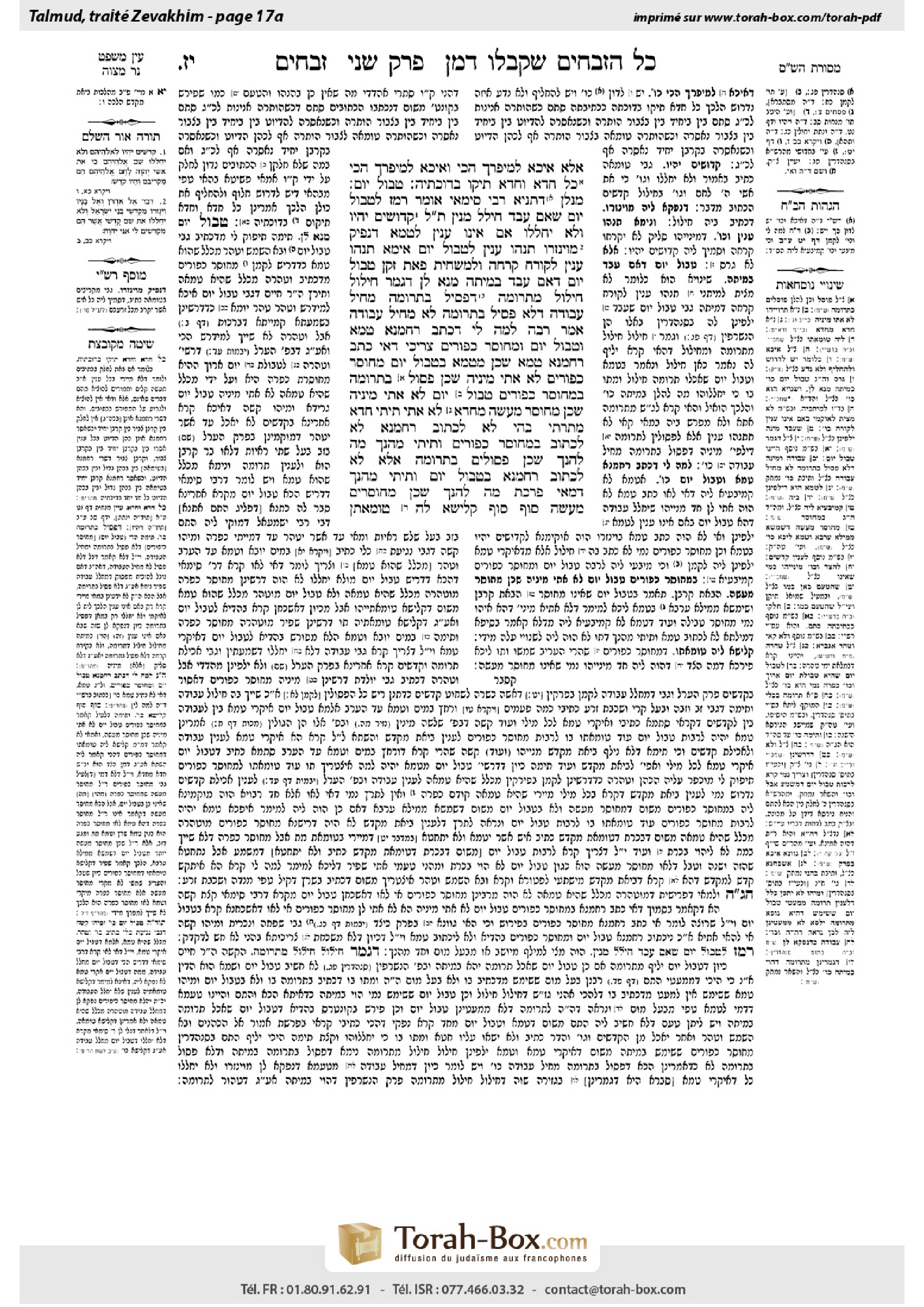
Zevachim 17a: Talmud study for Daf Yomi
Daf Yomi is the daily study of one Talmud folio. Explore 37 tractates with scans, Hebrew text, Sefaria English and AI-generated French translations where annotated.
Passage selection and English or AI-generated French translation are available where the scan has annotations. Daf Study is independent of Torah-Box and Sefaria.
Browse Zevachim · זבחים · All tractatesZevachim 17a text and translations
This page of Zevachim includes the Aramaic text, an English translation and an AI-generated French translation, alongside the scan above.
זבחים י״ז א · Aramaic and Hebrew text
אֶלָּא אִיכָּא לְמִיפְרַךְ הָכִי וְאִיכָּא לְמִיפְרַךְ הָכִי, כֹּל חֲדָא וַחֲדָא תֵּיקוּ בְּדוּכְתֵּיהּ.
טְבוּל יוֹם מְנָלַן? דְּתַנְיָא, רַבִּי סִימַאי אוֹמֵר: רֶמֶז לִטְבוּל יוֹם שֶׁאִם עָבַד חִילֵּל – מִנַּיִן? תַּלְמוּד לוֹמַר: ״קְדֹשִׁים יִהְיוּ וְלֹא יְחַלְּלוּ״;
אִם אֵינוֹ עִנְיָן לְטָמֵא – דְּנָפֵיק מִ״וְּיִנָּזְרוּ״, תְּנֵהוּ עִנְיָן לִטְבוּל יוֹם.
אֵימָא: תְּנֵהוּ עִנְיָן לְקוֹרֵחַ קׇרְחָה, וּלְמַשְׁחִית פְּאַת זָקָן!
טְבוּל יוֹם דְּאִם עָבַד – בְּמִיתָה, מְנָא לַן? דְּגָמַר ״חִילּוּל״–״חִילּוּל״ מִתְּרוּמָה; דְּפָסֵיל בִּתְרוּמָה – מַחֵיל עֲבוֹדָה, דְּלָא פָּסֵיל בִּתְרוּמָה – לָא מַחֵיל עֲבוֹדָה.
אָמַר רַבָּה: לְמָה לִי דִּכְתַב רַחֲמָנָא טָמֵא, וּטְבוּל יוֹם, וּמְחוּסַּר כִּפּוּרִים?
צְרִיכִי; דְּאִי כְּתַב רַחֲמָנָא טָמֵא – שֶׁכֵּן מְטַמֵּא. בִּטְבוּל יוֹם; מְחוּסַּר כִּפּוּרִים לָא אָתֵי מִינֵּיהּ – שֶׁכֵּן פָּסוּל בִּתְרוּמָה. בִּמְחוּסַּר כִּפּוּרִים; טְבוּל יוֹם לָא אָתֵי מִינֵּיהּ – שֶׁכֵּן מְחוּסָּר מַעֲשֶׂה.
מֵחֲדָא לָא אָתֵי; תֵּיתֵי חֲדָא מִתַּרְתֵּי!
בְּהֵי לָא לִכְתּוֹב רַחֲמָנָא? לָא לִכְתּוֹב בִּמְחוּסַּר כִּפּוּרִים וְתֵיתֵי מֵהָנָךְ – מָה לְהָנָךְ, שֶׁכֵּן פְּסוּלִים בִּתְרוּמָה.
אֶלָּא לָא לִכְתּוֹב רַחֲמָנָא בִּטְבוּל יוֹם, וְתֵיתֵי מֵהָנָךְ; דְּמַאי פָּרְכַתְּ – מָה לְהָנָךְ שֶׁכֵּן מְחוּסָּרִים מַעֲשֶׂה? סוֹף סוֹף קְלִישָׁא לַהּ טוּמְאָתָן.
Zevachim 17a · English translation
Rather, one can derive this way and one can derive that way. Since these derivations contradict one another, each and every halakha shall stand in its place and not modify the other by a fortiori inference.
§ The mishna teaches that sacrificial rites performed by one who immersed that day are disqualified. The Gemara asks: From where do we derive this halakha? The Gemara answers: It is derived as it is taught in a baraita that Rabbi Simai says: From where in the Torah is the allusion with regard to a priest who immersed that day, that if he performed the Temple service he desecrated that service? It is derived from a verse, as the verse states: “They shall be sacred to their God and they shall not desecrate the name of their God” (Leviticus 21:6).
If this verse is not written with regard to the matter of an impure priest who performed the Temple service, as that halakha is derived for us from the verse: “That they separate themselves from the sacred items of the children of Israel” (Leviticus 22:2), then apply it to the matter of a priest who immersed that day who performed the Temple service. Although he is no longer impure in every sense, the priest remains impure in the sense that he is prohibited from partaking of teruma and sacrificial food, and from entering the Temple.
The Gemara asks: Why must the verse be applied to the matter of one who immersed that day? Say that one should apply it to the matter of one who creates a bald spot upon his head or to the matter of one who destroys his beard, as these matters are discussed in the preceding verse.
The Gemara responds: This verse is already used to indicate another halakha relating to one who immersed that day: From where do we derive that if one who immersed that day performed sacrificial rites, he is liable to receive the punishment of death at the hand of Heaven? As it is derived by verbal analogy between profanation mentioned in this context and profanation from teruma, as the verse states in this context: “And not profane the name of their God” (Leviticus 21:6), and the verse states with regard to teruma: “Lest they bear sin for it, and die therein, if they profane it” (Leviticus 22:9). It can be inferred from this verbal analogy that one who disqualifies teruma, i.e., one who immersed that day, profanes the Temple service, and one who does not disqualify teruma, i.e., one who creates a bald spot or one who destroys his beard, does not profane the service.
§ Rabba said: Why do I need that which the Merciful One wrote, i.e., that an impure priest, and one who immersed that day, and one who has not yet brought an atonement offering all disqualify the rites they perform? Wouldn’t it have been enough to teach the halakha in only one case?
Rabba explains: All three are necessary, as in each case there is a stringency not present in the others. Therefore, had the Merciful One written only that an impure priest desecrates the service, one might say that this is because he imparts impurity to others, and since the other two cases do not, one cannot derive them from the case of an impure priest. And had the Merciful One written the halakha only with regard to one who immersed that day, then the case of one who has not yet brought an atonement offering could not be derived from it, since the former is unfit to partake of teruma while the latter is not. And had the Merciful One written the halakha only with regard to one who has not yet brought an atonement offering, then the case of one who immersed that day could not be derived from it, since only the former has not yet performed a necessary action, while one who immersed that day must simply wait for nightfall in order to become fully pure.
The Gemara asks: Still, why are all three necessary? Granted, from one of these cases the other two cannot be derived, but let one be derived from the other two.
The Gemara asks: Which of the three should the Merciful One not write? If one suggests: Let the Merciful One not write the halakha with regard to one who has not yet brought an atonement offering and derive it from these other two, an impure priest and one who immersed that day, one can reply: What is notable about these? They are notable in that they are unfit to partake of teruma. Since one who has not yet brought an atonement offering may partake of teruma, perhaps he does not disqualify rites he performs.
Rather, say: Let the Merciful One not write the halakha with regard to one who immersed that day and derive it from these other two, an impure priest and one who has not yet brought an atonement offering. As, what can you say to refute this? One cannot reply: What is notable about these; they are notable since they have not yet performed a necessary action, because ultimately their impurity, i.e., the impurity of one who has not yet brought an atonement offering, is weak when compared to one who immersed that day, and relatively speaking, one who has not yet brought an atonement offering is not considered to be lacking the performance of an action.
Zevachim 17a · Traduction française (IA)
On peut plutôt déduire dans un sens comme dans l’autre. Puisque ces déductions se contredisent, chaque halakha doit rester à sa place, sans modifier l’autre par un raisonnement a fortiori.
§ La Michna enseigne que les rites sacrificiels accomplis par celui qui s’est immergé ce jour-là sont invalides. La Guemara demande : D’où déduisons-nous cette halakha ? La Guemara répond : Elle est déduite de ce qui est enseigné dans une baraïta, où Rabbi Simai dit : Où trouve-t-on dans la Torah une allusion au prêtre qui s’est immergé ce jour-là, indiquant que, s’il a accompli le service du Temple, il l’a profané ? On le déduit d’un verset, comme il est dit : « Ils seront saints pour leur Dieu et ne profaneront pas le nom de leur Dieu » (Lévitique 21, 6).
Si ce verset n’est pas écrit au sujet du prêtre impur qui a accompli le service du Temple, puisque cette halakha est déjà déduite pour nous du verset : « Qu’ils se séparent des choses saintes des enfants d’Israël » (Lévitique 22, 2), alors applique-le au cas du prêtre qui s’est immergé ce jour-là et a accompli le service du Temple. Bien qu’il ne soit plus impur à tous égards, le prêtre demeure impur en ce qu’il lui est interdit de consommer la terouma et les aliments sacrificiels, ainsi que d’entrer dans le Temple.
La Guemara demande : Pourquoi faut-il appliquer le verset au cas de celui qui s’est immergé ce jour-là ? Dis plutôt qu’il faut l’appliquer au cas de celui qui se fait une tonsure sur la tête ou de celui qui détruit sa barbe, puisque ces cas sont évoqués dans le verset précédent.
La Guemara répond : Ce verset sert déjà à enseigner une autre halakha concernant celui qui s’est immergé ce jour-là : D’où déduisons-nous que, s’il accomplit des rites sacrificiels, il est passible de mort par la main du Ciel ? On le déduit par analogie verbale entre la profanation mentionnée dans ce contexte et celle de la terouma. En effet, il est dit dans ce contexte : « Et ne profaneront pas le nom de leur Dieu » (Lévitique 21, 6), et il est dit au sujet de la terouma : « De peur qu’ils ne portent la faute liée à celle-ci et qu’ils n’en meurent, s’ils la profanent » (Lévitique 22, 9). On peut déduire de cette analogie verbale que celui qui invalide la terouma, c’est-à-dire celui qui s’est immergé ce jour-là, profane le service du Temple, tandis que celui qui n’invalide pas la terouma, c’est-à-dire celui qui se fait une tonsure ou détruit sa barbe, ne profane pas le service.
§ Rabba dit : Pourquoi le Miséricordieux a-t-il dû écrire que le prêtre impur, celui qui s’est immergé ce jour-là et celui qui n’a pas encore apporté son sacrifice expiatoire invalident les rites qu’ils accomplissent ? N’aurait-il pas suffi d’enseigner la halakha dans un seul cas ?
Rabba explique : Les trois cas sont nécessaires, car chacun comporte une rigueur absente des autres. Ainsi, si le Miséricordieux avait écrit uniquement qu’un prêtre impur profane le service, on aurait pu dire que c’est parce qu’il transmet l’impureté à autrui ; puisque les deux autres cas ne la transmettent pas, on ne pourrait pas déduire leur cas de celui du prêtre impur. Si le Miséricordieux avait écrit la halakha uniquement au sujet de celui qui s’est immergé ce jour-là, on n’aurait pas pu en déduire le cas de celui qui n’a pas encore apporté son sacrifice expiatoire, car le premier n’est pas apte à consommer la terouma, tandis que le second l’est. Enfin, si le Miséricordieux avait écrit la halakha uniquement au sujet de celui qui n’a pas encore apporté son sacrifice expiatoire, on n’aurait pas pu en déduire le cas de celui qui s’est immergé ce jour-là, car seul le premier n’a pas encore accompli une action nécessaire, tandis que celui qui s’est immergé ce jour-là doit simplement attendre la tombée de la nuit pour devenir entièrement pur.
La Guemara demande : Pourtant, pourquoi les trois cas sont-ils nécessaires ? Certes, on ne peut pas déduire les deux autres de l’un de ces cas, mais ne pourrait-on pas déduire l’un d’eux des deux autres ?
La Guemara demande : Lequel des trois le Miséricordieux aurait-il pu ne pas écrire ? Si l’on propose que le Miséricordieux n’écrive pas la halakha concernant celui qui n’a pas encore apporté son sacrifice expiatoire, et qu’on la déduise des deux autres cas — celui du prêtre impur et celui de celui qui s’est immergé ce jour-là —, on peut répondre : En quoi ces cas sont-ils particuliers ? En ceci qu’ils ne sont pas aptes à consommer la terouma. Puisque celui qui n’a pas encore apporté son sacrifice expiatoire peut consommer la terouma, peut-être n’invalide-t-il pas les rites qu’il accomplit.
Dis plutôt que le Miséricordieux n’écrive pas la halakha concernant celui qui s’est immergé ce jour-là et qu’on la déduise des deux autres cas — celui du prêtre impur et celui de celui qui n’a pas encore apporté son sacrifice expiatoire. Que peut-on répondre pour réfuter cela ? On ne peut pas dire : En quoi ces cas sont-ils particuliers ? En ceci qu’ils n’ont pas encore accompli une action nécessaire. Car, en définitive, l’impureté de celui qui n’a pas encore apporté son sacrifice expiatoire est faible par rapport à celle de celui qui s’est immergé ce jour-là ; et, relativement, celui qui n’a pas encore apporté son sacrifice expiatoire n’est pas considéré comme devant encore accomplir une action.
Traduction française générée par IA à partir de l’édition anglaise de Sefaria. Vérifie toujours un passage avec le texte source.
Text from Sefaria: William Davidson Edition - Vocalized Aramaic (CC BY NC); William Davidson Edition - English (CC BY NC).