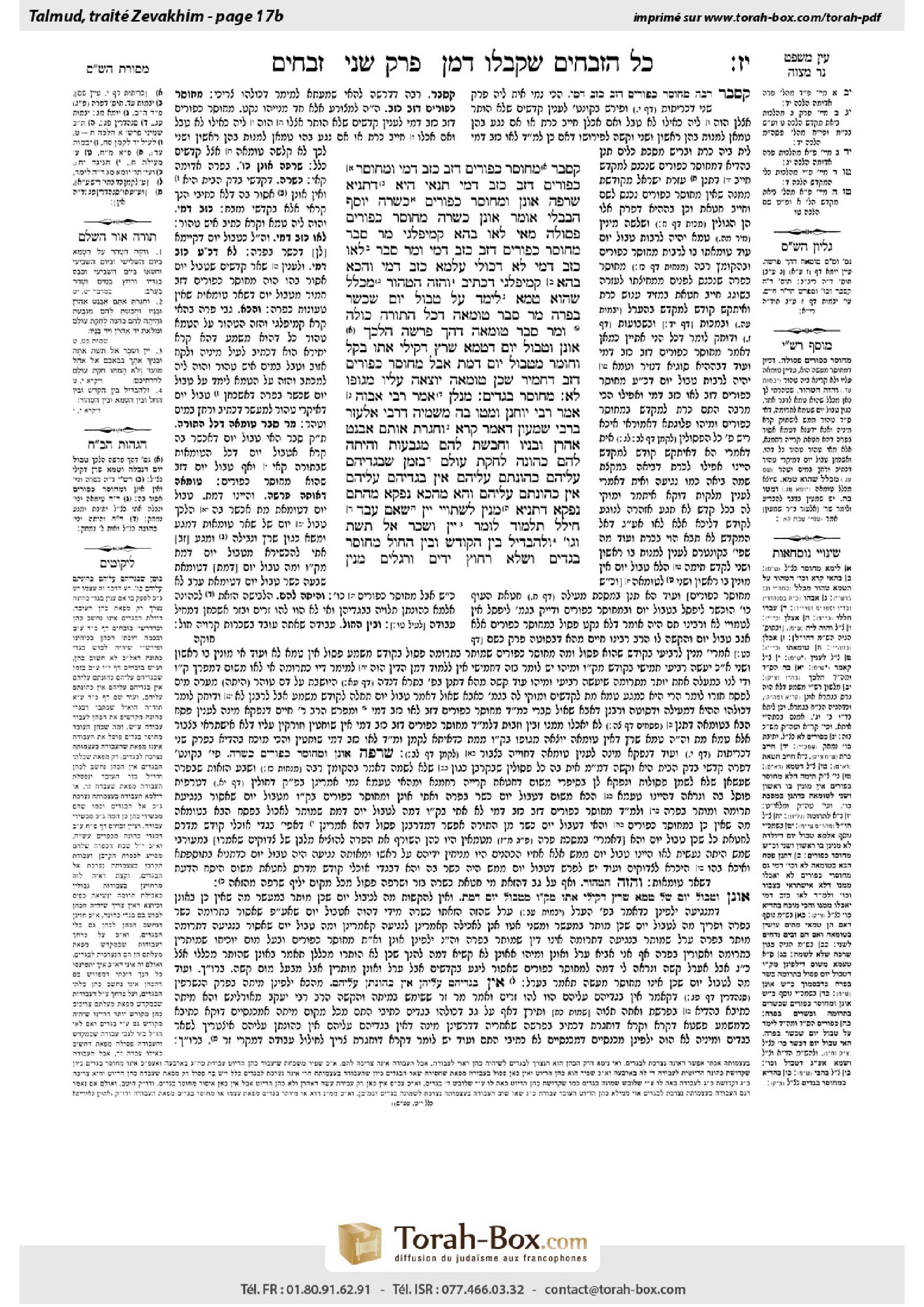
Zevachim 17b: Talmud study for Daf Yomi
Daf Yomi is the daily study of one Talmud folio. Explore 37 tractates with scans, Hebrew text, Sefaria English and AI-generated French translations where annotated.
Passage selection and English or AI-generated French translation are available where the scan has annotations. Daf Study is independent of Torah-Box and Sefaria.
Browse Zevachim · זבחים · All tractatesZevachim 17b text and translations
This page of Zevachim includes the Aramaic text, an English translation and an AI-generated French translation, alongside the scan above.
זבחים י״ז ב · Aramaic and Hebrew text
קָסָבַר מְחוּסַּר כִּפּוּרִים דְּזָב – כְּזָב דָּמֵי.
וּמְחוּסַּר כִּפּוּרִים דְּזָב כְּזָב דָּמֵי – תַּנָּאֵי הִיא; דְּתַנְיָא: שְׂרָפָהּ אוֹנֵן וּמְחוּסַּר כִּפּוּרִים – כְּשֵׁרָה. יוֹסֵף הַבַּבְלִי אוֹמֵר: אוֹנֵן – כְּשֵׁרָה, מְחוּסַּר כִּפּוּרִים – פְּסוּלָה. מַאי, לָאו בְּהָא קָמִיפַּלְגִי – מָר סָבַר: מְחוּסַּר כִּפּוּרִים דְּזָב כְּזָב דָּמֵי, וּמָר סָבַר: לָאו כְּזָב דָּמֵי?
לָא, דְּכוּלֵּי עָלְמָא – כְּזָב דָּמֵי; וְהָכָא בְּהָא קָמִיפַּלְגִי, דִּכְתִיב: ״וְהִזָּה הַטָּהֹר״ – מִכְּלָל שֶׁהוּא טָמֵא; לִימֵּד עַל טְבוּל יוֹם שֶׁכָּשֵׁר בַּפָּרָה.
מָר סָבַר: טוּמְאָה דְּכׇל הַתּוֹרָה כּוּלָּהּ, וּמָר סָבַר: טוּמְאָה דְּהָךְ פָּרָשָׁה.
הִלְכָּךְ, אוֹנֵן וּטְבוּל יוֹם דִּטְמֵא שֶׁרֶץ – דְּקִילִי, אָתוּ בְּקַל וָחוֹמֶר מִטְּבוּל יוֹם דְּמֵת; אֲבָל מְחוּסַּר כִּפּוּרִים דְּזָב – דַּחֲמִיר, שֶׁכֵּן טוּמְאָה יוֹצְאָה עָלָיו מִגּוּפוֹ; לָא.
מְחוּסַּר בְּגָדִים מְנָלַן? אָמַר רַבִּי אֲבוּהּ אָמַר רַבִּי יוֹחָנָן, וּמָטוּ בָּהּ מִשְּׁמֵיהּ דְּרַבִּי אֶלְעָזָר בְּרַבִּי שִׁמְעוֹן, דְּאָמַר קְרָא: ״וְחָגַרְתָּ אוֹתָם אַבְנֵט אַהֲרֹן וּבָנָיו, וְחָבַשְׁתָּ לָהֶם מִגְבָּעֹת, וְהָיְתָה לָהֶם כְּהֻנָּה לְחֻקַּת עוֹלָם״ – בִּזְמַן שֶׁבִּגְדֵיהֶם עֲלֵיהֶם, כְּהוּנָּתָם עֲלֵיהֶם; אֵין בִּגְדֵיהֶם עֲלֵיהֶם, אֵין כְּהוּנָּתָם עֲלֵיהֶם.
וְהָא – מֵהָכָא נָפְקָא?! מֵהָתָם נָפְקָא – דְּתַנְיָא: מִנַּיִן לִשְׁתוּיֵי יַיִן שֶׁאִם עָבַד חִילֵּל? תַּלְמוּד לוֹמַר: ״יַיִן וְשֵׁכָר אַל תֵּשְׁתְּ וְגוֹ׳, וּלְהַבְדִּיל בֵּין הַקֹּדֶשׁ וּבֵין הַחֹל״. מְחוּסַּר בְּגָדִים וְשֶׁלֹּא רָחוּץ יָדַיִם וְרַגְלַיִם, מִנַּיִן?
Zevachim 17b · English translation
The Gemara responds: Rabba holds that a man who experiences a gonorrhea-like discharge [zav] who has not yet brought an atonement offering is still considered to have the impure status of a zav. The impurity of one who has immersed but has not yet brought an atonement offering is therefore considered stronger than that of one who immersed that day but requires no atonement.
The Gemara notes: And the matter of whether a zav who has not yet brought an atonement offering is still considered a zav is a dispute between tanna’im, as it is taught in a baraita: If an acute mourner or one who has not yet brought an atonement offering burned the red heifer, it is fit. Yosef the Babylonian says: If an acute mourner burned it, it is fit, but if one who has not yet brought an atonement offering burned it, it is disqualified. What, is it not that they disagree with regard to this: One Sage, Yosef the Babylonian, holds that a zav who has not yet brought an atonement offering is considered a full-fledged zav and therefore disqualifies the red heifer, and one Sage, the first tanna, holds that a zav who has not yet brought an atonement offering is not considered a zav, but is instead considered like one who immersed that day, who is fit to burn the red heifer?
The Gemara responds: No, everyone agrees that he is considered a zav, and here the tanna’im disagree with regard to this matter, as it is written with regard to the rite of the red heifer: “And the pure person shall sprinkle” the water of purification (Numbers 19:19). The preceding verse already states that the one performing the service must be ritually pure. Therefore, by stating “pure” this verse emphasizes that he needs be pure enough only to perform the rite of the red heifer specifically. By inference, one derives that he may be impure in some way that disqualifies him for other rites. This teaches that one who immersed that day is fit to participate in the rite of the red heifer.
The tanna’im disagree as to the extent of this halakha: One Sage, the first tanna, holds that it is referring to any state of impurity mentioned in the entire Torah, i.e., anyone who immersed that day due to any impurity may participate in the rite of the red heifer. And one Sage, Yosef the Babylonian, holds that it is referring specifically to one who was in the state of impurity mentioned in this passage, i.e., impurity contracted from a corpse, which the red heifer purifies.
Therefore, according to Yosef the Babylonian, with regard to an acute mourner and one who immersed that day after becoming impure due to contact with the carcass of a creeping animal, since they are treated more leniently, they are derived a fortiori from the case of one who immersed that day to remove impurity contracted from a corpse, and they are fit to participate in the rite of the red heifer. But with regard to a zav who has not yet brought an atonement offering, who is treated more stringently, since his impurity emerges onto him from his body rather than being imparted from without, one does not derive that he is fit to participate in the rite of the red heifer.
§ The mishna teaches that a priest lacking the requisite priestly vestments disqualifies the rites he performs. The Gemara asks: From where do we derive this? Rabbi Avuh says that Rabbi Yoḥanan says, and some determined it to be stated in the name of Rabbi Elazar, son of Rabbi Shimon: As the verse states: “And you shall gird them with belts, Aaron and his sons, and bind mitres on them; and they shall have the priesthood by a perpetual statute” (Exodus 29:9). The verse indicates that when their vestments are on them, their priesthood is upon them, but if their vestments are not on them, their priesthood is not upon them and their rites are disqualified.
The Gemara asks: But is this halakha derived from here? It is derived from there, as it is taught in a baraita: From where is it derived that if those who drank wine performed sacrificial rites they have desecrated the service? The verse states with regard to the priests: “Drink no wine or strong drink, you, nor your sons with you, when you go into the Tent of Meeting, so that you not die; it shall be a statute forever throughout your generations. That you may put difference between the holy and the common” (Leviticus 10:9–10). The baraita continues: With regard to one lacking the requisite vestments and one whose hands and feet are not washed, from where is it derived that their rites are disqualified as well?
Zevachim 17b · Traduction française (IA)
La Guemara répond : Rabba considère qu’un homme qui présente un écoulement semblable à la gonorrhée [zav] et n’a pas encore apporté de sacrifice expiatoire conserve le statut d’impureté d’un zav. L’impureté de celui qui s’est immergé mais n’a pas encore apporté de sacrifice expiatoire est donc considérée comme plus grave que celle de celui qui s’est immergé le jour même mais n’a pas besoin d’apporter de sacrifice expiatoire.
La Guemara fait remarquer que la question de savoir si un zav qui n’a pas encore apporté de sacrifice expiatoire est toujours considéré comme un zav fait l’objet d’un désaccord entre des tannaïm, comme l’enseigne une baraïta : Si un endeuillé le jour du décès ou une personne qui n’a pas encore apporté de sacrifice expiatoire a brûlé la vache rousse, celle-ci est valide. Yossef le Babylonien dit : Si un endeuillé le jour du décès l’a brûlée, elle est valide, mais si une personne qui n’a pas encore apporté de sacrifice expiatoire l’a brûlée, elle est invalidée. N’est-ce pas sur ce point qu’ils sont en désaccord ? Un Sage, Yossef le Babylonien, considère qu’un zav qui n’a pas encore apporté de sacrifice expiatoire est un zav à part entière et invalide donc la vache rousse ; l’autre Sage, le premier tanna, considère qu’un zav qui n’a pas encore apporté de sacrifice expiatoire n’est pas considéré comme un zav, mais plutôt comme quelqu’un qui s’est immergé le jour même, lequel peut brûler la vache rousse.
La Guemara répond : Non, tous conviennent qu’il est considéré comme un zav. Ici, les tannaïm sont en désaccord sur un autre point, car il est écrit au sujet du rite de la vache rousse : « Et la personne pure fera l’aspersion » de l’eau de purification (Nombres 19:19). Le verset précédent indique déjà que celui qui accomplit le rite doit être rituellement pur. Par conséquent, en précisant « pure », ce verset souligne qu’il lui suffit d’être pur au degré requis pour accomplir précisément le rite de la vache rousse. On en déduit qu’il peut être impur d’une manière qui l’invaliderait pour d’autres rites. Cela enseigne que celui qui s’est immergé le jour même peut participer au rite de la vache rousse.
Les tannaïm sont en désaccord sur la portée de cette halakha : un Sage, le premier tanna, considère qu’elle concerne tout état d’impureté mentionné dans l’ensemble de la Torah, c’est-à-dire que toute personne qui s’est immergée le jour même à la suite d’une impureté quelconque peut participer au rite de la vache rousse. L’autre Sage, Yossef le Babylonien, considère qu’elle concerne spécifiquement celui qui se trouvait dans l’état d’impureté mentionné dans ce passage, c’est-à-dire l’impureté contractée au contact d’un cadavre, que la vache rousse permet de purifier.
Par conséquent, selon Yossef le Babylonien, un endeuillé le jour du décès et une personne qui s’est immergée le jour même après avoir été rendue impure au contact de la carcasse d’un animal rampant, puisqu’ils sont traités avec plus d’indulgence, sont déclarés aptes à participer au rite de la vache rousse par un raisonnement a fortiori fondé sur le cas de celui qui s’est immergé le jour même pour être purifié de l’impureté contractée au contact d’un cadavre. En revanche, s’agissant d’un zav qui n’a pas encore apporté de sacrifice expiatoire, auquel on applique un traitement plus rigoureux, puisque son impureté provient de son propre corps plutôt que de lui être transmise de l’extérieur, on ne déduit pas qu’il peut participer au rite de la vache rousse.
§ La Michna enseigne qu’un prêtre dépourvu des vêtements sacerdotaux requis invalide les rites qu’il accomplit. La Guemara demande : D’où le déduit-on ? Rabbi Avouh dit au nom de Rabbi Yoḥanan — et certains rapportent que cet enseignement a été transmis au nom de Rabbi Elazar, fils de Rabbi Shimon — : le verset dit : « Tu les ceindras de ceintures, Aaron et ses fils, et tu leur attacheras des turbans ; et ils exerceront la prêtrise en vertu d’un statut perpétuel » (Exode 29:9). Le verset indique que, lorsqu’ils portent leurs vêtements, leur prêtrise leur est conférée ; mais s’ils ne les portent pas, leur prêtrise ne leur est pas conférée et leurs rites sont invalidés.
La Guemara demande : Mais cette halakha ne se déduit-elle pas d’un autre passage ? Elle se déduit de là, comme l’enseigne une baraïta : D’où déduit-on que ceux qui ont bu du vin et accompli des rites sacrificiels ont profané le service ? Le verset dit au sujet des prêtres : « Ne buvez pas de vin ni de boisson enivrante, toi et tes fils avec toi, lorsque vous entrez dans la Tente d’assignation, afin que vous ne mouriez pas ; ce sera un statut perpétuel pour vos générations, afin que vous puissiez distinguer entre le sacré et le profane » (Lévitique 10:9–10). La baraïta poursuit : D’où déduit-on qu’une personne dépourvue des vêtements requis et une personne dont les mains et les pieds n’ont pas été lavés invalident également leurs rites ?
Traduction française générée par IA à partir de l’édition anglaise de Sefaria. Vérifie toujours un passage avec le texte source.
Text from Sefaria: William Davidson Edition - Vocalized Aramaic (CC BY NC); William Davidson Edition - English (CC BY NC).