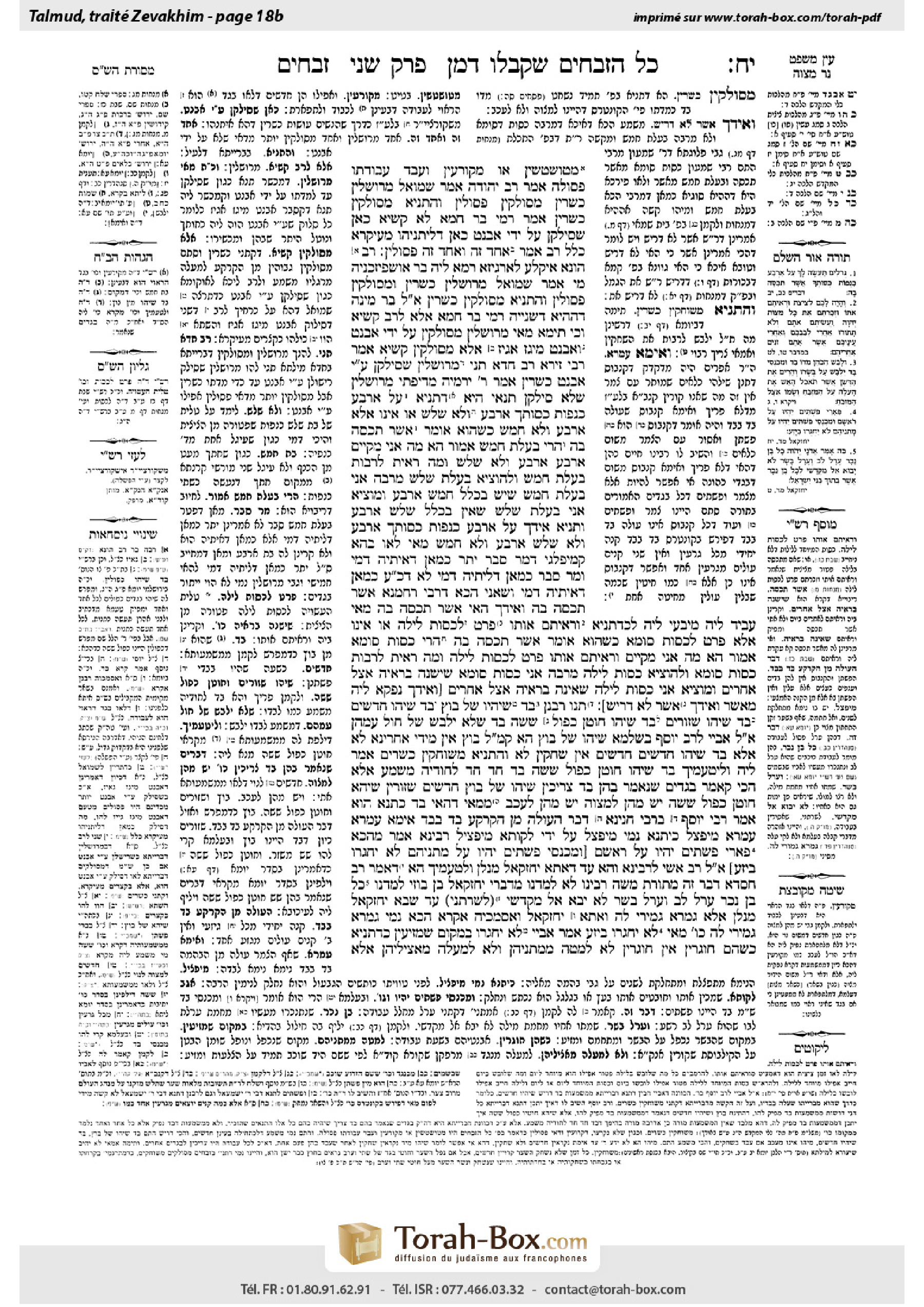
Zevachim 18b: Talmud study for Daf Yomi
Daf Yomi is the daily study of one Talmud folio. Explore 37 tractates with scans, Hebrew text, Sefaria English and AI-generated French translations where annotated.
Passage selection and English or AI-generated French translation are available where the scan has annotations. Daf Study is independent of Torah-Box and Sefaria.
Browse Zevachim · זבחים · All tractatesZevachim 18b text and translations
This page of Zevachim includes the Aramaic text, an English translation and an AI-generated French translation, alongside the scan above.
זבחים י״ח ב · Aramaic and Hebrew text
מְטוּשְׁטָשִׁין אוֹ מְקוֹרָעִין – וְעָבַד; עֲבוֹדָתוֹ פְּסוּלָה.
אָמַר רַב יְהוּדָה אָמַר שְׁמוּאֵל: מְרוּשָּׁלִין – כְּשֵׁרִין, מְסוּלָּקִין – פְּסוּלִין. וְהָתַנְיָא מְסוּלָּקִין כְּשֵׁרִין! אָמַר רָמֵי בַּר חָמָא: לָא קַשְׁיָא; כָּאן שֶׁסִּילְקָן עַל יְדֵי אַבְנֵט, כָּאן דְּלֵיתְנִיהוּ מֵעִיקָּרָא כְּלָל.
רַב אָמַר: אֶחָד זֶה וְאֶחָד זֶה – פְּסוּלִין.
רַב הוּנָא אִיקְּלַע לְאַרְגִּיזָא, רְמָא לֵיהּ בַּר אוּשְׁפִּיזְכָנֵיהּ: מִי אָמַר שְׁמוּאֵל מְרוּשָּׁלִין כְּשֵׁרִין וּמְסוּלָּקִין פְּסוּלִין?! וְהָתַנְיָא: מְסוּלָּקִין – כְּשֵׁרִין! אֲמַר לֵיהּ: בַּר מִינַּהּ דְּהַהִיא, דְּשַׁנְּיַיהּ רָמֵי בַּר חָמָא.
אֶלָּא לְרַב – קַשְׁיָא! וְכִי תֵּימָא: מַאי מְרוּשָּׁלִין – מְסוּלָּקִין עַל יְדֵי אַבְנֵט, וְאַבְנֵט מֵיגָז אָגֵיז; אֶלָּא מְסוּלָּקִין קַשְׁיָא!
אָמַר רַבִּי זֵירָא, רַב חֲדָא תָּנֵי: מְרוּשָּׁלִין שֶׁסִּילְּקָן עַל יְדֵי אַבְנֵט – כְּשֵׁרִין.
אָמַר רַבִּי יִרְמְיָה מִדִּיפְתִּי: מְרוּשָּׁלִין שֶׁלֹּא סִילְּקָן – תַּנָּאֵי הִיא, דְּתַנְיָא: ״עַל אַרְבַּע כַּנְפוֹת כְּסוּתְךָ״ – אַרְבַּע וְלֹא שָׁלֹשׁ. אוֹ אֵינוֹ אֶלָּא אַרְבַּע וְלֹא חָמֵשׁ? כְּשֶׁהוּא אוֹמֵר ״אֲשֶׁר תְּכַסֶּה בָּהּ״ – הֲרֵי בַּעֲלַת חָמֵשׁ אָמוּר; הָא מָה אֲנִי מְקַיֵּים אַרְבַּע? אַרְבַּע וְלֹא שָׁלֹשׁ. וּמָה רָאִיתָ לְרַבּוֹת בַּעֲלַת חָמֵשׁ וּלְהוֹצִיא בַּעֲלַת שָׁלֹשׁ? מְרַבֶּה אֲנִי בַּעֲלַת חָמֵשׁ – שֶׁיֵּשׁ בִּכְלַל חָמֵשׁ אַרְבַּע, וּמוֹצִיא אֲנִי בַּעֲלַת שָׁלֹשׁ – שֶׁאֵין בִּכְלַל שָׁלֹשׁ אַרְבַּע.
וְתַנְיָא אִידַּךְ: ״עַל אַרְבַּע כַּנְפוֹת כְּסוּתְךָ״ – אַרְבַּע וְלֹא שָׁלֹשׁ, אַרְבַּע וְלֹא חָמֵשׁ. מַאי, לָאו בְּהָא קָמִיפַּלְגִי – דְּמָר סָבַר: יָתֵר כְּמַאן דְּאִיתֵיהּ דָּמֵי, וּמָר סָבַר: כְּמַאן דְּלֵיתֵיהּ דָּמֵי?
לָא, דְּכוּלֵּי עָלְמָא כְּמַאן דְּאִיתֵיהּ דָּמֵי; וְשָׁאנֵי הָכָא, דְּרַבִּי רַחֲמָנָא: ״אֲשֶׁר תְּכַסֶּה בָּהּ״.
וְאִידַּךְ, הַאי ״אֲשֶׁר תְּכַסֶּה בָּהּ״ מַאי עָבֵיד לֵיהּ? מִיבְּעֵי לֵיהּ לְכִדְתַנְיָא: ״וּרְאִיתֶם אֹתוֹ״ – פְּרָט לִכְסוּת לַיְלָה. אוֹ אֵינוֹ אֶלָּא פְּרָט לִכְסוּת סוֹמֵא? כְּשֶׁהוּא אוֹמֵר: ״אֲשֶׁר תְּכַסֶּה בָּהּ״ – הֲרֵי כְּסוּת סוֹמֵא אָמוּר, הָא מָה אֲנִי מְקַיֵּים ״וּרְאִיתֶם אֹתוֹ״? פְּרָט לִכְסוּת לַיְלָה.
וּמָה רָאִיתָ לְרַבּוֹת כְּסוּת סוֹמֵא וּלְהוֹצִיא כְּסוּת לַיְלָה? מְרַבֶּה אֲנִי כְּסוּת סוֹמֵא – שֶׁיֶּשְׁנָהּ בִּרְאִיָּה אֵצֶל אֲחֵרִים, וּמוֹצִיא אֲנִי כְּסוּת לַיְלָה – שֶׁאֵינָהּ בִּרְאִיָּה אֵצֶל אֲחֵרִים.
וְאִידַּךְ – נָפְקָא לֵיהּ מֵ״אֲשֶׁר״. וְאִידַּךְ – ״אֲשֶׁר״ לָא דָּרֵישׁ.
תָּנוּ רַבָּנַן: בַּד – שֶׁיִּהְיוּ שֶׁל בּוּץ; ״בַּד״ – שֶׁיְּהוּ חֲדָשִׁים; ״בַּד״ – שֶׁיְּהוּ שְׁזוּרִים; ״בַּד״ – שֶׁיְּהוּ חוּטָן כָּפוּל שִׁשָּׁה; ״בַּד״ – שֶׁלֹּא יִלְבַּשׁ שֶׁל חוֹל עִמָּהֶן.
אֲמַר לֵיהּ אַבָּיֵי לְרַב יוֹסֵף: בִּשְׁלָמָא שֶׁיְּהוּ שֶׁל בּוּץ – הָא קָא מַשְׁמַע לַן: בּוּץ אִין, מִידֵּי אַחֲרִינָא לָא. אֶלָּא ״בַּד״ שֶׁיְּהוּ חֲדָשִׁים – חֲדָשִׁים אִין, שְׁחָקִין לָא?! וְהָתַנְיָא: מְשׁוּחָקִין – כְּשֵׁרִים!
אֲמַר לֵיהּ: וְלִיטַעְמָיךְ, ״בַּד״ – שֶׁיְּהוּ חוּטָן כָּפוּל שִׁשָּׁה?! ״בַּד״ – חַד חַד לְחוֹדֵיהּ מַשְׁמַע! אֶלָּא הָכִי קָאָמַר: בְּגָדִים שֶׁנֶּאֱמַר בָּהֶן ״בַּד״ – צְרִיכִין שֶׁיְּהוּ שֶׁל בּוּץ, חֲדָשִׁים, שְׁזוּרִין, שֶׁיְּהֵא חוּטָן כָּפוּל שִׁשָּׁה; יֵשׁ מֵהֶן לְמִצְוָה, יֵשׁ מֵהֶן לְעַכֵּב.
מִמַּאי דְּהַאי ״בַּד״ – כִּתָּנָא הוּא? אָמַר רַבִּי יוֹסֵף בְּרַבִּי חֲנִינָא: דָּבָר הָעוֹלֶה מִן הַקַּרְקַע בַּד בְּבַד.
אֵימָא עַמְרָא! עַמְרָא מִיפְּצֵל. כִּיתָּנָא נָמֵי מִיפְּצֵל! עַל יְדֵי לָקוּתָא מִיפְּצֵיל.
רָבִינָא אָמַר מֵהָכָא: ״פַּאֲרֵי פִשְׁתִּים יִהְיוּ עַל רֹאשָׁם, וּמִכְנְסֵי פִשְׁתִּים יִהְיוּ עַל מׇתְנֵיהֶם, לֹא יַחְגְּרוּ בַּיָּזַע״.
אֲמַר לֵיהּ רַב אָשֵׁי לְרָבִינָא: וְהָא עַד דַּאֲתָא יְחֶזְקֵאל – מְנָלַן? וּלְטַעְמָיךְ, הָא דְּאָמַר רַב חִסְדָּא: דָּבָר זֶה – מִתּוֹרַת מֹשֶׁה רַבֵּינוּ לֹא לָמַדְנוּ, מִדִּבְרֵי יְחֶזְקֵאל בֶּן בּוּזִי לָמַדְנוּ: ״כׇּל בֶּן נֵכָר עֶרֶל לֵב וְעֶרֶל בָּשָׂר לֹא יָבֹא אֶל מִקְדָּשִׁי לְשָׁרְתֵנִי״; עַד שֶׁבָּא יְחֶזְקֵאל מְנָלַן? אֶלָּא גְּמָרָא גְּמִירִי לַהּ – וַאֲתָא יְחֶזְקֵאל וְאַסְמְכֵיהּ אַקְּרָא; הָכָא נָמֵי גְּמָרָא גְּמִירִי לַהּ כּוּ׳.
מַאי ״לֹא יַחְגְּרוּ בַּיָּזַע״? אָמַר אַבָּיֵי: לָא יַחְגְּרוּ בִּמְקוֹם שֶׁמְּזִיעִין. כִּדְתַנְיָא: כְּשֶׁהֵם חוֹגְרִין, אֵין חוֹגְרִין לֹא לְמַטָּה מִמׇּתְנֵיהֶן, וְלֹא לְמַעְלָה מֵאַצִּילֵיהֶן, אֶלָּא
Zevachim 18b · English translation
soiled or ripped, and he performed sacrificial rites, his service is disqualified.
Rav Yehuda says that Shmuel says: If the vestments are dragging on the ground, they are fit, but if they are raised up above the ground, they are unfit. The Gemara asks: But isn’t it taught in the above baraita that even if the vestments were raised up they are fit? Rami bar Ḥama says: This is not difficult. Here, the baraita deems them fit in a case where the priest raised them up by his belt, although they were initially the proper length; there, Shmuel deems them unfit in a case where they do not initially cover the priest’s feet at all.
Rav says: In both this case and that case, whether they were dragging or raised up, they are unfit.
The Gemara recounts: Rav Huna happened to come to Argiza. The son of his innkeeper [oshpizekhaneih] raised a contradiction before him: Did Shmuel actually say that if the vestments are dragging on the ground, they are fit, but if they are raised up above the ground, they are unfit? But isn’t it taught in the baraita that even if the vestments were raised up they are fit? Rav Huna said to him: Raise a contradiction from any source apart from this baraita, as Rami bar Ḥama already answered that it does not contradict Shmuel’s statement, as it applies only to vestments that were initially the proper length.
The Gemara asks: But doesn’t the baraita pose a difficulty for Rav, who deems the vestments unfit even if they were dragging? And if you would say: What is the meaning of the word: Dragging, in the baraita? It means that they would initially drag but were raised up by a belt to the proper length, and they are fit since the belt effectively trims them, but then the term: Raised up, in the baraita poses a difficulty. Why should the baraita deem raised vestments fit? If the baraita is referring to vestments that were initially the proper length and were then raised up by a belt, then shouldn’t they be unfit as the belt trims them?
Rabbi Zeira says: Rav taught the baraita not as referring separately to both dragging and raised vestments, but as one statement referring to vestments that are simultaneously dragging and raised, i.e., dragging vestments that the priest raised up by his belt to the proper height are fit. But if they were above or below their proper height for any reason, they are unfit.
§ Rabbi Yirmeya of Difti says: The case of dragging vestments that the priest did not raise is the subject of a dispute between tanna’im. As it is taught in a baraita: The verse states: “On the four corners of your garment” (Deuteronomy 22:12), from which it can be inferred: Four, but not three, i.e., a three-cornered garment is exempt from the obligation of ritual fringes. One may ask: Or perhaps it is only specifying four, but not five? When it says in the same verse: “With which you cover yourself,” a garment of five corners is mentioned as obligated. If so, how do I realize the meaning of: “Four corners”? It means four, but not three. And what did you see that led you to include a garment of five corners and to exclude a garment of three corners? I include a garment of five corners as four is included in five, and I exclude a garment of three corners as four is not included in three.
And it is taught in another baraita that the verse states: “On the four corners of your garment,” from which it may be inferred: Four, but not three, and also four, but not five, i.e., only a four-cornered garment is obligated in the mitzva of ritual fringes. Rabbi Yirmeya continues: What, is it not that these tanna’im disagree with regard to this: That one Sage, who deems a five-cornered garment exempt, holds that an extra item is considered as though it exists and cannot be ignored, and one Sage, who deems it obligated, holds that it is considered as though it does not exist and the garment has only four corners? Accordingly, the first Sage deems a dragging priestly vestment unfit, since one cannot ignore the extra fabric, while the second Sage deems it fit since the extra fabric is treated as immaterial.
The Gemara responds: No, everyone agrees that an extra piece of a garment is considered as though it exists, and therefore dragging vestments are unfit. And according to the tanna of the second baraita, it is different here, with regard to ritual fringes, as the Merciful One amplifies the halakha to obligate even five-cornered garments with the words “with which you cover yourself.”
The Gemara asks: And the other Sage, who deems five-cornered garments exempt, what does he do with this verse: “With which you cover yourself”? The Gemara responds: He requires it for that which is taught in a baraita: The verse states: “And it shall be unto you for a fringe, that you may look upon it” (Numbers 15:39). The phrase: “That you may look upon it,” serves to exclude a night garment from the obligation of ritual fringes, as the fringes on such a garment cannot be seen. One might ask: Or is it only to exclude the garment of a blind person, who is unable to see the ritual fringes? When it states in the verse: “With which you cover yourself” (Deuteronomy 22:12), the obligation of ritual fringes for the garment of a blind person is mentioned. If so, how do I realize the meaning of the phrase: “That you may look upon it”? It serves to exclude a night garment.
The baraita continues: And what did you see that led you to include the garment of a blind person and to exclude a night garment and not the reverse? I include the garment of a blind person because it is at least visible to others, and I exclude a night garment because it is not visible, even to others.
The Gemara asks: And the other Sage, who derives that a five-cornered garment requires ritual fringes from the phrase: “With which you cover yourself,” from where does he derive that the garment of a blind person requires ritual fringes? The Gemara responds: He derives it from the word “which” in the phrase, as that term itself connotes an amplification of the halakha. The Gemara asks: And what does the other Sage do with this word? The Gemara responds: He does not interpret the word “which” as an amplification.
§ The Sages taught with regard to the priestly vestments that the term: “Linen [bad ]” (Leviticus 6:3), used in the verse indicates several properties of the garments: The verse states “linen” to indicate that they must be made of fine linen [butz]; “linen,” that they must be new; “linen,” that their thread must be twisted of several plies; “linen,” that their thread must be folded six times; “linen,” that the priest may not wear non-sacred clothes along with them.
Abaye said to Rav Yosef: Granted, the statement that they must be of fine linen is understood; this requirement teaches us that if they are of fine linen they are fit, but if they are of something else they are not. But with regard to the statement: Linen, that they must be new, one can infer that if they are new they are fit but if they are frayed they are not. But isn’t it taught in the baraita (18a) that even if they were frayed they are fit?
Rav Yosef said to him: And according to your reasoning that the baraita intends to derive all of these requirements from the word linen, such that all of these requirements are indispensable, how can one understand the requirement: Linen, that their thread must be folded six times? The word bad itself means each one on its own (see Exodus 30:34). Rather, this is what the baraita is saying: Those garments with regard to which it is stated: Linen, must be made of fine linen, and they must be new and twisted, and their thread must be folded six times. Some of these requirements constitute a mitzva ab initio, and some of them are indispensable.
The Gemara asks: From where is it known that this material bad is produced from the flax plant? Rabbi Yosef, son of Rabbi Ḥanina, says: The verse is referring to an item that grows from the ground with each stalk growing on its own [bad bevad], i.e., it does not split into multiple stalks. The flax plant fulfills this criterion.
The Gemara asks: Why not say that it is wool? The Gemara responds: The individual wool fibers split into smaller fibers. The Gemara rejects this: But flax also splits. The Gemara responds: It splits only by being struck. Wool, by contrast, splits naturally.
Ravina says that the identity of bad is derived from here: The verse states with regard to the priestly vestments: “They shall have linen [pishtim] crowns upon their heads, and shall have linen breeches upon their loins; they shall not gird themselves with yaza” (Ezekiel 44:18). The word pishtim is clearly referring to flax.
Rav Ashi said to Ravina: But before Ezekiel came, from where did we derive the identity of bad? Ravina responded: And according to your reasoning, one could ask the same of that which Rav Ḥisda said with regard to the prohibition against Temple service by one who is uncircumcised or an apostate: We did not learn this following matter from the Torah of Moses, our teacher; we learned it from the words of Ezekiel, son of Buzi: “No stranger, uncircumcised in heart or uncircumcised in flesh, shall enter into My Sanctuary to serve Me” (Ezekiel 44:9). Until Ezekiel came, from where did we derive this? Rather, this halakha is learned as a tradition and therefore was observed for generations, and Ezekiel came and gave it support by writing a verse. Here too, it is learned as a tradition, and Ezekiel came and gave it support by writing a verse.
The Gemara asks: What is the meaning of the phrase in the verse: “They shall not gird themselves with yaza”? Abaye said: They shall not gird themselves in a place in which people sweat [mezi’in]. As it is taught in a baraita: When they gird themselves with the belt, they may not gird themselves below their loins nor above their elbows, but rather
Zevachim 18b · Traduction française (IA)
souillés ou déchirés, et qu’il a accompli le service sacrificiel, son service est invalide.
Rav Yehuda dit au nom de Shmuel : Si les vêtements traînent par terre, ils sont valides ; mais s’ils sont relevés au-dessus du sol, ils sont invalides. La Guemara demande : Mais n’est-il pas enseigné dans la baraïta citée plus haut que même si les vêtements étaient relevés, ils sont valides ? Rami bar Ḥama dit : Il n’y a pas de difficulté. Ici, la baraïta les déclare valides dans le cas où le prêtre les a relevés à l’aide de sa ceinture, alors qu’ils étaient initialement de la bonne longueur ; là, Shmuel les déclare invalides dans le cas où, dès le départ, ils ne couvrent pas du tout les pieds du prêtre.
Rav dit : Dans les deux cas, qu’ils traînent par terre ou qu’ils soient relevés, ils sont invalides.
La Guemara rapporte : Rav Huna vint par hasard à Argiza. Le fils de son aubergiste [oshpizekhaneih] lui souleva une contradiction : Shmuel a-t-il vraiment dit que si les vêtements traînent par terre, ils sont valides, mais que s’ils sont relevés au-dessus du sol, ils sont invalides ? Pourtant, n’est-il pas enseigné dans la baraïta que même si les vêtements étaient relevés, ils sont valides ? Rav Huna lui dit : Soulève une contradiction à partir de n’importe quelle source, sauf de cette baraïta, car Rami bar Ḥama a déjà répondu qu’elle ne contredit pas la déclaration de Shmuel, puisqu’elle concerne uniquement des vêtements qui étaient initialement de la bonne longueur.
La Guemara demande : Mais la baraïta ne pose-t-elle pas une difficulté à Rav, qui déclare les vêtements invalides même s’ils traînent par terre ? Et si tu dis : Que signifie le mot « traînent » dans la baraïta ? Il s’agit de vêtements qui traînaient initialement, mais que le prêtre a relevés à l’aide d’une ceinture jusqu’à la bonne longueur ; ils sont alors valides, puisque la ceinture les raccourcit effectivement. Mais alors, le terme « relevés » dans la baraïta pose une difficulté. Pourquoi la baraïta déclarerait-elle valides des vêtements relevés ? Si la baraïta parle de vêtements qui étaient initialement de la bonne longueur et que le prêtre a ensuite relevés à l’aide d’une ceinture, ne devraient-ils pas être invalides, puisque la ceinture les raccourcit ?
Rabbi Zeira dit : Rav enseignait la baraïta non pas comme faisant référence séparément aux vêtements qui traînent et à ceux qui sont relevés, mais comme une seule déclaration portant sur des vêtements qui traînent tout en étant relevés : autrement dit, des vêtements qui traînent, mais que le prêtre a relevés à l’aide de sa ceinture à la hauteur requise, sont valides. Mais s’ils sont au-dessus ou au-dessous de la hauteur requise, quelle qu’en soit la raison, ils sont invalides.
§ Rabbi Yirmeya de Difti dit : Le cas des vêtements qui traînent sans que le prêtre les ait relevés fait l’objet d’une controverse entre tannaïm. En effet, il est enseigné dans une baraïta : Le verset dit : « Aux quatre coins de ton vêtement » (Deutéronome 22:12), d’où l’on peut déduire : quatre, mais pas trois ; autrement dit, un vêtement à trois coins est exempt de l’obligation des franges rituelles. On pourrait demander : Ou peut-être le verset précise-t-il seulement quatre, mais pas cinq ? Puisque le même verset dit : « dont tu te couvres », un vêtement à cinq coins est mentionné comme étant soumis à l’obligation. Comment faut-il donc comprendre l’expression « quatre coins » ? Elle signifie quatre, mais pas trois. Et qu’est-ce qui t’a conduit à inclure un vêtement à cinq coins et à exclure un vêtement à trois coins ? J’inclus le vêtement à cinq coins, car quatre est compris dans cinq ; et j’exclus le vêtement à trois coins, car quatre n’est pas compris dans trois.
Et une autre baraïta enseigne que le verset dit : « Aux quatre coins de ton vêtement », d’où l’on peut déduire : quatre, mais pas trois, et également quatre, mais pas cinq ; autrement dit, seul un vêtement à quatre coins est soumis à la mitsva des franges rituelles. Rabbi Yirmeya poursuit : N’est-ce pas que ces tannaïm sont en désaccord sur le point suivant : le Sage qui déclare exempt un vêtement à cinq coins estime qu’un élément supplémentaire est considéré comme existant et ne peut être ignoré, tandis que le Sage qui le déclare soumis à l’obligation estime qu’il est considéré comme inexistant et que le vêtement n’a que quatre coins ? En conséquence, le premier Sage déclare invalide un vêtement sacerdotal qui traîne, puisqu’on ne peut pas ignorer le tissu supplémentaire, tandis que le second le déclare valide, puisque le tissu supplémentaire est traité comme négligeable.
La Guemara répond : Non, tous sont d’accord qu’une partie supplémentaire d’un vêtement est considérée comme existante ; les vêtements qui traînent sont donc invalides. Selon le tanna de la seconde baraïta, la situation est différente ici, en ce qui concerne les franges rituelles, car le Miséricordieux élargit la halakha pour soumettre également les vêtements à cinq coins à l’obligation, par les mots « dont tu te couvres ».
La Guemara demande : Et l’autre Sage, qui déclare exempts les vêtements à cinq coins, que fait-il de ce verset : « dont tu te couvres » ? La Guemara répond : Il en a besoin pour ce qui est enseigné dans une baraïta : Le verset dit : « Et cela sera pour vous une frange, afin que vous la regardiez » (Nombres 15:39). L’expression « afin que vous la regardiez » sert à exclure de l’obligation des franges rituelles un vêtement de nuit, dont les franges ne peuvent être vues. On pourrait demander : Ou sert-elle seulement à exclure le vêtement d’un aveugle, qui ne peut pas voir les franges rituelles ? Lorsque le verset dit : « dont tu te couvres » (Deutéronome 22:12), l’obligation des franges rituelles pour le vêtement d’un aveugle est mentionnée. Comment faut-il donc comprendre l’expression « afin que vous la regardiez » ? Elle sert à exclure un vêtement de nuit.
La baraïta poursuit : Et qu’est-ce qui t’a conduit à inclure le vêtement d’un aveugle et à exclure un vêtement de nuit, plutôt que l’inverse ? J’inclus le vêtement d’un aveugle, car il est au moins visible par les autres ; et j’exclus un vêtement de nuit, car il n’est visible par personne, pas même par les autres.
La Guemara demande : Et l’autre Sage, qui déduit de l’expression « dont tu te couvres » qu’un vêtement à cinq coins requiert des franges rituelles, d’où déduit-il que le vêtement d’un aveugle requiert des franges rituelles ? La Guemara répond : Il le déduit du mot « dont » dans cette expression, car ce terme même suggère un élargissement de la halakha. La Guemara demande : Et que fait l’autre Sage de ce mot ? La Guemara répond : Il ne donne pas au mot « dont » une interprétation qui élargit la halakha.
§ Les Sages ont enseigné au sujet des vêtements sacerdotaux que le terme « lin [bad] » (Lévitique 6:3), employé dans le verset, indique plusieurs caractéristiques des vêtements : le verset dit « lin » pour indiquer qu’ils doivent être faits de lin fin [butz] ; « lin », pour indiquer qu’ils doivent être neufs ; « lin », pour indiquer que leur fil doit être torsadé à partir de plusieurs brins ; « lin », pour indiquer que leur fil doit être plié six fois ; « lin », pour indiquer que le prêtre ne doit pas porter avec eux des vêtements profanes.
Abaye dit à Rav Yosef : Certes, on comprend la déclaration selon laquelle ils doivent être en lin fin ; cette exigence nous enseigne que s’ils sont en lin fin, ils sont valides, mais que s’ils sont faits d’une autre matière, ils ne le sont pas. Mais quant à la déclaration « lin », selon laquelle ils doivent être neufs, on peut en déduire que s’ils sont neufs, ils sont valides, mais que s’ils sont élimés, ils ne le sont pas. Pourtant, n’est-il pas enseigné dans la baraïta (18a) que même s’ils étaient élimés, ils sont valides ?
Rav Yosef lui dit : Et selon ton raisonnement, si la baraïta entend déduire toutes ces exigences du mot « lin », de sorte qu’elles soient toutes indispensables, comment comprendre l’exigence « lin », selon laquelle leur fil doit être plié six fois ? Le mot bad lui-même signifie « chacun à part » (voir Exode 30:34). Il faut plutôt comprendre que la baraïta dit ceci : Ces vêtements au sujet desquels il est dit « lin » doivent être faits de lin fin, être neufs et torsadés, et leur fil doit être plié six fois. Certaines de ces exigences relèvent de la mitsva a priori, et d’autres sont indispensables.
La Guemara demande : D’où sait-on que la matière bad provient de la plante du lin ? Rabbi Yosef, fils de Rabbi Ḥanina, dit : Le verset fait référence à une chose qui pousse de la terre, chaque tige poussant séparément [bad bevad], c’est-à-dire sans se diviser en plusieurs tiges. La plante du lin répond à ce critère.
La Guemara demande : Pourquoi ne pas dire qu’il s’agit de laine ? La Guemara répond : Les fibres de laine se divisent en fibres plus petites. La Guemara objecte : Mais le lin aussi se divise. La Guemara répond : Il ne se divise que lorsqu’on le frappe. En revanche, la laine se divise naturellement.
Ravina dit que l’identité de bad se déduit de ce verset : Au sujet des vêtements sacerdotaux, le verset dit : « Ils auront sur la tête des coiffes de lin [pishtim], et des caleçons de lin sur les reins ; ils ne se ceindront pas de yaza » (Ézéchiel 44:18). Le mot pishtim désigne clairement le lin.
Rav Ashi dit à Ravina : Mais avant la venue d’Ézéchiel, d’où déduisions-nous l’identité de bad ? Ravina répondit : Selon ton raisonnement, on pourrait poser la même question au sujet de ce que Rav Ḥisda a dit concernant l’interdiction du service au Temple par un incirconcis ou un apostat : « Nous n’avons pas appris cette règle de la Torah de Moïse, notre maître ; nous l’avons apprise des paroles d’Ézéchiel, fils de Buzi : “Aucun étranger, incirconcis de cœur ou incirconcis de chair, n’entrera dans Mon sanctuaire pour Me servir” » (Ézéchiel 44:9). Avant la venue d’Ézéchiel, d’où la déduisions-nous ? Il faut plutôt dire que cette halakha est connue par tradition et qu’elle a donc été observée au fil des générations ; Ézéchiel est venu et l’a étayée en écrivant un verset. Ici aussi, elle est connue par tradition, et Ézéchiel est venu l’étayer en écrivant un verset.
La Guemara demande : Que signifie l’expression du verset « ils ne se ceindront pas de yaza » ? Abaye dit : Ils ne doivent pas se ceindre à l’endroit où les gens transpirent [mezi’in]. En effet, il est enseigné dans une baraïta : Lorsqu’ils se ceignent de la ceinture, ils ne doivent pas la placer au-dessous des reins ni au-dessus des coudes, mais plutôt
Traduction française générée par IA à partir de l’édition anglaise de Sefaria. Vérifie toujours un passage avec le texte source.
Text from Sefaria: William Davidson Edition - Vocalized Aramaic (CC BY NC); William Davidson Edition - English (CC BY NC).