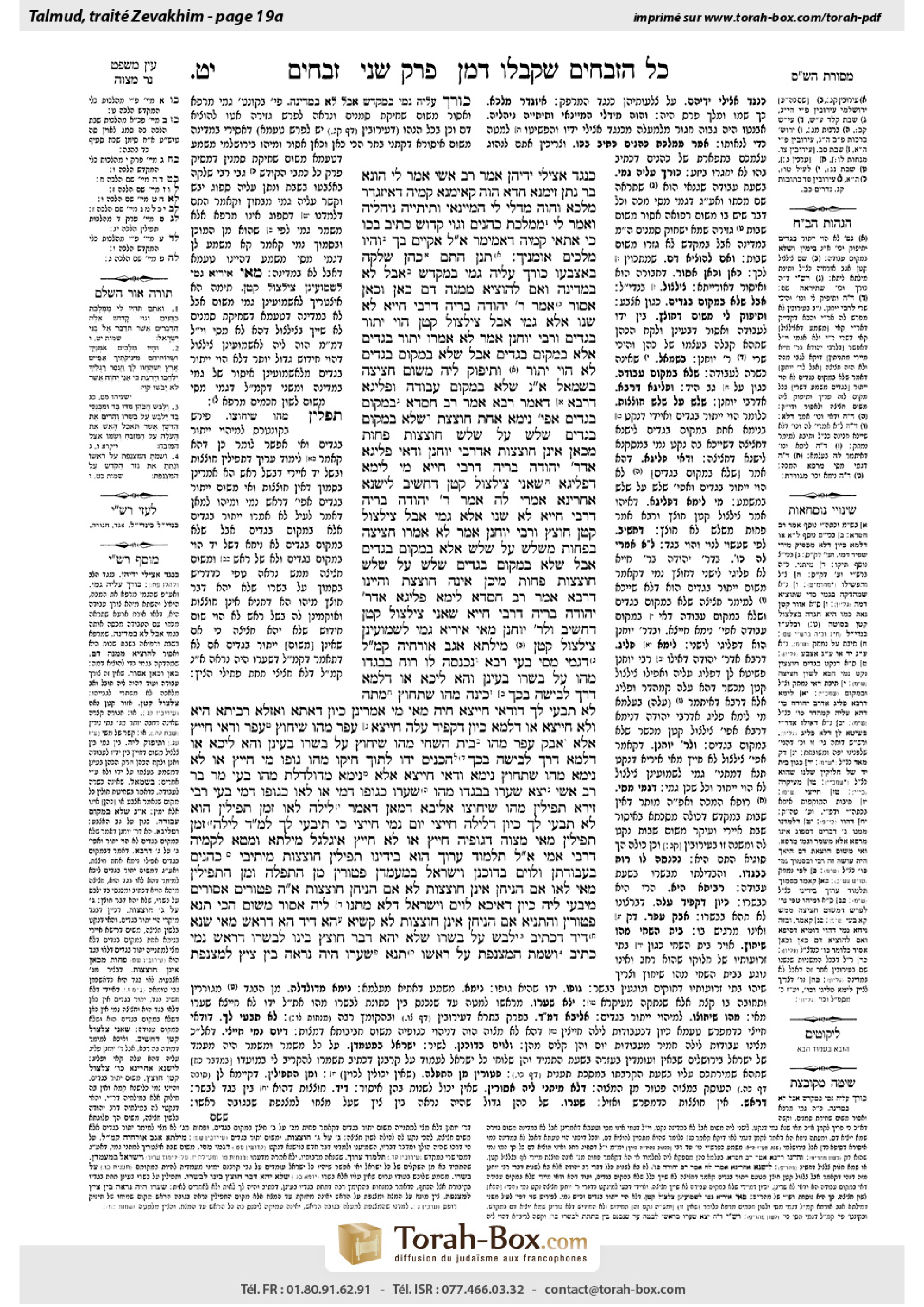
Zevachim 19a: Talmud study for Daf Yomi
Daf Yomi is the daily study of one Talmud folio. Explore 37 tractates with scans, Hebrew text, Sefaria English and AI-generated French translations where annotated.
Passage selection and English or AI-generated French translation are available where the scan has annotations. Daf Study is independent of Torah-Box and Sefaria.
Browse Zevachim · זבחים · All tractatesZevachim 19a text and translations
This page of Zevachim includes the Aramaic text, an English translation and an AI-generated French translation, alongside the scan above.
זבחים י״ט א · Aramaic and Hebrew text
כְּנֶגֶד אַצִּילֵי יְדֵיהֶן.
אָמַר רַב אָשֵׁי, אָמַר לִי הוּנָא בַּר נָתָן: זִימְנָא חֲדָא הֲוָה קָאֵימְנָא קַמֵּיהּ דְּאִיזְגַּדַּר מַלְכָּא וַהֲוָה מִדְּלֵי לִי הֶמְיָינַאי, וְתַיְתְיֵיהּ נִיהֲלֵיהּ, וַאֲמַר לִי: ״מַמְלֶכֶת כֹּהֲנִים וְגוֹי קָדוֹשׁ״ כְּתִיב בְּכוּ. כִּי אֲתַאי קַמֵּיהּ דְּאַמֵּימָר, אֲמַר לִי: אִקַּיַּים בְּךָ ״וְהָיוּ מְלָכִים אֹמְנַיִךְ״.
תְּנַן הָתָם: כֹּהֵן שֶׁלָּקָה בְּאֶצְבָּעוֹ – כּוֹרֵךְ עָלֶיהָ גֶּמִי בְּמִקְדָּשׁ, אֲבָל לֹא בַּמְּדִינָה. וְאִם לְהוֹצִיא מִמֶּנָּה דָּם – כָּאן וְכָאן אָסוּר.
אָמַר רַבִּי יְהוּדָה בְּרֵיהּ דְּרַבִּי חִיָּיא: לֹא שָׁנוּ אֶלָּא גֶּמִי, אֲבָל צִילְצוֹל קָטָן – הָוֵי יִתּוּר בְּגָדִים. וְרַבִּי יוֹחָנָן אָמַר: לֹא אָמְרוּ יִתּוּר בְּגָדִים אֶלָּא בִּמְקוֹם בְּגָדִים, אֲבָל שֶׁלֹּא בִּמְקוֹם בְּגָדִים – לָא הָוֵי יִתּוּר.
וְתִיפּוֹק לֵיהּ מִשּׁוּם חֲצִיצָה! בִּשְׂמֹאל. אִי נָמֵי, שֶׁלֹּא בִּמְקוֹם עֲבוֹדָה.
וּפְלִיגָא דְּרָבָא – דְּאָמַר רָבָא אָמַר רַב חִסְדָּא: בִּמְקוֹם בְּגָדִים – אֲפִילּוּ נִימָא אַחַת חוֹצֶצֶת. שֶׁלֹּא בִּמְקוֹם בְּגָדִים – שָׁלֹשׁ עַל שָׁלֹשׁ חוֹצְצוֹת, פָּחוֹת מִכָּאן אֵינָן חוֹצְצוֹת.
אַדְּרַבִּי יוֹחָנָן – וַדַּאי פְּלִיגָא; אַדְּרַבִּי יְהוּדָה בְּרֵיהּ דְּרַבִּי חִיָּיא מִי לֵימָא דִּפְלִיגָא?
שָׁאנֵי צִילְצוֹל קָטָן, דַּחֲשִׁיב.
לִישָּׁנָא אַחֲרִינָא אָמְרִי לַהּ, אָמַר רַבִּי יְהוּדָה בְּרֵיהּ דְּרַבִּי חִיָּיא: לֹא שָׁנוּ אֶלָּא גֶּמִי, אֲבָל צִילְצוֹל קָטָן – חוֹצֵץ. וְרַבִּי יוֹחָנָן אָמַר: לֹא אָמְרוּ חֲצִיצָה בְּפָחוֹת מִשָּׁלֹשׁ עַל שָׁלֹשׁ – אֶלָּא בִּמְקוֹם בְּגָדִים, אֲבָל שֶׁלֹּא בִּמְקוֹם בְּגָדִים – שָׁלֹשׁ עַל שָׁלֹשׁ חוֹצְצוֹת, פָּחוֹת מִיכֵּן אֵינָהּ חוֹצֶצֶת. וְהַיְינוּ דְּרָבָא אָמַר רַב חִסְדָּא.
לֵימָא פְּלִיגָא אַדְּרַבִּי יְהוּדָה בְּרֵיהּ דְּרַבִּי חִיָּיא? שָׁאנֵי צִילְצוֹל קָטָן, דַּחֲשִׁיב.
וּלְרַבִּי יוֹחָנָן – מַאי אִירְיָא גֶּמִי? לַשְׁמְעִינַן צִילְצוֹל קָטָן! מִילְּתָא אַגַּב אוֹרְחֵיהּ קָא מַשְׁמַע לַן, דְּגֶמִי מַסֵּי.
בָּעֵי רָבָא: נִכְנְסָה לוֹ רוּחַ בְּבִגְדוֹ, מַהוּ? ״עַל בְּשָׂרוֹ״ בָּעֵינַן – וְהָא לֵיכָּא; אוֹ דִלְמָא דֶּרֶךְ לְבִישָׁה בְּכָךְ?
כִּינָּה – מַהוּ שֶׁתָּחוֹץ?
מֵתָה לָא תִּבְּעֵי לָךְ, דְּוַדַּאי חָיְיצָא; חַיָּה מַאי? מִי אָמְרִינַן: כֵּיוָן (דאתא) [דְּאָתְיָא] וְאָזְלָא – רְבִיתָא הִיא וְלָא חָיְיצָא; אוֹ דִלְמָא, כֵּיוָן דְּקָפֵיד עֲלַהּ – חָיְיצָא?
עָפָר – מַהוּ שֶׁיָּחוֹץ? עָפָר וַדַּאי חָיֵיץ! אֶלָּא אֲבַק עָפָר מַהוּ?
בֵּית הַשֶּׁחִי – מַהוּ שֶׁיָּחוֹץ? ״עַל בְּשָׂרוֹ״ בָּעֵינַן – וְהָא לֵיכָּא; אוֹ דִּלְמָא דֶּרֶךְ לְבִישָׁה בְּכָךְ?
הִכְנִיס יָדוֹ לְתוֹךְ חֵיקוֹ, מַהוּ? גּוּפוֹ מִי חָיֵיץ, אוֹ לָא?
נִימָא – מַהוּ שֶׁתָּחוֹץ? נִימָא וַדַּאי חָיְיצָא! אֶלָּא נִימָא מְדוּלְדֶּלֶת מַהוּ?
בָּעֵי מָר בַּר רַב אָשֵׁי: יָצָא שְׂעָרוֹ בְּבִגְדוֹ, מַהוּ? שְׂעָרוֹ כְּגוּפוֹ דָּמֵי, אוֹ לָאו כְּגוּפוֹ דָּמֵי?
בָּעֵי רַבִּי זֵירָא: תְּפִילִּין – מַהוּ שֶׁיָּחוֹצּוּ? אַלִּיבָּא דְּמַאן דְּאָמַר לַיְלָה לָאו זְמַן תְּפִילִּין הוּא – לָא תִּבְעֵי לָךְ; כֵּיוָן דְּלַיְלָה חָיְיצִי, יוֹם נָמֵי חָיְיצִי. כִּי תִּיבְּעֵי לָךְ – לְמַאן דְּאָמַר לַיְלָה זְמַן תְּפִילִּין; מַאי? מִצְוָה דְגוּפֵיהּ – חָיֵיץ אוֹ לָא חָיֵיץ?
אִיגַּלְגַּל מִילְּתָא, וּמְטָא לְקַמֵּיהּ דְּרַבִּי אַמֵּי. אֲמַר לֵיהּ: תַּלְמוּד עָרוּךְ הוּא בְּיָדֵינוּ: תְּפִילִּין חוֹצְצוֹת.
מֵיתִיבִי: כֹּהֲנִים בַּעֲבוֹדָתָן ולְוִיִּם בְּדוּכָנָן וְיִשְׂרָאֵל בְּמַעֲמָדָן – פְּטוּרִין מִן הַתְּפִלָּה וּמִן הַתְּפִילִּין. מַאי, לָאו אִם הִנִּיחָן אֵינָן חוֹצְצוֹת? לָא, אִם הִנִּיחָן חוֹצְצוֹת.
אִי הָכִי, ״פְּטוּרִים״?! ״אֲסוּרִים״ מִיבְּעֵי לֵיהּ! כֵּיוָן דְּאִיכָּא לְוִיִּם וְיִשְׂרָאֵל – דְּלָא מַתְנוּ לֵיהּ ״אָסוּר״, מִשּׁוּם הָכִי תְּנָא ״פְּטוּרִין״.
וְהָתַנְיָא: אִם הִנִּיחָן אֵינָן חוֹצְצוֹת! לָא קַשְׁיָא; הָא דְּיָד, הָא דְּרֹאשׁ.
מַאי שְׁנָא דְּיָד, דִּכְתִיב: ״יִלְבַּשׁ עַל בְּשָׂרוֹ״ – שֶׁלֹּא יְהֵא דָּבָר חוֹצֵץ בֵּינוֹ לִבְשָׂרוֹ; דְּרֹאשׁ נָמֵי, כְּתִיב: ״וְשַׂמְתָּ הַמִּצְנֶפֶת עַל רֹאשׁוֹ״!
תָּנָא: שְׂעָרוֹ הָיָה נִרְאֶה בֵּין צִיץ לְמִצְנֶפֶת,
Zevachim 19a · English translation
at the level of their elbows.
Rav Ashi says: Huna bar Natan said to me: Once, I was standing before Izgadar, king of Persia, and my belt was raised above its appropriate height, and he lowered it into place and said to me: “A kingdom of priests, and a holy nation” (Exodus 19:6), is written about you; therefore, you should always look dignified. When I came before Ameimar and recounted this incident, he said to me: With regard to you, God’s promise to Israel: “And kings shall be your foster fathers” (Isaiah 49:23), was fulfilled.
§ With regard to the priestly vestments, we learned in a mishna elsewhere (Eiruvin 103b): A priest who was injured on his finger on Shabbat may temporarily wrap it with a reed so that his wound is not visible while he is serving in the Temple. This leniency applies in the Temple, but not in the rest of the country, as the reed also heals the wound, and medical treatment is prohibited on Shabbat by rabbinic decree. But if his intention is to draw blood from the wound, it is prohibited both here and there.
Rabbi Yehuda, son of Rabbi Ḥiyya, says: They taught only that a reed is permitted. But a small sash [tziltzul] as a bandage is considered an extra garment and is therefore forbidden, since it is prohibited for a priest to add to the priestly vestments prescribed by the Torah. And Rabbi Yoḥanan says: They said that wearing extra garments is prohibited only if the extra garment is worn in a place on the priest’s body where the requisite vestments are worn. But if the sash is in a place on his body where the vestments are not worn, e.g., on his hand, it is not considered an extra garment.
The Gemara challenges: And let Rabbi Yoḥanan derive that a sash is prohibited because it acts as an interposition between the priest’s hand and the sacred vessel he grips, which disqualifies the service. The Gemara rejects this: Rabbi Yoḥanan is referring to a case where the wound is on the priest’s left hand. Since the entire service is performed exclusively with his right hand, a bandage on his left hand is not an interposition. Alternatively, the wound is on the priest’s right hand, but not in a place used for the service, such that the bandage does not interpose between his hand and the sacred vessel.
And Rabbi Yoḥanan disagrees with the opinion of Rava, as Rava says that Rav Ḥisda says: In a place on the priest’s body where the vestments are worn, even one extra thread interposes and is prohibited, whereas in a place on his body where the vestments are not worn, if the fabric is three fingerbreadths by three fingerbreadths it interposes, but if it is less than that it does not interpose.
The Gemara notes: Rava certainly disagrees with the opinion of Rabbi Yoḥanan, who holds that fabric of any size that is in a place on his body where the vestments are not worn is not considered an interposition. Shall we say that he also disagrees with the opinion of Rabbi Yehuda, son of Rabbi Ḥiyya, who deems any sash an interposition, even one smaller than three by three fingerbreadths?
The Gemara responds: Even according to Rava, a small sash is different, as it is significant, and it is therefore considered a garment even if it is less than three by three fingerbreadths.
Some say that there is another version of the dispute: Rabbi Yehuda, son of Rabbi Ḥiyya, says that they taught only that a reed is permitted, but a small sash interposes. And Rabbi Yoḥanan says: They said that an item acts as an interposition when it is less than three by three fingerbreadths only in a place on the priest’s body where the vestments are worn. But in a place on his body where the vestments are not worn, the following distinction applies: If the fabric is three fingerbreadths by three fingerbreadths, it interposes, but if it is less than this, it does not interpose. And this is the same ruling that Rava says that Rav Ḥisda says.
The Gemara suggests: Let us say that Rava disagrees with the opinion of Rabbi Yehuda, son of Rabbi Ḥiyya, who deems any sash an interposition, even one smaller than three fingerbreadths by three fingerbreadths. The Gemara rejects this: This is not necessarily so, as a small sash is different, since it is significant. It is therefore like a vestment, even if it is smaller than three fingerbreadths by three fingerbreadths.
The Gemara raises a question: And according to the opinion of Rabbi Yoḥanan, why does the mishna teach the halakha specifically with regard to a reed? Let the mishna teach us that a priest may wrap his wounded finger with a small sash, since this would teach the greater novelty that although a sash is significant, it does not constitute an interposition. The Gemara responds: It teaches us a matter in passing, that a reed heals.
§ Rava raises a dilemma: If a gust of wind entered the priest’s vestment, raising it slightly off his body, what is the halakha? Do we require that the vestment be: “Upon his body” (Leviticus 6:3), in a literal sense, and this is not the case when the wind raises his vestment? Or perhaps the service is valid because this is the normal manner of wearing clothes.
Furthermore, what is the halakha with regard to a louse found under the priest’s vestments? Does it interpose between the vestments and his body, disqualifying the service?
The Gemara clarifies: Do not raise a dilemma with regard to a dead louse, as it certainly interposes, like any other item. Rather, what is the halakha with regard to a live louse? Do we say that since it comes and goes, i.e., it moves around on his body, it is like a growth and does not interpose? Or perhaps, since he objects to its presence, it interposes?
Furthermore, what is the halakha with regard to dirt found under the priest’s vestments? Does it interpose? The Gemara objects: But dirt certainly interposes. The Gemara clarifies: Rather, the question is: What is the halakha with regard to dust of dirt, i.e., a minute amount of dust?
Furthermore, what is the halakha with regard to the gap between the underarm of the vestment and the priest’s armpit? Does it interpose? Do we require that the vestment is “upon his body” in a literal sense, and this is not the case? Or perhaps the service is valid since this is the normal manner of wearing clothes.
Furthermore, if the priest inserted his hand into his vestments and touched his chest, what is the halakha? Does his body interpose or not?
Furthermore, what is the halakha with regard to a thread [nima]? Does it interpose? The Gemara interjects: But a thread certainly interposes. Rather, the question is: What is the halakha with regard to a thread that hangs off the vestment itself and will soon fall off? Is such a thread considered as though it has already detached from the vestment, in which case it interposes?
Mar bar Rav Ashi raises a dilemma: If his hair emerged from his head and extended into his vestment and separated it from his skin, what is the halakha? Is his hair considered like his body, in which case it does not interpose, or is it not considered like his body?
Rabbi Zeira raises a dilemma: What is the halakha with regard to phylacteries? Do they interpose? The Gemara clarifies: According to the opinion of one who says that night is not an appropriate time to don phylacteries, do not raise the dilemma. Since they interpose at night, they also interpose during the day. Rather, when you raise the dilemma, do so according to the one who says that night is an appropriate time to don phylacteries. According to this opinion, what is the halakha? Does a mitzva that one fulfills with his body interpose, or does it not interpose?
This matter circulated and eventually came before Rabbi Ami, who said to him: It is a settled tradition in our possession that phylacteries interpose.
The Gemara raises an objection from a baraita: Priests in their service; and Levites on their platform in the Temple, where they recite songs; and Israelites at their watches, where they observe the sacrifice of the daily offering, are all exempt from prayer and from donning phylacteries. What, is it not that the term: Exempt, indicates that if they donned phylacteries anyway, they do not interpose? Apparently, priests may wear phylacteries while performing the Temple service. The Gemara responds: No, if they donned phylacteries, they interpose.
The Gemara asks: If so, why does the baraita use the word: Exempt? It should have used the word: Prohibited, since wearing phylacteries disqualifies the priests’ service. The Gemara responds: Since there are also Levites and Israelites mentioned in the baraita, concerning whom the baraita could not teach the word: Prohibited, as it is permitted for them to don phylacteries, due to that reason the baraita taught the word: Exempt, which is applicable to all.
The Gemara challenges: But isn’t it taught in a baraita: If a priest donned phylacteries they do not interpose? The Gemara responds: That is not difficult. This baraita, which teaches that phylacteries interpose is referring to the phylacteries of the hand, whereas that baraita, which teaches that they do not is referring to the phylacteries of the head.
The Gemara asks: What is different about the phylacteries of the hand that only they interpose? The verse indicates the difference, as it is written with regard to the vestments covering the body: “Shall he put upon his body” (Leviticus 6:3), indicating that nothing may interpose between the vestment and his body. The Gemara challenges: But there is also a verse written with regard to the head: “And you shall set the mitre upon his head” (Exodus 29:6), indicating that there must be no interposition between the mitre and the head. If so, the phylacteries of the head should be considered an interposition as well.
The Gemara responds: The Sages taught: The hair of the High Priest was visible between the frontplate and the mitre. The frontplate was set on the forehead, below the hairline, while the mitre was set above it;
Zevachim 19a · Traduction française (IA)
à la hauteur de leurs coudes.
Rav Ashi dit : Huna bar Natan m’a dit : « Un jour, je me tenais devant Izgadar, roi de Perse, et ma ceinture était remontée au-dessus de la hauteur convenable. Il la remit à sa place et me dit : “C’est de vous qu’il est écrit : ‘Un royaume de prêtres et une nation sainte’ (Exode 19,6) ; c’est pourquoi vous devez toujours avoir une apparence digne.” Lorsque je me présentai devant Ameimar et lui racontai cet épisode, il me dit : “En ce qui vous concerne, la promesse de Dieu à Israël s’est accomplie : ‘Des rois seront tes nourriciers’ (Isaïe 49,23).” »
§ Concernant les vêtements sacerdotaux, nous avons appris dans une Michna ailleurs (Erouvin 103b) : Un prêtre qui se blesse au doigt pendant Chabbat peut l’envelopper provisoirement d’un roseau, afin que sa blessure ne soit pas visible lorsqu’il officie dans le Temple. Cette permission vaut dans le Temple, mais pas dans le reste du pays, car le roseau soigne également la blessure, et les soins médicaux sont interdits pendant Chabbat par décret rabbinique. Mais s’il a l’intention de faire saigner la blessure, cela est interdit aussi bien ici que là.
Rabbi Yehouda, fils de Rabbi Ḥiyya, dit : Ils n’ont enseigné que la permission d’utiliser un roseau. Mais une petite bande [tziltzul] utilisée comme bandage est considérée comme un vêtement supplémentaire et est donc interdite, puisqu’il est interdit au prêtre d’ajouter aux vêtements sacerdotaux prescrits par la Torah. Rabbi Yoḥanan dit : Ils ont dit que le port de vêtements supplémentaires n’est interdit que si le vêtement supplémentaire est porté sur une partie du corps du prêtre où se portent les vêtements sacerdotaux requis. Mais si la bande se trouve sur une partie du corps où ces vêtements ne se portent pas, par exemple sur sa main, elle n’est pas considérée comme un vêtement supplémentaire.
La Guemara objecte : Rabbi Yoḥanan ne devrait-il pas déduire qu’une bande est interdite parce qu’elle fait écran entre la main du prêtre et le récipient sacré qu’il saisit, ce qui invalide le service ? La Guemara rejette cette objection : Rabbi Yoḥanan parle d’un cas où la blessure se trouve sur la main gauche du prêtre. Puisque tout le service s’effectue exclusivement avec la main droite, un bandage sur sa main gauche ne fait pas écran. Autre possibilité : la blessure se trouve sur la main droite du prêtre, mais pas à un endroit utilisé pour le service ; le bandage ne fait donc pas écran entre sa main et le récipient sacré.
Et Rabbi Yoḥanan est en désaccord avec l’opinion de Rava, car Rava rapporte au nom de Rav Ḥisda : Sur une partie du corps du prêtre où se portent les vêtements sacerdotaux, même un seul fil supplémentaire fait écran et est interdit ; mais sur une partie du corps où ces vêtements ne se portent pas, un tissu de trois doigts sur trois fait écran, tandis qu’un tissu plus petit ne fait pas écran.
La Guemara note : Rava est certainement en désaccord avec l’opinion de Rabbi Yoḥanan, qui considère qu’un tissu de n’importe quelle taille, placé sur une partie du corps où les vêtements sacerdotaux ne se portent pas, ne fait pas écran. Faut-il dire qu’il est également en désaccord avec l’opinion de Rabbi Yehouda, fils de Rabbi Ḥiyya, qui considère toute bande comme un écran, même si elle mesure moins de trois doigts sur trois ?
La Guemara répond : Même selon Rava, une petite bande est un cas particulier, car elle est importante ; elle est donc considérée comme un vêtement, même si elle mesure moins de trois doigts sur trois.
Certains disent qu’il existe une autre version du désaccord : Rabbi Yehouda, fils de Rabbi Ḥiyya, dit qu’ils n’ont enseigné que la permission d’utiliser un roseau, mais qu’une petite bande fait écran. Rabbi Yoḥanan dit : Ils ont dit qu’un objet fait écran lorsqu’il mesure moins de trois doigts sur trois uniquement sur une partie du corps du prêtre où se portent les vêtements sacerdotaux. Mais sur une partie du corps où ces vêtements ne se portent pas, la distinction suivante s’applique : si le tissu mesure trois doigts sur trois, il fait écran, mais s’il est plus petit, il ne fait pas écran. C’est la même règle que celle rapportée par Rava au nom de Rav Ḥisda.
La Guemara suggère : Disons que Rava est en désaccord avec l’opinion de Rabbi Yehouda, fils de Rabbi Ḥiyya, qui considère toute bande comme un écran, même si elle mesure moins de trois doigts sur trois. La Guemara rejette cette conclusion : Ce n’est pas nécessairement le cas, car une petite bande est un cas particulier, puisqu’elle est importante. Elle est donc comme un vêtement sacerdotal, même si elle mesure moins de trois doigts sur trois.
La Guemara soulève une question : Selon l’opinion de Rabbi Yoḥanan, pourquoi la Michna enseigne-t-elle précisément la règle concernant un roseau ? Qu’elle nous enseigne qu’un prêtre peut envelopper son doigt blessé d’une petite bande ; cela nous apprendrait une nouveauté plus grande : bien qu’une bande soit importante, elle ne constitue pas un écran. La Guemara répond : Elle nous enseigne incidemment qu’un roseau soigne.
§ Rava soulève un dilemme : Si une rafale de vent s’engouffre sous le vêtement sacerdotal du prêtre et le soulève légèrement de son corps, quelle est la halakha ? Exige-t-on que le vêtement soit littéralement « sur son corps » (Lévitique 6,3), ce qui n’est pas le cas lorsque le vent le soulève ? Ou peut-être le service est-il valide, puisque c’est ainsi que les vêtements se portent normalement.
En outre, quelle est la halakha concernant un pou trouvé sous les vêtements sacerdotaux du prêtre ? Fait-il écran entre les vêtements et son corps, invalidant ainsi le service ?
La Guemara précise : Ne soulève pas de dilemme au sujet d’un pou mort, car il fait certainement écran, comme tout autre objet. La question porte plutôt sur un pou vivant. Quelle est la halakha ? Dit-on que, puisqu’il va et vient, c’est-à-dire qu’il se déplace sur son corps, il est comme une excroissance et ne fait pas écran ? Ou peut-être fait-il écran, puisqu’il est gêné par sa présence ?
En outre, quelle est la halakha concernant de la saleté trouvée sous les vêtements sacerdotaux du prêtre ? Fait-elle écran ? La Guemara objecte : Mais la saleté fait certainement écran. La Guemara précise : La question porte plutôt sur une poussière infime de saleté.
En outre, quelle est la halakha concernant l’espace entre la partie du vêtement située sous le bras et l’aisselle du prêtre ? Fait-il écran ? Exige-t-on que le vêtement soit littéralement « sur son corps », ce qui n’est pas le cas ? Ou peut-être le service est-il valide, puisque c’est ainsi que les vêtements se portent normalement.
En outre, si le prêtre introduit sa main sous ses vêtements et touche sa poitrine, quelle est la halakha ? Son corps fait-il écran ou non ?
En outre, quelle est la halakha concernant un fil [nima] ? Fait-il écran ? La Guemara intervient : Mais un fil fait certainement écran. La question porte plutôt sur un fil qui pend du vêtement lui-même et va bientôt tomber. Un tel fil est-il considéré comme s’il s’était déjà détaché du vêtement, auquel cas il fait écran ?
Mar bar Rav Ashi soulève un dilemme : Si ses cheveux sortent de sa tête, pénètrent sous son vêtement sacerdotal et le séparent de sa peau, quelle est la halakha ? Ses cheveux sont-ils considérés comme faisant partie de son corps, auquel cas ils ne font pas écran, ou ne sont-ils pas considérés comme faisant partie de son corps ?
Rabbi Zeira soulève un dilemme : Quelle est la halakha concernant les téfilines ? Font-elles écran ? La Guemara précise : Selon celui qui dit que la nuit n’est pas un moment approprié pour mettre les téfilines, ne soulève pas le dilemme. Puisqu’elles font écran la nuit, elles font également écran le jour. Soulève plutôt le dilemme selon celui qui dit que la nuit est un moment approprié pour mettre les téfilines. Selon cette opinion, quelle est la halakha ? Une mitsva que l’on accomplit avec son corps fait-elle écran, ou non ?
Cette question circula et finit par parvenir à Rabbi Ami, qui lui dit : Nous avons une tradition établie selon laquelle les téfilines font écran.
La Guemara soulève une objection à partir d’une baraïta : Les prêtres pendant leur service, les lévites sur leur estrade dans le Temple, où ils chantent, et les Israélites durant leurs tours de garde, où ils assistent au sacrifice de l’offrande quotidienne, sont tous dispensés de la prière et du port des téfilines. Le terme « dispensés » signifie-t-il que, s’ils mettent malgré tout les téfilines, celles-ci ne font pas écran ? Il semblerait donc que les prêtres puissent porter les téfilines pendant le service au Temple. La Guemara répond : Non, s’ils mettent les téfilines, elles font écran.
La Guemara demande : Dans ce cas, pourquoi la baraïta emploie-t-elle le mot « dispensés » ? Elle aurait dû dire « interdit », puisque le port des téfilines invalide le service des prêtres. La Guemara répond : Comme la baraïta mentionne également les lévites et les Israélites, à propos desquels elle ne pouvait pas employer le terme « interdit », puisqu’il leur est permis de mettre les téfilines, elle utilise pour cette raison le terme « dispensés », qui s’applique à tous.
La Guemara objecte : Mais n’est-il pas enseigné dans une baraïta que, si un prêtre met les téfilines, elles ne font pas écran ? La Guemara répond : Il n’y a pas de difficulté. La baraïta qui enseigne que les téfilines font écran concerne les téfilines du bras, tandis que l’autre baraïta, qui enseigne qu’elles ne font pas écran, concerne les téfilines de la tête.
La Guemara demande : En quoi les téfilines du bras diffèrent-elles, pour être les seules à faire écran ? Le verset indique la différence, car il est écrit à propos des vêtements qui couvrent le corps : « Il mettra sur son corps » (Lévitique 6,3), ce qui indique que rien ne peut faire écran entre le vêtement et son corps. La Guemara objecte : Mais un verset est également écrit à propos de la tête : « Tu poseras le turban sur sa tête » (Exode 29,6), ce qui indique qu’il ne doit y avoir aucun écran entre le turban et la tête. Dans ce cas, les téfilines de la tête devraient elles aussi être considérées comme un écran.
La Guemara répond : Les Sages ont enseigné : Les cheveux du grand prêtre étaient visibles entre le tsits et le turban. Le tsits était placé sur le front, au-dessous de la naissance des cheveux, tandis que le turban était placé au-dessus ;
Traduction française générée par IA à partir de l’édition anglaise de Sefaria. Vérifie toujours un passage avec le texte source.
Text from Sefaria: William Davidson Edition - Vocalized Aramaic (CC BY NC); William Davidson Edition - English (CC BY NC).