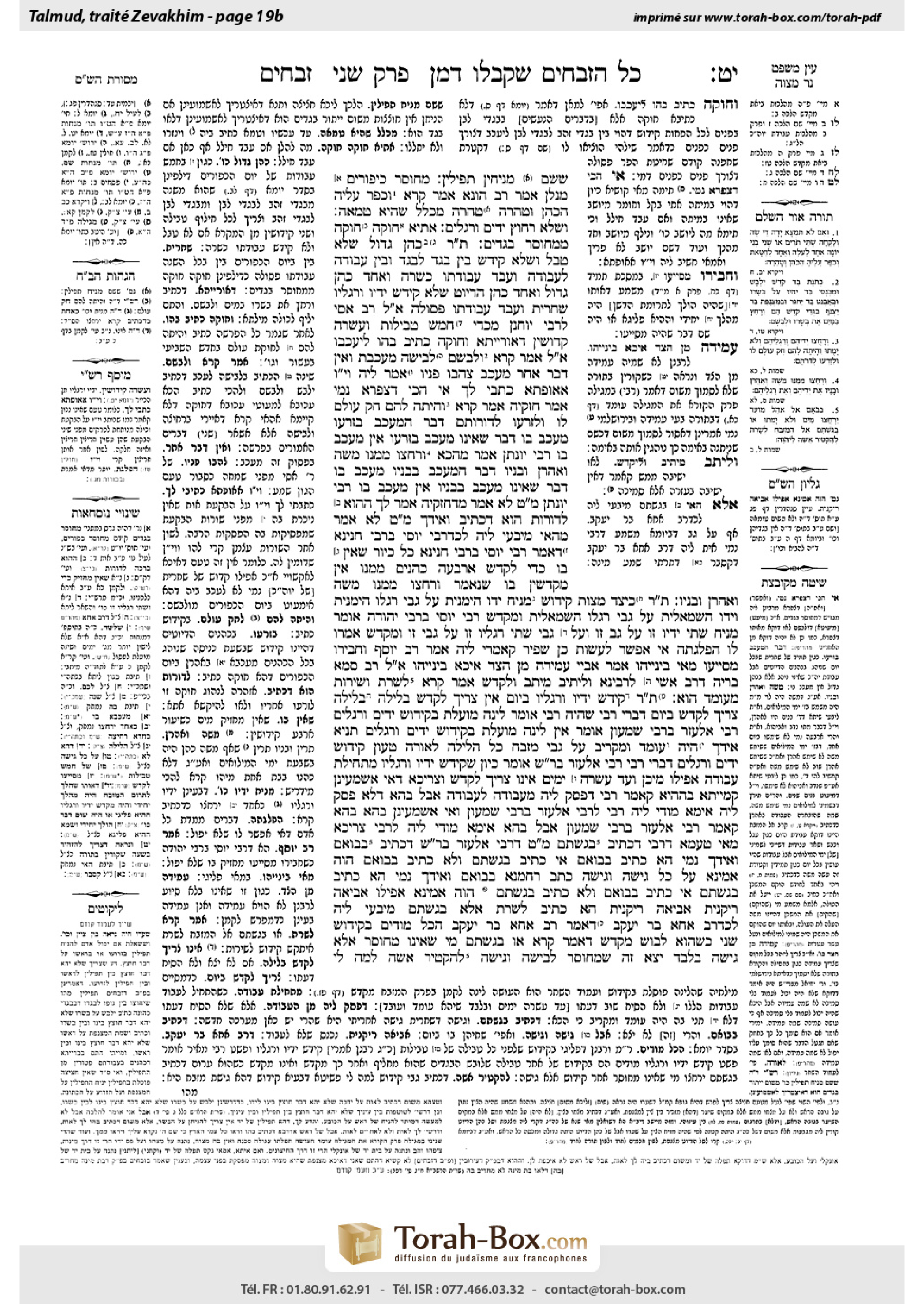
Zevachim 19b: Talmud study for Daf Yomi
Daf Yomi is the daily study of one Talmud folio. Explore 37 tractates with scans, Hebrew text, Sefaria English and AI-generated French translations where annotated.
Passage selection and English or AI-generated French translation are available where the scan has annotations. Daf Study is independent of Torah-Box and Sefaria.
Browse Zevachim · זבחים · All tractatesZevachim 19b text and translations
This page of Zevachim includes the Aramaic text, an English translation and an AI-generated French translation, alongside the scan above.
זבחים י״ט ב · Aramaic and Hebrew text
שֶׁשָּׁם מַנִּיחִין תְּפִילִּין.
מְחוּסַּר כִּיפּוּרִים מְנָלַן? אָמַר רַב הוּנָא, אָמַר קְרָא: ״וְכִפֶּר עָלֶיהָ הַכֹּהֵן וְטָהֵרָה״ – ״טָהֵרָה״ מִכְּלָל שֶׁהִיא טְמֵאָה.
וְשֶׁלֹּא רָחוּץ יָדַיִם וְרַגְלַיִם. אָתְיָא ״חוּקָּה״–״חוּקָּה״ מִמְּחוּסַּר בְּגָדִים.
תָּנוּ רַבָּנַן: כֹּהֵן גָּדוֹל שֶׁלֹּא טָבַל וְשֶׁלֹּא קִידֵּשׁ בֵּין בֶּגֶד לְבֶגֶד וּבֵין עֲבוֹדָה לַעֲבוֹדָה, וְעָבַד – עֲבוֹדָתוֹ כְּשֵׁרָה. וְאֶחָד כֹּהֵן גָּדוֹל וְאֶחָד כֹּהֵן הֶדְיוֹט שֶׁלֹּא קִידֵּשׁ יָדָיו וְרַגְלָיו שַׁחֲרִית, וְעָבַד – עֲבוֹדָתוֹ פְּסוּלָה.
אֲמַר לֵיהּ רַב אַסִּי לְרַבִּי יוֹחָנָן: מִכְּדִי חָמֵשׁ טְבִילוֹת וַעֲשָׂרָה קִדּוּשִׁין דְּאוֹרָיְיתָא, וְ״חוּקָּה״ כְּתִיב בְּהוּ – לִיעַכְּבוּ!
אֲמַר לֵיהּ, אָמַר קְרָא: ״וּלְבֵשָׁם״ – לְבִישָׁה מְעַכֶּבֶת, וְאֵין דָּבָר אַחֵר מְעַכֵּב.
צָהֲבוּ פָּנָיו, אֲמַר לֵיהּ: וָי״ו אַאוּפְתָּא כְּתַבִי לָךְ – אִי הָכִי, דְּצַפְרָא נָמֵי.
אָמַר חִזְקִיָּה, אָמַר קְרָא: ״וְהָיְתָה לָהֶם חׇק עוֹלָם לוֹ וּלְזַרְעוֹ לְדֹרֹתָם״ – דָּבָר הַמְעַכֵּב בְּזַרְעוֹ, מְעַכֵּב בּוֹ; דָּבָר שֶׁאֵינוֹ מְעַכֵּב בְּזַרְעוֹ, אֵין מְעַכֵּב בּוֹ.
רַבִּי יוֹנָתָן אָמַר מֵהָכָא: ״וְרָחֲצוּ מִמֶּנּוּ מֹשֶׁה וְאַהֲרֹן וּבָנָיו״ – דָּבָר הַמְעַכֵּב בְּבָנָיו מְעַכֵּב בּוֹ, דָּבָר שֶׁאֵינוֹ מְעַכֵּב בְּבָנָיו אֵין מְעַכֵּב בּוֹ.
רַבִּי יוֹנָתָן מַאי טַעְמָא לָא אָמַר מִדְּחִזְקִיָּה? אָמַר לָךְ: הָהוּא לְדוֹרוֹת הוּא דִּכְתִיב.
וְאִידַּךְ – מַאי טַעְמָא לָא אָמַר מֵהַאי? מִיבְּעֵי לֵיהּ לְכִדְרַבִּי יוֹסֵי בְּרַבִּי חֲנִינָא – דְּאָמַר רַבִּי יוֹסֵי בְּרַבִּי חֲנִינָא: כׇּל כִּיּוֹר שֶׁאֵין בּוֹ כְּדֵי לְקַדֵּשׁ אַרְבָּעָה כֹּהֲנִים מִמֶּנּוּ – אֵין מְקַדְּשִׁין בּוֹ, שֶׁנֶּאֱמַר: ״וְרָחֲצוּ מִמֶּנּוּ מֹשֶׁה וְאַהֲרֹן וּבָנָיו״.
תָּנוּ רַבָּנַן: כֵּיצַד מִצְוַת קִידּוּשׁ? מַנִּיחַ יָדוֹ הַיְמָנִית עַל גַּבֵּי רַגְלוֹ הַיְמָנִית, וְיָדוֹ הַשְּׂמָאלִית עַל גַּבֵּי רַגְלוֹ הַשְּׂמָאלִית, וּמְקַדֵּשׁ. רַבִּי יוֹסֵי בְּרַבִּי יְהוּדָה אוֹמֵר: מַנִּיחַ שְׁתֵּי יָדָיו זוֹ עַל גַּב זוֹ, וְעַל גַּבֵּי שְׁתֵּי רַגְלָיו זוֹ עַל גַּבֵּי זוֹ, וּמְקַדֵּשׁ. אָמְרוּ לוֹ: הִפְלַגְתָּה, אִי אֶפְשָׁר לַעֲשׂוֹת כֵּן.
שַׁפִּיר קָאָמְרִי לֵיהּ! אָמַר רַב יוֹסֵף: וַחֲבֵירוֹ מְסַיְּיעוֹ.
מַאי בֵּינַיְיהוּ? אָמַר אַבָּיֵי: עֲמִידָה מִן הַצַּד אִיכָּא בֵּינַיְיהוּ.
אֲמַר לֵיהּ רַב סַמָּא בְּרֵיהּ דְּרַב אָשֵׁי לְרָבִינָא: וְלִיתֵּיב מִיתָּב וּלְקַדֵּשׁ! אָמַר קְרָא: ״לְשָׁרֵת״ – וְשֵׁירוּת מְעוּמָּד הוּא.
תָּנוּ רַבָּנַן: קִידֵּשׁ יָדָיו וְרַגְלָיו בַּיּוֹם – אֵין צָרִיךְ לְקַדֵּשׁ בַּלַּיְלָה, בַּלַּיְלָה – צָרִיךְ לְקַדֵּשׁ בַּיּוֹם, דִּבְרֵי רַבִּי; שֶׁהָיָה רַבִּי אוֹמֵר: לִינָה מוֹעֶלֶת בְּקִידּוּשׁ יָדַיִם וְרַגְלַיִם. רַבִּי אֶלְעָזָר בְּרַבִּי שִׁמְעוֹן אוֹמֵר: אֵין לִינָה מוֹעֶלֶת בְּקִידּוּשׁ יָדַיִם וְרַגְלַיִם.
תַּנְיָא אִידַּךְ: הָיָה עוֹמֵד וּמַקְרִיב עַל גַּבֵּי מִזְבֵּחַ כׇּל הַלַּיְלָה לָאוֹרָה – טָעוּן קִידּוּשׁ יָדַיִם וְרַגְלַיִם. דִּבְרֵי רַבִּי. רַבִּי אֶלְעָזָר בְּרַבִּי שִׁמְעוֹן אוֹמֵר: כֵּיוָן שֶׁקִּידֵּשׁ יָדָיו וְרַגְלָיו מִתְּחִילַּת עֲבוֹדָה – אֲפִילּוּ מִיכָּן וְעַד עֲשָׂרָה יָמִים אֵינוֹ צָרִיךְ לְקַדֵּשׁ.
וּצְרִיכָא; דְּאִי אַשְׁמְעִינַן קַמַּיְיתָא – בְּהַהִיא קָאָמַר רַבִּי, דִּפְסַק לֵיהּ מֵעֲבוֹדָה לַעֲבוֹדָה; אֲבָל בְּהָא, דְּלָא פְּסַק לֵיהּ – אֵימָא מוֹדֵי לֵיהּ רַבִּי לְרַבִּי אֶלְעָזָר בְּרַבִּי שִׁמְעוֹן. וְאִי אַשְׁמְעִינַן בְּהָא – בְּהָא קָאָמַר רַבִּי אֶלְעָזָר בְּרַבִּי שִׁמְעוֹן; אֲבָל בְּהָא – אֵימָא מוֹדֵי לֵיהּ לְרַבִּי; צְרִיכָא.
מַאי טַעְמָא דְּרַבִּי? דִּכְתִיב: ״בְּגִשְׁתָּם״. מַאי טַעְמָא דְּרַבִּי אֶלְעָזָר בְּרַבִּי שִׁמְעוֹן? דִּכְתִיב: ״בְּבוֹאָם״.
וְאִידַּךְ נָמֵי, הָא כְּתִיב ״בְּבוֹאָם״! אִי כְּתִיב ״בְּגִשְׁתָּם״ וְלָא כְּתִיב ״בְּבוֹאָם״ – הֲוָה אָמֵינָא: עַל כׇּל גִּישָׁה וְגִישָׁה; כְּתַב רַחֲמָנָא: ״בְּבוֹאָם״.
וְאִידַּךְ נָמֵי, הָא כְּתִיב ״בְּגִשְׁתָּם״! אִי כְּתִיב ״בְּבוֹאָם״ וְלָא כְּתִיב ״בְּגִשְׁתָּם״ – הֲוָה אָמֵינָא: אֲפִילּוּ אַבִּיאָה רֵיקָנִית.
אַבִּיאָה רֵיקָנִית?! הָא כְּתִיב: ״לְשָׁרֵת״! אֶלָּא בְּגִשְׁתָּם מִיבְּעֵי לֵיהּ, לְכִדְרַב אַחָא בַּר יַעֲקֹב. דְּאָמַר רַב אַחָא בַּר יַעֲקֹב: הַכֹּל מוֹדִים בְּקִידּוּשׁ שֵׁנִי – כְּשֶׁהוּא לָבוּשׁ מְקַדֵּשׁ; דְּאָמַר קְרָא: ״אוֹ בְגִשְׁתָּם״ – מִי שֶׁאֵינוֹ מְחוּסָּר אֶלָּא גִּישָׁה בִּלְבַד, יָצָא זֶה שֶׁמְחוּסָּר לְבִישָׁה וְגִישָׁה.
״לְהַקְטִיר אִשֶּׁה״ לְמָה לִּי?
Zevachim 19b · English translation
it was there that the High Priests would don their phylacteries. Consequently, the phylacteries of the head did not interpose between the mitre and the priest’s head.
§ The mishna teaches that rites performed by one who has not yet brought an atonement offering to complete the purification process are disqualified. The Gemara asks: From where do we derive this? Rav Huna says: The verse states with regard to the offering brought by a woman who has given birth: “And the priest shall make atonement for her, and she shall be pure” (Leviticus 12:8). Since the verse states: “And she shall be pure,” one learns by inference that she is ritually impure to some extent until she brings her offering, even though she has already immersed. Anyone who has not yet brought an atonement offering is likewise impure to some extent, and rites performed by one who is impure are disqualified (see 17a).
§ The mishna teaches that rites performed by one whose hands and feet are not washed are disqualified. The Gemara explains: This halakha is derived by verbal analogy between “statute” mentioned in this context and “statute” from the case of one lacking the requisite vestments, whose rites are disqualified (see 17b).
The Sages taught: With regard to a High Priest who did not immerse or did not sanctify his hands and feet during the Yom Kippur service between donning the golden garments and the white linen garments, or between performance of one rite and another rite, and he performed the service in this state, his service is valid after the fact. But with regard to either a High Priest or an ordinary priest who did not sanctify his hands and feet at all in the morning and performed the service, his service is disqualified.
Rav Asi said to Rabbi Yoḥanan: Now, there are five immersions and ten sanctifications of the hands and feet during the Yom Kippur service by Torah law, and the word: “Statute” (Leviticus 16:34), is written with regard to them. Accordingly, they should be indispensable and should disqualify the service if not performed.
Rabbi Yoḥanan said to him: After stipulating that the High Priest must wear the requisite vestments before performing the Yom Kippur service, the verse states: “And put them on” (Leviticus 16:4). This superfluous term serves to indicate that wearing the requisite vestments is indispensable, but nothing else is indispensable.
Rav Asi’s face lit up with joy after hearing this response. Rabbi Yoḥanan said to him: I have merely written the letter vav on a piece of wood for you, i.e., I have not given you a satisfactory answer. As, if that is so, that only the wearing of the vestments is indispensable, then failure to sanctify the hands and feet in the morning should also not disqualify the service, yet according to the baraita it disqualifies the service.
Ḥizkiyya says there is an alternative answer: The verse states with regard to sanctification of the hands and feet: “And it shall be a statute forever to them, even to him and to his seed throughout their generations” (Exodus 30:21). From the comparison of Aaron to his children one may derive that anything that is indispensable with regard to his seed, the priests, is indispensable with regard to him, the High Priest during the Yom Kippur service, which only he may perform. But anything that is not indispensable with regard to his seed is not indispensable with regard to him. Therefore, the sanctification of the hands and feet between each rite, which is unnecessary for priests during the daily service, does not disqualify the High Priest’s Yom Kippur service if not done.
Rabbi Yonatan says: The principle is derived from here: The verse states with regard to the Basin in the Temple: “That Moses and Aaron and his sons might wash their hands and their feet from it” (Exodus 40:31). One may derive from the verse that anything that is indispensable with regard to his sons is indispensable with regard to him. But anything that is not indispensable with regard to his sons is not indispensable with regard to him.
The Gemara asks: What is the reason that Rabbi Yonatan did not say to derive this from the verse cited by Ḥizkiyya? The Gemara responds: Rabbi Yonatan could have said to you: That verse cited by Ḥizkiyya is written to teach that the halakha applies even for future generations, not to draw a parallel between the High Priest and ordinary priests.
The Gemara asks: And the other Sage, Ḥizkiyya, what is the reason that he did not say to derive the halakha from that verse cited by Rabbi Yonatan? The Gemara responds: He requires that verse for the halakha taught by Rabbi Yosei, son of Rabbi Ḥanina. As Rabbi Yosei, son of Rabbi Ḥanina, says: With regard to any circumstance in which the Basin does not contain enough water for four priests to sanctify their hands and feet from it, the priests may not sanctify their hands and feet with it, as it is stated: “That Moses and Aaron and his sons might wash their hands and their feet from it.” Moses, Aaron, and Aaron’s two sons total four.
§ The Sages taught: How is the mitzva of sanctification of the hands and feet performed? The priest lays his right hand on top of his right foot, and his left hand on top of his left foot, and sanctifies them with the water flowing from the Basin. Rabbi Yosei, son of Rabbi Yehuda, says: He lays both his hands one on top of the other, and lays them together on top of both his feet, themselves laid one on top of the other, and sanctifies them. They said to him: You have gone too far; it is impossible to do so.
The Gemara notes: They speak well to him; it seems impossible to assume such a position without losing one’s balance. Rav Yosef says: Rabbi Yosei, son of Rabbi Yehuda, meant that the priest would assume the position while another priest would help him maintain his balance.
The Gemara asks: What is the difference between the reasoning of the Sages and that of Rabbi Yosei, son of Rabbi Yehuda? Abaye says: The difference between them is their opinion with regard to standing with support from the side. According to the Sages, this is not considered standing and the priest may not sanctify his hands and feet while in such a position.
Rav Samma, son of Rav Ashi, said to Ravina: And let him sit and sanctify his hands and feet while seated, and in this manner he may sanctify them all at once. Ravina said to him: The verse states: “When they go into the Tent of Meeting, they shall wash with water, that they not die; or when they come near to the altar to minister” (Exodus 30:20), and ministration is performed while standing, as the verse states: “To stand to minister” (Deuteronomy 18:5). Therefore, sanctification must also be performed while standing.
§ The Sages taught: If a priest sanctified his hands and feet during the day, he does not need to sanctify them that night, but if he sanctified them at night, he must sanctify them during the following day. This is the statement of Rabbi Yehuda HaNasi, as Rabbi Yehuda HaNasi would say: The disqualification of being left overnight is determinative with regard to sanctification of the hands and feet, like any sacrificial item that is sanctified. Accordingly, once night has passed, the priest must sanctify them again. Rabbi Elazar, son of Rabbi Shimon, says: The disqualification of being left overnight is not determinative with regard to sanctification of the hands and feet. Therefore, as long as the priest continues to serve, he need not sanctify them again.
It is taught in another baraita: If the priest was standing and sacrificing offerings on top of the altar all night, in the morning he requires sanctification of the hands and feet again. This is the statement of Rabbi Yehuda HaNasi. Rabbi Elazar, son of Rabbi Shimon, says: Once he sanctified his hands and feet at the beginning of the service, even if he continues to perform rites for the next ten days, he does not need to sanctify them again.
The Gemara notes: And both of the above baraitot are necessary, though they seem to present the same dispute. As, if it had taught us only the first baraita, one might have thought that Rabbi Yehuda HaNasi stated his opinion only with regard to that case, as there the priest paused between one rite and another rite. But in this case, i.e., the second baraita, where he did not pause between rites, say that Rabbi Yehuda HaNasi concedes to Rabbi Elazar, son of Rabbi Shimon, that the priest need not sanctify his hands and feet again. And conversely, if it had taught us only with regard to that case, i.e., the second baraita, one might have thought: Rabbi Elazar, son of Rabbi Shimon, stated his opinion only in that case. But in this case, say that he concedes to Rabbi Yehuda HaNasi. Therefore, both baraitot are necessary.
The Gemara asks: What is the reasoning of Rabbi Yehuda HaNasi? As it is written: The priests must sanctify their hands and feet: “When they come near to the altar to minister” (Exodus 30:20), i.e., when they begin the service in the morning. And what is the reasoning of Rabbi Elazar, son of Rabbi Shimon? As it is written in the same verse: “When they go into the Tent of Meeting,” indicating that one sanctification suffices for the duration of a priest’s service in the Tent of Meeting.
The Gemara asks: But according to the other Sage, Rabbi Yehuda HaNasi, as well, isn’t it written: “When they go into the Tent of Meeting”? How does he interpret this term? The Gemara responds: If only “when they come near” had been written, and “when they go into” had not been written, I would say that the priest must sanctify his hands and feet for each and every approach, i.e., every rite. Therefore the Merciful One wrote: “When they go into,” to indicate that it is necessary only once a day.
The Gemara asks: But according to the other Sage, Rabbi Elazar, son of Rabbi Shimon, as well, isn’t it written: “When they come near”? How does he interpret this term? The Gemara responds: If only “when they go into” had been written, and “when they come near” had not been written, I would say that even for an entrance with no purpose, i.e., where the priest has no intention of performing rites, he must sanctify his hands and feet. Therefore, the Merciful One wrote: “When they come near.”
The Gemara rejects this: How could one have thought that the priest must sanctify his hands and feet for an entrance with no purpose? Isn’t is written in the same verse: “To minister”? Rather, according to Rabbi Elazar, son of Rabbi Shimon, “when they come near” is necessary for the halakha taught by Rav Aḥa bar Ya’akov. As Rav Aḥa bar Ya’akov says: All concede with regard to the second sanctification performed by the High Priest on Yom Kippur after each immersion that he must sanctify his hands and feet while he is dressed in the priestly vestments, as the verse states: “Or when they come near to the altar to minister.” The verse indicates that one who is lacking only to come near to the altar, i.e., one who is in all other ways prepared for the service, may perform this sanctification. Excluded is this one, who is lacking both dressing and coming near.
The Gemara asks: Why do I need the continuation of the verse: “To cause an offering by fire to smoke”?
Zevachim 19b · Traduction française (IA)
C’est là que les grands prêtres revêtaient leurs téfilines. Par conséquent, les téfilines de la tête ne faisaient pas obstacle entre la tiare et la tête du prêtre.
§ La Michna enseigne que les rites accomplis par celui qui n’a pas encore apporté de sacrifice expiatoire pour achever le processus de purification sont invalides. La Guemara demande : D’où le déduisons-nous ? Rav Houna dit : Le verset relatif à l’offrande apportée par une femme qui a accouché dit : « Le prêtre fera expiation pour elle, et elle sera pure » (Lévitique 12:8). Puisque le verset dit : « Et elle sera pure », on en déduit qu’elle reste, à certains égards, rituellement impure jusqu’à ce qu’elle apporte son offrande, même si elle s’est déjà immergée. De même, quiconque n’a pas encore apporté de sacrifice expiatoire reste, à certains égards, impur, et les rites accomplis par une personne impure sont invalides (voir 17a).
§ La Michna enseigne que les rites accomplis par celui qui ne s’est pas lavé les mains et les pieds sont invalides. La Guemara explique : Cette halakha est déduite par analogie verbale entre le terme « statut », mentionné dans ce contexte, et le terme « statut » employé dans le cas de celui qui ne porte pas les vêtements requis, dont les rites sont invalides (voir 17b).
Les Sages ont enseigné : Si, pendant le service de Yom Kippour, un grand prêtre ne s’est pas immergé ou ne s’est pas sanctifié les mains et les pieds entre le moment où il revêt les vêtements d’or et celui où il revêt les vêtements de lin blanc, ou entre l’accomplissement d’un rite et celui d’un autre, et qu’il a accompli le service dans cet état, son service est valide a posteriori. En revanche, si un grand prêtre ou un prêtre ordinaire ne s’est pas du tout sanctifié les mains et les pieds le matin et a accompli le service, celui-ci est invalide.
Rav Assi dit à Rabbi Yoḥanan : Or, selon la Torah, il y a cinq immersions et dix sanctifications des mains et des pieds pendant le service de Yom Kippour, et le terme « statut » (Lévitique 16:34) est écrit à leur sujet. Elles devraient donc être indispensables, et leur omission devrait invalider le service.
Rabbi Yoḥanan lui dit : Après avoir stipulé que le grand prêtre doit porter les vêtements requis avant d’accomplir le service de Yom Kippour, le verset dit : « Et il les revêtira » (Lévitique 16:4). Cette expression superflue indique que le port des vêtements requis est indispensable, mais que rien d’autre ne l’est.
Le visage de Rav Assi s’illumina de joie après avoir entendu cette réponse. Rabbi Yoḥanan lui dit : Je n’ai fait que tracer pour toi la lettre vav sur un morceau de bois, c’est-à-dire que je ne t’ai pas donné de réponse satisfaisante. En effet, si seul le port des vêtements était indispensable, l’omission de la sanctification des mains et des pieds le matin ne devrait pas non plus invalider le service ; pourtant, selon la baraïta, elle l’invalide.
Ḥizkiyya donne une autre réponse : Le verset relatif à la sanctification des mains et des pieds dit : « Ce sera pour eux un statut perpétuel, pour lui et pour sa descendance, de génération en génération » (Exode 30:21). De la comparaison entre Aaron et ses fils, on peut déduire que tout ce qui est indispensable pour sa descendance, les prêtres, l’est aussi pour lui, le grand prêtre pendant le service de Yom Kippour, qu’il est seul à pouvoir accomplir. Mais ce qui n’est pas indispensable pour sa descendance ne l’est pas pour lui. Par conséquent, l’omission de la sanctification des mains et des pieds entre chaque rite, qui n’est pas nécessaire aux prêtres pendant le service quotidien, n’invalide pas le service de Yom Kippour du grand prêtre.
Rabbi Yonatan dit : Ce principe se déduit de ce verset : Le verset relatif au bassin du Temple dit : « Afin que Moïse, Aaron et ses fils s’y lavent les mains et les pieds » (Exode 40:31). On peut en déduire que tout ce qui est indispensable pour ses fils l’est aussi pour lui. Mais ce qui n’est pas indispensable pour ses fils ne l’est pas pour lui.
La Guemara demande : Pourquoi Rabbi Yonatan n’a-t-il pas déduit cette halakha du verset cité par Ḥizkiyya ? La Guemara répond : Rabbi Yonatan aurait pu te dire que le verset cité par Ḥizkiyya a été écrit pour enseigner que la halakha s’applique aussi aux générations futures, et non pour établir une comparaison entre le grand prêtre et les prêtres ordinaires.
La Guemara demande : Et l’autre Sage, Ḥizkiyya, pourquoi n’a-t-il pas déduit cette halakha du verset cité par Rabbi Yonatan ? La Guemara répond : Il a besoin de ce verset pour la halakha enseignée par Rabbi Yosei, fils de Rabbi Ḥanina. En effet, Rabbi Yosei, fils de Rabbi Ḥanina, dit : Si le bassin ne contient pas assez d’eau pour que quatre prêtres s’y sanctifient les mains et les pieds, ils ne peuvent pas le faire avec cette eau, comme il est dit : « Afin que Moïse, Aaron et ses fils s’y lavent les mains et les pieds. » Moïse, Aaron et les deux fils d’Aaron sont au nombre de quatre.
§ Les Sages ont enseigné : Comment accomplit-on la mitsva de sanctifier les mains et les pieds ? Le prêtre pose sa main droite sur son pied droit et sa main gauche sur son pied gauche, puis les sanctifie avec l’eau qui coule du bassin. Rabbi Yosei, fils de Rabbi Yehouda, dit : Il pose ses deux mains l’une sur l’autre, puis les pose ensemble sur ses deux pieds, eux-mêmes l’un sur l’autre, et les sanctifie. Ils lui dirent : Tu es allé trop loin ; c’est impossible à faire.
La Guemara note : Les Sages ont raison ; il semble impossible de prendre une telle position sans perdre l’équilibre. Rav Yosef dit : Rabbi Yosei, fils de Rabbi Yehouda, voulait dire que le prêtre prenait cette position tandis qu’un autre prêtre l’aidait à garder l’équilibre.
La Guemara demande : Quelle est la différence entre la position des Sages et celle de Rabbi Yosei, fils de Rabbi Yehouda ? Abaye dit : Leur divergence porte sur la question de savoir si l’on peut se tenir debout avec un appui latéral. Selon les Sages, cela n’est pas considéré comme se tenir debout ; le prêtre ne peut donc pas sanctifier ses mains et ses pieds dans une telle position.
Rav Samma, fils de Rav Ashi, dit à Ravina : Qu’il s’assoie et sanctifie ses mains et ses pieds assis ; il pourra ainsi les sanctifier tous en même temps. Ravina lui dit : Le verset dit : « Lorsqu’ils entreront dans la Tente d’assignation, ils se laveront avec de l’eau, afin qu’ils ne meurent pas, ou lorsqu’ils s’approcheront de l’autel pour officier » (Exode 30:20). Or, l’office s’accomplit debout, comme le dit le verset : « Se tenir debout pour officier » (Deutéronome 18:5). Par conséquent, la sanctification doit elle aussi s’accomplir debout.
§ Les Sages ont enseigné : Si un prêtre a sanctifié ses mains et ses pieds pendant la journée, il n’a pas besoin de les sanctifier cette nuit-là ; mais s’il les a sanctifiés pendant la nuit, il doit les sanctifier le jour suivant. Telle est l’opinion de Rabbi Yehouda HaNassi, qui disait : La disqualification due au fait qu’une chose soit restée toute la nuit s’applique à la sanctification des mains et des pieds, comme à tout élément consacré destiné au sacrifice. Par conséquent, une fois la nuit passée, le prêtre doit les sanctifier à nouveau. Rabbi Elazar, fils de Rabbi Shimon, dit : La disqualification due au fait qu’une chose soit restée toute la nuit ne s’applique pas à la sanctification des mains et des pieds. Par conséquent, tant que le prêtre poursuit son service, il n’a pas besoin de les sanctifier à nouveau.
Il est enseigné dans une autre baraïta : Si le prêtre est resté debout et a offert des sacrifices sur l’autel toute la nuit, il doit se sanctifier de nouveau les mains et les pieds le matin. Telle est l’opinion de Rabbi Yehouda HaNassi. Rabbi Elazar, fils de Rabbi Shimon, dit : Dès lors qu’il a sanctifié ses mains et ses pieds au début du service, même s’il continue d’accomplir des rites pendant les dix jours suivants, il n’a pas besoin de les sanctifier à nouveau.
La Guemara note que les deux baraïtot sont nécessaires, bien qu’elles semblent présenter la même controverse. En effet, si seule la première baraïta nous avait été enseignée, on aurait pu penser que Rabbi Yehouda HaNassi n’exprime son opinion que dans ce cas, puisque le prêtre s’interrompt entre deux rites. Mais dans le cas de la deuxième baraïta, où il ne s’interrompt pas entre les rites, on aurait pu dire que Rabbi Yehouda HaNassi reconnaît à Rabbi Elazar, fils de Rabbi Shimon, que le prêtre n’a pas besoin de se sanctifier les mains et les pieds à nouveau. Inversement, si seul ce cas, celui de la deuxième baraïta, nous avait été enseigné, on aurait pu penser que Rabbi Elazar, fils de Rabbi Shimon, n’exprime son opinion que dans ce cas. Mais dans le premier cas, on aurait pu dire qu’il reconnaît l’opinion de Rabbi Yehouda HaNassi. Les deux baraïtot sont donc nécessaires.
La Guemara demande : Quel est le raisonnement de Rabbi Yehouda HaNassi ? Le verset dit que les prêtres doivent sanctifier leurs mains et leurs pieds : « Lorsqu’ils s’approcheront de l’autel pour officier » (Exode 30:20), c’est-à-dire lorsqu’ils commencent le service le matin. Et quel est le raisonnement de Rabbi Elazar, fils de Rabbi Shimon ? Le même verset dit : « Lorsqu’ils entreront dans la Tente d’assignation », ce qui indique qu’une seule sanctification suffit pour toute la durée du service du prêtre dans la Tente d’assignation.
La Guemara demande : Mais n’est-il pas également écrit, selon l’autre Sage, Rabbi Yehouda HaNassi : « Lorsqu’ils entreront dans la Tente d’assignation » ? Comment interprète-t-il cette expression ? La Guemara répond : Si seul « lorsqu’ils s’approcheront » avait été écrit, sans « lorsqu’ils entreront », j’aurais dit que le prêtre doit sanctifier ses mains et ses pieds à chaque approche, c’est-à-dire avant chaque rite. Le Miséricordieux a donc écrit : « Lorsqu’ils entreront », pour indiquer que cela n’est nécessaire qu’une fois par jour.
La Guemara demande : Mais n’est-il pas également écrit, selon l’autre Sage, Rabbi Elazar, fils de Rabbi Shimon : « Lorsqu’ils s’approcheront » ? Comment interprète-t-il cette expression ? La Guemara répond : Si seul « lorsqu’ils entreront » avait été écrit, sans « lorsqu’ils s’approcheront », j’aurais dit que même pour une entrée sans but, c’est-à-dire lorsque le prêtre n’a pas l’intention d’accomplir des rites, il doit sanctifier ses mains et ses pieds. Le Miséricordieux a donc écrit : « Lorsqu’ils s’approcheront ».
La Guemara rejette cette explication : Comment aurait-on pu penser que le prêtre doit sanctifier ses mains et ses pieds pour une entrée sans but ? Le même verset ne dit-il pas : « Pour officier » ? En réalité, selon Rabbi Elazar, fils de Rabbi Shimon, l’expression « lorsqu’ils s’approcheront » est nécessaire pour la halakha enseignée par Rav Aḥa bar Ya’akov. Car Rav Aḥa bar Ya’akov dit : Tous reconnaissent que, pour la deuxième sanctification accomplie par le grand prêtre à Yom Kippour après chaque immersion, il doit sanctifier ses mains et ses pieds alors qu’il est vêtu des habits sacerdotaux, comme le dit le verset : « Ou lorsqu’ils s’approcheront de l’autel pour officier. » Le verset indique que celui à qui il ne manque que de s’approcher de l’autel, c’est-à-dire celui qui est prêt au service à tous les autres égards, peut accomplir cette sanctification. Est exclu celui à qui il manque à la fois de revêtir les habits sacerdotaux et de s’approcher de l’autel.
La Guemara demande : Pourquoi ai-je besoin de la suite du verset : « Pour faire fumer une offrande consumée par le feu » ?
Traduction française générée par IA à partir de l’édition anglaise de Sefaria. Vérifie toujours un passage avec le texte source.
Text from Sefaria: William Davidson Edition - Vocalized Aramaic (CC BY NC); William Davidson Edition - English (CC BY NC).