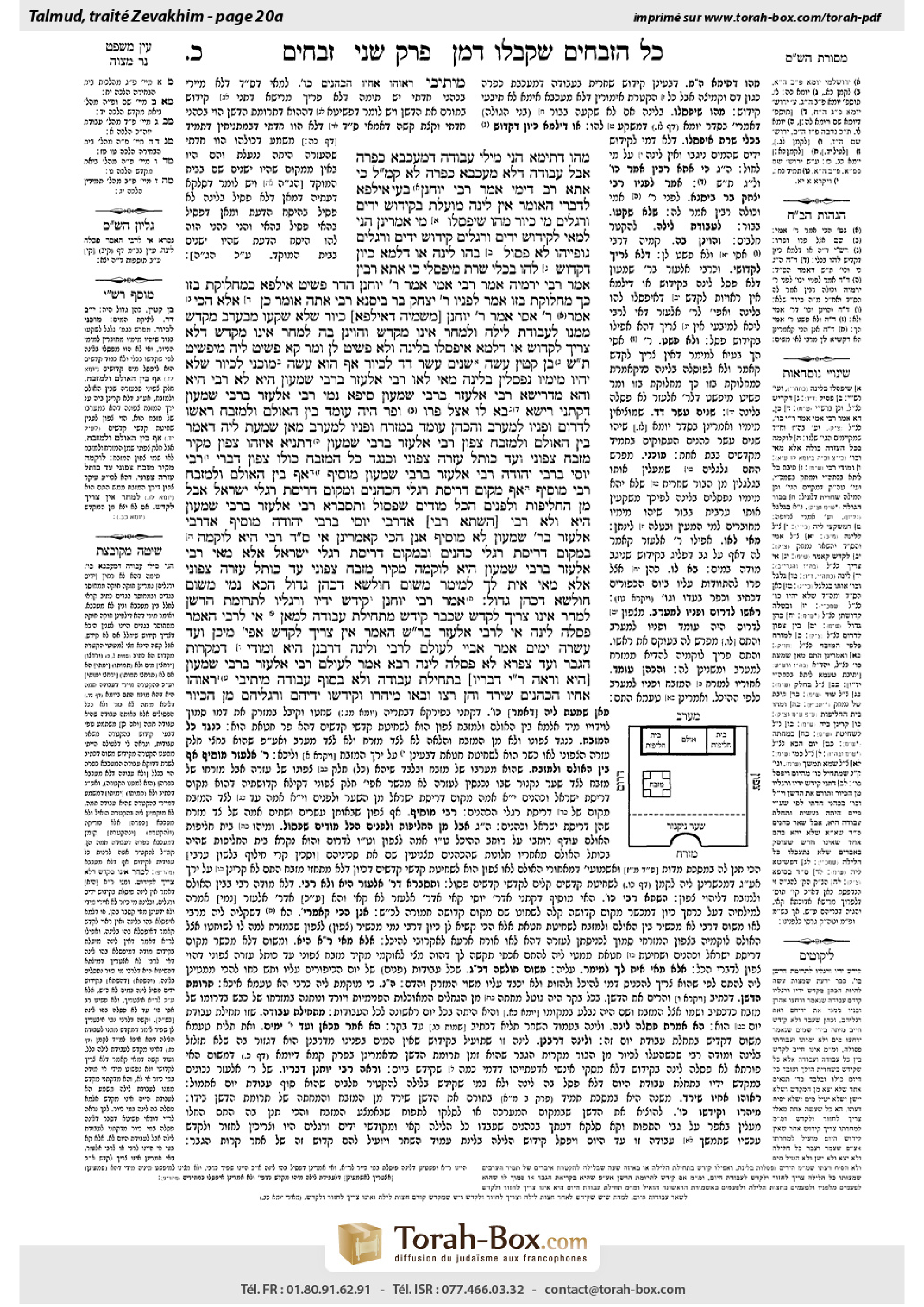
Zevachim 20a: Talmud study for Daf Yomi
Daf Yomi is the daily study of one Talmud folio. Explore 37 tractates with scans, Hebrew text, Sefaria English and AI-generated French translations where annotated.
Passage selection and English or AI-generated French translation are available where the scan has annotations. Daf Study is independent of Torah-Box and Sefaria.
Browse Zevachim · זבחים · All tractatesZevachim 20a text and translations
This page of Zevachim includes the Aramaic text, an English translation and an AI-generated French translation, alongside the scan above.
זבחים כ׳ א · Aramaic and Hebrew text
מַהוּ דְּתֵימָא: הָנֵי מִילֵּי – עֲבוֹדָה דִּמְעַכְּבָא כַּפָּרָה, אֲבָל עֲבוֹדָה דְּלָא מְעַכְּבָא כַּפָּרָה – לָא; קָא מַשְׁמַע לַן.
כִּי אֲתָא רַב דִּימִי, אָמַר רַבִּי יוֹחָנָן: בָּעֵי אִילְפָא, לְדִבְרֵי הָאוֹמֵר אֵין לִינָה מוֹעֶלֶת בְּקִידּוּשׁ יָדַיִם וְרַגְלַיִם – מֵי כִיּוֹר מַהוּ שֶׁיִּפָּסְלוּ? מִי אָמְרִינַן: הָנֵי לְמַאי – לְקִידּוּשׁ יָדַיִם וְרַגְלַיִם, קִידּוּשׁ יָדַיִם וְרַגְלַיִם גּוּפַיְיהוּ לָא פָּסֵיל בְּהוּ לִינָה; אוֹ דִלְמָא, כֵּיוָן דִּקְדוּשׁ לְהוּ בִּכְלֵי שָׁרֵת – מִיפַּסְלִי?
כִּי אֲתָא רָבִין אָמַר רַבִּי יִרְמְיָה אָמַר רַבִּי אַמֵּי אָמַר רַבִּי יוֹחָנָן, הֲדַר פָּשֵׁיט אִילְפָא: כְּמַחְלוֹקֶת בָּזוֹ כָּךְ מַחְלוֹקֶת בָּזוֹ.
אָמַר לְפָנָיו רַבִּי יִצְחָק בַּר בִּיסְנָא: רַבִּי, אַתָּה אוֹמֵר כֵּן?! אֶלָּא הָכִי אָמַר רַבִּי אַסִּי אָמַר רַבִּי יוֹחָנָן [מִשְּׁמֵיהּ דְּאִילְפָא]: כִּיּוֹר שֶׁלֹּא שִׁקְּעוֹ מִבָּעֶרֶב – מְקַדֵּשׁ מִמֶּנּוּ לַעֲבוֹדַת לַיְלָה, וּלְמָחָר אֵינוֹ מְקַדֵּשׁ.
וְהָוֵינַן בַּהּ: לְמָחָר אֵינוֹ מְקַדֵּשׁ – דְּלָא צְרִיךְ לְקַדּוֹשֵׁי; אוֹ דִלְמָא, אִיפְּסַלוּ בְּלִינָה? וְלָא פְּשִׁיט לַן, וּמָר קָא פָשֵׁיט לֵיהּ מִיפְשָׁיט.
תָּא שְׁמַע: בֶּן קָטִין עָשָׂה שְׁנֵים עָשָׂר דַּד לַכִּיּוֹר, אַף הוּא עָשָׂה מוּכְנִי לַכִּיּוֹר שֶׁלֹּא יִהְיוּ מֵימָיו נִפְסָלִין בְּלִינָה. מַאי, לָאו רַבִּי אֶלְעָזָר בְּרַבִּי שִׁמְעוֹן הִיא? לָא, רַבִּי הִיא.
וְהָא מִדְּרֵישָׁא רַבִּי אֶלְעָזָר בְּרַבִּי שִׁמְעוֹן – סֵיפָא נָמֵי רַבִּי אֶלְעָזָר בְּרַבִּי שִׁמְעוֹן!
דְּקָתָנֵי רֵישָׁא: בָּא לוֹ אֵצֶל פָּרוֹ; וּפַר הָיָה עוֹמֵד בֵּין הָאוּלָם וּלְמִזְבֵּחַ, רֹאשׁוֹ לַדָּרוֹם וּפָנָיו לַמַּעֲרָב; וְהַכֹּהֵן עוֹמֵד בַּמִּזְרָח וּפָנָיו לַמַּעֲרָב. מַאן שָׁמְעַתְּ לֵיהּ דְּאָמַר בֵּין הָאוּלָם וְלַמִּזְבֵּחַ – צָפוֹן? רַבִּי אֶלְעָזָר בְּרַבִּי שִׁמְעוֹן!
דְּתַנְיָא: אֵיזֶהוּ צָפוֹן? מִקִּיר מִזְבֵּחַ צְפוֹנִי וְעַד כּוֹתֶל עֲזָרָה צְפוֹנִי, וּכְנֶגֶד כׇּל הַמִּזְבֵּחַ כּוּלּוֹ צָפוֹן. דִּבְרֵי רַבִּי יוֹסֵי בְּרַבִּי יְהוּדָה. רַבִּי אֶלְעָזָר בְּרַבִּי שִׁמְעוֹן מוֹסִיף: אַף בֵּין הָאוּלָם וְלַמִּזְבֵּחַ. רַבִּי מוֹסִיף: אַף מְקוֹם דְּרִיסַת רַגְלֵי הַכֹּהֲנִים וּמְקוֹם דְּרִיסַת רַגְלֵי יִשְׂרָאֵל. אֲבָל מִן הַחֲלִיפוֹת וְלִפְנִים – הַכֹּל מוֹדִים שֶׁפָּסוּל.
וְתִסְבְּרָא?! רַבִּי אֶלְעָזָר בְּרַבִּי שִׁמְעוֹן הִיא – וְלָא רַבִּי?! [הַשְׁתָּא רַבִּי] אַדְּרַבִּי יוֹסֵי בְּרַבִּי יְהוּדָה מוֹסֵיף, אַדְּרַבִּי אֶלְעָזָר בְּרַבִּי שִׁמְעוֹן לָא מוֹסֵיף?!
אֲנַן הָכִי קָאָמְרִינַן: אִי סָלְקָא דַּעְתָּךְ רַבִּי הִיא, לוֹקְמַהּ בִּמְקוֹם דְּרִיסַת רַגְלֵי כֹהֲנִים וּבִמְקוֹם דְּרִיסַת רַגְלֵי יִשְׂרָאֵל.
אֶלָּא מַאי, רַבִּי אֶלְעָזָר בְּרַבִּי שִׁמְעוֹן הִיא?! לוֹקְמַהּ מִקִּיר מִזְבֵּחַ צְפוֹנִי עַד כּוֹתֶל עֲזָרָה צְפוֹנִי! אֶלָּא מַאי אִית לָךְ לְמֵימַר – מִשּׁוּם חוּלְשָׁא דְּכֹהֵן גָּדוֹל; הָכָא נָמֵי, מִשּׁוּם חוּלְשָׁא דְּכֹהֵן גָּדוֹל.
אָמַר רַבִּי יוֹחָנָן: קִידֵּשׁ יָדָיו וְרַגְלָיו לִתְרוּמַת הַדֶּשֶׁן – לְמָחָר אֵינוֹ צָרִיךְ לְקַדֵּשׁ, שֶׁכְּבָר קִידֵּשׁ מִתְּחִילַּת עֲבוֹדָה.
לְמַאן? אִי לְרַבִּי, הָאָמַר: פָּסְלָה לִינָה! אִי לְרַבִּי אֶלְעָזָר בְּרַבִּי שִׁמְעוֹן, הָאָמַר: אֵין צָרִיךְ לְקַדֵּשׁ אֲפִילּוּ מִיכָּן וְעַד עֲשָׂרָה יָמִים!
אָמַר אַבָּיֵי: לְעוֹלָם לְרַבִּי; וְלִינָה – דְּרַבָּנַן הִיא, וּמוֹדֵי דְּמִקְּרוֹת הַגֶּבֶר וְעַד צַפְרָא לָא פָּסְלָה לִינָה.
רָבָא אָמַר: לְעוֹלָם רַבִּי אֶלְעָזָר בְּרַבִּי שִׁמְעוֹן [הִיא, וְרָאָה רַבִּי יוֹחָנָן דְּבָרָיו] בִּתְחִילַּת עֲבוֹדָה, וְלֹא בְּסוֹף עֲבוֹדָה.
מֵיתִיבִי: רָאוּהוּ אֶחָיו הַכֹּהֲנִים שֶׁיָּרַד – וְהֵם רָצוּ וּבָאוּ, מִיהֲרוּ וְקִידְּשׁוּ יְדֵיהֶם וְרַגְלֵיהֶם מִן הַכִּיּוֹר.
Zevachim 20a · English translation
The Gemara responds: Lest you say that this matter, sanctification of the hands and feet, applies only to a rite that is indispensable for effecting atonement, e.g., sprinkling the blood on the altar; but a rite that is not indispensable for effecting atonement, e.g., placing the fats and sacrificial portions of the offering on the altar, does not require prior sanctification of the hands and feet, therefore this verse teaches us that even such rites require sanctification of the hands and feet.
§ When Rav Dimi came from Eretz Yisrael to Babylonia, he said that Rabbi Yoḥanan says: Ilfa raises a dilemma: According to the statement of Rabbi Elazar, son of Rabbi Shimon, who says that the disqualification of being left overnight is not determinative with regard to sanctification of the hands and feet, what is the halakha with regard to the water in the Basin? Is it disqualified by being left overnight? Do we say: For what purpose is this water? It is for the sanctification of the hands and feet, and since sanctification of the hands and feet itself is not disqualified by being left overnight, the halakha should be the same concerning the water. Or perhaps, since the water is sanctified in a service vessel, i.e., the Basin, it is disqualified by being left overnight, like all other items sanctified in service vessels.
When Ravin came from Eretz Yisrael to Babylonia, he said: Rabbi Yirmeya says that Rabbi Ami says that Rabbi Yoḥanan says: Ilfa then resolved the dilemma: Just as there is a dispute between Rabbi Yehuda HaNasi and Rabbi Elazar, son of Rabbi Shimon, with regard to that issue, i.e., whether sanctification of the hands and feet is disqualified overnight, so too there is a dispute between the two with regard to this issue, i.e., the water in the Basin. Accordingly, Rabbi Elazar, son of Rabbi Shimon, holds that the water is not disqualified by being left overnight.
Ravin continued: Rabbi Yitzḥak bar Bisna said before Rabbi Yirmeya: My teacher, do you say so? But this is what Rabbi Asi says that Rabbi Yoḥanan says in the name of Ilfa: With regard to a Basin that they did not sink into its pit at night, which would have prevented the water from being disqualified by being left overnight, a priest sanctifies his hands and feet from it for the service of that night, and the next day he does not sanctify his hands and feet from it.
And we discussed it: When Ilfa said that the next day he does not sanctify his hands and feet from it, did he mean that he does not require sanctification the next day, since sanctification is not disqualified overnight? Or perhaps Ilfa meant that it is prohibited to sanctify one’s hands and feet from the Basin since the water was disqualified by being left overnight? And Rabbi Asi did not resolve the issue for us. But you, Master, are resolving the issue by claiming that Ilfa ruled explicitly with regard to the opinion of Rabbi Elazar, son of Rabbi Shimon.
The Gemara attempts to resolve the issue: Come and hear a proof from a mishna (Yoma 37a): The High Priest ben Katin made twelve spigots for the Basin so that several priests could sanctify their hands and feet at once. He also made a mechanism [mukhani] for sinking the Basin into water during the night so that its water would not be disqualified by being left overnight. What, is it not that this mishna is in accordance with the opinion of Rabbi Elazar, son of Rabbi Shimon? If so, he holds that water of the Basin is disqualified by being left overnight. The Gemara responds: No, it is in accordance with the opinion of Rabbi Yehuda HaNasi.
The Gemara challenges: But from the fact that the first clause of the mishna is in accordance with the opinion of Rabbi Elazar, son of Rabbi Shimon, one should infer that the latter clause is also in accordance with the opinion of Rabbi Elazar, son of Rabbi Shimon.
The Gemara elaborates: As the first clause teaches (Yoma 35b): At one point during the Yom Kippur service, the High Priest would come and stand next to his bull, and his bull was standing between the Entrance Hall and the altar with its head to the south and its face to the west. And the priest stands to the east of the bull, and his face points to the west. This is where he would slaughter the bull. Whom have you heard who says that between the Entrance Hall and the altar is considered part of the north of the courtyard, where it is permitted to slaughter offerings of the most sacred order? It is Rabbi Elazar, son of Rabbi Shimon.
This is as it is taught in a baraita: What is the north? It is the area from the northern wall of the altar until the northern wall of the Temple courtyard. And opposite the entire altar is considered the north; this is the statement of Rabbi Yosei, son of Rabbi Yehuda. Rabbi Elazar, son of Rabbi Shimon, adds even the area between the Entrance Hall and the altar to the area that is considered north. Rabbi Yehuda HaNasi adds even the areas to the north in the place where the priests walk, and the areas to the north in the place where the Israelites walk. But all concede that the area from the Chamber of the Knives [haḥalifot] and inward, which is an area to the side, is unfit for slaughtering offerings of the most sacred order, as it is not visible from the altar.
The Gemara rejects the proof: And must you understand that the first clause of the mishna is in accordance with the opinion of Rabbi Elazar, son of Rabbi Shimon, and not the opinion of Rabbi Yehuda HaNasi? Now, does Rabbi Yehuda HaNasi add only to the statement of Rabbi Yosei, son of Rabbi Yehuda, but not add to the statement of Rabbi Elazar, son of Rabbi Shimon? The area deemed north according to Rabbi Elazar, son of Rabbi Shimon, is included in the area deemed north by Rabbi Yehuda HaNasi. Accordingly, since the first clause of the mishna can also be in accordance with the opinion of Rabbi Yehuda HaNasi, perhaps the mishna offers no proof at all with regard to the opinion of Rabbi Elazar, son of Rabbi Shimon.
The Gemara reformulates its suggestion: This is what we are saying: If it enters your mind to say that the mishna is in accordance with the opinion of Rabbi Yehuda HaNasi, then let him stand the bull in the place where the priests walk and in the place where the Israelites walk, since Rabbi Yehuda HaNasi holds that those areas are also considered north. Why is the bull placed specifically between the Entrance Hall and the altar?
The Gemara rejects this: Rather, what shall you say? Will you say that the mishna is only in accordance with the opinion of Rabbi Elazar, son of Rabbi Shimon? But if so, let him stand the bull anywhere from the north wall of the altar to the north wall of the Temple courtyard, as everyone agrees that this area is considered north. Rather, what have you to say to explain why the bull is positioned specifically between the Entrance Hall and the altar? It is due to the weakness of the High Priest, so that he need not exert himself and walk long distances on Yom Kippur. Here too, the mishna may be in accordance with the opinion of Rabbi Yehuda HaNasi, and due to the weakness of the High Priest the bull is positioned there.
§ Rabbi Yoḥanan says: If a priest sanctified his hands and feet in preparation for the removal of the ashes, the first service performed every day in the Temple, which was performed before dawn, then the next day, i.e., after dawn, he does not need to sanctify them again, as he already sanctified them at the beginning of the day’s service.
The Gemara asks: In accordance with whose opinion is this statement? If it is in accordance with the opinion of Rabbi Yehuda HaNasi, doesn’t he say that being left overnight disqualifies sanctification of the hands and feet? If so, one should be required to sanctify them again after dawn. And if it is in accordance with the opinion of Rabbi Elazar, son of Rabbi Shimon, doesn’t he say that if the priest sanctified his hands and feet at the beginning of the service, he does not need to sanctify them again even if he continues to perform rites for the next ten days? Why, then, does Rabbi Yoḥanan state only that one who sanctified his hands and feet before the removal of the ashes is not required to do so after dawn?
Abaye says: Actually, the statement is in accordance with the opinion of Rabbi Yehuda HaNasi, and the disqualification of sanctification of the hands and feet by being left overnight is by rabbinic law. And although the Sages mandate that a priest must sanctify his hands and feet every morning, they concede that during the period from the rooster’s crow before dawn until morning, being left overnight does not disqualify his sanctification. Therefore, one who sanctifies his hands and feet at the rooster’s crow may continue to perform rites after dawn.
Rava says: Actually, the statement is in accordance with the opinion of Rabbi Elazar, son of Rabbi Shimon. And Rabbi Yoḥanan saw the statement of Rabbi Elazar, son of Rabbi Shimon, as correct with regard to the beginning of the service, i.e., that a priest may serve during the day on the strength of sanctification performed before dawn. But he did not agree with regard to the end of the service. Rather, Rabbi Yoḥanan holds that if a priest sanctified his hands and feet before participating in the day’s final rites, he must sanctify them again the next morning. According to the opinion of Rabbi Yehuda HaNasi, one who sanctified his hands and feet before sunrise must do so again afterward.
The Gemara raises an objection from a mishna (Tamid 28b) that describes the daily service: His priestly brethren, members of the patrilineal family, saw that the priest who removed the ashes descended from the altar with the coal pan in his hands, and they ran and arrived at the Basin. They hurried and sanctified their hands and their feet with water from the Basin.
Zevachim 20a · Traduction française (IA)
La Guemara répond : De crainte que tu ne dises que cette règle, la sanctification des mains et des pieds, ne s’applique qu’à un rite indispensable à l’expiation, comme l’aspersion du sang sur l’autel, mais qu’un rite qui n’est pas indispensable à l’expiation, comme le dépôt sur l’autel des graisses et des portions sacrificielles de l’offrande, ne requiert pas de sanctification préalable des mains et des pieds, le verset vient nous enseigner que même de tels rites requièrent la sanctification des mains et des pieds.
§ Lorsque Rav Dimi vint d’Eretz Israël en Babylonie, il dit que Rabbi Yoḥanan rapporte qu’Ilfa soulève une question : selon l’opinion de Rabbi Elazar, fils de Rabbi Shimon, qui affirme que le fait d’avoir passé la nuit ne rend pas invalide la sanctification des mains et des pieds, quel est le statut de l’eau du bassin ? Est-elle invalidée si elle a passé la nuit ? Doit-on dire : à quoi sert cette eau ? À la sanctification des mains et des pieds ; et puisque la sanctification des mains et des pieds elle-même n’est pas invalidée par le fait d’avoir passé la nuit, il en va de même de l’eau. Ou peut-être, puisque l’eau est sanctifiée dans un ustensile de service, à savoir le bassin, est-elle invalidée par le fait d’avoir passé la nuit, comme tous les autres éléments sanctifiés dans des ustensiles de service ?
Lorsque Ravin vint d’Eretz Israël en Babylonie, il dit que Rabbi Yirmeya rapporte au nom de Rabbi Ami, qui le rapporte au nom de Rabbi Yoḥanan, qu’Ilfa résolut alors la question : de même qu’il existe une controverse entre Rabbi Yehuda HaNassi et Rabbi Elazar, fils de Rabbi Shimon, sur cette question, à savoir si la sanctification des mains et des pieds est invalidée lorsqu’elle a passé la nuit, de même existe-t-il une controverse entre eux sur cette question-ci, celle de l’eau du bassin. Par conséquent, Rabbi Elazar, fils de Rabbi Shimon, considère que l’eau n’est pas invalidée si elle a passé la nuit.
Ravin poursuivit : Rabbi Yitzḥak bar Bisna dit à Rabbi Yirmeya : « Mon maître, est-ce bien ce que tu dis ? » Rabbi Asi rapporte pourtant au nom de Rabbi Yoḥanan, au nom d’Ilfa, la chose suivante : dans le cas d’un bassin qu’on n’a pas descendu dans sa fosse pendant la nuit, ce qui aurait empêché l’eau d’être invalidée du fait qu’elle a passé la nuit, un prêtre sanctifie ses mains et ses pieds à partir de ce bassin pour le service de cette nuit, mais ne les y sanctifie pas le lendemain.
Et nous avons discuté de cette question : lorsqu’Ilfa a dit que le lendemain, le prêtre ne sanctifie pas ses mains et ses pieds à partir du bassin, voulait-il dire qu’il n’a pas besoin de les sanctifier le lendemain, puisque la sanctification n’est pas invalidée lorsqu’elle a passé la nuit ? Ou voulait-il dire qu’il est interdit de sanctifier ses mains et ses pieds à partir du bassin, parce que l’eau a été invalidée du fait qu’elle a passé la nuit ? Rabbi Asi ne nous a pas donné de réponse à cette question. Mais toi, Maître, tu la résous en affirmant qu’Ilfa a explicitement statué selon l’opinion de Rabbi Elazar, fils de Rabbi Shimon.
La Guemara tente de résoudre la question : viens et écoute une preuve tirée d’une Michna (Yoma 37a) : le grand prêtre ben Katin fit installer douze robinets sur le bassin afin que plusieurs prêtres puissent sanctifier leurs mains et leurs pieds en même temps. Il fit également fabriquer un mécanisme [mukhani] pour descendre le bassin dans l’eau pendant la nuit, afin que l’eau ne soit pas invalidée du fait qu’elle a passé la nuit. N’est-il pas vrai que cette Michna suit l’opinion de Rabbi Elazar, fils de Rabbi Shimon ? Si tel est le cas, il considère que l’eau du bassin est invalidée si elle a passé la nuit. La Guemara répond : non, elle suit l’opinion de Rabbi Yehuda HaNassi.
La Guemara objecte : mais puisque la première partie de la Michna suit l’opinion de Rabbi Elazar, fils de Rabbi Shimon, on devrait en déduire que la dernière partie suit elle aussi l’opinion de Rabbi Elazar, fils de Rabbi Shimon.
La Guemara développe : car la première partie enseigne (Yoma 35b) : à un moment du service de Yom Kippour, le grand prêtre venait se tenir à côté de son taureau, qui se tenait entre le vestibule et l’autel, la tête au sud et la face à l’ouest. Le prêtre se tenait à l’est du taureau, le visage tourné vers l’ouest. C’est là qu’il égorgeait le taureau. Qui as-tu entendu dire que l’espace entre le vestibule et l’autel est considéré comme faisant partie du nord de la cour, où il est permis d’égorger les offrandes d’une sainteté supérieure ? C’est Rabbi Elazar, fils de Rabbi Shimon.
C’est ce qui est enseigné dans une baraïta : qu’est-ce que le nord ? C’est la zone comprise entre le mur nord de l’autel et le mur nord de la cour du Temple. Toute la zone qui fait face à l’autel est considérée comme le nord ; telle est la déclaration de Rabbi Yosei, fils de Rabbi Yehuda. Rabbi Elazar, fils de Rabbi Shimon, ajoute à cette zone l’espace entre le vestibule et l’autel. Rabbi Yehuda HaNassi y ajoute également les zones situées au nord, là où les prêtres circulent, ainsi que celles situées au nord, là où les Israélites circulent. Mais tous conviennent que la zone située à partir de la Chambre des couteaux [haḥalifot] vers l’intérieur, qui se trouve sur le côté, ne convient pas à l’égorgement des offrandes d’une sainteté supérieure, car elle n’est pas visible depuis l’autel.
La Guemara rejette cette preuve : faut-il nécessairement comprendre que la première partie de la Michna suit l’opinion de Rabbi Elazar, fils de Rabbi Shimon, et non celle de Rabbi Yehuda HaNassi ? Rabbi Yehuda HaNassi n’ajouterait-il qu’à la déclaration de Rabbi Yosei, fils de Rabbi Yehuda, sans rien ajouter à celle de Rabbi Elazar, fils de Rabbi Shimon ? La zone considérée comme le nord selon Rabbi Elazar, fils de Rabbi Shimon, est incluse dans celle considérée comme le nord selon Rabbi Yehuda HaNassi. Par conséquent, puisque la première partie de la Michna peut également suivre l’opinion de Rabbi Yehuda HaNassi, la Michna n’apporte peut-être aucune preuve quant à l’opinion de Rabbi Elazar, fils de Rabbi Shimon.
La Guemara reformule son argument : voici ce que nous disons : si tu envisages que la Michna suit l’opinion de Rabbi Yehuda HaNassi, qu’il place alors le taureau à l’endroit où les prêtres circulent ou à celui où les Israélites circulent, puisque Rabbi Yehuda HaNassi considère également ces zones comme faisant partie du nord. Pourquoi le taureau est-il placé précisément entre le vestibule et l’autel ?
La Guemara rejette cet argument : alors, que diras-tu ? Dirais-tu que la Michna suit uniquement l’opinion de Rabbi Elazar, fils de Rabbi Shimon ? Mais dans ce cas, qu’il place le taureau n’importe où entre le mur nord de l’autel et le mur nord de la cour du Temple, puisque tous conviennent que cette zone est considérée comme le nord. Alors, que peux-tu dire pour expliquer pourquoi le taureau est placé précisément entre le vestibule et l’autel ? C’est en raison de la faiblesse du grand prêtre, afin qu’il n’ait pas à faire d’efforts ni à parcourir de longues distances le jour de Yom Kippour. Ici aussi, la Michna peut suivre l’opinion de Rabbi Yehuda HaNassi, et c’est en raison de la faiblesse du grand prêtre que le taureau est placé à cet endroit.
§ Rabbi Yoḥanan dit : si un prêtre a sanctifié ses mains et ses pieds en vue du retrait des cendres, premier service accompli chaque jour dans le Temple, avant l’aube, alors le lendemain, c’est-à-dire après l’aube, il n’a pas besoin de les sanctifier à nouveau, puisqu’il les a déjà sanctifiés au début du service de la journée.
La Guemara demande : selon l’opinion de qui cette déclaration est-elle faite ? Si elle suit l’opinion de Rabbi Yehuda HaNassi, ne dit-il pas que le fait d’avoir passé la nuit invalide la sanctification des mains et des pieds ? Dans ce cas, le prêtre devrait les sanctifier à nouveau après l’aube. Et si elle suit l’opinion de Rabbi Elazar, fils de Rabbi Shimon, ne dit-il pas que si le prêtre a sanctifié ses mains et ses pieds au début du service, il n’a pas besoin de les sanctifier à nouveau, même s’il continue à accomplir des rites pendant les dix jours suivants ? Pourquoi Rabbi Yoḥanan dit-il alors seulement que celui qui a sanctifié ses mains et ses pieds avant le retrait des cendres n’a pas à le faire après l’aube ?
Abaye dit : en réalité, cette déclaration suit l’opinion de Rabbi Yehuda HaNassi, et l’invalidation de la sanctification des mains et des pieds du fait qu’elle a passé la nuit relève d’une règle rabbinique. Bien que les Sages imposent au prêtre de sanctifier ses mains et ses pieds chaque matin, ils reconnaissent que, pendant la période qui va du chant du coq avant l’aube jusqu’au matin, le fait d’avoir passé la nuit n’invalide pas cette sanctification. Par conséquent, celui qui sanctifie ses mains et ses pieds au chant du coq peut continuer à accomplir des rites après l’aube.
Rava dit : en réalité, cette déclaration suit l’opinion de Rabbi Elazar, fils de Rabbi Shimon. Rabbi Yoḥanan estimait que la déclaration de Rabbi Elazar, fils de Rabbi Shimon, était juste en ce qui concerne le début du service, c’est-à-dire qu’un prêtre peut officier pendant la journée en vertu d’une sanctification accomplie avant l’aube. Mais il n’était pas d’accord en ce qui concerne la fin du service. Rabbi Yoḥanan considère plutôt que si un prêtre a sanctifié ses mains et ses pieds avant de prendre part aux derniers rites de la journée, il doit les sanctifier à nouveau le lendemain matin. Selon l’opinion de Rabbi Yehuda HaNassi, celui qui a sanctifié ses mains et ses pieds avant le lever du soleil doit le faire à nouveau après celui-ci.
La Guemara soulève une objection tirée d’une Michna (Tamid 28b) qui décrit le service quotidien : ses frères prêtres, membres de la famille patrilinéaire, virent le prêtre qui avait retiré les cendres descendre de l’autel avec la pelle à braises dans les mains. Ils coururent et arrivèrent au bassin. Ils se hâtèrent de sanctifier leurs mains et leurs pieds avec l’eau du bassin.
Traduction française générée par IA à partir de l’édition anglaise de Sefaria. Vérifie toujours un passage avec le texte source.
Text from Sefaria: William Davidson Edition - Vocalized Aramaic (CC BY NC); William Davidson Edition - English (CC BY NC).