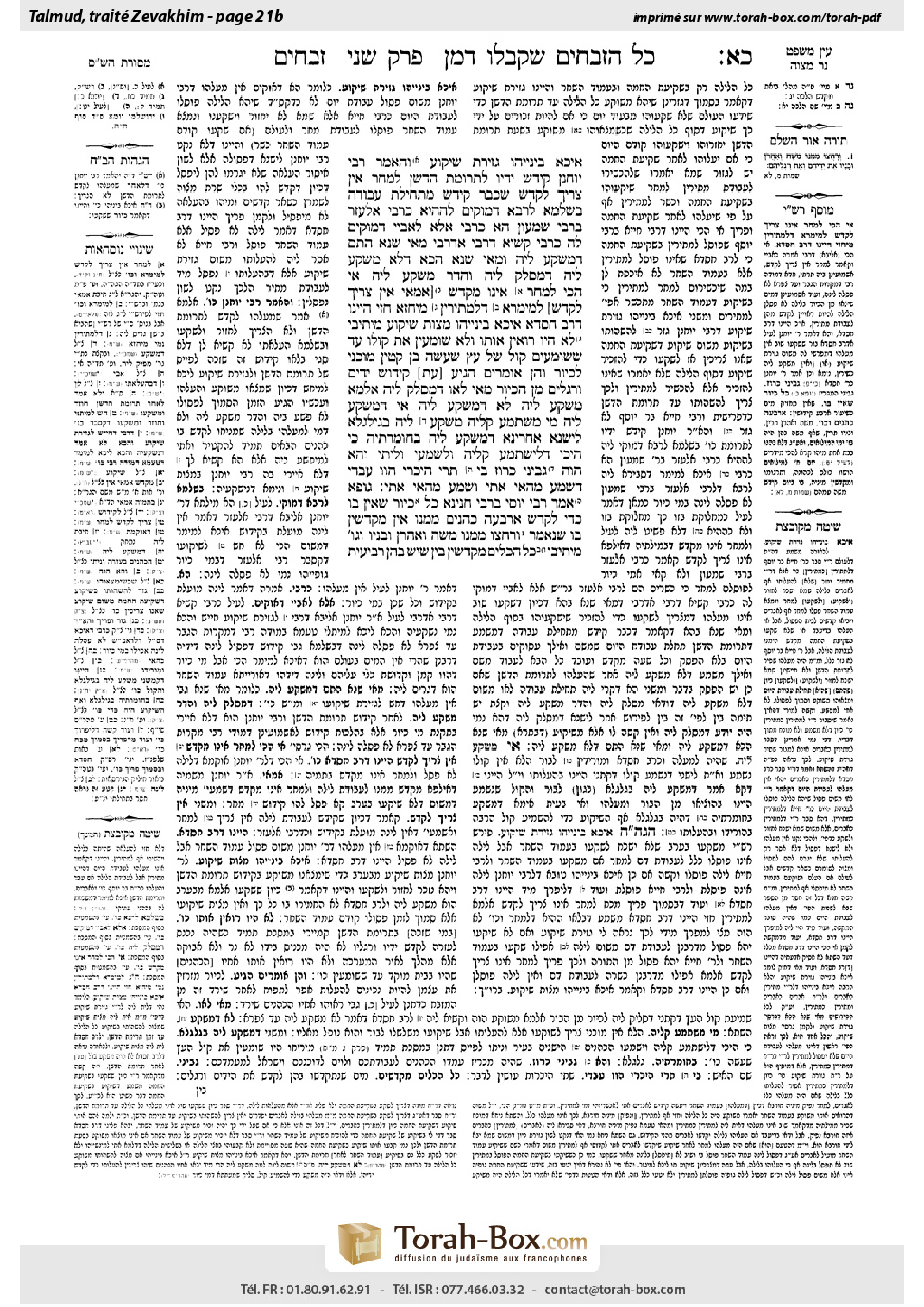
Zevachim 21b: Talmud study for Daf Yomi
Daf Yomi is the daily study of one Talmud folio. Explore 37 tractates with scans, Hebrew text, Sefaria English and AI-generated French translations where annotated.
Passage selection and English or AI-generated French translation are available where the scan has annotations. Daf Study is independent of Torah-Box and Sefaria.
Browse Zevachim · זבחים · All tractatesZevachim 21b text and translations
This page of Zevachim includes the Aramaic text, an English translation and an AI-generated French translation, alongside the scan above.
זבחים כ״א ב · Aramaic and Hebrew text
אִיכָּא בֵּינַיְיהוּ גְּזֵירַת שִׁיקּוּעַ.
וְהָאָמַר רַבִּי יוֹחָנָן: קִידֵּשׁ יָדָיו לִתְרוּמַת הַדֶּשֶׁן – לְמָחָר אֵין צָרִיךְ לְקַדֵּשׁ, שֶׁכְּבָר קִידֵּשׁ מִתְּחִילַּת עֲבוֹדָה.
בִּשְׁלָמָא לְרָבָא, דְּמוֹקֵים לְהָהִיא כְּרַבִּי אֶלְעָזָר בְּרַבִּי שִׁמְעוֹן – הָא כְּרַבִּי.
אֶלָּא לְאַבָּיֵי דְּמוֹקֵים לַהּ כְּרַבִּי – קַשְׁיָא דְּרַבִּי אַדְּרַבִּי: מַאי שְׁנָא הָתָם דִּמְשַׁקַּע לֵיהּ, וּמַאי שְׁנָא הָכָא דְּלָא מְשַׁקַּע לֵיהּ?
דִּמְסַלֵּק לֵיהּ וַהֲדַר מְשַׁקַּע לֵיהּ.
אִי הָכִי, ״לְמָחָר אֵינוֹ מְקַדֵּשׁ״ – [אַמַּאי? אֵין צָרִיךְ לְקַדֵּשׁ.]
לְמֵימְרָא דִּלְמַתִּירִין מִיחְזָא חֲזֵי?! הַיְינוּ דְּרַב חִסְדָּא!
אִיכָּא בֵּינַיְיהוּ מִצְוַת שִׁיקּוּעַ.
מֵיתִיבִי: לֹא הָיוּ רוֹאִין אוֹתוֹ וְלֹא שׁוֹמְעִין אֶת קוֹלוֹ, עַד שֶׁשּׁוֹמְעִים קוֹל שֶׁל עֵץ שֶׁעָשָׂה בֶּן קָטִין מוּכְנִי לַכִּיּוֹר, וְהֵן אוֹמְרִים: הִגִּיעַ [עֵת] קִידּוּשׁ יָדַיִם וְרַגְלַיִם מִן הַכִּיּוֹר. מַאי, לָאו דִּמְסַלֵּק לֵיהּ? אַלְמָא מְשַׁקַּע לֵיהּ!
לָא, דִּמְשַׁקַּע לֵיהּ. אִי דִּמְשַׁקַּע לֵיהּ – מִי מִשְׁתְּמַע קָלֵיהּ?! מְשַׁקַּע לֵיהּ בְּגִילְגְּלָא.
לִישָּׁנָא אַחֲרִינָא: דִּמְשַׁקַּע לֵיהּ בְּחוּמַרְתֵּיהּ, כִּי הֵיכִי דְּלִישְׁתְּמַע קָלֵיהּ וְלִשְׁמְעִי וְלֵיתֵי. וְהָא הֲוָה גְּבִינִי כָּרוֹז! (בי) [אַבֵּי] תְּרֵי הֶיכֵּרֵי הֲווֹ עָבְדִי; דְּשָׁמַע מֵהַאי אָתֵי, וְשָׁמַע מֵהַאי אָתֵי.
גּוּפָא – אָמַר רַבִּי יוֹסֵי בְּרַבִּי חֲנִינָא: כׇּל כִּיּוֹר שֶׁאֵין בּוֹ כְּדֵי לְקַדֵּשׁ אַרְבָּעָה כֹּהֲנִים מִמֶּנּוּ – אֵין מְקַדְּשִׁין בּוֹ, שֶׁנֶּאֱמַר: ״וְרָחֲצוּ מִמֶּנּוּ מֹשֶׁה וְאַהֲרֹן וּבָנָיו וְגוֹ׳״.
מֵיתִיבִי: כׇּל הַכֵּלִים מְקַדְּשִׁין – בֵּין שֶׁיֵּשׁ בָּהֶן רְבִיעִית,
Zevachim 21b · English translation
The Gemara responds: The difference between them is that according to Rabbi Ḥiyya bar Yosef, if the water is raised at any point throughout the night, it is disqualified for sanctification prior to the day’s services. According to Rabbi Yoḥanan, the water is not disqualified unless the Basin is raised at the break of dawn, but the Sages issued a rabbinic decree of sinking the Basin into its pit all night ab initio, so that it would not be raised at dawn accidentally.
The Gemara asks: Does Rabbi Yoḥanan really hold that the Basin must be sunk all night? But doesn’t Rabbi Yoḥanan say: If a priest sanctified his hands and feet in preparation for the removal of the ashes before dawn, then the next day he does not need to sanctify them again, as he already sanctified them at the beginning of the day’s service? Evidently, the Basin is raised before dawn.
The Gemara elaborates: Granted, according to Rava, who interprets that statement in accordance with the opinion of Rabbi Elazar, son of Rabbi Shimon, that sanctification of the hands and feet is not disqualified overnight (see 20a), this statement that the Basin must be sunk all night is in accordance with the opinion of Rabbi Yehuda HaNasi, who holds that sanctification of the hands and feet is disqualified at dawn. Accordingly, he holds that the water in the Basin is disqualified as well.
But according to Abaye, who interprets that statement in accordance with the opinion of Rabbi Yehuda HaNasi, the first statement of Rabbi Yehuda HaNasi is difficult to reconcile with this other statement of Rabbi Yehuda HaNasi: What is different there that one must sink the Basin all night, and what is different here, with regard to sanctification prior to removal of the ashes, that one does not need to sink it?
The Gemara responds: There is no contradiction. Prior to removal of the ashes, one raises the Basin and then sinks it again so that it will not remain raised at dawn and render the water disqualified.
The Gemara asks: If so, why does Rabbi Yoḥanan say that the priest does not sanctify his hands and feet again the next day? If the water has not been disqualified, why would the priest need to avoid sanctifying his hands and feet with it? The Gemara responds: Rabbi Yoḥanan means to say that he does not need to sanctify them again for service on the same day, not that he is prohibited from doing so.
The Gemara asks: Is this to say that according to Rabbi Yoḥanan, if one raised the Basin at night and sank it again before dawn, it remains fit for sanctification prior to performing the offering’s permitting factors that day? If so, Rabbi Yoḥanan’s opinion is the same as that of Rav Ḥisda.
The Gemara responds: The difference between them is that according to Rav Ḥisda, there is no mitzva of sinking the Basin into its pit throughout the night, whereas Rabbi Yoḥanan holds that there is a mitzva of sinking the Basin into its pit all night ab initio.
The Gemara raises an objection to the opinion of Rav Ḥisda from a mishna (Tamid 28b): The priests would not see the priest performing the removal of the ashes, nor would they hear his voice. Rather, they were unaware of his actions until they would hear the sound of the wood with which ben Katin made a mechanism for sinking the Basin into water during the night. And when they heard the sound of the mechanism, they would say to each other: The time for sanctifying hands and feet from the Basin has come. The Gemara asks: What, is it not that they heard the mechanism raising the Basin? Apparently, the mechanism would sink it during the night, in contradiction to the opinion of Rav Ḥisda, who holds that there was no need to sink it overnight.
The Gemara responds: No, they heard the mechanism sinking the Basin, which had been raised all night. The Gemara asks: If the mechanism were sinking it, would its sound be audible? No mechanism is necessary to lower the Basin; it can simply be lowered with a chain. The Gemara responds: The priest would still sink it by using a wheel, which would make a sound.
The Gemara presents another version of the answer: The priest would deliberately sink it by its wheel so that its sound would be audible, and the other priests would hear and come to begin the service. The Gemara asks: But wasn’t there Gevini the crier, who would notify the priests of the beginning of the service? The Gemara responds: They would make two conspicuous markers for the beginning of the service: The sound of the wheel and the crier. Anyone who heard from this marker would come, and anyone who heard from that marker would come.
§ Having mentioned a halakha earlier (19b), the Gemara addresses the matter itself: Rabbi Yosei, son of Rabbi Ḥanina, says: With regard to any Basin that does not contain enough water for four priests to sanctify their hands and feet from it, the priests may not sanctify their hands and feet with it, as it is stated: “That Moses and Aaron and his sons might wash their hands and their feet from it” (Exodus 40:31).
The Gemara raises an objection from a baraita: The priests may sanctify their hands and feet from all vessels, whether they can hold a quarter-log of water
Zevachim 21b · Traduction française (IA)
La Guemara répond : La différence entre eux est que, selon Rabbi Ḥiyya bar Yosef, si le bassin est élevé à quelque moment que ce soit pendant la nuit, l’eau qu’il contient devient impropre à la sanctification avant les offices du jour. Selon Rabbi Yoḥanan, l’eau ne devient impropre que si le bassin est élevé à l’aube. Toutefois, les Sages ont institué par décret rabbinique que le bassin soit immergé dans sa fosse toute la nuit, a priori, afin qu’il ne soit pas élevé par inadvertance à l’aube.
La Guemara demande : Rabbi Yoḥanan pense-t-il vraiment que le bassin doit être immergé toute la nuit ? Pourtant, Rabbi Yoḥanan ne dit-il pas : Si un prêtre a sanctifié ses mains et ses pieds en vue du retrait des cendres avant l’aube, il n’a pas besoin de les sanctifier de nouveau le lendemain, puisqu’il les a déjà sanctifiés au début des offices du jour ? Il ressort de là que le bassin est élevé avant l’aube.
La Guemara développe : Cela se comprend selon Rava, qui interprète cette déclaration conformément à l’opinion de Rabbi Elazar, fils de Rabbi Shimon, selon laquelle la sanctification des mains et des pieds n’est pas invalidée pendant la nuit (voir 20a). Cette déclaration selon laquelle le bassin doit être immergé toute la nuit est alors conforme à l’opinion de Rabbi Yehuda HaNasi, qui considère que la sanctification des mains et des pieds est invalidée à l’aube. Par conséquent, il considère également que l’eau du bassin est invalidée.
Mais selon Abaye, qui interprète cette déclaration conformément à l’opinion de Rabbi Yehuda HaNasi, la première déclaration de Rabbi Yehuda HaNasi est difficile à concilier avec cette autre déclaration de Rabbi Yehuda HaNasi : Qu’est-ce qui distingue le cas où l’on doit immerger le bassin toute la nuit du cas où, pour la sanctification avant le retrait des cendres, on n’a pas besoin de l’immerger ?
La Guemara répond : Il n’y a pas de contradiction. Avant le retrait des cendres, on élève le bassin, puis on l’immerge de nouveau, afin qu’il ne reste pas élevé à l’aube et que l’eau ne devienne pas impropre.
La Guemara demande : Dans ce cas, pourquoi Rabbi Yoḥanan dit-il que le prêtre n’a pas besoin de sanctifier de nouveau ses mains et ses pieds le lendemain ? Si l’eau n’est pas devenue impropre, pourquoi le prêtre devrait-il éviter d’y sanctifier ses mains et ses pieds ? La Guemara répond : Rabbi Yoḥanan veut dire qu’il n’a pas besoin de les sanctifier de nouveau pour le service de ce même jour, et non qu’il lui est interdit de le faire.
La Guemara demande : Faut-il en déduire que, selon Rabbi Yoḥanan, si l’on a élevé le bassin pendant la nuit puis qu’on l’a immergé de nouveau avant l’aube, il reste apte à la sanctification avant l’accomplissement, ce jour-là, des facteurs qui rendent l’offrande permise ? Si tel est le cas, l’opinion de Rabbi Yoḥanan est identique à celle de Rav Ḥisda.
La Guemara répond : La différence entre eux est que, selon Rav Ḥisda, il n’y a pas de mitsva d’immerger le bassin dans sa fosse toute la nuit, tandis que Rabbi Yoḥanan considère qu’il y a, a priori, une mitsva d’immerger le bassin dans sa fosse toute la nuit.
La Guemara soulève une objection contre l’opinion de Rav Ḥisda à partir d’une Michna (Tamid 28b) : Les prêtres ne voyaient pas le prêtre qui procédait au retrait des cendres et n’entendaient pas sa voix. Ils ne savaient pas ce qu’il faisait jusqu’à ce qu’ils entendent le bruit du mécanisme en bois que ben Katin avait fabriqué pour immerger le bassin dans l’eau pendant la nuit. Lorsqu’ils entendaient le bruit du mécanisme, ils se disaient les uns aux autres : « Le moment de sanctifier les mains et les pieds à partir du bassin est arrivé. » La Guemara demande : N’est-ce pas le bruit du mécanisme qui élevait le bassin qu’ils entendaient ? Il semble que le mécanisme immergeait le bassin pendant la nuit, contrairement à l’opinion de Rav Ḥisda, qui considère qu’il n’était pas nécessaire de l’immerger pendant la nuit.
La Guemara répond : Non, ils entendaient le mécanisme immerger le bassin, qui était resté élevé toute la nuit. La Guemara demande : Si le mécanisme l’immergeait, son bruit aurait-il été audible ? Aucun mécanisme n’est nécessaire pour abaisser le bassin ; on peut simplement l’abaisser à l’aide d’une chaîne. La Guemara répond : Le prêtre l’immergeait néanmoins au moyen d’une roue, qui produisait un bruit.
La Guemara présente une autre version de la réponse : Le prêtre l’immergeait délibérément au moyen de sa roue, afin que le bruit soit audible et que les autres prêtres l’entendent et viennent commencer le service. La Guemara demande : Mais n’y avait-il pas Gevini le crieur, qui informait les prêtres du début du service ? La Guemara répond : On avait prévu deux signaux bien distincts pour annoncer le début du service : le bruit de la roue et le crieur. Quiconque entendait l’un de ces signaux venait, et quiconque entendait l’autre venait également.
§ Ayant mentionné plus tôt une halakha (19b), la Guemara examine la question elle-même : Rabbi Yosei, fils de Rabbi Ḥanina, dit : Pour tout bassin qui ne contient pas assez d’eau pour que quatre prêtres puissent y sanctifier leurs mains et leurs pieds, les prêtres ne peuvent pas y sanctifier leurs mains et leurs pieds, comme il est dit : « afin que Moïse, Aaron et ses fils s’y lavent les mains et les pieds » (Exode 40:31).
La Guemara soulève une objection à partir d’une baraïta : Les prêtres peuvent sanctifier leurs mains et leurs pieds à partir de tous les récipients, qu’ils puissent contenir ou non un quart de log d’eau.
Traduction française générée par IA à partir de l’édition anglaise de Sefaria. Vérifie toujours un passage avec le texte source.
Text from Sefaria: William Davidson Edition - Vocalized Aramaic (CC BY NC); William Davidson Edition - English (CC BY NC).