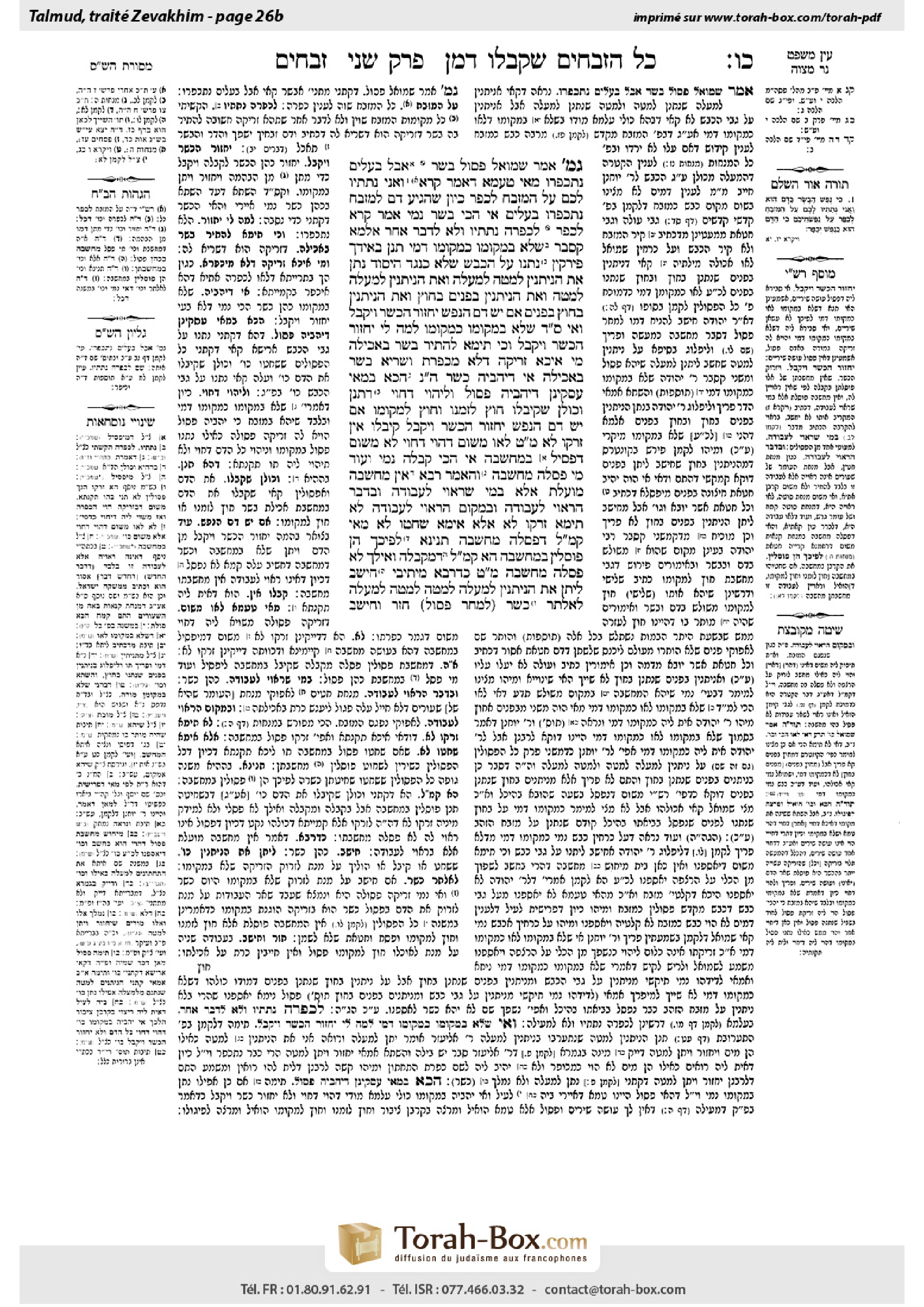
Zevachim 26b: Talmud study for Daf Yomi
Daf Yomi is the daily study of one Talmud folio. Explore 37 tractates with scans, Hebrew text, Sefaria English and AI-generated French translations where annotated.
Passage selection and English or AI-generated French translation are available where the scan has annotations. Daf Study is independent of Torah-Box and Sefaria.
Browse Zevachim · זבחים · All tractatesZevachim 26b text and translations
This page of Zevachim includes the Aramaic text, an English translation and an AI-generated French translation, alongside the scan above.
זבחים כ״ו ב · Aramaic and Hebrew text
גְּמָ׳ אָמַר שְׁמוּאֵל: פָּסוּל בָּשָׂר, אֲבָל בְּעָלִים נִתְכַּפְּרוּ. מַאי טַעְמָא? דְּאָמַר קְרָא: ״וַאֲנִי נְתַתִּיו לָכֶם עַל הַמִּזְבֵּחַ לְכַפֵּר״ – כֵּיוָן שֶׁהִגִּיעַ דָּם לַמִּזְבֵּחַ, נִתְכַּפְּרוּ בְּעָלִים.
אִי הָכִי, בָּשָׂר נָמֵי! אָמַר קְרָא: ״לְכַפֵּר״ – לְכַפָּרָה נְתַתִּיו, וְלֹא לְדָבָר אַחֵר.
אַלְמָא קָסָבַר: שֶׁלֹּא בִּמְקוֹמוֹ – כִּמְקוֹמוֹ דָּמֵי. תְּנַן בְּאִידַּךְ פִּירְקִין: נְתָנוֹ עַל הַכֶּבֶשׁ שֶׁלֹּא כְּנֶגֶד הַיְסוֹד; נָתַן אֶת הַנִּיתָּנִין לְמַטָּה לְמַעְלָה; וְאֶת הַנִּיתָּנִין לְמַעְלָה לְמַטָּה; וְאֶת הַנִּיתָּנִין בִּפְנִים בַּחוּץ; וְאֶת הַנִּיתָּנִין בַּחוּץ בִּפְנִים – אִם יֵשׁ דַּם הַנֶּפֶשׁ, יַחְזוֹר הַכָּשֵׁר וִיקַבֵּל.
וְאִי סָלְקָא דַעְתָּךְ שֶׁלֹּא בִּמְקוֹמוֹ כִּמְקוֹמוֹ, לְמָה לִי יַחְזוֹר הַכָּשֵׁר וִיקַבֵּל? וְכִי תֵּימָא לְהַתִּיר בָּשָׂר בַּאֲכִילָה – מִי אִיכָּא זְרִיקָה דְּלָא מְכַפְּרָא, וְשָׁרְיָא בָּשָׂר בַּאֲכִילָה?!
אִי דְּיַהֲבֵיהּ כָּשֵׁר – הָכִי נָמֵי; הָכָא בְּמַאי עָסְקִינַן – דְּיַהֲבֵיהּ פָּסוּל.
וְלִיהְוֵי דָּחוּי! דִּתְנַן: וְכוּלָּן שֶׁקִּיבְּלוּ חוּץ לִזְמַנּוֹ וְחוּץ לִמְקוֹמוֹ – אִם יֵשׁ דַּם הַנֶּפֶשׁ, יַחְזוֹר הַכָּשֵׁר וִיקַבֵּל. קִיבְּלוּ אִין, זָרְקוּ לָא; מַאי טַעְמָא? לָאו מִשּׁוּם דְּהָוֵי דָּחוּי?
לָא; מִשּׁוּם דִּפְסִיל בְּמַחְשָׁבָה.
אִי הָכִי, קַבָּלָה נָמֵי! וְעוֹד, מִי פָּסְלָה מַחְשָׁבָה?! וְהָאָמַר רָבָא: אֵין מַחְשָׁבָה מוֹעֶלֶת אֶלָּא בְּמִי שֶׁרָאוּי לַעֲבוֹדָה, וּבְדָבָר הָרָאוּי לַעֲבוֹדָה, וּבְמָקוֹם הָרָאוּי לָעֲבוֹדָה!
לָא תֵּימָא: זָרְקוּ לָא, אֶלָּא אֵימָא: שָׁחֲטוּ לָא.
מַאי קָא מַשְׁמַע לַן – דְּפָסְלָה מַחְשָׁבָה? תְּנֵינָא: לְפִיכָךְ הֵן פּוֹסְלִין בְּמַחְשָׁבָה!
הָא קָא מַשְׁמַע לַן – דְּמִקַּבָּלָה וְאֵילָךְ לָא פָּסְלָה מַחְשָׁבָה. מַאי טַעְמָא? כִּדְרָבָא.
מֵיתִיבִי: חִישֵּׁב לִיתֵּן אֶת הַנִּיתָּנִין לְמַעְלָה לְמַטָּה; לְמַטָּה לְמַעְלָה – לְאַלְתַּר כָּשֵׁר (לְמָחָר פָּסוּל). חָזַר וְחִישֵּׁב
Zevachim 26b · English translation
GEMARA: Shmuel says: When the mishna states that the offering is disqualified, it means that the meat is unfit for consumption. But the owner of the offering has achieved atonement through it. What is the reason for this? It is as the verse states with regard to the blood: “And I have given it to you upon the altar to atone for your souls” (Leviticus 17:11), from which it is derived that once the blood reaches any location on the altar, the owner of the offering has achieved atonement.
The Gemara challenges: If so, the meat should be fit for consumption as well. The Gemara responds: The verse states “to atone,” emphasizing that I have given it to you for atonement and for nothing else, e.g., consumption of the meat.
The Gemara notes: Apparently, Shmuel holds that blood sprinkled not in its proper place is considered as though it were sprinkled in its proper place. But we learned in a mishna in another chapter (32a): If an unfit person placed the blood upon the ramp, or on the wall of the altar that is not opposite the base of the altar; or if he placed the blood that is to be placed below the red line above the red line, or if he placed the blood that is to be placed above the red line below the red line; or if he placed the blood that is to be placed inside the Sanctuary outside the Sanctuary or the blood that is to be placed outside the Sanctuary inside the Sanctuary, then if there is blood of the soul that remains in the animal, the priest fit for Temple service should collect the blood again and sprinkle it on the altar.
The Gemara continues: And if it would enter your mind to say that blood sprinkled not in its proper place is considered as though it were sprinkled in its proper place, why do I need the fit priest to collect the blood again and sprinkle it? And if you would say that although the first sprinkling already effected atonement, the second sprinkling is necessary to permit the meat of the offering for consumption, is there such a concept as a sprinkling that does not itself effect atonement and yet permits the meat for consumption? Rather, one must conclude that the first sprinkling did not effect atonement at all, since it was not sprinkled in its proper place.
The Gemara responds: If a fit priest had initially placed the blood improperly, the sprinkling would indeed have effected atonement after the fact and there would not be another sprinkling. But here we are dealing with a case where an unfit person placed the blood, so that it did not effect atonement at all.
The Gemara asks: But if the mishna is dealing with a case where an unfit person placed the blood initially, then the offering should be rejected permanently, as we learned in the same mishna: And with regard to all unfit people who collected the blood with the intent to offer it beyond its designated time or outside its designated area, if there is blood of the soul that remains in the animal, the priest fit for Temple service should collect the blood again and sprinkle it on the altar. Since the mishna states this halakha only with regard to collection of the blood, one can infer that specifically if an unfit person collected the blood with improper intent, a fit priest can indeed collect the blood again, but if they sprinkled the blood with improper intent he cannot. What is the reason for this? Is it not because the offering is rejected permanently when an unfit person sprinkles its blood?
The Gemara responds: No, the offering is rejected because it is disqualified by the improper intent of the person sprinkling the blood, not because that person is unfit.
The Gemara challenges: If so, then improper intent with regard to collection of the blood should disqualify the offering as well. And furthermore, does intent disqualify offerings in such cases? But doesn’t Rava say: Intent is effective to disqualify an offering only when it is expressed by one who is fit for the Temple service, and with regard to an item that is fit for the Temple service, and in a place that is fit for the Temple service? Here, the one collecting the blood is unfit.
The Gemara responds: Do not say that one infers from the mishna that if an unfit person sprinkled the blood with improper intent a fit priest cannot collect it again. Rather, say that one infers that if an unfit person slaughtered the offering with improper intent the mistake cannot be rectified. Slaughter is valid if performed by one unfit for the Temple service, and therefore an unfit person’s improper intent is effective to disqualify the offering. By contrast, collection and sprinkling of the blood must be performed by a fit priest. Consequently, an unfit person’s intent with regard to those rites does not disqualify the offering.
The Gemara asks: According to this interpretation, what is the mishna teaching us? Can it mean to teach only that improper intent by an unfit person during slaughter disqualifies the offering? We already learn this in the same mishna (31b), which states: With regard to all those who are unfit for Temple service who slaughtered an offering, their slaughter is valid, and therefore, these unfit people disqualify the offering with improper intent.
The Gemara responds: This is what the mishna teaches us: That one who is unfit can disqualify the offering only during its slaughter, but from the rite of collection of the blood onward the intent of an unfit person does not disqualify the offering. What is the reason for this? It is like that which Rava says: Intent is effective to disqualify an offering only when expressed by one who is fit for the service in question.
The Gemara raises an objection from a baraita: If one slaughtered an offering and had intent to place the blood that is to be placed above the red line below the red line, or to place the blood that is to be placed below the red line above the red line, and he had intent to do so immediately, i.e., on the same day, the offering remains fit. Therefore, if he subsequently had intent when performing the other rites
Zevachim 26b · Traduction française (IA)
GUEMARA : Chmouel dit : Lorsque la Michna affirme que l’offrande est disqualifiée, cela signifie que la viande est impropre à la consommation. Toutefois, le propriétaire de l’offrande a obtenu l’expiation grâce à elle. Pourquoi ? Comme le dit le verset au sujet du sang : « Je vous l’ai donné sur l’autel pour faire expiation pour vos âmes » (Lévitique 17,11). On en déduit que, dès que le sang atteint n’importe quel endroit de l’autel, le propriétaire de l’offrande a obtenu l’expiation.
La Guemara objecte : Dans ce cas, la viande devrait également être propre à la consommation. La Guemara répond : Le verset dit « pour faire expiation », soulignant que Je vous l’ai donné pour l’expiation et pour rien d’autre, par exemple pour la consommation de la viande.
La Guemara remarque : Il semble donc que Chmouel considère que le sang aspergé à un endroit qui n’est pas le sien est considéré comme s’il avait été aspergé à l’endroit qui lui est destiné. Pourtant, nous avons appris dans une Michna d’un autre chapitre (32a) : Si une personne inapte a déposé le sang sur la rampe ou sur la paroi de l’autel qui ne fait pas face à la base de l’autel ; ou si elle a déposé au-dessus de la ligne rouge le sang qui doit être déposé en dessous de cette ligne, ou en dessous de la ligne rouge le sang qui doit être déposé au-dessus de celle-ci ; ou si elle a déposé à l’extérieur du Sanctuaire le sang qui doit être déposé à l’intérieur du Sanctuaire, ou à l’intérieur du Sanctuaire le sang qui doit être déposé à l’extérieur du Sanctuaire, alors, s’il reste dans l’animal du sang vital, le prêtre apte au service du Temple doit recueillir de nouveau le sang et l’asperger sur l’autel.
La Guemara poursuit : Si l’on pouvait penser que le sang aspergé à un endroit qui n’est pas le sien est considéré comme s’il avait été aspergé à l’endroit qui lui est destiné, pourquoi faut-il que le prêtre apte recueille de nouveau le sang et l’asperge ? Et si l’on disait que, bien que la première aspersion ait déjà produit l’expiation, la seconde aspersion est nécessaire pour rendre la viande de l’offrande propre à la consommation, existe-t-il une aspersion qui ne produit pas elle-même l’expiation, mais qui rend néanmoins la viande propre à la consommation ? Il faut plutôt conclure que la première aspersion n’a aucunement produit l’expiation, puisqu’elle n’a pas été faite à l’endroit qui lui est destiné.
La Guemara répond : Si un prêtre apte avait déposé le sang au mauvais endroit au départ, l’aspersion aurait effectivement produit l’expiation a posteriori et il n’y aurait pas eu de seconde aspersion. Mais ici, il s’agit d’un cas où une personne inapte a déposé le sang ; l’acte n’a donc aucunement produit l’expiation.
La Guemara demande : Mais si la Michna traite d’un cas où une personne inapte a déposé le sang au départ, l’offrande devrait être définitivement rejetée. En effet, nous avons appris dans la même Michna : Et concernant toutes les personnes inaptes qui ont recueilli le sang avec l’intention de l’offrir après le temps qui lui est fixé ou en dehors de l’endroit qui lui est fixé, s’il reste dans l’animal du sang vital, le prêtre apte au service du Temple doit recueillir de nouveau le sang et l’asperger sur l’autel. Puisque la Michna énonce cette halakha uniquement à propos du recueil du sang, on peut en déduire que, précisément si une personne inapte a recueilli le sang avec une intention incorrecte, un prêtre apte peut effectivement le recueillir de nouveau, mais que si elle a aspergé le sang avec une intention incorrecte, il ne le peut pas. Pourquoi ? N’est-ce pas parce que l’offrande est définitivement rejetée lorsqu’une personne inapte en asperge le sang ?
La Guemara répond : Non, l’offrande est rejetée parce qu’elle est disqualifiée par l’intention incorrecte de la personne qui asperge le sang, et non parce que cette personne est inapte.
La Guemara objecte : Dans ce cas, une intention incorrecte lors du recueil du sang devrait également disqualifier l’offrande. En outre, une intention peut-elle disqualifier des offrandes dans de telles circonstances ? Rava ne dit-il pas qu’une intention ne peut disqualifier une offrande que si elle est exprimée par une personne apte au service du Temple, à propos d’un élément apte à ce service et en un lieu apte à ce service ? Ici, la personne qui recueille le sang est inapte.
La Guemara répond : Ne dis pas que l’on déduit de la Michna que si une personne inapte a aspergé le sang avec une intention incorrecte, un prêtre apte ne peut pas le recueillir de nouveau. Dis plutôt que l’on déduit que si une personne inapte a abattu l’offrande avec une intention incorrecte, l’erreur ne peut pas être rectifiée. L’abattage est valable même s’il est effectué par une personne inapte au service du Temple ; l’intention incorrecte d’une personne inapte peut donc disqualifier l’offrande. En revanche, le recueil et l’aspersion du sang doivent être effectués par un prêtre apte. Par conséquent, l’intention d’une personne inapte concernant ces rites ne disqualifie pas l’offrande.
La Guemara demande : Selon cette interprétation, que nous enseigne la Michna ? Peut-elle vouloir enseigner seulement qu’une intention incorrecte d’une personne inapte pendant l’abattage disqualifie l’offrande ? Nous l’apprenons déjà dans la même Michna (31b), qui dit : Concernant toutes les personnes inaptes au service du Temple qui ont abattu une offrande, leur abattage est valable ; ces personnes inaptes disqualifient donc l’offrande par une intention incorrecte.
La Guemara répond : Voici ce que la Michna nous enseigne : une personne inapte ne peut disqualifier l’offrande que lors de son abattage ; à partir du rite du recueil du sang, l’intention d’une personne inapte ne disqualifie plus l’offrande. Pourquoi ? Comme le dit Rava : une intention ne peut disqualifier une offrande que si elle est exprimée par une personne apte à accomplir le service en question.
La Guemara soulève une objection à partir d’une baraïta : Si quelqu’un a abattu une offrande avec l’intention de déposer en dessous de la ligne rouge le sang qui doit être déposé au-dessus de cette ligne, ou de déposer au-dessus de la ligne rouge le sang qui doit être déposé en dessous de celle-ci, et qu’il a eu l’intention de le faire immédiatement, c’est-à-dire le même jour, l’offrande reste valide. Par conséquent, s’il a ensuite eu une intention lors de l’accomplissement des autres rites
Traduction française générée par IA à partir de l’édition anglaise de Sefaria. Vérifie toujours un passage avec le texte source.
Text from Sefaria: William Davidson Edition - Vocalized Aramaic (CC BY NC); William Davidson Edition - English (CC BY NC).