Zevachim 26a: Talmud study for Daf Yomi
Daf Yomi is the daily study of one Talmud folio. Explore 37 tractates with scans, Hebrew text, Sefaria English and AI-generated French translations where annotated.
Passage selection and English or AI-generated French translation are available where the scan has annotations. Daf Study is independent of Torah-Box and Sefaria.
Browse Zevachim · זבחים · All tractatesZevachim 26a text and translations
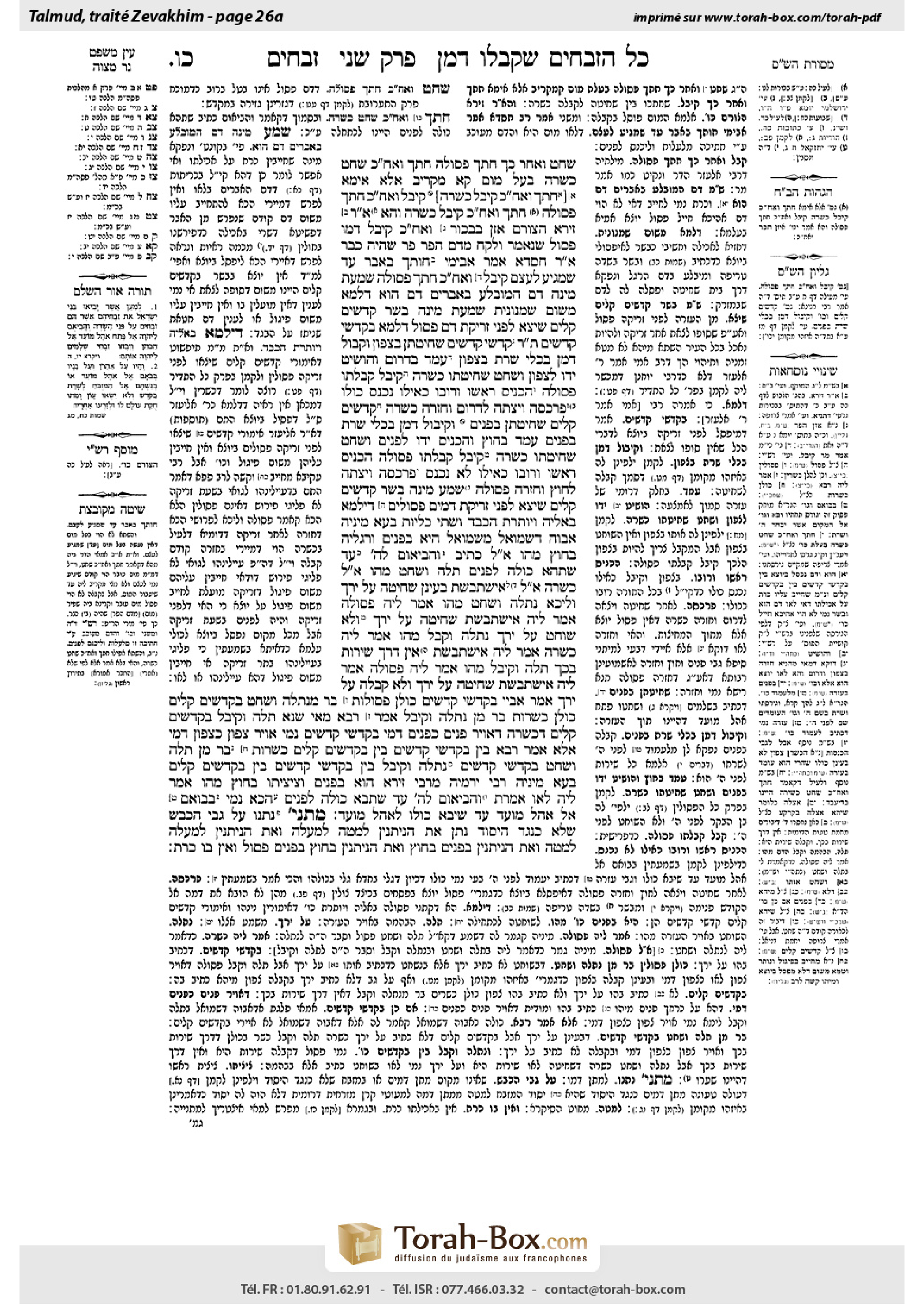
This page of Zevachim includes the Aramaic text, an English translation and an AI-generated French translation, alongside the scan above.
זבחים כ״ו א · Aramaic and Hebrew text
שָׁחַט וְאַחַר כָּךְ חָתַךְ – פְּסוּלָה.
חָתַךְ וְאַחַר כָּךְ שָׁחַט – כְּשֵׁרָה?! בַּעַל מוּם קָא מַקְרִיב! אֶלָּא אֵימָא: חָתַךְ וְאַחַר כָּךְ קִיבֵּל – כְּשֵׁרָה, קִיבֵּל וְאַחַר כָּךְ חָתַךְ – פְּסוּלָה.
חָתַךְ וְאַחַר כָּךְ קִיבֵּל – כְּשֵׁרָה?! וְהָא אָמַר רַבִּי זֵירָא: הַצּוֹרֵם אֹזֶן בִּבְכוֹר, וְאַחַר כָּךְ קִיבֵּל דָּמוֹ – פָּסוּל; שֶׁנֶּאֱמַר: ״וְלָקַח מִדַּם הַפָּר״ – פַּר שֶׁהָיָה כְּבָר!
אָמַר רַב חִסְדָּא אָמַר אֲבִימִי: חוֹתֵךְ בָּאֵבָר עַד שֶׁמַּגִּיעַ לָעֶצֶם.
קִיבֵּל וְאַחַר כָּךְ חָתַךְ – פְּסוּלָה. שָׁמְעַתְּ מִינַּהּ: דָּם הַמּוּבְלָע בָּאֵבָרִים – דָּם הוּא?
דִּלְמָא מִשּׁוּם שַׁמְנוּנִית.
שָׁמְעַתְּ מִינַּהּ: בְּשַׂר קָדָשִׁים קַלִּים שֶׁיָּצָא לִפְנֵי זְרִיקַת דָּם – פָּסוּל?
דִּלְמָא בְּקׇדְשֵׁי קָדָשִׁים.
תָּנוּ רַבָּנַן: קׇדְשֵׁי קָדָשִׁים – שְׁחִיטָתָן בַּצָּפוֹן, וְקִבּוּל דָּמָן בִּכְלִי שָׁרֵת בַּצָּפוֹן. עָמַד בַּדָּרוֹם, וְהוֹשִׁיט יָדוֹ לַצָּפוֹן וְשָׁחַט – שְׁחִיטָתוֹ כְּשֵׁרָה. קִיבֵּל – קַבָּלָתוֹ פְּסוּלָה. הִכְנִיס רֹאשׁוֹ וְרוּבּוֹ – כְּאִילּוּ נִכְנַס כּוּלּוֹ. פִּרְכְּסָה וְיָצְתָה לַדָּרוֹם וְחָזְרָה – כְּשֵׁרָה.
קָדָשִׁים קַלִּים – שְׁחִיטָתָן בִּפְנִים, וְקִיבּוּל דָּמָן בִּכְלִי שָׁרֵת בִּפְנִים. עָמַד בַּחוּץ, וְהִכְנִיס יָדוֹ לִפְנִים וְשָׁחַט – שְׁחִיטָתוֹ כְּשֵׁרָה. קִיבֵּל – קַבָּלָתוֹ פְּסוּלָה; וְהִכְנִיס רֹאשׁוֹ וְרוּבּוֹ – כְּאִילּוּ לֹא נִכְנַס. פִּרְכְּסָה וְיָצְתָה לַחוּץ וְחָזְרָה – פְּסוּלָה. שְׁמַע מִינַּהּ: בְּשַׂר קָדָשִׁים קַלִּים שֶׁיָּצָא לִפְנֵי זְרִיקַת דָּמִים – פְּסוּלִים!
דִּילְמָא בְּאַלְיָה וְיוֹתֶרֶת הַכָּבֵד וּשְׁתֵּי כְלָיוֹת.
בְּעָא מִינֵּיהּ אֲבוּהּ דִּשְׁמוּאֵל מִשְּׁמוּאֵל: הִיא בִּפְנִים וְרַגְלֶיהָ בַּחוּץ, מַהוּ?
אֲמַר לֵיהּ: כְּתִיב ״וֶהֱבִיאוּם לַה׳״ – עַד שֶׁתְּהֵא כּוּלָּהּ לִפְנִים.
תָּלָה וְשָׁחַט, מַהוּ? אֲמַר לֵיהּ: כְּשֵׁרָה. אֲמַר לֵיהּ: אִישְׁתַּבַּשְׁתְּ; בָּעֵינַן שְׁחִיטָה עַל יָרֵךְ, וְלֵיכָּא.
נִתְלָה וְשָׁחַט, מַהוּ? אֲמַר לֵיהּ: פְּסוּלָה. אֲמַר לֵיהּ: אִישְׁתַּבַּשְׁתְּ; שְׁחִיטָה עַל יָרֵךְ, וְלֹא שׁוֹחֵט עַל יָרֵךְ.
נִתְלָה וְקִבֵּל, מַהוּ? אֲמַר לֵיהּ: כְּשֵׁרָה. אֲמַר לֵיהּ: אִישְׁתַּבַּשְׁתְּ; אֵין דֶּרֶךְ שֵׁירוּת בְּכָךְ.
תָּלָה וְקִיבֵּל, מַהוּ? אֲמַר לֵיהּ: פְּסוּלָה. אֲמַר לֵיהּ: אִישְׁתַּבַּשְׁתְּ; שְׁחִיטָה עַל יָרֵךְ, וְלֹא קַבָּלָה עַל יָרֵךְ.
אָמַר אַבָּיֵי: בְּקׇדְשֵׁי קָדָשִׁים – כּוּלָּן פְּסוּלוֹת, בַּר מִנִּתְלָה וְשָׁחַט. בְּקָדָשִׁים קַלִּים – כּוּלָּן כְּשֵׁרוֹת, בַּר מִן נִתְלָה וְקִיבֵּל.
אָמַר רָבָא: מַאי שְׁנָא תָּלָה וְקִיבֵּל בְּקָדָשִׁים קַלִּים – דִּכְשֵׁרָה, דַּאֲוִיר פְּנִים כִּפְנִים דָּמֵי? בְּקׇדְשֵׁי קָדָשִׁים נָמֵי – אֲוִיר צָפוֹן כְּצָפוֹן דָּמֵי!
אֶלָּא אָמַר רָבָא: בֵּין בְּקׇדְשֵׁי קָדָשִׁים בֵּין בְּקָדָשִׁים קַלִּים – כְּשֵׁרוֹת; בַּר מִן תָּלָה וְשָׁחַט – בְּקׇדְשֵׁי קָדָשִׁים, נִתְלָה וְקִיבֵּל – בֵּין בְּקׇדְשֵׁי קָדָשִׁים בֵּין בְּקָדָשִׁים קַלִּים.
בְּעָא מִינֵּיהּ רַבִּי יִרְמְיָה מֵרַבִּי זֵירָא: הוּא בִּפְנִים וְצִיצִיתוֹ בַּחוּץ, מַהוּ? אֲמַר לֵיהּ: לָאו אָמְרַתְּ ״וֶהֱבִיאוּם לַה׳״ – עַד שֶׁתָּבֹא כּוּלָּהּ לִפְנִים? הָכָא נָמֵי, ״בְּבוֹאָם אֶל אֹהֶל מוֹעֵד״ – עַד שֶׁיָּבֹא כּוּלּוֹ לְאֹהֶל מוֹעֵד.
מַתְנִי׳ נְתָנוֹ עַל גַּבֵּי הַכֶּבֶשׁ; שֶׁלֹּא כְּנֶגֶד הַיְסוֹד; נָתַן אֶת הַנִּיתָּנִין לְמַטָּה לְמַעְלָה; וְאֶת הַנִּיתָּנִין לְמַעְלָה לְמַטָּה; וְאֶת הַנִּיתָּנִין בִּפְנִים בַּחוּץ; וְאֶת הַנִּיתָּנִין בַּחוּץ בִּפְנִים – פָּסוּל, וְאֵין בּוֹ כָּרֵת.
Zevachim 26a · English translation
But if he slaughtered the animal and thereafter severed its legs, the offering is disqualified because some of the blood collected is from the legs, which are outside the courtyard.
The Gemara asks: If he severed its legs and thereafter slaughtered it, is the offering fit? But isn’t he sacrificing a blemished animal? Rather, say: If one slaughtered the animal while it stood wholly in the courtyard, and afterward its legs moved beyond the edge of the courtyard, and then he severed its legs and thereafter collected the blood, the offering is fit. But if he collected the blood and thereafter severed the animal’s legs, the offering is disqualified, since the blood from the legs is mixed with the other blood of the animal.
The Gemara challenges: If he severed its legs and thereafter collected the blood, is the offering fit? But doesn’t Rabbi Zeira say: If one slits the ear of a firstborn animal with the knife after slaughter, creating a blemish, and thereafter collected its blood from the neck, the offering is disqualified, as it is stated: “And the anointed priest shall take from the blood of the bull” (Leviticus 4:5)? The verse indicates that the bull must be at the time of collection of the blood as it already was before slaughter, without a blemish.
Rav Ḥisda says that Avimi says: Rabbi Ami is not referring to a case where one severs the entire leg. Rather, one cuts the flesh of the limb until he reaches the bone, leaving the bone intact. This is not considered a blemish, and the animal remains fit for sacrifice.
The Gemara suggests: Given that if he collected the blood and thereafter severed the animal’s legs, the offering is disqualified, perhaps you can conclude from it that blood absorbed in the limbs of an animal is considered blood, such that it disqualifies the offering because this blood left the Temple courtyard.
The Gemara responds: Perhaps the offering is disqualified because of the animal’s fat that is mixed with the blood in the legs. This is considered to be like meat of the offering that has left the Temple courtyard, which also disqualifies the offering.
The Gemara suggests: If so, perhaps you can conclude another halakha from it: In the case of meat of offerings of lesser sanctity that left the Temple courtyard before the sprinkling of the blood, the offering is disqualified, even though the meat of such offerings may be eaten outside the Temple after the blood has been sprinkled.
The Gemara responds: Perhaps the halakha was stated only with regard to offerings of the most sacred order, whose meat must be eaten inside the Temple courtyard. It proves nothing about offerings of lesser sanctity.
The Gemara suggests: Come and hear a proof from that which the Sages taught in a baraita: With regard to offerings of the most sacred order, their slaughter is in the north of the Temple courtyard, and collection of their blood in a service vessel is in the north. If one stood in the south and extended his hand into the north and slaughtered the offering there, his slaughter is valid. If he collected the blood in a similar manner, his collection is not valid. If he inserted his head and most of his body into the north of the courtyard and collected the blood there, it is as if his entire body entered the north. If he slaughtered the animal and it then convulsed and left the north to the south and then returned to the north, it remains fit.
The baraita continues: With regard to offerings of lesser sanctity, their slaughter is anywhere inside the Temple courtyard, and collection of their blood in a service vessel is anywhere inside the Temple courtyard. If one stood outside and inserted his hand into the courtyard and slaughtered the offering there, his slaughter is valid. If he collected the blood in a similar manner, his collection is not valid. And if he inserted his head and most of his body into the courtyard and collected the blood, it is as if he had not entered it at all. If he slaughtered the animal and it then convulsed and left to the outside of the courtyard and returned, it is disqualified. The Gemara infers: Conclude from this baraita that in cases of meat of offerings of lesser sanctity that left the Temple courtyard before the sprinkling of the blood, the offerings are disqualified.
The Gemara responds: Perhaps the baraita is referring to the tail, the diaphragm, and the two kidneys of offerings of lesser sanctity, which are all burned on the altar. Since these portions are never meant to leave the Temple courtyard, they are disqualified if they leave even momentarily. It may still be that the remaining meat of such offerings is not disqualified.
§ Shmuel’s father raised a dilemma before Shmuel: If the offering was standing inside the Temple courtyard and its legs were outside, what is the halakha? May one slaughter it?
Shmuel said to him: It is written: “That they may bring them to the Lord” (Leviticus 17:5), indicating that the offering may not be slaughtered unless all of it is inside.
His father asked him further: If one suspended the animal in the air and slaughtered it, what is the halakha? Shmuel said to him: It is valid. His father said to him: You are mistaken. We require that the slaughter occur on the side of the altar (see Leviticus 1:11), and this is not considered to fulfill that requirement.
His father asked him further: If the one slaughtering the animal was suspended in the air and slaughtered the offering while it was on the ground, what is the halakha? Shmuel said to him: It is not valid. His father said to him: You are mistaken. We require only that the slaughter occur on the side of the altar, but not that the one who slaughters be on the side of the altar.
His father asked him further: If the priest was suspended in the air and collected the blood of the offering in that position, what is the halakha? Shmuel said to him: It is valid. His father said to him: You are mistaken. This is not a normal manner of ministration.
His father asked him further: If the priest suspended the offering in the air after slaughter and collected its blood, what is the halakha? Shmuel said to him: It is not valid. His father said to him: You are mistaken. We require only that the slaughter occur on the side of the altar, but not that collection of the blood occur on the side of the altar.
Abaye said: With regard to offerings of the most sacred order, in all of those cases the offerings are disqualified, except for the case where one was suspended in the air and slaughtered the animal. With regard to offerings of lesser sanctity, in all of those cases the offerings are fit, except for the case where the priest was suspended in the air and collected the blood.
Rava said: What is different about a case where one suspended the animal and collected the blood of an offering of lesser sanctity, such that the offering is fit? Perhaps it is because the air inside the Temple courtyard is considered to be inside the courtyard for purposes of the service. But if so, then with regard to offerings of the most sacred order as well, let one say that air in the north of the Temple courtyard is considered to be in the north for purposes of the service.
Rather, Rava says: Both with regard to offerings of the most sacred order and with regard to offerings of lesser sanctity, they are fit in all of those cases except where one suspended the animal and slaughtered it in the case of offerings of the most sacred order, because the Torah mandates that such offerings be slaughtered on the side of the altar. And the offerings are also disqualified where the priest was suspended in the air and collected the blood, both with regard to offerings of the most sacred order and with regard to offerings of lesser sanctity, since this is not a normal manner of ministration.
Rabbi Yirmeya raised a dilemma before Rabbi Zeira: If the priest was inside and his fringes, i.e., his hair, were outside, and he collected the blood, what is the halakha? Rabbi Zeira said to him: Did you not say that the verse: “That they may bring them to the Lord” (Leviticus 17:5), indicates that an offering may not be slaughtered unless all of it comes inside? Here, too, the verse states with regard to the priests: “When they go into the Tent of Meeting” (Exodus 28:43), indicating that the priest may not perform rites unless all of him comes into the Tent of Meeting.
MISHNA: If the priest placed the blood upon the ramp leading up to the altar, or if he placed it on the wall of the altar in an area that is not opposite the base of the altar, i.e., in those parts of the altar where there is no foundation; or if he placed the blood that is to be placed below the red line that runs along the middle of the altar, e.g., the blood of a burnt offering, above the red line, or if he placed the blood that is to be placed above the red line, e.g., the blood of a sin offering, below the red line; or if he placed the blood that is to be placed inside the Sanctuary, i.e., on the golden altar or in the Holy of Holies, outside the Sanctuary on the external altar, or if he placed the blood that is to be placed outside the Sanctuary inside the Sanctuary, in all these cases the offering is disqualified. Nevertheless, there is no liability for karet for one who partakes of these offerings.
Zevachim 26a · Traduction française (IA)
Mais s’il égorge l’animal, puis lui coupe les pattes, le sacrifice est invalidé, car une partie du sang recueilli provient des pattes, qui se trouvent hors de la cour.
La Guemara demande : s’il lui coupe les pattes, puis l’égorge, le sacrifice est-il valide ? Mais n’offre-t-il pas ainsi un animal présentant un défaut ? Il faut plutôt dire : si quelqu’un égorge l’animal alors qu’il se trouve entièrement dans la cour, puis que ses pattes dépassent la limite de la cour, qu’il lui coupe alors les pattes, puis recueille le sang, le sacrifice est valide. Mais s’il recueille le sang, puis coupe les pattes de l’animal, le sacrifice est invalidé, puisque le sang provenant des pattes se mêle au reste du sang de l’animal.
La Guemara objecte : s’il lui coupe les pattes, puis recueille le sang, le sacrifice est-il valide ? Mais Rabbi Zeira ne dit-il pas que si l’on fend l’oreille d’un animal premier-né avec un couteau après l’égorgement, lui créant ainsi un défaut, puis que l’on recueille son sang au niveau du cou, le sacrifice est invalidé, comme il est dit : « Et le prêtre oint prendra du sang du taureau » (Lévitique 4:5) ? Le verset indique qu’au moment du recueil du sang, le taureau doit être dans l’état où il se trouvait avant l’égorgement, c’est-à-dire sans défaut.
Rav Ḥisda dit au nom d’Avimi : Rabbi Ami ne parle pas d’un cas où l’on coupe toute la patte. On entaille plutôt la chair du membre jusqu’à atteindre l’os, en laissant celui-ci intact. Cela n’est pas considéré comme un défaut, et l’animal reste apte à être offert.
La Guemara suggère : étant donné que si l’on recueille le sang, puis que l’on coupe les pattes de l’animal, le sacrifice est invalidé, peut-être peut-on en conclure que le sang absorbé dans les membres d’un animal est considéré comme du sang, de sorte qu’il invalide le sacrifice parce qu’il est sorti de la cour du Temple.
La Guemara répond : peut-être le sacrifice est-il invalidé à cause de la graisse de l’animal, mêlée au sang dans les pattes. Cela revient à de la viande du sacrifice qui serait sortie de la cour du Temple, ce qui invalide également le sacrifice.
La Guemara suggère : dans ce cas, peut-être peut-on en déduire une autre halakha : la viande des sacrifices de moindre sainteté qui sort de la cour du Temple avant l’aspersion du sang invalide le sacrifice, bien que la viande de tels sacrifices puisse être consommée hors du Temple après l’aspersion du sang.
La Guemara répond : peut-être cette halakha a-t-elle été énoncée uniquement à propos des sacrifices de sainteté suprême, dont la viande doit être consommée à l’intérieur de la cour du Temple. Cela ne prouve rien au sujet des sacrifices de moindre sainteté.
La Guemara suggère : viens et entends une preuve de ce que les Sages ont enseigné dans une baraïta : pour les sacrifices de sainteté suprême, l’égorgement a lieu au nord de la cour du Temple, et le recueil de leur sang dans un récipient de service a lieu au nord. Si quelqu’un se tient au sud, tend la main vers le nord et y égorge le sacrifice, son égorgement est valide. S’il recueille le sang de la même manière, son recueil n’est pas valide. S’il fait entrer sa tête et la majeure partie de son corps dans la partie nord de la cour et y recueille le sang, c’est comme si tout son corps était entré au nord. Si, après avoir égorgé l’animal, celui-ci se débat, quitte le nord en direction du sud, puis retourne au nord, il reste apte.
La baraïta poursuit : pour les sacrifices de moindre sainteté, l’égorgement peut avoir lieu partout à l’intérieur de la cour du Temple, et le recueil de leur sang dans un récipient de service peut également avoir lieu partout à l’intérieur de la cour du Temple. Si quelqu’un se tient à l’extérieur, fait entrer sa main dans la cour et y égorge le sacrifice, son égorgement est valide. S’il recueille le sang de la même manière, son recueil n’est pas valide. Et s’il fait entrer sa tête et la majeure partie de son corps dans la cour et y recueille le sang, c’est comme s’il n’y était pas entré du tout. S’il égorge l’animal, qui se débat ensuite, sort de la cour, puis y retourne, le sacrifice est invalidé. La Guemara en déduit : conclus de cette baraïta que les sacrifices sont invalidés lorsque la viande de sacrifices de moindre sainteté sort de la cour du Temple avant l’aspersion du sang.
La Guemara répond : peut-être la baraïta parle-t-elle de la queue, du diaphragme et des deux reins des sacrifices de moindre sainteté, qui sont tous brûlés sur l’autel. Comme ces parties ne doivent jamais sortir de la cour du Temple, elles sont invalidées si elles en sortent, même un instant. Il se peut encore que le reste de la viande de tels sacrifices ne soit pas invalidé.
§ Le père de Chmouel posa à Chmouel la question suivante : si le sacrifice se trouve dans la cour du Temple et que ses pattes sont à l’extérieur, quelle est la halakha ? Peut-on l’égorger ?
Il lui dit : il est écrit : « afin qu’ils les amènent au Seigneur » (Lévitique 17:5), ce qui indique qu’on ne peut égorger le sacrifice que si celui-ci se trouve entièrement à l’intérieur.
Son père lui demanda encore : si l’on suspend l’animal en l’air et qu’on l’égorge, quelle est la halakha ? Chmouel lui répondit : c’est valide. Son père lui dit : tu te trompes. Nous exigeons que l’égorgement ait lieu sur le côté de l’autel (voir Lévitique 1:11), et cela n’est pas considéré comme satisfaisant à cette exigence.
Son père lui demanda encore : si celui qui égorge l’animal est suspendu en l’air et égorge le sacrifice alors que celui-ci est au sol, quelle est la halakha ? Chmouel lui répondit : ce n’est pas valide. Son père lui dit : tu te trompes. Nous exigeons seulement que l’égorgement ait lieu sur le côté de l’autel, et non que celui qui égorge se trouve lui-même sur le côté de l’autel.
Son père lui demanda encore : si le prêtre est suspendu en l’air et recueille le sang du sacrifice dans cette position, quelle est la halakha ? Chmouel lui répondit : c’est valide. Son père lui dit : tu te trompes. Ce n’est pas une manière normale d’accomplir le service.
Son père lui demanda encore : si le prêtre suspend le sacrifice en l’air après l’égorgement et en recueille le sang, quelle est la halakha ? Chmouel lui répondit : ce n’est pas valide. Son père lui dit : tu te trompes. Nous exigeons seulement que l’égorgement ait lieu sur le côté de l’autel, mais non que le recueil du sang ait lieu sur le côté de l’autel.
Abayé dit : pour les sacrifices de sainteté suprême, ils sont invalidés dans tous ces cas, sauf dans celui où l’on suspend l’animal en l’air et où on l’égorge. Pour les sacrifices de moindre sainteté, ils sont valides dans tous ces cas, sauf dans celui où le prêtre est suspendu en l’air et recueille le sang.
Rava dit : qu’est-ce qui distingue le cas où l’on suspend l’animal et recueille le sang d’un sacrifice de moindre sainteté, de sorte que le sacrifice est valide ? Peut-être est-ce parce que l’espace aérien de la cour du Temple est considéré comme faisant partie de la cour aux fins du service. Mais dans ce cas, pour les sacrifices de sainteté suprême également, qu’on dise que l’espace aérien au nord de la cour du Temple est considéré comme étant au nord aux fins du service.
Rava dit plutôt : tant pour les sacrifices de sainteté suprême que pour les sacrifices de moindre sainteté, ils sont valides dans tous ces cas, à l’exception du cas où l’on suspend l’animal en l’air et où on l’égorge, lorsqu’il s’agit d’un sacrifice de sainteté suprême, car la Torah exige que de tels sacrifices soient égorgés sur le côté de l’autel. Les sacrifices sont également invalidés lorsque le prêtre est suspendu en l’air et recueille le sang, tant pour les sacrifices de sainteté suprême que pour ceux de moindre sainteté, car ce n’est pas une manière normale d’accomplir le service.
Rabbi Yirmeya posa à Rabbi Zeira la question suivante : si le prêtre se trouve à l’intérieur, mais que ses franges, c’est-à-dire ses cheveux, sont à l’extérieur, et qu’il recueille le sang, quelle est la halakha ? Rabbi Zeira lui dit : n’as-tu pas dit que le verset « afin qu’ils les amènent au Seigneur » (Lévitique 17:5) indique qu’on ne peut égorger un sacrifice que si celui-ci entre tout entier ? Ici aussi, le verset dit au sujet des prêtres : « Lorsqu’ils entreront dans la tente d’assignation » (Exode 28:43), ce qui indique que le prêtre ne peut accomplir les rites que s’il entre tout entier dans la tente d’assignation.
Michna : Si le prêtre a placé le sang sur la rampe qui monte vers l’autel, ou s’il l’a placé sur le mur de l’autel à un endroit qui ne se trouve pas en face de la base de l’autel, c’est-à-dire dans les parties de l’autel dépourvues de fondation ; ou s’il a placé au-dessus de la ligne rouge qui traverse le milieu de l’autel le sang qui doit être placé en dessous de cette ligne, par exemple le sang d’un holocauste ; ou s’il a placé en dessous de la ligne rouge le sang qui doit être placé au-dessus, par exemple le sang d’un sacrifice expiatoire ; ou s’il a placé à l’extérieur du Sanctuaire, sur l’autel extérieur, le sang qui doit être placé à l’intérieur du Sanctuaire, c’est-à-dire sur l’autel d’or ou dans le Saint des Saints ; ou s’il a placé à l’intérieur du Sanctuaire le sang qui doit être placé à l’extérieur du Sanctuaire, dans tous ces cas, le sacrifice est invalidé. Néanmoins, celui qui consomme ces sacrifices n’encourt pas la peine de retranchement, le karet.
Traduction française générée par IA à partir de l’édition anglaise de Sefaria. Vérifie toujours un passage avec le texte source.
Text from Sefaria: William Davidson Edition - Vocalized Aramaic (CC BY NC); William Davidson Edition - English (CC BY NC).