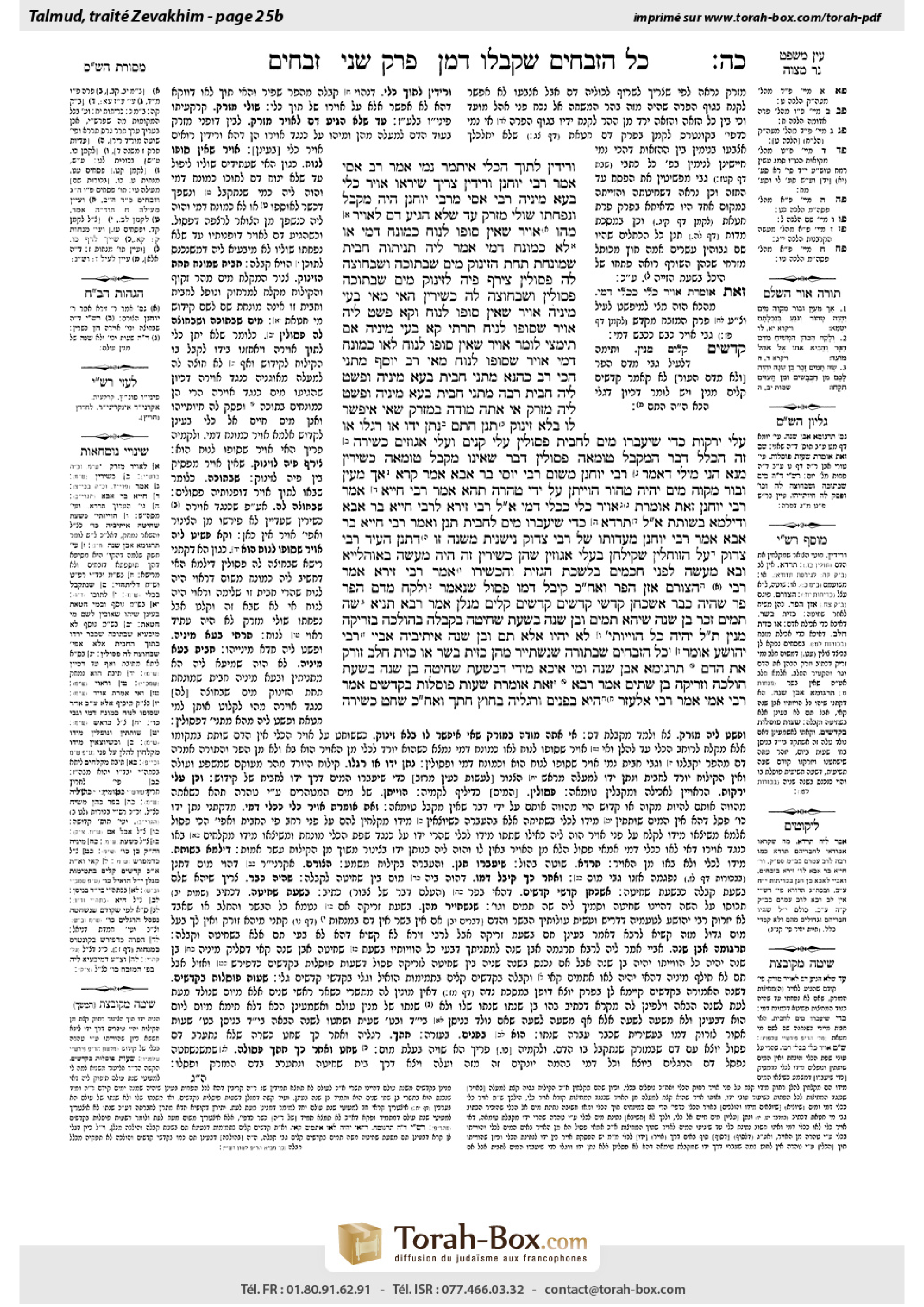
Zevachim 25b: Talmud study for Daf Yomi
Daf Yomi is the daily study of one Talmud folio. Explore 37 tractates with scans, Hebrew text, Sefaria English and AI-generated French translations where annotated.
Passage selection and English or AI-generated French translation are available where the scan has annotations. Daf Study is independent of Torah-Box and Sefaria.
Browse Zevachim · זבחים · All tractatesZevachim 25b text and translations
This page of Zevachim includes the Aramaic text, an English translation and an AI-generated French translation, alongside the scan above.
זבחים כ״ה ב · Aramaic and Hebrew text
וְרִידִין לְתוֹךְ הַכְּלִי. אִיתְּמַר נָמֵי, אָמַר רַב אַסִּי אָמַר רַבִּי יוֹחָנָן: וְרִידִין צָרִיךְ שֶׁיִּרְאוּ אֲוִיר כְּלִי.
בְּעָא מִינֵּיהּ רַבִּי אַסִּי מֵרַבִּי יוֹחָנָן: הָיָה מְקַבֵּל, וְנִפְחֲתוּ שׁוּלֵי מִזְרָק עַד שֶׁלֹּא הִגִּיעַ דָּם לַאֲוִיר – מַהוּ? אֲוִיר שֶׁאֵין סוֹפוֹ לָנוּחַ – כְּמוּנָּח דָּמֵי, אוֹ לָא כְּמוּנָּח דָּמֵי?
אֲמַר לֵיהּ, תְּנֵיתוּהָ: חָבִית שֶׁמּוּנַּחַת תַּחַת הַזִּינּוּק – מַיִם שֶׁבְּתוֹכָהּ וְשֶׁבְּחוּצָה לַהּ, פְּסוּלִין. צֵירַף פִּיהָ לַזִּינּוּק – מַיִם שֶׁבְּתוֹכָהּ פְּסוּלִין, וְשֶׁבְּחוּצָה לָהּ כְּשֵׁירִין.
הַאי מַאי בָּעֵי מִינֵּיהּ – אֲוִיר שֶׁאֵין סוֹפוֹ לָנוּחַ; וְקָא פָשֵׁט לֵיהּ אֲוִיר שֶׁסּוֹפוֹ לָנוּחַ!
תַּרְתֵּי קָא בָעֵי מִינֵּיהּ; אִם תִּימְצֵי לוֹמַר: אֲוִיר שֶׁאֵין סוֹפוֹ לָנוּחַ – לָאו כְּמוּנָּח דָּמֵי, אֲוִיר שֶׁסּוֹפוֹ לָנוּחַ מַאי?
רַב יוֹסֵף מַתְנֵי הָכִי. רַב כָּהֲנָא מַתְנֵי: חָבִית בְּעָא מִינֵּיהּ, וּפְשַׁט לֵיהּ חָבִית.
רַבָּה מַתְנֵי: חָבִית בְּעָא מִינֵּיהּ, וּפְשַׁט לֵיהּ מִזְרָק – אִי אַתָּה מוֹדֶה בְּמִזְרָק, שֶׁאִי אִיפְשָׁר לוֹ בְּלֹא זִינּוּק?!
תְּנַן הָתָם: נָתַן יָדוֹ אוֹ רַגְלוֹ אוֹ עֲלֵי יְרָקוֹת כְּדֵי שֶׁיַּעַבְרוּ מַיִם לֶחָבִית – פְּסוּלִין. עֲלֵי קָנִים וַעֲלֵי אֱגוֹזִים – כְּשֵׁירָה. זֶה הַכְּלָל: דָּבָר הַמְקַבֵּל טוּמְאָה – פְּסוּלִין, דָּבָר שֶׁאֵינוֹ מְקַבֵּל טוּמְאָה – כְּשֵׁירִין.
מְנָא הָנֵי מִילֵּי? דְּאָמַר רַבִּי יוֹחָנָן מִשּׁוּם רַבִּי יוֹסֵי בַּר אַבָּא, אָמַר קְרָא: ״אַךְ מַעְיָן וּבוֹר מִקְוֵה מַיִם יִהְיֶה טָהוֹר״ – הֲוָיָיתָן עַל יְדֵי טׇהֳרָה תְּהֵא.
אָמַר רַבִּי חִיָּיא אָמַר רַבִּי יוֹחָנָן: זֹאת אוֹמֶרֶת, אֲוִיר כְּלִי כִּכְלִי דָּמֵי.
אֲמַר לֵיהּ רַבִּי זֵירָא לְרַבִּי חִיָּיא בַּר אַבָּא: וְדִילְמָא בְּשׁוֹתֵת? אֲמַר לֵיהּ: תְּרָדָא! ״כְּדֵי שֶׁיַּעַבְרוּ מַיִם לֶחָבִית״ תְּנַן!
וְאָמַר רַבִּי חִיָּיא בַּר אַבָּא אָמַר רַבִּי יוֹחָנָן: מֵעֵדוּתוֹ שֶׁל רַבִּי צָדוֹק נִישְׁנֵית מִשְׁנָה זוֹ; דִּתְנַן: הֵעִיד רַבִּי צָדוֹק עַל הַזּוֹחֲלִין שֶׁקִּילְּחָן בַּעֲלֵי אֱגוֹזִין – שֶׁהֵן כְּשֵׁירִין; זֶה הָיָה מַעֲשֶׂה בְּאוֹהָלִיָּיא, וּבָא מַעֲשֶׂה לִפְנֵי חֲכָמִים בְּלִשְׁכַּת הַגָּזִית, וְהִכְשִׁירוּ.
אָמַר רַבִּי זֵירָא אָמַר רַבִּי: הַצּוֹרֵם אֹזֶן הַפָּר, וְאַחַר כָּךְ קִיבֵּל דָּמוֹ – פָּסוּל; שֶׁנֶּאֱמַר: ״וְלָקַח מִדַּם הַפָּר״ – פַּר שֶׁהָיָה כְּבָר.
אַשְׁכְּחַן קׇדְשֵׁי קֳדָשִׁים; קָדָשִׁים קַלִּים מְנָלַן?
אָמַר רָבָא, תַּנְיָא: ״שֶׂה תָמִים זָכָר בֶּן שָׁנָה״ – שֶׁיְּהֵא תָּמִים וּבֶן שָׁנָה בִּשְׁעַת שְׁחִיטָה. בְּקַבָּלָה, בְּהוֹלָכָה, בִּזְרִיקָה – מִנַּיִן? תַּלְמוּד לוֹמַר: ״יִהְיֶה״ – כׇּל הֲוָייוֹתָיו לֹא יִהְיוּ אֶלָּא תָּם וּבֶן שָׁנָה.
אֵיתִיבֵיהּ אַבָּיֵי, רַבִּי יְהוֹשֻׁעַ אוֹמֵר: כׇּל הַזְּבָחִים שֶׁבַּתּוֹרָה שֶׁנִּשְׁתַּיֵּיר מֵהֶן כְּזַיִת בָּשָׂר אוֹ כְּזַיִת חֵלֶב – זוֹרֵק אֶת הַדָּם!
תַּרְגּוּמָא אַבֶּן שָׁנָה.
וּמִי אִיכָּא מִידֵּי דְּבִשְׁעַת שְׁחִיטָה בֶּן שָׁנָה, בִּשְׁעַת הוֹלָכָה וּזְרִיקָה בֶּן שְׁתֵּים?!
אָמַר רָבָא: זֹאת אוֹמֶרֶת, שָׁעוֹת פּוֹסְלוֹת בַּקֳּדָשִׁים.
אָמַר רַבִּי אַמֵּי אָמַר רַבִּי אֶלְעָזָר: הִיא בִּפְנִים וְרַגְלֶיהָ בַּחוּץ; חָתַךְ וְאַחַר כָּךְ שָׁחַט – כְּשֵׁירָה,
Zevachim 25b · English translation
the veins of the offering into the vessel, so that all the blood will empty into it. It was also stated: Rav Asi says that Rabbi Yoḥanan says: The veins must see the airspace of the vessel.
§ Rabbi Asi raised a dilemma before Rabbi Yoḥanan: If the priest was collecting the blood, and the bottom of the bowl broke before the blood reached the bowl’s airspace, what is the halakha? Is blood that enters the airspace of a bowl that will not ultimately allow it to settle inside nevertheless considered as though it settled inside the vessel, so that when it spills through the break it is considered to have already been collected in the bowl? If so, it remains fit for sprinkling. Or is it not considered as though it settled, but is instead considered to have spilled directly from the animal’s neck onto the floor, and is therefore disqualified?
Rabbi Yoḥanan said to him: You learned the answer in a baraita: With regard to a barrel that is placed under a pipe to catch water running from it, both the water that has already flowed inside the barrel and that which is still outside it but about to fall in are unfit to be used as water of purification, which purify one who contracts impurity from a corpse. The water of purification must be flowing water, and all of this water is considered to have been collected in the barrel. But if one joined the mouth of the barrel to the pipe, the water that is inside the barrel is unfit, but water that is still outside it is fit, even though it will ultimately fall in, since it is still in the pipe and is not considered to be above the airspace of the barrel. One can infer from the baraita that all liquid that enters the airspace of a vessel is considered to have been collected in it.
The Gemara rejects this: What is this comparison? Rabbi Asi raises a dilemma before Rabbi Yoḥanan with regard to a case where an item enters the airspace of a vessel that will not ultimately allow it to settle inside, and Rabbi Yoḥanan resolves the dilemma by citing a case where the item enters the airspace of a vessel that will ultimately allow it to settle inside.
The Gemara responds: Rabbi Asi raises two dilemmas before Rabbi Yoḥanan: First, what is the halakha with regard to an item that will not come to rest in the vessel? Second, if you say that an item that enters the airspace of a vessel that will not ultimately allow it to settle inside is not considered as though it settled inside the vessel, what is the halakha with regard to an item that entered the airspace of a vessel that will ultimately allow it to settle inside?
The Gemara notes: Rav Yosef teaches the exchange in this manner, i.e., as recounted. Rav Kahana teaches it as follows: Rabbi Asi raised the dilemma before Rabbi Yoḥanan with regard to a barrel, asking whether the water in its airspace is fit to be used for the water of purification, and Rabbi Yoḥanan resolved the dilemma for him by citing the baraita mentioning a barrel, with which he was unfamiliar.
Rabba teaches the exchange as follows: Rabbi Asi raised the dilemma before Rabbi Yoḥanan with regard to a barrel, and Rabbi Yoḥanan resolved the dilemma for him by citing the halakha concerning a bowl used to collect the blood in the Temple, saying: Do you not concede with regard to the bowl that it is impossible to collect the blood in it without a stream of blood flowing through the air from the animal’s neck? If the air above the bowl is not considered part of the bowl, the blood would be considered to have entered the bowl from the air above rather than directly from the animal’s neck, and all collected blood would be unfit. Therefore, the airspace must be considered part of the bowl, and the same holds for the barrel with regard to the water of purification.
The Gemara adds: We learned in a mishna elsewhere (Para 6:4) with regard to sanctifying the water of purification: If one placed his hand or his foot or vegetable leaves in order to allow flowing water to pass through them to the barrel, the water is disqualified. But if the water passed through leaves of reeds or leaves of nuts, the water remains fit. This is the principle: If the water passes through an item that is susceptible to impurity, it is disqualified; if it passes through an item that is not susceptible to impurity, it is fit.
The Gemara asks: From where are these matters derived? As Rabbi Yoḥanan says in the name of Rabbi Yosei bar Abba: The verse states: “Nevertheless a fountain or a cistern wherein is a gathering of water shall be pure” (Leviticus 11:36). The verse indicates that their being must be by way of purity, i.e., the gathering of the water must not be accomplished by way of items susceptible to impurity.
Rabbi Ḥiyya says that Rabbi Yoḥanan says: Since this mishna states that water that flows over one’s hand through the air into the barrel is disqualified, that is to say that the airspace above a vessel is considered as though it were part of the vessel itself. If it were not, the water would not be considered to have flowed directly from the hand to the vessel, but rather from the air above the vessel. Since air is not susceptible to impurity, the water would not be disqualified.
Rabbi Zeira said to Rabbi Ḥiyya bar Abba: But perhaps the mishna is referring to a case where the water flows weakly straight from the hand into the vessel itself, since the hand is situated directly on the edge of the vessel, with no air separating them? Rabbi Ḥiyya bar Abba said to him: Imbecile, we learned in the mishna: In order to allow flowing water to pass through them to the barrel. This indicates that the water is traveling in a stream and will pass through the air before reaching the barrel.
And Rabbi Ḥiyya bar Abba says that Rabbi Yoḥanan says: This mishna concerning the barrel was taught from the testimony of Rabbi Tzadok, as we learned in a mishna (Eduyyot 7:4): Rabbi Tzadok testified with regard to rivulets that one diverted by way of a pipe made with leaves of nuts that their water is fit to be used as water of purification. This was an incident in the town of Ohalya, and an account of the incident came before the Sages in the Chamber of Hewn Stone in the Temple, and they deemed the water fit.
§ Rabbi Zeira says that Rabbi Yehuda HaNasi says: In the case of one who slits the ear of the bull with the knife after slaughter, creating a blemish, and thereafter collected its blood from the neck, the offering is disqualified, as it is stated: “And the anointed priest shall take from the blood of the bull” (Leviticus 4:5). By referring to the animal as a bull even after its slaughter, the verse indicates that the bull must be at the time of collection of the blood as it already was before slaughter, without a blemish.
The Gemara asks: We found a source for this halakha with regard to offerings of the most sacred order, since the verse is referring to such an offering; from where do we derive that the same holds for offerings of lesser sanctity?
Rava says: It is taught in a baraita with regard to the Paschal offering, an offering of lesser sanctity: The verse states: “A lamb without blemish, a male of the first year it shall be for you” (Exodus 12:5), indicating that it shall be unblemished and in its first year at the time of slaughter. From where is it derived that it must also be without blemish at the time of collection of the blood, at the time of conveying the blood to the altar, and at the time of the sprinkling of the blood? The verse states: “It shall be,” emphasizing that all its happenings shall be only when it is unblemished and in its first year.
Abaye raised an objection to this from a baraita: Rabbi Yehoshua says: With regard to any of the types of offerings that are mentioned in the Torah from which there remains either an olive-bulk of flesh or an olive-bulk of fat, the halakha is that the priest sprinkles the blood of that offering. Apparently, one may sprinkle the blood even if much of the offering is damaged or missing.
The Gemara responds: Interpret the verse as referring only to the requirement that the animal be in its first year until after the sprinkling. It may have a blemish at the time of sprinkling.
The Gemara challenges this: But is there any case where the animal is in its first year at the time of slaughter, but at the time of conveying the blood to the altar and sprinkling the blood it is in its second year?
Rava says: That is to say that hours disqualify sacrificial animals, i.e., one measures the age of the offering from the exact time of its birth. It is therefore possible that the animal reaches its second year between its slaughter and the conveying of its blood to the altar.
§ Rabbi Ami says that Rabbi Elazar says: In a case where the animal is standing inside the Temple courtyard but its legs are planted outside it, if one severed its legs and thereafter slaughtered it, the offering is fit, since all the blood collected in the bowl is from the portion of the animal standing in the courtyard.
Zevachim 25b · Traduction française (IA)
les veines de l’offrande dans le récipient, afin que tout le sang s’y écoule. Il est également dit : Rav Asi rapporte au nom de Rabbi Yoḥanan que les veines doivent se trouver dans l’espace aérien du récipient.
§ Rabbi Asi soumit une question à Rabbi Yoḥanan : si le prêtre recueillait le sang et que le fond du bol se brisait avant que le sang n’atteigne son espace aérien, quelle est la halakha ? Le sang qui pénètre dans l’espace aérien d’un bol qui ne permettra finalement pas qu’il s’y dépose est-il néanmoins considéré comme s’il s’était déposé dans le récipient, de sorte que, lorsqu’il s’écoule par la brèche, on considère qu’il a déjà été recueilli dans le bol ? Dans ce cas, il reste apte à l’aspersion. Ou bien n’est-il pas considéré comme s’y étant déposé, mais comme s’étant écoulé directement du cou de l’animal sur le sol, et est-il donc invalidé ?
Rabbi Yoḥanan lui dit : Tu as appris la réponse dans une baraïta : à propos d’un tonneau placé sous un tuyau pour recueillir l’eau qui en coule, l’eau qui s’est déjà écoulée à l’intérieur du tonneau comme celle qui est encore à l’extérieur, mais sur le point d’y tomber, sont impropres à servir d’eau de purification, qui purifie celui qui contracte l’impureté d’un cadavre. L’eau de purification doit être de l’eau courante, et toute cette eau est considérée comme ayant été recueillie dans le tonneau. Mais si l’on a raccordé l’ouverture du tonneau au tuyau, l’eau qui se trouve à l’intérieur du tonneau est impropre, tandis que celle qui est encore à l’extérieur est apte, même si elle finira par y tomber, puisqu’elle se trouve encore dans le tuyau et n’est pas considérée comme se trouvant au-dessus de l’espace aérien du tonneau. On peut déduire de la baraïta que tout liquide qui pénètre dans l’espace aérien d’un récipient est considéré comme y ayant été recueilli.
La Guemara rejette cette comparaison : en quoi ces cas sont-ils comparables ? Rabbi Asi soumet à Rabbi Yoḥanan une question portant sur un cas où un élément pénètre dans l’espace aérien d’un récipient qui ne permettra finalement pas qu’il s’y dépose, et Rabbi Yoḥanan résout la question en citant un cas où l’élément pénètre dans l’espace aérien d’un récipient qui permettra finalement qu’il s’y dépose.
La Guemara répond : Rabbi Asi soumit deux questions à Rabbi Yoḥanan. Premièrement, quelle est la halakha concernant un élément qui ne finira pas par se déposer dans le récipient ? Deuxièmement, si tu dis qu’un élément qui pénètre dans l’espace aérien d’un récipient qui ne permettra finalement pas qu’il s’y dépose n’est pas considéré comme s’étant déposé dans le récipient, quelle est la halakha concernant un élément qui a pénétré dans l’espace aérien d’un récipient qui permettra finalement qu’il s’y dépose ?
La Guemara relève : Rav Yosef rapporte cet échange sous la forme qui vient d’être présentée. Rav Kahana le rapporte ainsi : Rabbi Asi soumit à Rabbi Yoḥanan une question au sujet d’un tonneau, lui demandant si l’eau présente dans son espace aérien est apte à servir d’eau de purification ; Rabbi Yoḥanan résolut sa question en citant la baraïta qui mentionne un tonneau, dont il n’avait pas connaissance.
Rabba rapporte l’échange ainsi : Rabbi Asi soumit à Rabbi Yoḥanan une question au sujet d’un tonneau, et Rabbi Yoḥanan la résolut en citant la halakha concernant le bol servant à recueillir le sang au Temple. Il lui dit : Ne reconnais-tu pas que, dans le cas du bol, il est impossible d’y recueillir le sang sans qu’un filet de sang traverse l’air depuis le cou de l’animal ? Si l’air au-dessus du bol n’était pas considéré comme faisant partie du bol, on considérerait que le sang est entré dans le bol depuis l’air qui le surplombe, plutôt que directement depuis le cou de l’animal, et tout le sang recueilli serait impropre. Par conséquent, l’espace aérien doit être considéré comme faisant partie du bol, et il en va de même pour le tonneau en ce qui concerne l’eau de purification.
La Guemara ajoute : Nous avons appris dans une Michna ailleurs (Para 6:4), à propos de la sanctification de l’eau de purification : si quelqu’un plaçait sa main, son pied ou des feuilles de légume de manière à faire passer l’eau courante à travers eux jusqu’au tonneau, l’eau est invalidée. Mais si l’eau passait à travers des feuilles de roseau ou des feuilles de noix, elle reste apte. Voici le principe : si l’eau passe à travers un élément susceptible de contracter l’impureté, elle est invalidée ; si elle passe à travers un élément qui n’est pas susceptible de contracter l’impureté, elle est apte.
La Guemara demande : De quoi déduit-on ces règles ? Rabbi Yoḥanan dit au nom de Rabbi Yosei bar Abba : Le verset dit : « Toutefois, une source ou une citerne où se rassemble de l’eau sera pure » (Lévitique 11:36). Le verset indique que leur formation doit se faire dans la pureté, c’est-à-dire que le rassemblement de l’eau ne doit pas s’effectuer au moyen d’éléments susceptibles de contracter l’impureté.
Rabbi Ḥiyya dit au nom de Rabbi Yoḥanan : Puisque cette Michna enseigne que l’eau qui coule de la main d’une personne à travers l’air jusque dans le tonneau est invalidée, cela signifie que l’espace aérien au-dessus d’un récipient est considéré comme faisant partie du récipient lui-même. Si ce n’était pas le cas, on ne considérerait pas que l’eau a coulé directement de la main dans le récipient, mais plutôt qu’elle est passée par l’air au-dessus du récipient. Comme l’air n’est pas susceptible de contracter l’impureté, l’eau ne serait pas invalidée.
Rabbi Zeira dit à Rabbi Ḥiyya bar Abba : Mais peut-être la Michna parle-t-elle d’un cas où l’eau coule faiblement de la main directement dans le récipient lui-même, puisque la main se trouve juste sur le bord du récipient, sans qu’il y ait d’air entre eux ? Rabbi Ḥiyya bar Abba lui dit : Imbécile, nous avons appris dans la Michna : « de manière à faire passer l’eau courante à travers eux jusqu’au tonneau ». Cela indique que l’eau s’écoule en un filet et passe par l’air avant d’atteindre le tonneau.
Et Rabbi Ḥiyya bar Abba dit au nom de Rabbi Yoḥanan : Cette Michna concernant le tonneau a été enseignée à la suite du témoignage de Rabbi Tzadok, comme nous l’avons appris dans une Michna (Eduyyot 7:4) : Rabbi Tzadok témoigna au sujet de ruisselets dont on avait détourné le cours au moyen d’un tuyau fabriqué avec des feuilles de noix, que leur eau est apte à servir d’eau de purification. Cet incident eut lieu dans la ville d’Ohalya, et son récit fut présenté aux Sages dans la Chambre de pierre de taille du Temple, qui déclarèrent l’eau apte.
§ Rabbi Zeira dit au nom de Rabbi Yehuda HaNasi : Si quelqu’un entaille l’oreille du taureau avec le couteau après l’abattage, lui causant ainsi un défaut, puis recueille son sang au niveau du cou, l’offrande est invalidée, comme il est dit : « Le prêtre oint prendra du sang du taureau » (Lévitique 4:5). En désignant l’animal comme un taureau même après son abattage, le verset indique qu’au moment du prélèvement du sang, le taureau doit être dans le même état qu’avant l’abattage, c’est-à-dire sans défaut.
La Guemara demande : Nous avons trouvé une source pour cette halakha concernant les offrandes de sainteté supérieure, puisque le verset parle d’une telle offrande ; d’où déduit-on qu’il en va de même pour les offrandes de moindre sainteté ?
Rava dit : Une baraïta l’enseigne au sujet de l’offrande pascale, qui est une offrande de moindre sainteté : le verset dit : « Un agneau sans défaut, un mâle âgé d’un an, il sera pour vous » (Exode 12:5), ce qui indique qu’il doit être sans défaut et âgé d’un an au moment de l’abattage. D’où déduit-on qu’il doit également être sans défaut au moment du prélèvement du sang, du transport du sang jusqu’à l’autel et de l’aspersion du sang ? Le verset dit : « Il sera », soulignant que toutes les étapes de son service ne doivent avoir lieu que tant qu’il est sans défaut et âgé d’un an.
Abaye objecta à cela en citant une baraïta : Rabbi Yehoshua dit : Pour toute catégorie d’offrandes mentionnée dans la Torah dont il reste soit une olive de chair, soit une olive de graisse, le prêtre asperge le sang de cette offrande. Apparemment, on peut asperger le sang même si une grande partie de l’offrande est abîmée ou manque.
La Guemara répond : Interprète le verset comme exigeant seulement que l’animal soit dans sa première année jusqu’après l’aspersion. Il peut présenter un défaut au moment de l’aspersion.
La Guemara objecte : Existe-t-il un cas où l’animal est dans sa première année au moment de l’abattage, mais dans sa deuxième année au moment du transport du sang jusqu’à l’autel et de son aspersion ?
Rava dit : Cela signifie que les heures invalident les animaux destinés aux sacrifices, c’est-à-dire que l’âge de l’offrande se mesure à partir de l’heure exacte de sa naissance. Il est donc possible que l’animal atteigne sa deuxième année entre son abattage et le transport de son sang jusqu’à l’autel.
§ Rabbi Ami dit au nom de Rabbi Elazar : Si un animal se tient à l’intérieur de la cour du Temple, mais a les pattes plantées à l’extérieur, et qu’on lui coupe ensuite les pattes avant de l’abattre, l’offrande est apte, puisque tout le sang recueilli dans le bol provient de la partie de l’animal qui se trouve dans la cour.
Traduction française générée par IA à partir de l’édition anglaise de Sefaria. Vérifie toujours un passage avec le texte source.
Text from Sefaria: William Davidson Edition - Vocalized Aramaic (CC BY NC); William Davidson Edition - English (CC BY NC).