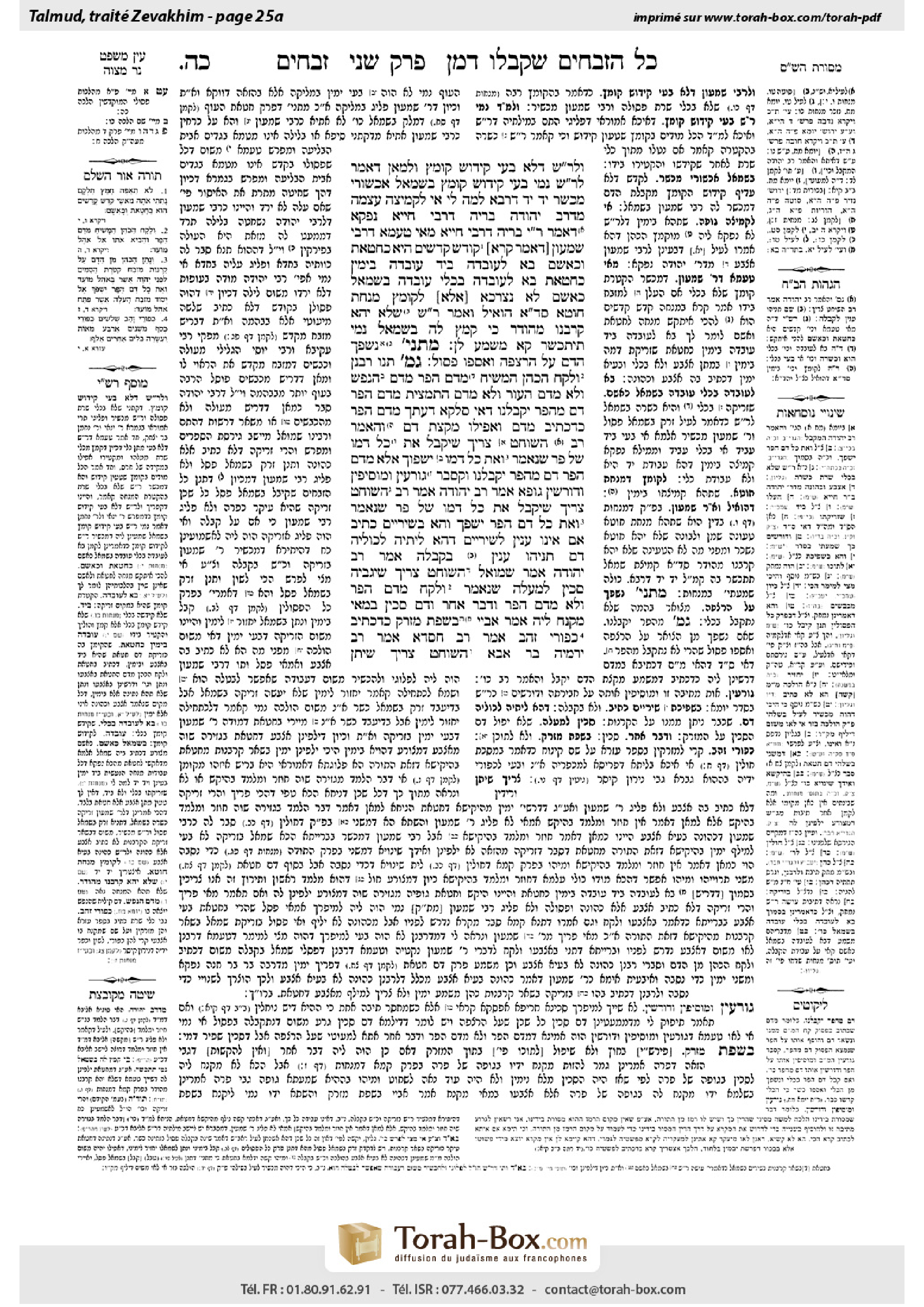
Zevachim 25a: Talmud study for Daf Yomi
Daf Yomi is the daily study of one Talmud folio. Explore 37 tractates with scans, Hebrew text, Sefaria English and AI-generated French translations where annotated.
Passage selection and English or AI-generated French translation are available where the scan has annotations. Daf Study is independent of Torah-Box and Sefaria.
Browse Zevachim · זבחים · All tractatesZevachim 25a text and translations
This page of Zevachim includes the Aramaic text, an English translation and an AI-generated French translation, alongside the scan above.
זבחים כ״ה א · Aramaic and Hebrew text
וּלְרַבִּי שִׁמְעוֹן – דְּלָא בָּעֵי קִידּוּשׁ קוֹמֶץ; וּלְמַאן דְּאָמַר לְרַבִּי שִׁמְעוֹן נָמֵי בָּעֵי קִידּוּשׁ – קוֹמֶץ בִּשְׂמֹאל אַכְשׁוֹרֵי מַכְשַׁר; ״יָד״–״יָד״ דְּרָבָא לְמָה לִי?
אִי לִקְמִיצָה עַצְמָהּ – מִדְּרַב יְהוּדָה בְּרֵיהּ דְּרַבִּי חִיָּיא נָפְקָא; דְּאָמַר רַב יְהוּדָה בְּרֵיהּ דְּרַבִּי חִיָּיא: מַאי טַעְמָא דְּרַבִּי שִׁמְעוֹן? דְּאָמַר קְרָא: ״קֹדֶשׁ קָדָשִׁים הִיא כַּחַטָּאת וְכָאָשָׁם״;
בָּא לְעוֹבְדָהּ בַּיָּד – עוֹבְדָהּ בְּיָמִין, כְּחַטָּאת; בָּא לְעוֹבְדָהּ בִּכְלִי – עוֹבְדָהּ בִּשְׂמֹאל, כְּאָשָׁם!
לֹא נִצְרְכָא [אֶלָּא] לְקוֹמֵץ מִנְחַת חוֹטֵא; סָלְקָא דַּעְתָּךְ אָמֵינָא, הוֹאִיל וְאָמַר רַבִּי שִׁמְעוֹן שֶׁלֹּא יְהֵא קׇרְבָּנוֹ מְהוּדָּר – כִּי קָמַץ לַהּ בִּשְׂמֹאל נָמֵי תִּיתַּכְשַׁר; קָא מַשְׁמַע לַן.
מַתְנִי׳ נִשְׁפַּךְ הַדָּם עַל הָרִצְפָּה, וַאֲסָפוֹ – פָּסוּל.
גְּמָ׳ תָּנוּ רַבָּנַן: ״וְלָקַח הַכֹּהֵן הַמָּשִׁיחַ מִדַּם הַפָּר״ – מִדַּם הַנֶּפֶשׁ, וְלֹא מִדַּם הָעוֹר וְלֹא מִדַּם הַתַּמְצִית.
״מִדַּם הַפָּר״ – דָּם מֵהַפָּר יְקַבְּלֶנּוּ. דְּאִי סָלְקָא דַעְתָּךְ ״מִדַּם הַפָּר״ כְּדִכְתִיב – ״מִדַּם״ וַאֲפִילּוּ מִקְצָת דָּם; וְהָאָמַר רַב: הַשּׁוֹחֵט צָרִיךְ שֶׁיְּקַבֵּל אֶת כׇּל דָּמוֹ שֶׁל פַּר, שֶׁנֶּאֱמַר: ״וְאֵת כׇּל דָּמוֹ יִשְׁפֹּךְ״!
אֶלָּא ״מִדַּם הַפָּר״ – דָּם מֵהַפָּר יְקַבְּלֶנּוּ. וְקָסָבַר: גּוֹרְעִין וּמוֹסִיפִין וְדוֹרְשִׁין.
גּוּפָא – אָמַר רַב יְהוּדָה אָמַר רַב: הַשּׁוֹחֵט צָרִיךְ שֶׁיְּקַבֵּל אֶת כׇּל דָּמוֹ שֶׁל פַּר, שֶׁנֶּאֱמַר: ״וְאֵת כׇּל דַּם הַפָּר יִשְׁפֹּךְ״. וְהָא בְּשִׁירַיִים כְּתִיב!
אִם אֵינוֹ עִנְיָן לְשִׁירַיִים – דְּהָא לֵיתֵיהּ לְכוּלֵּיהּ דָּם; תְּנֵיהוּ עִנְיָן (בְּקַבָּלָה) [לְקַבָּלָה].
אָמַר רַב יְהוּדָה אָמַר שְׁמוּאֵל: הַשּׁוֹחֵט צָרִיךְ שֶׁיַּגְבִּיהַּ סַכִּין לְמַעְלָה, שֶׁנֶּאֱמַר: ״וְלָקַח מִדַּם הַפָּר״ – וְלֹא מִדַּם הַפָּר וְדָבָר אַחֵר.
וְדַם סַכִּין בְּמַאי מְקַנַּח לֵיהּ? אָמַר אַבָּיֵי: בִּשְׂפַת מִזְרָק, כְּדִכְתִיב: ״כְּפוֹרֵי זָהָב״.
אָמַר רַב חִסְדָּא אָמַר רַב יִרְמְיָה בַּר אַבָּא: הַשּׁוֹחֵט צָרִיךְ שֶׁיִּתֵּן
Zevachim 25a · English translation
The Gemara asks: And according to Rabbi Shimon, who does not require sanctification of the handful, or according to the one who says that Rabbi Shimon also requires the sanctification of the handful but that he deems the sanctification fit when performed with the left hand, why do I need the verbal analogy of Rava between “hand” and “hand”?
If one suggests that it is necessary to indicate that the removal of the handful itself must be performed with the right hand, this cannot be, since that is derived from the verse cited by Rav Yehuda, son of Rabbi Ḥiyya. As Rav Yehuda, son of Rabbi Ḥiyya, says: What is the reason that Rabbi Shimon does not require that the handful be sanctified in a service vessel? As the verse states with regard to the meal offering: “It is most holy, as the sin offering, and as the guilt offering” (Leviticus 6:10).
The verse compares the meal offering to a sin offering and a guilt offering. Therefore, if the priest comes to perform the burning of the handful with his hand, then he performs it with his right hand, like a sin offering, whose blood is sprinkled by hand. And if he comes to perform it with a vessel, i.e., if he first sanctifies the handful in a service vessel, then he may perform it with his left hand, like a guilt offering, whose blood is sprinkled from a vessel. Since the removal of the handful is performed by hand, the verse indicates that it must be performed with the right hand, and the verbal analogy is unnecessary.
The Gemara responds: The verbal analogy is necessary only for the handful of a meal offering of a sinner, to teach that it must be removed with the right hand. It might enter your mind to say: Since Rabbi Shimon says that this offering does not require oil and frankincense so that his offering will not be of superior quality, perhaps when he removed the handful with his left hand, which is an inferior manner, it should be fit as well. The verbal analogy therefore teaches us that the handful must always be removed with the right hand, even in the case of the meal offering of a sinner.
MISHNA: If the blood spilled on the floor before the priest managed to collect it into a vessel, and the priest then collected it from the floor into a vessel, it is disqualified.
GEMARA: The Sages taught: The verse states: “And the anointed priest shall take from the blood of the bull [middam happar]” (Leviticus 4:5). This means that the priest shall take from the blood of the soul, i.e., the blood that flows from the place of slaughter as the animal dies, but not from the blood of the skin, which bleeds out when the skin is cut before the slaughter, nor from the blood of exudate, i.e., that exudes from the neck of the animal after the initial spurt of its slaughter concludes.
The baraita continues: When the verse states: “From the blood of the bull,” it should be interpreted as if it is written: He shall collect the blood from the bull, i.e., if the blood spills onto the floor before it is collected in a service vessel, it is disqualified. As, if it enters your mind that “from the blood of the bull” should be interpreted as it is written, i.e., that “from the blood” means that the priest may collect even only a portion of the blood, that is difficult: But doesn’t Rav say: One who slaughters the offering must collect all the blood of the bull, as it is stated: “And all the blood of the bull he shall pour out on the base of the altar” (Leviticus 4:7)? The verse emphasizes that the priest must pour all the blood of the bull, which is possible only if he has collected all of it.
Rather, “from the blood of the bull” means that the priest shall collect the blood from the bull. And this Sage holds that the Sages subtract and add and interpret homiletically, i.e., one may take a letter from one word, insert it into a second word, and explain the phrase in that manner. In this case, the mem of middam is added to happar, so that the verse is interpreted as though it states: Dam mehappar, meaning: Blood from the bull.
§ The Gemara turns to the matter itself: Rav Yehuda says that Rav says: One who slaughters the offering must collect all the blood of the bull, as it is stated: “And all the blood of the bull he shall pour out on the base of the altar.” The Gemara asks: But isn’t this verse written with regard to the remainder of the blood that is poured onto the base of the altar after the sprinkling? How, then, can a halakha with regard to the collection of the blood be derived from it?
The Gemara responds: If this verse is not referring to the matter of the remainder of the blood after sprinkling, as not all of the blood is present for that rite since some of it has already been sprinkled, apply it instead to the matter of collection of the blood from the animal.
Rav Yehuda says that Shmuel says: One who slaughters the offering must hold the knife up after slaughter, so that blood that is on the knife does not fall into the service vessel, as it is stated: “And the anointed priest shall take from the blood of the bull,” i.e., and not from a mixture of the blood of the bull and something else, such as the blood from the knife.
The Gemara asks: And with what does he wipe the blood from the knife? Abaye says: He wipes it with the rim of the bowl used to collect the blood, as it is written of the bowls used to collect the blood: “Atoning-bowls [keforei] of gold” (Ezra 1:10). The root kaf, peh, reish can also mean to wipe.
Rav Ḥisda says that Rav Yirmeya bar Abba says: One who slaughters the offering must place
Zevachim 25a · Traduction française (IA)
La Guemara demande : Et selon Rabbi Chimon, qui n’exige pas la sanctification de la poignée, ou selon celui qui affirme que Rabbi Chimon exige lui aussi la sanctification de la poignée, mais considère que celle-ci est valable même lorsqu’elle est effectuée de la main gauche, pourquoi Rava a-t-il besoin de l’analogie verbale entre « main » et « main » ?
Si l’on suggère qu’elle est nécessaire pour enseigner que le prélèvement de la poignée lui-même doit être effectué de la main droite, cela ne peut être le cas, car cette règle se déduit du verset cité par Rav Yehouda, fils de Rabbi Ḥiyya. En effet, Rav Yehouda, fils de Rabbi Ḥiyya, dit : Pour quelle raison Rabbi Chimon n’exige-t-il pas que la poignée soit sanctifiée dans un ustensile de service ? Car le verset dit au sujet de l’offrande végétale : « Elle est très sainte, comme le sacrifice expiatoire et comme le sacrifice de culpabilité » (Lévitique 6:10).
Le verset compare l’offrande végétale au sacrifice expiatoire et au sacrifice de culpabilité. Par conséquent, si le prêtre entreprend de brûler la poignée à la main, il le fait de la main droite, comme pour un sacrifice expiatoire, dont le sang est aspergé à la main. Et s’il entreprend de le faire avec un ustensile, c’est-à-dire s’il sanctifie d’abord la poignée dans un ustensile de service, il peut alors le faire de la main gauche, comme pour un sacrifice de culpabilité, dont le sang est aspergé à l’aide d’un ustensile. Puisque le prélèvement de la poignée s’effectue à la main, le verset indique qu’il doit être fait de la main droite, et l’analogie verbale est inutile.
La Guemara répond : L’analogie verbale n’est nécessaire que pour la poignée de l’offrande végétale d’un pécheur, afin d’enseigner qu’elle doit être prélevée de la main droite. On pourrait penser : puisque Rabbi Chimon dit que cette offrande ne requiert ni huile ni encens, afin que l’offrande du pécheur ne soit pas de meilleure qualité, peut-être serait-elle également valable si l’on prélevait la poignée de la main gauche, d’une manière moins conforme. L’analogie verbale nous enseigne donc que la poignée doit toujours être prélevée de la main droite, même dans le cas de l’offrande végétale d’un pécheur.
MICHNA : Si le sang se répand sur le sol avant que le prêtre ait réussi à le recueillir dans un ustensile, puis que le prêtre le recueille du sol dans un ustensile, il est disqualifié.
GUEMARA : Les Sages ont enseigné : Le verset dit : « Le prêtre oint prendra du sang du taureau [middam happar] » (Lévitique 4:5). Cela signifie que le prêtre prendra le sang de la vie, c’est-à-dire le sang qui s’écoule du lieu de l’abattage au moment où l’animal meurt, mais non le sang de la peau, qui s’écoule lorsqu’on incise la peau avant l’abattage, ni le sang résiduel, c’est-à-dire celui qui suinte du cou de l’animal après la fin du premier jet de sang lors de l’abattage.
La baraïta poursuit : Lorsque le verset dit : « Du sang du taureau », il faut l’interpréter comme s’il était écrit : « Il recueillera le sang provenant du taureau » ; autrement dit, si le sang se répand sur le sol avant d’être recueilli dans un ustensile de service, il est disqualifié. En effet, si l’on pensait que l’expression « du sang du taureau » devait être interprétée telle qu’elle est écrite, c’est-à-dire que « du sang » signifie que le prêtre peut n’en recueillir qu’une partie, cela poserait une difficulté : Rav ne dit-il pas que celui qui abat l’offrande doit recueillir tout le sang du taureau, comme il est dit : « Il versera tout le sang du taureau à la base de l’autel » (Lévitique 4:7) ? Le verset souligne que le prêtre doit verser tout le sang du taureau, ce qui n’est possible que s’il l’a recueilli en totalité.
Il faut donc comprendre l’expression « du sang du taureau » comme signifiant que le prêtre recueillera le sang provenant du taureau. Ce Sage considère que les Sages retranchent, ajoutent et interprètent de manière homilétique, c’est-à-dire qu’on peut prendre une lettre d’un mot, l’insérer dans un second mot et expliquer l’expression ainsi. Dans ce cas, le mem de middam est ajouté à happar, de sorte que le verset s’interprète comme s’il disait : Dam mehappar, c’est-à-dire : « le sang provenant du taureau ».
§ La Guemara revient à la question elle-même : Rav Yehouda dit au nom de Rav : Celui qui abat l’offrande doit recueillir tout le sang du taureau, comme il est dit : « Il versera tout le sang du taureau à la base de l’autel. » La Guemara demande : Mais ce verset ne concerne-t-il pas le reste du sang, qui est versé à la base de l’autel après l’aspersion ? Comment peut-on alors en déduire une halakha concernant le recueil du sang ?
La Guemara répond : Si ce verset ne se rapporte pas au reste du sang après l’aspersion, puisque tout le sang n’est pas disponible pour cet acte, une partie ayant déjà été aspergée, applique-le plutôt au recueil du sang de l’animal.
Rav Yehouda dit au nom de Chmouel : Celui qui abat l’offrande doit tenir le couteau en hauteur après l’abattage, afin que le sang qui s’y trouve ne tombe pas dans l’ustensile de service, comme il est dit : « Le prêtre oint prendra du sang du taureau », c’est-à-dire qu’il ne prendra pas un mélange du sang du taureau et d’autre chose, tel que le sang provenant du couteau.
La Guemara demande : Et avec quoi essuie-t-il le sang du couteau ? Abayé dit : Il l’essuie sur le bord du bol utilisé pour recueillir le sang, car il est écrit au sujet des bols utilisés pour recueillir le sang : « des bassins [keforei] d’or » (Esdras 1:10). La racine kaf, peh, reish peut aussi signifier « essuyer ».
Rav Ḥisda dit au nom de Rav Yirmeya bar Abba : Celui qui abat l’offrande doit placer
Traduction française générée par IA à partir de l’édition anglaise de Sefaria. Vérifie toujours un passage avec le texte source.
Text from Sefaria: William Davidson Edition - Vocalized Aramaic (CC BY NC); William Davidson Edition - English (CC BY NC).