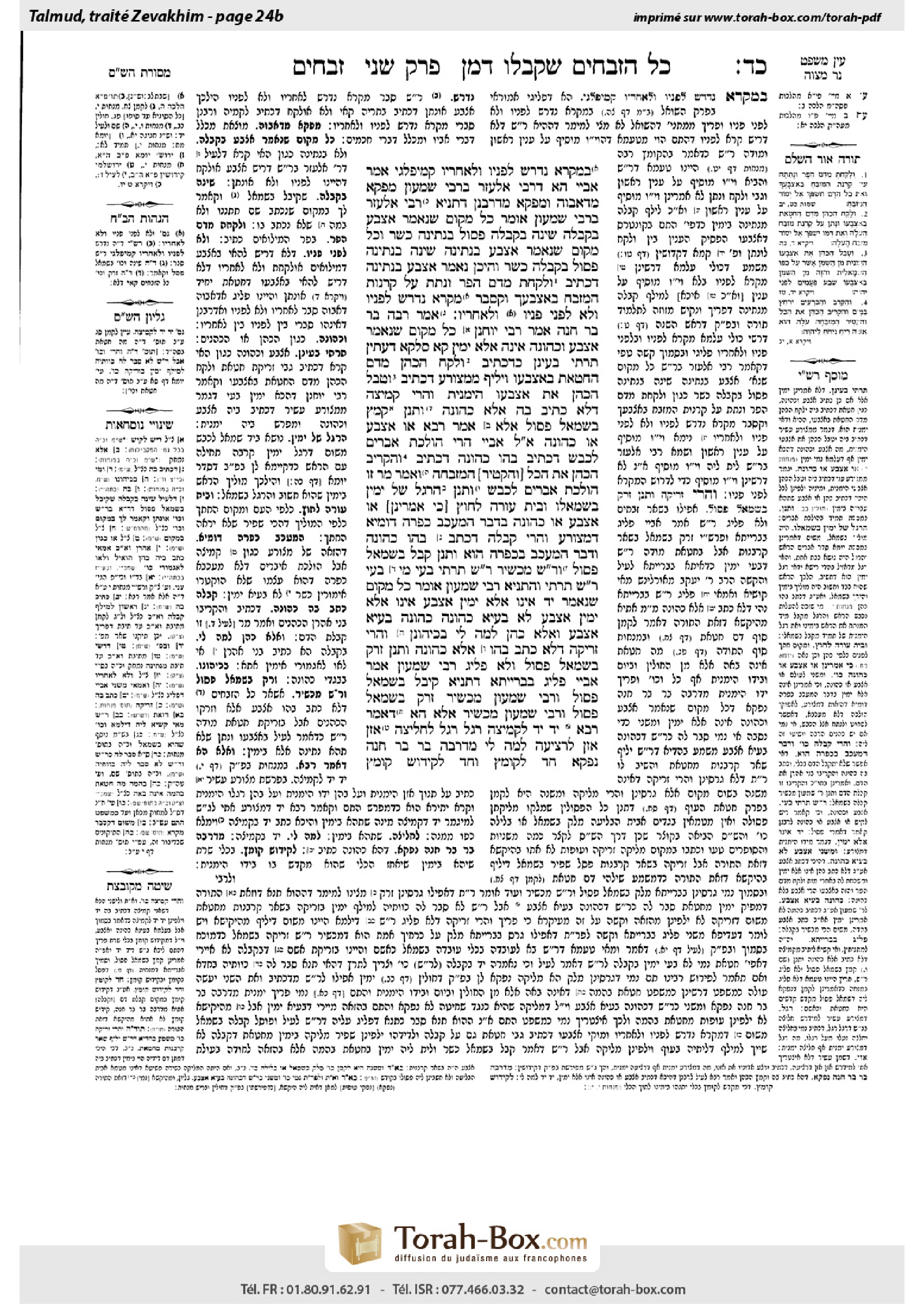
Zevachim 24b: Talmud study for Daf Yomi
Daf Yomi is the daily study of one Talmud folio. Explore 37 tractates with scans, Hebrew text, Sefaria English and AI-generated French translations where annotated.
Passage selection and English or AI-generated French translation are available where the scan has annotations. Daf Study is independent of Torah-Box and Sefaria.
Browse Zevachim · זבחים · All tractatesZevachim 24b text and translations
This page of Zevachim includes the Aramaic text, an English translation and an AI-generated French translation, alongside the scan above.
זבחים כ״ד ב · Aramaic and Hebrew text
בְּמִקְרָא נִדְרָשׁ לְפָנָיו וּלְאַחֲרָיו קָמִיפַּלְגִי.
אָמַר אַבָּיֵי: הָא דְּרַבִּי אֶלְעָזָר בְּרַבִּי שִׁמְעוֹן – מַפְּקָא מִדַּאֲבוּהּ, וּמַפְּקָא מִדְּרַבָּנַן. דְּתַנְיָא, רַבִּי אֶלְעָזָר בְּרַבִּי שִׁמְעוֹן אוֹמֵר: כׇּל מָקוֹם שֶׁנֶּאֱמַר אֶצְבַּע בְּקַבָּלָה – שִׁינָּה בַּקַּבָּלָה, פָּסוּל; בַּנְּתִינָה, כָּשֵׁר. וְכׇל מָקוֹם שֶׁנֶּאֱמַר אֶצְבַּע בִּנְתִינָה – שִׁינָּה בַּנְּתִינָה, פָּסוּל; בַּקַּבָּלָה, כָּשֵׁר.
וְהֵיכָן נֶאֱמַר אֶצְבַּע בִּנְתִינָה? דִּכְתִיב: ״וְלָקַחְתָּ מִדַּם הַפָּר וְנָתַתָּ עַל קַרְנֹת הַמִּזְבֵּחַ בְּאֶצְבָּעֶךָ״, וְקָסָבַר: מִקְרָא נִדְרָשׁ לְפָנָיו, וְלֹא לִפְנֵי פָנָיו וּלְאַחֲרָיו.
אָמַר רַבָּה בַּר בַּר חָנָה אָמַר רַבִּי יוֹחָנָן: כׇּל מָקוֹם שֶׁנֶּאֱמַר אֶצְבַּע וּכְהוּנָּה – אֵינָהּ אֶלָּא יָמִין.
קָא סָלְקָא דַּעְתִּין תַּרְתֵּי בָּעֵינַן – כְּדִכְתִיב: ״וְלָקַח הַכֹּהֵן מִדַּם הַחַטָּאת בְּאֶצְבָּעוֹ״, וְיָלֵיף מִמְּצוֹרָע – דִּכְתִיב: ״וְטָבַל הַכֹּהֵן אֶת אֶצְבָּעוֹ הַיְמָנִית״. וַהֲרֵי קְמִיצָה – דְּלָא כְּתִיב בַּהּ אֶלָּא כְּהוּנָּה; וּתְנַן: קָמַץ בִּשְׂמֹאל – פָּסוּל!
אֶלָּא אָמַר רָבָא: אוֹ אֶצְבַּע, אוֹ כְּהוּנָּה.
אֲמַר לֵיהּ אַבָּיֵי: הֲרֵי הוֹלָכַת אֵבָרִים לַכֶּבֶשׁ – דִּכְתִיב בְּהוּ כְּהוּנָּה, דִּכְתִיב: ״וְהִקְרִיב הַכֹּהֵן אֶת הַכֹּל [וְהִקְטִיר] הַמִּזְבֵּחָה״; וְאָמַר מָר: זוֹ הוֹלָכַת אֵבָרִים לַכֶּבֶשׁ; וּתְנַן: הָרֶגֶל שֶׁל יָמִין בִּשְׂמֹאלוֹ, וּבֵית עוֹרָהּ לַחוּץ!
[כִּי אָמְרִינַן] אוֹ אֶצְבַּע אוֹ כְּהוּנָּה – בְּדָבָר הַמְעַכֵּב כַּפָּרָה, דּוּמְיָא דִּמְצוֹרָע.
וַהֲרֵי קַבָּלָה – דִּכְתַב בְּהוּ כְּהוּנָּה, וְדָבָר הַמְעַכֵּב בְּכַפָּרָה הוּא; וּתְנַן: קִבֵּל בִּשְׂמֹאל – פָּסוּל, וְרַבִּי שִׁמְעוֹן מַכְשִׁיר!
רַבִּי שִׁמְעוֹן תַּרְתֵּי בָּעֵי.
מִי בָּעֵי רַבִּי שִׁמְעוֹן תַּרְתֵּי?! וְהָתַנְיָא, רַבִּי שִׁמְעוֹן אוֹמֵר: כׇּל מָקוֹם שֶׁנֶּאֱמַר יָד – אֵינוֹ אֶלָּא יָמִין, אֶצְבַּע – אֵינוֹ אֶלָּא יָמִין!
אֶצְבַּע – לָא בָּעֲיָא כְּהוּנָּה, כְּהוּנָּה – בָּעֲיָא אֶצְבַּע.
וְאֶלָּא כֹּהֵן לְמָה לִי? (בְּכִיהוּנָּן) [בְּכִיהוּנּוֹ].
וַהֲרֵי זְרִיקָה – דְּלָא כְּתִב בְּהוּ אֶלָּא כְּהוּנָּה; וּתְנַן: זָרַק בִּשְׂמֹאל – פָּסוּל, וְלָא פְּלִיג רַבִּי שִׁמְעוֹן!
אָמַר אַבָּיֵי: פְּלִיג בְּבָרַיְיתָא – דְּתַנְיָא: קִיבֵּל בִּשְׂמֹאל – פָּסוּל, וְרַבִּי שִׁמְעוֹן מַכְשִׁיר. זָרַק בִּשְׂמֹאל – פָּסוּל, וְרַבִּי שִׁמְעוֹן מַכְשִׁיר.
אֶלָּא הָא דְּאָמַר רָבָא: ״יָד״–״יָד״ לִקְמִיצָה, ״רֶגֶל״–״רֶגֶל״ לַחֲלִיצָה, ״אֹזֶן״–״אֹזֶן״ לִרְצִיעָה; לְמָה לִי? מִדְּרַבָּה בַּר בַּר חָנָה נָפְקָא!
חַד לְקוֹמֵץ, וְחַד לְקִידּוּשׁ קוֹמֶץ.
Zevachim 24b · English translation
They disagree with regard to whether a verse is interpreted based on juxtaposition to the language preceding it and to the language following it. According to Rabbi Shimon, a verse is interpreted only based on the language following it. Therefore, when the verse states: “And the priest shall take of the blood of the sin offering with his finger and put it upon the corners of the altar,” the word “finger” is referring only to the placing of the blood and not its collection. The Rabbis hold that the verse is also interpreted based on the language preceding it. Accordingly, they require that both rites be performed with the right hand.
Abaye says: This statement of Rabbi Elazar, son of Rabbi Shimon, diverges from the opinion of his father, and it diverges from the opinion of the Rabbis: As it is taught in a baraita: Rabbi Elazar, son of Rabbi Shimon, says: In every instance in the Torah that the word “finger” is stated with regard to collection of the blood and not with regard to placing of the blood on the altar, if the priest deviated from the proper method of collection and performed it with the left hand, the offering is disqualified, but if he deviated from the proper method of placing the blood, the offering remains fit. And in every instance that the word “finger” is stated only with regard to placing the blood, if the priest deviated from the proper method of placing, the offering is disqualified, but if he deviated from the proper method of collection, the offering remains fit.
And where is the word “finger” stated only with regard to placing? As it is written: “And you shall take of the blood of the bullock and put it upon the corners of the altar with your finger” (Exodus 29:12). And he holds that a verse is interpreted based on juxtaposition to the language immediately preceding it and not to the language before that which immediately precedes it, nor to the language following it.
§ Rabba bar bar Ḥana says that Rabbi Yoḥanan says: In every instance in the Torah that it is stated that an action is performed with a finger and by members of the priesthood, it may be performed only with the right hand.
The Gemara comments: It might enter our mind to say that this means that we require both a finger and the priesthood to be stated together in the verse in order to mandate use of the right hand, e.g., as it is written: “And the priest shall take of the blood of the sin offering with his finger” (Leviticus 4:25). And the fact that this verse is referring to a finger from his right hand is derived from a leper, as it is written: “And the priest shall dip his right finger” (Leviticus 14:16). This cannot be correct, as there is the verse that addresses the removal of a handful from a meal offering, in which only the priesthood is written, and yet we learned in a mishna (Menaḥot 6a): If one removed the handful with his left hand, the meal offering is disqualified.
Rather, Rava says: This statement means that if the verse mentions either a finger or the priesthood, only the right hand may be used.
Abaye said to Rava: But this is contradicted by the verse discussing the conveyance of the limbs of the daily burnt offering to the ramp of the altar, as priesthood is written with regard to it, as it is written: “And the priest shall sacrifice the whole and make it smoke upon the altar” (Leviticus 1:13), and the Master said that this verse is referring to the conveyance of the limbs to the ramp. And yet we learned in a mishna (Tamid 31b): When the priest conveys the limbs to the ramp, the foot of the right side of the offering is carried in the left hand of the priest, and the place of its skin, i.e., the side of the limb covered in skin, is held facing outward. Clearly, use of the left hand does not disqualify the conveyance of the limbs.
The Gemara responds: When we say that if the verse states either finger or priesthood then the left hand is disqualified, this is only with regard to a matter that precludes atonement, i.e., a rite whose performance is indispensable to the atonement, similar to the sprinkling of the oil on the leper (see Leviticus 14:16). The conveyance of the limbs, by contrast, is not indispensable to atonement.
The Gemara asks: But isn’t there the collection of the blood in a service vessel, about which priesthood is written and which is a matter that precludes atonement? And yet we learned in the mishna: If one collected the blood with his left hand, the blood is disqualified for offering, and Rabbi Shimon deems it fit.
The Gemara responds: Rabbi Shimon requires that both matters appear in the verse, i.e., both finger and priesthood.
The Gemara asks: Does Rabbi Shimon really require both? But isn’t it taught in a baraita that Rabbi Shimon says: In every instance in the Torah that the word “hand” is stated, the verse is referring only to the right hand, and whenever the verse mentions “finger,” it is referring only to a finger of the right hand?
The Gemara responds: According to Rabbi Shimon, if the verse mentions only “finger,” then it does not require a mention of the priesthood as well for the limitation to apply. But if the verse mentions only the priesthood, it requires a mention of “finger” for the limitation to apply.
The Gemara asks: But according to Rabbi Shimon, if the mention of the priesthood alone does not suffice to disqualify the right hand, then why do I need the superfluous reference to a priest with regard to the collection of the blood? After all, the verse already states that the collection must be performed by the sons of Aaron. The Gemara responds: The additional mention of the priesthood indicates that the priests must perform the collection of the blood in their priestly state, i.e., while wearing the priestly vestments.
The Gemara asks: But isn’t there the sprinkling of the blood, concerning which only the priesthood is written in the verse, and we learned: If one sprinkled the blood with his left hand it is disqualified; and Rabbi Shimon does not disagree with this ruling, indicating that Rabbi Shimon holds that a mention of the priesthood does not require a mention of “finger”?
Abaye says: He disagrees with this ruling in a baraita, as it is taught in a baraita: If one collected the blood with his left hand, it is disqualified, and Rabbi Shimon deems it fit. Additionally, if one sprinkled the blood with his left hand, it is disqualified, and Rabbi Shimon deems it fit.
The Gemara asks: But that which Rava says with regard to the superfluous phrases in the passage discussing a leper: One derives a verbal analogy between “hand” and “hand” mentioned with regard to the removal of a handful from a meal offering, to indicate that the latter must also be performed with the right hand. Additionally, one derives a verbal analogy between “foot” and “foot” mentioned with regard to the ḥalitza ritual. And one derives a verbal analogy between “ear” and “ear” mentioned with regard to the piercing of a Hebrew slave’s ear with an awl. One may ask: Why do I need the first analogy? The requirement that the handful be removed with the right hand can be derived from the statement of Rabba bar bar Ḥana above, since priesthood is mentioned in the verse describing it.
The Gemara responds: Both derivations are necessary, one for the removal of the handful from a meal offering, and one for the sanctification of the handful, i.e., placing it into a second service vessel. Both must be performed with the right hand.
Zevachim 24b · Traduction française (IA)
Ils sont en désaccord sur la question de savoir si un verset s’interprète en fonction de sa juxtaposition aux termes qui le précèdent et à ceux qui le suivent. Selon Rabbi Shimon, un verset s’interprète uniquement en fonction des termes qui le suivent. Ainsi, lorsque le verset dit : « Le prêtre prendra avec son doigt du sang du sacrifice expiatoire et en mettra sur les cornes de l’autel », le mot « doigt » se rapporte uniquement au dépôt du sang, et non à son prélèvement. Les Sages considèrent que le verset s’interprète également en fonction des termes qui le précèdent. Par conséquent, ils exigent que les deux rites soient accomplis de la main droite.
Abayé dit : Cette déclaration de Rabbi Elazar, fils de Rabbi Shimon, diverge de l’opinion de son père et de celle des Sages. En effet, il est enseigné dans une baraïta : Rabbi Elazar, fils de Rabbi Shimon, dit : Chaque fois que le mot « doigt » est mentionné dans la Torah à propos du prélèvement du sang, mais non de son dépôt sur l’autel, si le prêtre s’écarte de la procédure prescrite et effectue le prélèvement de la main gauche, l’offrande est disqualifiée ; mais s’il s’écarte de la procédure prescrite pour le dépôt du sang, l’offrande reste valide. Et chaque fois que le mot « doigt » est mentionné uniquement à propos du dépôt du sang, si le prêtre s’écarte de la procédure prescrite pour le dépôt, l’offrande est disqualifiée ; mais s’il s’écarte de la procédure prescrite pour le prélèvement, l’offrande reste valide.
Et où le mot « doigt » est-il mentionné uniquement à propos du dépôt du sang ? Il est écrit : « Tu prendras du sang du taureau et tu en mettras avec ton doigt sur les cornes de l’autel » (Exode 29,12). Il considère qu’un verset s’interprète en fonction des termes qui le précèdent immédiatement, mais non en fonction de ceux qui précèdent ces termes, ni de ceux qui le suivent.
§ Rabba bar bar Ḥana dit au nom de Rabbi Yoḥanan : Chaque fois que la Torah prescrit qu’un acte soit accompli avec un doigt et par un prêtre, il ne peut être accompli qu’avec la main droite.
La Guemara commente : On pourrait penser que cela signifie que le verset doit mentionner à la fois un doigt et un prêtre pour imposer l’usage de la main droite, par exemple comme il est écrit : « Le prêtre prendra avec son doigt du sang du sacrifice expiatoire » (Lévitique 4,25). Le fait que ce verset désigne un doigt de sa main droite se déduit du cas du lépreux, car il est écrit : « Le prêtre trempera son doigt droit » (Lévitique 14,16). Cela ne peut être exact, car il y a le verset qui traite du prélèvement d’une poignée de l’offrande végétale : seul le prêtre y est mentionné, et pourtant nous avons appris dans une Michna (Menaḥot 6a) : Si quelqu’un a prélevé la poignée de la main gauche, l’offrande végétale est disqualifiée.
Rava dit plutôt : Cette déclaration signifie que si le verset mentionne soit un doigt, soit un prêtre, seule la main droite peut être utilisée.
Abayé dit à Rava : Mais cela est contredit par le verset qui traite du transport des membres de l’holocauste quotidien jusqu’à la rampe de l’autel, car un prêtre y est mentionné, comme il est écrit : « Le prêtre offrira le tout et le fera fumer sur l’autel » (Lévitique 1,13). Or, le Maître a dit que ce verset se rapporte au transport des membres jusqu’à la rampe. Pourtant, nous avons appris dans une Michna (Tamid 31b) : Lorsque le prêtre transporte les membres jusqu’à la rampe, le pied droit de l’offrande est porté dans la main gauche du prêtre, et la partie où se trouve la peau, c’est-à-dire le côté du membre recouvert de peau, est tournée vers l’extérieur. Il est donc clair que l’usage de la main gauche n’invalide pas le transport des membres.
La Guemara répond : Lorsque nous disons que si le verset mentionne soit un doigt, soit un prêtre, la main gauche disqualifie l’acte, cela ne concerne que ce qui conditionne l’expiation, c’est-à-dire un rite indispensable à celle-ci, comme l’aspersion de l’huile sur le lépreux (voir Lévitique 14,16). En revanche, le transport des membres n’est pas indispensable à l’expiation.
La Guemara demande : Mais n’y a-t-il pas le prélèvement du sang dans un récipient de service, au sujet duquel un prêtre est mentionné et qui conditionne l’expiation ? Pourtant, nous avons appris dans la Michna : Si quelqu’un a prélevé le sang de la main gauche, le sang est disqualifié pour l’offrande, tandis que Rabbi Shimon le déclare valide.
La Guemara répond : Rabbi Shimon exige que les deux éléments figurent dans le verset, c’est-à-dire que soient mentionnés à la fois le doigt et le prêtre.
La Guemara demande : Rabbi Shimon exige-t-il vraiment les deux ? Pourtant, il est enseigné dans une baraïta que Rabbi Shimon dit : Chaque fois que le mot « main » est mentionné dans la Torah, le verset désigne uniquement la main droite ; et chaque fois que le verset mentionne un « doigt », il désigne uniquement un doigt de la main droite.
La Guemara répond : Selon Rabbi Shimon, si le verset mentionne uniquement le « doigt », il n’est pas nécessaire qu’il mentionne également le prêtre pour que cette restriction s’applique. Mais si le verset mentionne uniquement le prêtre, il faut que le « doigt » soit également mentionné pour que cette restriction s’applique.
La Guemara demande : Mais selon Rabbi Shimon, si la seule mention du prêtre ne suffit pas à exclure la main gauche, pourquoi ai-je besoin de la mention supplémentaire d’un prêtre à propos du prélèvement du sang ? Après tout, le verset dit déjà que le prélèvement doit être effectué par les fils d’Aaron. La Guemara répond : La mention supplémentaire du prêtre indique que les prêtres doivent prélever le sang dans leur état sacerdotal, c’est-à-dire en portant les vêtements sacerdotaux.
La Guemara demande : Mais n’y a-t-il pas l’aspersion du sang, au sujet de laquelle seul le prêtre est mentionné dans le verset, et n’avons-nous pas appris : Si quelqu’un a aspergé le sang de la main gauche, l’acte est disqualifié ? Rabbi Shimon ne conteste pas cette règle, ce qui indique qu’il considère que la mention du prêtre n’exige pas que le « doigt » soit également mentionné.
Abayé dit : Il conteste cette règle dans une baraïta, car il est enseigné dans une baraïta : Si quelqu’un a prélevé le sang de la main gauche, le prélèvement est disqualifié, mais Rabbi Shimon le déclare valide. De même, si quelqu’un a aspergé le sang de la main gauche, l’aspersion est disqualifiée, mais Rabbi Shimon la déclare valide.
La Guemara demande : Mais concernant ce que Rava dit au sujet des expressions superflues dans le passage qui traite du lépreux : on établit une analogie verbale entre « main » et « main », le terme employé à propos du prélèvement d’une poignée de l’offrande végétale, pour enseigner que celui-ci doit lui aussi être effectué de la main droite. On établit également une analogie verbale entre « pied » et « pied », à propos du rite de la ḥalitza, et une analogie verbale entre « oreille » et « oreille », à propos du percement à l’alêne de l’oreille d’un esclave hébreu. On peut demander : Pourquoi ai-je besoin de la première analogie ? L’obligation de prélever la poignée de la main droite peut se déduire de la déclaration de Rabba bar bar Ḥana ci-dessus, puisque le prêtre est mentionné dans le verset qui décrit ce prélèvement.
La Guemara répond : Les deux déductions sont nécessaires, l’une pour le prélèvement de la poignée de l’offrande végétale, et l’autre pour la sanctification de la poignée, c’est-à-dire son dépôt dans un second récipient de service. Les deux doivent être effectués de la main droite.
Traduction française générée par IA à partir de l’édition anglaise de Sefaria. Vérifie toujours un passage avec le texte source.
Text from Sefaria: William Davidson Edition - Vocalized Aramaic (CC BY NC); William Davidson Edition - English (CC BY NC).