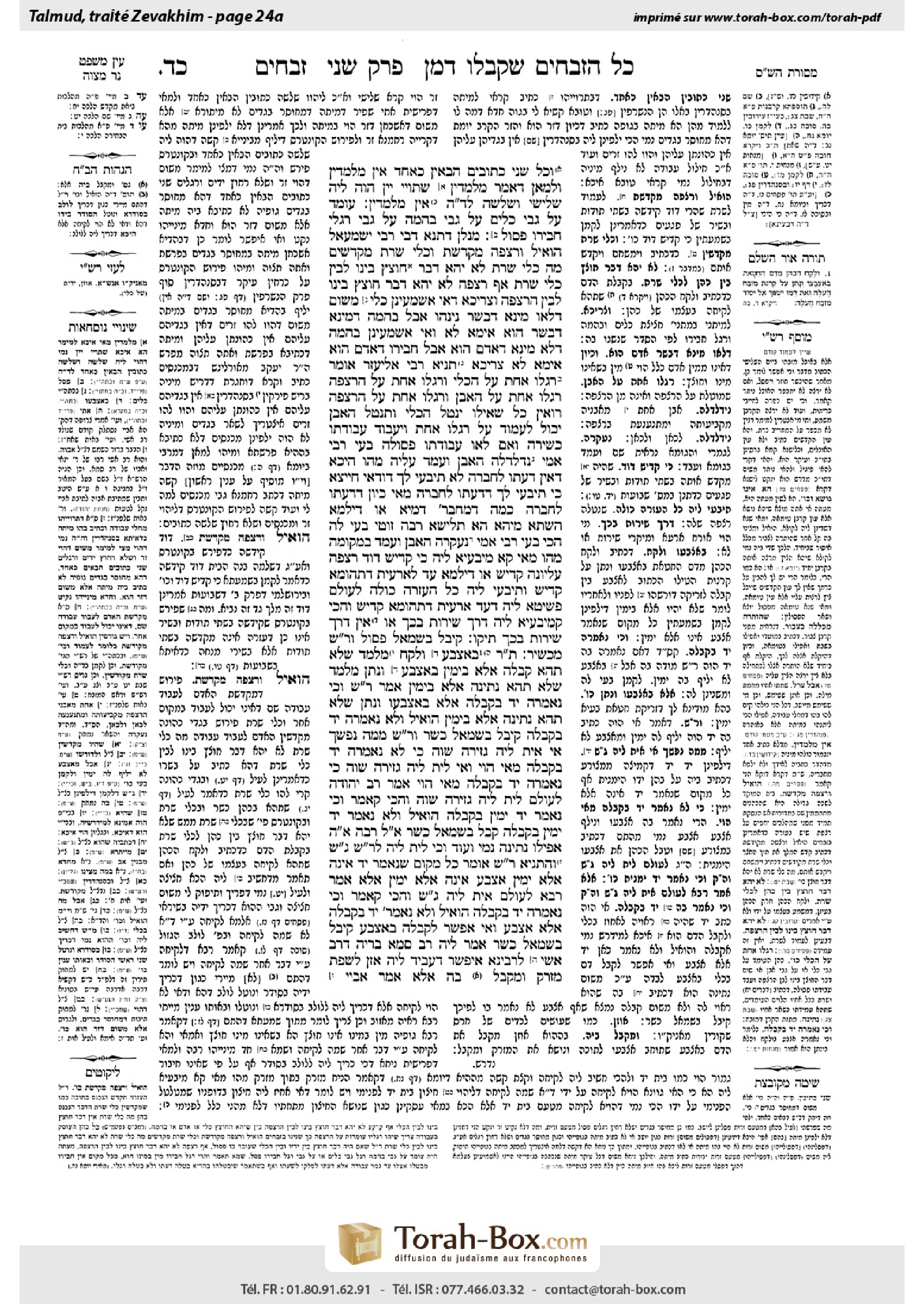
Zevachim 24a: Talmud study for Daf Yomi
Daf Yomi is the daily study of one Talmud folio. Explore 37 tractates with scans, Hebrew text, Sefaria English and AI-generated French translations where annotated.
Passage selection and English or AI-generated French translation are available where the scan has annotations. Daf Study is independent of Torah-Box and Sefaria.
Browse Zevachim · זבחים · All tractatesZevachim 24a text and translations
This page of Zevachim includes the Aramaic text, an English translation and an AI-generated French translation, alongside the scan above.
זבחים כ״ד א · Aramaic and Hebrew text
וְכׇל שְׁנֵי כְתוּבִים הַבָּאִין כְּאֶחָד – אֵין מְלַמְּדִין.
וּלְמַאן דְּאָמַר מְלַמְּדִין – שְׁתוּיֵי יַיִן הָוֵה לֵיהּ שְׁלִישִׁי, וּשְׁלֹשָׁה לְדִבְרֵי הַכֹּל אֵין מְלַמְּדִין.
עוֹמֵד עַל גַּבֵּי כֵּלִים, עַל גַּבֵּי בְּהֵמָה, עַל גַּבֵּי רַגְלֵי חֲבֵירוֹ – פָּסוּל. מְנָלַן? דְּתָנָא דְּבֵי רַבִּי יִשְׁמָעֵאל: הוֹאִיל וְרִצְפָּה מְקַדֶּשֶׁת וּכְלֵי שָׁרֵת מְקַדְּשִׁים; מָה כְּלֵי שָׁרֵת – לֹא יְהֵא דָּבָר חוֹצֵץ בֵּינוֹ לְבֵין כְּלֵי שָׁרֵת, אַף רִצְפָּה – לֹא יְהֵא דָּבָר חוֹצֵץ בֵּינוֹ לְבֵין הָרִצְפָּה.
וּצְרִיכָא; דְּאִי אַשְׁמְעִינַן כְּלִי – מִשּׁוּם דְּלָאו מִינָא דְּבָשָׂר נִינְהוּ; אֲבָל בְּהֵמָה, דְּמִינָא דְּבָשָׂר הוּא – אֵימָא לָא. וְאִי אַשְׁמְעִינַן בְּהֵמָה – דְּלָא מִינָא דְּאָדָם הוּא; אֲבָל חֲבֵירוֹ, דְּאָדָם הוּא – אֵימָא לָא; צְרִיכָא.
תַּנְיָא, רַבִּי אֱלִיעֶזֶר אוֹמֵר: רַגְלוֹ אַחַת עַל הַכְּלִי וְרַגְלוֹ אַחַת עַל הָרִצְפָּה, רַגְלוֹ אַחַת עַל הָאֶבֶן וְרַגְלוֹ אַחַת עַל הָרִצְפָּה – רוֹאִין; כֹּל שֶׁאִילּוּ יִנָּטֵל הַכְּלִי וְתִנָּטֵל הָאֶבֶן, יָכוֹל לַעֲמוֹד עַל רַגְלוֹ אַחַת וְיַעֲבוֹד – עֲבוֹדָתוֹ כְּשֵׁירָה; וְאִם לָאו – עֲבוֹדָתוֹ פְּסוּלָה.
בָּעֵי רַבִּי אַמֵּי: נִדַּלְדְּלָה הָאֶבֶן וְעָמַד עָלֶיהָ, מַהוּ? הֵיכָא דְּאֵין דַּעְתּוֹ לְחַבְּרָהּ – לָא תִּיבְּעֵי לָךְ, דְּוַדַּאי חָיְיצָא. כִּי תִּיבְּעֵי לָךְ – דְּדַעְתּוֹ לְחַבְּרָהּ. מַאי? כֵּיוָן דְּדַעְתּוֹ לְחַבְּרָהּ – כְּמָה דִּמְחַבְּרָא דָּמְיָא; אוֹ דִילְמָא, הַשְׁתָּא מִיהָא הָא תְּלִישָׁא?
רַבָּה זוּטֵי בָּעֵי לַהּ הָכִי, בָּעֵי רַבִּי אַמֵּי: נֶעֶקְרָה הָאֶבֶן וְעָמַד בִּמְקוֹמָהּ, מַהוּ?
מַאי קָא מִיבַּעְיָא לֵיהּ? כִּי קַדֵּישׁ דָּוִד – רִצְפָּה עֶלְיוֹנָה קַדֵּישׁ; אוֹ דִילְמָא עַד לְאַרְעִית תְּהוֹמָא קַדֵּישׁ, וְתִיבְּעֵי לֵיהּ כׇּל הָעֲזָרָה כּוּלָּהּ?
לְעוֹלָם פְּשִׁיטָא לֵיהּ דְּעַד אַרְעִית תְּהוֹמָא קַדֵּישׁ; וְהָכִי קָמִיבַּעְיָא לֵיהּ: דֶּרֶךְ שֵׁירוּת בְּכָךְ, אוֹ אֵין דֶּרֶךְ שֵׁירוּת בְּכָךְ? תֵּיקוּ.
קִיבֵּל בִּשְׂמֹאל – פָּסוּל, וְרַבִּי שִׁמְעוֹן מַכְשִׁיר. תָּנוּ רַבָּנַן: ״בְּאֶצְבָּעוֹ״ ״וְלָקַח״ – מְלַמֵּד שֶׁלֹּא תְּהֵא קַבָּלָה אֶלָּא בְּיָמִין. ״בְּאֶצְבָּעוֹ וְנָתַן״ – מְלַמֵּד שֶׁלֹּא תְּהֵא נְתִינָה אֶלָּא בְּיָמִין.
אָמַר רַבִּי שִׁמְעוֹן: וְכִי נֶאֶמְרָה יָד בְּקַבָּלָה?! אֶלָּא ״בְּאֶצְבָּעוֹ וְנָתַן״ – שֶׁלֹּא תְּהֵא נְתִינָה אֶלָּא בְּיָמִין; הוֹאִיל וְלֹא נֶאֶמְרָה יָד בְּקַבָּלָה – קִיבֵּל בִּשְׂמֹאל כָּשֵׁר.
וְרַבִּי שִׁמְעוֹן – מִמָּה נַפְשָׁךְ; אִי אִית לֵיהּ גְּזֵירָה שָׁוָה – כִּי לֹא נֶאֶמְרָה יָד בְּקַבָּלָה מַאי הָוֵי? וְאִי לֵית לֵיהּ גְּזֵירָה שָׁוָה – כִּי נֶאֶמְרָה יָד בְּקַבָּלָה מַאי הָוֵי?
אָמַר רַב יְהוּדָה: לְעוֹלָם לֵית לֵיהּ גְּזֵירָה שָׁוָה; וְהָכִי קָאָמַר: וְכִי נֶאֱמַר יַד יָמִין בְּקַבָּלָה?! הוֹאִיל וְלֹא נֶאֱמַר יַד יָמִין בְּקַבָּלָה, קִבֵּל בִּשְׂמֹאל – כָּשֵׁר.
אֲמַר לֵיהּ רַבָּה: אִי הָכִי, אֲפִילּוּ נְתִינָה נָמֵי! וְעוֹד, וְכִי לֵית לֵיהּ לְרַבִּי שִׁמְעוֹן גְּזֵירָה שָׁוָה?! וְהָתַנְיָא, רַבִּי שִׁמְעוֹן אוֹמֵר: כׇּל מָקוֹם שֶׁנֶּאֱמַר יָד – אֵינָהּ אֶלָּא יָמִין, אֶצְבַּע – אֵינָהּ אֶלָּא יָמִין!
אֶלָּא אָמַר רָבָא: לְעוֹלָם אִית לֵיהּ גְּזֵירָה שָׁוָה; וְהָכִי קָאָמַר: וְכִי נֶאֶמְרָה יָד בְּקַבָּלָה?! הוֹאִיל וְלֹא נֶאֶמְרָה יָד בְּקַבָּלָה אֶלָּא אֶצְבַּע, וְאִי אֶפְשָׁר לְקַבֵּל בְּאֶצְבַּע; קִיבֵּל בִּשְׂמֹאל – כָּשֵׁר.
אֲמַר לֵיהּ רַב סַמָּא בְּרֵיהּ דְּרַב אָשֵׁי לְרָבִינָא: אִיפְשָׁר דְּעָבֵיד לֵיהּ אֹזֶן לִשְׂפַת מִזְרָק, וּמְקַבֵּל בַּהּ!
אֶלָּא אָמַר אַבָּיֵי:
Zevachim 24a · English translation
And any two verses that come as one do not teach their common aspect to similar cases. Therefore, one cannot assume that analogous prohibitions carry penalty of death at the hand of Heaven as well.
And even according to the one who says that they do teach their common aspect, the prohibition against service by those who drank wine also contains explicit mention of death at the hand of Heaven and constitutes a third verse. And all agree that three verses that come as one do not teach their common aspect.
§ The mishna teaches that one who is standing upon vessels, or upon an animal, or upon the feet of another, is unfit to perform rites. The Gemara elaborates: From where do we derive this? This is derived as the Sage from the school of Rabbi Yishmael taught: Since the floor of the Temple courtyard sanctifies the priest to perform the service, and service vessels, i.e., priestly vestments, also sanctify him, one may draw a comparison between the two: Just as with regard to service vessels, nothing may interpose between the priest and the service vessel, so too with regard to the floor, nothing may interpose between the priest and the floor.
The Gemara adds: And each of the three cases mentioned in the mishna is necessary. As, had the mishna taught us only that a vessel interposes between the priest’s feet and the floor, one might have thought that this is only because it is not a type of flesh, but with regard to an animal, which is a type of flesh, I will say that it does not constitute an interposition. And had it taught us only that an animal interposes, one might have thought that this is only because it is not of the human species, but another person, who is human, I will say that he does not interpose. Therefore, each is necessary.
It is taught in a baraita that Rabbi Eliezer says: If one of the priest’s feet was on a vessel and one of his feet was on the floor, or if one of his feet was on a stone and one of his feet was on the floor, one sees: Any case where, were the vessel to be removed or the stone removed, he would still be able to stand on one foot and perform rites, his service is valid. But if he would not be able to stand on one foot, his service is disqualified.
Rabbi Ami raises a dilemma: If one of the stone tiles of the Temple floor came loose and began to wobble, and the priest stood on it, what is the halakha? The Gemara elaborates: Do not raise the dilemma with regard to a case where he does not intend to attach the stone to the floor again, as it certainly interposes in such a case, since it is considered an item separate from the Temple. Rather, when you raise this dilemma, do so with regard to a case where he intends to attach it again. In such a case, what is the halakha? Does one say that since he intends to attach it, it is considered like that which is already attached? Or perhaps now, at least, it is disconnected, and it is considered a separate item.
Rabba Zuti raises this dilemma like this: Rabbi Ami raises a dilemma: If one of the stone tiles was uprooted and the priest stood in its empty place, what is the halakha?
The Gemara interjects: What is the dilemma he is raising? Perhaps this is the dilemma: When King David sanctified the site of the Temple, did he sanctify the upper level of the floor but nothing underneath it, or perhaps he sanctified it to the depths of the earth? But if this is the dilemma, let him raise the dilemma with regard to the entire Temple courtyard, i.e., what is the halakha if the entire floor is removed?
The Gemara responds: Actually, it is obvious to him that King David sanctified the site of the Temple to the depths of the earth, and this is the dilemma that he raised: When a priest stands on an unfinished part of the Temple floor, is this a normal manner of ministration, or is this not a normal manner of ministration? Concerning the dilemma itself, the Gemara responds: The dilemma shall stand unresolved.
§ The mishna teaches: If the priest collected the blood with his left hand, the service is disqualified, and Rabbi Shimon deems it fit. The Sages taught: The verse states: “And the priest shall take of the blood of the sin offering with his finger and put it upon the corners of the altar” (Leviticus 4:25). The conjunction of the term “with his finger” and the term “and the priest shall take” teaches that the collection of the blood may be performed only with the right hand, since the word “finger” in the context of priesthood is always referring to the right hand. Likewise, the phrase “with his finger and put it” teaches that the placing of the blood may be performed only with the right hand.
Rabbi Shimon said: But is the word: Hand, stated with regard to the collection of the blood? Rather, the verse states only: “With his finger and put it,” teaching that the placing of the blood may be performed only with the right hand. Since the word: Hand, is not stated with regard to the collection of the blood, even if one collected the blood with his left hand, the offering is fit.
The Gemara asks: But as for Rabbi Shimon, whichever way you look at it, his opinion is difficult. If he holds that one derives a verbal analogy from the passage discussing a leper (Leviticus, chapter 14), which indicates that all references to hands and fingers mean specifically the right hand, then even if the word: Hand, is not stated with regard to the collection of the blood, what of it? In any event, the word “finger” is stated. And if he does not hold that one derives this verbal analogy, then even if the word: Hand, were stated with regard to the collection of the blood, what of it? The word would have no significance.
Rav Yehuda says: Actually, he does not hold that one derives this verbal analogy. And this is what Rabbi Shimon is saying: But is the phrase: Right hand, stated with regard to the collection of the blood? Rather, since the phrase: Right hand, is not stated with regard to the collection of the blood, even if one collected the blood with his left hand, the offering is fit.
Rabba said to him: If so, then even the rite of placing the blood should be valid when performed with the left hand, since the phrase: Right hand, does not appear with regard to it as well. And furthermore, does Rabbi Shimon really not hold that one derives this verbal analogy? But isn’t it taught in a baraita that Rabbi Shimon says: In every instance in the Torah that the word “hand” is stated, the verse is referring only to the right hand, and whenever the verse mentions “finger,” it is referring only to a finger of the right hand?
Rather, Rava says: Actually, Rabbi Shimon holds that one derives this verbal analogy, and this is what he is saying: But is the word: Hand, stated with regard to the collection of the blood? Since the word: Hand, is not stated with regard to the collection of the blood, but the word “finger” is stated, and collection cannot be performed with a finger alone, one must conclude that the word “finger” must actually be referring to the placing of the blood. Therefore, while the placing of the blood must be performed with the right hand, if one collected the blood with his left hand, the offering is fit.
Rav Samma, son of Rav Ashi, said to Ravina: But it is possible to fashion a small handle for the rim of the bowl, and one could then hold the bowl with his finger and collect the blood in it. If so, it is possible for one to collect the blood with only his finger.
Rather, Abaye says:
Zevachim 24a · Traduction française (IA)
Et deux versets qui viennent ensemble n’enseignent pas leur point commun pour des cas analogues. On ne peut donc pas supposer que les interdictions analogues entraînent elles aussi une peine de mort par la main du Ciel.
Et même selon celui qui affirme qu’ils enseignent leur point commun, l’interdiction pour ceux qui ont bu du vin d’accomplir le service mentionne elle aussi explicitement la mort par la main du Ciel et constitue un troisième verset. Tous sont d’accord que trois versets qui viennent ensemble n’enseignent pas leur point commun.
§ La Michna enseigne que celui qui se tient sur des ustensiles, sur un animal ou sur les pieds d’une autre personne n’est pas apte à accomplir le service. La Guemara précise : D’où déduisons-nous cela ? Cela découle de ce qu’enseigna le Sage de l’école de Rabbi Yishmaël : puisque le sol de la cour du Temple sanctifie le prêtre pour le service, et que les ustensiles du service, c’est-à-dire les vêtements sacerdotaux, le sanctifient également, on peut établir une comparaison entre les deux : de même que, s’agissant des ustensiles du service, rien ne doit s’interposer entre le prêtre et l’ustensile, de même, s’agissant du sol, rien ne doit s’interposer entre le prêtre et le sol.
La Guemara ajoute : chacun des trois cas mentionnés dans la Michna est nécessaire. En effet, si la Michna nous avait enseigné seulement qu’un ustensile s’interpose entre les pieds du prêtre et le sol, on aurait pu penser que c’est uniquement parce qu’il n’est pas de nature charnelle ; mais, concernant un animal, qui est de nature charnelle, on aurait dit qu’il ne constitue pas une interposition. Et si elle nous avait enseigné seulement qu’un animal s’interpose, on aurait pu penser que c’est uniquement parce qu’il n’appartient pas à l’espèce humaine ; mais, concernant une autre personne, qui est humaine, on aurait dit qu’elle ne constitue pas une interposition. Chacun des cas est donc nécessaire.
Il est enseigné dans une baraïta que Rabbi Eliezer dit : si l’un des pieds du prêtre était posé sur un ustensile et l’autre sur le sol, ou si l’un de ses pieds était posé sur une pierre et l’autre sur le sol, on examine la situation : dans tout cas où, si l’on retirait l’ustensile ou la pierre, il pourrait encore se tenir sur un pied et accomplir le service, son service est valide. Mais s’il ne pouvait pas se tenir sur un pied, son service est invalide.
Rabbi Ami soulève une question : si l’une des dalles de pierre du sol du Temple s’est détachée et s’est mise à vaciller, et que le prêtre s’est tenu dessus, quelle est la halakha ? La Guemara précise : ne pose pas la question dans le cas où il n’a pas l’intention de rattacher la pierre au sol, car alors elle constitue certainement une interposition, puisqu’elle est considérée comme un élément distinct du Temple. Pose plutôt la question dans le cas où il a l’intention de la rattacher. Dans ce cas, quelle est la halakha ? Dit-on que, puisqu’il a l’intention de la rattacher, elle est considérée comme déjà rattachée ? Ou peut-être est-elle, pour l’instant du moins, détachée et considérée comme un élément distinct ?
Rabba Zuti soulève la question de la manière suivante : Rabbi Ami soulève une question : si l’une des dalles de pierre a été arrachée et que le prêtre s’est tenu à l’endroit qu’elle occupait, désormais vide, quelle est la halakha ?
La Guemara intervient : quelle question soulève-t-il ? Peut-être la question est-elle la suivante : lorsque le roi David a consacré l’emplacement du Temple, en a-t-il consacré la surface, mais rien en dessous, ou l’a-t-il peut-être consacré jusqu’aux profondeurs de la terre ? Mais si telle est la question, qu’il la pose à propos de toute la cour du Temple, c’est-à-dire : quelle est la halakha si tout le sol est retiré ?
La Guemara répond : en réalité, il lui est évident que le roi David a consacré l’emplacement du Temple jusqu’aux profondeurs de la terre, et voici la question qu’il a soulevée : lorsqu’un prêtre se tient sur une partie inachevée du sol du Temple, est-ce une manière normale d’accomplir le service, ou non ? Quant à la question elle-même, la Guemara répond : elle restera sans réponse.
§ La Michna enseigne : si le prêtre a recueilli le sang de la main gauche, le service est invalide, tandis que Rabbi Shimon le considère comme valide. Les Sages ont enseigné : le verset dit : « Le prêtre prendra du sang du sacrifice expiatoire avec son doigt et en mettra sur les cornes de l’autel » (Lévitique 4,25). L’association de l’expression « avec son doigt » et des mots « le prêtre prendra » enseigne que le recueil du sang ne peut être effectué qu’avec la main droite, car le mot « doigt », dans le contexte de la prêtrise, désigne toujours la main droite. De même, l’expression « avec son doigt et en mettra » enseigne que le dépôt du sang ne peut être effectué qu’avec la main droite.
Rabbi Shimon dit : Mais le mot « main » est-il mentionné à propos du recueil du sang ? Le verset dit seulement : « Avec son doigt et en mettra », ce qui enseigne que le dépôt du sang ne peut être effectué qu’avec la main droite. Puisque le mot « main » n’est pas mentionné à propos du recueil du sang, même si l’on a recueilli le sang avec la main gauche, l’offrande est valide.
La Guemara demande : Mais, quelle que soit la manière dont on l’examine, l’opinion de Rabbi Shimon est difficile. S’il estime que l’on déduit une analogie verbale du passage concernant le lépreux (Lévitique, chapitre 14), qui indique que toutes les mentions de mains et de doigts désignent spécifiquement la main droite, alors, même si le mot « main » n’est pas mentionné à propos du recueil du sang, qu’importe ? Le mot « doigt » est de toute façon mentionné. Et s’il n’estime pas que l’on déduit cette analogie verbale, alors, même si le mot « main » était mentionné à propos du recueil du sang, qu’importe ? Ce mot n’aurait aucune portée.
Rav Yehouda dit : en réalité, il n’estime pas que l’on déduit cette analogie verbale. Voici ce que dit Rabbi Shimon : Mais l’expression « main droite » est-elle mentionnée à propos du recueil du sang ? Puisque cette expression n’est pas mentionnée à propos du recueil du sang, même si l’on a recueilli le sang avec la main gauche, l’offrande est valide.
Rabba lui dit : dans ce cas, même le rite du dépôt du sang devrait être valide s’il est accompli de la main gauche, puisque l’expression « main droite » n’y apparaît pas non plus. En outre, Rabbi Shimon n’est-il vraiment pas d’avis que l’on déduit cette analogie verbale ? N’est-il pas enseigné dans une baraïta que Rabbi Shimon dit : chaque fois que le mot « main » est mentionné dans la Torah, le verset désigne uniquement la main droite ; et chaque fois que le verset mentionne le mot « doigt », il désigne uniquement un doigt de la main droite ?
Rava dit plutôt : en réalité, Rabbi Shimon estime que l’on déduit cette analogie verbale, et voici ce qu’il dit : Mais le mot « main » est-il mentionné à propos du recueil du sang ? Puisque le mot « main » n’est pas mentionné à propos du recueil du sang, mais que le mot « doigt » l’est, et qu’on ne peut pas recueillir le sang avec un doigt seul, il faut conclure que le mot « doigt » se rapporte en fait au dépôt du sang. Par conséquent, tandis que le dépôt du sang doit être effectué avec la main droite, si l’on a recueilli le sang avec la main gauche, l’offrande est valide.
Rav Samma, fils de Rav Ashi, dit à Ravina : Mais il est possible de façonner une petite poignée sur le bord du bol, puis de tenir le bol avec le doigt et d’y recueillir le sang. Il est donc possible de recueillir le sang avec le seul doigt.
Abayé dit plutôt :
Traduction française générée par IA à partir de l’édition anglaise de Sefaria. Vérifie toujours un passage avec le texte source.
Text from Sefaria: William Davidson Edition - Vocalized Aramaic (CC BY NC); William Davidson Edition - English (CC BY NC).