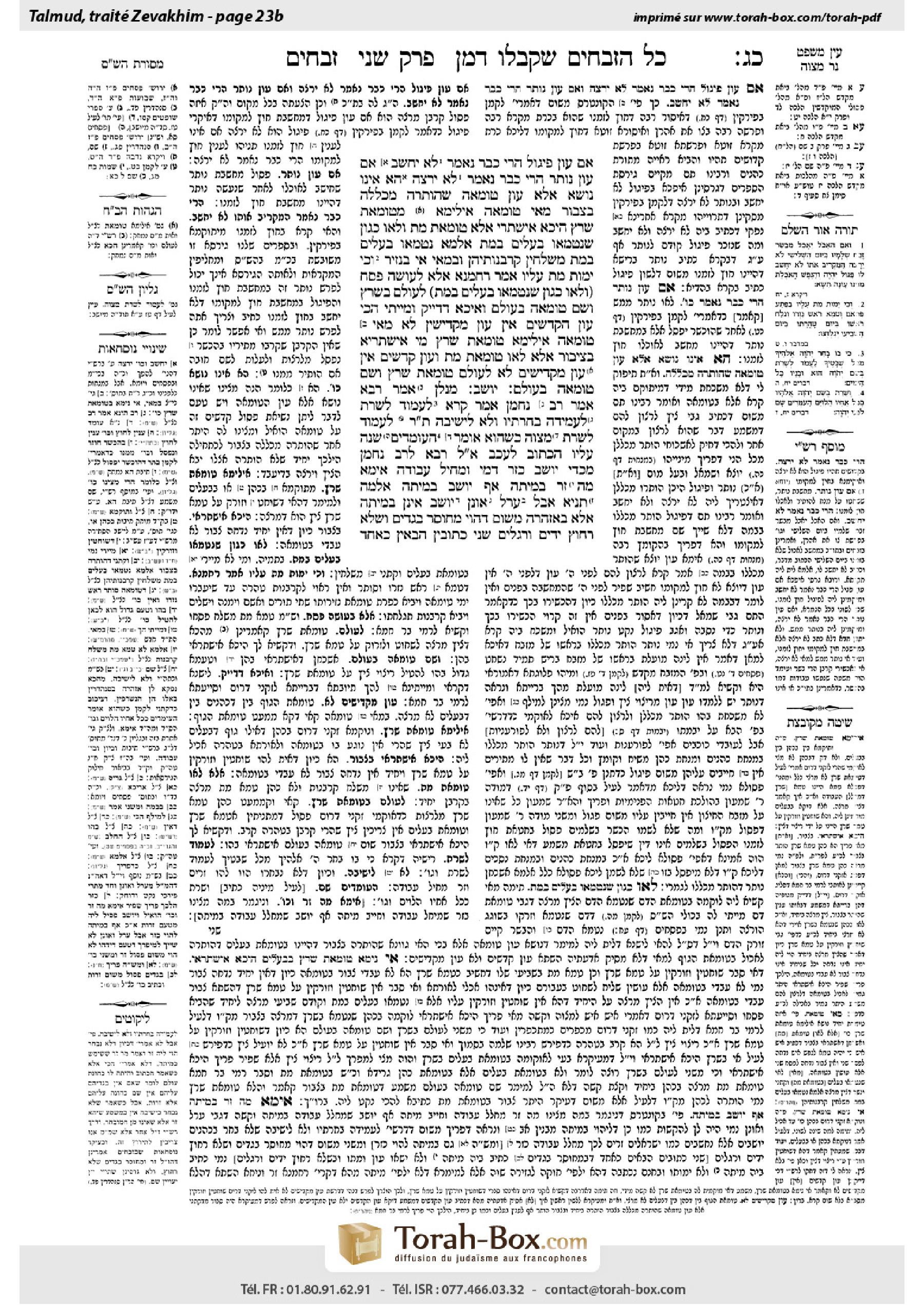
Zevachim 23b: Talmud study for Daf Yomi
Daf Yomi is the daily study of one Talmud folio. Explore 37 tractates with scans, Hebrew text, Sefaria English and AI-generated French translations where annotated.
Passage selection and English or AI-generated French translation are available where the scan has annotations. Daf Study is independent of Torah-Box and Sefaria.
Browse Zevachim · זבחים · All tractatesZevachim 23b text and translations
This page of Zevachim includes the Aramaic text, an English translation and an AI-generated French translation, alongside the scan above.
זבחים כ״ג ב · Aramaic and Hebrew text
אִם עֲוֹן פִּיגּוּל – הֲרֵי כְּבָר נֶאֱמַר ״לֹא יֵחָשֵׁב״! אִם עֲוֹן נוֹתָר – הֲרֵי כְּבָר נֶאֱמַר ״לֹא יֵרָצֶה״!
הָא אֵינוֹ נוֹשֵׂא אֶלָּא עֲוֹן טוּמְאָה, שֶׁהוּתְּרָה מִכְּלָלָהּ בְּצִבּוּר.
מַאי טוּמְאָה? אִילֵּימָא מִטּוּמְאַת שֶׁרֶץ, הֵיכָא אִישְׁתְּרַי? אֶלָּא טוּמְאַת מֵת. וְלָאו כְּגוֹן שֶׁנִּטְמְאוּ בְּעָלִים בְּמֵת? אַלְמָא נִטְמְאוּ בְּעָלִים בְּמֵת – מְשַׁלְּחִין קׇרְבְּנוֹתֵיהֶן.
וּבְמַאי? אִי בְּנָזִיר – ״וְכִי יָמוּת מֵת עָלָיו״ אָמַר רַחֲמָנָא! אֶלָּא לְעוֹשֵׂה פֶסַח! (וְלָאו כְּגוֹן שֶׁנִּטְמְאוּ בְּעָלִים בְּמֵת?)
לְעוֹלָם בְּשֶׁרֶץ; וְשֵׁם טוּמְאָה בָּעוֹלָם.
וְאִיכָּא דְּדָיֵיק וּמַיְיתֵי הָכִי: עֲוֹן הַקֳּדָשִׁים אִין, עֲוֹן מַקְדִּישִׁין לָא; מַאי טוּמְאָה? אִילֵימָא טוּמְאַת שֶׁרֶץ – מִי אִישְׁתְּרַיא בְּצִיבּוּר?! אֶלָּא לָאו טוּמְאַת מֵת? וַעֲוֹן קֳדָשִׁים אִין, עֲוֹן מַקְדִּישִׁים לָא!
לְעוֹלָם טוּמְאַת שֶׁרֶץ; וְשֵׁם טוּמְאָה בָּעוֹלָם.
יוֹשֵׁב מְנָלַן? אָמַר רָבָא אָמַר רַב נַחְמָן, אָמַר קְרָא: ״לַעֲמֹד לְשָׁרֵת״ – לַעֲמִידָה בְּחַרְתִּיו, וְלֹא לִישִׁיבָה.
תָּנוּ רַבָּנַן: ״לַעֲמֹד לְשָׁרֵת״ – מִצְוָה; כְּשֶׁהוּא אוֹמֵר: ״הָעֹמְדִים״ – שָׁנָה עָלָיו הַכָּתוּב לְעַכֵּב.
אֲמַר לֵיהּ רָבָא לְרַב נַחְמָן: מִכְּדִי יוֹשֵׁב כְּזָר דָּמֵי וּמַחֵיל עֲבוֹדָה, אֵימָא: מָה זָר בְּמִיתָה – אַף יוֹשֵׁב בְּמִיתָה! אַלְּמָה תַּנְיָא: אֲבָל עָרֵל, אוֹנֵן, יוֹשֵׁב – אֵינָן בְּמִיתָה אֶלָּא בְּאַזְהָרָה?
מִשּׁוּם דְּהָוֵי מְחוּסַּר בְּגָדִים וְשֶׁלֹּא רָחוּץ יָדַיִם וְרַגְלַיִם – שְׁנֵי כְתוּבִין הַבָּאִין כְּאֶחָד,
Zevachim 23b · English translation
If the verse means that he bears the sin of piggul, it is already stated: “And if any of the flesh of his peace offerings be at all eaten on the third day, it shall not be accepted, neither shall it be credited to he who offers it” (Leviticus 7:18). If he bears the sin of notar, it is already stated in the same verse: “It shall not be accepted.”
Rather, the frontplate bears only the sin of impurity, whose general prohibition was permitted in cases involving the public. The verse indicates that the frontplate effects acceptance for individual offerings sacrificed in a state of ritual impurity.
The Gemara clarifies: What is the impurity borne by the frontplate? If we say that it effects acceptance for impurity due to a creeping animal, where does one find that the general prohibition was permitted in cases involving the public? Rather, it must be referring to impurity due to a corpse. And is it not referring to a case where the owner of the offerings became impure from a corpse? Evidently, if the owner became impure from a corpse, he may send his offerings for sacrifice, as the frontplate effects acceptance for them.
And to what offering is this statement referring? If it is referring to the offering of a nazirite, doesn’t the Merciful One state: “And if any man die very suddenly beside him, and he defile his consecrated head” (Numbers 6:9)? The passage indicates that even if a nazirite contracts impurity against his will, he still cannot bring his offerings until he is pure. Rather, it must be referring to one who performs the rite of the Paschal offering. This proves the claim of the Elders of the South that one who is impure due to a corpse may send his Paschal offering for sacrifice.
The Gemara responds: Actually, the statement is referring to impurity due to a creeping animal, not due to a corpse. And although the general prohibition with regard to impurity due to a creeping animal was not permitted in cases involving the public, nevertheless, one finds that the category of impurity in general was permitted in such cases.
The Gemara notes: And some infer the opposite and derive like this: The verse states of the frontplate: “And it shall be upon Aaron’s forehead, and Aaron shall bear the sin committed with the sacred items” (Exodus 28:38). That is, it does bear the iniquity of the sacred items, but it does not bear the iniquity of those who consecrate or sacrifice them, i.e., the owners of the offering or the priests involved in its sacrifice. And to what impurity is this verse referring? If we say that it is referring to impurity due to a creeping animal, is such impurity permitted in cases involving the public? Rather, is it not referring to impurity due to a corpse, and the verse indicates that the frontplate does bear the iniquity of the sacred items but does not bear the iniquity of those who consecrate them? This refutes the opinion of the Elders of the South that owners who are impure due to a corpse may send their offerings.
The Gemara responds: Actually, the verse is referring to impurity due to a creeping animal, and although the general prohibition with regard to impurity due to a creeping animal was not permitted in cases involving the public, the category of impurity in general was permitted in such cases.
§ The mishna teaches that a priest who is sitting disqualifies the rites that he performs. The Gemara asks: From where do we derive this? Rava says that Rav Naḥman says: The verse states with regard to the priests: “For the Lord your God has chosen him out of all your tribes, to stand to minister” (Deuteronomy 18:5). The verse indicates that I have chosen him for standing and not for sitting.
The Sages taught: “To stand to minister,” indicates that there is a mitzva to perform the service while standing. When it says: “Then he shall minister in the name of the Lord his God, as all his brethren the Levites do, who stand there before the Lord” (Deuteronomy 18:7), the verse repeats the matter to invalidate rites that are performed while not standing.
Rava said to Rav Naḥman: Now, one who is sitting is considered like a non-priest and desecrates the service. Therefore, I will say: Just as a non-priest who performs a rite is liable to receive death at the hand of Heaven, so too one who is sitting should be liable to receive death at the hand of Heaven. If so, why is it taught in a baraita: But one who is uncircumcised, an acute mourner, and one who is sitting are not liable to receive death at the hand of Heaven if they performed rites; rather, they simply transgress a prohibition?
The Gemara responds: That is taught because the case of a priest lacking the requisite priestly vestments and that of one whose hands and feet are not washed are two verses that come as one, as the verse states explicitly for each case that if they perform rites they are liable to receive death at the hand of Heaven.
Zevachim 23b · Traduction française (IA)
Si le verset signifie qu’il porte la faute de piggoul, cela est déjà énoncé : « Si l’on mange quoi que ce soit de la chair de son sacrifice de paix le troisième jour, il ne sera pas agréé et cela ne sera pas imputé à celui qui l’offre » (Lévitique 7:18). S’il porte la faute de notar, cela est déjà énoncé dans le même verset : « Il ne sera pas agréé. »
Au contraire, le tsits ne porte que la faute liée à l’impureté, dont l’interdiction générale a été levée dans les cas concernant la collectivité. Le verset indique que le tsits obtient l’agrément pour les sacrifices individuels offerts en état d’impureté rituelle.
La Guemara précise : quelle impureté le tsits porte-t-il ? Si l’on dit qu’il obtient l’agrément pour une impureté due à un reptile, où trouve-t-on que l’interdiction générale a été levée dans les cas concernant la collectivité ? Il faut donc qu’il s’agisse d’une impureté due à un cadavre. Et ne s’agit-il pas du cas où le propriétaire des sacrifices a contracté l’impureté au contact d’un cadavre ? Il en ressort que si le propriétaire a contracté l’impureté au contact d’un cadavre, il peut envoyer ses sacrifices pour qu’ils soient offerts, puisque le tsits obtient l’agrément pour eux.
Et de quel sacrifice s’agit-il ici ? S’il s’agit du sacrifice d’un nazir, le Miséricordieux ne dit-il pas : « Si un homme meurt très soudainement près de lui et souille sa tête consacrée » (Nombres 6:9) ? Le passage indique que même si un nazir contracte l’impureté contre son gré, il ne peut tout de même pas apporter ses sacrifices avant d’être pur. Il doit donc s’agir de celui qui accomplit le rite du sacrifice pascal. Cela prouve la thèse des Anciens du Sud, selon laquelle celui qui est impur en raison d’un cadavre peut envoyer son sacrifice pascal pour qu’il soit offert.
La Guemara répond : en réalité, il s’agit d’une impureté due à un reptile, et non à un cadavre. Bien que l’interdiction générale concernant l’impureté due à un reptile n’ait pas été levée dans les cas concernant la collectivité, on trouve néanmoins que la catégorie de l’impureté en général a été autorisée dans de tels cas.
La Guemara relève : certains déduisent l’inverse et raisonnent ainsi : le verset dit au sujet du tsits : « Il sera sur le front d’Aaron, et Aaron portera la faute commise avec les choses saintes » (Exode 28:38). Autrement dit, il porte la faute des choses saintes, mais non celle de ceux qui les consacrent ou les offrent, c’est-à-dire les propriétaires du sacrifice ou les prêtres qui participent à son offrande. De quelle impureté ce verset parle-t-il ? Si l’on dit qu’il s’agit d’une impureté due à un reptile, une telle impureté est-elle autorisée dans les cas concernant la collectivité ? Il s’agit donc bien d’une impureté due à un cadavre, et le verset indique que le tsits porte la faute des choses saintes, mais non celle de ceux qui les consacrent. Cela réfute l’opinion des Anciens du Sud, selon laquelle les propriétaires impurs en raison d’un cadavre peuvent envoyer leurs sacrifices.
La Guemara répond : en réalité, le verset parle d’une impureté due à un reptile. Bien que l’interdiction générale concernant l’impureté due à un reptile n’ait pas été levée dans les cas concernant la collectivité, la catégorie de l’impureté en général a été autorisée dans de tels cas.
§ La Michna enseigne qu’un prêtre assis invalide les rites qu’il accomplit. La Guemara demande : d’où le déduisons-nous ? Rava dit au nom de Rav Naḥman : le verset dit au sujet des prêtres : « Car le Seigneur, ton Dieu, l’a choisi parmi toutes tes tribus pour se tenir debout afin d’officier » (Deutéronome 18:5). Le verset indique qu’il l’a choisi pour se tenir debout, et non pour s’asseoir.
Les Sages ont enseigné : « Pour se tenir debout afin d’officier » indique qu’il y a une mitsva d’accomplir le service debout. Lorsque le texte dit : « Alors il officiera au nom du Seigneur, son Dieu, comme tous ses frères lévites qui se tiennent là devant le Seigneur » (Deutéronome 18:7), il répète cette idée afin d’invalider les rites accomplis sans être debout.
Rava dit à Rav Naḥman : celui qui est assis est désormais considéré comme un non-prêtre et profane le service. Je dirai donc : de même qu’un non-prêtre qui accomplit un rite est passible de mort par la main du Ciel, de même celui qui est assis devrait être passible de mort par la main du Ciel. Si tel est le cas, pourquoi est-il enseigné dans une baraïta que celui qui n’est pas circoncis, l’endeuillé dans la période aiguë du deuil et celui qui est assis ne sont pas passibles de mort par la main du Ciel s’ils ont accompli des rites, mais ne font que transgresser une interdiction ?
La Guemara répond : cela est enseigné parce que le cas du prêtre dépourvu des vêtements sacerdotaux requis et celui de celui dont les mains et les pieds ne sont pas lavés sont deux versets qui viennent énoncer une même règle : le verset précise explicitement, pour chacun de ces cas, que ceux qui accomplissent des rites sont passibles de mort par la main du Ciel.
Traduction française générée par IA à partir de l’édition anglaise de Sefaria. Vérifie toujours un passage avec le texte source.
Text from Sefaria: William Davidson Edition - Vocalized Aramaic (CC BY NC); William Davidson Edition - English (CC BY NC).