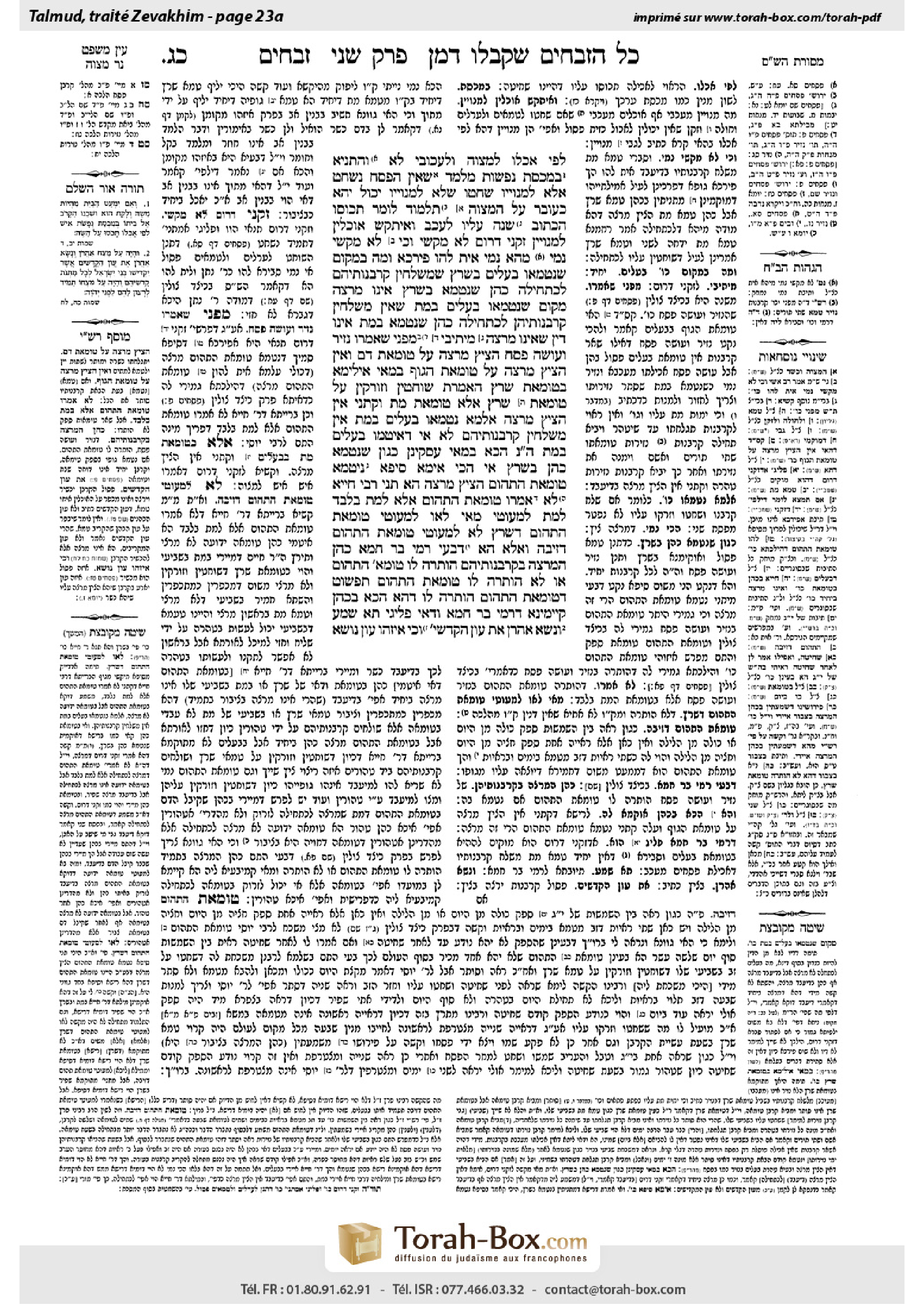
Zevachim 23a: Talmud study for Daf Yomi
Daf Yomi is the daily study of one Talmud folio. Explore 37 tractates with scans, Hebrew text, Sefaria English and AI-generated French translations where annotated.
Passage selection and English or AI-generated French translation are available where the scan has annotations. Daf Study is independent of Torah-Box and Sefaria.
Browse Zevachim · זבחים · All tractatesZevachim 23a text and translations
This page of Zevachim includes the Aramaic text, an English translation and an AI-generated French translation, alongside the scan above.
זבחים כ״ג א · Aramaic and Hebrew text
לְפִי אׇכְלוֹ״! לְמִצְוָה.
וּלְעַכּוֹבֵי לָא?! וְהָתַנְיָא: ״בְּמִכְסַת נְפָשׁוֹת״ – מְלַמֵּד שֶׁאֵין הַפֶּסַח נִשְׁחָט אֶלָּא לִמְנוּיָיו. שְׁחָטוֹ שֶׁלֹּא לִמְנוּיָיו – יָכוֹל יְהֵא כְּעוֹבֵר עַל הַמִּצְוָה? תַּלְמוּד לוֹמַר: ״תָּכֹסּוּ״ – הַכָּתוּב שָׁנָה עָלָיו לְעַכֵּב. וְאִיתַּקַּשׁ אוֹכְלִין לִמְנוּיִין!
זִקְנֵי דָרוֹם לָא מַקְּשִׁי. וְכִי לָא מַקְּשִׁי נָמֵי – מֵהָא נָמֵי אִית לְהוּ פִּירְכָא: וּמָה בִּמְקוֹם שֶׁנִּטְמְאוּ בְּעָלִים בְּשֶׁרֶץ, שֶׁמְּשַׁלְּחִין קׇרְבְּנוֹתֵיהֶם לְכַתְּחִילָּה – כֹּהֵן שֶׁנִּטְמָא בְּשֶׁרֶץ אֵינוֹ מְרַצֶּה; מְקוֹם שֶׁנִּטְמְאוּ בְּעָלִים בְּמֵת, שֶׁאֵין מְשַׁלְּחִין קׇרְבְּנוֹתֵיהֶן לְכַתְּחִילָּה – כֹּהֵן שֶׁנִּטְמָא בְּמֵת אֵינוֹ דִּין שֶׁאֵינוֹ מְרַצֶּה?!
מֵיתִיבִי, מִפְּנֵי שֶׁאָמְרוּ: נָזִיר וְעוֹשֵׂה פֶסַח – הַצִּיץ מְרַצֶּה עַל טוּמְאַת דָּם, וְאֵין הַצִּיץ מְרַצֶּה עַל טוּמְאַת הַגּוּף.
בְּמַאי? אִילֵּימָא בְּטוּמְאַת שֶׁרֶץ, הָאָמְרַתְּ: שׁוֹחֲטִין וְזוֹרְקִין עַל טוּמְאַת שֶׁרֶץ! אֶלָּא טוּמְאַת מֵת; וְקָתָנֵי: אֵין הַצִּיץ מְרַצֶּה; אַלְמָא נִטְמְאוּ בְּעָלִים בְּמֵת – אֵין מְשַׁלְּחִין קׇרְבְּנוֹתֵיהֶם!
לָא; אִי דְּאִיטַּמּוֹ בְּעָלִים בְּמֵת – הָכִי נָמֵי; הָכָא בְּמַאי עָסְקִינַן – כְּגוֹן שֶׁנִּטְמָא כֹּהֵן בְּשֶׁרֶץ.
אִי הָכִי, אֵימָא סֵיפָא: נִיטְמָא טוּמְאַת הַתְּהוֹם – הַצִּיץ מְרַצֶּה. הָא תָּנֵי רַבִּי חִיָּיא: לֹא אָמְרוּ טוּמְאַת הַתְּהוֹם – אֶלָּא לְמֵת בִּלְבַד; לְמֵת לְמַעוֹטֵי מַאי? לָאו לְמַעוֹטֵי טוּמְאַת הַתְּהוֹם דְּשֶׁרֶץ?!
לָא; לְמַעוֹטֵי טוּמְאַת הַתְּהוֹם דְּזִיבָה.
וְאֶלָּא הָא דְּבָעֵי רָמֵי בַּר חָמָא: כֹּהֵן הַמְרַצֶּה בְּקׇרְבְּנוֹתֵיהֶם – הוּתְּרָה לוֹ טוּמְאַת הַתְּהוֹם, אוֹ לֹא הוּתְּרָה לוֹ טוּמְאַת הַתְּהוֹם? תִּפְשׁוֹט דְּטוּמְאַת הַתְּהוֹם הוּתְּרָה לוֹ; דְּהָא הָכָא בְּכֹהֵן קָיָימִינָא!
דְּרָמֵי בַּר חָמָא וַדַּאי פְּלִיגִי.
תָּא שְׁמַע: ״וְנָשָׂא אַהֲרֹן אֶת עֲוֹן הַקֳּדָשִׁים״ – וְכִי אֵיזֶהוּ עָוֹן נוֹשֵׂא?
Zevachim 23a · English translation
according to his eating, you shall make your count for the lamb” (Exodus 12:4)? This teaches that one may bring the Paschal offering only if he is able to partake of it. The Gemara responds: This requirement is also meant as a mitzva ab initio; it does not disqualify the offering if not fulfilled.
The Gemara asks: And is this requirement not indispensable even after the fact? But isn’t it taught in a baraita that the phrase “according to the number of the souls” teaches that the Paschal offering may be slaughtered only for those who registered for it in advance. If the Paschal offering was slaughtered for individuals who did not register for it, one might have thought that it would only be like transgressing a mitzva, but the offering would not be disqualified. Therefore, the verse states: “You shall make your count”; the verse repeats the issue of counting to stress that the halakha is indispensable, and if one slaughters the offering for one who is not registered, it is disqualified. The Gemara concludes: And those who eat the offering are juxtaposed to those registered for it, as the verse states: “According to the number of the souls; a man, according to his eating.” Accordingly, if one slaughters the Paschal offering for one who cannot partake of it, the offering is disqualified.
The Gemara responds: The Elders of the South do not juxtapose the phrases, i.e., they do not interpret the verse’s juxtaposition of the two phrases as significant. The Gemara asks: But even if they do not juxtapose the phrases, there is a refutation to their statement from this inference as well: And just as in a case where the owner became impure due to a creeping animal, where he may send his offerings for sacrifice ab initio, a priest who became impure due to a creeping animal nevertheless cannot effect acceptance, then in a case where the owner became impure due to a corpse, where he may not send his offerings ab initio, is it not right that a priest who became impure due to a corpse cannot effect acceptance?
Furthermore, the Gemara raises an objection from a mishna (Pesaḥim 80b): As the Sages said that with regard to a nazirite and one who performs the rite of the Paschal offering, the frontplate effects acceptance for offerings sacrificed in a state of impurity of the blood, but the frontplate does not effect acceptance for offerings sacrificed in a state of impurity of the body of the individual bringing it.
The Gemara continues: To what impurity is it referring? If we say that it is referring to impurity due to a creeping animal, didn’t you say above that according to the Elders of the South, one may slaughter the Paschal offering and sprinkle its blood for an owner who is in a state of impurity due to a creeping animal? Rather, it must be referring to impurity due to a corpse, and the mishna teaches: The frontplate does not effect acceptance. Evidently, if the owner became impure due to a corpse, he may not send his offerings for sacrifice, contrary to the opinion ascribed to the Elders of the South.
The Gemara responds: No, if the owner became impure due to a corpse, the frontplate indeed effects acceptance for the offering. The mishna is not referring to the owners of the offerings at all; rather, here we are dealing with a case where the officiating priest became impure due to a creeping animal.
The Gemara asks: If so, say the latter clause of the mishna: If it became known after the offering was brought that he had contracted ritual impurity imparted in the depths, i.e., a source of impurity that had been unknown at the time, the frontplate effects acceptance for the offering. This clause cannot be reconciled with the suggested interpretation of the mishna, since Rabbi Ḥiyya teaches: They stated this halakha of impurity imparted in the depths only with regard to impurity due to a corpse. Now, when he says that it applies only to impurity due to a corpse, he means to exclude what? Does he not mean to exclude impurity imparted by the carcass of a creeping animal in the depths? If so, the mishna cannot be referring to impurity due to a creeping animal.
The Gemara responds: No, Rabbi Ḥiyya means to exclude impurity imparted by a gonorrhea-like discharge [ziva] in the depths. Impurity due to the corpse of a creeping animal, by contrast, is within the scope of the mishna.
The Gemara asks: But how is one to understand this dilemma that Rami bar Ḥama raises: With regard to a priest who effects acceptance for the offerings of the nazirite and the Paschal offering, was impurity imparted in the depths permitted for him or was impurity imparted in the depths not permitted for him? According to the Elders of the South, why not resolve the dilemma and conclude that impurity imparted in the depths was permitted for him, since they hold that we interpret the mishna here as referring to an impure priest?
The Gemara responds: The premise of this dilemma of Rami bar Ḥama certainly disagrees with the opinion of the Elders of the South, and Rami bar Ḥama does not interpret the mishna in this manner.
The Gemara suggests: Come and hear a proof from a verse written about the frontplate: “And it shall be upon Aaron’s forehead, and Aaron shall bear the sin committed with the sacred items, which the children of Israel shall consecrate, even all their sacred gifts; and it shall be always upon his forehead, that they may be accepted before God” (Exodus 28:38). And the Sages expounded: Which sin does Aaron bear?
Zevachim 23a · Traduction française (IA)
« Selon le nombre de ceux qui en mangeront, vous ferez le compte pour l’agneau » (Exode 12, 4). Cela enseigne qu’on ne peut apporter le sacrifice pascal que si l’on est en mesure d’en manger. La Guemara répond : cette exigence est également une mitsva à accomplir a priori ; son non-respect ne disqualifie pas le sacrifice.
La Guemara demande : Cette exigence n’est-elle donc pas indispensable même a posteriori ? N’est-il pas enseigné dans une baraïta que l’expression « selon le nombre des personnes » enseigne que le sacrifice pascal ne peut être égorgé que pour ceux qui s’y sont inscrits à l’avance ? Si le sacrifice pascal a été égorgé pour des personnes qui ne s’y étaient pas inscrites, on aurait pu penser qu’il s’agissait seulement de la transgression d’une mitsva, sans que le sacrifice soit disqualifié. C’est pourquoi le verset dit : « Vous ferez le compte » ; il répète la question du décompte pour souligner que cette halakha est indispensable et que, si l’on égorge le sacrifice pour quelqu’un qui n’est pas inscrit, il est disqualifié. La Guemara conclut : ceux qui mangent le sacrifice sont également mis en parallèle avec ceux qui y sont inscrits, comme le dit le verset : « Selon le nombre des personnes ; un homme, selon ce qu’il mange. » Par conséquent, si l’on égorge le sacrifice pascal pour quelqu’un qui ne peut pas en manger, le sacrifice est disqualifié.
La Guemara répond : les Anciens du Sud ne mettent pas ces expressions en parallèle, c’est-à-dire qu’ils ne considèrent pas comme significative la juxtaposition des deux expressions dans le verset. La Guemara demande : Mais même s’ils ne les mettent pas en parallèle, cette déduction réfute également leur propos : de même que, lorsque le propriétaire est devenu impur à cause d’un animal rampant, il peut envoyer ses offrandes pour qu’elles soient offertes a priori, tandis qu’un prêtre devenu impur à cause d’un animal rampant ne peut néanmoins pas obtenir l’agrément, alors, lorsque le propriétaire est devenu impur à cause d’un cadavre et ne peut pas envoyer ses offrandes a priori, n’est-il pas d’autant plus évident qu’un prêtre devenu impur à cause d’un cadavre ne peut pas obtenir l’agrément ?
En outre, la Guemara soulève une objection à partir d’une Michna (Pessa'him 80b) : les Sages ont dit que, dans le cas d’un nazir et de celui qui accomplit le rite du sacrifice pascal, le pectoral obtient l’agrément pour les offrandes sacrifiées alors que leur sang était impur, mais qu’il ne l’obtient pas pour les offrandes sacrifiées alors que le corps de la personne qui les apporte était impur.
La Guemara poursuit : De quelle impureté s’agit-il ? Si l’on dit qu’il s’agit de l’impureté due à un animal rampant, n’as-tu pas dit plus haut que, selon les Anciens du Sud, on peut égorger le sacrifice pascal et asperger son sang pour un propriétaire en état d’impureté due à un animal rampant ? Il faut donc plutôt dire qu’il s’agit de l’impureté due à un cadavre, et la Michna enseigne que le pectoral n’obtient pas l’agrément. Il ressort manifestement que, si le propriétaire est devenu impur à cause d’un cadavre, il ne peut pas envoyer ses offrandes pour qu’elles soient offertes, contrairement à l’opinion attribuée aux Anciens du Sud.
La Guemara répond : Non, si le propriétaire est devenu impur à cause d’un cadavre, le pectoral obtient bien l’agrément pour l’offrande. La Michna ne parle pas du tout des propriétaires des offrandes ; il s’agit ici d’un cas où le prêtre officiant est devenu impur à cause d’un animal rampant.
La Guemara demande : Dans ce cas, considérons la dernière clause de la Michna : s’il fut découvert après que l’offrande eut été apportée qu’il avait contracté une impureté transmise dans les profondeurs, c’est-à-dire une source d’impureté qui était inconnue à ce moment-là, le pectoral obtient l’agrément pour l’offrande. Cette clause ne peut être conciliée avec l’interprétation proposée de la Michna, car Rabbi Ḥiyya enseigne : cette halakha relative à l’impureté transmise dans les profondeurs n’a été énoncée qu’à propos de l’impureté due à un cadavre. Or, lorsqu’il dit qu’elle ne s’applique qu’à l’impureté due à un cadavre, qu’entend-il exclure ? N’entend-il pas exclure l’impureté transmise dans les profondeurs par la carcasse d’un animal rampant ? Dans ce cas, la Michna ne peut pas parler de l’impureté due à un animal rampant.
La Guemara répond : Non, Rabbi Ḥiyya entend exclure l’impureté transmise dans les profondeurs par un écoulement semblable à celui de la gonorrhée [ziva]. En revanche, l’impureté due au cadavre d’un animal rampant entre dans le champ d’application de la Michna.
La Guemara demande : Mais comment comprendre la question que soulève Rami bar Ḥama : s’agissant d’un prêtre qui obtient l’agrément pour les offrandes du nazir et pour le sacrifice pascal, l’impureté transmise dans les profondeurs lui est-elle permise ou non ? Selon les Anciens du Sud, pourquoi ne pas trancher la question et conclure que l’impureté transmise dans les profondeurs lui était permise, puisqu’ils soutiennent que la Michna doit être interprétée ici comme parlant d’un prêtre impur ?
La Guemara répond : le présupposé de la question de Rami bar Ḥama est assurément contraire à l’opinion des Anciens du Sud, et Rami bar Ḥama n’interprète pas la Michna de cette manière.
La Guemara propose : Venons et entendons une preuve tirée d’un verset relatif au pectoral : « Il sera sur le front d’Aaron, et Aaron portera la faute commise à l’égard des choses saintes que les enfants d’Israël consacreront, de tous leurs dons sacrés ; il sera toujours sur son front, afin qu’ils soient agréés devant Dieu » (Exode 28, 38). Et les Sages ont interprété : Quelle faute Aaron porte-t-il ?
Traduction française générée par IA à partir de l’édition anglaise de Sefaria. Vérifie toujours un passage avec le texte source.
Text from Sefaria: William Davidson Edition - Vocalized Aramaic (CC BY NC); William Davidson Edition - English (CC BY NC).