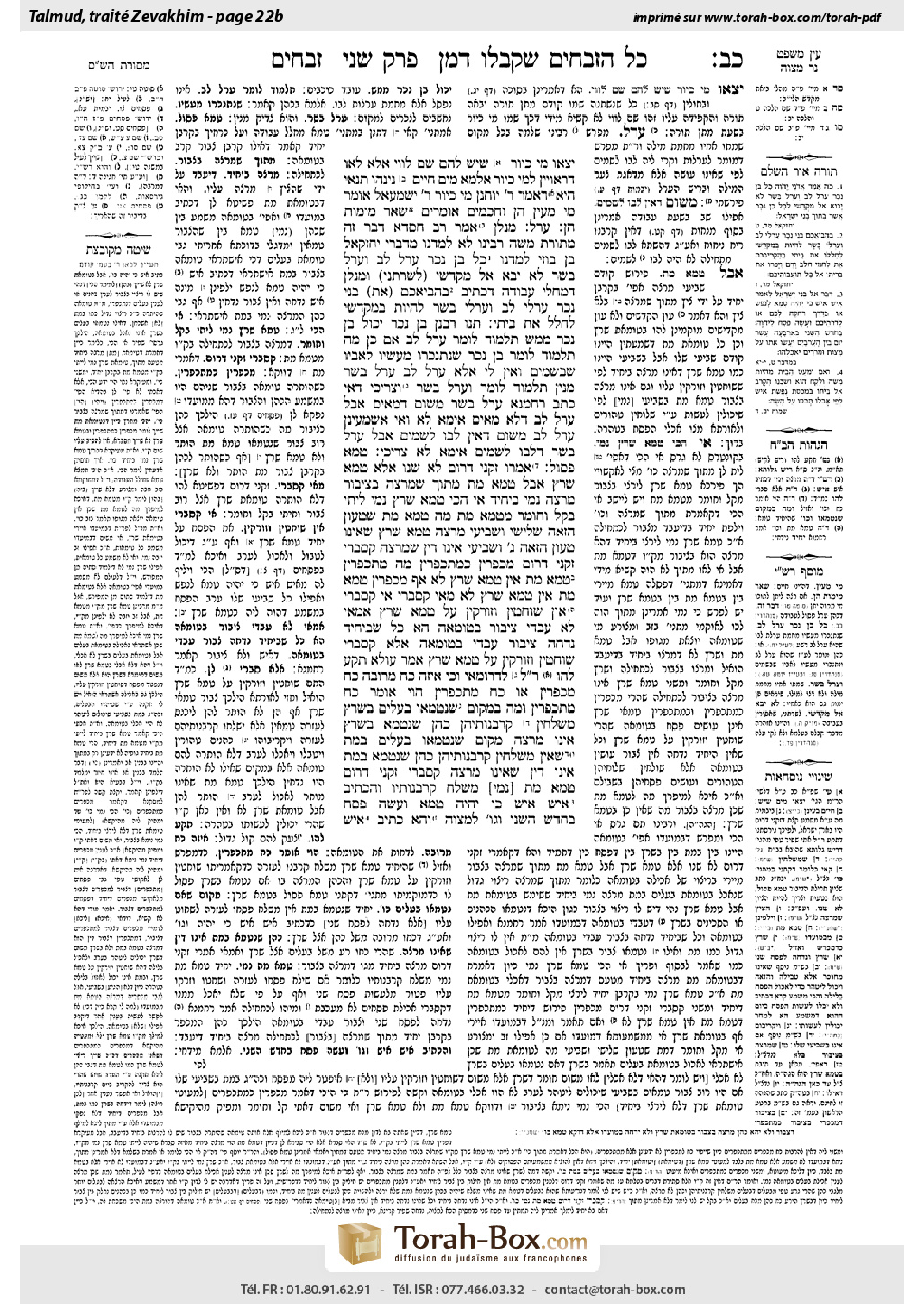
Zevachim 22b: Talmud study for Daf Yomi
Daf Yomi is the daily study of one Talmud folio. Explore 37 tractates with scans, Hebrew text, Sefaria English and AI-generated French translations where annotated.
Passage selection and English or AI-generated French translation are available where the scan has annotations. Daf Study is independent of Torah-Box and Sefaria.
Browse Zevachim · זבחים · All tractatesZevachim 22b text and translations
This page of Zevachim includes the Aramaic text, an English translation and an AI-generated French translation, alongside the scan above.
זבחים כ״ב ב · Aramaic and Hebrew text
יָצְאוּ מֵי כִיּוֹר שֶׁיֵּשׁ לָהֶם שֵׁם לְוַוי. אֶלָּא לָאו דִּרְאוּיִין לְמֵי כִיּוֹר? אַלְמָא מַיִם חַיִּים נִינְהוּ!
תַּנָּאֵי הִיא. דְּאָמַר רַבִּי יוֹחָנָן: מֵי כִיּוֹר – רַבִּי יִשְׁמָעֵאל אוֹמֵר: מֵי מַעְיָן הֵן, וַחֲכָמִים אוֹמְרִים: שְׁאָר מֵימוֹת הֵן.
עָרֵל מְנָלַן? אָמַר רַב חִסְדָּא: דָּבָר זֶה מִתּוֹרַת מֹשֶׁה רַבֵּינוּ לֹא לָמַדְנוּ, מִדִּבְרֵי יְחֶזְקֵאל בֶּן בּוּזִי לָמַדְנוּ: ״כׇּל בֶּן נֵכָר עֶרֶל לֵב וְעֶרֶל בָּשָׂר לֹא יָבֹא אֶל מִקְדָּשִׁי לְשָׁרְתֵנִי״.
וּמְנָלַן דְּמַחֲלִי עֲבוֹדָה? דִּכְתִיב: ״בַּהֲבִיאֲכֶם אֶת בְּנֵי נֵכָר עַרְלֵי לֵב וְעַרְלֵי בָשָׂר לִהְיוֹת בְּמִקְדָּשִׁי לְחַלֵּל אֶת בֵּיתִי״.
תָּנוּ רַבָּנַן: ״בֶּן נֵכָר״ – יָכוֹל בֶּן נֵכָר מַמָּשׁ? תַּלְמוּד לוֹמַר ״עֶרֶל לֵב״. אִם כֵּן, מָה תַּלְמוּד לוֹמַר ״בֶּן נֵכָר״? שֶׁנִּתְנַכְּרוּ מַעֲשָׂיו לְאָבִיו שֶׁבְּשָׁמַיִם. וְאֵין לִי אֶלָּא עֶרֶל לֵב; עֶרֶל בָּשָׂר מִנַּיִן? תַּלְמוּד לוֹמַר: ״וְעֶרֶל בָּשָׂר״.
וּצְרִיכִי; דְּאִי כְּתַב רַחֲמָנָא: ״עֶרֶל בָּשָׂר״ – מִשּׁוּם דִּמְאִיס; אֲבָל עֶרֶל לֵב, דְּלָא מְאִיס – אֵימָא לָא. וְאִי אַשְׁמְעִינַן עֶרֶל לֵב – מִשּׁוּם דְּאֵין לִבּוֹ לַשָּׁמַיִם; אֲבָל עֶרֶל בָּשָׂר, דְּלִבּוֹ לַשָּׁמַיִם – אֵימָא לָא; צְרִיכִי.
טָמֵא פָּסוּל. אָמְרוּ זִקְנֵי דָרוֹם: לֹא שָׁנוּ אֶלָּא טְמֵא שֶׁרֶץ; אֲבָל טְמֵא מֵת – מִתּוֹךְ שֶׁמְּרַצֶּה בְּצִיבּוּר, מְרַצֶּה נָמֵי בְּיָחִיד.
אִי הָכִי, טְמֵא שֶׁרֶץ נָמֵי – לֵיתֵי בְּקַל וָחוֹמֶר מִטְּמֵא מֵת: מָה טְמֵא מֵת, שֶׁטָּעוּן הַזָּאָה שְׁלִישִׁי וּשְׁבִיעִי – מְרַצֶּה; טְמֵא שֶׁרֶץ, שֶׁאֵינוֹ טָעוּן הַזָּאָה שְׁלִישִׁי וּשְׁבִיעִי – אֵינוֹ דִּין שֶׁמְּרַצֶּה?!
קָסָבְרִי זִקְנֵי דָרוֹם: מְכַפְּרִין – כְּמִתְכַּפְּרִין; מָה מִתְכַּפְּרִין – טְמֵא מֵת אִין, טְמֵא שֶׁרֶץ לָא; אַף מְכַפְּרִין – טְמֵא מֵת אִין, טְמֵא שֶׁרֶץ לָא.
מַאי קָסָבְרִי? אִי קָסָבְרִי: אֵין שׁוֹחֲטִין וְזוֹרְקִין עַל טְמֵא שֶׁרֶץ; אַמַּאי לָא עָבְדִי צִיבּוּר בְּטוּמְאָה? הָא כֹּל שֶׁבְּיָחִיד נִדְחֶה – צִיבּוּר עָבְדִי בְּטוּמְאָה!
אֶלָּא קָסָבְרִי: שׁוֹחֲטִין וְזוֹרְקִין עַל טְמֵא שֶׁרֶץ.
אָמַר עוּלָּא, תְּקַע לְהוּ רֵישׁ לָקִישׁ לִדְרוֹמָאֵי: וְכִי אֵיזֶה כֹּחַ מְרוּבֶּה – כֹּחַ מְכַפְּרִין אוֹ כֹחַ מִתְכַּפְּרִין? הֱוֵי אוֹמֵר: כֹּחַ מִתְכַּפְּרִין;
וּמָה בִּמְקוֹם שֶׁנִּטְמְאוּ בְּעָלִים בְּשֶׁרֶץ מְשַׁלְּחִין קׇרְבְּנוֹתֵיהֶן – כֹּהֵן שֶׁנִּטְמָא בְּשֶׁרֶץ אֵינוֹ מְרַצֶּה; מְקוֹם שֶׁנִּטְמְאוּ בְּעָלִים בְּמֵת, שֶׁאֵין מְשַׁלְּחִין קׇרְבְּנוֹתֵיהֶן – כֹּהֵן שֶׁנִּטְמָא בְּמֵת אֵינוֹ דִּין שֶׁאֵינוֹ מְרַצֶּה?!
קָסָבְרִי זִקְנֵי דָרוֹם: טְמֵא מֵת [נָמֵי] מְשַׁלֵּחַ קׇרְבְּנוֹתָיו.
וְהָכְתִיב: ״אִישׁ אִישׁ כִּי יִהְיֶה טָמֵא וַעֲשֵׂה פֶּסַח בְּחֹדֶשׁ הַשֵּׁנִי וְגוֹ׳״! לְמִצְוָה.
וְהָא כְּתִיב: ״אִישׁ
Zevachim 22b · English translation
excluded is water of the Basin, which has a modifier in its name? Rather, since the baraita cannot be referring to the water of the Basin itself, as it is unfit for washing the innards, is it not referring to water that is fit to be water of the Basin? Apparently, the only reason such water could be preferable is because it is flowing water.
The Gemara responds: The issue is a dispute between tanna’im, as Rabbi Yoḥanan says: With regard to the water of the Basin, Rabbi Yishmael says: It must be spring water, i.e., flowing water, and the Rabbis say: It may be another type of water.
§ The mishna teaches that a priest who is uncircumcised disqualifies sacrificial rites he performs. The Gemara elaborates: From where do we derive this? Rav Ḥisda says: We did not learn this matter from the Torah of Moses, our teacher; rather, we learned it from the words of the prophet Ezekiel, son of Buzi: “No stranger, uncircumcised in heart or uncircumcised in flesh, shall enter into My Sanctuary to serve Me” (Ezekiel 44:9).
And from where do we derive that he desecrates the service after the fact? As it is written: “In that you have brought in strangers, uncircumcised in heart or uncircumcised in flesh, to be in My Sanctuary, to profane My house” (Ezekiel 44:7).
The Sages taught: The verse states “stranger”; one might have thought that this is referring to an actual stranger, i.e., a gentile. Therefore, the verse states: “Uncircumcised in heart,” to indicate that it is referring to a priest rather than a gentile. If so, what is the meaning when the verse states: “Stranger”? It is referring to one whose actions are considered estranged from his Father in Heaven, i.e., an apostate, who sins regularly. And I have derived only that one uncircumcised in heart is unfit to serve; from where is it derived that one uncircumcised in flesh is unfit as well? The verse states: “Or uncircumcised in flesh.”
The Gemara notes: And both phrases in the verse are necessary. As, had the Merciful One written only: “Uncircumcised in flesh,” one might think that only he is unfit because he is disgusting in that he possesses a foreskin, but concerning one uncircumcised in heart, who is not disgusting, I will say that he is not unfit. And had the verse taught us only that one uncircumcised in heart is unfit, one might think that only he is unfit, because his heart is not directed toward Heaven, but one uncircumcised in flesh, whose heart is directed toward Heaven, I will say that he is not unfit. Therefore, both phrases are necessary.
§ The mishna teaches that a ritually impure priest is unfit for Temple service and disqualifies rites he performs. The Elders of the South said: They taught this only with regard to one who became impure due to contact with the carcass of a creeping animal. But with regard to a priest who became impure due to contact with a corpse, since he can effect acceptance of his rites for communal offerings ab initio if the majority of the community has contracted impurity from a corpse, he can effect acceptance of his rites for individual offerings as well after the fact.
The Gemara asks: If so, let it be derived that one impure due to the carcass of a creeping animal can also effect acceptance for communal offerings in cases of communal impurity ab initio, and for individual offerings after the fact, by a fortiori inference from one impure due to a corpse: Just as a priest who is impure due to a corpse, who requires sprinkling of the water containing the ashes of the red heifer on the third and seventh day to be purified, still effects acceptance, then with regard to one who is impure due to the carcass of a creeping animal, who does not require sprinkling on the third and seventh day, is it not right that he should also effect acceptance?
The Gemara responds: The Elders of the South hold that the halakha with regard to those who effect atonement is like those who achieve atonement: Just as with regard to those who achieve atonement through communal offerings, i.e., the community, only if a majority is impure due to a corpse may the offering be sacrificed in a state of impurity, but if they are impure due to the carcass of a creeping animal it may not, so too with regard to those who effect atonement, i.e., the priests, if they serve when they are impure due to a corpse, yes, their service achieves atonement, but if they serve when they are impure due to the carcass of a creeping animal, it does not.
The response of the Gemara assumes that communal offerings may not be brought when the majority of the community is impure due to a creeping animal. The Gemara therefore asks: What do the Elders of the South hold with regard to the Paschal offering? If they hold that one may not slaughter it nor sprinkle its blood on the altar for an owner who is impure due to a creeping animal, even though he can immerse and become pure in time to eat the offering that night, then one may ask: Why can’t the community perform communal offerings in such a state of impurity? Isn’t it a principle that for any impurity for which an individual may not sacrifice the Paschal offering and is deferred to the second Pesaḥ, the community may perform its offerings in such a state of impurity?
Rather, they must hold that one may slaughter the Paschal offering and sprinkle its blood for an owner who is impure due to a creeping animal. Accordingly, the community may not offer the Paschal offering in such a state of impurity.
Ulla says: Reish Lakish shouted [teka] to the Elders of the South: But which power is greater to overcome impurity with respect to offerings, the power of those who effect atonement, i.e., the priests, or the power of those who achieve atonement, the offerings’ owners? Since the Elders of the South hold that the Paschal offering may be sacrificed for an owner who is impure due to a creeping animal, while a priest who is similarly impure may not sacrifice any offering, you must say that the power of those who achieve atonement is greater.
If so, your initial statement that a priest who contracted impurity from a corpse can effect acceptance for individual offerings can be refuted a fortiori: And just as in a case where the owner became impure due to a creeping animal, he may send his offerings for sacrifice, and yet a priest who became impure due to a creeping animal cannot effect acceptance, then in a case where the owner became impure due to a corpse, where he may not send his offerings for sacrifice, is it not right that a priest who became impure due to a corpse cannot effect acceptance?
The Gemara responds: The Elders of the South hold that an owner who is impure due to a corpse may also send his offerings, even though he will not be able to partake of his Paschal offering. Therefore, the a fortiori inference does not stand.
The Gemara protests: But isn’t it written: “If any man of you or of your generations shall be impure by reason of a dead body, or be in a journey afar off, he shall perform the Paschal offering to the Lord. In the second month on the fourteenth day at dusk they shall perform it” (Numbers 9:10–11)? Apparently, one impure due to a corpse in the first month must defer his Paschal offering to the second month. The Gemara responds: The verse intends this as a mitzva ab initio. But if he sends his offering in the first month, it is accepted, and he is not required to sacrifice a Paschal offering in the second month.
The Gemara asks: But isn’t it written: “And if the household be too little for a lamb, then shall he and his neighbor next to his house take one according to the number of the souls; a man,
Zevachim 22b · Traduction française (IA)
Ce qui est exclu, c’est l’eau du bassin, dont le nom comporte un qualificatif ? Mais puisque la baraïta ne peut pas désigner l’eau du bassin elle-même, car elle ne convient pas au lavage des entrailles, ne désigne-t-elle pas l’eau qui pourrait servir à remplir le bassin ? Il semble donc que la seule raison pour laquelle une telle eau pourrait être préférable est qu’il s’agit d’eau courante.
La Guemara répond : il s’agit d’une controverse entre tannaïm, car Rabbi Yoḥanan dit : au sujet de l’eau du bassin, Rabbi Yishmael dit qu’elle doit être de l’eau de source, c’est-à-dire de l’eau courante, tandis que les Sages disent qu’elle peut être d’un autre type d’eau.
§ La Michna enseigne qu’un prêtre incirconcis invalide les rites sacrificiels qu’il accomplit. La Guemara précise : d’où déduisons-nous cela ? Rav Ḥisda dit : nous n’avons pas appris cette règle dans la Torah de Moïse, notre maître ; nous l’avons plutôt apprise des paroles du prophète Ézéchiel, fils de Bouzi : « Aucun étranger, incirconcis de cœur ou incirconcis de chair, n’entrera dans Mon sanctuaire pour Me servir » (Ézéchiel 44, 9).
Et d’où déduisons-nous qu’il invalide le service après coup ? Car il est écrit : « En ce que vous avez introduit des étrangers, incirconcis de cœur ou incirconcis de chair, pour qu’ils soient dans Mon sanctuaire, afin de profaner Ma maison » (Ézéchiel 44, 7).
Les Sages ont enseigné : le verset dit « étranger » ; on aurait pu penser qu’il s’agit d’un véritable étranger, c’est-à-dire d’un non-Juif. Le verset dit donc : « incirconcis de cœur », pour indiquer qu’il s’agit d’un prêtre et non d’un non-Juif. Si tel est le cas, que signifie le mot « étranger » dans le verset ? Il désigne celui dont les actes le rendent étranger à son Père céleste, c’est-à-dire un apostat qui pèche régulièrement. Or, j’ai seulement déduit qu’un incirconcis de cœur est impropre au service ; d’où déduit-on qu’un incirconcis de chair l’est également ? Le verset dit : « ou incirconcis de chair ».
La Guemara fait remarquer que les deux expressions du verset sont nécessaires. En effet, si le Miséricordieux avait écrit seulement « incirconcis de chair », on aurait pu penser que lui seul est impropre, parce qu’il est répugnant en raison de son prépuce ; mais, s’agissant de celui qui est incirconcis de cœur et qui n’est pas répugnant, on aurait pu dire qu’il n’est pas impropre. Et si le verset nous avait enseigné seulement que l’incirconcis de cœur est impropre, on aurait pu penser que lui seul l’est, parce que son cœur n’est pas tourné vers le Ciel ; mais, s’agissant de l’incirconcis de chair, dont le cœur est tourné vers le Ciel, on aurait pu dire qu’il n’est pas impropre. Les deux expressions sont donc nécessaires.
§ La Michna enseigne qu’un prêtre en état d’impureté rituelle est impropre au service du Temple et invalide les rites qu’il accomplit. Les Anciens du Sud ont dit : cette règle n’a été enseignée qu’au sujet de celui qui est devenu impur par contact avec la carcasse d’un animal rampant. Mais, s’agissant d’un prêtre devenu impur par contact avec un cadavre, puisqu’il peut rendre recevables ses rites pour les offrandes communautaires a priori si la majorité de la communauté a contracté l’impureté d’un cadavre, il peut aussi rendre recevables ses rites pour les offrandes individuelles après coup.
La Guemara demande : dans ce cas, ne devrait-on pas déduire que celui qui est impur à cause de la carcasse d’un animal rampant peut lui aussi rendre recevables les rites des offrandes communautaires a priori en cas d’impureté de la communauté, et ceux des offrandes individuelles après coup, par raisonnement a fortiori à partir de celui qui est impur à cause d’un cadavre ? De même qu’un prêtre impur à cause d’un cadavre, qui doit recevoir l’aspersion de l’eau contenant les cendres de la vache rousse le troisième et le septième jour pour être purifié, peut malgré tout rendre ses rites recevables, à plus forte raison celui qui est impur à cause de la carcasse d’un animal rampant, qui n’a pas besoin de recevoir l’aspersion le troisième et le septième jour, ne devrait-il pas lui aussi rendre ses rites recevables ?
La Guemara répond : les Anciens du Sud tiennent que la halakha concernant ceux qui assurent l’expiation est parallèle à celle concernant ceux qui obtiennent l’expiation. De même que, pour ceux qui obtiennent l’expiation au moyen des offrandes communautaires, c’est-à-dire la communauté, l’offrande ne peut être sacrifiée en état d’impureté que si la majorité est impure à cause d’un cadavre, mais pas si elle est impure à cause de la carcasse d’un animal rampant, de même, pour ceux qui assurent l’expiation, c’est-à-dire les prêtres, si leur service est accompli alors qu’ils sont impurs à cause d’un cadavre, leur service assure l’expiation ; mais s’ils servent alors qu’ils sont impurs à cause de la carcasse d’un animal rampant, il ne l’assure pas.
La réponse de la Guemara suppose qu’on ne peut pas apporter les offrandes communautaires lorsque la majorité de la communauté est impure à cause d’un animal rampant. La Guemara demande donc : quelle est la position des Anciens du Sud au sujet du sacrifice pascal ? S’ils tiennent qu’on ne peut ni l’égorger ni asperger son sang sur l’autel pour un propriétaire impur à cause d’un animal rampant, même s’il peut s’immerger et être pur à temps pour consommer l’offrande cette nuit-là, on peut alors demander : pourquoi la communauté ne pourrait-elle pas accomplir les offrandes communautaires dans un tel état d’impureté ? N’est-il pas de principe que, pour toute impureté à cause de laquelle un individu ne peut pas offrir le sacrifice pascal et doit le reporter au second Pessaḥ, la communauté peut accomplir ses offrandes dans un tel état d’impureté ?
Ils doivent plutôt tenir qu’on peut égorger le sacrifice pascal et asperger son sang pour un propriétaire impur à cause d’un animal rampant. Par conséquent, la communauté ne peut pas offrir le sacrifice pascal dans un tel état d’impureté.
Oulla dit : Reish Lakish cria [teka] aux Anciens du Sud : mais lequel des deux a le plus de force pour surmonter l’impureté en ce qui concerne les offrandes, ceux qui assurent l’expiation, c’est-à-dire les prêtres, ou ceux qui obtiennent l’expiation, c’est-à-dire les propriétaires des offrandes ? Puisque les Anciens du Sud tiennent qu’on peut sacrifier le sacrifice pascal pour un propriétaire impur à cause d’un animal rampant, alors qu’un prêtre impur de la même manière ne peut sacrifier aucune offrande, il faut dire que ceux qui obtiennent l’expiation ont plus de force.
Dans ce cas, votre affirmation initiale selon laquelle un prêtre ayant contracté l’impureté d’un cadavre peut rendre recevables les offrandes individuelles peut être réfutée par raisonnement a fortiori : si, lorsque le propriétaire est devenu impur à cause d’un animal rampant, il peut envoyer ses offrandes pour qu’elles soient sacrifiées, alors qu’un prêtre devenu impur à cause d’un animal rampant ne peut pas rendre ses rites recevables, à plus forte raison, lorsque le propriétaire est devenu impur à cause d’un cadavre et ne peut pas envoyer ses offrandes pour qu’elles soient sacrifiées, un prêtre devenu impur à cause d’un cadavre ne peut-il pas rendre ses rites recevables ?
La Guemara répond : les Anciens du Sud tiennent qu’un propriétaire impur à cause d’un cadavre peut lui aussi envoyer ses offrandes, même s’il ne pourra pas consommer son sacrifice pascal. Le raisonnement a fortiori ne tient donc pas.
La Guemara objecte : mais n’est-il pas écrit : « Si quelqu’un parmi vous ou parmi vos descendants est impur à cause d’un cadavre, ou se trouve en voyage lointain, qu’il célèbre le sacrifice pascal pour le Seigneur. Le deuxième mois, le quatorzième jour, au crépuscule, ils le célébreront » (Nombres 9, 10-11) ? Il semble donc que celui qui est impur à cause d’un cadavre au premier mois doit reporter son sacrifice pascal au deuxième mois. La Guemara répond : le verset indique que c’est là la mitsva a priori. Mais s’il envoie son offrande au premier mois, elle est acceptée et il n’est pas tenu d’offrir un sacrifice pascal au deuxième mois.
La Guemara demande : mais n’est-il pas écrit : « Si la maisonnée est trop petite pour un agneau, qu’elle le prenne avec son voisin le plus proche de sa maison, selon le nombre de personnes ; un homme, »
Traduction française générée par IA à partir de l’édition anglaise de Sefaria. Vérifie toujours un passage avec le texte source.
Text from Sefaria: William Davidson Edition - Vocalized Aramaic (CC BY NC); William Davidson Edition - English (CC BY NC).