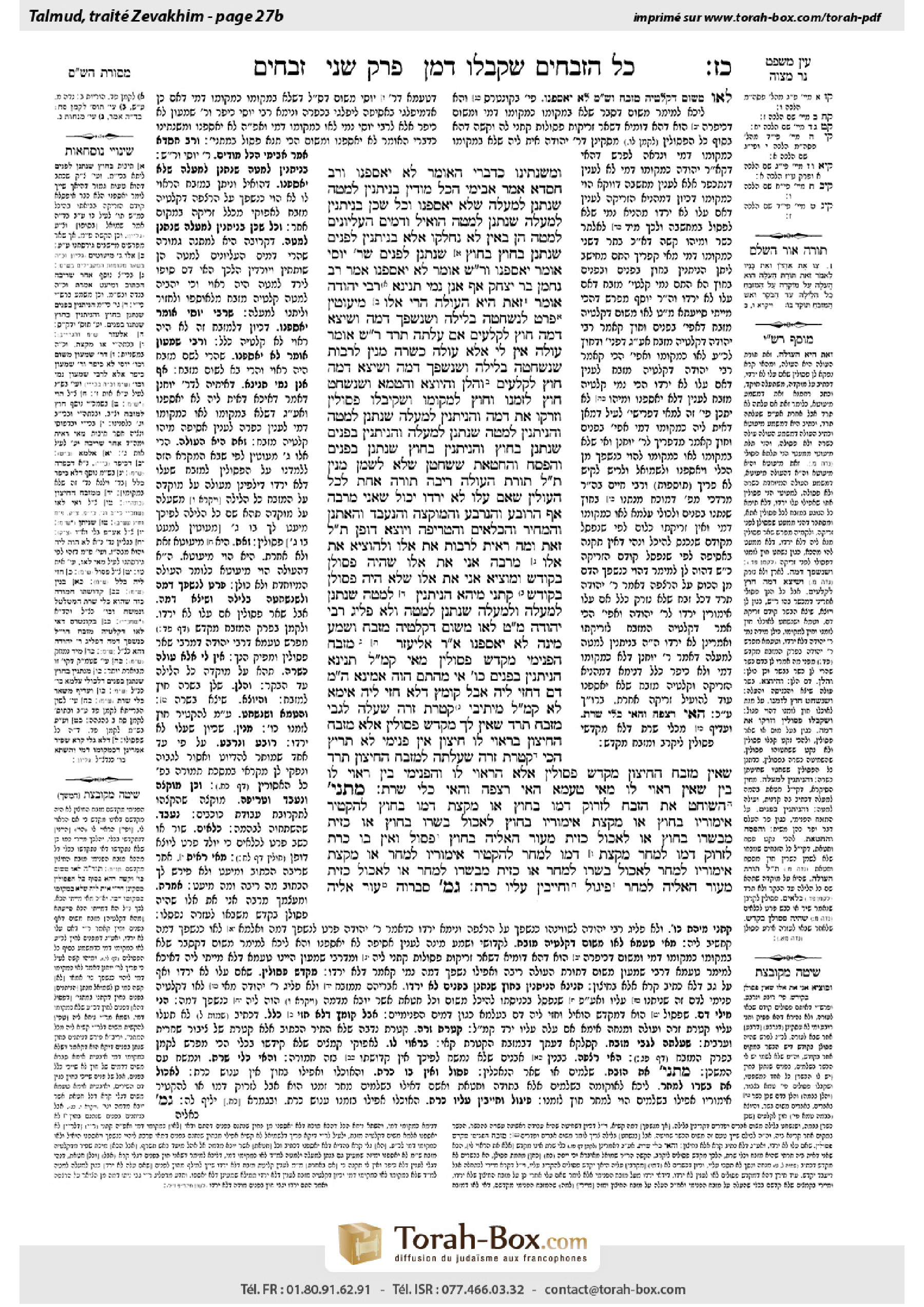
Zevachim 27b: Talmud study for Daf Yomi
Daf Yomi is the daily study of one Talmud folio. Explore 37 tractates with scans, Hebrew text, Sefaria English and AI-generated French translations where annotated.
Passage selection and English or AI-generated French translation are available where the scan has annotations. Daf Study is independent of Torah-Box and Sefaria.
Browse Zevachim · זבחים · All tractatesZevachim 27b text and translations
This page of Zevachim includes the Aramaic text, an English translation and an AI-generated French translation, alongside the scan above.
זבחים כ״ז ב · Aramaic and Hebrew text
וּמִשְׁנָתֵינוּ כְּדִבְרֵי הָאוֹמֵר לֹא יַאַסְפֶנּוּ.
וְרַב חִסְדָּא אָמַר אֲבִימִי: הַכֹּל מוֹדִין בַּנִּיתָּנִין לְמַטָּה שֶׁנְּתָנָן לְמַעְלָה – שֶׁלֹּא יַאַסְפֶנּוּ; וְכׇל שֶׁכֵּן בַּנִּיתָּנִין לְמַעְלָה שֶׁנְּתָנָן לְמַטָּה – הוֹאִיל וְדָמִים הָעֶלְיוֹנִים לְמַטָּה הֵן בָּאִין. לֹא נֶחְלְקוּ אֶלָּא בַּנִּיתָּנִין לִפְנִים שֶׁנְּתָנָן בַּחוּץ, בַּחוּץ שֶׁנְּתָנָן לִפְנִים – שֶׁרַבִּי יוֹסֵי אוֹמֵר: יַאַסְפֶנּוּ, וְרַבִּי שִׁמְעוֹן אוֹמֵר: לֹא יַאַסְפֶנּוּ.
אָמַר רַב נַחְמָן בַּר יִצְחָק: אַף אֲנַן נָמֵי תְּנֵינָא, רַבִּי יְהוּדָה אוֹמֵר: ״זֹאת הִיא הָעוֹלָה״ – הֲרֵי אֵלּוּ מִיעוּטִין; פְּרָט לְנִשְׁחֲטָה בַּלַּיְלָה וְשֶׁנִּשְׁפַּךְ דָּמָהּ וְשֶׁיָּצָא דָּמָהּ חוּץ לַקְּלָעִים – אִם עָלְתָה תֵּרֵד.
רַבִּי שִׁמְעוֹן אוֹמֵר: ״עוֹלָה״ – אֵין לִי אֶלָּא עוֹלָה כְּשֵׁרָה; מִנַּיִן לְרַבּוֹת שֶׁנִּשְׁחֲטָה בַּלַּיְלָה, וְשֶׁנִּשְׁפַּךְ דָּמָהּ, וְשֶׁיָּצָא דָּמָהּ חוּץ לַקְּלָעִים, וְהַלָּן, וְהַיּוֹצֵא, וְהַטָּמֵא, וְשֶׁנִּשְׁחַט חוּץ לִזְמַנּוֹ, וְחוּץ לִמְקוֹמוֹ, וְשֶׁקִּיבְּלוּ פְּסוּלִין וְזָרְקוּ אֶת דָּמָהּ, וְהַנִּיתָּנִין לְמַעְלָה שֶׁנְּתָנָן לְמַטָּה, וְהַנִּיתָּנִין לְמַטָּה שֶׁנְּתָנָן לְמַעְלָה, וְהַנִּיתָּנִין בִּפְנִים שֶׁנְּתָנָן בַּחוּץ, וְהַנִּיתָּנִין בַּחוּץ שֶׁנְּתָנָן בִּפְנִים, וְהַפֶּסַח וְהַחַטָּאת שֶׁשְּׁחָטָן שֶׁלֹּא לִשְׁמָן – מִנַּיִן?
תַּלְמוּד לוֹמַר: ״תּוֹרַת הָעוֹלָה״ – רִיבָּה תּוֹרָה אַחַת לְכׇל הָעוֹלִין, שֶׁאִם עָלוּ לֹא יֵרְדוּ.
יָכוֹל שֶׁאֲנִי מְרַבֶּה אַף הָרוֹבֵעַ, וְהַנִּרְבָּע, וְהַמּוּקְצֶה, וְהַנֶּעֱבָד, וְהָאֶתְנַן, וְהַמְּחִיר, וְהַכִּלְאַיִם, וְהַטְּרֵיפָה, וְיוֹצֵא דּוֹפֶן? תַּלְמוּד לוֹמַר: ״זֹאת״.
וּמָה רָאִיתָ לְרַבּוֹת אֶת אֵלּוּ וּלְהוֹצִיא אֶת אֵלּוּ? מְרַבֶּה אֲנִי אֶת אֵלּוּ – שֶׁהָיָה פְּסוּלָן בַּקּוֹדֶשׁ, וּמוֹצִיא אֲנִי אֶת אֵלּוּ – שֶׁלֹּא הָיָה פְּסוּלָן בַּקּוֹדֶשׁ.
קָתָנֵי מִיהָא: הַנִּיתָּנִין לְמַטָּה שֶׁנְּתָנָן לְמַעְלָה, וּלְמַעְלָה שֶׁנְּתָנָן לְמַטָּה – וְלָא פְּלִיג רַבִּי יְהוּדָה; מַאי טַעְמָא? לָאו מִשּׁוּם דְּקַלְטֵיהּ מִזְבֵּחַ – וּשְׁמַע מִינַּהּ: לֹא יַאַסְפֶנּוּ.
אָמַר רַבִּי אֱלִיעֶזֶר: מִזְבֵּחַ הַפְּנִימִי מְקַדֵּשׁ פְּסוּלִין.
מַאי קָא מַשְׁמַע לַן? תְּנֵינָא: הַנִּיתָּנִין בְּפָנִים כּוּ׳!
אִי מֵהָתָם, הֲוָה אָמֵינָא: הָנֵי מִילֵּי דָּם – דַּחֲזֵי לֵיהּ; אֲבָל קוֹמֶץ, דְּלָא חֲזֵי לֵיהּ – אֵימָא לָא; קָא מַשְׁמַע לַן.
מֵיתִיבִי: קְטֹרֶת זָרָה (שעלה) [שֶׁעָלְתָה] לְגַבֵּי מִזְבֵּחַ – תֵּרֵד; שֶׁאֵין לְךָ מְקַדֵּשׁ פְּסוּלִין אֶלָּא מִזְבֵּחַ הַחִיצוֹן בְּרָאוּי לוֹ. חִיצוֹן אִין, פְּנִימִי לָא!
תָּרֵיץ הָכִי: קְטֹרֶת זָרָה שֶׁעָלְתָה לְמִזְבֵּחַ הַחִיצוֹן – תֵּרֵד; שֶׁאֵין מִזְבֵּחַ הַחִיצוֹן מְקַדֵּשׁ פְּסוּלִין אֶלָּא הָרָאוּי לוֹ, וְהַפְּנִימִי בֵּין רָאוּי לוֹ בֵּין שֶׁאֵין רָאוּי לוֹ. מַאי טַעְמָא? הַאי רִצְפָּה, וְהַאי כְּלֵי שָׁרֵת.
מַתְנִי׳ הַשּׁוֹחֵט אֶת הַזֶּבַח לִזְרוֹק דָּמוֹ בַּחוּץ אוֹ מִקְצָת דָּמוֹ בַּחוּץ, לְהַקְטִיר אֵימוּרָיו בַּחוּץ אוֹ מִקְצָת אֵימוּרָיו בַּחוּץ, לֶאֱכוֹל בְּשָׂרוֹ בַּחוּץ אוֹ כְּזַיִת מִבְּשָׂרוֹ בַּחוּץ, אוֹ לֶאֱכוֹל כְּזַיִת מֵעוֹר הָאַלְיָה בַּחוּץ – פָּסוּל, וְאֵין בּוֹ כָּרֵת.
לִזְרוֹק דָּמוֹ לְמָחָר, מִקְצָת דָּמוֹ לְמָחָר, לְהַקְטִיר אֵימוּרָיו לְמָחָר אוֹ מִקְצָת אֵימוּרָיו לְמָחָר, לֶאֱכוֹל בְּשָׂרוֹ לְמָחָר אוֹ כְּזַיִת מִבְּשָׂרוֹ לְמָחָר, אוֹ לֶאֱכוֹל כְּזַיִת מֵעוֹר הָאַלְיָה לְמָחָר – פִּיגּוּל, וְחַיָּיבִין עָלָיו כָּרֵת.
גְּמָ׳ סַבְרוּהָ: עוֹר אַלְיָה –
Zevachim 27b · English translation
And our mishna is in accordance with the statement of the one who says: He may not gather it up.
And Rav Ḥisda says that Avimi says: Everyone concedes with regard to the blood that is to be placed below the red line that if one placed it above the red line he may not gather it up again. And all the more so with regard to the blood that is to be placed above the red line that one placed below the red line, since the blood placed above the red line will eventually run down the side of the altar and reach below the red line. They disagree only with regard to the blood that is to be placed inside the Sanctuary that one placed outside on the external altar, or blood that is to be placed outside that one placed inside, as Rabbi Yosei says: He may gather it up, as though it had spilled on the floor, and Rabbi Shimon says: He may not gather it up, because the blood was nevertheless placed on an altar.
Rav Naḥman bar Yitzḥak says: We learn in a baraita as well that if the blood is misapplied on the altar it may not be gathered, in accordance with the opinion of Rabbi Yoḥanan: Rabbi Yehuda says that the verse states: “This is the law of the burnt offering: It is that which goes up [ha’ola] on the pyre upon the altar” (Leviticus 6:2), from which it is derived that a disqualified offering that ascended upon the altar shall not descend from it. These terms, i.e., “this,” “it,” and “that,” are three terms of exclusion, which serve to exclude three cases of disqualified offerings from this halakha: An offering that was slaughtered at night, one whose blood was spilled, and one whose blood emerged outside the curtains, i.e., the Temple courtyard. In these cases, even if the offering ascended upon the altar it shall descend.
Rabbi Shimon says: From the term “burnt offering [ola]” I have derived only that a fit burnt offering shall not descend. From where is it derived that the halakha includes an offering that was slaughtered at night, or one whose blood was spilled, or one whose blood emerged outside the curtains, or one that was left overnight, or one that left the courtyard, or one that became impure, or one that was slaughtered with intent to consume it beyond its designated time or outside its designated area, or an offering for which an unfit person collected and sprinkled its blood, or a case where one placed the blood that is to be placed above the red line below it, or where one placed the blood that is to be placed below the red line above it, or where one placed the blood that is to be placed inside the Sanctuary outside on the external altar, or where one placed the blood that is to be placed outside the Sanctuary inside it, or a Paschal offering or a sin offering that one slaughtered not for their sake? From where is it derived that if these offerings ascended they shall not descend?
The verse states: “The law of the burnt offering [ha’ola],” literally: That which goes up. The verse included under one law all items that ascend upon the altar, teaching that if they ascended the altar, they shall not descend.
One might have thought that I should include even an animal that copulated with a person, or an animal that was the object of bestiality, or an animal that was set aside for idol worship, or an animal that was worshipped as a deity, or an animal that was given as payment to a prostitute or as the price of a dog, or an animal born of a mixture of diverse kinds, or an animal that is a tereifa, or an animal born by caesarean section. The verse therefore states: “This,” to exclude these animals from the halakha.
The Gemara asks: And what did you see as the reason to include the former cases and to exclude the latter ones? The Gemara responds: I include these former cases, whose disqualification occurred in sanctity, i.e., in the course of the Temple service, and I exclude these latter cases, whose disqualification did not occur in sanctity and were disqualified as offerings from the outset.
Rav Naḥman bar Yitzḥak continues: In any event, the baraita teaches that if one placed the blood that is to be placed below the red line above it, or if one placed the blood that is to be placed above the red line below it, the offering does not descend from the altar. And Rabbi Yehuda does not disagree, even though he holds that if the blood spilled on the ground the offering descends from the altar. What is the reason for this? Is it not because even if the blood was misapplied, the altar has absorbed the blood and it is not considered to have been spilled on the floor? Conclude from it that if blood was misapplied on the altar, the priest may not gather it up again, in accordance with the statement of Rabbi Yoḥanan.
§ Pursuant to the discussion of disqualified offerings that do not descend from the external altar, Rabbi Eliezer says: The inner altar, i.e., the golden altar inside the Sanctuary, sanctifies disqualified offerings such that if they ascended onto it, they do not descend.
The Gemara asks: What is this statement teaching us? We already learn this in the above baraita: If one placed the blood that is to be placed inside the Sanctuary outside on the external altar, or if one placed the blood that is to be placed outside the Sanctuary inside it, on the golden altar, the offering does not descend.
The Gemara responds: If one were to learn the halakha only from there, I would say: This matter applies only to blood mistakenly placed on the golden altar, as it is fit to be placed on that altar in certain contexts, i.e., the blood of the bull and goat sin offerings on Yom Kippur; but with regard to a handful from a meal offering, which is not fit to be placed on the golden altar in any context, I will say that it is not sanctified when placed on it. Rabbi Eliezer therefore teaches us that even a handful from a meal offering does not descend from it.
The Gemara raises an objection from a baraita: If strange incense, i.e., incense that it is prohibited to burn on the golden altar, ascended onto the altar, it shall descend, as only the external altar sanctifies disqualified offerings that are suited for it. One can infer that the external altar does sanctify disqualified offerings, but the inner altar does not.
The Gemara responds: Answer like this: The baraita means that if strange incense ascended onto the external altar, it shall descend, as the external altar sanctifies only disqualified offerings that are suited for it. But the inner altar sanctifies everything, whether it is suited for it or it is not suited for it. What is the reason for this? This, the external altar, is considered part of the floor, since it is fixed to the floor of the Temple, and that, the inner altar, is considered a service vessel with a higher level of sanctity.
MISHNA: With regard to one who slaughters the offering with intent to sprinkle its blood outside the Temple or to sprinkle part of its blood outside the Temple, to burn its sacrificial portions outside the Temple or to burn part of its sacrificial portions outside the Temple, to partake of its meat outside the Temple or to partake of an olive-bulk of its meat outside the Temple, or to partake of an olive-bulk of the skin of the tail outside the Temple, in all of these cases the offering is disqualified, and there is no liability for karet for one who partakes of it.
But if one had intent to sprinkle its blood the next day or part of its blood the next day, to burn its sacrificial portions the next day or to burn part of its sacrificial portions the next day, to partake of its meat the next day or to partake of an olive-bulk of its meat the next day, or to partake of an olive-bulk of the skin of the tail the next day, the offering is piggul, and one is liable to receive karet for burning or partaking of it.
GEMARA: The students assumed that the skin of the tail
Zevachim 27b · Traduction française (IA)
Et notre Michna est conforme à l'opinion de celui qui dit : Il ne peut pas le ramasser.
Et Rav Ḥisda dit qu'Avimi dit : Tout le monde concède, en ce qui concerne le sang qui doit être placé en dessous de la ligne rouge, que si on l'a placé au-dessus de la ligne rouge, on ne peut pas le ramasser à nouveau. Et a fortiori en ce qui concerne le sang qui doit être placé au-dessus de la ligne rouge et qu'on a placé en dessous de la ligne rouge, puisque le sang placé au-dessus de la ligne rouge finira par couler le long du côté de l'autel et atteindre la zone située en dessous de la ligne rouge. Ils ne sont en désaccord qu'en ce qui concerne le sang qui doit être placé à l'intérieur du Sanctuaire et qu'on a placé à l'extérieur sur l'autel extérieur, ou le sang qui doit être placé à l'extérieur et qu'on a placé à l'intérieur, comme le dit Rabbi Yosei : Il peut le ramasser, comme s'il s'était répandu sur le sol, et Rabbi Shimon dit : Il ne peut pas le ramasser, parce que le sang a néanmoins été placé sur un autel.
Rav Naḥman bar Yitzḥak dit : Nous apprenons également dans une baraïta que si le sang est appliqué par erreur sur l'autel, il ne peut pas être ramassé, conformément à l'opinion de Rabbi Yoḥanan : Rabbi Yehuda dit que le verset énonce : « Voici la loi de l'holocauste : c'est ce qui monte [ha'ola] sur le bûcher sur l'autel » (Lévitique 6:2), d'où il est déduit qu'une offrande disqualifiée qui a monté sur l'autel ne doit pas en descendre. Ces termes, à savoir « voici », « c'est » et « ce qui », sont trois termes d'exclusion, qui servent à exclure trois cas d'offrandes disqualifiées de cette halakha : une offrande qui a été immolée la nuit, une dont le sang s'est répandu, et une dont le sang est sorti à l'extérieur des rideaux, c'est-à-dire de la cour du Temple. Dans ces cas, même si l'offrande a monté sur l'autel, elle doit descendre.
Rabbi Shimon dit : Du terme « holocauste [ola] », je n'ai déduit que le fait qu'un holocauste valide ne doit pas descendre. D'où est-il déduit que la halakha inclut une offrande qui a été immolée la nuit, ou une dont le sang s'est répandu, ou une dont le sang est sorti à l'extérieur des rideaux, ou une qui a passé la nuit, ou une qui est sortie de la cour, ou une qui est devenue impure, ou une qui a été immolée avec l'intention de la consommer au-delà de son temps désigné ou en dehors de sa zone désignée, ou une offrande pour laquelle une personne inapte a recueilli et aspergé son sang, ou un cas où l'on a placé le sang qui doit être placé au-dessus de la ligne rouge en dessous, ou où l'on a placé le sang qui doit être placé en dessous de la ligne rouge au-dessus, ou où l'on a placé le sang qui doit être placé à l'intérieur du Sanctuaire à l'extérieur sur l'autel extérieur, ou où l'on a placé le sang qui doit être placé à l'extérieur du Sanctuaire à l'intérieur, ou une offrande pascal ou un sacrifice expiatoire qu'on a immolé non pour leur propre compte ? D'où est-il déduit que si ces offrandes ont monté, elles ne doivent pas descendre ?
Le verset énonce : « La loi de l'holocauste [ha'ola] », littéralement : Ce qui monte. Le verset a inclus sous une seule loi tous les éléments qui montent sur l'autel, enseignant que s'ils ont monté sur l'autel, ils ne doivent pas descendre.
On aurait pu penser que je devais inclure même un animal qui a copulé avec un être humain, ou un animal qui a été l'objet d'un acte de bestialité, ou un animal qui a été mis de côté pour le culte des idoles, ou un animal qui a été adoré comme une divinité, ou un animal qui a été donné en paiement à une prostituée ou comme prix d'un chien, ou un animal né d'un mélange d'espèces différentes, ou un animal qui est une tereifa, ou un animal né par césarienne. Le verset énonce donc : « Voici », pour exclure ces animaux de la halakha.
La Guemara demande : Et quelle raison avez-vous vue pour inclure les premiers cas et exclure les seconds ? La Guemara répond : J'inclus ces premiers cas, dont la disqualification s'est produite dans la sainteté, c'est-à-dire dans le cadre du service du Temple, et j'exclus ces seconds cas, dont la disqualification ne s'est pas produite dans la sainteté et qui étaient disqualifiés en tant qu'offrandes dès le départ.
Rav Naḥman bar Yitzḥak poursuit : En tout état de cause, la baraïta enseigne que si l'on a placé le sang qui devait être appliqué en dessous de la ligne rouge au-dessus de celle-ci, ou si l'on a placé le sang qui devait être appliqué au-dessus de la ligne rouge en dessous de celle-ci, l'offrande ne descend pas de l'autel. Et Rabbi Yehuda ne conteste pas, même s'il soutient que si le sang s'est répandu sur le sol, l'offrande descend de l'autel. Quelle est la raison de cela ? N'est-ce pas parce que, même si le sang a été appliqué par erreur, l'autel l'a absorbé et il n'est pas considéré comme s'étant répandu sur le sol ? On en conclut que si le sang a été appliqué par erreur sur l'autel, le prêtre ne peut pas le ramasser à nouveau, conformément à l'enseignement de Rabbi Yoḥanan.
§ Dans le prolongement de la discussion sur les offrandes disqualifiées qui ne descendent pas de l'autel extérieur, Rabbi Eliezer dit : L'autel intérieur, c'est-à-dire l'autel d'or situé dans le Sanctuaire, sanctifie les offrandes disqualifiées de telle sorte que, si elles y ont été placées, elles ne descendent pas.
La Guemara demande : Qu'est-ce que cet énoncé nous enseigne ? Nous apprenons déjà cela dans la baraïta ci-dessus : Si l'on a placé le sang qui doit être placé à l'intérieur du Sanctuaire à l'extérieur, sur l'autel extérieur, ou si l'on a placé le sang qui doit être placé à l'extérieur du Sanctuaire à l'intérieur, sur l'autel d'or, l'offrande ne descend pas.
La Guemara répond : Si l'on devait apprendre la halakha uniquement de là, je dirais : Cette règle ne s'applique qu'au sang placé par erreur sur l'autel d'or, car il est apte à y être placé dans certains contextes, à savoir le sang des sacrifices expiatoires du taureau et du bouc le jour du Grand Pardon ; mais en ce qui concerne une poignée d'une offrande de farine, qui n'est pas apte à être placée sur l'autel d'or dans aucun contexte, je dirais qu'elle n'est pas sanctifiée lorsqu'elle y est placée. Rabbi Eliezer nous enseigne donc qu'une poignée d'une offrande de farine ne descend pas non plus de cet autel.
La Guemara soulève une objection à partir d'une baraïta : Si de l'encens étranger, c'est-à-dire de l'encens dont la combustion est interdite sur l'autel d'or, est monté sur l'autel, il doit descendre, car seul l'autel extérieur sanctifie les offrandes disqualifiées qui lui sont destinées. On peut en déduire que l'autel extérieur sanctifie les offrandes disqualifiées, mais que l'autel intérieur ne le fait pas.
La Guemara répond : Répondez ainsi : La baraïta signifie que si de l'encens étranger est monté sur l'autel extérieur, il doit descendre, car l'autel extérieur ne sanctifie que les offrandes disqualifiées qui lui sont destinées. Mais l'autel intérieur sanctifie tout, qu'il lui soit destiné ou non. Quelle est la raison de cela ? Celui-ci, l'autel extérieur, est considéré comme faisant partie du sol, puisqu'il est fixé au sol du Temple, tandis que celui-là, l'autel intérieur, est considéré comme un ustensile de service ayant un niveau de sainteté supérieur.
MICHNA : Concernant celui qui égorge l'offrande avec l'intention d'en répandre le sang hors du Temple, ou d'en répandre une partie hors du Temple, de brûler ses portions sacrificielles hors du Temple ou d'en brûler une partie hors du Temple, de consommer sa chair hors du Temple ou de consommer un volume d'olive de sa chair hors du Temple, ou de consommer un volume d'olive de la peau de la queue hors du Temple, dans tous ces cas, l'offrande est disqualifiée, et il n'y a pas de responsabilité de karet pour celui qui en consomme.
Mais si l'on avait l'intention d'en répandre le sang le lendemain, ou une partie de son sang le lendemain, de brûler ses portions sacrificielles le lendemain, ou d'en brûler une partie le lendemain, de consommer sa chair le lendemain, ou de consommer un volume d'olive de sa chair le lendemain, ou de consommer un volume d'olive de la peau de la queue le lendemain, l'offrande est piggul, et l'on est passible de karet pour l'avoir brûlée ou consommée.
Guemara : Les étudiants supposaient que la peau de la queue
Traduction française générée par IA à partir de l’édition anglaise de Sefaria. Vérifie toujours un passage avec le texte source.
Text from Sefaria: William Davidson Edition - Vocalized Aramaic (CC BY NC); William Davidson Edition - English (CC BY NC).