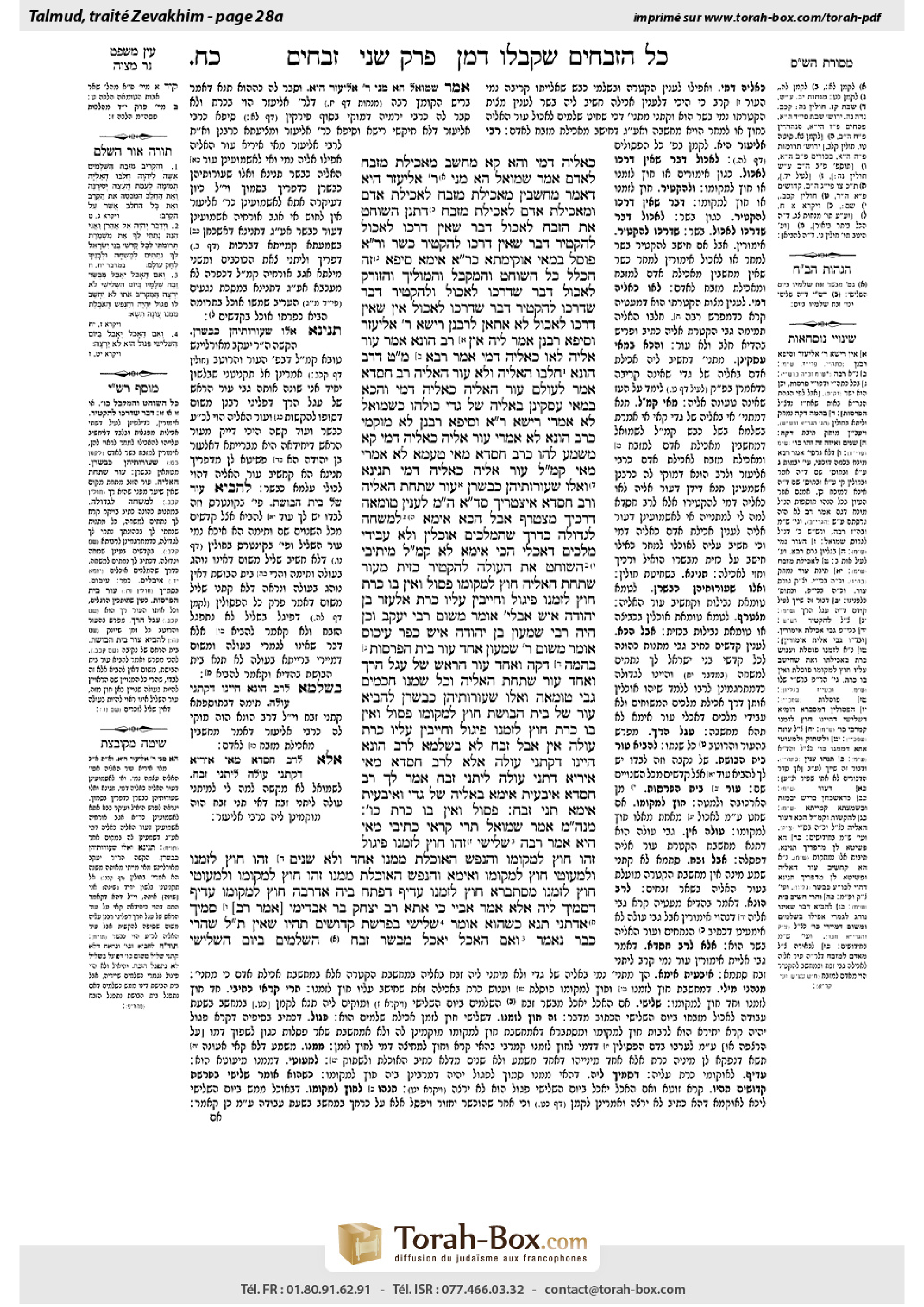
Zevachim 28a: Talmud study for Daf Yomi
Daf Yomi is the daily study of one Talmud folio. Explore 37 tractates with scans, Hebrew text, Sefaria English and AI-generated French translations where annotated.
Passage selection and English or AI-generated French translation are available where the scan has annotations. Daf Study is independent of Torah-Box and Sefaria.
Browse Zevachim · זבחים · All tractatesZevachim 28a text and translations
This page of Zevachim includes the Aramaic text, an English translation and an AI-generated French translation, alongside the scan above.
זבחים כ״ח א · Aramaic and Hebrew text
כְּאַלְיָה דָּמֵי; וְהָא קָא מְחַשֵּׁב מֵאֲכִילַת מִזְבֵּחַ לְאָדָם!
אָמַר שְׁמוּאֵל: הָא מַנִּי – רַבִּי אֱלִיעֶזֶר הִיא; דְּאָמַר: מְחַשְּׁבִין מֵאֲכִילַת מִזְבֵּחַ לַאֲכִילַת אָדָם, וּמֵאֲכִילַת אָדָם לַאֲכִילַת מִזְבֵּחַ.
דִּתְנַן: הַשּׁוֹחֵט אֶת הַזֶּבַח לֶאֱכוֹל דָּבָר שֶׁאֵין דַּרְכּוֹ לֶאֱכוֹל; לְהַקְטִיר דָּבָר שֶׁאֵין דַּרְכּוֹ לְהַקְטִיר – כָּשֵׁר. וְרַבִּי אֱלִיעֶזֶר פּוֹסֵל.
בְּמַאי אוֹקֵימְתַּהּ – כְּרַבִּי אֱלִיעֶזֶר? אֵימָא סֵיפָא, זֶה הַכְּלָל: כׇּל הַשּׁוֹחֵט, וְהַמְקַבֵּל, וְהַמּוֹלִיךְ, וְהַזּוֹרֵק; לֶאֱכוֹל דָּבָר שֶׁדַּרְכּוֹ לֶאֱכוֹל, וּלְהַקְטִיר דָּבָר שֶׁדַּרְכּוֹ לְהַקְטִיר.
דָּבָר שֶׁדַּרְכּוֹ לֶאֱכוֹל אִין, שֶׁאֵין דַּרְכּוֹ לֶאֱכוֹל לָא; אֲתָאן לְרַבָּנַן. רֵישָׁא רַבִּי אֱלִיעֶזֶר וְסֵיפָא רַבָּנַן?! אֲמַר לֵיהּ: אִין.
רַב הוּנָא אָמַר: עוֹר אַלְיָה – לָאו כְּאַלְיָה דָּמֵי. אָמַר רָבָא: מַאי טַעְמָא דְּרַב הוּנָא? ״חֶלְבּוֹ הָאַלְיָה״ – וְלֹא עוֹר הָאַלְיָה.
רַב חִסְדָּא אָמַר: לְעוֹלָם עוֹר הָאַלְיָה כְּאַלְיָה דָּמֵי; וְהָכָא בְּמַאי עָסְקִינַן – בְּאַלְיָה שֶׁל גְּדִי.
כּוּלְּהוּ כִּשְׁמוּאֵל לָא אָמְרִי – רֵישָׁא רַבִּי אֱלִיעֶזֶר וְסֵיפָא רַבָּנַן לָא מוֹקְמִי. כְּרַב הוּנָא לָא אָמְרִי – עוֹר אַלְיָה כְּאַלְיָה דָּמֵי קָא מַשְׁמַע לְהוּ.
כְּרַב חִסְדָּא – מַאי טַעְמָא לָא אָמְרִי? מַאי קָא מַשְׁמַע לַן – עוֹר אַלְיָה כְּאַלְיָה דְּמֵי?! תְּנֵינָא: וְאֵלּוּ שֶׁעוֹרוֹתֵיהֶן כִּבְשָׂרָן – עוֹר שֶׁתַּחַת הָאַלְיָה!
וְרַב חִסְדָּא – אִיצְטְרִיךְ; סָלְקָא דַּעְתָּךְ אָמֵינָא: הָנֵי מִילֵּי לְעִנְיַן טוּמְאָה – דְּרַכִּיךְ מִצְטְרֵף. אֲבָל הָכָא, אֵימָא ״לְמׇשְׁחָה״ – לִגְדוּלָּה, כְּדֶרֶךְ שֶׁהַמְּלָכִים אוֹכְלִין; וְלָא עֲבִידִי מְלָכִים דְּאָכְלִי הָכִי, אֵימָא לָא; קָא מַשְׁמַע לַן.
מֵיתִיבִי: הַשּׁוֹחֵט אֶת הָעוֹלָה לְהַקְטִיר כְּזַיִת מֵעוֹר שֶׁתַּחַת הָאַלְיָה; חוּץ לִמְקוֹמוֹ – פָּסוּל, וְאֵין בּוֹ כָּרֵת; חוּץ לִזְמַנּוֹ – פִּיגּוּל, וְחַיָּיבִין עָלָיו כָּרֵת.
אֶלְעָזָר בֶּן יְהוּדָה אִישׁ אֲבֵלִים אוֹמֵר מִשּׁוּם רַבִּי יַעֲקֹב, וְכֵן הָיָה רַבִּי שִׁמְעוֹן בֶּן יְהוּדָה אִישׁ כְּפַר עִיכּוּס אוֹמֵר מִשּׁוּם רַבִּי שִׁמְעוֹן: אֶחָד עוֹר בֵּית הַפְּרָסוֹת בְּהֵמָה דַּקָּה, וְאֶחָד עוֹר הָרֹאשׁ שֶׁל עֵגֶל הָרַךְ, וְאֶחָד עוֹר שֶׁתַּחַת הָאַלְיָה, וְכׇל שֶׁמָּנוּ חֲכָמִים גַּבֵּי טוּמְאָה ״וְאֵלּוּ שֶׁעוֹרוֹתֵיהֶן כִּבְשָׂרָן״ – לְהָבִיא עוֹר שֶׁל בֵּית הַבּוֹשֶׁת; חוּץ לִמְקוֹמוֹ – פָּסוּל, וְאֵין בּוֹ כָּרֵת; חוּץ לִזְמַנּוֹ – פִּיגּוּל, וְחַיָּיבִין עָלָיו כָּרֵת.
עוֹלָה אִין, אֲבָל זֶבַח לָא; בִּשְׁלָמָא לְרַב הוּנָא – הַיְינוּ דְקָתָנֵי ״עוֹלָה״; אֶלָּא לְרַב חִסְדָּא – מַאי אִירְיָא דְּתָנֵי ״עוֹלָה״? לִיתְנֵי ״זֶבַח״!
אָמַר לְךָ רַב חִסְדָּא: אִיבָּעֵית אֵימָא, בְּאַלְיָה שֶׁל גְּדִי; וְאִיבָּעֵית אֵימָא, תְּנִי: ״זֶבַח״.
פָּסוּל וְאֵין בּוֹ כָּרֵת כּוּ׳. מְנָא הָנֵי מִילֵּי? אָמַר שְׁמוּאֵל: תְּרֵי קְרָאֵי כְּתִיבִי.
מַאי הִיא? אָמַר רַבָּה: ״שְׁלִישִׁי״ – זֶהוּ חוּץ לִזְמַנּוֹ.
״פִּגּוּל״ – זֶהוּ חוּץ לִמְקוֹמוֹ. ״וְהַנֶּפֶשׁ הָאוֹכֶלֶת מִמֶּנּוּ״ – אֶחָד וְלֹא שְׁנַיִם; זֶהוּ חוּץ לִזְמַנּוֹ, וּלְמַעוֹטֵי חוּץ לִמְקוֹמוֹ.
וְאֵימָא: ״וְהַנֶּפֶשׁ הָאוֹכֶלֶת מִמֶּנּוּ״ – זֶהוּ חוּץ לִמְקוֹמוֹ, וּלְמַעוֹטֵי חוּץ לִזְמַנּוֹ! מִסְתַּבְּרָא חוּץ לִזְמַנּוֹ עֲדִיף – דִּפְתַח בֵּיהּ. אַדְּרַבָּה! חוּץ לִמְקוֹמוֹ עֲדִיף – דִּסְמִיךְ לֵיהּ!
אֶלָּא אֲמַר אַבָּיֵי: כִּי אֲתָא רַב יִצְחָק בַּר אַבְדִּימִי [אָמַר רַב], סָמֵיךְ אַדְּתָנֵי תַּנָּא: כְּשֶׁהוּא אוֹמֵר ״שְׁלִישִׁי״ בְּפָרָשַׁת ״קְדֹשִׁים תִּהְיוּ״ – שֶׁאֵין תַּלְמוּד לוֹמַר, שֶׁהֲרֵי כְּבָר נֶאֱמַר: ״וְאִם הֵאָכֹל יֵאָכֵל מִבְּשַׂר זֶבַח הַשְּׁלָמִים בְּיוֹם הַשְּׁלִישִׁי״;
Zevachim 28a · English translation
is considered as though it were part of the tail itself. The tail of a sheep sacrificed as a peace offering is burned on the altar rather than eaten. But if so, one who slaughters the sheep with intent to consume the skin of its tail the next day has intent to shift its consumption from consumption by the altar, i.e., burning the offering, to consumption by a person. Since intent to consume part of an offering beyond its designated time renders an offering piggul only if that part is intended for human consumption, why does the mishna rule that such an offering is piggul?
Shmuel says: In accordance with whose opinion is this? It is in accordance with the opinion of Rabbi Eliezer, who says: One can have intent to shift an item’s consumption from consumption by the altar to consumption by a person, or from consumption by a person to consumption by the altar, and the offering will still be rendered piggul.
This is as we learned in a mishna (35a): In a case of one who slaughters the offering with intent to partake of an item whose typical manner is such that one does not partake of it, or to burn an item whose typical manner is such that one does not burn it on the altar, beyond its designated time or outside its designated area, the offering is fit. And Rabbi Eliezer deems it unfit.
The Gemara asks: In accordance with which opinion did you interpret the mishna here? You interpreted it in accordance with the opinion of Rabbi Eliezer. But if so, say the latter clause, i.e., the next mishna (29b): This is the principle: Anyone who slaughters the animal, or who collects the blood, or who conveys the blood, or who sprinkles the blood with the intent to partake of an item whose typical manner is such that one partakes of it, or to burn an item whose typical manner is such that one burns it on the altar, beyond its designated time, renders it piggul.
One can infer that intent to partake of an item whose typical manner is such that one partakes of it does render it piggul, while intent to partake of an item whose typical manner is such that one does not partake of it does not render it piggul. In this clause, we arrive at the opinion of the Rabbis. Can it be that the first clause is in accordance with the opinion of Rabbi Eliezer, while the latter clause is in accordance with the opinion of the Rabbis? Shmuel said to him: Yes. That is how one must understand the mishna.
Rav Huna says: The skin of the tail is not considered as though it were the tail itself. Unlike the tail itself, its skin is consumed. Consequently, both this mishna and the next can be understood in accordance with the opinion of the Rabbis. Rava said: What is the reasoning of Rav Huna? As the verse states: “And he shall present of the sacrifice of peace offerings an offering made by fire unto the Lord: The fat thereof, the fat tail” (Leviticus 3:9), indicating that the priest must offer the fat of the tail on the altar, but not the skin of the tail.
Rav Ḥisda says: Actually, the skin of the tail is considered as though it were the tail itself, and it is burned on the altar. And here, in the mishna, we are dealing with the tail of a kid, which is not burned on the altar but is consumed. Accordingly, intent to consume it outside its designated time renders it piggul.
The Gemara notes: All of them, Rav Huna and Rav Ḥisda, do not say as Shmuel says, since they do not wish to interpret that the first clause is in accordance with the opinion of Rabbi Eliezer and the latter clause is in accordance with the opinion of the Rabbis. And Shmuel and Rav Ḥisda do not say as Rav Huna says, since they heard that the skin of the tail is considered as though it were the tail itself.
The Gemara asks: What is the reason that Shmuel and Rav Huna do not say as Rav Ḥisda says, that the mishna is referring to the tail of a kid? The Gemara responds that they reason: According to Rav Ḥisda, what is the mishna teaching us by referring specifically to the skin of the tail? Does it mean to teach simply that the skin of the tail is considered edible, like the tail itself? We already learn this in another mishna (Ḥullin 122a): These are the entities whose skin has a halakhic status like that of their meat, since it is soft and edible: The skin beneath the tail.
The Gemara asks: And Rav Ḥisda, how would he respond? The Gemara answers: The reference here to the skin of the tail was necessary, as given only the mishna in tractate Ḥullin, it might enter your mind to say: This matter, the equation between the skin of the tail and the tail itself, applies only with regard to the matter of ritual impurity, as the skin of the tail is soft and edible, and it is therefore counted as part of the tail. But here, with regard to the matter of the Temple service, I will say that the verse states with regard to the gifts to which members of the priesthood are entitled: “As a consecrated portion” (Numbers 18:8), to indicate that they must be eaten in greatness, in the way that the kings eat. And since kings do not generally eat the skin of the tail, I will say that it is not considered an eaten portion of the offering. The mishna therefore teaches us that it is nevertheless considered like the tail itself.
The Gemara raises an objection from a baraita: One who slaughters a burnt offering with intent to burn an olive-bulk of the skin beneath the tail outside its designated area renders the offering disqualified, but there is no liability for karet for one who partakes of the offering. If his intent is to burn it beyond its designated time, it is rendered piggul, and one is liable to receive karet for eating it. This is the opinion of the Rabbis.
Elazar ben Yehuda of Avelim says in the name of Rabbi Ya’akov, and so Rabbi Shimon ben Yehuda of Kefar Ikos would say in the name of Rabbi Shimon: Whether the hide of the hooves of small livestock, or the skin of the head of a young calf, or the skin beneath the tail, or any of the skins that the Sages listed with regard to ritual impurity under the heading: These are the entities whose skin has a halakhic status like that of their meat, which means to include the skin of the womb, if one has intent to burn one of them outside its designated area, the offering is disqualified, but there is no liability for karet for burning or partaking of it, and if one’s intent is to burn it beyond its designated time, he renders it piggul, and one is liable to receive karet for burning or partaking of it.
One can infer from the baraita that only with regard to a burnt offering, yes, the skin of the tail is burned on the altar like the tail itself. But with regard to another offering, this is not the halakha. Granted, according to Rav Huna, who holds that the skin of the tail of a peace offering is not considered as though it were the tail itself, and it is eaten rather than burned, this is the reason that the tanna teaches about a burnt offering specifically, as all portions of a burnt offering are burned, even those that are eaten in the case of other offerings. But according to Rav Ḥisda, who holds that the skin of the tail is burned together with the tail, why does the tanna specifically teach about a burnt offering? If the skin of the tail is always considered as though it were the tail itself, let the tanna teach about any offering.
Rav Ḥisda could have said to you: If you wish, say that the baraita is referring to the tail of a kid, which is never burned on the altar except in the case of a burnt offering. And if you wish, say instead that one should emend the text of the baraita to teach: One who slaughters any offering, etc.
§ The mishna states that if one intends to consume the meat or sprinkle the blood outside its designated area, the offering is disqualified, and there is no liability for karet for one who partakes of it. If one intends to do so beyond its designated time, the offering is rendered piggul, and one is liable to receive karet for burning or partaking of it. The Gemara asks: From where are these matters derived? Shmuel says: Two verses are written.
The Gemara asks: What are these verses? Rabba said: Shmuel is referring to two phrases from the verse: “And if any of the flesh of his peace offerings be at all eaten on the third day, it shall not be accepted, neither shall it be credited to he who offers it; it shall be piggul, and the soul that eats of it shall bear his iniquity” (Leviticus 7:18). The Sages taught that this verse is referring not to offerings actually eaten on the third day, but to one who performs one of the sacrificial rites with intent to eat the offering beyond its designated time. Now, when the verse states: “And if any of the flesh…be at all eaten on the third day,” this is referring to intent to consume the meat beyond its designated time.
When the verse states: “It shall be piggul,” this is referring to one who has intent to consume it outside its designated area. And when the verse states: “And the soul that eats of it shall bear his iniquity,” i.e., shall be liable to receive karet, “of it” indicates that only one of the above disqualifications carries the penalty of karet for one who partakes of it, but not two of them. And this included case is intent to consume the offering beyond its designated time, to the exclusion of intent to consume it outside its designated area, which carries no such penalty.
The Gemara asks: But why not say the opposite, that when the verse states: “And the soul that eats of it shall bear his iniquity,” this is referring to intent to consume the offering outside its designated area, to the exclusion of intent to consume it beyond its designated time? The Gemara responds: It stands to reason that intent to consume the offering beyond its designated time is the preferable candidate to carry the punishment of karet, as the verse opened with it. The Gemara rejects this: On the contrary, intent to consume the offering outside its designated area is preferable, as the clause that teaches liability for karet is adjacent to it.
Rather, Abaye said: When Rav Yitzḥak bar Avdimi came, he said that Rav says: Shmuel was actually referring to two separate verses. And he relied on that which the tanna taught: The verse is seemingly redundant when it states: “And if it be eaten at all on the third day, it is piggul; it shall not be accepted” (Leviticus 19:7), in the Torah portion that begins: “You shall be holy” (Leviticus 19:2), as there is no need for the verse to state this, since it is already stated: “And if any of the flesh of his peace offerings be at all eaten on the third day…it shall be piggul” (Leviticus 7:18).
Zevachim 28a · Traduction française (IA)
est considérée comme faisant partie de la queue elle-même. La queue d’un mouton offert en sacrifice de paix est brûlée sur l’autel plutôt que consommée. Mais, dans ce cas, celui qui égorge le mouton avec l’intention de consommer le lendemain la peau de sa queue entend faire passer sa consommation de celle de l’autel, c’est-à-dire la combustion de l’offrande, à la consommation humaine. Puisque l’intention de consommer une partie d’une offrande après le délai fixé ne rend celle-ci piggul que si cette partie est destinée à la consommation humaine, pourquoi la Michna statue-t-elle qu’une telle offrande est piggul ?
Chmouel dit : De l’avis de qui est-ce ? De l’avis de Rabbi Eliezer, qui dit qu’on peut avoir l’intention de faire passer la consommation d’un élément de celle de l’autel à celle d’une personne, ou de celle d’une personne à celle de l’autel, et que l’offrande sera néanmoins rendue piggul.
C’est ce que nous avons appris dans une Michna (35a) : dans le cas de celui qui égorge l’offrande avec l’intention de consommer un élément qu’on n’a pas coutume de consommer, ou de brûler un élément qu’on n’a pas coutume de brûler sur l’autel, après le délai fixé ou hors de l’aire prévue, l’offrande reste valide. Rabbi Eliezer la déclare invalide.
La Guemara demande : De l’avis de qui as-tu interprété la Michna ici ? Tu l’as interprétée selon l’avis de Rabbi Eliezer. Mais, dans ce cas, considère la clause suivante, c’est-à-dire la Michna suivante (29b) : « Voici le principe : quiconque égorge l’animal, recueille le sang, transporte le sang ou asperge le sang avec l’intention de consommer un élément qu’on a coutume de consommer, ou de brûler un élément qu’on a coutume de brûler sur l’autel, après le délai fixé, rend l’offrande piggul. »
On peut en déduire que l’intention de consommer un élément qu’on a coutume de consommer rend l’offrande piggul, tandis que l’intention de consommer un élément qu’on n’a pas coutume de consommer ne la rend pas piggul. Dans cette clause, nous arrivons à l’avis des Sages. Se peut-il que la première clause soit selon l’avis de Rabbi Eliezer, tandis que la clause suivante soit selon l’avis des Sages ? Chmouel lui répondit : Oui. C’est ainsi qu’il faut comprendre la Michna.
Rav Houna dit : la peau de la queue n’est pas considérée comme faisant partie de la queue elle-même. À la différence de la queue, sa peau est consommée. Par conséquent, cette Michna et la suivante peuvent toutes deux être comprises selon l’avis des Sages. Rava dit : Quel est le raisonnement de Rav Houna ? Le verset dit : « Il offrira, du sacrifice de paix, une offrande consumée par le feu pour le Seigneur : sa graisse, la queue grasse » (Lévitique 3:9), ce qui indique que le prêtre doit offrir sur l’autel la graisse de la queue, mais non la peau de la queue.
Rav Ḥisda dit : En réalité, la peau de la queue est considérée comme faisant partie de la queue elle-même et elle est brûlée sur l’autel. Ici, dans la Michna, il s’agit de la queue d’un chevreau, qui n’est pas brûlée sur l’autel, mais consommée. Par conséquent, l’intention de la consommer après le délai fixé rend l’offrande piggul.
La Guemara fait remarquer : Aucun d’eux, ni Rav Houna ni Rav Ḥisda, ne partage l’avis de Chmouel, car ils ne veulent pas interpréter la première clause selon l’avis de Rabbi Eliezer et la clause suivante selon l’avis des Sages. Quant à Chmouel et Rav Ḥisda, ils ne partagent pas l’avis de Rav Houna, car ils ont entendu que la peau de la queue est considérée comme faisant partie de la queue elle-même.
La Guemara demande : Pour quelle raison Chmouel et Rav Houna ne partagent-ils pas l’avis de Rav Ḥisda, selon lequel la Michna parle de la queue d’un chevreau ? La Guemara répond qu’ils raisonnent ainsi : selon Rav Ḥisda, que nous enseigne la Michna en mentionnant précisément la peau de la queue ? Veut-elle simplement enseigner que la peau de la queue est considérée comme comestible, au même titre que la queue ? Nous l’apprenons déjà dans une autre Michna (Ḥoullin 122a) : voici les éléments dont la peau a, du point de vue de la halakha, le statut de la viande, parce qu’elle est souple et comestible : la peau sous la queue.
La Guemara demande : Et que répondrait Rav Ḥisda ? La Guemara répond : Il était nécessaire de mentionner ici la peau de la queue, car, si nous n’avions que la Michna du traité Ḥoullin, on pourrait penser que l’équivalence entre la peau de la queue et la queue elle-même ne s’applique qu’en matière d’impureté rituelle, puisque la peau de la queue est souple et comestible et qu’elle est donc considérée comme une partie de la queue. Mais ici, en matière de service du Temple, je dirais que le verset dit, à propos des parts auxquelles les membres de la prêtrise ont droit : « comme part consacrée » (Nombres 18:8), pour indiquer qu’elles doivent être consommées avec magnificence, à la manière des rois. Et puisque les rois ne mangent généralement pas la peau de la queue, je dirais qu’elle n’est pas considérée comme une partie de l’offrande destinée à être consommée. La Michna nous enseigne donc qu’elle est néanmoins considérée comme la queue elle-même.
La Guemara soulève une objection à partir d’une baraïta : celui qui égorge un holocauste avec l’intention de brûler un volume d’olive de la peau sous la queue hors de l’aire prévue rend l’offrande invalide, mais celui qui en consomme n’encourt pas la peine de retranchement. Si son intention est de la brûler après le délai fixé, l’offrande est rendue piggul, et celui qui en mange encourt la peine de retranchement. Telle est l’opinion des Sages.
Elazar ben Yehouda d’Avelim dit au nom de Rabbi Ya’akov, et Rabbi Chimon ben Yehouda de Kefar Ikos disait de même au nom de Rabbi Chimon : qu’il s’agisse de la peau des sabots du petit bétail, de la peau de la tête d’un jeune veau, de la peau sous la queue, ou de l’une des peaux que les Sages ont énumérées à propos de l’impureté rituelle sous l’intitulé « Voici les éléments dont la peau a, du point de vue de la halakha, le statut de la viande », ce qui inclut la peau de la matrice : si l’on a l’intention d’en brûler une hors de l’aire prévue, l’offrande est invalidée, mais on n’encourt pas la peine de retranchement pour l’avoir brûlée ou consommée. Si l’on a l’intention de la brûler après le délai fixé, on rend l’offrande piggul et l’on encourt la peine de retranchement pour l’avoir brûlée ou consommée.
On peut déduire de la baraïta que c’est uniquement dans le cas d’un holocauste que la peau de la queue est brûlée sur l’autel comme la queue elle-même. Mais, pour une autre offrande, ce n’est pas la halakha. Cela se comprend selon Rav Houna, qui tient que la peau de la queue d’un sacrifice de paix n’est pas considérée comme faisant partie de la queue elle-même et qu’elle est consommée au lieu d’être brûlée : c’est pourquoi le tanna parle précisément d’un holocauste, car toutes les parties d’un holocauste sont brûlées, même celles qui sont consommées dans le cas d’autres offrandes. Mais, selon Rav Ḥisda, qui tient que la peau de la queue est brûlée avec la queue, pourquoi le tanna parle-t-il précisément d’un holocauste ? Si la peau de la queue est toujours considérée comme faisant partie de la queue elle-même, que le tanna parle de n’importe quelle offrande.
Rav Ḥisda aurait pu te répondre : si tu veux, dis que la baraïta parle de la queue d’un chevreau, qui n’est jamais brûlée sur l’autel, sauf dans le cas d’un holocauste. Et si tu veux, dis plutôt qu’il faut corriger le texte de la baraïta pour enseigner : « Celui qui égorge n’importe quelle offrande, etc. »
§ La Michna dit que si l’on a l’intention de consommer la viande ou d’asperger le sang hors de l’aire prévue, l’offrande est invalidée, et celui qui en mange n’encourt pas la peine de retranchement. Si l’on a l’intention de le faire après le délai fixé, l’offrande est rendue piggul, et celui qui la brûle ou la consomme encourt la peine de retranchement. La Guemara demande : D’où tire-t-on ces règles ? Chmouel dit : Deux versets sont écrits.
La Guemara demande : Quels sont ces versets ? Rabba dit : Chmouel fait référence à deux expressions du verset : « Si l’on mange de la chair de son sacrifice de paix, même le troisième jour, il ne sera pas agréé et cela ne sera pas imputé à celui qui l’offre ; ce sera piggul, et la personne qui en mangera portera sa faute » (Lévitique 7:18). Les Sages ont enseigné que ce verset ne parle pas d’offrandes effectivement mangées le troisième jour, mais de celui qui accomplit l’un des rites sacrificiels avec l’intention de manger l’offrande après le délai fixé. Or, lorsque le verset dit : « Si l’on mange de la chair […] même le troisième jour », il fait référence à l’intention de consommer la viande après le délai fixé.
Lorsque le verset dit : « Ce sera piggul », il fait référence à celui qui a l’intention de la consommer hors de l’aire prévue. Et lorsque le verset dit : « Et la personne qui en mangera portera sa faute », c’est-à-dire qu’elle encourra la peine de retranchement, l’expression « en mangera » indique qu’une seule des disqualifications précédentes entraîne la peine de retranchement pour celui qui en consomme, mais pas les deux. Le cas ainsi inclus est l’intention de consommer l’offrande après le délai fixé, à l’exclusion de l’intention de la consommer hors de l’aire prévue, qui n’entraîne pas cette peine.
La Guemara demande : Mais pourquoi ne pas dire le contraire, à savoir que lorsque le verset dit : « Et la personne qui en mangera portera sa faute », il fait référence à l’intention de consommer l’offrande hors de l’aire prévue, à l’exclusion de l’intention de la consommer après le délai fixé ? La Guemara répond : Il est logique de considérer que l’intention de consommer l’offrande après le délai fixé est celle qui mérite le plus d’entraîner la peine de retranchement, puisque le verset commence par elle. La Guemara rejette cette réponse : Au contraire, l’intention de consommer l’offrande hors de l’aire prévue est celle qui mérite le plus cette peine, puisque la clause qui enseigne la responsabilité pénale passible de retranchement lui est contiguë.
Abayé dit plutôt : Lorsque Rav Yitzḥak bar Avdimi vint, il dit que Rav avait dit : Chmouel faisait en réalité référence à deux versets distincts. Il s’appuyait sur l’enseignement du tanna : le verset semble redondant lorsqu’il dit : « Si l’on en mange, même le troisième jour, ce sera piggul ; il ne sera pas agréé » (Lévitique 19:7), dans la section de la Torah qui commence par « Vous serez saints » (Lévitique 19:2), car il n’était pas nécessaire de l’énoncer, puisque le verset dit déjà : « Si l’on mange de la chair de son sacrifice de paix, même le troisième jour […] ce sera piggul » (Lévitique 7:18).
Traduction française générée par IA à partir de l’édition anglaise de Sefaria. Vérifie toujours un passage avec le texte source.
Text from Sefaria: William Davidson Edition - Vocalized Aramaic (CC BY NC); William Davidson Edition - English (CC BY NC).