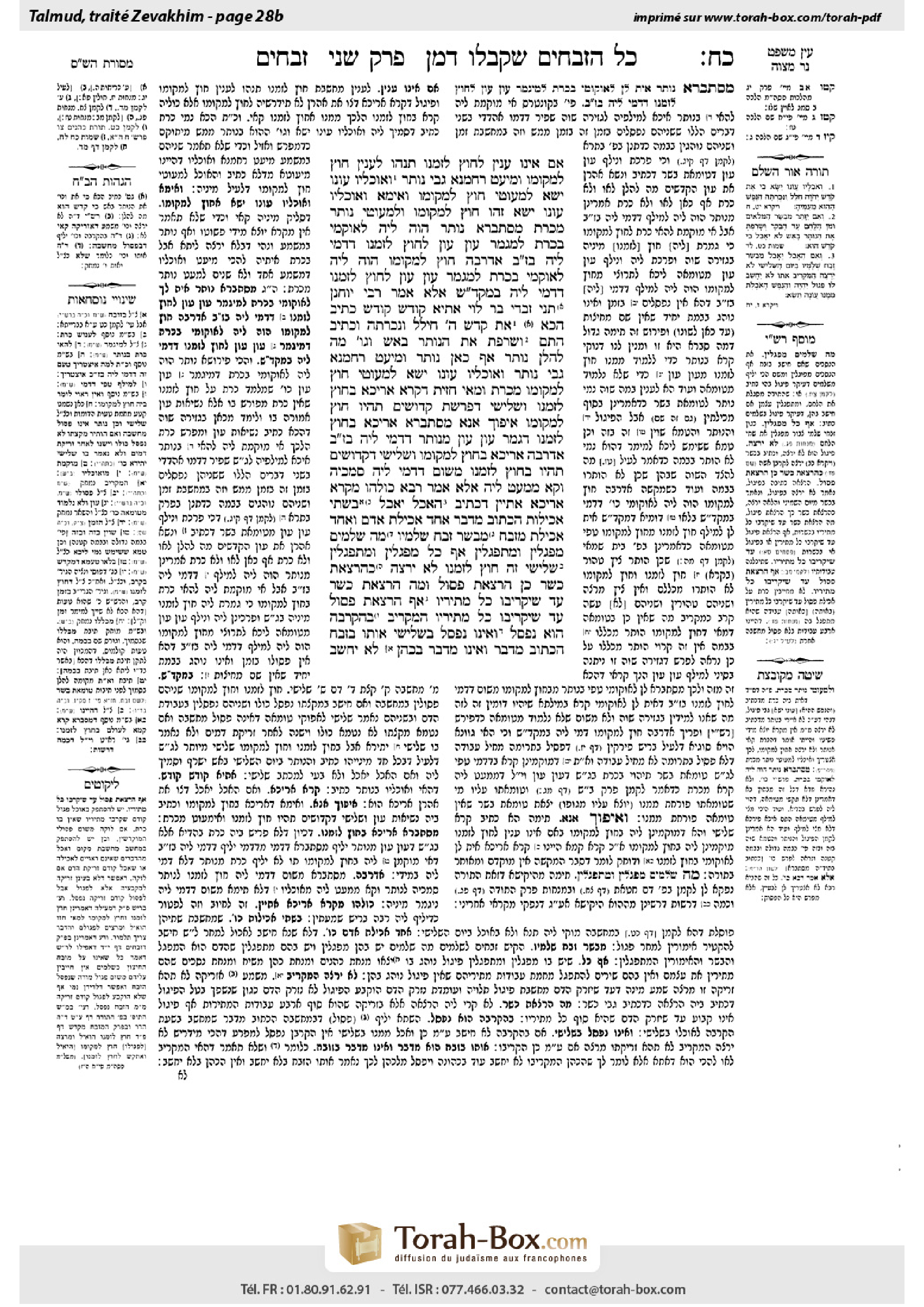
Zevachim 28b: Talmud study for Daf Yomi
Daf Yomi is the daily study of one Talmud folio. Explore 37 tractates with scans, Hebrew text, Sefaria English and AI-generated French translations where annotated.
Passage selection and English or AI-generated French translation are available where the scan has annotations. Daf Study is independent of Torah-Box and Sefaria.
Browse Zevachim · זבחים · All tractatesZevachim 28b text and translations
This page of Zevachim includes the Aramaic text, an English translation and an AI-generated French translation, alongside the scan above.
זבחים כ״ח ב · Aramaic and Hebrew text
אִם אֵינוֹ עִנְיָן לְחוּץ לִזְמַנּוֹ, תְּנֵהוּ לְעִנְיַן חוּץ לִמְקוֹמוֹ; וּמִיעֵט רַחֲמָנָא גַּבֵּי נוֹתָר: ״וְאֹכְלָיו עֲוֹנוֹ יִשָּׂא״ – לְמַעוֹטֵי חוּץ לִמְקוֹמוֹ.
וְאֵימָא: ״וְאֹכְלָיו עֲוֹנוֹ יִשָּׂא״ – זֶהוּ חוּץ לִמְקוֹמוֹ, וּלְמַעוֹטֵי נוֹתָר מִכָּרֵת!
מִסְתַּבְּרָא נוֹתָר הֲוָה לֵיהּ לְאוֹקוֹמֵי בְּכָרֵת – לְמִגְמַר ״עָוֹן״–״עָוֹן״ לְחוּץ לִזְמַנּוֹ, דְּדָמֵי לֵיהּ בְּז״ב.
אַדְּרַבָּה! חוּץ לִמְקוֹמוֹ הֲוָה לֵיהּ לְאוֹקוֹמֵי בְּכָרֵת – לְמִגְמַר ״עָוֹן״–״עָוֹן״ לְחוּץ לִזְמַנּוֹ, דְּדָמֵי לֵיהּ בְּמקד״ש!
אֶלָּא אָמַר רַבִּי יוֹחָנָן, תָּנֵי זַבְדִּי בַּר לֵוִי: אַתְיָא ״קֹדֶשׁ״–״קֹדֶשׁ״; כְּתִיב הָכָא: ״אֶת קֹדֶשׁ ה׳ חִלֵּל וְנִכְרְתָה״, וּכְתִיב הָתָם: ״וְשָׂרַפְתָּ אֶת הַנּוֹתָר בָּאֵשׁ וְגוֹ׳״; מָה לְהַלָּן נוֹתָר, אַף כָּאן נוֹתָר.
וּמִיעֵט רַחֲמָנָא גַּבֵּי נוֹתָר ״וְאֹכְלָיו עֲוֹנוֹ יִשָּׂא״ – לְמַעוֹטֵי חוּץ לִמְקוֹמוֹ מִכָּרֵת.
וּמַאי חָזֵית דִּקְרָא אֲרִיכָא – בְּחוּץ לִזְמַנּוֹ, וּ״שְׁלִישִׁי״ דְּפָרָשַׁת ״קְדֹשִׁים תִּהְיוּ״ – חוּץ לִמְקוֹמוֹ? אֵיפוֹךְ אֲנָא!
מִסְתַּבְּרָא אֲרִיכָא בְּחוּץ לִזְמַנּוֹ – דְּגָמַר ״עָוֹן״–״עָוֹן״ מִנּוֹתָר, דְּדָמֵי לֵיהּ בְּז״ב.
אַדְּרַבָּה! אֲרִיכָא בְּחוּץ לִמְקוֹמוֹ, וּ״שְׁלִישִׁי״ דִּ״קְדֹשִׁים תִּהְיוּ״ בְּחוּץ לִזְמַנּוֹ – מִשּׁוּם דְּדָמֵי לֵיהּ, סַמְכֵיהּ וְקָא מְמַעֵט לֵיהּ!
אֶלָּא אָמַר רָבָא: כּוּלְּהוּ מִקְּרָא אֲרִיכָא אָתַיִין; דִּכְתִיב: ״הֵאָכֹל יֵאָכֵל״ – בִּשְׁתֵּי אֲכִילוֹת הַכָּתוּב מְדַבֵּר, אֶחָד אֲכִילַת אָדָם וְאֶחָד אֲכִילַת מִזְבֵּחַ.
״מִבְּשַׂר זֶבַח שְׁלָמָיו״ – מָה שְׁלָמִים מְפַגְּלִין וּמִתְפַּגְּלִין, אַף כֹּל מְפַגְּלִין וּמִתְפַּגְּלִין.
״שְׁלִישִׁי״ – זֶה חוּץ לִזְמַנּוֹ.
״לֹא יֵרָצֶה״ – כְּהַרְצָאַת כָּשֵׁר, כֵּן הַרְצָאַת פָּסוּל; וּמָה הַרְצָאַת כָּשֵׁר – עַד שֶׁיַּקְרִיבוּ כׇּל מַתִּירָיו, אַף הַרְצָאַת פָּסוּל – עַד שֶׁיַּקְרִיבוּ כׇּל מַתִּירָיו.
״הַמַּקְרִיב״ – בְּהַקְרָבָה הוּא נִפְסָל, וְאֵינוֹ נִפְסָל בִּשְׁלִישִׁי. ״אוֹתוֹ״ – בַּזֶּבַח הַכָּתוּב מְדַבֵּר, וְאֵינוֹ מְדַבֵּר בַּכֹּהֵן.
״לֹא יֵחָשֵׁב״ –
Zevachim 28b · English translation
Therefore, if the verse is not referring to the matter of intent to consume the offering beyond its designated time, apply it to the matter of intent to consume it outside its designated area. And as for the punishment of karet, the Merciful One restricted it to the prohibition of notar, i.e., actually partaking of the offering beyond its designated time, as the verse states: “But whoever eats it shall bear his iniquity” (Leviticus 19:8). This indicates that one is liable to receive karet for partaking of notar, to the exclusion of intent to consume the offering outside its designated area.
The Gemara asks: But why not say instead that when the verse states: “But whoever eats it shall bear his iniquity,” this is referring to intent to consume the offering outside its designated area, and the verse serves to exclude notar from the penalty of karet?
The Gemara responds: It stands to reason that notar should be interpreted as carrying the penalty of karet, because this would allow one to derive by way of verbal analogy between “iniquity” and “iniquity” stated with regard to the case of intent to consume the meat beyond its designated time, that the punishment of karet applies to the latter as well. The verbal analogy would be apt since one prohibition is similar to the other in that they share features that form the acronym zayin, beit: Both concern the offering’s designated time [zeman], and both are applicable to an offering sacrificed on a private altar [bama].
The Gemara rejects this: On the contrary, intent to consume the offering outside its designated area should be interpreted as carrying the penalty of karet, because this would allow one to derive by way of verbal analogy between “iniquity” and “iniquity” stated with regard to the case of intent to consume the meat beyond its designated time, that the punishment of karet applies to the latter as well. The verbal analogy would still be apt since one prohibition is similar to the other in that both share features that form the acronym mikdash: Both concern intent [maḥashava]; both disqualify the entire offering even if one had intent with regard to only part [ketzat] of it; both occur while collecting or sprinkling the offering’s blood [dam]; and with regard to both the verse contains an extraneous mention of the third [shelishi] day.
Rather, Rabbi Yoḥanan says that Zavdi bar Levi taught: It is derived that the prohibition of notar carries the penalty of karet by way of verbal analogy between “sacred” and “sacred.” It is written here: “But whoever eats it shall bear his iniquity, because he has profaned the sacred item of the Lord; and that soul shall be cut off from his people” (Leviticus 19:8). And it is written there: “And if any of the flesh of the consecration, or of the bread, remain until the morning, then you shall burn the remainder [notar] with fire; it shall not be eaten, because it is sacred” (Exodus 29:34). Just as the verse there is referring to notar, so too, the verse here is referring to notar.
And consequently, when the Merciful One restricted the penalty of karet to the prohibition of eating notar, as the verse states: “But whoever eats it shall bear his iniquity,” this restriction serves to exclude the case of intent to consume the offering outside its designated area from the penalty of karet.
The Gemara returns to the initial assumption that the statement of Shmuel is referring to two verses: And what did you see that led you to conclude that the long verse (Leviticus 7:18) is referring to intent to consume the offering beyond its designated time, and that the verse that mentions the third day (Leviticus 19:7) in the Torah portion that begins: “You shall be holy,” is referring to intent to consume it outside its designated area? I might just as well reverse the two.
The Gemara responds: It stands to reason that the long verse is referring to intent to consume the offering beyond its designated time, as this allows for one to derive by way of verbal analogy between “iniquity” and “iniquity” from notar that an offering sacrificed with such intent carries the penalty of karet. The verbal analogy is apt since one prohibition is similar to the other in that both share the features mentioned above that form the acronym: Zayin, beit.
The Gemara rejects this: On the contrary, it stands to reason that the long verse is referring to intent to consume the offering outside its designated area, and that the verse that mentions the third day in the Torah portion that begins: “You shall be holy,” is referring to intent to consume it beyond its designated time. This is due to the fact that the latter intent is similar to notar in that both prohibitions share the features mentioned above that form the acronym: Zayin, beit, and it is therefore reasonable that the Torah juxtaposed the two in adjacent verses. And if so, when the verse states with regard to notar: “But whoever eats it shall bear his iniquity,” this excludes intent to consume the offering beyond its designated time from the penalty of karet.
Rather, Rava says: One must accept the original interpretation of Shmuel’s statement, that all of these halakhot with regard to intent to consume the offering beyond its designated time or outside its designated area are derived from the long verse. As it is written: “If any of the flesh of his peace offerings be at all eaten on the third day, it shall not be accepted, neither shall it be credited to he who offers it; it shall be piggul, and the soul that eats of it shall bear his iniquity” (Leviticus 7:18). When the verse states: “Be at all eaten [he’akhol ye’akhel],” using a doubled verb, the verse speaks of intent with regard to two consumptions, one consumption by a person, and one consumption by the altar, i.e., burning the offering. Improper intent with regard to either of these acts renders the offering piggul.
The phrase “any of the flesh of his peace offerings” indicates that just as a peace offering possesses that which renders piggul and that which is rendered piggul, i.e., the blood, which renders the offering piggul through one’s intent with regard to its rites, and the meat, which is rendered piggul through such intent, so too the verse is referring to all offerings that possess that which renders an offering piggul and that which is rendered piggul.
The term “on the third day” indicates that the verse is referring to intent to consume the offering beyond its designated time, as peace offerings may be eaten for only two days.
The phrase “it shall not be accepted” indicates that an offering is deemed piggul following the stage of the service at which it would have otherwise effected atonement. Therefore, like the acceptance of a fit offering, so is the acceptance of a disqualified offering, and just as the acceptance of a fit offering does not occur until one sacrifices all its permitting factors, i.e., one sprinkles the blood properly, so too the acceptance of a disqualified offering does not occur until one sacrifices all its permitting factors.
The term “he who offers” indicates that piggul is disqualified at the time of offering, due to improper intent, and it is not disqualified on the third day literally. And when the verse states “it,” this indicates that the verse is speaking of a disqualification of the offering only, but it is not speaking of the priest, who is not disqualified from the priesthood through such intent.
The phrase “neither shall it be credited [yeḥashev]”
Zevachim 28b · Traduction française (IA)
Par conséquent, si le verset ne fait pas référence à l’intention de consommer le sacrifice au-delà du délai qui lui est imparti, on l’applique à l’intention de le consommer hors de l’aire qui lui est assignée. Quant à la peine de karet, le Miséricordieux l’a limitée à l’interdit de notar, c’est-à-dire au fait de consommer effectivement le sacrifice au-delà du délai qui lui est imparti, comme le dit le verset : « Mais quiconque en mangera portera sa faute » (Lévitique 19, 8). Cela indique que l’on est passible de karet pour avoir consommé du notar, à l’exclusion de l’intention de consommer le sacrifice hors de l’aire qui lui est assignée.
La Guemara demande : Mais pourquoi ne pas dire plutôt que, lorsque le verset dit : « Mais quiconque en mangera portera sa faute », il fait référence à l’intention de consommer le sacrifice hors de l’aire qui lui est assignée et qu’il exclut ainsi le notar de la peine de karet ?
La Guemara répond : Il est logique d’interpréter le notar comme entraînant la peine de karet, car cela permettrait de déduire, par analogie verbale entre « faute » et « faute », à propos du cas où l’on a l’intention de consommer la viande au-delà du délai qui lui est imparti, que la peine de karet s’applique également à ce dernier cas. L’analogie verbale est pertinente, car les deux interdits se ressemblent en ce qu’ils partagent des caractéristiques formant l’acronyme zayin, beit : tous deux concernent le délai assigné au sacrifice [zeman], et tous deux s’appliquent à un sacrifice offert sur un autel privé [bama].
La Guemara rejette cette proposition : Au contraire, il faut interpréter l’intention de consommer le sacrifice hors de l’aire qui lui est assignée comme entraînant la peine de karet, car cela permettrait de déduire, par analogie verbale entre « faute » et « faute », à propos du cas où l’on a l’intention de consommer la viande au-delà du délai qui lui est imparti, que la peine de karet s’applique également à ce dernier cas. L’analogie verbale resterait pertinente, car les deux interdits se ressemblent en ce qu’ils partagent des caractéristiques formant l’acronyme mikdash : tous deux concernent l’intention [maḥashava] ; tous deux invalident le sacrifice entier, même si l’intention ne portait que sur une partie [ketzat] de celui-ci ; tous deux surviennent lors du recueil ou de l’aspersion du sang du sacrifice [dam] ; et, dans les deux cas, le verset comporte une mention superflue du troisième [shelishi] jour.
Rabbi Yoḥanan dit plutôt que Zavdi bar Levi a enseigné que l’interdit de notar entraînant la peine de karet se déduit par analogie verbale entre « saint » et « saint ». Il est écrit ici : « Mais quiconque en mangera portera sa faute, car il a profané la chose sainte de l’Éternel ; cette personne sera retranchée de son peuple » (Lévitique 19, 8). Et il est écrit là : « Si une partie de la chair de l’offrande de consécration ou du pain reste jusqu’au matin, tu brûleras au feu ce qui reste [notar] ; on n’en mangera pas, car c’est saint » (Exode 29, 34). De même que le verset cité là fait référence au notar, de même le verset cité ici fait référence au notar.
Par conséquent, lorsque le Miséricordieux a limité la peine de karet à l’interdit de consommer du notar, comme le dit le verset : « Mais quiconque en mangera portera sa faute », cette restriction exclut de la peine de karet le cas de l’intention de consommer le sacrifice hors de l’aire qui lui est assignée.
La Guemara revient à l’hypothèse initiale selon laquelle l’énoncé de Shmuel porte sur deux versets : Qu’est-ce qui t’a amené à conclure que le long verset (Lévitique 7, 18) fait référence à l’intention de consommer le sacrifice au-delà du délai qui lui est imparti, et que le verset qui mentionne le troisième jour (Lévitique 19, 7), dans la paracha qui commence par « Soyez saints », fait référence à l’intention de le consommer hors de l’aire qui lui est assignée ? On pourrait tout aussi bien inverser les deux.
La Guemara répond : Il est logique que le long verset fasse référence à l’intention de consommer le sacrifice au-delà du délai qui lui est imparti, car cela permet de déduire, par analogie verbale entre « faute » et « faute », à partir du notar, qu’un sacrifice offert avec une telle intention entraîne la peine de karet. Cette analogie verbale est pertinente, car les deux interdits se ressemblent en ce qu’ils partagent les caractéristiques mentionnées plus haut, formant l’acronyme zayin, beit.
La Guemara rejette cette proposition : Au contraire, il est logique que le long verset fasse référence à l’intention de consommer le sacrifice hors de l’aire qui lui est assignée, et que le verset qui mentionne le troisième jour, dans la paracha qui commence par « Soyez saints », fasse référence à l’intention de le consommer au-delà du délai qui lui est imparti. Cela tient au fait que cette dernière intention ressemble au notar, les deux interdits partageant les caractéristiques mentionnées plus haut et formant l’acronyme zayin, beit ; il est donc logique que la Torah les ait rapprochés dans des versets consécutifs. Dans ce cas, lorsque le verset dit, à propos du notar : « Mais quiconque en mangera portera sa faute », il exclut de la peine de karet l’intention de consommer le sacrifice au-delà du délai qui lui est imparti.
Rava dit plutôt : il faut accepter l’interprétation initiale de l’énoncé de Shmuel, selon laquelle toutes ces halakhot relatives à l’intention de consommer le sacrifice au-delà du délai qui lui est imparti ou hors de l’aire qui lui est assignée sont déduites du long verset. Car il est écrit : « Si une partie de la chair de ses sacrifices de paix est jamais mangée le troisième jour, elle ne sera pas agréée et ne sera pas imputée à celui qui l’offre ; elle sera piggoul, et la personne qui en mangera portera sa faute » (Lévitique 7, 18). Lorsque le verset dit : « est jamais mangée [he’akhol ye’akhel] », en employant un verbe redoublé, il parle de l’intention concernant deux consommations : l’une par une personne, l’autre par l’autel, c’est-à-dire la combustion du sacrifice. Une intention inappropriée concernant l’un ou l’autre de ces actes rend le sacrifice piggoul.
L’expression « une partie de la chair de ses sacrifices de paix » indique que, de même qu’un sacrifice de paix possède à la fois ce qui rend piggoul et ce qui est rendu piggoul — c’est-à-dire le sang, qui rend le sacrifice piggoul par l’intention relative à ses rites, et la viande, qui est rendue piggoul par une telle intention —, de même le verset fait référence à tous les sacrifices qui possèdent à la fois ce qui rend un sacrifice piggoul et ce qui est rendu piggoul.
L’expression « le troisième jour » indique que le verset fait référence à l’intention de consommer le sacrifice au-delà du délai qui lui est imparti, car les sacrifices de paix ne peuvent être consommés que pendant deux jours.
L’expression « elle ne sera pas agréée » indique qu’un sacrifice est considéré comme piggoul après l’étape du service qui aurait autrement produit l’expiation. Par conséquent, l’agrément d’un sacrifice invalide correspond à celui d’un sacrifice valide ; et, de même que l’agrément d’un sacrifice valide n’intervient qu’après que tous les facteurs qui en permettent la consommation ont été accomplis, c’est-à-dire après l’aspersion correcte du sang, de même l’agrément d’un sacrifice invalide n’intervient qu’après que tous les facteurs qui en permettent la consommation ont été accomplis.
Le terme « celui qui l’offre » indique que le sacrifice est invalidé comme piggoul au moment de l’offrande, en raison d’une intention inappropriée, et non littéralement le troisième jour. Et lorsque le verset dit « elle », cela indique qu’il parle uniquement de l’invalidation du sacrifice, et non du prêtre, qui n’est pas disqualifié de la prêtrise par une telle intention.
L’expression « elle ne sera pas imputée [yeḥashev] »
Traduction française générée par IA à partir de l’édition anglaise de Sefaria. Vérifie toujours un passage avec le texte source.
Text from Sefaria: William Davidson Edition - Vocalized Aramaic (CC BY NC); William Davidson Edition - English (CC BY NC).