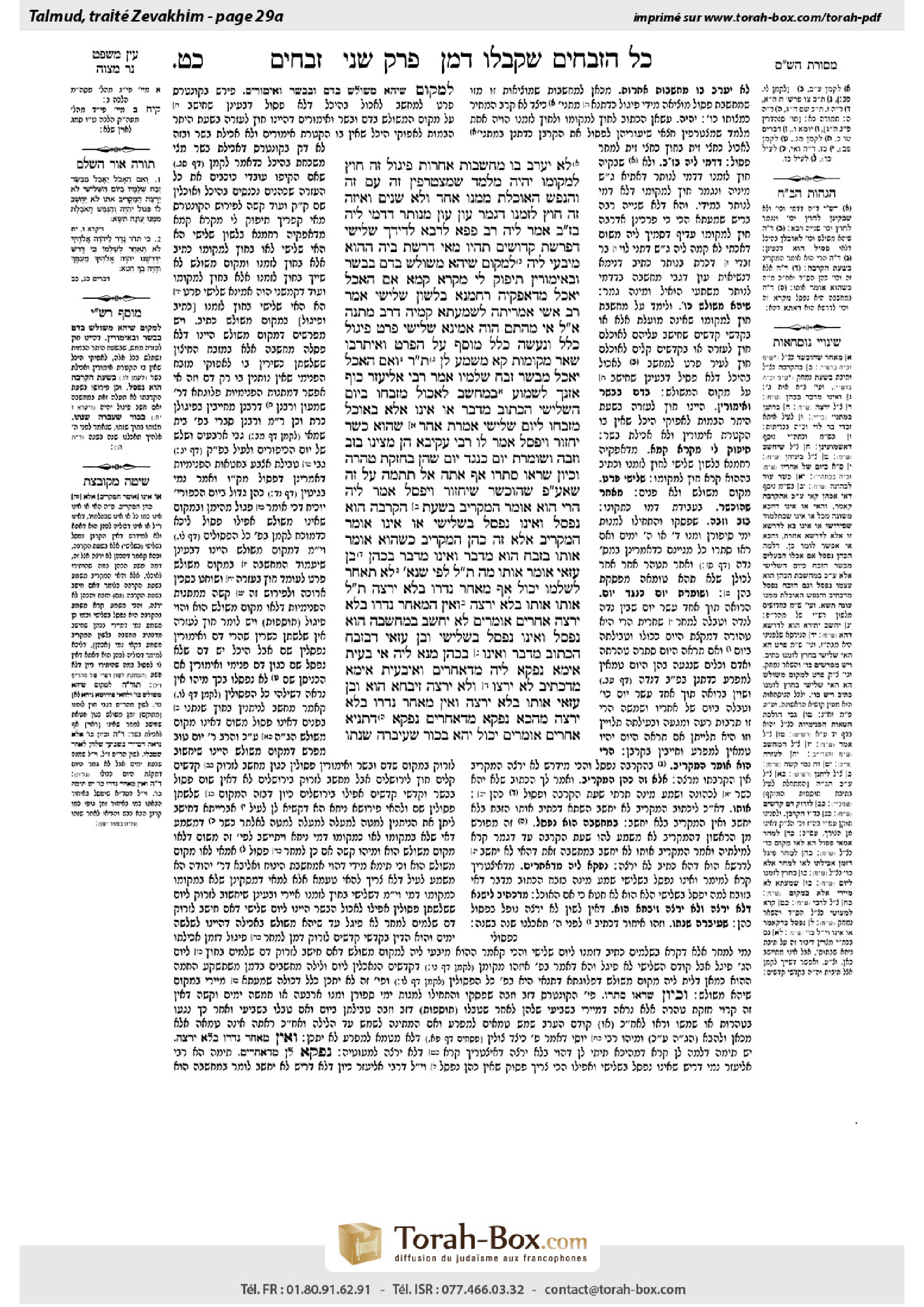
Zevachim 29a: Talmud study for Daf Yomi
Daf Yomi is the daily study of one Talmud folio. Explore 37 tractates with scans, Hebrew text, Sefaria English and AI-generated French translations where annotated.
Passage selection and English or AI-generated French translation are available where the scan has annotations. Daf Study is independent of Torah-Box and Sefaria.
Browse Zevachim · זבחים · All tractatesZevachim 29a text and translations
This page of Zevachim includes the Aramaic text, an English translation and an AI-generated French translation, alongside the scan above.
זבחים כ״ט א · Aramaic and Hebrew text
לֹא יְעָרֵב בּוֹ מַחְשָׁבוֹת אֲחֵרוֹת.
״פִּגּוּל״ – זֶה חוּץ לִמְקוֹמוֹ.
״יִהְיֶה״ – מְלַמֵּד שֶׁמִּצְטָרְפִין זֶה עִם זֶה.
״וְהַנֶּפֶשׁ הָאֹכֶלֶת מִמֶּנּוּ״ – אֶחָד וְלֹא שְׁנַיִם; וְאֵיזֶה? זֶה חוּץ לִזְמַנּוֹ – דְּגָמַר ״עָוֹן״–״עָוֹן״ מִנּוֹתָר, דְּדָמֵי לֵיהּ בְּז״ב.
אֲמַר לֵיהּ רַב פָּפָּא לְרָבָא: לְדִידָךְ, ״שְׁלִישִׁי״ דְּפָרָשַׁת ״קְדֹשִׁים תִּהְיוּ״ – מַאי דָּרְשַׁתְּ בֵּיהּ? הָהוּא מִיבְּעֵי לֵיהּ לְמָקוֹם שֶׁיְּהֵא מְשׁוּלָּשׁ בְּדָם, בְּבָשָׂר וּבְאֵימוּרִין.
תִּיפּוֹק לִי מִקְרָא קַמָּא: ״אִם הֵאָכֹל יֵאָכֵל״ – מִדְּאַפְּקֵיהּ רַחֲמָנָא בִּלְשׁוֹן ״שְׁלִישִׁי״!
אָמַר רַב אָשֵׁי: אַמְרִיתַהּ לִשְׁמַעְתָּא קַמֵּיהּ דְּרַב מַתְנָה; אָמַר לִי: אִי מֵהָתָם, הֲוָה אָמֵינָא: ״שְׁלִישִׁי״ – פְּרָט, ״פִּגּוּל״ – כְּלָל; וְנַעֲשֶׂה כְּלָל מוּסָף עַל הַפְּרָט, וְאִיתְרַבּוֹ שְׁאָר מְקוֹמוֹת; קָא מַשְׁמַע לַן.
תָּנוּ רַבָּנַן: ״וְאִם הֵאָכֹל יֵאָכֵל מִבְּשַׂר זֶבַח שְׁלָמָיו״ – אָמַר רַבִּי אֱלִיעֶזֶר: כּוֹף אׇזְנְךָ לִשְׁמוֹעַ – בִּמְחַשֵּׁב לֶאֱכוֹל מִזִּבְחוֹ בַּיּוֹם הַשְּׁלִישִׁי הַכָּתוּב מְדַבֵּר. אוֹ אֵינוֹ אֶלָּא בְּאוֹכֵל מִזִּבְחוֹ לְיוֹם שְׁלִישִׁי? אָמַרְתָּ: אַחַר שֶׁהוּא כָּשֵׁר, יַחְזוֹר וְיִפָּסֵל?!
אָמַר לוֹ רַבִּי עֲקִיבָא: הֵן! מָצִינוּ בְּזָב וְזָבָה וְשׁוֹמֶרֶת יוֹם כְּנֶגֶד יוֹם – שֶׁהֵן בְּחֶזְקַת טׇהֳרָה, וְכֵיוָן שֶׁרָאוּ סָתְרוּ; אַף אַתָּה אַל תִּתְמַהּ עַל זֶה – שֶׁאַף עַל פִּי שֶׁהוּכְשַׁר, שֶׁיַּחְזוֹר וְיִפָּסֵל.
אֲמַר לֵיהּ: הֲרֵי הוּא אוֹמֵר ״הַמַּקְרִיב״ – בִּשְׁעַת הַקְרָבָה הוּא נִפְסָל, וְאֵינוֹ נִפְסָל בַּשְּׁלִישִׁי. אוֹ אֵינוֹ אוֹמֵר ״הַמַּקְרִיב״ אֶלָּא זֶה כֹּהֵן הַמַּקְרִיב? כְּשֶׁהוּא אוֹמֵר ״אֹתוֹ״ – בַּזֶּבַח הוּא מְדַבֵּר, וְאֵינוֹ מְדַבֵּר בַּכֹּהֵן.
בֶּן עַזַּאי אוֹמֵר: ״אֹתוֹ״ מָה תַּלְמוּד לוֹמַר? לְפִי שֶׁנֶּאֱמַר: ״לֹא תְאַחֵר לְשַׁלְּמוֹ״ – יָכוֹל אַף מְאַחֵר נִדְרוֹ בְּלֹא יֵרָצֶה? תַּלְמוּד לוֹמַר: ״אֹתוֹ״ – אוֹתוֹ בְּלֹא יֵרָצֶה, וְאֵין הַמְאַחֵר נִדְרוֹ בְּלֹא יֵרָצֶה.
אֲחֵרִים אוֹמְרִים: ״לֹא יֵחָשֵׁב״ – בְּמַחְשָׁבָה הוּא נִפְסָל, וְאֵינוֹ נִפְסָל בַּשְּׁלִישִׁי.
וּבֶן עַזַּאי – דִּבְזֶבַח הַכָּתוּב מְדַבֵּר וְאֵינוֹ בְּכֹהֵן, מְנָא לֵיהּ? אִי בָּעֵית אֵימָא: נָפְקָא לֵיהּ מִדַּאֲחֵרִים, וְאִיבָּעֵית אֵימָא: מִדִּכְתִיב ״לֹא יֵרָצוּ״ וְ״לֹא יֵרָצֶה״ – זִיבְחָא הוּא.
וּבֶן עַזַּאי – אוֹתוֹ בְּ״לֹא יֵרָצֶה״ וְאֵין מְאַחֵר נִדְרוֹ בְּ״לֹא יֵרָצֶה״, מֵהָכָא נָפְקָא?! מִדַּאֲחֵרִים נָפְקָא! דְּתַנְיָא, אֲחֵרִים אוֹמְרִים: יָכוֹל יְהֵא בְּכוֹר שֶׁעִיבְּרָה שְׁנָתוֹ –
Zevachim 29a · English translation
indicates that to render an offering piggul, the priest does not mix other improper intentions [maḥashavot] with intent of piggul. If he has more than one type of improper intent, the offering is disqualified, but it is not rendered piggul.
When the verse states: “Piggul,” this is referring to an offering that one had intent to consume outside its designated area.
And since the verse states: “It shall be,” and not: They shall be, this teaches that intent to consume half an olive-bulk beyond its designated time and intent to consume half an olive-bulk outside its designated area join together with one another to constitute the minimum measure required to disqualify the offering.
Finally, when the verse states: “And the soul that eats of it shall bear his iniquity,” the term “of it” indicates that only one of the above disqualifications carries the penalty of karet, but not two of them. And which is this? It is intent to consume the offering beyond its designated time, as one derives by way of verbal analogy between “iniquity” and “iniquity” from notar (Leviticus 19:8), that “bear his iniquity” means that one is liable to receive karet. The comparison is apt since notar is similar to intent to consume the offering beyond its designated time in that both prohibitions share the features mentioned above that form the acronym: Zayin, beit.
Rav Pappa said to Rava: According to your opinion, in what way do you interpret the reference to the third day (Leviticus 19:7) in the Torah portion that begins: “You shall be holy”? Rava responded: That verse is necessary to teach that a given location is considered to be outside the offering’s designated area only if it is so in three ways, i.e., outside the permitted limits of the blood, of the meat, and of the sacrificial portions.
The Gemara asks: Why not let me derive that halakha from the first verse: “And if any of the flesh of his peace offerings be at all eaten on the third day” (Leviticus 7:18), since the Merciful One expresses that verse as well with the term “third”? Since Rava derives the disqualification of intent to consume an offering outside its designated area from this verse, why not let him derive this halakha from the verse as well?
Rav Ashi said: I stated this halakha before Rav Mattana, and he said to me: If one were to derive this halakha only from there (Leviticus 7:18), I would say: The term “third” is a detail, and the term “piggul” is a generalization, and whenever a detail is followed by a generalization, the generalization becomes an addition to the detail, and consequently, all other areas are included as well. The additional verse teaches us that the halakha includes only those areas that are outside in three ways.
§ The Sages taught with regard to the verse: “And if any of the flesh of his peace offerings be at all eaten on the third day, it shall not be accepted” (Leviticus 7:18): Rabbi Eliezer said: Bend your ear to hear the true meaning of the verse: The verse is speaking of one who intends to partake of his offering on the third day. Or perhaps it is referring only to one who actually partakes of his offering on the third day, per the straightforward meaning of the verse? But that cannot be; would you say that after the offering is fit for the first two days, it should then be disqualified retroactively by being eaten on the third day?
Rabbi Akiva said to him: Yes, it could be disqualified retroactively. After all, we find with regard to a man who experiences a gonorrhea-like discharge [zav], or a woman who experiences a discharge of uterine blood after her menstrual period [zava], or a woman who observes a clean day for a day when she experiences a discharge, that they all have the presumptive status of purity after immersing. But once they have seen another discharge the same day, they have negated this status retroactively, and everything they had touched after immersing becomes impure. Therefore, you as well should not be surprised about this offering consumed beyond its designated time, that even though it was rendered fit, it may then be disqualified retroactively.
Rabbi Eliezer said to him: But the same verse says: “He who offers it,” indicating that the offering is disqualified at the time of its offering, and it is not disqualified on the third day. Or perhaps when the verse says: “He who offers it,” this is referring only to the priest who sacrifices the offering, indicating that he is disqualified. But if so, it would have been enough for the verse to state: He who offers shall not be credited. Therefore, when it states instead: “Neither shall it be credited to he who offers it,” this indicates that the verse is speaking of the offering, and it is not speaking of the priest.
Ben Azzai says: Why must the verse state: “It”? It is necessary because elsewhere it is stated: “When you shall vow a vow to the Lord your God, you shall not delay paying it; for the Lord your God will require it from you, and it will be sin in you” (Deuteronomy 23:22). One might have thought that even one who is late in fulfilling his vow is included in: “It shall not be accepted” (Leviticus 7:18). Therefore, the verse states: “It,” to indicate that it, an offering rendered piggul, is included in the halakha of: “It shall not be accepted,” but the animal of one who is late in fulfilling his vow is not included in the halakha of: “It shall not be accepted.”
Aḥerim say: One can conclude that the verse (Leviticus 7:18) is referring to improper intention rather than improper consumption from the phrase “neither shall it be credited [yeḥashev],” which indicates that the offering is disqualified by improper intention [maḥashava], and it is not disqualified by consumption on the third day.
The Gemara asks: And ben Azzai, who interprets the term “it” as excluding vows that were fulfilled late, from where does he derive that the verse is speaking of the offering and not of the priest? The Gemara responds: If you wish, say that he derives it from the statement of Aḥerim that the verse rules out disqualification on the third day itself. This would be necessary only if the verse is referring to the offering and not the priest. Or, if you wish, say instead: From the fact that it is written: “They shall not be accepted” (Leviticus 22:25), and: “It shall not be accepted” (Leviticus 7:18), it is evident that the verse is referring to an offering, which may be accepted or may not be accepted.
The Gemara asks: And with regard to the statement of ben Azzai that one derives from the word “it” that it, i.e., piggul, is included in the halakha of: “It shall not be accepted,” but the animal of one who is late in fulfilling his vow is not included in the halakha of: “It shall not be accepted,” is this halakha derived from here? It is derived from the statement of Aḥerim, as it is taught in a baraita: Aḥerim say: One might have thought that a firstborn animal whose first year passed, during which time it ought to have been sacrificed, should be
Zevachim 29a · Traduction française (IA)
Cela indique que, pour rendre une offrande piggul, le prêtre ne mêle pas d’autres intentions impropres [maḥashavot] à l’intention de piggul. S’il a plusieurs types d’intentions impropres, l’offrande est disqualifiée, mais ne devient pas piggul.
Lorsque le verset dit : « Piggul », il désigne une offrande que l’on a eu l’intention de consommer en dehors de son lieu prescrit.
Et puisque le verset dit : « Il sera », et non : « Ils seront », cela enseigne que l’intention de consommer un demi-volume d’olive après le temps prescrit et l’intention de consommer un demi-volume d’olive en dehors du lieu prescrit s’additionnent pour atteindre la mesure minimale requise afin de disqualifier l’offrande.
Enfin, lorsque le verset dit : « Et la personne qui en mangera portera sa faute », l’expression « en » indique qu’une seule des disqualifications mentionnées entraîne la peine de karet, mais pas deux. Laquelle ? L’intention de consommer l’offrande après le temps prescrit, comme on le déduit par analogie verbale entre « faute » et « faute » à partir du notar (Lévitique 19:8) : « portera sa faute » signifie que l’on est passible de karet. Cette comparaison convient, car le notar ressemble à l’intention de consommer l’offrande après le temps prescrit en ce que les deux interdictions présentent les caractéristiques mentionnées plus haut, dont les initiales forment l’acronyme : zayin, beit.
Rav Pappa dit à Rava : Selon ton opinion, comment interprètes-tu la mention du troisième jour (Lévitique 19:7) dans la section de la Torah qui commence par : « Vous serez saints » ? Rava répondit : Ce verset est nécessaire pour enseigner qu’un lieu n’est considéré comme extérieur à la zone prescrite pour l’offrande que s’il l’est à trois égards, c’est-à-dire au-delà des limites autorisées pour le sang, la viande et les portions sacrificielles.
La Guemara demande : Pourquoi ne pas déduire cette halakha du premier verset : « Si l’on mange tant soit peu de la chair de son sacrifice de paix le troisième jour » (Lévitique 7:18), puisque le Miséricordieux emploie également le terme « troisième » dans ce verset ? Puisque Rava déduit de ce verset la disqualification liée à l’intention de consommer une offrande en dehors de la zone prescrite, pourquoi ne pas en déduire également cette halakha ?
Rav Ashi dit : J’ai exposé cette halakha devant Rav Mattana, qui m’a dit : Si l’on ne déduisait cette halakha que de là (Lévitique 7:18), je dirais que le terme « troisième » est un détail et que le terme « piggul » est une généralité ; or, lorsqu’une généralité suit un détail, elle s’ajoute à celui-ci, et, par conséquent, tous les autres lieux sont également inclus. Le verset supplémentaire nous enseigne que la halakha ne concerne que les lieux qui sont extérieurs à trois égards.
§ Les Sages ont enseigné au sujet du verset : « Si l’on mange tant soit peu de la chair de son sacrifice de paix le troisième jour, il ne sera pas agréé » (Lévitique 7:18) : Rabbi Eliezer dit : « Tendez l’oreille pour entendre le véritable sens du verset. » Le verset parle de celui qui a l’intention de consommer son offrande le troisième jour. Ou peut-être ne fait-il référence qu’à celui qui consomme effectivement son offrande le troisième jour, selon le sens littéral du verset ? Mais cela ne se peut pas : diriez-vous qu’après avoir été apte pendant les deux premiers jours, l’offrande serait alors disqualifiée rétroactivement parce qu’elle a été consommée le troisième jour ?
Rabbi Akiva lui dit : Oui, elle pourrait être disqualifiée rétroactivement. En effet, nous trouvons le cas d’un homme atteint d’un écoulement semblable à la gonorrhée [zav], d’une femme qui a des pertes de sang utérin après ses règles [zava], ou d’une femme qui observe un jour de pureté pour chaque jour où elle a un écoulement : tous ont le statut présomptif de pureté après l’immersion. Mais dès qu’ils ont un nouvel écoulement le même jour, cette présomption est annulée rétroactivement et tout ce qu’ils ont touché après l’immersion devient impur. De même, il ne faut donc pas s’étonner qu’une offrande consommée après le temps prescrit puisse être disqualifiée rétroactivement, même si elle avait été rendue apte.
Rabbi Eliezer lui dit : Mais le même verset dit : « Celui qui l’offre », ce qui indique que l’offrande est disqualifiée au moment où elle est offerte, et non le troisième jour. Ou peut-être, lorsque le verset dit : « Celui qui l’offre », fait-il uniquement référence au prêtre qui offre le sacrifice, indiquant que celui-ci est disqualifié ? Mais dans ce cas, il aurait suffi que le verset dise : « Celui qui offre ne sera pas agréé. » Par conséquent, lorsqu’il dit plutôt : « Il ne sera pas agréé pour celui qui l’offre », cela indique que le verset parle de l’offrande, et non du prêtre.
Ben Azzai dit : Pourquoi le verset doit-il dire : « Cela » ? C’est nécessaire parce qu’il est dit ailleurs : « Quand tu feras un vœu à l’Éternel, ton Dieu, tu ne tarderas pas à l’accomplir, car l’Éternel, ton Dieu, te le réclamera et ce sera un péché pour toi » (Deutéronome 23:22). On aurait pu penser que même celui qui tarde à accomplir son vœu est inclus dans la règle : « Il ne sera pas agréé » (Lévitique 7:18). Le verset dit donc : « Cela », pour indiquer que l’offrande devenue piggul est incluse dans la règle : « Il ne sera pas agréé », mais que l’animal de celui qui tarde à accomplir son vœu n’y est pas inclus.
Aḥerim disent : On peut conclure que le verset (Lévitique 7:18) parle d’une intention impropre plutôt que d’une consommation impropre à partir de l’expression « il ne sera pas porté à son compte [yeḥashev] », qui indique que l’offrande est disqualifiée par une intention impropre [maḥashava], et non parce qu’elle est consommée le troisième jour.
La Guemara demande : Et ben Azzai, qui interprète le terme « cela » comme excluant les vœux accomplis tardivement, d’où déduit-il que le verset parle de l’offrande et non du prêtre ? La Guemara répond : Si tu veux, dis qu’il le déduit de l’enseignement d’Aḥerim selon lequel le verset exclut la disqualification le troisième jour même. Cela ne serait nécessaire que si le verset parlait de l’offrande et non du prêtre. Ou bien, dis plutôt : du fait qu’il est écrit : « Ils ne seront pas agréés » (Lévitique 22:25) et : « Il ne sera pas agréé » (Lévitique 7:18), il est évident que le verset parle d’une offrande, qui peut être agréée ou ne pas l’être.
La Guemara demande : Et concernant l’enseignement de ben Azzai selon lequel on déduit du mot « cela » que cette offrande, c’est-à-dire le piggul, est incluse dans la règle : « Il ne sera pas agréé », mais que l’animal de celui qui tarde à accomplir son vœu n’y est pas inclus, cette halakha est-elle déduite d’ici ? Elle est déduite de l’enseignement d’Aḥerim, comme il est enseigné dans une baraïta : Aḥerim disent : On aurait pu penser qu’un animal premier-né dont la première année s’est écoulée, période durant laquelle il aurait dû être offert, devait être
Traduction française générée par IA à partir de l’édition anglaise de Sefaria. Vérifie toujours un passage avec le texte source.
Text from Sefaria: William Davidson Edition - Vocalized Aramaic (CC BY NC); William Davidson Edition - English (CC BY NC).