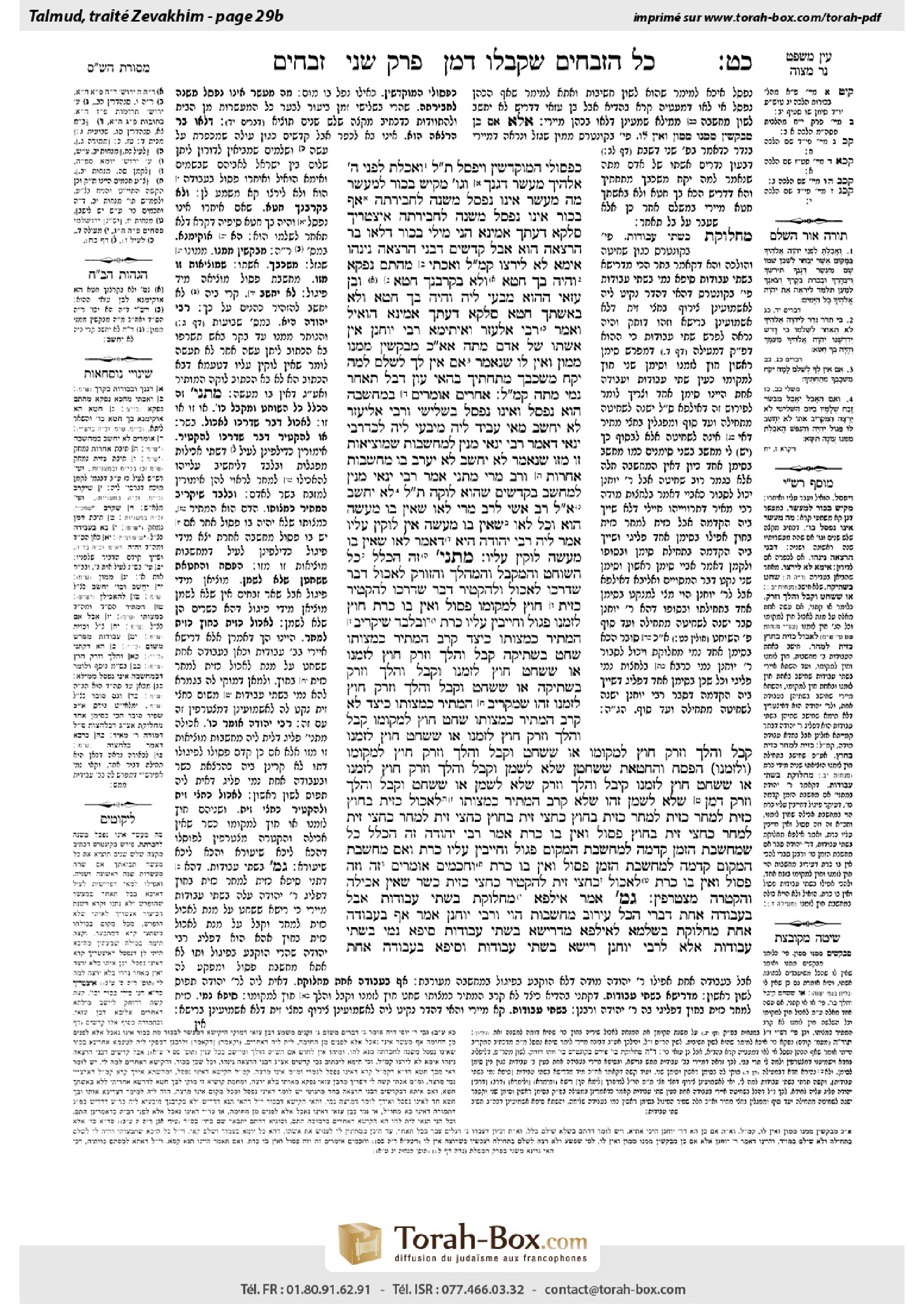
Zevachim 29b: Talmud study for Daf Yomi
Daf Yomi is the daily study of one Talmud folio. Explore 37 tractates with scans, Hebrew text, Sefaria English and AI-generated French translations where annotated.
Passage selection and English or AI-generated French translation are available where the scan has annotations. Daf Study is independent of Torah-Box and Sefaria.
Browse Zevachim · זבחים · All tractatesZevachim 29b text and translations
This page of Zevachim includes the Aramaic text, an English translation and an AI-generated French translation, alongside the scan above.
זבחים כ״ט ב · Aramaic and Hebrew text
כִּפְסוּלֵי הַמּוּקְדָּשִׁין, וְיִפָּסֵל?
תַּלְמוּד לוֹמַר: ״וְאָכַלְתָּ לִפְנֵי ה׳ אֱלֹהֶיךָ מַעְשַׂר דְּגָנְךָ וְגוֹ׳״ – מַקִּישׁ בְּכוֹר לְמַעֲשֵׂר; מָה מַעֲשֵׂר – אֵינוֹ נִפְסָל מִשָּׁנָה לַחֲבֶירְתָּהּ, אַף בְּכוֹר – אֵינוֹ נִפְסָל מִשָּׁנָה לַחֲבֶירְתָּהּ.
אִיצְטְרִיךְ; סָלְקָא דַּעְתָּךְ אָמֵינָא: הָנֵי מִילֵּי בְּכוֹר, דְּלָאו בַּר הַרְצָאָה הוּא; אֲבָל קָדָשִׁים, דִּבְנֵי הַרְצָאָה נִינְהוּ – אֵימָא לָא לִירַצּוֹ; קָא מַשְׁמַע לַן.
וְאַכַּתִּי מֵהָתָם נָפְקָא?! ״וְהָיָה בְךָ חֵטְא״ – וְלֹא בְּקׇרְבָּנְךָ חֵטְא!
וּבֶן עַזַּאי – הָהוּא מִבְּעֵי לֵיהּ: ״וְהָיָה בְךָ חֵטְא״ – וְלֹא בְּאִשְׁתְּךָ חֵטְא. סָלְקָא דַּעְתָּךְ אָמֵינָא: הוֹאִיל וְאָמַר רַבִּי אֶלְעָזָר וְאִיתֵּימָא רַבִּי יוֹחָנָן: אֵין אִשְׁתּוֹ שֶׁל אָדָם מֵתָה אֶלָּא אִם כֵּן מְבַקְּשִׁין מִמֶּנּוּ מָמוֹן וְאֵין לוֹ, שֶׁנֶּאֱמַר: ״אִם אֵין לְךָ לְשַׁלֵּם לָמָּה יִקַּח מִשְׁכָּבְךָ מִתַּחְתֶּיךָ״ – בְּהַאי עָוֹן דְּ״בַל תְּאַחֵר״ נָמֵי מֵתָה; קָא מַשְׁמַע לַן.
אֲחֵרִים אוֹמְרִים: בְּמַחְשָׁבָה הוּא נִפְסָל, וְאֵינוֹ נִפְסָל בִּשְׁלִישִׁי. וְרַבִּי אֱלִיעֶזֶר – ״לֹא יֵחָשֵׁב״ מַאי עָבֵיד לֵיהּ?
מִיבְּעֵי לֵיהּ לְכִדְרַבִּי יַנַּאי – דְּאָמַר רַבִּי יַנַּאי: מִנַּיִן לְמַחְשָׁבוֹת שֶׁמּוֹצִיאוֹת זוֹ מִזּוֹ? שֶׁנֶּאֱמַר: ״לֹא יֵחָשֵׁב״ – לֹא יְעָרֵב בּוֹ מַחְשָׁבוֹת אֲחֵרוֹת.
וְרַב מָרִי מַתְנֵי, אָמַר רַבִּי יַנַּאי: מִנַּיִן לִמְחַשֵּׁב בְּקָדָשִׁים שֶׁהוּא לוֹקֶה? תַּלְמוּד לוֹמַר: ״לֹא יֵחָשֵׁב״.
אֲמַר לֵיהּ רַב אָשֵׁי לְרַב מָרִי: לָאו שֶׁאֵין בּוֹ מַעֲשֶׂה הוּא, וְכׇל לָאו שֶׁאֵין בּוֹ מַעֲשֶׂה – אֵין לוֹקִין עָלָיו! אֲמַר לֵיהּ: רַבִּי יְהוּדָה הִיא, דְּאָמַר: לָאו שֶׁאֵין בּוֹ מַעֲשֶׂה – לוֹקִין עָלָיו.
מַתְנִי׳ זֶה הַכְּלָל: כׇּל הַשּׁוֹחֵט, וְהַמְקַבֵּל, וְהַמְהַלֵּךְ, וְהַזּוֹרֵק; לֶאֱכוֹל דָּבָר שֶׁדַּרְכּוֹ לֶאֱכוֹל, וּלְהַקְטִיר דָּבָר שֶׁדַּרְכּוֹ לְהַקְטִיר; כְּזַיִת; חוּץ לִמְקוֹמוֹ – פָּסוּל, וְאֵין בּוֹ כָּרֵת. חוּץ לִזְמַנּוֹ – פִּגּוּל, וְחַיָּיבִין עָלָיו כָּרֵת; וּבִלְבַד שֶׁיַּקְרִיב הַמַּתִּיר כְּמִצְוָתוֹ.
כֵּיצַד קָרַב הַמַּתִּיר כְּמִצְוָתוֹ? שָׁחַט בִּשְׁתִיקָה, קִבֵּל וְהִלֵּךְ וְזָרַק חוּץ לִזְמַנּוֹ; אוֹ שֶׁשָּׁחַט חוּץ לִזְמַנּוֹ, וְקִבֵּל וְהִלֵּךְ וְזָרַק בִּשְׁתִיקָה; אוֹ שֶׁשָּׁחַט וְקִבֵּל וְהִלֵּךְ וְזָרַק חוּץ לִזְמַנּוֹ – זֶהוּ שֶׁמַּקְרִיב הַמַּתִּיר כְּמִצְוָתוֹ.
כֵּיצַד לֹא קָרַב הַמַּתִּיר כְּמִצְוָתוֹ? שָׁחַט חוּץ לִמְקוֹמוֹ, קִבֵּל וְהִלֵּךְ וְזָרַק חוּץ לִזְמַנּוֹ; אוֹ שֶׁשָּׁחַט חוּץ לִזְמַנּוֹ, קִבֵּל וְהִלֵּךְ וְזָרַק חוּץ לִמְקוֹמוֹ; אוֹ שֶׁשָּׁחַט וְקִבֵּל וְהִלֵּךְ וְזָרַק חוּץ לִמְקוֹמוֹ (וְלִזְמַנּוֹ).
הַפֶּסַח וְהַחַטָּאת שֶׁשְּׁחָטָן שֶׁלֹּא לִשְׁמָן, וְקִבֵּל וְהִלֵּךְ וְזָרַק חוּץ לִזְמַנּוֹ; אוֹ שֶׁשָּׁחַט חוּץ לִזְמַנּוֹ, קִיבֵּל וְהִלֵּךְ וְזָרַק שֶׁלֹּא לִשְׁמָן; אוֹ שֶׁשָּׁחַט וְקִבֵּל וְהִלֵּךְ וְזָרַק דָּמָן שֶׁלֹּא לִשְׁמָן – זֶהוּ שֶׁלֹּא קָרַב הַמַּתִּיר כְּמִצְוָתוֹ.
לֶאֱכוֹל כְּזַיִת בַּחוּץ כְּזַיִת לְמָחָר; כְּזַיִת לְמָחָר כְּזַיִת בַּחוּץ; כַּחֲצִי זַיִת בַּחוּץ כַּחֲצִי זַיִת לְמָחָר; כַּחֲצִי זַיִת לְמָחָר כַּחֲצִי זַיִת בַּחוּץ – פָּסוּל, וְאֵין בּוֹ כָּרֵת.
אָמַר רַבִּי יְהוּדָה, זֶה הַכְּלָל: כׇּל שֶׁמַּחְשֶׁבֶת הַזְּמַן קָדְמָה לְמַחְשֶׁבֶת הַמָּקוֹם – פִּגּוּל, וְחַיָּיבִין עָלָיו כָּרֵת. וְאִם מַחְשֶׁבֶת הַמָּקוֹם קָדְמָה לְמַחְשֶׁבֶת הַזְּמַן – פָּסוּל, וְאֵין בּוֹ כָּרֵת. וַחֲכָמִים אוֹמְרִים: זֶה וָזֶה – פָּסוּל, וְאֵין בּוֹ כָּרֵת. לֶאֱכוֹל כַּחֲצִי זַיִת לְהַקְטִיר כַּחֲצִי זַיִת – כָּשֵׁר; שֶׁאֵין אֲכִילָה וְהַקְטָרָה מִצְטָרְפִין.
גְּמָ׳ אָמַר אִילְפָא: מַחְלוֹקֶת בִּשְׁתֵּי עֲבוֹדוֹת; אֲבָל בַּעֲבוֹדָה אַחַת – דִּבְרֵי הַכֹּל עֵירוּב מַחְשָׁבוֹת הָוֵי. וְרַבִּי יוֹחָנָן אָמַר: אַף בַּעֲבוֹדָה אַחַת מַחְלוֹקֶת.
בִּשְׁלָמָא לְאִילְפָא – מִדְּרֵישָׁא בִּשְׁתֵּי עֲבוֹדוֹת, סֵיפָא נָמֵי בִּשְׁתֵּי עֲבוֹדוֹת. אֶלָּא לְרַבִּי יוֹחָנָן – רֵישָׁא בִּשְׁתֵּי עֲבוֹדוֹת, וְסֵיפָא בַּעֲבוֹדָה אַחַת?!
Zevachim 29b · English translation
like disqualified consecrated animals, and it should be disqualified from being sacrificed, as though it had developed a blemish.
Therefore, the verse states: “And you shall eat before the Lord your God, in the place which He shall choose to place His name there, the tithe of your grain, of your wine, and of your oil, and the firstborns of your herds, and of your flocks” (Deuteronomy 14:23). The verse juxtaposes a firstborn animal to the tithe of grain to indicate that just as the tithe is not disqualified by being kept over from one year to the next (see Deuteronomy 14:28), so too a firstborn animal is not disqualified by being kept over from one year to the next. If so, one already derives from this verse that an offering is not disqualified even if it is brought late.
The Gemara responds: Nevertheless, the verse cited by ben Azzai was necessary, as without it, it might enter your mind to say that this matter applies only to a firstborn, which is not for acceptance, i.e., it does not serve to atone for any sin and is merely a gift for the priest, but with regard to other sacrificial animals that are for acceptance, say that they shall not effect acceptance when brought late. Therefore, the verse teaches us that even these others are not disqualified when brought late.
The Gemara asks further: But still, isn’t this halakha derived from a baraita elsewhere: The verse states: “When you shall vow a vow to the Lord your God, you shall not delay paying it; for the Lord your God will require it from you; and it will be sin in you” (Deuteronomy 23:22), indicating that there is sin in you, but there is no sin in your offering, and therefore it is not disqualified due to the delay?
The Gemara responds: Ben Azzai requires that verse to teach a different halakha: The phrase “and it will be sin in you” indicates that there will be sin in you, but there will not be sin in your wife. It might enter your mind to say: Since Rabbi Elazar said, and some say that it was Rabbi Yoḥanan who said: A man’s wife does not die unless his creditors ask him for money that he owes and he does not have it, as it is stated: “If you do not have with what to pay, why should he take away your bed from under you?” (Proverbs 22:27); therefore, one’s wife also dies for this transgression of the prohibition: You shall not delay, since one has failed to fulfill his commitment. Consequently, the verse teaches us that the sin is imputed to him alone.
§ The baraita stated that Aḥerim say: The phrase “neither shall it be credited” indicates that the offering is disqualified by improper intention, and it is not disqualified by consumption beyond its designated time on the third day. The Gemara asks: And Rabbi Eliezer, who derives this halakha from a different source, what does he do with the phrase “neither shall it be credited”?
The Gemara responds: He requires it for that which Rabbi Yannai says, as Rabbi Yannai says: From where is it derived with regard to intentions that they displace one another, i.e., that an additional improper intention prevents the offering from being rendered piggul? As it is stated: “Neither shall it be credited [yeḥashev],” indicating that an offering is rendered piggul only if the priest does not mix other improper intentions [maḥashavot] with intent of piggul.
And Rav Mari teaches that Rabbi Yannai says: From where is it derived that one who has improper intentions with regard to sacrificial animals is flogged like one who transgressed a prohibition? The verse states: “Neither shall it be credited [lo yeḥashev],” i.e., one reads the verse as if it states: One shall not have improper intention [lo y’ḥashev].
Rav Ashi said to Rav Mari: But it is a prohibition that does not involve an action, and the principle is that for transgressing any prohibition that does not involve an action one is not flogged. Rav Mari said to him: It is in accordance with the opinion of Rabbi Yehuda, who says: For transgressing a prohibition that does not involve an action one is flogged.
MISHNA: This is the principle: With regard to anyone who slaughters the animal, or who collects the blood, or who conveys the blood, or who sprinkles the blood, with intent to partake of an item whose typical manner is such that one partakes of it, e.g., the meat of the offering, or to burn an item whose typical manner is such that one burns it on the altar, if his intent was to partake of or to burn the measure of an olive-bulk outside its designated area, the offering is disqualified, but there is no liability for karet for burning or partaking of it. If his intent was to do so beyond its designated time, the offering is piggul and one is liable to receive karet for burning or partaking of it, provided that the permitting factor, the blood, is sacrificed in accordance with its mitzva.
How is the permitting factor sacrificed in accordance with its mitzva? If one slaughtered the animal in silence with no specific intent, and he collected and conveyed and sprinkled the blood with intent to burn or partake of the offering beyond its designated time; or if one slaughtered it with intent to burn or partake of the offering beyond its designated time, and he collected and conveyed and sprinkled the blood in silence; or if one slaughtered the animal and collected and conveyed and sprinkled the blood with intent to burn or partake of the offering beyond its designated time, that is the case where one sacrifices the permitting factor in accordance with its mitzva.
How is the permitting factor not sacrificed in accordance with its mitzva? If one slaughtered the animal with intent to burn it or partake of it outside its designated area, and he collected and conveyed and sprinkled the blood with intent to burn it or partake of it beyond its designated time; or if one slaughtered the animal with intent to burn it or partake of it beyond its designated time, and collected and conveyed and sprinkled the blood with intent to burn it or partake of it outside its designated area; or if one slaughtered the animal and collected and conveyed and sprinkled the blood with intent to burn it or partake of it outside its designated area, these are cases in which the permitting factor is not sacrificed in accordance with the mitzva.
Similarly, in the case of the Paschal offering and the sin offering that one slaughtered not for their sake, and one collected and conveyed and sprinkled the blood with intent to burn it or partake of it beyond its designated time; or if one slaughtered the Paschal offering or sin offering with intent to burn it or partake of it beyond its designated time, and he collected and conveyed and sprinkled the blood not for their sake; or that one slaughtered the Paschal offering or sin offering and collected and conveyed and sprinkled their blood not for their sake, that is the case of an offering whose permitting factor is not sacrificed in accordance with its mitzva.
If one performed one of the sacrificial rites with the intent to eat an olive-bulk outside its designated area and an olive-bulk the next day, or an olive-bulk the next day and an olive-bulk outside its designated area, or half an olive-bulk outside its designated area and half an olive-bulk the next day, or half an olive-bulk the next day and half an olive-bulk outside its designated area, the offering is disqualified and there is no liability for karet for burning or partaking of it.
Rabbi Yehuda said that this is the principle: In any case where the intent with regard to the time preceded the intent with regard to the area, the offering is piggul and one is liable to receive karet for burning or partaking of it. And if the intent with regard to the area preceded the intent with regard to the time, the offering is disqualified and there is no liability for karet for burning or partaking of it. And the Rabbis say: In both this case and that case, the offering is disqualified and there is no liability for karet for burning or partaking of it. If his intent was to eat half an olive-bulk and to burn half an olive-bulk not at the appropriate time or in the appropriate area, the offering is fit because eating and burning do not join together.
GEMARA: With regard to the disagreement between Rabbi Yehuda and the Rabbis concerning a case where one has intent with regard to both time and area, Ilfa says: There is a disagreement only with regard to two sacrificial rites, i.e., where each intent was held during a different rite, but if both were held in the course of one rite, all agree that it constitutes a combination of intentions, and the offering is not rendered piggul. And Rabbi Yoḥanan says: Even if the intentions were both held in the course of one rite, there is still a disagreement.
The Gemara asks: Granted, the mishna is understandable according to Ilfa, since the first clause of the mishna: If one slaughtered the animal in silence with no specific intent and collected…beyond its designated time, etc., is referring to different intentions held in the course of two sacrificial rites, one can assume that the latter clause is referring to two rites as well. But according to Rabbi Yoḥanan, could it be that the first clause is referring to two rites, and the latter clause is referring to only one rite?
Zevachim 29b · Traduction française (IA)
comme des animaux consacrés disqualifiés, et il devrait être disqualifié pour le sacrifice, comme s’il avait développé un défaut.
C’est pourquoi le verset dit : « Tu mangeras devant le Seigneur ton Dieu, dans le lieu qu’Il choisira pour y faire demeurer Son nom, la dîme de ton blé, de ton vin et de ton huile, ainsi que les premiers-nés de tes troupeaux de gros et de petit bétail » (Deutéronome 14:23). Le verset rapproche un animal premier-né de la dîme du blé pour indiquer que, de même que la dîme n’est pas disqualifiée parce qu’elle a été conservée d’une année à l’autre (voir Deutéronome 14:28), de même un animal premier-né n’est pas disqualifié parce qu’il a été conservé d’une année à l’autre. On déduit donc déjà de ce verset qu’une offrande n’est pas disqualifiée même si elle est apportée tardivement.
La Guemara répond : Néanmoins, le verset cité par ben Azzai était nécessaire, car, sans lui, on aurait pu penser que cette règle ne s’applique qu’au premier-né, qui n’est pas destiné à obtenir l’agrément, c’est-à-dire qu’il ne sert pas à expier un péché et constitue seulement un don au prêtre ; mais qu’en ce qui concerne les autres animaux sacrificiels, qui sont destinés à obtenir l’agrément, ils ne l’obtiennent pas s’ils sont apportés tardivement. Le verset nous enseigne donc que même ces autres animaux ne sont pas disqualifiés lorsqu’ils sont apportés tardivement.
La Guemara demande encore : Mais cette halakha n’est-elle pas déjà déduite d’une baraïta citée ailleurs ? Le verset dit : « Lorsque tu feras un vœu au Seigneur ton Dieu, tu ne tarderas pas à l’acquitter ; car le Seigneur ton Dieu te le réclamera, et ce sera un péché pour toi » (Deutéronome 23:22). Cela indique qu’il y a un péché pour toi, mais qu’il n’y a pas de péché dans ton offrande, laquelle n’est donc pas disqualifiée par le retard.
La Guemara répond : Ben Azzai a besoin de ce verset pour enseigner une autre halakha : l’expression « et ce sera un péché pour toi » indique qu’il y aura un péché pour toi, mais pas pour ta femme. On aurait pu penser : puisque Rabbi Elazar a dit — et certains disent que c’est Rabbi Yoḥanan qui l’a dit — qu’un homme ne perd sa femme que lorsque ses créanciers lui réclament l’argent qu’il leur doit et qu’il ne l’a pas, comme il est dit : « Si tu n’as pas de quoi payer, pourquoi prendrait-il ton lit de dessous toi ? » (Proverbes 22:27), alors sa femme meurt également à cause de cette transgression de l’interdit « Tu ne tarderas pas », puisqu’il n’a pas tenu son engagement. Le verset nous enseigne donc que le péché ne lui est imputé qu’à lui seul.
§ La baraïta indiquait que les Aḥerim disent : l’expression « il ne sera pas imputé » indique que l’offrande est disqualifiée par une intention impropre, mais qu’elle ne l’est pas si elle est consommée au-delà du délai qui lui est imparti, le troisième jour. La Guemara demande : Et Rabbi Eliezer, qui déduit cette halakha d’une autre source, que fait-il de l’expression « il ne sera pas imputé » ?
La Guemara répond : Il en a besoin pour enseigner ce que dit Rabbi Yannai. En effet, Rabbi Yannai dit : D’où déduit-on que les intentions se neutralisent mutuellement, c’est-à-dire qu’une intention impropre supplémentaire empêche l’offrande de devenir piggoul ? Comme il est dit : « Il ne sera pas imputé [yeḥashev] », ce qui indique qu’une offrande ne devient piggoul que si le prêtre ne mêle pas d’autres intentions impropres [maḥashavot] à l’intention de piggoul.
Et Rav Mari enseigne que Rabbi Yannai dit : D’où déduit-on que celui qui a des intentions impropres au sujet des sacrifices est passible de flagellation, comme celui qui transgresse un interdit ? Le verset dit : « Il ne sera pas imputé [lo yeḥashev] », c’est-à-dire qu’on lit le verset comme s’il disait : « On ne doit pas avoir d’intention impropre [lo y’ḥashev]. »
Rav Ashi dit à Rav Mari : Mais il s’agit d’un interdit qui n’implique aucun acte, et le principe est que celui qui transgresse un interdit n’impliquant aucun acte n’est pas passible de flagellation. Rav Mari lui dit : Cela suit l’opinion de Rabbi Yehuda, qui dit que celui qui transgresse un interdit n’impliquant aucun acte est passible de flagellation.
MICHNA : Voici le principe : si quelqu’un égorge l’animal, recueille le sang, transporte le sang ou asperge le sang, avec l’intention de consommer un élément habituellement consommé, par exemple la viande de l’offrande, ou de brûler un élément habituellement brûlé sur l’autel, et que son intention est d’en consommer ou d’en brûler le volume d’une olive hors de l’endroit prévu, l’offrande est disqualifiée, mais il n’est pas passible de karet pour l’avoir brûlée ou consommée. Si son intention est de le faire après le délai prévu, l’offrande est piggoul et il est passible de karet pour l’avoir brûlée ou consommée, à condition que l’élément qui rend l’offrande permise, le sang, soit offert conformément à sa mitsva.
Comment l’élément qui rend l’offrande permise est-il offert conformément à sa mitsva ? Si l’on a égorgé l’animal sans intention particulière, puis recueilli, transporté et aspergé le sang avec l’intention de brûler ou de consommer l’offrande après le délai prévu ; ou si on l’a égorgé avec l’intention de brûler ou de consommer l’offrande après le délai prévu, puis recueilli, transporté et aspergé le sang sans intention particulière ; ou si l’on a égorgé l’animal, recueilli, transporté et aspergé le sang avec l’intention de brûler ou de consommer l’offrande après le délai prévu, voilà le cas où l’on offre l’élément qui rend l’offrande permise conformément à sa mitsva.
Comment l’élément qui rend l’offrande permise n’est-il pas offert conformément à sa mitsva ? Si l’on a égorgé l’animal avec l’intention de le brûler ou de le consommer hors de l’endroit prévu, puis recueilli, transporté et aspergé le sang avec l’intention de le brûler ou de le consommer après le délai prévu ; ou si l’on a égorgé l’animal avec l’intention de le brûler ou de le consommer après le délai prévu, puis recueilli, transporté et aspergé le sang avec l’intention de le brûler ou de le consommer hors de l’endroit prévu ; ou si l’on a égorgé l’animal, recueilli, transporté et aspergé le sang avec l’intention de le brûler ou de le consommer hors de l’endroit prévu : ce sont des cas où l’élément qui rend l’offrande permise n’est pas offert conformément à sa mitsva.
De même, dans le cas de l’offrande pascale et du sacrifice expiatoire : si on les a égorgés sans les destiner à leur usage propre, puis recueilli, transporté et aspergé le sang avec l’intention de les brûler ou de les consommer après le délai prévu ; ou si l’on a égorgé l’offrande pascale ou le sacrifice expiatoire avec l’intention de les brûler ou de les consommer après le délai prévu, puis recueilli, transporté et aspergé le sang sans les destiner à leur usage propre ; ou si l’on a égorgé l’offrande pascale ou le sacrifice expiatoire, puis recueilli, transporté et aspergé leur sang sans les destiner à leur usage propre : c’est le cas d’une offrande dont l’élément qui la rend permise n’est pas offert conformément à sa mitsva.
Si l’on a accompli l’un des rites sacrificiels avec l’intention de consommer un volume d’olive hors de l’endroit prévu et un volume d’olive le lendemain, ou un volume d’olive le lendemain et un volume d’olive hors de l’endroit prévu, ou un demi-volume d’olive hors de l’endroit prévu et un demi-volume d’olive le lendemain, ou un demi-volume d’olive le lendemain et un demi-volume d’olive hors de l’endroit prévu, l’offrande est disqualifiée et l’on n’est pas passible de karet pour l’avoir brûlée ou consommée.
Rabbi Yehuda dit que voici le principe : dans tous les cas où l’intention concernant le délai précède l’intention concernant l’endroit, l’offrande est piggoul et l’on est passible de karet pour l’avoir brûlée ou consommée. Si l’intention concernant l’endroit précède l’intention concernant le délai, l’offrande est disqualifiée et l’on n’est pas passible de karet pour l’avoir brûlée ou consommée. Les Sages disent : dans les deux cas, l’offrande est disqualifiée et l’on n’est pas passible de karet pour l’avoir brûlée ou consommée. Si l’intention était de consommer un demi-volume d’olive et de brûler un demi-volume d’olive au mauvais moment ou au mauvais endroit, l’offrande est apte, car consommer et brûler ne s’additionnent pas.
GUEMARA : Au sujet du désaccord entre Rabbi Yehuda et les Sages dans le cas où l’on a une intention à la fois concernant le délai et concernant l’endroit, Ilfa dit : le désaccord ne porte que sur deux rites sacrificiels, c’est-à-dire lorsque chaque intention a été formulée pendant un rite différent ; mais si les deux intentions ont été formulées au cours d’un seul rite, tous s’accordent à dire qu’elles forment une combinaison d’intentions et que l’offrande ne devient pas piggoul. Rabbi Yoḥanan dit : même si les deux intentions ont été formulées au cours d’un seul rite, il y a néanmoins désaccord.
La Guemara demande : Il est certes possible de comprendre la Michna selon Ilfa, puisque le premier cas de la Michna — si l’on a égorgé l’animal sans intention particulière, puis recueilli… avec l’intention de le faire après le délai prévu, etc. — concerne des intentions différentes formulées au cours de deux rites sacrificiels ; on peut donc supposer que le cas suivant concerne lui aussi deux rites. Mais selon Rabbi Yoḥanan, se pourrait-il que le premier cas concerne deux rites et que le cas suivant n’en concerne qu’un seul ?
Traduction française générée par IA à partir de l’édition anglaise de Sefaria. Vérifie toujours un passage avec le texte source.
Text from Sefaria: William Davidson Edition - Vocalized Aramaic (CC BY NC); William Davidson Edition - English (CC BY NC).