Zevachim 30a: Talmud study for Daf Yomi
Daf Yomi is the daily study of one Talmud folio. Explore 37 tractates with scans, Hebrew text, Sefaria English and AI-generated French translations where annotated.
Passage selection and English or AI-generated French translation are available where the scan has annotations. Daf Study is independent of Torah-Box and Sefaria.
Browse Zevachim · זבחים · All tractatesZevachim 30a text and translations
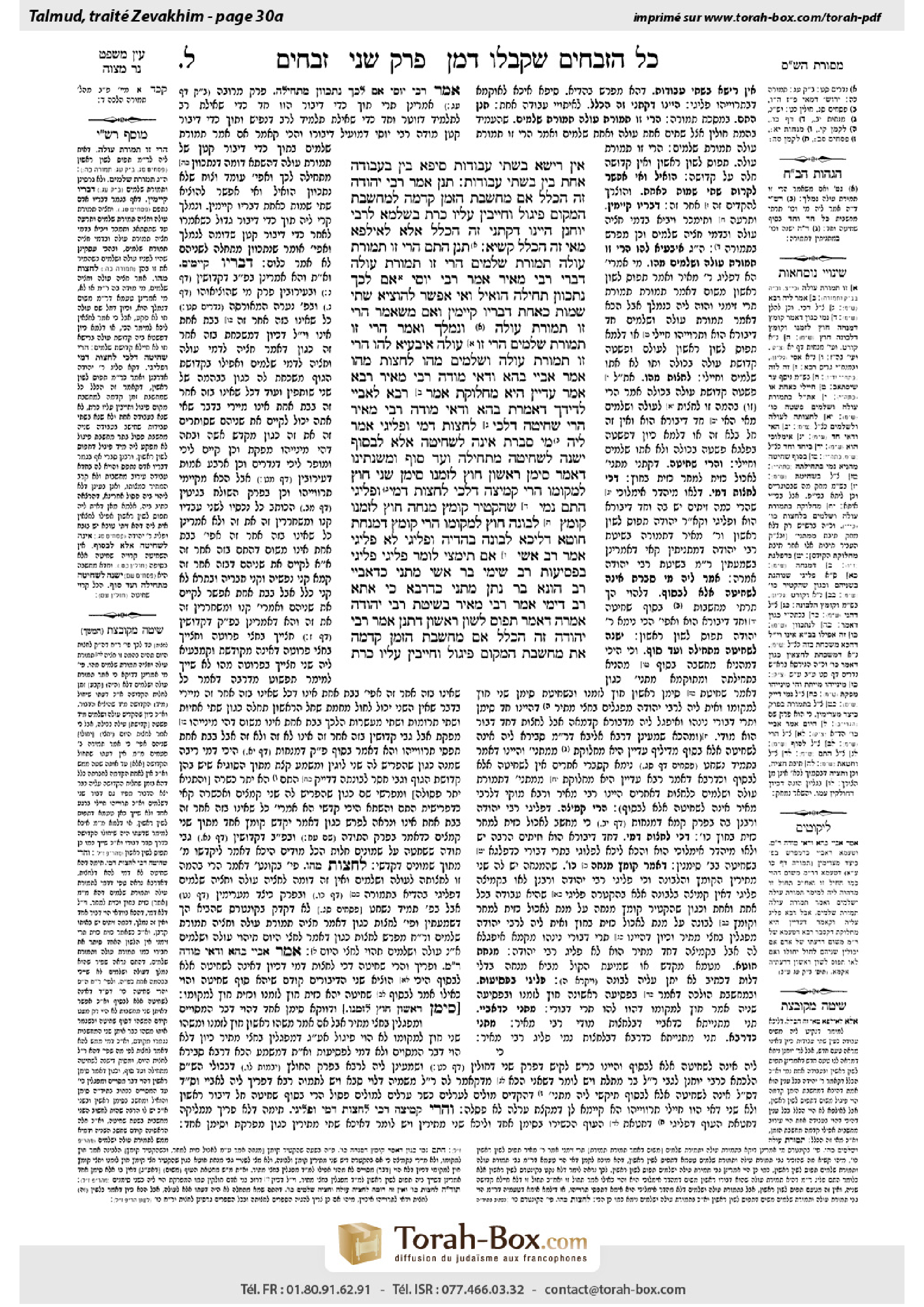
This page of Zevachim includes the Aramaic text, an English translation and an AI-generated French translation, alongside the scan above.
זבחים ל׳ א · Aramaic and Hebrew text
אִין; רֵישָׁא – בִּשְׁתֵּי עֲבוֹדוֹת, סֵיפָא – בֵּין בַּעֲבוֹדָה אַחַת בֵּין בִּשְׁתֵּי עֲבוֹדוֹת.
תְּנַן: אָמַר רַבִּי יְהוּדָה, זֶה הַכְּלָל: אִם מַחְשֶׁבֶת הַזְּמַן קָדְמָה לְמַחְשֶׁבֶת הַמָּקוֹם – פִּיגּוּל, וְחַיָּיבִין עָלָיו כָּרֵת. בִּשְׁלָמָא לְרַבִּי יוֹחָנָן – הַיְינוּ דְּקָתָנֵי ״זֶה הַכְּלָל״. אֶלָּא לְאִילְפָא – מַאי ״זֶה הַכְּלָל״? קַשְׁיָא.
תְּנַן הָתָם: ״הֲרֵי זוֹ תְּמוּרַת עוֹלָה תְּמוּרַת שְׁלָמִים״ – הֲרֵי זוֹ תְּמוּרַת עוֹלָה. דִּבְרֵי רַבִּי מֵאִיר.
אָמַר רַבִּי יוֹסֵי: אִם לְכָךְ נִתְכַּוֵּון תְּחִילָּה, הוֹאִיל וְאִי אֶפְשָׁר לְהוֹצִיא שְׁתֵּי שֵׁמוֹת כְּאַחַת – דְּבָרָיו קַיָּימִין; וְאִם מִשֶּׁאָמַר ״הֲרֵי זוֹ תְּמוּרַת עוֹלָה״, וְנִמְלַךְ וְאָמַר ״הֲרֵי זוֹ תְּמוּרַת שְׁלָמִים״ – הֲרֵי זוֹ עוֹלָה.
אִיבַּעְיָא לְהוּ: ״הֲרֵי זוֹ תְּמוּרַת עוֹלָה וּשְׁלָמִים״, מַהוּ? ״לַחֲצוֹת״, מַהוּ?
אָמַר אַבָּיֵי: בְּהָא וַדַּאי מוֹדֶה רַבִּי מֵאִיר. רָבָא אֲמַר: עֲדַיִין הִיא מַחְלוֹקֶת.
אָמַר רָבָא לְאַבָּיֵי: לְדִידָךְ דְּאָמְרַתְּ בְּהָא וַדַּאי מוֹדֶה רַבִּי מֵאִיר; הֲרֵי שְׁחִיטָה – (דלכי) [דִּכִי] ״לַחֲצוֹת״ דָּמֵי, וּפְלִיגִי!
אֲמַר לֵיהּ: מִי סָבְרַתְּ אֵינָהּ לִשְׁחִיטָה אֶלָּא לְבַסּוֹף?! יֶשְׁנָהּ לִשְׁחִיטָה מִתְּחִילָּה וְעַד סוֹף; וּמִשְׁנָתֵינוּ – דְּאָמַר: סִימָן רִאשׁוֹן חוּץ לִזְמַנּוֹ, סִימָן שֵׁנִי חוּץ לִמְקוֹמוֹ.
הֲרֵי קְמִיצָה – (דלכי) [דִּכִי] לַחֲצוֹת דָּמֵי, וּפְלִיגִי!
הָתָם נָמֵי – שֶׁהִקְטִיר קוֹמֶץ מִנְחָה חוּץ לִזְמַנּוֹ, קוֹמֶץ לְבוֹנָה חוּץ לִמְקוֹמוֹ.
הֲרֵי קוֹמֶץ דְּמִנְחַת חוֹטֵא – דְּלֵיכָּא לְבוֹנָה בַּהֲדֵיהּ, וּפְלִיגִי!
לָא פְּלִיגִי. אָמַר רַב אָשֵׁי: אִם תִּימְצֵי לוֹמַר פְּלִיגִי, פְּלִיגִי בִּפְסִיעוֹת.
רַב שִׁימִי בַּר אָשֵׁי מַתְנֵי כִּדְאַבָּיֵי, רַב הוּנָא בַּר נָתָן מַתְנֵי כִּדְרָבָא.
כִּי אֲתָא רַב דִּימִי, אֲמַר: רַבִּי מֵאִיר – בְּשִׁיטַת רַבִּי יְהוּדָה אֲמָרָהּ, דְּאָמַר: תְּפוֹס לָשׁוֹן רִאשׁוֹן.
דִּתְנַן: אָמַר רַבִּי יְהוּדָה, זֶה הַכְּלָל: אִם מַחְשֶׁבֶת הַזְּמַן קָדְמָה אֶת מַחְשֶׁבֶת הַמָּקוֹם – פִּיגּוּל, וְחַיָּיבִין עָלָיו כָּרֵת.
Zevachim 30a · English translation
The Gemara responds: Yes, it can be explained that the first clause is referring to two sacrificial rites, while the latter clause, i.e., the disagreement between Rabbi Yehuda and the Rabbis, applies to both one rite and two rites.
The Gemara suggests a proof: We learned in the mishna: Rabbi Yehuda says that this is the principle: If the intent with regard to the time preceded the intent with regard to the area, the offering is piggul and one is liable to receive karet for burning or partaking of it. Granted, according to Rabbi Yoḥanan, who says that the disagreement applies even to one rite, this is the reason that the tanna teaches: This is the principle, indicating that the principle is broad. But according to Ilfa, what is added by the phrase: This is the principle? The Gemara responds: This indeed poses a difficulty to the opinion of Ilfa.
§ We learned in a mishna elsewhere (Temura 25b): If one had two animals standing before him, one a burnt offering and one a peace offering, and he said with regard to another non-sacred animal of his: This animal is hereby the substitute of the burnt offering, the substitute of the peace offering, then that animal is the substitute of the burnt offering; this is the statement of Rabbi Meir.
Rabbi Yosei said: If that was his intent from the outset, i.e., his intent was that this animal be the substitute of both a burnt offering and a peace offering, since it is impossible to produce two designations simultaneously and one designation must precede the other, his statement is effective, and the animal is the substitute of both a burnt offering and a peace offering. But if it was only after he said: This animal is hereby the substitute of the burnt offering, that he reconsidered and said: This animal is hereby the substitute of the peace offering, then that animal is the substitute of a burnt offering alone.
A dilemma was raised before the Sages: If one expressed the two intentions simultaneously and said: This is hereby the substitute of a burnt offering and a peace offering, what is the halakha? Additionally, if one specified his intention to split the animal between a burnt offering and a peace offering, but mentioned the burnt offering first, what is the halakha?
Abaye said: In this case, Rabbi Meir certainly concedes that both types of sanctity apply to the animal. Rava said: It is still a disagreement; Rabbi Meir still holds in this case that since he mentioned the burnt offering first, only that sanctity applies to the animal.
Rava said to Abaye: According to your opinion, as you say that in this case Rabbi Meir certainly concedes, one may raise an objection from the mishna, which describes a case where one performs slaughter with intent to eat one olive-bulk of the offering beyond its time and one olive-bulk outside its area, which is comparable to a case where one says: To split, since both intentions are held during the singular act of slaughter. And nevertheless, Rabbi Yehuda and the Rabbis disagree, and Rabbi Yehuda, who holds that one attends only to the first statement, renders the animal piggul.
Abaye said to him: Do you hold that slaughter is considered to have been performed only at its end, such that it takes effect in a single instant? Actually, slaughter is accomplished progressively, from beginning to end, and our mishna is referring to a case where one says: I slaughter the first siman, the gullet or the windpipe, with intent to consume the offering beyond its designated time, and the second siman with intent to consume it outside its designated area.
The Gemara asks: But what about the removal of a handful from a meal offering with intent to eat one olive-bulk beyond its time and one outside of its area, which is comparable to a case where one says: To split, since both intentions are held during the removal, and nevertheless, Rabbi Yehuda and the Rabbis disagree with regard to it in tractate Menaḥot (12a)?
The Gemara responds: Since the mishna does not state such a dispute explicitly, one can say that their disagreement is not with regard to the removal of the handful but with regard to the burning of the two permitting factors of the meal offering, the handful and the frankincense. Accordingly, there too, the case is such that the priest burned the handful of the meal offering with intent to eat it beyond its designated time, and he burned the handful of frankincense with intent to eat the meal offering outside its designated area.
The Gemara persists: But what about the handful from a meal offering of a sinner, which has no frankincense with it, and still Rabbi Yehuda and the Rabbis disagree?
The Gemara responds: In that case they do not disagree. Rav Ashi says: Even if you say that they disagree in that case, one may say that they disagree specifically with regard to a case where the priest had different intentions during his steps toward the altar while holding the handful. Consequently, even this rite is divisible into separate parts.
Rav Shimi bar Ashi would teach in accordance with the opinion of Abaye that in a case where one explicitly mentions both intentions at once, Rabbi Meir concedes that both sanctities apply to the animal. Rav Huna bar Natan would teach in accordance with the opinion of Rava that even in such a case, Rabbi Meir considers only the first sanctity mentioned.
When Rav Dimi came from Eretz Yisrael to Babylonia, he said: When Rabbi Meir said that if one says: This animal is hereby the substitute of a burnt offering, the substitute of a peace offering, then the animal is the substitute of a burnt offering, he said this according to the opinion of Rabbi Yehuda, who says that in general, the halakha is to attend only to the first statement.
As we learned in the mishna: Rabbi Yehuda said that this is the principle: If the intent with regard to the time preceded the intent with regard to the area, the offering is piggul and one is liable to receive karet for burning or partaking of it.
Zevachim 30a · Traduction française (IA)
La Guemara répond : Oui, on peut expliquer que la première clause porte sur deux rites sacrificiels, tandis que la dernière clause, c’est-à-dire le désaccord entre Rabbi Yehouda et les Sages, s’applique aussi bien à un seul rite qu’à deux rites.
La Guemara propose une preuve : Nous avons appris dans la Michna : Rabbi Yehouda dit : « Tel est le principe : si l’intention concernant le temps a précédé celle concernant le lieu, l’offrande est piggul, et l’on est passible de karet pour l’avoir brûlée ou consommée. » Certes, selon Rabbi Yoḥanan, qui dit que le désaccord s’applique même à un seul rite, le tanna enseigne les mots « tel est le principe » pour indiquer que le principe a une portée générale. Mais selon Ilfa, qu’ajoute l’expression « tel est le principe » ? La Guemara répond : Cela constitue effectivement une difficulté pour l’opinion d’Ilfa.
§ Nous avons appris dans une Michna d’un autre traité (Temoura 25b) : Si deux animaux se tenaient devant quelqu’un, l’un étant un holocauste et l’autre une offrande de paix, et qu’il dit au sujet d’un autre de ses animaux non consacrés : « Cet animal est désormais le substitut de l’holocauste, le substitut de l’offrande de paix », cet animal devient le substitut de l’holocauste. Telle est la déclaration de Rabbi Meïr.
Rabbi Yosei dit : Si telle était son intention dès le départ, c’est-à-dire qu’il voulait que cet animal soit le substitut à la fois d’un holocauste et d’une offrande de paix, sa déclaration est valide et l’animal devient le substitut des deux offrandes, car il est impossible de prononcer simultanément les deux désignations : l’une doit nécessairement précéder l’autre. Mais si ce n’est qu’après avoir dit : « Cet animal est désormais le substitut de l’holocauste », qu’il s’est ravisé et a dit : « Cet animal est désormais le substitut de l’offrande de paix », alors cet animal est uniquement le substitut d’un holocauste.
Une question fut posée aux Sages : Si quelqu’un exprime simultanément les deux intentions et dit : « Ceci est désormais le substitut d’un holocauste et d’une offrande de paix », quelle est la halakha ? De plus, si quelqu’un précise son intention de partager l’animal entre un holocauste et une offrande de paix, mais mentionne l’holocauste en premier, quelle est la halakha ?
Abayé dit : Dans ce cas, Rabbi Meïr reconnaît certainement que les deux types de sainteté s’appliquent à l’animal. Rava dit : Le désaccord subsiste ; dans ce cas aussi, Rabbi Meïr soutient que, puisque l’holocauste a été mentionné en premier, seule cette sainteté s’applique à l’animal.
Rava dit à Abayé : Selon ton opinion, puisque tu dis que, dans ce cas, Rabbi Meïr reconnaît certainement cela, on peut soulever une objection à partir de la Michna, qui décrit le cas où quelqu’un procède à l’abattage avec l’intention de consommer un volume d’olive de l’offrande après le délai prescrit et un autre volume d’olive en dehors du lieu prescrit. Cela est comparable au cas où l’on dit : « À partager », puisque les deux intentions sont présentes pendant l’acte unique de l’abattage. Pourtant, Rabbi Yehouda et les Sages sont en désaccord, et Rabbi Yehouda, qui estime qu’on ne tient compte que de la première déclaration, rend l’animal piggul.
Abayé lui dit : Estimes-tu que l’abattage est considéré comme n’ayant été accompli qu’à son terme, de sorte qu’il prend effet en un seul instant ? En réalité, l’abattage s’accomplit progressivement, du début à la fin, et notre Michna porte sur le cas où quelqu’un dit : « J’abats le premier siman, l’œsophage ou la trachée, avec l’intention de consommer l’offrande après le délai qui lui est prescrit, et le second siman avec l’intention de la consommer en dehors du lieu qui lui est prescrit. »
La Guemara demande : Mais qu’en est-il du prélèvement d’une poignée d’une offrande végétale avec l’intention d’en consommer un volume d’olive après le délai prescrit et un autre en dehors du lieu prescrit ? Cela est comparable au cas où l’on dit : « À partager », puisque les deux intentions sont présentes au moment du prélèvement ; pourtant, Rabbi Yehouda et les Sages sont en désaccord à ce sujet dans le traité Menaḥot (12a).
La Guemara répond : Puisque la Michna n’énonce pas explicitement un tel désaccord, on peut dire que leur désaccord ne porte pas sur le prélèvement de la poignée, mais sur la combustion des deux éléments qui rendent l’offrande végétale permise : la poignée et l’encens. Ainsi, là aussi, il s’agit du cas où le prêtre a brûlé la poignée de l’offrande végétale avec l’intention d’en consommer après le délai qui lui est prescrit, puis a brûlé la poignée d’encens avec l’intention de consommer l’offrande végétale en dehors du lieu qui lui est prescrit.
La Guemara insiste : Mais qu’en est-il de la poignée d’une offrande végétale d’un pécheur, à laquelle n’est associé aucun encens, et au sujet de laquelle Rabbi Yehouda et les Sages sont malgré tout en désaccord ?
La Guemara répond : Dans ce cas, ils ne sont pas en désaccord. Rav Ashi dit : Même si l’on affirme qu’ils sont en désaccord dans ce cas, on peut dire que leur désaccord porte précisément sur le cas où le prêtre avait des intentions différentes pendant ses déplacements vers l’autel, alors qu’il tenait la poignée. Par conséquent, même ce rite peut être divisé en étapes distinctes.
Rav Shimi bar Ashi enseignait conformément à l’opinion d’Abayé que, dans le cas où quelqu’un mentionne explicitement les deux intentions à la fois, Rabbi Meïr reconnaît que les deux saintetés s’appliquent à l’animal. Rav Houna bar Natan enseignait conformément à l’opinion de Rava que, même dans un tel cas, Rabbi Meïr ne tient compte que de la première sainteté mentionnée.
Lorsque Rav Dimi arriva d’Eretz Israël en Babylonie, il dit : Lorsque Rabbi Meïr a déclaré que, si quelqu’un dit : « Cet animal est désormais le substitut d’un holocauste, le substitut d’une offrande de paix », l’animal devient le substitut d’un holocauste, il parlait conformément à l’opinion de Rabbi Yehouda, qui dit qu’en règle générale, la halakha veut que l’on ne tienne compte que de la première déclaration.
Comme nous l’avons appris dans la Michna : Rabbi Yehouda dit : « Tel est le principe : si l’intention concernant le temps a précédé celle concernant le lieu, l’offrande est piggul, et l’on est passible de karet pour l’avoir brûlée ou consommée. »
Traduction française générée par IA à partir de l’édition anglaise de Sefaria. Vérifie toujours un passage avec le texte source.
Text from Sefaria: William Davidson Edition - Vocalized Aramaic (CC BY NC); William Davidson Edition - English (CC BY NC).