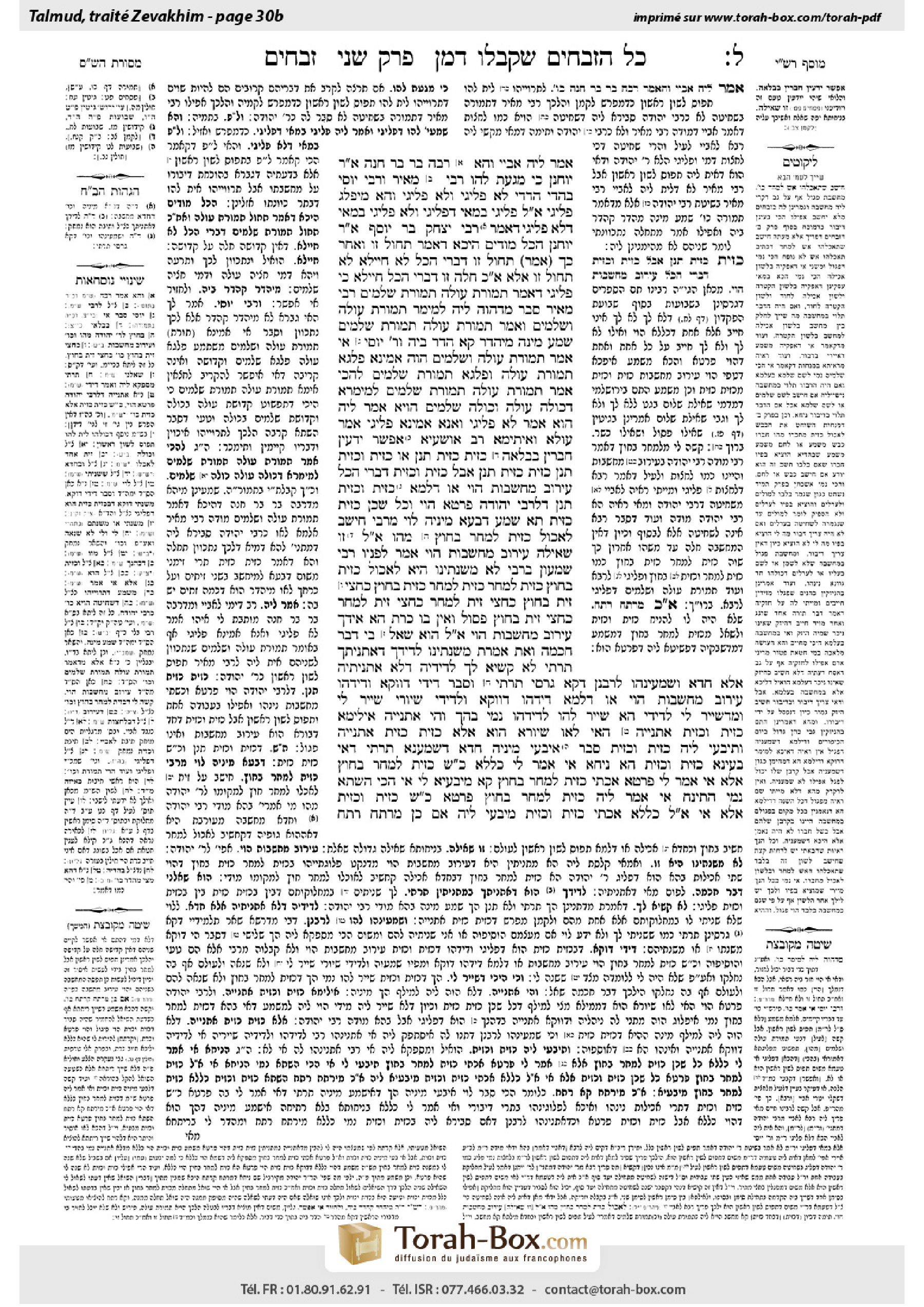
Zevachim 30b: Talmud study for Daf Yomi
Daf Yomi is the daily study of one Talmud folio. Explore 37 tractates with scans, Hebrew text, Sefaria English and AI-generated French translations where annotated.
Passage selection and English or AI-generated French translation are available where the scan has annotations. Daf Study is independent of Torah-Box and Sefaria.
Browse Zevachim · זבחים · All tractatesZevachim 30b text and translations
This page of Zevachim includes the Aramaic text, an English translation and an AI-generated French translation, alongside the scan above.
זבחים ל׳ ב · Aramaic and Hebrew text
אֲמַר לֵיהּ אַבָּיֵי, וְהָא רַבָּה בַּר בַּר חָנָה אָמַר רַבִּי יוֹחָנָן: כִּי מַגְּעַתְּ לְהוּ רַבִּי מֵאִיר וְרַבִּי יוֹסֵי בַּהֲדֵי הֲדָדֵי, לָא פְּלִיגִי!
וְלָא פְּלִיגִי?! וְהָא מִיפְלָג פְּלִיגִי! אֲמַר לֵיהּ: פְּלִיגִי בְּמַאי דִּפְלִיגִי, וְלָא פְּלִיגִי בְּמַאי דְּלָא פְּלִיגִי.
דְּאָמַר רַבִּי יִצְחָק בַּר יוֹסֵף אָמַר רַבִּי יוֹחָנָן: הַכֹּל מוֹדִים הֵיכָא דְּאָמַר ״תָּחוּל זוֹ וְאַחַר כָּךְ (אָמַר) תָּחוּל זוֹ״ – דִּבְרֵי הַכֹּל לָא חָיְילָא; ״לֹא תָּחוּל זוֹ אֶלָּא אִם כֵּן חָלָה זוֹ״ – דִּבְרֵי הַכֹּל חָיְילָא;
כִּי פְּלִיגִי, דְּאָמַר: ״תְּמוּרַת עוֹלָה תְּמוּרַת שְׁלָמִים״. רַבִּי מֵאִיר סָבַר: מִדַּהֲוָה לֵיהּ לְמֵימַר ״תְּמוּרַת עוֹלָה וּשְׁלָמִים״ וַאֲמַר ״תְּמוּרַת עוֹלָה תְּמוּרַת שְׁלָמִים״ – שְׁמַע מִינַּהּ מִיהְדָּר קָא הָדַר בֵּיהּ.
וְרַבִּי יוֹסֵי – אִי אֲמַר: ״תְּמוּרַת עוֹלָה וּשְׁלָמִים״ – הֲוָה אָמֵינָא פַּלְגָא תְּמוּרַת עוֹלָה וּפַלְגָא תְּמוּרַת שְׁלָמִים; לְהָכִי אֲמַר: ״תְּמוּרַת עוֹלָה תְּמוּרַת שְׁלָמִים״ – לְמֵימְרָא דְּכוּלַּהּ עוֹלָה וְכוּלַּהּ שְׁלָמִים הָוְיָא.
אֲמַר לֵיהּ: הוּא אָמַר לָא פְּלִיגִי, וַאֲנָא אָמֵינָא פְּלִיגִי.
אָמַר עוּלָּא וְאִיתֵּימָא רַב אוֹשַׁעְיָא: אֶפְשָׁר יָדְעִין חַבְרִין בַּבְלָאָה – ״כְּזַיִת״ ״כְּזַיִת״ תְּנַן, אוֹ ״כְּזַיִת״ ״וּכְזַיִת״ תְּנַן?
״כְּזַיִת״ ״כְּזַיִת״ תְּנַן – אֲבָל ״כְּזַיִת״ ״וּכְזַיִת״ דִּבְרֵי הַכֹּל עֵירוּב מַחְשָׁבוֹת הָוֵי; אוֹ דִלְמָא ״כְּזַיִת״ ״וּכְזַיִת״ תְּנַן, דִּלְרַבִּי יְהוּדָה פְּרָטָא הָוֵי – וְכׇל שֶׁכֵּן ״כְּזַיִת״ ״כְּזַיִת״?
תָּא שְׁמַע, דִּבְעָא מִינֵּיהּ לֵוִי מֵרַבִּי: חִישֵּׁב לֶאֱכוֹל כְּזַיִת לְמָחָר בַּחוּץ, מַהוּ? אָמַר לוֹ: זוֹ שְׁאֵילָה! עֵירוּב מַחְשָׁבוֹת הָוֵי.
אָמַר לְפָנָיו רַבִּי שִׁמְעוֹן בְּרַבִּי: לֹא מִשְׁנָתֵינוּ הִיא?! לֶאֱכוֹל כְּזַיִת בַּחוּץ כְּזַיִת לְמָחָר; כְּזַיִת לְמָחָר כְּזַיִת בַּחוּץ; כַּחֲצִי זַיִת בַּחוּץ כַּחֲצִי זַיִת לְמָחָר; כַּחֲצִי זַיִת לְמָחָר כַּחֲצִי זַיִת בַּחוּץ – פָּסוּל, וְאֵין בּוֹ כָּרֵת. הָא אִידַּךְ – עֵירוּב מַחְשָׁבוֹת הָוֵי!
אֲמַר לֵיהּ: הוּא שָׁאַל בִּי דְּבַר חָכְמָה, וְאַתְּ אָמַרְתָּ מִשְׁנָתֵינוּ?! לְדִידָךְ דְּאַתְנִיתָךְ תַּרְתֵּי – לָא קַשְׁיָא לָךְ;
לְדִידֵיהּ דְּלָא אַתְנִיתֵיהּ אֶלָּא חֲדָא, וְשַׁמְעִינְהוּ לְרַבָּנַן דְּקָא גָרְסִי תַּרְתֵּי – וְסָבַר: דִּידִי דַּוְוקָא, וְדִידְהוּ עֵירוּב מַחְשָׁבוֹת הָוֵי? אוֹ דִלְמָא דִּידְהוּ דַּוְוקָא, וּלְדִידִי שַׁיּוֹרֵי שַׁיַּיר לִי; וּמִדְּשַׁיַּיר לִי לְדִידִי הָא – שַׁיַּיר לְהוּ לְדִידְהוּ נָמֵי בְּהָךְ?
וְהֵי אַתְנְיֵיהּ? אִילֵּימָא ״כְּזַיִת״ ״וּכְזַיִת״ אַתְנְיֵיהּ – הַאי לָאו שִׁיּוּרָא הוּא! אֶלָּא ״כְּזַיִת״ ״כְּזַיִת״ אַתְנְיֵיהּ.
וְתִיבְּעֵי לֵיהּ ״כְּזַיִת״ ״וּכְזַיִת״!
סְבַר: אִיבְעֵי מִינֵּיהּ חֲדָא – דְּשָׁמַעְנָא תַּרְתֵּי. דְּאִי בָּעֵינָא ״כְּזַיִת״ ״וּכְזַיִת״ – הָא נִיחָא אִי אָמַר לִי כְּלָלָא, כׇּל שֶׁכֵּן ״כְּזַיִת לְמָחָר בַּחוּץ״; אֶלָּא אִי אָמַר לִי פְּרָטָא – אַכַּתִּי ״כְּזַיִת לְמָחָר בַּחוּץ״ קָא מִיבַּעְיָא לִי.
אִי הָכִי, הַשְׁתָּא נָמֵי – הָתִינַח אִי אָמַר לֵיהּ ״כְּזַיִת לְמָחָר בַּחוּץ״ פְּרָטָא, כׇּל שֶׁכֵּן ״כְּזַיִת״ ״וּכְזַיִת״; אֶלָּא אִי אָמַר לֵיהּ כְּלָלָא, אַכַּתִּי ״כְּזַיִת״ ״וּכְזַיִת״ מִיבְּעֵי לֵיהּ!
אִם כֵּן מִרְתָּח רָתַח:
Zevachim 30b · English translation
Abaye said to Rav Dimi: But doesn’t Rabba bar bar Ḥana say that Rabbi Yoḥanan says: When you consider their opinions, Rabbi Meir and Rabbi Yosei do not disagree with one another, i.e., neither holds that one attends only to the first statement?
Rav Dimi objected: And is it so that they do not disagree? But don’t they disagree explicitly in the mishna cited earlier? Abaye said to him: They disagree where they disagree, i.e., that specific case, but they do not disagree where they do not disagree, i.e., the underlying principle. Accordingly, one must understand the basis of their dispute in another manner.
This is as Rav Yitzḥak bar Yosef says that Rabbi Yoḥanan says: All, i.e., Rabbi Meir and Rabbi Yosei, concede that in a case where one says: Let this sanctity of a burnt offering take effect and afterward let that sanctity of a peace offering take effect, everyone agrees that the sanctity of a peace offering does not take effect, because the sanctity of the burnt offering took effect first. Likewise, if one said: This sanctity shall not take effect unless that sanctity applies, everyone agrees that the sanctity of a peace offering takes effect as well.
They disagree with regard to a case where one says: This animal is hereby a substitute for a burnt offering, a substitute for a peace offering. Rabbi Meir holds: Since if he wanted both sanctities to take effect, he should have said: A substitute for a burnt offering and a peace offering, but he said instead: A substitute for a burnt offering, a substitute for a peace offering, learn from his language that he originally intended for it to be a burnt offering, and he then retracted his first intention.
And Rabbi Yosei holds that if he had said: A substitute for a burnt offering and a peace offering, I would say that he means that half the animal should be a substitute for a burnt offering and half a substitute for a peace offering. He therefore says: A substitute for a burnt offering, a substitute for a peace offering; that is to say that all of it is a burnt offering and all of it is a peace offering. In any event, according to this explanation, Rabbi Meir does not necessarily hold that one attends only to the first statement.
Rav Dimi said to Abaye: He, Rabba bar bar Ḥana, says that they do not disagree, but I say that they disagree, and Rabbi Meir holds that one attends only to the first statement, in accordance with the opinion of Rabbi Yehuda in the mishna.
§ The Gemara returns to discuss the mishna itself: Ulla said, and some say it was Rav Oshaya who said: Perhaps our colleagues, the Babylonians, know whether we learn the language of the improper intention in the mishna as: I hereby slaughter the animal with intent to consume an olive-bulk beyond its designated time, an olive-bulk outside its designated area, or we learn: An olive-bulk beyond its designated time and an olive-bulk outside its designated area?
The Gemara elaborates: Perhaps we learn: An olive-bulk, an olive-bulk, and it is only in this case that Rabbi Yehuda disagrees with the Rabbis. But if one said: An olive-bulk and an olive-bulk, everyone agrees that it constitutes a combination of intentions, and the animal is not rendered piggul. Or perhaps we learn: An olive-bulk and an olive-bulk, where according to Rabbi Yehuda each term constitutes a separate term despite the use of the conjunction: And, and he holds that one attends only to the first statement, and all the more so if one said: An olive-bulk, an olive-bulk.
The Gemara suggests: Come and hear a proof from that dilemma which Levi raised before Rabbi Yehuda HaNasi: If one had intent to consume an olive-bulk the next day outside its designated area, what is the halakha? Rabbi Yehuda HaNasi said to him: This is an excellent question. The answer is that even Rabbi Yehuda concedes that this constitutes a combination of intentions and that the animal is not rendered piggul.
Rabbi Shimon, son of Rabbi Yehuda HaNasi, said before him: How is this an excellent question; is it not our mishna? As we learned in the mishna: If one expressed intent to eat an olive-bulk outside its designated area and an olive-bulk the next day, or an olive-bulk the next day and an olive-bulk outside its designated area, or half an olive-bulk outside its designated area and half an olive-bulk the next day, or half an olive-bulk the next day and half an olive-bulk outside its designated area, the offering is disqualified and there is no liability for karet for burning or partaking of it. Rabbi Yehuda disagrees only with regard to these cases; but in another case, it could easily be inferred that he concedes that it constitutes a combination of intentions.
Rabbi Yehuda HaNasi said to him: Levi asked me a matter of wisdom, and you say our mishna. For you, whom I taught two phrasings of the mishna, both: An olive-bulk, an olive-bulk, and: An olive-bulk and an olive-bulk, the question is not difficult, since my omission of this other case allows you to infer its halakha.
For him, whom I taught only one phrasing, and who heard the Rabbis reciting two, the question is excellent, since Levi thought: Perhaps my phrasing is exact, and their additional phrasing constitutes a combination of intentions according to all opinions. Or perhaps their phrasing is exact, and my phrasing omitted this case. And if my phrasing omitted this case, perhaps their phrasing also omitted that other case, even though it is subject to disagreement.
The Gemara asks: And which phrasing did Rabbi Yehuda HaNasi teach Levi? If we say that he taught him: An olive-bulk and an olive-bulk, i.e., that Rabbi Yehuda still holds the terms to be distinct despite the conjunction, this is not an omission, since one can infer a fortiori that the same applies to: An olive-bulk, an olive-bulk. Rather, it must be that he taught him: An olive-bulk, an olive-bulk, so that it was unclear to Levi what the halakha would be if one used the conjunction: And.
The Gemara asks: If so, why did Levi raise the dilemma with regard to the phrasing: The next day outside? Let him raise the dilemma with regard to the phrasing: An olive-bulk and an olive-bulk.
The Gemara responds: Levi thought: I will raise one dilemma before him so as to learn two halakhot. As, if I ask only with regard to: An olive-bulk and an olive-bulk, it will work out well if he says to me that Rabbi Yehuda concedes that they constitute one general term, as this would apply all the more so if one said: An olive-bulk the next day outside, which is even more unified. But if he says to me that each term constitutes a separate term according to Rabbi Yehuda, then I will still need to raise the dilemma with regard to the case of: An olive-bulk the next day outside. I will therefore inquire with regard to the latter case.
The Gemara challenges: If so, now too, it works out well if he says to him that Rabbi Yehuda maintains that the wording: An olive-bulk the next day outside, is constituted of separate terms, as this would apply all the more so if one said: An olive-bulk and an olive-bulk, which is less unified. But if he says to him that it is one general term according to Rabbi Yehuda, then he will still need to raise the dilemma with regard to the case of: An olive-bulk and an olive-bulk.
The Gemara responds: If Rabbi Yehuda HaNasi answered in this manner, i.e., that Rabbi Yehuda concedes that: An olive-bulk the next day outside, is considered one term, he would unwittingly provide the answer to the other question as well. As, if Rabbi Yehuda had also conceded with regard to: An olive-bulk and an olive-bulk, Rabbi Yehuda HaNasi would become angry with Levi for asking the wrong question and say:
Zevachim 30b · Traduction française (IA)
Abayé dit à Rav Dimi : Mais Rabba bar bar Ḥana ne dit-il pas que Rabbi Yoḥanan dit : Si l’on examine leurs opinions, Rabbi Meïr et Rabbi Yossé ne sont pas en désaccord, c’est-à-dire qu’aucun des deux ne soutient qu’on ne tient compte que de la première déclaration ?
Rav Dimi objecta : Est-il donc vrai qu’ils ne sont pas en désaccord ? Mais ne sont-ils pas explicitement en désaccord dans la Michna citée précédemment ? Abayé lui dit : Ils sont en désaccord là où ils le sont, c’est-à-dire dans ce cas précis, mais ils ne sont pas en désaccord là où ils ne le sont pas, c’est-à-dire sur le principe sous-jacent. Il faut donc comprendre autrement le fondement de leur controverse.
C’est ce que dit Rav Yitzḥak bar Yosef au nom de Rabbi Yoḥanan : Tous, c’est-à-dire Rabbi Meïr et Rabbi Yossé, reconnaissent que, si quelqu’un dit : « Que la sainteté d’holocauste prenne effet, puis que la sainteté de sacrifice de paix prenne effet », tous conviennent que la sainteté du sacrifice de paix ne prend pas effet, car celle de l’holocauste a pris effet en premier. De même, si quelqu’un dit : « Que cette sainteté ne prenne effet que si cette autre sainteté s’applique », tous conviennent que la sainteté du sacrifice de paix prend également effet.
Ils sont en désaccord dans le cas où quelqu’un dit : « Cet animal est dès à présent un substitut d’holocauste, un substitut de sacrifice de paix. » Rabbi Meïr soutient que, s’il avait voulu que les deux saintetés prennent effet, il aurait dû dire : « Un substitut d’holocauste et de sacrifice de paix. » Or, il a plutôt dit : « Un substitut d’holocauste, un substitut de sacrifice de paix. » Il faut donc déduire de ses paroles qu’il avait d’abord l’intention d’en faire un holocauste, puis qu’il est revenu sur sa première intention.
Rabbi Yossé, lui, soutient que s’il avait dit : « Un substitut d’holocauste et de sacrifice de paix », on aurait compris qu’il voulait dire que la moitié de l’animal serait un substitut d’holocauste et l’autre moitié un substitut de sacrifice de paix. Il dit donc : « Un substitut d’holocauste, un substitut de sacrifice de paix », c’est-à-dire que l’animal tout entier est un holocauste et tout entier un sacrifice de paix. Quoi qu’il en soit, selon cette explication, Rabbi Meïr ne soutient pas nécessairement qu’on ne tient compte que de la première déclaration.
Rav Dimi dit à Abayé : Lui, Rabba bar bar Ḥana, dit qu’ils ne sont pas en désaccord ; mais moi, je dis qu’ils le sont, et Rabbi Meïr soutient qu’on ne tient compte que de la première déclaration, conformément à l’opinion de Rabbi Yehouda dans la Michna.
§ La Guemara revient à l’étude de la Michna elle-même. Oulla dit, et certains rapportent que c’est Rav Oshaya qui l’a dit : Peut-être nos collègues babyloniens savent-ils si nous interprétons la formulation de l’intention incorrecte dans la Michna ainsi : « Je procède dès à présent à l’abattage de l’animal avec l’intention de consommer un volume d’olive après le délai prescrit, un volume d’olive hors de l’endroit prescrit », ou ainsi : « Un volume d’olive après le délai prescrit et un volume d’olive hors de l’endroit prescrit » ?
La Guemara développe : Peut-être lisons-nous : « Un volume d’olive, un volume d’olive », et Rabbi Yehouda n’est en désaccord avec les Sages que dans ce cas. Mais si quelqu’un a dit : « Un volume d’olive et un volume d’olive », tous conviennent qu’il s’agit d’une combinaison d’intentions et que l’animal n’est pas rendu piggoul. Ou peut-être lisons-nous : « Un volume d’olive et un volume d’olive » ; selon Rabbi Yehouda, chaque expression constitue alors une expression distincte malgré l’emploi de la conjonction « et », et il soutient qu’on ne tient compte que de la première déclaration. À plus forte raison en va-t-il ainsi si quelqu’un a dit : « Un volume d’olive, un volume d’olive ».
La Guemara propose : Viens et entends une preuve tirée de la question que Lévi posa à Rabbi Yehouda HaNassi : Si quelqu’un avait l’intention de consommer un volume d’olive le lendemain, hors de l’endroit prescrit, quelle est la halakha ? Rabbi Yehouda HaNassi lui dit : « C’est une excellente question. » La réponse est que même Rabbi Yehouda reconnaît qu’il s’agit d’une combinaison d’intentions et que l’animal n’est pas rendu piggoul.
Rabbi Shimon, fils de Rabbi Yehouda HaNassi, lui dit : En quoi est-ce une excellente question ? N’est-ce pas notre Michna ? Car nous avons appris dans la Michna : Si quelqu’un a exprimé l’intention de manger un volume d’olive hors de l’endroit prescrit et un volume d’olive le lendemain, ou un volume d’olive le lendemain et un volume d’olive hors de l’endroit prescrit, ou la moitié d’un volume d’olive hors de l’endroit prescrit et l’autre moitié le lendemain, ou la moitié d’un volume d’olive le lendemain et l’autre moitié hors de l’endroit prescrit, l’offrande est invalidée et l’on n’encourt pas la peine de retranchement pour l’avoir brûlée ou consommée. Rabbi Yehouda n’est en désaccord que dans ces cas ; dans un autre cas, on pourrait facilement déduire qu’il reconnaît qu’il s’agit d’une combinaison d’intentions.
Rabbi Yehouda HaNassi lui dit : Lévi m’a posé une question de sagesse, et toi, tu me parles de notre Michna ! Toi, à qui j’ai enseigné les deux formulations de la Michna, « un volume d’olive, un volume d’olive » et « un volume d’olive et un volume d’olive », tu ne trouves pas la question difficile, car l’omission de cet autre cas te permet d’en déduire la halakha.
Mais pour lui, à qui je n’ai enseigné qu’une seule formulation et qui a entendu les Sages en réciter deux, la question est excellente, car Lévi s’est dit : Peut-être ma formulation est-elle exacte, et la formulation supplémentaire des Sages constitue-t-elle une combinaison d’intentions selon toutes les opinions. Ou peut-être leur formulation est-elle exacte et la mienne omet-elle ce cas. Et si ma formulation omet ce cas, peut-être leur formulation omet-elle aussi cet autre cas, bien qu’il fasse l’objet d’un désaccord.
La Guemara demande : Quelle formulation Rabbi Yehouda HaNassi a-t-il enseignée à Lévi ? Si nous disons qu’il lui a enseigné : « Un volume d’olive et un volume d’olive », c’est-à-dire que Rabbi Yehouda considère toujours les termes comme distincts malgré la conjonction, il ne s’agit pas d’une omission, car on peut déduire a fortiori que cela s’applique aussi à : « Un volume d’olive, un volume d’olive ». Il faut donc plutôt dire qu’il lui a enseigné : « Un volume d’olive, un volume d’olive », de sorte que Lévi ne savait pas quelle était la halakha si l’on employait la conjonction « et ».
La Guemara demande : Si c’est le cas, pourquoi Lévi a-t-il soulevé la question à propos de la formulation : « Le lendemain, hors de l’endroit prescrit » ? Qu’il la soulève à propos de la formulation : « Un volume d’olive et un volume d’olive ».
La Guemara répond : Lévi s’est dit : Je vais lui poser une question afin d’en apprendre deux halakhot. En effet, si je l’interroge uniquement sur « un volume d’olive et un volume d’olive », tout ira bien s’il me répond que Rabbi Yehouda reconnaît qu’ils constituent une seule expression générale, car cela s’appliquerait à plus forte raison si quelqu’un disait : « Un volume d’olive le lendemain, hors de l’endroit prescrit », formulation encore plus unifiée. Mais s’il me répond que, selon Rabbi Yehouda, chaque terme constitue une expression distincte, je devrai encore soulever la question à propos du cas : « Un volume d’olive le lendemain, hors de l’endroit prescrit. » Je vais donc l’interroger sur ce dernier cas.
La Guemara objecte : Si c’est le cas, même alors, tout ira bien s’il lui répond que, selon Rabbi Yehouda, la formulation « un volume d’olive le lendemain, hors de l’endroit prescrit » est constituée de termes distincts, car cela s’appliquerait à plus forte raison si quelqu’un disait : « Un volume d’olive et un volume d’olive », formulation moins unifiée. Mais s’il lui répond que, selon Rabbi Yehouda, il s’agit d’une seule expression générale, il devra encore soulever la question à propos du cas : « Un volume d’olive et un volume d’olive ».
La Guemara répond : Si Rabbi Yehouda HaNassi avait répondu ainsi, c’est-à-dire que Rabbi Yehouda reconnaît que « un volume d’olive le lendemain, hors de l’endroit prescrit » est considéré comme une seule expression, il aurait sans le vouloir fourni aussi la réponse à l’autre question. En effet, si Rabbi Yehouda avait également reconnu qu’il en va de même pour « un volume d’olive et un volume d’olive », Rabbi Yehouda HaNassi se serait irrité contre Lévi de lui avoir posé la mauvaise question et lui aurait dit :
Traduction française générée par IA à partir de l’édition anglaise de Sefaria. Vérifie toujours un passage avec le texte source.
Text from Sefaria: William Davidson Edition - Vocalized Aramaic (CC BY NC); William Davidson Edition - English (CC BY NC).