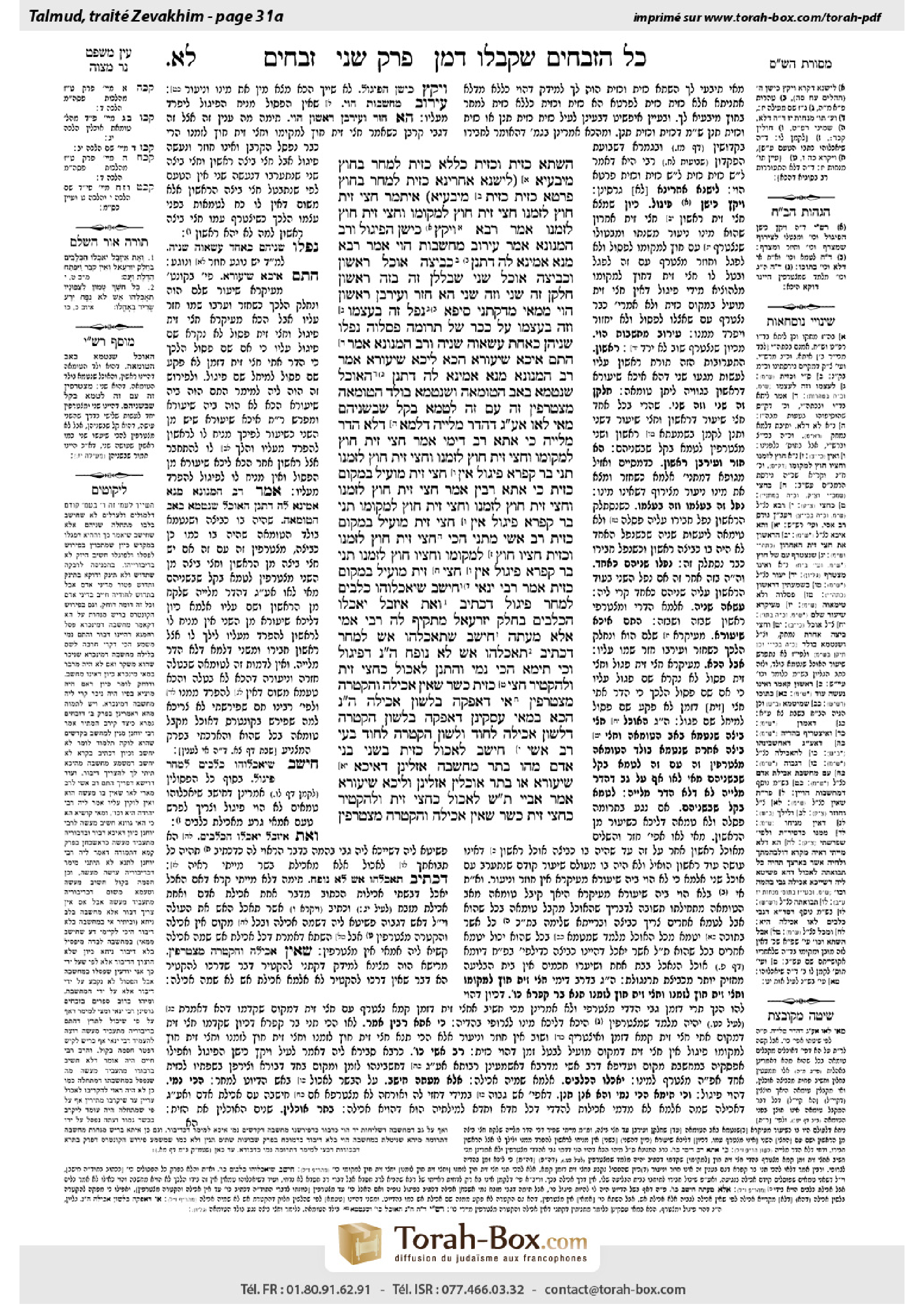
Zevachim 31a: Talmud study for Daf Yomi
Daf Yomi is the daily study of one Talmud folio. Explore 37 tractates with scans, Hebrew text, Sefaria English and AI-generated French translations where annotated.
Passage selection and English or AI-generated French translation are available where the scan has annotations. Daf Study is independent of Torah-Box and Sefaria.
Browse Zevachim · זבחים · All tractatesZevachim 31a text and translations
This page of Zevachim includes the Aramaic text, an English translation and an AI-generated French translation, alongside the scan above.
זבחים ל״א א · Aramaic and Hebrew text
הַשְׁתָּא ״כְּזַיִת״ ״וּכְזַיִת״ כְּלָלָא, ״כְּזַיִת לְמָחָר בַּחוּץ״ מִיבַּעְיָא?!
לִישָּׁנָא אַחֲרִינָא: ״כְּזַיִת לְמָחָר בַּחוּץ״ פְּרָטָא, ״כְּזַיִת״ ״כְּזַיִת״ מִיבַּעְיָא?!
אִיתְּמַר: חֲצִי זַיִת חוּץ לִזְמַנּוֹ, חֲצִי זַיִת חוּץ לִמְקוֹמוֹ, וַחֲצִי זַיִת חוּץ לִזְמַנּוֹ – אָמַר רָבָא: ״וַיִּקַץ כְּיָשֵׁן״ הַפִּיגּוּל. וְרַב הַמְנוּנָא אָמַר: עֵירוּב מַחְשָׁבוֹת הָוֵי.
אָמַר רָבָא: מְנָא אָמֵינָא לַהּ? דִּתְנַן: כְּבֵיצָה אוֹכֶל רִאשׁוֹן וּכְבֵיצָה אוֹכֶל שֵׁנִי שֶׁבְּלָלָן זֶה בָּזֶה – רִאשׁוֹן. חִלְּקָן – זֶה שֵׁנִי וְזֶה שֵׁנִי. הָא חָזַר וְעֵירְבָן – רִאשׁוֹן הָוֵי.
מִמַּאי? מִדְּקָתָנֵי סֵיפָא: נָפֵל זֶה בְּעַצְמוֹ וְזֶה בְּעַצְמוֹ עַל כִּכָּר שֶׁל תְּרוּמָה – פְּסָלוּהָ. נָפְלוּ שְׁנֵיהֶן כְּאַחַת – עֲשָׂאוּהָ שְׁנִיָּה.
וְרַב הַמְנוּנָא אָמַר: הָתָם אִיכָּא שִׁיעוּרָא, הָכָא לֵיכָּא שִׁיעוּרָא.
אָמַר רַב הַמְנוּנָא: מְנָא אָמֵינָא לַהּ? דִּתְנַן: הָאוֹכֶל שֶׁנִּטְמָא בְּאַב הַטּוּמְאָה, וְשֶׁנִּטְמָא בִּוְלַד הַטּוּמְאָה – מִצְטָרְפִין זֶה עִם זֶה לְטַמֵּא בַּקַּל שֶׁבִּשְׁנֵיהֶם. מַאי, לָאו אַף עַל גַּב דַּהֲדַר מַלְּיֵיהּ?
דִּלְמָא דְּלָא הֲדַר מַלְּיֵיהּ!
כִּי אֲתָא רַב דִּימִי אָמַר: חֲצִי זַיִת חוּץ לִמְקוֹמוֹ, וַחֲצִי זַיִת חוּץ לִזְמַנּוֹ, וַחֲצִי זַיִת חוּץ לִזְמַנּוֹ – תָּנֵי בַּר קַפָּרָא: פִּיגּוּל; אֵין חֲצִי זַיִת מוֹעִיל בִּמְקוֹם כְּזַיִת.
כִּי אֲתָא רָבִין אָמַר: חֲצִי זַיִת חוּץ לִזְמַנּוֹ, וַחֲצִי זַיִת חוּץ לִזְמַנּוֹ, וַחֲצִי זַיִת חוּץ לִמְקוֹמוֹ – תָּנֵי בַּר קַפָּרָא: פִּיגּוּל; אֵין חֲצִי זַיִת מוֹעִיל בִּמְקוֹם כְּזַיִת.
רַב אָשֵׁי מַתְנֵי הָכִי: חֲצִי זַיִת חוּץ לִזְמַנּוֹ, וּכְזַיִת – חֶצְיוֹ חוּץ לִמְקוֹמוֹ וְחֶצְיוֹ חוּץ לִזְמַנּוֹ; תָּנֵי בַּר קַפָּרָא: פִּיגּוּל; אֵין חֲצִי זַיִת מוֹעִיל בִּמְקוֹם כְּזַיִת.
אָמַר רַבִּי יַנַּאי: חִישֵּׁב שֶׁיֹּאכְלוּהוּ כְּלָבִים לְמָחָר – פִּיגּוּל; דִּכְתִיב: ״וְאֶת אִיזֶבֶל יֹאכְלוּ הַכְּלָבִים בְּחֵלֶק יִזְרְעֶאל״.
מַתְקֵיף לַהּ רַבִּי אַמֵּי: אֶלָּא מֵעַתָּה, חִישֵּׁב שֶׁתֹּאכְלֵהוּ אֵשׁ לְמָחָר, דִּכְתִיב: ״תְּאׇכְלֵהוּ אֵשׁ לֹא נֻפָּח״ – הָכִי נָמֵי דְּפִיגּוּל?! וְכִי תֵּימָא הָכִי נָמֵי; וְהָתְנַן: לֶאֱכוֹל כַּחֲצִי זַיִת וּלְהַקְטִיר חֲצִי כְּזַיִת – כָּשֵׁר, שֶׁאֵין אֲכִילָה וְהַקְטָרָה מִצְטָרְפִין!
אִי דְּאַפְּקַהּ בִּלְשׁוֹן אֲכִילָה – הָכִי נָמֵי; הָכָא בְּמַאי עָסְקִינַן – דְּאַפְּקַהּ בִּלְשׁוֹן הַקְטָרָה. דִּלְשׁוֹן אֲכִילָה לְחוֹד, וּלְשׁוֹן הַקְטָרָה לְחוּד.
בָּעֵי רַב אָשֵׁי: חִישֵּׁב לֶאֱכוֹל כְּזַיִת בִּשְׁנֵי בְּנֵי אָדָם, מַהוּ? בָּתַר מַחְשָׁבָה אָזְלִינַן – דְּאִיכָּא שִׁיעוּרָא, אוֹ בָתַר אוֹכְלִין אָזְלִינַן – וְלֵיכָּא שִׁיעוּרָא?
אָמַר אַבָּיֵי, תָּא שְׁמַע: לֶאֱכוֹל כַּחֲצִי זַיִת וּלְהַקְטִיר כַּחֲצִי זַיִת – כָּשֵׁר, שֶׁאֵין אֲכִילָה וְהַקְטָרָה מִצְטָרְפִין.
Zevachim 31a · English translation
Now that Rabbi Yehuda concedes that even: An olive-bulk and an olive-bulk, is one general term, is it necessary to inquire with regard to: An olive-bulk the next day outside?
The Gemara presents another version of this discussion: Rabbi Yehuda HaNasi might say that if Rabbi Yehuda maintains that even when one says: An olive-bulk the next day outside, each term is considered separate, is it necessary to inquire with regard to: An olive-bulk, an olive-bulk?
§ It was stated: If one had intent to eat half an olive-bulk beyond its designated time, half an olive-bulk outside its designated area, and another half an olive-bulk beyond its designated time, Rava says: In such a case, the piggul: “Awaked as one asleep” (Psalms 78:65), i.e., since one had intent to consume two halves of an olive-bulk beyond their designated time, these intentions are joined together. The middle thought is disregarded, since it constitutes only half the requisite measure, and the offering is rendered piggul. And Rav Hamnuna says: It constitutes a combination of improper intentions. The middle thought, although itself insufficient to disqualify the offering, is sufficient to interfere with the intention to consume it beyond its time, and the offering is not rendered piggul.
Rava said: From where, i.e., based on what, do I state my ruling? As we learned in a mishna (Teharot 1:5): An egg-bulk of food with first-degree impurity and an egg-bulk of food with second-degree impurity that one mixed together are collectively considered to have first-degree impurity. If one separated them into two portions, each containing a homogenous mixture, this portion is considered to have second-degree impurity and that portion is considered to have second-degree impurity. Since neither of them contains the requisite amount of food with first-degree impurity, each mixture settles to the lower level of impurity between the two foods. Rava reasoned: But if one mixed them again, they revert to be of first-degree impurity.
From where do I know this? From the fact that the latter clause of that mishna teaches: If this portion fell by itself and that portion fell by itself onto a loaf of teruma, it disqualifies it, as would any food with second-degree impurity. But it does not render it impure, since only foods with first-degree impurity impart impurity to other foods. But if they both fell simultaneously onto the loaf, they render it a food with second-degree impurity. Evidently, although the first-degree impurity lay dormant for lack of a requisite measure, it resurfaces when the rest of the measure is added, despite the fact that each portion was previously considered to have second-degree impurity. The halakha would be the same in the case of intent to consume the offering beyond its designated time, i.e., the intent to consume half an olive-bulk outside its area does not interfere with the intent of piggul.
And Rav Hamnuna says: The cases are different. There, in the case of ritual impurity, there is a requisite measure present at the outset, which is divided and then recombined. Here, in the case of the offering, there is no requisite measure present at the outset to render it piggul.
Rav Hamnuna said: From where do I say my opinion? As we learned in another mishna (Me’ila 17b): The food that became ritually impure through contact with a primary source of ritual impurity, thereby assuming first-degree impurity, and the food that became ritually impure through contact with a derivative source of ritual impurity, thereby assuming second-degree impurity, join together to constitute the requisite measure of an egg-bulk to impart impurity in accordance with the more lenient of the two, i.e., as a food of second-degree impurity. What, is it not that they retain second-degree impurity even if one makes up the requisite measure again? If so, it can be inferred that the first-degree impurity is lost, and it does not lie dormant or resurface. Here as well, the latter intent of piggul cannot restore the initial intent of piggul, as the intent to consume half an olive-bulk outside its area interfered.
The Gemara responds: Perhaps the mishna is referring specifically to a case where one does not complete the requisite measure again.
The Gemara presents similar cases: When Rav Dimi came from Eretz Yisrael, he said: If one had intent to eat half an olive-bulk outside its designated area, and half an olive-bulk beyond its designated time, and then another half an olive-bulk beyond its designated time, bar Kappara teaches that the offering is rendered piggul, since the half an olive-bulk with regard to the area is not effective to interfere where the intent with regard to the time concerns a whole olive-bulk.
When Ravin came from Eretz Yisrael, he stated a different formulation: If one had intent to eat half an olive-bulk beyond its designated time, and then another half an olive-bulk beyond its designated time, and then half an olive-bulk outside its designated area, bar Kappara teaches that the offering is rendered piggul, since the half an olive-bulk is not effective to interfere where the intent of piggul concerns a whole olive-bulk.
Rav Ashi teaches the halakha in this manner: If one had intent to eat half an olive-bulk beyond its designated time, and then intended with regard to a whole olive-bulk to eat half of it outside its designated area and half of it beyond its designated time, bar Kappara teaches that the offering is rendered piggul, because the half an olive-bulk is not effective to interfere where the intent of piggul concerns a whole olive-bulk.
§ Rabbi Yannai says: If one had intent that dogs would eat the offering the next day, it is rendered piggul, as it is written: “And the dogs shall eat Jezebel in the portion of Jezreel” (II Kings 9:10). The verse indicates that consumption by dogs is considered eating.
Rabbi Ami objects to this: If that is so, then if one had intent that non-sacred fire would consume it the next day, as it is written: “A fire not blown shall consume him” (Job 20:26), this too should be piggul. And if you would say that this is indeed so, that is difficult: But didn’t we learn in the mishna: If his intent was to eat half an olive-bulk and to burn half an olive-bulk not at the appropriate time or in the appropriate area, the offering is fit because eating and burning do not join together?
The Gemara responds: If one expressed his intention to burn the offering in terms of consumption, it would indeed join together with intention to eat. But in the mishna here we are dealing with a case where he expressed it in terms of burning. The two intentions do not join together since terms of consumption and terms of burning are discrete entities.
§ Rav Ashi raises a dilemma: If one had intent that two people would collectively eat an olive-bulk, what is the halakha? Do we follow the intent, in which case there is the requisite measure of an olive-bulk? Or do we follow those who eat, and neither eats the requisite measure?
Abaye said: Come and hear a proof from the mishna: If his intent was to eat half an olive-bulk and to burn half an olive-bulk beyond the designated time or outside the designated area, the offering is fit because eating and burning do not join together.
Zevachim 31a · Traduction française (IA)
Maintenant que Rabbi Yehouda admet que même « un volume d’olive et un volume d’olive » constituent une seule expression générale, est-il encore nécessaire de s’interroger au sujet de « un volume d’olive le lendemain, à l’extérieur » ?
La Guemara présente une autre version de cette discussion : Rabbi Yehouda HaNassi pourrait dire que, si Rabbi Yehouda estime que même lorsqu’on dit « un volume d’olive le lendemain, à l’extérieur », chaque expression est considérée séparément, est-il encore nécessaire de s’interroger au sujet de « un volume d’olive, un volume d’olive » ?
§ Il a été enseigné : si quelqu’un a eu l’intention de consommer un demi-volume d’olive au-delà du délai prescrit, un demi-volume d’olive hors de la zone prescrite, puis un autre demi-volume d’olive au-delà du délai prescrit, Rava dit : dans ce cas, le piggoul « s’éveilla comme un homme endormi » (Psaumes 78,65), c’est-à-dire que, puisqu’il a eu l’intention de consommer deux demi-volumes d’olive au-delà du délai prescrit, ces intentions s’additionnent. La pensée intermédiaire est écartée, puisqu’elle ne représente que la moitié de la mesure requise, et l’offrande devient piggoul. Rav Hamnouna dit : il s’agit d’une combinaison d’intentions inadéquates. La pensée intermédiaire, bien qu’insuffisante à elle seule pour invalider l’offrande, suffit à faire obstacle à l’intention de la consommer au-delà du délai prescrit, et l’offrande ne devient pas piggoul.
Rava dit : Sur quoi, c’est-à-dire sur quelle base, est-ce que je fonde ma décision ? Sur ce que nous avons appris dans une Michna (Teharot 1,5) : une mesure d’un œuf d’aliments ayant une impureté de premier degré et une mesure d’un œuf d’aliments ayant une impureté de second degré, que l’on a mélangées, sont considérées ensemble comme ayant une impureté de premier degré. Si on les sépare en deux portions, chacune constituée d’un mélange homogène, cette portion est considérée comme ayant une impureté de second degré, et cette portion également. Puisqu’aucune des deux ne contient la quantité requise d’aliments ayant une impureté de premier degré, chaque mélange se stabilise au niveau d’impureté inférieur des deux aliments. Rava raisonne ainsi : mais si on les mélange de nouveau, elles redeviennent de premier degré d’impureté.
Comment le sais-je ? Du fait que la dernière partie de cette Michna enseigne : si cette portion tombe seule et que l’autre portion tombe seule sur un pain de terouma, elle le disqualifie, comme le ferait tout aliment ayant une impureté de second degré. Mais elle ne le rend pas impur, car seuls les aliments ayant une impureté de premier degré transmettent l’impureté à d’autres aliments. En revanche, si les deux portions tombent simultanément sur le pain, elles lui confèrent une impureté de second degré. Il ressort de là que, bien que l’impureté de premier degré soit restée latente faute d’une quantité suffisante, elle réapparaît lorsque le reste de la quantité requise est ajouté, même si chaque portion était auparavant considérée comme ayant une impureté de second degré. Il en va de même pour l’intention de consommer l’offrande au-delà du délai prescrit : l’intention de consommer un demi-volume d’olive hors de la zone prescrite ne fait pas obstacle à l’intention de rendre l’offrande piggoul.
Rav Hamnouna dit : les cas sont différents. Là-bas, dans le cas de l’impureté rituelle, la quantité requise est présente dès le départ, puis elle est divisée et ensuite réunie. Ici, dans le cas de l’offrande, la quantité requise n’est pas présente dès le départ pour la rendre piggoul.
Rav Hamnouna dit : Sur quoi est-ce que je fonde mon opinion ? Sur ce que nous avons appris dans une autre Michna (Meïla 17b) : l’aliment qui est devenu rituellement impur au contact d’une source primaire d’impureté rituelle, acquérant ainsi une impureté de premier degré, et l’aliment qui est devenu rituellement impur au contact d’une source dérivée d’impureté rituelle, acquérant ainsi une impureté de second degré, s’additionnent pour constituer la quantité requise d’un œuf afin de transmettre l’impureté selon le degré le plus faible des deux, c’est-à-dire comme un aliment ayant une impureté de second degré. N’est-ce pas qu’ils conservent une impureté de second degré même si l’on complète de nouveau la quantité requise ? Si tel est le cas, on peut en déduire que l’impureté de premier degré est perdue et qu’elle ne reste pas latente ni ne réapparaît. Ici aussi, l’intention ultérieure de rendre l’offrande piggoul ne peut pas rétablir l’intention initiale de la rendre piggoul, car l’intention de consommer un demi-volume d’olive hors de la zone prescrite y a fait obstacle.
La Guemara répond : peut-être la Michna parle-t-elle précisément d’un cas où l’on ne complète pas de nouveau la quantité requise.
La Guemara présente des cas similaires : lorsque Rav Dimi vint d’Eretz Israël, il dit : si quelqu’un a eu l’intention de consommer un demi-volume d’olive hors de la zone prescrite, puis un demi-volume d’olive au-delà du délai prescrit, puis encore un demi-volume d’olive au-delà du délai prescrit, bar Kappara enseigne que l’offrande devient piggoul, car le demi-volume d’olive relatif à la zone ne peut pas faire obstacle lorsque l’intention relative au délai porte sur un volume entier d’olive.
Lorsque Ravin vint d’Eretz Israël, il énonça une formulation différente : si quelqu’un a eu l’intention de consommer un demi-volume d’olive au-delà du délai prescrit, puis encore un demi-volume d’olive au-delà du délai prescrit, puis un demi-volume d’olive hors de la zone prescrite, bar Kappara enseigne que l’offrande devient piggoul, car le demi-volume d’olive ne peut pas faire obstacle lorsque l’intention de rendre l’offrande piggoul porte sur un volume entier d’olive.
Rav Ashi enseigne la halakha de cette manière : si quelqu’un a eu l’intention de consommer un demi-volume d’olive au-delà du délai prescrit, puis a eu l’intention, concernant un volume entier d’olive, d’en consommer la moitié hors de la zone prescrite et l’autre moitié au-delà du délai prescrit, bar Kappara enseigne que l’offrande devient piggoul, car le demi-volume d’olive ne peut pas faire obstacle lorsque l’intention de rendre l’offrande piggoul porte sur un volume entier d’olive.
§ Rabbi Yannai dit : si quelqu’un a eu l’intention que des chiens consomment l’offrande le lendemain, elle devient piggoul, comme il est écrit : « Les chiens mangeront Jézabel dans le territoire de Jezréel » (II Rois 9,10). Le verset indique que la consommation par des chiens est considérée comme une consommation.
Rabbi Ami objecte : si tel est le cas, alors, si quelqu’un a eu l’intention qu’un feu profane consume l’offrande le lendemain, comme il est écrit : « Un feu que nul n’a attisé le dévorera » (Job 20,26), cela devrait aussi rendre l’offrande piggoul. Et si l’on dit que c’est effectivement le cas, cela pose une difficulté : n’avons-nous pas appris dans la Michna que si son intention était de consommer un demi-volume d’olive et de brûler un demi-volume d’olive au moment ou dans la zone qui ne conviennent pas, l’offrande est valide, car consommation et combustion ne s’additionnent pas ?
La Guemara répond : s’il avait formulé son intention de brûler l’offrande en termes de consommation, cette intention s’additionnerait effectivement à l’intention de consommer. Mais, dans la Michna, nous sommes en présence d’un cas où il a formulé son intention en termes de combustion. Les deux intentions ne s’additionnent pas, car les expressions de consommation et celles de combustion sont distinctes.
§ Rav Ashi soulève un dilemme : quelle est la halakha si quelqu’un a eu l’intention que deux personnes consomment ensemble un volume d’olive ? Se fonde-t-on sur l’intention, auquel cas la mesure requise d’un volume d’olive est atteinte ? Ou se fonde-t-on sur ceux qui consomment, dont aucun ne consomme la mesure requise ?
Abayé dit : Viens entendre une preuve tirée de la Michna : si son intention était de consommer un demi-volume d’olive et de brûler un demi-volume d’olive au-delà du délai prescrit ou hors de la zone prescrite, l’offrande est valide, car consommation et combustion ne s’additionnent pas.
Traduction française générée par IA à partir de l’édition anglaise de Sefaria. Vérifie toujours un passage avec le texte source.
Text from Sefaria: William Davidson Edition - Vocalized Aramaic (CC BY NC); William Davidson Edition - English (CC BY NC).