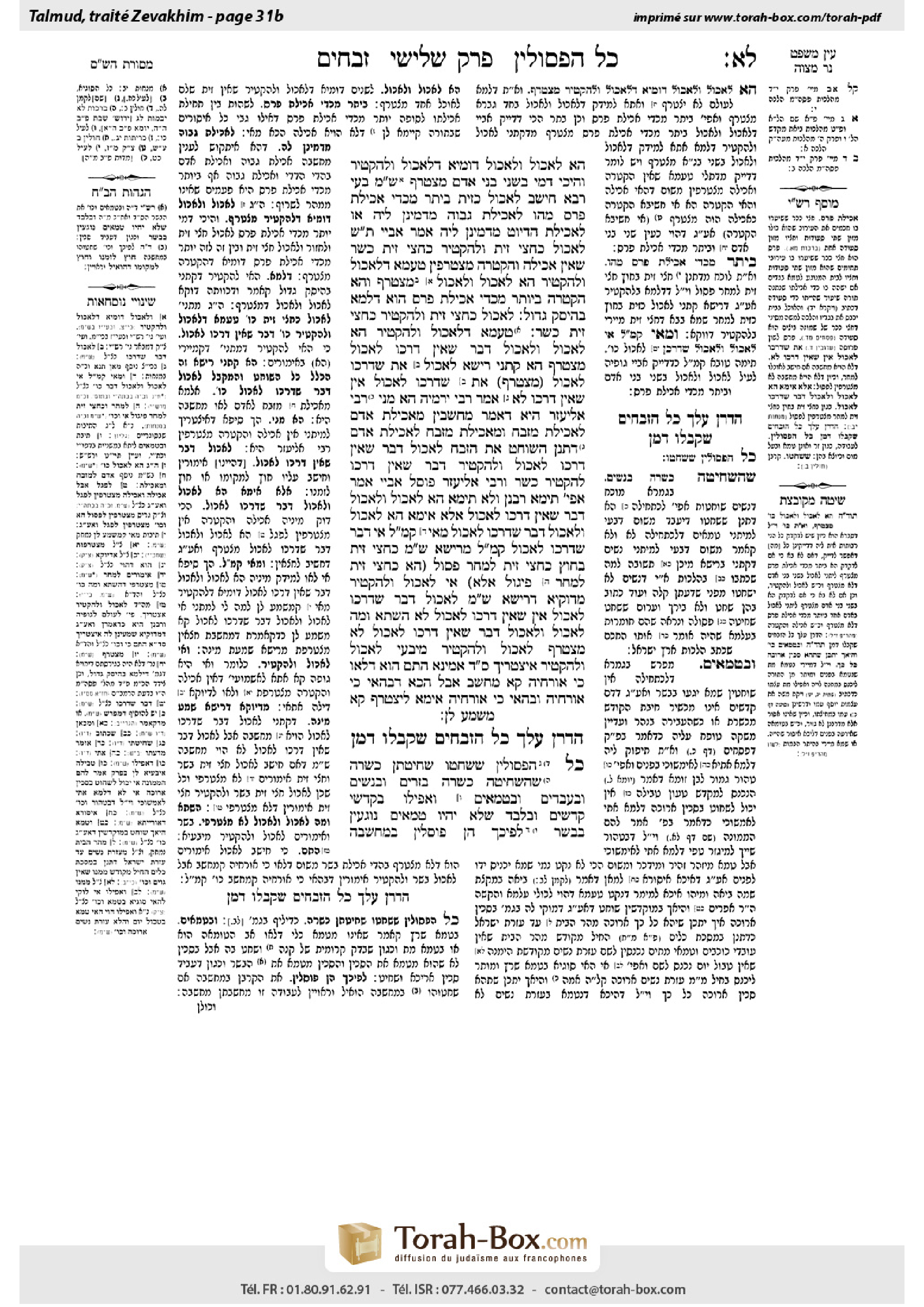
Zevachim 31b: Talmud study for Daf Yomi
Daf Yomi is the daily study of one Talmud folio. Explore 37 tractates with scans, Hebrew text, Sefaria English and AI-generated French translations where annotated.
Passage selection and English or AI-generated French translation are available where the scan has annotations. Daf Study is independent of Torah-Box and Sefaria.
Browse Zevachim · זבחים · All tractatesZevachim 31b text and translations
This page of Zevachim includes the Aramaic text, an English translation and an AI-generated French translation, alongside the scan above.
זבחים ל״א ב · Aramaic and Hebrew text
הָא לֶאֱכוֹל וְלֶאֱכוֹל דּוּמְיָא דְּלֶאֱכוֹל וּלְהַקְטִיר, וְהֵיכִי דָּמֵי – בִּשְׁנֵי בְּנֵי אָדָם; מִצְטָרֵף! שְׁמַע מִינַּהּ.
בָּעֵי רָבָא: חִישֵּׁב לֶאֱכוֹל כְּזַיִת בְּיָתֵר מִכְּדֵי אֲכִילַת פְּרָס, מַהוּ? לַאֲכִילַת גָּבוֹהַּ מְדַמֵּינַן לֵיהּ, אוֹ לַאֲכִילַת הֶדְיוֹט מְדַמֵּינַן לֵיהּ?
אָמַר אַבָּיֵי, תָּא שְׁמַע: לֶאֱכוֹל כַּחֲצִי זַיִת וּלְהַקְטִיר כַּחֲצִי זַיִת – כָּשֵׁר, שֶׁאֵין אֲכִילָה וְהַקְטָרָה מִצְטָרְפִין. טַעְמָא דְּלֶאֱכוֹל וּלְהַקְטִיר, הָא לֶאֱכוֹל וְלֶאֱכוֹל – מִצְטָרֵף; וְהָא הַקְטָרָה בְּיוֹתֵר מִכְּדֵי אֲכִילַת פְּרָס הוּא!
דִּלְמָא בְּהֶיסֵּק גָּדוֹל.
לֶאֱכוֹל כַּחֲצִי זַיִת וּלְהַקְטִיר כַּחֲצִי זַיִת – כָּשֵׁר. טַעְמָא דְּלֶאֱכוֹל וּלְהַקְטִיר, הָא לֶאֱכוֹל וְלֶאֱכוֹל דָּבָר שֶׁאֵין דַּרְכּוֹ לֶאֱכוֹל – מִצְטָרֵף;
הָא קָתָנֵי רֵישָׁא: לֶאֱכוֹל אֶת שֶׁדַּרְכּוֹ לֶאֱכוֹל – מִצְטָרֵף; אֶת שֶׁדַּרְכּוֹ לֶאֱכוֹל אִין, שֶׁאֵין דַּרְכּוֹ לָא!
אָמַר רַבִּי יִרְמְיָה: הָא מַנִּי – רַבִּי אֱלִיעֶזֶר הִיא, דְּאָמַר: מְחַשְּׁבִין מֵאֲכִילַת אָדָם לַאֲכִילַת מִזְבֵּחַ, וּמֵאֲכִילַת מִזְבֵּחַ לַאֲכִילַת אָדָם. דִּתְנַן: הַשּׁוֹחֵט אֶת הַזֶּבַח לֶאֱכוֹל דָּבָר שֶׁאֵין דַּרְכּוֹ לֶאֱכוֹל, וּלְהַקְטִיר דָּבָר שֶׁאֵין דַּרְכּוֹ לְהַקְטִיר – כָּשֵׁר. וְרַבִּי אֱלִיעֶזֶר פּוֹסֵל.
אַבָּיֵי אָמַר: אֲפִילּוּ תֵּימָא רַבָּנַן – וְלָא תֵּימָא: הָא לֶאֱכוֹל וְלֶאֱכוֹל דָּבָר שֶׁאֵין דַּרְכּוֹ לֶאֱכוֹל, אֶלָּא אֵימָא: הָא לֶאֱכוֹל וְלֶאֱכוֹל דָּבָר שֶׁדַּרְכּוֹ לֶאֱכוֹל.
מַאי קָא מַשְׁמַע לַן? אִי דָּבָר שֶׁדַּרְכּוֹ לֶאֱכוֹל קָא מַשְׁמַע לַן – מֵרֵישָׁא שְׁמַע מִינַּהּ: כַּחֲצִי זַיִת בַּחוּץ כַּחֲצִי זַיִת לְמָחָר – פָּסוּל; הָא כַּחֲצִי זַיִת לְמָחָר – פִּיגּוּל!
אֶלָּא אִי לֶאֱכוֹל וּלְהַקְטִיר – מִדּוּקְיָא דְּרֵישָׁא שְׁמַע מִינַּהּ: לֶאֱכוֹל דָּבָר שֶׁדַּרְכּוֹ לֶאֱכוֹל – אִין, שֶׁאֵין דַּרְכּוֹ לֶאֱכוֹל – לֹא;
הַשְׁתָּא וּמָה לֶאֱכוֹל וְלֶאֱכוֹל דָּבָר שֶׁאֵין דַּרְכּוֹ לֶאֱכוֹל – לָא מִצְטָרֵף, לֶאֱכוֹל וּלְהַקְטִיר מִיבְּעֵי?!
לֶאֱכוֹל וּלְהַקְטִיר אִיצְטְרִיךְ; סָלְקָא דַּעְתָּךְ אָמֵינָא: הָתָם הוּא דְּלָאו כִּי אוֹרְחֵיהּ קָא מְחַשֵּׁב; אֲבָל הָכָא, דִּבְהַאי כִּי אוֹרְחֵיהּ וּבְהַאי כִּי אוֹרְחֵיהּ – אֵימָא לִיצְטָרֵף; קָא מַשְׁמַע לַן.
הֲדַרַן עֲלָךְ כׇּל הַזְּבָחִים שֶׁקִּבְּלוּ דָּמָן
מַתְנִי׳ כׇּל הַפְּסוּלִין שֶׁשָּׁחֲטוּ – שְׁחִיטָתָן כְּשֵׁרָה, שֶׁהַשְּׁחִיטָה כְּשֵׁרָה בְּזָרִים וּבְנָשִׁים וּבַעֲבָדִים וּבִטְמֵאִים. וַאֲפִילּוּ בְּקׇדְשֵׁי קָדָשִׁים, וּבִלְבַד שֶׁלֹּא יִהְיוּ טְמֵאִים נוֹגְעִין בַּבָּשָׂר. לְפִיכָךְ הֵן פּוֹסְלִין בְּמַחְשָׁבָה.
Zevachim 31b · English translation
It can be inferred that if one had intent to eat and to eat in a manner similar to a case of intent to eat half an olive-bulk and to burn half an olive-bulk; Abaye interjects: And what are the circumstances of such a case? It is a case with two people, i.e., where each one will consume half an olive-bulk. Abaye continues with the conclusion of his statement: Then the two halves join together. The Gemara concludes: Learn from it that this is so.
Rava raises a dilemma: If one had intent to eat an olive-bulk in more than the period of time it takes to eat a half-loaf of bread, what is the halakha? Do we equate the consumption of offerings to the consumption of the Most High, i.e., the burning of offerings on the altar, for which there is no maximum allotted time? Or do we equate it to the consumption of an ordinary person, for whom consumption slower than this rate is not considered eating?
Abaye said: Come and hear a proof from the mishna: If his intent was to eat half an olive-bulk and to burn half an olive-bulk not at the appropriate time or in the appropriate area, the offering is fit because eating and burning do not join together. One may infer that the reason the offering is fit is that he had intent to eat and to burn the offering. But if he had intent to eat half an olive-bulk at the normal rate and to eat half an olive-bulk in the time it takes to burn half an olive-bulk, the two would join together. But the burning of an olive-bulk of an offering can take more than the time it takes to eat a half-loaf of bread. It therefore seems that there is no upper limit on the time in which one is considered to have consumed an offering.
The Gemara rejects the proof: Perhaps the mishna is referring to intent to burn half an olive-bulk in a large fire, which can consume it in the time it takes to eat a half-loaf of bread. Accordingly, one may draw the inference only with regard to a case where his intent was to consume the halves of an olive-bulk within this time.
§ The mishna teaches: If one slaughtered the animal with intent to eat half an olive-bulk and to burn half an olive-bulk not at the appropriate time or in the appropriate area, the offering is fit. The Gemara infers: The reason that the two halves of an olive-bulk do not join together is because his intent was to eat half an olive-bulk and to burn half an olive-bulk. But if his intent was to eat half an olive-bulk of the meat and to eat half an olive-bulk of an item whose typical manner is such that one does not partake of it, then the halves do join together and disqualify the offering, as both intentions concern eating.
The Gemara notes an apparent contradiction: But the first clause of the mishna teaches: If one’s intent was to partake of an item whose typical manner is such that one partakes of it, beyond its designated time, his intent joins together to disqualify the offering. One can infer that only if his intent was to partake of an item whose typical manner is such that one partakes of it, does his intent join together, but if his intent was to partake of an item whose typical manner is such that one does not partake of it, then it does not join together.
Rabbi Yirmeya says: In accordance with whose opinion is this latter clause? It is in accordance with the opinion of Rabbi Eliezer, who says: One can have intent to shift an item’s consumption from consumption by a person to consumption by the altar, or from consumption by the altar to consumption by a person. As we learned in another mishna (35a): In the case of one who slaughters the offering with intent to partake of an item whose typical manner is such that one does not partake of it, or to burn an item whose typical manner is such that one does not burn it on the altar, beyond its designated time or outside its designated area, the offering is fit, and Rabbi Eliezer deems it unfit.
Abaye says: You may even say that the latter clause is in accordance with the opinion of the Rabbis. And do not say that one should infer from the mishna that if his intent was to eat half an olive-bulk of an item normally consumed and to eat half an olive-bulk of an item whose typical manner is such that one does not partake of it, then the offering is disqualified. Rather, say that one infers that if his intent was to eat half an olive-bulk and to eat another half an olive-bulk, both halves from an item whose typical manner is such that one partakes of it, then the halves join together to disqualify the offering.
The Gemara asks: If so, what is this latter clause teaching us? If it teaches us that two half olive-bulks from an item whose typical manner is such that one partakes of it, join together, one can already learn this from the first clause of the mishna: If one has intent to consume half an olive-bulk outside its designated area and half an olive-bulk the next day, the offering is disqualified. One can infer that if his intent was to eat the first half an olive-bulk the next day, the offering would be rendered piggul.
But if one will say that this term teaches its literal meaning, that intentions to eat and to burn two halves of an olive-bulk do not join together, one can already learn this from the inference drawn above from the first clause of the mishna, namely that intent to partake of an item whose typical manner is such that one partakes of it does disqualify the offering, but intent to partake of an item whose typical manner is such that one does not partake of it does not. By extension, intent to consume half an olive-bulk of such an item does not join to disqualify the offering.
Now, consider the following: And just as if when one has intent to partake of an item normally eaten and to partake of an item whose typical manner is such that one does not partake of it, his intentions do not join together, even though both intentions concern consumption, is it necessary for the mishna to teach that intentions to consume and to burn do not join together? The last clause therefore seems unnecessary.
The Gemara responds: It was necessary for the mishna to explicitly address the case where one had intent to eat and to burn, as it might enter your mind to say that it is only there, where one’s intentions are referring solely to consumption, that they do not join together, since he has intent to act in a way that is not consistent with its typical manner and consume an item not normally consumed. But here, where his intent is to both eat and burn the offering, such that with regard to this half he intends to act in a way consistent with its typical manner, and with regard to that half he intends to act in a way consistent with its typical manner, one might say that they should join together. Therefore, the mishna teaches us that intentions to eat and to burn do not join together.
MISHNA: With regard to all those who are unfit for Temple service who slaughtered an offering, their slaughter is valid, as the slaughter of an offering is valid ab initio when performed even by non-priests, by women, by Canaanite slaves, and by ritually impure individuals. And this is the halakha even with regard to offerings of the most sacred order, provided that the ritually impure will not touch the flesh of the slaughtered animal, thereby rendering it impure. Therefore, these unfit individuals can disqualify the offering with prohibited intent, e.g., if one of them intended to partake of the offering beyond its designated time or outside its designated area.
Zevachim 31b · Traduction française (IA)
On peut en déduire que, si quelqu’un avait l’intention de manger, dans un cas semblable à celui où il aurait eu l’intention de manger un demi-kazaït et de brûler un demi-kazaït, Abaye intervient : « Dans quelles circonstances cela se produit-il ? » Il s’agit du cas de deux personnes, c’est-à-dire que chacune consomme un demi-kazaït. Abaye poursuit en énonçant la conclusion de son propos : les deux moitiés s’additionnent. La Guemara conclut : déduis-en que c’est bien le cas.
Rava soulève un dilemme : quelle est la halakha si quelqu’un a eu l’intention de manger un kazaït en un temps supérieur à celui nécessaire pour manger un demi-pain ? Assimile-t-on la consommation des offrandes à celle du Très-Haut, c’est-à-dire à la combustion des offrandes sur l’autel, pour laquelle il n’existe aucun délai maximal ? Ou bien l’assimile-t-on à la consommation d’une personne ordinaire, pour qui une consommation plus lente que ce rythme n’est pas considérée comme manger ?
Abaye dit : « Viens et écoute » une preuve tirée de la Michna : si son intention était de manger un demi-kazaït et de brûler un demi-kazaït à un moment ou dans un lieu qui ne convient pas, l’offrande est valide, car manger et brûler ne s’additionnent pas. On peut en déduire que l’offrande est valide parce qu’il avait l’intention de manger et de brûler l’offrande. Mais s’il avait eu l’intention de manger un demi-kazaït au rythme normal et un autre demi-kazaït dans le temps nécessaire pour en brûler un demi-kazaït, les deux s’additionneraient. Or, brûler un kazaït d’une offrande peut prendre plus de temps que celui nécessaire pour manger un demi-pain. Il semble donc qu’il n’y ait pas de limite supérieure au temps pendant lequel on est considéré comme ayant consommé une offrande.
La Guemara rejette cette preuve : la Michna fait peut-être référence à l’intention de brûler un demi-kazaït dans un grand feu, qui peut le consumer en un temps égal à celui nécessaire pour manger un demi-pain. Par conséquent, on ne peut tirer cette déduction que dans le cas où son intention était de consommer les deux moitiés d’un kazaït dans ce délai.
§ La Michna enseigne : si quelqu’un a égorgé l’animal avec l’intention de manger un demi-kazaït et de brûler un demi-kazaït à un moment ou dans un lieu qui ne convient pas, l’offrande est valide. La Guemara en déduit que si les deux moitiés d’un kazaït ne s’additionnent pas, c’est parce qu’il avait l’intention de manger un demi-kazaït et de brûler un demi-kazaït. Mais s’il avait eu l’intention de manger un demi-kazaït de la viande et un demi-kazaït d’un élément qu’on n’a pas coutume de consommer, les deux moitiés s’additionneraient et rendraient l’offrande invalide, puisque les deux intentions portent sur la consommation.
La Guemara relève une contradiction apparente : le début de la Michna enseigne que, si l’intention de quelqu’un était de consommer, après le délai imparti, un élément qu’on a coutume de consommer, son intention s’additionne pour rendre l’offrande invalide. On peut en déduire que son intention ne s’additionne que s’il avait l’intention de consommer un élément qu’on a coutume de consommer ; mais si son intention était de consommer un élément qu’on n’a pas coutume de consommer, elle ne s’additionne pas.
Rabbi Yirmeya dit : selon l’opinion de qui cette dernière clause est-elle formulée ? Selon l’opinion de Rabbi Eliezer, qui dit qu’on peut transférer la consommation d’un élément de la consommation par une personne à la consommation par l’autel, ou de la consommation par l’autel à la consommation par une personne. En effet, nous avons appris dans une autre Michna (35a) : dans le cas de quelqu’un qui égorge l’offrande avec l’intention de consommer, après le délai imparti ou hors du lieu assigné, un élément qu’on n’a pas coutume de consommer, ou de brûler sur l’autel un élément qu’on n’a pas coutume d’y brûler, l’offrande est valide, mais Rabbi Eliezer la déclare invalide.
Abaye dit : on peut même dire que la dernière clause est conforme à l’opinion des Sages. Et ne dis pas qu’on doit déduire de la Michna que, si son intention était de manger un demi-kazaït d’un élément habituellement consommé et un demi-kazaït d’un élément qu’on n’a pas coutume de consommer, l’offrande est invalidée. Dis plutôt qu’on en déduit que, s’il avait eu l’intention de manger un demi-kazaït puis un autre demi-kazaït, tous deux provenant d’un élément qu’on a coutume de consommer, les deux moitiés s’additionnent pour rendre l’offrande invalide.
La Guemara demande : dans ce cas, que nous enseigne cette dernière clause ? Si elle nous enseigne que deux demi-kazaït provenant d’un élément qu’on a coutume de consommer s’additionnent, on peut déjà l’apprendre du début de la Michna : si quelqu’un a l’intention de consommer un demi-kazaït hors du lieu assigné et un demi-kazaït le lendemain, l’offrande est invalidée. On peut en déduire que s’il avait eu l’intention de manger le premier demi-kazaït le lendemain, l’offrande aurait été rendue piggoul.
Mais si l’on dit que cette expression conserve son sens littéral, à savoir que les intentions de manger et de brûler deux moitiés d’un kazaït ne s’additionnent pas, on peut déjà l’apprendre de la déduction tirée plus haut du début de la Michna : l’intention de consommer un élément qu’on a coutume de consommer invalide l’offrande, tandis que l’intention de consommer un élément qu’on n’a pas coutume de consommer ne l’invalide pas. Par extension, l’intention de consommer un demi-kazaït d’un tel élément ne s’ajoute pas pour rendre l’offrande invalide.
Considérons maintenant ce qui suit : si, lorsqu’on a l’intention de consommer un élément habituellement consommé et un élément qu’on n’a pas coutume de consommer, les intentions ne s’additionnent pas, alors même qu’elles portent toutes deux sur la consommation, est-il nécessaire que la Michna enseigne que les intentions de consommer et de brûler ne s’additionnent pas ? La dernière clause semble donc superflue.
La Guemara répond : il était nécessaire que la Michna traite explicitement du cas où quelqu’un avait l’intention de manger et de brûler, car on aurait pu penser que ce n’est que dans le premier cas, où les intentions portent uniquement sur la consommation, qu’elles ne s’additionnent pas, puisqu’il a l’intention d’agir d’une manière qui ne correspond pas à l’usage habituel et de consommer un élément qu’on ne consomme pas habituellement. Mais ici, où son intention est à la fois de manger et de brûler l’offrande, de sorte que, pour cette moitié, il entend agir selon l’usage habituel et que, pour l’autre moitié, il entend également agir selon l’usage habituel, on aurait pu dire que les intentions doivent s’additionner. La Michna nous enseigne donc que les intentions de manger et de brûler ne s’additionnent pas.
MICHNA : Tous ceux qui ne sont pas aptes au service du Temple et qui ont égorgé une offrande l’ont égorgée de manière valide, car l’égorgement d’une offrande est valide a priori même s’il est effectué par des non-prêtres, des femmes, des esclaves cananéens ou des personnes rituellement impures. Cette halakha vaut également pour les offrandes de sainteté suprême, à condition que la personne rituellement impure ne touche pas la chair de l’animal égorgé, ce qui la rendrait impure. Ces personnes inaptes peuvent donc invalider l’offrande par une intention interdite, par exemple si l’une d’elles a eu l’intention de consommer l’offrande après le délai qui lui est imparti ou hors du lieu qui lui est assigné.
Traduction française générée par IA à partir de l’édition anglaise de Sefaria. Vérifie toujours un passage avec le texte source.
Text from Sefaria: William Davidson Edition - Vocalized Aramaic (CC BY NC); William Davidson Edition - English (CC BY NC).