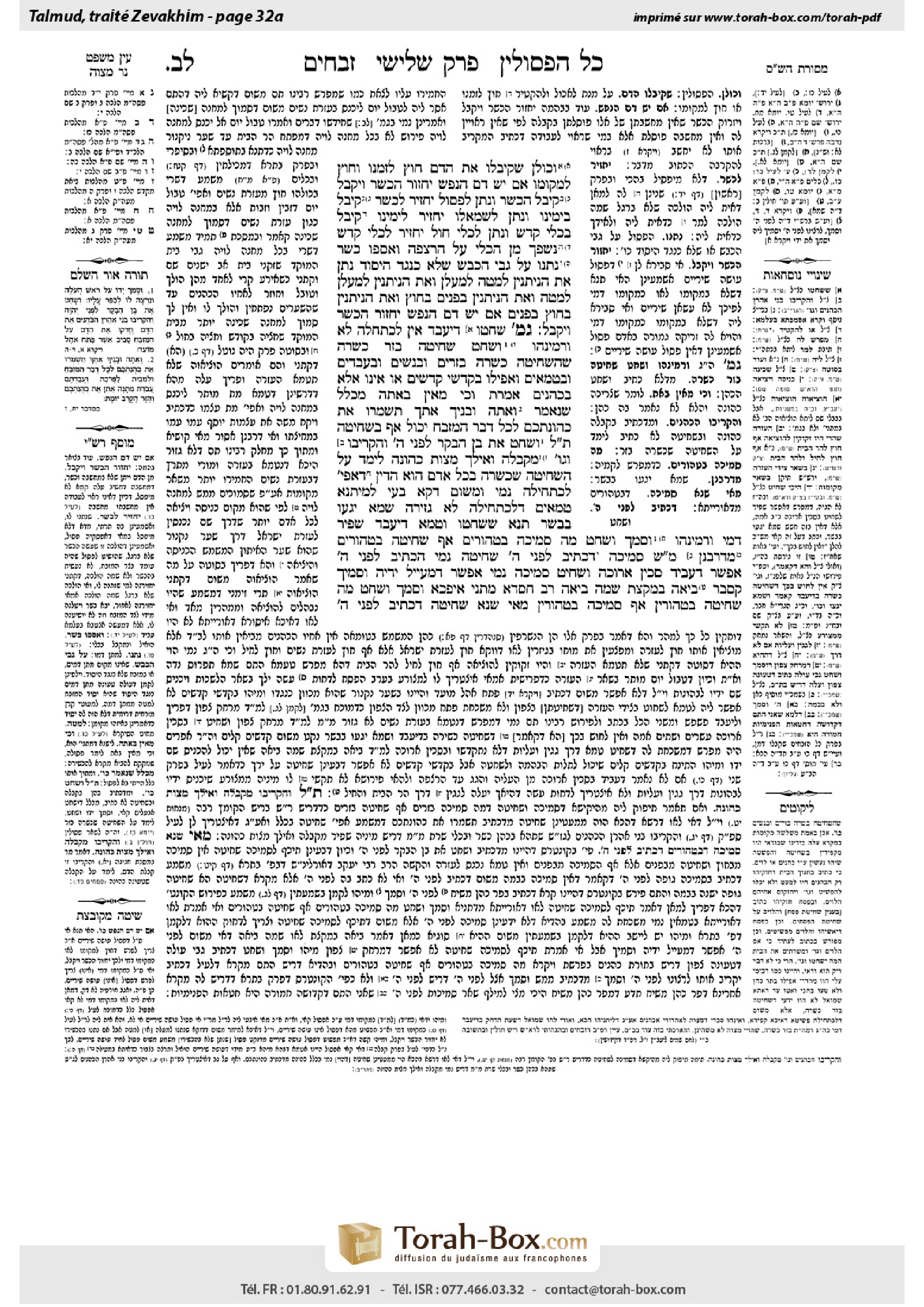
Zevachim 32a: Talmud study for Daf Yomi
Daf Yomi is the daily study of one Talmud folio. Explore 37 tractates with scans, Hebrew text, Sefaria English and AI-generated French translations where annotated.
Passage selection and English or AI-generated French translation are available where the scan has annotations. Daf Study is independent of Torah-Box and Sefaria.
Browse Zevachim · זבחים · All tractatesZevachim 32a text and translations
This page of Zevachim includes the Aramaic text, an English translation and an AI-generated French translation, alongside the scan above.
זבחים ל״ב א · Aramaic and Hebrew text
וְכוּלָּן שֶׁקִּיבְּלוּ אֶת הַדָּם חוּץ לִזְמַנּוֹ וְחוּץ לִמְקוֹמוֹ – אִם יֵשׁ דַּם הַנֶּפֶשׁ, יַחְזוֹר הַכָּשֵׁר וִיקַבֵּל.
קִיבֵּל הַכָּשֵׁר וְנָתַן לַפָּסוּל – יַחְזִיר לַכָּשֵׁר. קִיבֵּל בִּימִינוֹ וְנָתַן לִשְׂמֹאלוֹ – יַחְזִיר לִימִינוֹ. קִיבֵּל בִּכְלִי קֹדֶשׁ וְנָתַן לִכְלִי חוֹל – יַחְזִיר לִכְלֵי קֹדֶשׁ. נִשְׁפַּךְ מִן הַכְּלִי עַל הָרִצְפָּה וַאֲסָפוֹ – כָּשֵׁר.
נְתָנוֹ עַל גַּבֵּי הַכֶּבֶשׁ; שֶׁלֹּא כְּנֶגֶד הַיְסוֹד; נָתַן אֶת הַנִּיתָּנִין לְמַטָּה – לְמַעְלָן; וְאֶת הַנִּיתָּנִין לְמַעְלָן – לְמַטָּה; וְאֶת הַנִּיתָּנִין בִּפְנִים – בַּחוּץ; וְאֶת הַנִּיתָּנִין בַּחוּץ – בִּפְנִים; אִם יֵשׁ דַּם הַנֶּפֶשׁ – יַחְזוֹר הַכָּשֵׁר וִיקַבֵּל.
גְּמָ׳ ״שָׁחֲטוּ״ – דִּיעֲבַד אִין, לְכַתְּחִלָּה לָא.
וּרְמִינְהוּ: ״וְשָׁחַט״ – שְׁחִיטָה בְּזָר כְּשֵׁרָה, שֶׁהַשְּׁחִיטָה כְּשֵׁרָה בְּזָרִים וּבְנָשִׁים וּבַעֲבָדִים וּבִטְמֵאִים. וַאֲפִילּוּ בְּקׇדְשֵׁי קָדָשִׁים. אוֹ אֵינוֹ אֶלָּא בַּכֹּהֲנִים?
אָמַרְתָּ: וְכִי מֵאַיִן בָּאתָה – מִכְּלָל שֶׁנֶּאֱמַר: ״וְאַתָּה וּבָנֶיךָ אִתְּךָ תִּשְׁמְרוּ אֶת כְּהֻנַּתְכֶם לְכׇל דְּבַר הַמִּזְבֵּחַ״;
יָכוֹל אַף בִּשְׁחִיטָה? תַּלְמוּד לוֹמַר: ״וְשָׁחַט אֶת בֶּן הַבָּקָר לִפְנֵי ה׳ וְהִקְרִיבוּ וְגוֹ׳״ – מִקַּבָּלָה וְאֵילָךְ מִצְוַת כְּהוּנָּה; לִימֵּד עַל הַשְּׁחִיטָה שֶׁכְּשֵׁרָה בְּכׇל אָדָם.
הוּא הַדִּין דַּאֲפִילּוּ לְכַתְּחִילָּה נָמֵי; וּמִשּׁוּם דְּקָא בָּעֵי לְמִיתְנָא טְמֵאִים – דִּלְכַתְּחִילָּה לָא, גְּזֵירָה שֶׁמָּא יִגְּעוּ בַּבָּשָׂר; תְּנָא: ״שֶׁשָּׁחֲטוּ״.
וְטָמֵא דִּיעֲבַד שַׁפִּיר דָּמֵי?! וּרְמִינְהוּ: ״וְסָמַךְ... וְשָׁחַט״ – מָה סְמִיכָה בִּטְהוֹרִים, אַף שְׁחִיטָה בִּטְהוֹרִים! מִדְּרַבָּנַן.
מַאי שְׁנָא סְמִיכָה, דִּכְתִיב: ״לִפְנֵי ה׳״; שְׁחִיטָה נָמֵי, הָכְתִיב: ״לִפְנֵי ה׳״! אֶפְשָׁר דְּעָבֵיד סַכִּין אֲרוּכָּה וְשָׁחֵיט.
סְמִיכָה נָמֵי – אֶפְשָׁר דִּמְעַיֵּיל יְדֵיהּ וְסָמֵיךְ. קָסָבַר בִּיאָה בְּמִקְצָת שְׁמָהּ בִּיאָה.
רַב חִסְדָּא מַתְנִי אִיפְּכָא: ״וְסָמַךְ... וְשָׁחַט״ – מָה שְׁחִיטָה בִּטְהוֹרִין, אַף סְמִיכָה בִּטְהוֹרִין. מַאי שְׁנָא שְׁחִיטָה? דִּכְתִיב: ״לִפְנֵי ה׳״,
Zevachim 32a · English translation
And with regard to all of them, in a case where they collected the blood with the intent to offer it beyond its designated time or outside its designated area, if there is blood of the soul that remains in the animal, the priest fit for Temple service should again collect the blood and sprinkle it on the altar.
If the priest fit for Temple service collected the blood in a vessel and gave the vessel to an unfit person, that person should return it to the fit priest. If the priest collected the blood in a vessel in his right hand and moved it to his left hand, he should return it to his right hand. If the priest collected the blood in a sacred vessel and placed it in a non-sacred vessel, he should return the blood to a sacred vessel. If the blood spilled from the vessel onto the floor and he gathered it from the floor, it is valid.
If an unfit person placed the blood upon the ramp or on the wall of the altar that is not opposite the base of the altar, or if he placed the blood that is to be placed below the red line above the red line, or if he placed the blood that is to be placed above the red line below the red line, or if he placed the blood that is to be placed inside the Sanctuary outside the Sanctuary or the blood that is to be placed outside the Sanctuary inside the Sanctuary, then if there is blood of the soul that remains in the animal, the priest fit for Temple service should again collect the blood and sprinkle it on the altar.
GEMARA: The Gemara infers from the use of the past tense in the mishna: With regard to all those who are unfit for Temple service who slaughtered, that after the fact, yes, the slaughter is valid. But ab initio, no, those who are unfit may not slaughter an offering.
And the Gemara raises a contradiction from what was taught in the halakhic midrash Torat Kohanim: The verse states with regard to a burnt offering: “And he shall slaughter the bull before the Lord” (Leviticus 1:5). The fact that the verse does not stipulate that a priest must slaughter the offering teaches that slaughter is valid if performed by a non-priest, as stated in the mishna: As the sacrificial rite of slaughter is valid when performed by non-priests, by women, by Canaanite slaves, and by ritually impure individuals, and even with regard to offerings of the most sacred order. Or perhaps the term “and he shall slaughter” in the verse is referring only to slaughter by priests?
You can say in response: From where did you come to the idea that the verse is referring only to a priest? It is from the fact that it is stated to Aaron: “And you and your sons with you shall keep your priesthood in everything that pertains to the altar” (Numbers 18:7).
One might have thought that this is the halakha even with regard to slaughter, that only priests are fit to slaughter an offering. Therefore, the verse states: “And he shall slaughter the bull before the Lord, and Aaron’s sons, the priests, shall present [vehikrivu] the blood” (Leviticus 1:5), from which it is inferred that specifically from the collection of the blood and onward it is a mitzva exclusively of the priesthood. This teaches about the rite of slaughter that it is valid ab initio if performed by any person. This contradicts the inference from the mishna that slaughter of an offering by a non-priest is valid only after the fact.
The Gemara answers: The same is true that even ab initio as well it is permitted for those unfit for Temple service to slaughter an offering, but because the mishna wants to teach with regard to the ritually impure that they may not slaughter an offering ab initio due to a rabbinic decree lest they touch the flesh and render it ritually impure, therefore the mishna taught this halakha with the expression in the past tense: Who slaughtered, i.e., after the fact.
The Gemara asks: And in the case of a ritually impure individual who performed the slaughter, is it permitted even after the fact? And one can raise a contradiction from what is taught in the halakhic midrash: The Torah states two consecutive directives: “And he shall place his hand upon the head of the burnt offering…And he shall slaughter the bull before the Lord” (Leviticus 1:4–5). This juxtaposition indicates that both directives are referring to the same individual, which teaches that just as placing hands on the head of an offering may be performed only by ritually pure individuals, so too, the slaughter may be performed only by ritually pure individuals. The Gemara answers: By rabbinic law, an impure person is prohibited from slaughtering an offering lest he touch the flesh of the offering, but by Torah law the slaughter is valid.
The Gemara asks: What is different about placing hands that it can be performed only by those who are ritually pure even by Torah law? It is that it is written: “Before the Lord,” which is referring to the Temple courtyard, and an impure person may not enter the Temple courtyard. With regard to slaughter as well, isn’t it written: “Before the Lord” (Leviticus 1:5)? How can a ritually impure person enter the Temple courtyard to slaughter an offering? The Gemara answers: It is possible, in a case where he fashions a long knife, stands outside the Temple courtyard, and slaughters the offering that is inside the courtyard.
The Gemara asks: With regard to placing hands also, it is possible, in a case where he inserts his hands into the Temple courtyard and places them on the head of the offering. The Gemara answers: The tanna holds that a partial entry, in which only a part of the body enters the Temple courtyard, is called entry. Therefore, an impure individual may not insert even part of his body, such as his hands, into the Temple courtyard.
Rav Ḥisda taught the baraita in the opposite manner: “And he shall place his hand upon the head of the burnt offering…and he shall slaughter the bull” (Leviticus 1:4–5), teaches that just as slaughter may be performed only by ritually pure individuals, so too, placing hands may be performed only by ritually pure individuals. The Gemara asks: What is different about slaughter that it may be performed only by those who are ritually pure? It is that it is written with regard to it: “Before the Lord,” which refers to the Temple courtyard, and a ritually impure person may not enter the Temple courtyard.
Zevachim 32a · Traduction française (IA)
Et pour tous ces cas, si le sang a été recueilli avec l’intention de l’offrir après le délai qui lui est imparti ou en dehors de l’endroit qui lui est assigné, s’il reste dans l’animal du sang vital, le prêtre apte au service du Temple doit recueillir de nouveau le sang et l’asperger sur l’autel.
Si le prêtre apte au service du Temple a recueilli le sang dans un récipient et l’a remis à une personne inapte, celle-ci doit le rendre au prêtre apte. Si le prêtre a recueilli le sang dans un récipient de sa main droite et l’a transféré dans sa main gauche, il doit le remettre dans sa main droite. Si le prêtre a recueilli le sang dans un récipient sacré et l’a placé dans un récipient profane, il doit remettre le sang dans un récipient sacré. Si le sang s’est répandu du récipient sur le sol et qu’il l’a recueilli sur le sol, le rite est valide.
Si une personne inapte a placé le sang sur la rampe ou sur la paroi de l’autel qui ne fait pas face à sa base, ou si elle a placé au-dessus de la ligne rouge le sang qui doit être placé au-dessous, ou au-dessous de la ligne rouge le sang qui doit être placé au-dessus, ou si elle a placé à l’extérieur du Sanctuaire le sang qui doit être placé à l’intérieur, ou à l’intérieur le sang qui doit être placé à l’extérieur, alors, s’il reste dans l’animal du sang vital, le prêtre apte au service du Temple doit recueillir de nouveau le sang et l’asperger sur l’autel.
GUEMARA : La Guemara déduit de l’emploi du passé dans la Michna que, pour tous ceux qui sont inaptes au service du Temple et qui ont abattu l’animal, l’abattage est valide a posteriori, mais pas a priori : les personnes inaptes ne peuvent pas abattre un sacrifice.
La Guemara soulève une contradiction à partir de ce qui a été enseigné dans le midrach halakhique Torat Kohanim : au sujet de l’holocauste, le verset dit : « Il égorgera le taureau devant l’Éternel » (Lévitique 1:5). Le fait que le verset ne précise pas qu’un prêtre doit égorger le sacrifice enseigne que l’abattage est valide s’il est accompli par un non-prêtre, comme l’énonce la Michna : le rite de l’abattage est valide lorsqu’il est accompli par des non-prêtres, des femmes, des esclaves cananéens et des personnes rituellement impures, même lorsqu’il s’agit de sacrifices de très haute sainteté. Peut-être, cependant, l’expression « il égorgera » du verset ne désigne-t-elle que l’abattage par des prêtres ?
On peut répondre : d’où vient l’idée que le verset ne désigne qu’un prêtre ? Elle vient du fait que les paroles suivantes sont adressées à Aaron : « Toi et tes fils avec toi, vous garderez votre sacerdoce pour tout ce qui concerne l’autel » (Nombres 18:7).
On aurait pu penser que cette halakha s’applique aussi à l’abattage et que seuls les prêtres sont aptes à abattre un sacrifice. Le verset dit donc : « Il égorgera le taureau devant l’Éternel, et les fils d’Aaron, les prêtres, présenteront [vehikrivu] le sang » (Lévitique 1:5). On en déduit que c’est précisément à partir du recueil du sang, et pour tout ce qui suit, que le rite relève exclusivement du sacerdoce. Cela enseigne que le rite de l’abattage est valide a priori lorsqu’il est accompli par n’importe qui. Cela contredit la déduction tirée de la Michna selon laquelle l’abattage d’un sacrifice par un non-prêtre n’est valide qu’a posteriori.
La Guemara répond : en réalité, il est également permis a priori aux personnes inaptes au service du Temple d’abattre un sacrifice. Mais comme la Michna veut enseigner que les personnes rituellement impures ne peuvent pas abattre un sacrifice a priori, en vertu d’un décret rabbinique, de crainte qu’elles ne touchent la chair et ne la rendent rituellement impure, elle formule cette halakha au passé : « qui ont abattu », c’est-à-dire a posteriori.
La Guemara demande : dans le cas d’une personne rituellement impure qui a procédé à l’abattage, celui-ci est-il permis même a posteriori ? On peut soulever une contradiction à partir de ce qui est enseigné dans le midrach halakhique : la Torah énonce deux prescriptions consécutives : « Il posera sa main sur la tête de l’holocauste… Il égorgera le taureau devant l’Éternel » (Lévitique 1:4–5). Cette juxtaposition indique que les deux prescriptions concernent la même personne et enseigne que, de même que l’imposition des mains sur la tête d’un sacrifice ne peut être accomplie que par une personne rituellement pure, de même l’abattage ne peut être accompli que par une personne rituellement pure. La Guemara répond : selon la loi rabbinique, il est interdit à une personne impure d’abattre un sacrifice, de crainte qu’elle ne touche la chair du sacrifice ; mais selon la Torah, l’abattage est valide.
La Guemara demande : pourquoi l’imposition des mains ne peut-elle être accomplie que par des personnes rituellement pures, même selon la Torah ? Parce qu’il est écrit : « devant l’Éternel », ce qui désigne la cour du Temple, dans laquelle une personne impure ne peut pas entrer. Mais à propos de l’abattage aussi, n’est-il pas écrit : « devant l’Éternel » (Lévitique 1:5) ? Comment une personne rituellement impure peut-elle entrer dans la cour du Temple pour abattre un sacrifice ? La Guemara répond : c’est possible dans le cas où elle fabrique un long couteau, se tient à l’extérieur de la cour du Temple et abat le sacrifice qui se trouve à l’intérieur de la cour.
La Guemara demande : pour l’imposition des mains aussi, c’est possible dans le cas où la personne introduit les mains dans la cour du Temple et les pose sur la tête du sacrifice. La Guemara répond : le tanna considère qu’une entrée partielle, où seule une partie du corps pénètre dans la cour du Temple, est appelée une entrée. Par conséquent, une personne impure ne peut introduire dans la cour du Temple aucune partie de son corps, pas même ses mains.
Rav Ḥisda enseigna la baraïta dans l’ordre inverse : « Il posera sa main sur la tête de l’holocauste… et il égorgera le taureau » (Lévitique 1:4–5) enseigne que, de même que l’abattage ne peut être accompli que par des personnes rituellement pures, de même l’imposition des mains ne peut être accomplie que par des personnes rituellement pures. La Guemara demande : pourquoi l’abattage ne peut-il être accompli que par des personnes rituellement pures ? Parce qu’il est écrit à son sujet : « devant l’Éternel », ce qui désigne la cour du Temple, dans laquelle une personne rituellement impure ne peut pas entrer.
Traduction française générée par IA à partir de l’édition anglaise de Sefaria. Vérifie toujours un passage avec le texte source.
Text from Sefaria: William Davidson Edition - Vocalized Aramaic (CC BY NC); William Davidson Edition - English (CC BY NC).