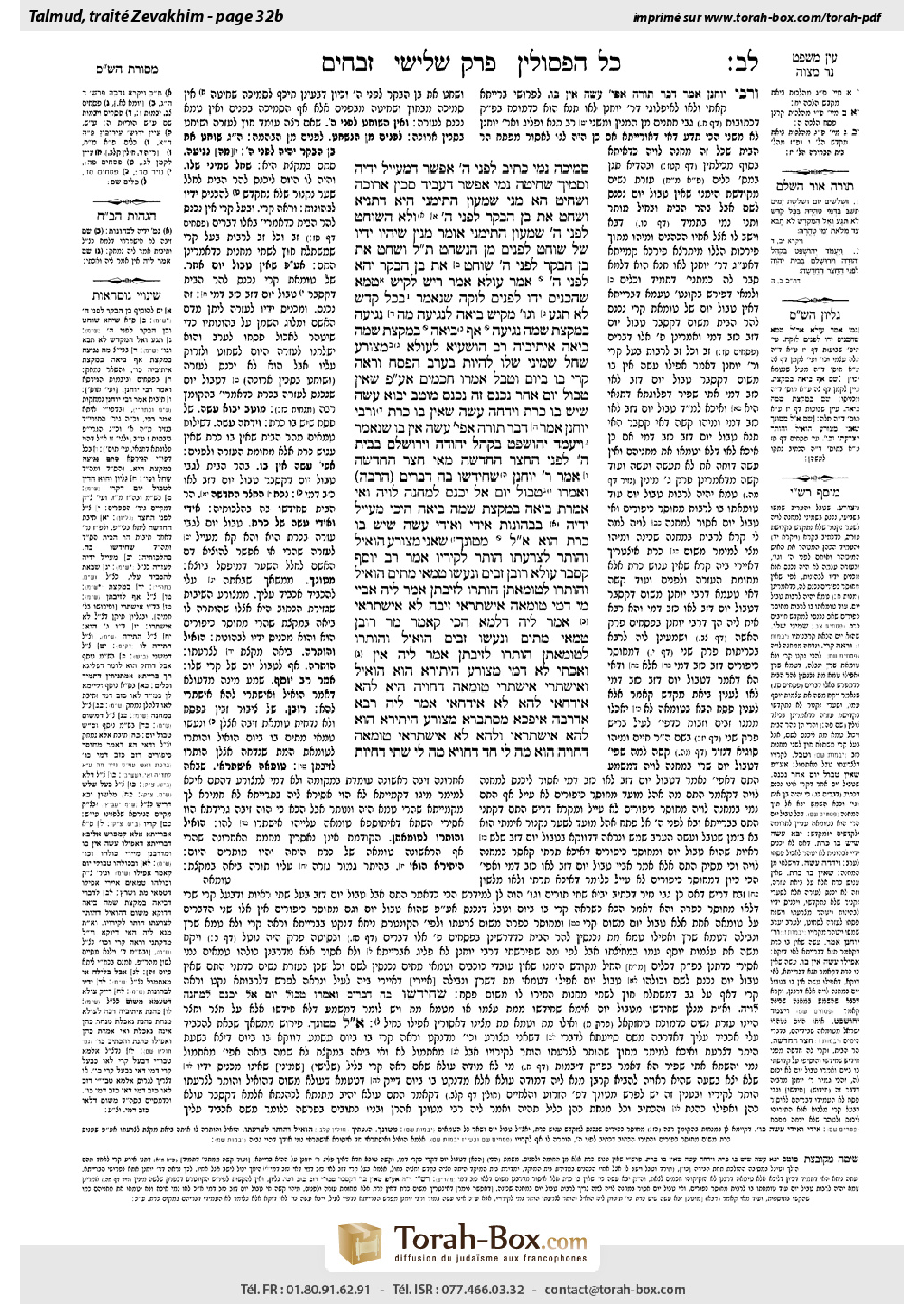
Zevachim 32b: Talmud study for Daf Yomi
Daf Yomi is the daily study of one Talmud folio. Explore 37 tractates with scans, Hebrew text, Sefaria English and AI-generated French translations where annotated.
Passage selection and English or AI-generated French translation are available where the scan has annotations. Daf Study is independent of Torah-Box and Sefaria.
Browse Zevachim · זבחים · All tractatesZevachim 32b text and translations
This page of Zevachim includes the Aramaic text, an English translation and an AI-generated French translation, alongside the scan above.
זבחים ל״ב ב · Aramaic and Hebrew text
סְמִיכָה נָמֵי כְּתִיב: ״לִפְנֵי ה׳״! אֶפְשָׁר דִּמְעַיֵּיל יְדֵיהּ וְסָמֵיךְ. שְׁחִיטָה נָמֵי אֶפְשָׁר דְּעָבֵיד סַכִּין אֲרוּכָּה וְשָׁחֵיט!
הָא מַנִּי – שִׁמְעוֹן הַתִּימְנִי הִיא. דְּתַנְיָא: ״וְשָׁחַט אֶת בֶּן הַבָּקָר לִפְנֵי ה׳״ – וְלֹא הַשּׁוֹחֵט לִפְנֵי ה׳. שִׁמְעוֹן הַתִּימְנִי אוֹמֵר: מִנַּיִן שֶׁיִּהְיוּ יָדָיו שֶׁל שׁוֹחֵט לִפְנִים מִן הַנִּשְׁחָט? תַּלְמוּד לוֹמַר: ״וְשָׁחַט אֶת בֶּן הַבָּקָר לִפְנֵי ה׳״ – שׁוֹחֵט אֶת בֶּן הַבָּקָר יְהֵא לִפְנֵי ה׳.
אָמַר עוּלָּא אָמַר רֵישׁ לָקִישׁ: טָמֵא שֶׁהִכְנִיס יָדוֹ לִפְנִים – לוֹקֶה. שֶׁנֶּאֱמַר: ״בְּכׇל קֹדֶשׁ לֹא תִגָּע וְגוֹ׳״ – מַקִּישׁ בִּיאָה לִנְגִיעָה; מָה נְגִיעָה בְּמִקְצָת שְׁמָהּ נְגִיעָה, אַף בִּיאָה בְּמִקְצָת שְׁמָהּ בִּיאָה.
אֵיתִיבֵיהּ רַב הוֹשַׁעְיָא לְעוּלָּא: מְצוֹרָע שֶׁחָל שְׁמִינִי שֶׁלּוֹ לִהְיוֹת בְּעֶרֶב הַפֶּסַח, וְרָאָה קֶרִי בּוֹ בַּיּוֹם, וְטָבַל –
אָמְרוּ חֲכָמִים: אַף עַל פִּי שֶׁאֵין טְבוּל יוֹם אַחֵר נִכְנָס, זֶה נִכְנָס; מוּטָב יָבוֹא עֲשֵׂה שֶׁיֵּשׁ בּוֹ כָּרֵת, וְיִדְחֶה עֲשֵׂה שֶׁאֵין בּוֹ כָּרֵת.
וְרַבִּי יוֹחָנָן אָמַר: דְּבַר תּוֹרָה – אֲפִילּוּ עֲשֵׂה אֵין בּוֹ. שֶׁנֶּאֱמַר: ״וַיַּעֲמֹד יְהוֹשָׁפָט בִּקְהַל יְהוּדָה וִירוּשָׁלִַם בְּבֵית ה׳ לִפְנֵי הֶחָצֵר הַחֲדָשָׁה״ – מַאי ״חָצֵר הַחֲדָשָׁה״? אָמַר רַבִּי יוֹחָנָן: שֶׁחִידְּשׁוּ בָּהּ דְּבָרִים (הַרְבֵּה), וְאָמְרוּ: טְבוּל יוֹם אַל יִכָּנֵס לְמַחֲנֵה לְוִיָּה.
וְאִי אָמְרַתְּ בִּיאָה בְּמִקְצָת שְׁמָהּ בִּיאָה, הֵיכִי מְעַיֵּיל יְדֵיהּ בִּבְהוֹנוֹת? אִידֵּי וְאִידֵּי עֲשֵׂה שֶׁיֵּשׁ בּוֹ כָּרֵת הוּא!
אֲמַר לֵיהּ: מִטּוּנָךְ – שָׁאנֵי מְצוֹרָע, הוֹאִיל וְהוּתַּר לְצָרַעְתּוֹ הוּתַּר לְקִירְיוֹ.
אָמַר רַב יוֹסֵף, קָסָבַר עוּלָּא: רוּבָּן זָבִים וְנַעֲשׂוּ טְמֵאֵי מֵתִים; הוֹאִיל וְהוּתְּרוּ לְטוּמְאָתָן – הוּתְּרוּ לְזִיבָתָן.
אֲמַר לֵיהּ אַבָּיֵי: מִי דָּמֵי?! טוּמְאָה אִישְׁתְּרַאי, זִיבָה לָא אִישְׁתְּרַאי!
אֲמַר לֵיהּ, דִּלְמָא הָכִי קָאָמַר מָר: רוּבָּן טְמֵאֵי מֵתִים וְנַעֲשׂוּ זָבִים; הוֹאִיל וְהוּתְּרוּ לְטוּמְאָתָן – הוּתְּרוּ לְזִיבָתָן? אֲמַר לֵיהּ: אִין.
וְאַכַּתִּי לָא דָּמֵי; מְצוֹרָע – הֶיתֵּירָא הוּא, הוֹאִיל וְאִישְׁתְּרִי אִישְׁתְּרִי. טוּמְאָה – דְּחוּיָה הִיא, לְהָא אִידְּחַאי לְהָא לָא אִידְּחַאי!
אֲמַר לֵיהּ רָבָא: אַדְּרַבָּה, אִיפְּכָא מִסְתַּבְּרָא! מְצוֹרָע – הֶיתֵּירָא הוּא, לְהָא אִישְׁתְּרַאי וּלְהָא לָא אִישְׁתְּרַאי; טוּמְאָה – דְּחוּיָה הוּא, מָה לִי חַד דִּחוּיָא מָה לִי שְׁתֵּי דְּחִיּוֹת?
Zevachim 32b · English translation
With regard to placing hands on the head of an offering as well, it is written: “Before the Lord.” The Gemara answers that it is possible, in a case where he inserts his hands into the Temple courtyard and places them on the head of the offering while he remains outside. The Gemara asks: But with regard to slaughter also, it is possible, in a case where he fashions a long knife and slaughters the animal while standing outside the Temple courtyard.
The Gemara answers: In accordance with whose opinion is this? It is in accordance with the opinion of Shimon HaTimni, who holds that the one who slaughters an offering must stand inside the Temple courtyard. This is as it is taught in a baraita, that when the verse states: “And he shall slaughter the bull before the Lord” (Leviticus 1:5), it teaches that the bull must be inside the Temple courtyard, but the slaughterer need not be “before the Lord.” Therefore, he may stand outside the Temple courtyard and slaughter the offering that is inside. Shimon HaTimni says: From where is it derived that the hands of the slaughterer must be farther inside the Temple courtyard than the animal that is slaughtered? The verse states: “And he shall slaughter the bull before the Lord,” which teaches that the slaughterer of the bull must be before the Lord.
§ Apropos the question of whether partial entry into the Temple courtyard is considered entry, Ulla says that Reish Lakish says: A ritually impure individual who inserted his hand inside the Temple courtyard is flogged for transgressing the prohibition of entering the Temple while impure, as it is stated with regard to the impurity of a woman who gave birth: “Every consecrated item she shall not touch, and to the Temple she shall not come, until the days of her purification are complete” (Leviticus 12:4). The verse juxtaposes entry into the courtyard to touching a sacred item. Just as touching with even a part of the body is considered touching, so too, entry with part of the body is considered entry.
Rav Hoshaya raised an objection to Ulla from that which was taught in a baraita: There is the case of a leper whose eighth day, on which he becomes ritually pure from his leprosy and performs the final stages of his purification process, occurs on Passover eve, such that it would be possible to bring his offerings and be fit to partake of the Paschal offering that evening. And he experienced a seminal emission on that day before he performed the final stages of his purification process, rendering him ritually impure and prohibited from entering the Temple. And he then immersed himself in a ritual bath. The question is whether he may come to the gate of the Temple courtyard, which is necessary to complete his purification process and terminate his status as a leper.
The Sages said: Although any other individual who was ritually impure who immersed that day and is waiting for nightfall for the purification process to be completed may not enter the Temple mount until nightfall, this one may enter. The reason is that it is better for a positive mitzva that has a punishment of karet, i.e., the bringing of the Paschal offering, to come and override a positive mitzva for which there is no liability to be punished with karet, i.e., the mitzva to remove individuals who are ritually impure from the Temple courtyard, than have the positive mitzva that has a punishment of karet not be performed.
And Rabbi Yoḥanan says: By Torah law, there is not even a positive mitzva that restricts from entering the Temple courtyard one who has immersed that day and will become pure only upon nightfall, as it is stated: “And Jehoshaphat stood in the congregation of Judea and Jerusalem, in the House of the Lord, before the new courtyard” (II Chronicles 20:5). What is the meaning of “the new courtyard”? Rabbi Yoḥanan says: This is referring to the place in which they innovated many matters and said that one who immersed that day may not enter the camp of the Levites, which in Jerusalem includes the entire Temple Mount. This indicates that the prohibition is of rabbinic origin, and by Torah law it is permitted for him to enter.
Rav Hoshaya concludes his objection: And if you say that partial entry into the courtyard is considered entry, how does the leper who immersed himself that day insert his hands into the courtyard so that his right thumb and big toe will become purified? In this situation, both this mitzva to eat of the Paschal offering and that mitzva for an impure person to not enter the courtyard are each a positive mitzva for which there is liability to be punished with karet, as someone who immersed himself that day who enters the Temple courtyard is liable to be punished with karet.
Ulla said to Rabbi Hoshaya: A proof to my opinion can be brought from your own burden, i.e., from the question you asked. A leper is different, as the Torah permitted him to insert his right thumb and big toe into the courtyard in order to become purified despite the fact that he has not yet brought an atonement offering to complete the purification process, and since he was permitted to partially enter the courtyard for purification from his leprosy, he was also permitted with regard to his impurity due to his seminal emission. Nevertheless, a partial entry into the courtyard is in fact considered an entry.
Based on Ulla’s previous comment, Rav Yosef said: Ulla holds that if most of the Jewish people were zavim on Passover eve, and were therefore prohibited from sacrificing the Paschal offering while impure, and then they became ritually impure due to a corpse, which allows them to sacrifice the Paschal offering despite their impurity as they are a majority of the Jewish people, since they are permitted to sacrifice the offering with regard to their impurity due to a corpse, they are also permitted with regard to their ziva.
Abaye said to him: Are the cases comparable? With regard to a leper who experienced a seminal emission, he was already permitted to partially enter the courtyard despite his initial impurity. Therefore, the subsequent impurity does not prohibit him from entering. By contrast, the zavim were originally prevented from sacrificing the Paschal offering. Therefore, even if he would be permitted to enter the courtyard despite becoming impure due to a corpse, he would not be permitted to enter due to the ziva that was previously present.
Furthermore, Abaye said to him: Perhaps this is what the Master is saying: If most of the Jewish people were initially ritually impure due to a corpse, and they subsequently became zavim, since they are permitted with regard to their impurity due to a corpse, they are permitted with regard to their ziva as well. Rav Yosef said to him: Yes, that was what I meant.
The Gemara asks: But still, this is not comparable to the case of Ulla, since with regard to a leper, it is with total permission that he is allowed partial entry into the courtyard. And since it was permitted with regard to one impurity, it was permitted with regard to a second impurity. But the ritual impurity with regard to the sacrificing of the Paschal offering is only overridden, and there is not a total permission. Perhaps with regard to this, i.e., ritual impurity due to a corpse, it is overridden, but with regard to that, i.e., the impurity of ziva, it is not overridden.
Rava said to him: On the contrary, the opposite is more reasonable. With regard to a leper, it is with specific permission that he was allowed by the Torah to insert his right thumb and big toe into the courtyard in order to become purified despite his ritual impurity, which was not granted for other impurities. Therefore, perhaps only with regard to this impurity it is permitted, but with regard to that impurity, i.e., due to a seminal emission, it is not permitted. But with regard to ritual impurity, since it is overridden in the case of ritual impurity due to a corpse, what difference does it make to me if there is one impurity that is overridden, and what difference does it make to me if there are two impurities that are overridden?
Zevachim 32b · Traduction française (IA)
Concernant également l’imposition des mains sur la tête d’une offrande, il est écrit : « Devant le Seigneur ». La Guemara répond qu’il est possible de procéder ainsi en introduisant les mains dans la cour du Temple et en les posant sur la tête de l’offrande tout en restant à l’extérieur. La Guemara demande : Mais, pour l’abattage aussi, cela est possible, si l’on fabrique un long couteau et que l’on abat l’animal en se tenant à l’extérieur de la cour du Temple.
La Guemara répond : De qui est-ce l’opinion ? C’est celle de Chimon HaTimni, qui soutient que celui qui abat une offrande doit se tenir à l’intérieur de la cour du Temple. C’est ce qui est enseigné dans une baraïta : lorsque le verset dit : « Il abattra le taureau devant le Seigneur » (Lévitique 1:5), il enseigne que le taureau doit se trouver dans la cour du Temple, mais que celui qui l’abat n’a pas besoin d’être « devant le Seigneur ». Il peut donc se tenir à l’extérieur de la cour du Temple et abattre l’offrande qui se trouve à l’intérieur. Chimon HaTimni dit : D’où déduit-on que les mains de celui qui abat doivent se trouver plus à l’intérieur de la cour du Temple que l’animal abattu ? Le verset dit : « Il abattra le taureau devant le Seigneur », ce qui enseigne que celui qui abat le taureau doit se trouver devant le Seigneur.
§ À propos de la question de savoir si une entrée partielle dans la cour du Temple est considérée comme une entrée, Oula rapporte que Rech Lakich dit : Un individu en état d’impureté rituelle qui introduit sa main dans la cour du Temple est passible de la flagellation pour avoir transgressé l’interdiction d’entrer dans le Temple en état d’impureté, comme il est dit au sujet de l’impureté d’une femme qui a accouché : « Elle ne touchera aucun objet consacré et ne viendra pas au Temple jusqu’à ce que les jours de sa purification soient accomplis » (Lévitique 12:4). Le verset met en parallèle l’entrée dans la cour et le contact avec un objet sacré. De même que toucher avec une partie du corps, quelle qu’elle soit, est considéré comme un contact, de même, entrer avec une partie du corps est considéré comme une entrée.
Rav Hoshaya soulève une objection contre Oula à partir de ce qui a été enseigné dans une baraïta : il y a le cas d’un lépreux dont le huitième jour — celui où il devient rituellement pur de sa lèpre et accomplit les dernières étapes de son processus de purification — tombe la veille de Pessa’h, de sorte qu’il pourrait apporter ses offrandes et être apte à consommer le sacrifice pascal ce soir-là. Or, il a eu une émission séminale ce jour-là, avant d’accomplir les dernières étapes de son processus de purification, ce qui l’a rendu impur et lui a interdit d’entrer dans le Temple. Il s’est ensuite immergé dans un bain rituel. La question est de savoir s’il peut se présenter à la porte de la cour du Temple, ce qui est nécessaire pour achever son processus de purification et mettre fin à son statut de lépreux.
Les Sages ont dit : Bien que tout autre individu en état d’impureté rituelle qui s’est immergé ce jour-là et attend la tombée de la nuit pour que son processus de purification s’achève ne puisse entrer sur le mont du Temple avant la tombée de la nuit, celui-ci peut entrer. La raison en est qu’il vaut mieux qu’une mitsva positive dont la transgression entraîne le retranchement, à savoir l’apport du sacrifice pascal, l’emporte sur une mitsva positive dont la transgression n’entraîne pas le retranchement, à savoir la mitsva consistant à éloigner de la cour du Temple les individus en état d’impureté rituelle, plutôt que de ne pas accomplir la mitsva positive dont la transgression entraîne le retranchement.
Et Rabbi Yo’hanan dit : Selon la Torah, il n’existe même pas de mitsva positive interdisant l’entrée dans la cour du Temple à celui qui s’est immergé ce jour-là et ne deviendra pur qu’à la tombée de la nuit, comme il est dit : « Josaphat se tint dans l’assemblée de Juda et de Jérusalem, dans la Maison du Seigneur, devant la nouvelle cour » (II Chroniques 20:5). Que signifie « la nouvelle cour » ? Rabbi Yo’hanan dit : Cela désigne l’endroit où ils innovèrent de nombreuses règles et décrétèrent que celui qui s’est immergé ce jour-là ne peut entrer dans le camp des Lévites, qui, à Jérusalem, comprend tout le mont du Temple. Cela indique que l’interdiction est d’origine rabbinique et que, selon la Torah, il lui est permis d’entrer.
Rav Hoshaya conclut son objection : Et si tu dis qu’une entrée partielle dans la cour est considérée comme une entrée, comment le lépreux qui s’est immergé ce jour-là peut-il introduire ses mains dans la cour afin que son pouce droit et son gros orteil droit deviennent purs ? Dans cette situation, la mitsva de consommer le sacrifice pascal et la mitsva interdisant à une personne impure d’entrer dans la cour sont toutes deux des mitsvot positives dont la transgression entraîne le retranchement, car celui qui s’est immergé ce jour-là et entre dans la cour du Temple est passible du retranchement.
Oula dit à Rabbi Hoshaya : Une preuve en faveur de mon opinion peut être tirée de ta propre objection, c’est-à-dire de la question que tu as posée. Le cas du lépreux est différent, car la Torah lui a permis d’introduire son pouce droit et son gros orteil droit dans la cour afin de devenir pur, bien qu’il n’ait pas encore apporté de sacrifice expiatoire pour achever son processus de purification. Puisqu’il lui a été permis d’entrer partiellement dans la cour pour être purifié de sa lèpre, cela lui a également été permis en ce qui concerne son impureté due à son émission séminale. Néanmoins, une entrée partielle dans la cour est bel et bien considérée comme une entrée.
À la lumière de la remarque précédente d’Oula, Rav Yossef dit : Oula soutient que si la majorité du peuple juif était composée de zavim la veille de Pessa’h et était donc empêchée d’offrir le sacrifice pascal en état d’impureté, puis devenait rituellement impure à cause d’un cadavre — ce qui lui permet d’offrir le sacrifice pascal malgré son impureté, puisqu’elle constitue la majorité du peuple juif —, alors, puisqu’il lui est permis d’offrir le sacrifice malgré son impureté due à un cadavre, cela lui est également permis en ce qui concerne sa ziva.
Abayé lui dit : Ces cas sont-ils comparables ? Dans le cas d’un lépreux qui a eu une émission séminale, il lui avait déjà été permis d’entrer partiellement dans la cour malgré son impureté initiale. Par conséquent, l’impureté ultérieure ne lui interdit pas d’entrer. En revanche, les zavim étaient initialement empêchés d’offrir le sacrifice pascal. Par conséquent, même s’il lui était permis d’entrer dans la cour malgré son impureté due à un cadavre, il ne lui serait pas permis d’y entrer en raison de la ziva qui était déjà présente.
Abayé lui dit encore : Peut-être est-ce ainsi que le Maître s’exprime : si la majorité du peuple juif était initialement en état d’impureté rituelle due à un cadavre, puis devenait composée de zavim, alors, puisqu’il lui est permis d’offrir le sacrifice malgré son impureté due à un cadavre, cela lui est également permis en ce qui concerne sa ziva. Rav Yossef lui dit : Oui, c’est bien ce que je voulais dire.
La Guemara demande : Mais cela n’est toujours pas comparable au cas d’Oula, car, dans le cas d’un lépreux, l’entrée partielle dans la cour lui est accordée avec une permission totale. Et puisqu’elle a été permise pour une impureté, elle l’a été pour une deuxième impureté. En revanche, l’impureté rituelle en ce qui concerne l’offrande du sacrifice pascal est seulement écartée ; il ne s’agit pas d’une permission totale. Peut-être que, dans ce cas-ci, c’est-à-dire pour l’impureté due à un cadavre, elle est écartée, mais que, dans cet autre cas, c’est-à-dire pour l’impureté de ziva, elle ne l’est pas.
Rava lui dit : Au contraire, c’est l’inverse qui paraît plus raisonnable. Dans le cas d’un lépreux, la Torah lui a accordé une permission spécifique d’introduire son pouce droit et son gros orteil droit dans la cour afin qu’il devienne pur malgré son impureté rituelle, permission qui n’a pas été accordée pour les autres impuretés. Par conséquent, peut-être que cette permission ne s’applique qu’à cette impureté, mais pas à cette autre impureté, c’est-à-dire celle due à une émission séminale. En revanche, en ce qui concerne l’impureté rituelle, puisqu’elle est écartée dans le cas de l’impureté due à un cadavre, quelle différence cela fait-il qu’une seule impureté soit écartée ou que deux impuretés le soient ?
Traduction française générée par IA à partir de l’édition anglaise de Sefaria. Vérifie toujours un passage avec le texte source.
Text from Sefaria: William Davidson Edition - Vocalized Aramaic (CC BY NC); William Davidson Edition - English (CC BY NC).