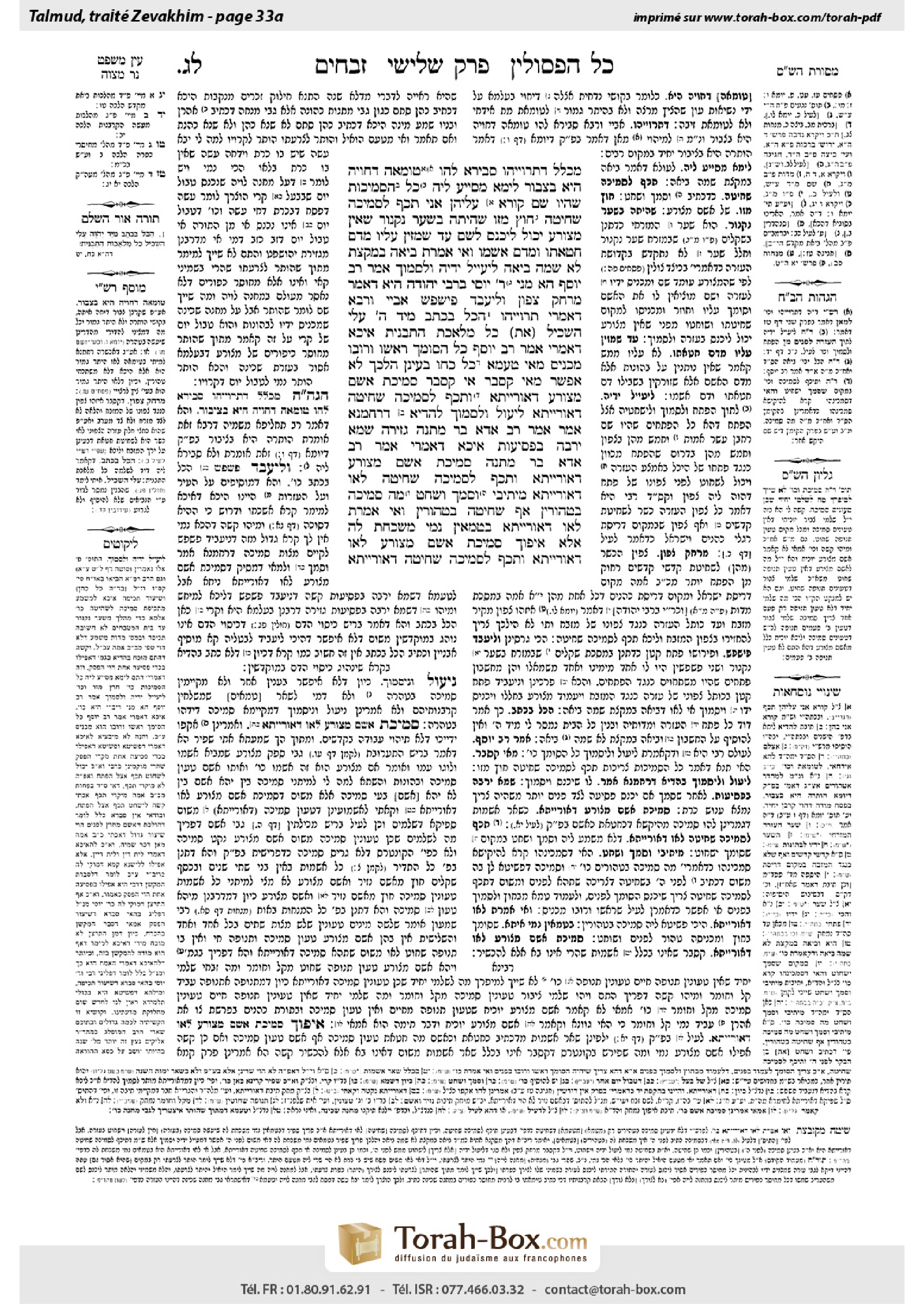
Zevachim 33a: Talmud study for Daf Yomi
Daf Yomi is the daily study of one Talmud folio. Explore 37 tractates with scans, Hebrew text, Sefaria English and AI-generated French translations where annotated.
Passage selection and English or AI-generated French translation are available where the scan has annotations. Daf Study is independent of Torah-Box and Sefaria.
Browse Zevachim · זבחים · All tractatesZevachim 33a text and translations
This page of Zevachim includes the Aramaic text, an English translation and an AI-generated French translation, alongside the scan above.
זבחים ל״ג א · Aramaic and Hebrew text
מִכְּלָל דְּתַרְוַיְיהוּ סְבִירָא לְהוּ: טוּמְאָה דְּחוּיָה הִיא בְּצִבּוּר.
לֵימָא מְסַיַּיע לֵיהּ: כׇּל הַסְּמִיכוֹת שֶׁהָיוּ שָׁם קוֹרֵא עֲלֵיהֶן אֲנִי תֵּכֶף לִסְמִיכָה שְׁחִיטָה;
חוּץ מִזּוֹ שֶׁהָיְתָה בְּשַׁעַר נִקָּנוֹר, שֶׁאֵין מְצוֹרָע יָכוֹל לִיכָּנֵס לְשָׁם עַד שֶׁמַּזִּין עָלָיו מִדַּם חַטָּאתוֹ וּמִדַּם אֲשָׁמוֹ. וְאִי אָמְרַתְּ בִּיאָה בְּמִקְצָת לֹא שְׁמָהּ בִּיאָה – לִיעַיֵּיל יְדֵיהּ וְלִסְמוֹךְ!
אָמַר רַב יוֹסֵף: הָא מַנִּי – רַבִּי יוֹסֵי בְּרַבִּי יְהוּדָה הִיא, דְּאָמַר: מְרַחַק צָפוֹן.
וְלֶיעֱבֵד פִּישְׁפֵּשׁ! אַבָּיֵי וְרָבָא דְּאָמְרִי תַּרְוַיְיהוּ: ״הַכֹּל בִּכְתָב מִיַּד ה׳ עָלַי הִשְׂכִּיל אֶת כׇּל מְלֶאכֶת הַתַּבְנִית״.
אִיכָּא דְּאָמְרִי, אָמַר רַב יוֹסֵף: כָּל הַסּוֹמֵךְ – רֹאשׁוֹ וְרוּבּוֹ מַכְנִיס, מַאי טַעְמָא? כֹּל כֹּחוֹ בָּעֵינַן; הִלְכָּךְ לָא אֶפְשָׁר.
מַאי קָסָבַר? אִי קָסָבַר סְמִיכַת אֲשַׁם מְצוֹרָע דְּאוֹרָיְיתָא, וְתֵכֶף לִסְמִיכָה שְׁחִיטָה דְּאוֹרָיְיתָא – לֵיעוּל וְלִסְמוֹךְ לְהֶדְיָא, דְּרַחֲמָנָא אָמַר!
אָמַר רַב אַדָּא בַּר מַתְנָה: גְּזֵירָה שֶׁמָּא יַרְבֶּה בִּפְסִיעוֹת. אִיכָּא דְּאָמְרִי, אָמַר רַב אַדָּא בַּר מַתְנָה: סְמִיכַת אֲשַׁם מְצוֹרָע דְּאוֹרָיְיתָא, וְתֵכֶף לִסְמִיכָה שְׁחִיטָה לָאו דְּאוֹרָיְיתָא.
מֵיתִיבִי: ״וְסָמַךְ... וְשָׁחַט״ – מָה סְמִיכָה בִּטְהוֹרִין, אַף שְׁחִיטָה בִּטְהוֹרִין. וְאִי אָמְרַתְּ לָאו דְּאוֹרָיְיתָא – בִּטְמֵאִין נָמֵי מַשְׁכַּחַתְּ לַהּ!
אֶלָּא אֵיפוֹךְ – סְמִיכַת אֲשַׁם מְצוֹרָע לָאו דְּאוֹרָיְיתָא, וְתֵכֶף לִסְמִיכָה שְׁחִיטָה דְּאוֹרָיְיתָא.
Zevachim 33a · English translation
The Gemara comments: It can be derived by inference that both Abaye and Rava hold that impurity is overridden in cases involving the public and is not entirely permitted.
The Gemara returns to discussing Ulla’s statement that partial entry of a ritually impure individual is considered entry: Let us say that a baraita (Tosefta, Nega’im 8:10) supports Ulla’s opinion: Concerning all the cases of placing hands that were there in the Temple, I say about them that the principle: Immediately following the placing of hands on the head of an offering is its slaughter, is applied, meaning that these acts must take place uninterruptedly and in the same location.
This is so except for this case of a leper who places hands on his guilt offering, which was done in the threshold of the Nicanor Gate and not in the Temple courtyard where the guilt offering was slaughtered. The reason for this is that a leper cannot enter the courtyard until they sprinkle from the blood of his sin offering and from the blood of his guilt offering on the altar on his behalf. The Gemara explains the proof: And if you say that partial entry is not considered entry, let him insert his hands and place them on the head of the offering, and the offering should then be slaughtered in that location next to the gate.
Rav Yosef said: There is no proof from here, as in accordance with whose opinion is this baraita? It is in accordance with the opinion of Rabbi Yosei, son of Rabbi Yehuda, who says that the northern side of the courtyard in which it is permitted to slaughter offerings of the most sacred order, which includes a guilt offering, includes only the area to the north of the altar and not the entire northern section of the courtyard. This area is far north of the entrance to the courtyard, i.e., more than twenty-two cubits away. Consequently, even if the leper were to insert his hands into the courtyard and place them on the head of his guilt offering, it would not be permitted to slaughter it there.
The Gemara suggests: But let an opening [pishpash] be made in the northern courtyard wall facing the altar, where the leper can insert his hands. The Gemara explains: Abaye and Rava both say that such structural changes cannot be made to the Temple, since the verse states with regard to the Temple construction: “All in writing, as the Lord has made me wise by His hand upon me, even all the works of this pattern” (I Chronicles 28:19).
There are those who say that Rabbi Yosef said another explanation as to why the leper cannot insert his hands into the courtyard and place them on the head of the offering: Anyone who places hands on the head of an offering must insert his head and most of his body into the courtyard. What is the reason? We require placing hands with all of his force. Therefore, it is not possible for the leper to perform the placing of his hands properly without entering the courtyard, and the placing of hands on the offering is done instead in the threshold of the Nicanor Gate.
The Gemara clarifies: What does the tanna of the baraita hold? If he holds that placing hands on the head of a guilt offering of a leper is by Torah law, and the principle that immediately following the placing of hands on the head of an offering must be its slaughter is also by Torah law, let the leper openly insert his hands into the courtyard and place them on the head of the offering, as the Merciful One states in the Torah that he must do so.
Rav Adda bar Mattana says: In principle that should be done. But the prohibition against the leper entering the courtyard is a rabbinic decree, due to the concern that perhaps he will increase his steps, enter the courtyard more than is necessary, and be liable for entering there in a state of impurity. There are those who say that Rav Adda bar Mattana says that placing hands on the head of a guilt offering of a leper is indeed by Torah law, but the requirement that immediately following the placing of hands is the slaughter is not by Torah law. Therefore, he places hands on the offering outside of the courtyard.
The Gemara raises an objection from a baraita cited previously (32a): The verse states: “And he shall place his hand upon the head of the burnt offering…And he shall slaughter the bull” (Leviticus 1:4–5). Just as placing hands may be performed only by ritually pure individuals, so too, the slaughter may be performed only by ritually pure individuals. And if you say that the requirement that placing hands must immediately precede the slaughter is not by Torah law, then with regard to ritually impure individuals you also find that placing hands may be performed, since they can do so outside the courtyard.
Rather, reverse it and say that placing hands on the head of the guilt offering of a leper is not by Torah law, and therefore the leper must do so outside the courtyard, but with regard to offerings that require placing of hands by Torah law, the requirement that immediately following the placing of hands must be the slaughter is by Torah law.
Zevachim 33a · Traduction française (IA)
La Guemara fait remarquer qu’on peut déduire qu’Abayé comme Rava considèrent que l’impureté est écartée dans les cas qui concernent la collectivité, mais qu’elle n’est pas entièrement permise.
La Guemara revient sur l’énoncé d’Oula selon lequel une entrée partielle d’un individu en état d’impureté rituelle est considérée comme une entrée. On peut supposer qu’une baraïta (Tossefta, Negaïm 8:10) appuie l’avis d’Oula : « À propos de tous les cas d’imposition des mains qui avaient lieu dans le Temple, je dis que le principe suivant s’applique : immédiatement après l’imposition des mains sur la tête d’une offrande vient son égorgement », c’est-à-dire que ces actes doivent se succéder sans interruption et avoir lieu au même endroit.
La seule exception est le cas du lépreux qui impose les mains sur son sacrifice de culpabilité : cela se faisait sur le seuil de la porte de Nicanor, et non dans le parvis du Temple, où le sacrifice de culpabilité était égorgé. En effet, le lépreux ne peut entrer dans le parvis avant qu’on ait fait pour lui l’aspersion, sur l’autel, du sang de son sacrifice expiatoire et de celui de son sacrifice de culpabilité. La Guemara explique la preuve : si tu dis qu’une entrée partielle n’est pas considérée comme une entrée, qu’il avance les mains et les pose sur la tête de l’offrande, puis que celle-ci soit égorgée à cet endroit, près de la porte.
Rav Yossef dit : il n’y a pas de preuve ici, car de qui cette baraïta suit-elle l’opinion ? Elle suit celle de Rabbi Yossi, fils de Rabbi Yehouda, qui dit que la partie nord du parvis où l’on peut égorger les offrandes de sainteté supérieure, notamment un sacrifice de culpabilité, se limite à la zone située au nord de l’autel et ne comprend pas toute la partie nord du parvis. Cette zone se trouve loin au nord de l’entrée du parvis, c’est-à-dire à plus de vingt-deux coudées de celle-ci. Par conséquent, même si le lépreux avançait les mains dans le parvis et les posait sur la tête de son sacrifice de culpabilité, il ne serait pas permis de l’y égorger.
La Guemara propose : qu’on aménage une ouverture [pishpash] dans le mur nord du parvis, face à l’autel, par laquelle le lépreux pourrait avancer les mains. La Guemara explique : Abayé et Rava disent tous deux qu’on ne peut pas apporter de telles modifications à la structure du Temple, car le verset dit à propos de sa construction : « Tout cela par écrit, par la main de l’Éternel qui m’a donné l’intelligence, pour tous les travaux du modèle » (I Chroniques 28:19).
Certains disent que Rav Yossef a donné une autre explication au fait que le lépreux ne peut pas avancer les mains dans le parvis et les poser sur la tête de l’offrande : quiconque impose les mains sur la tête d’une offrande doit faire entrer sa tête et la majeure partie de son corps dans le parvis. Pourquoi ? Parce que l’imposition des mains doit se faire de toute sa force. Le lépreux ne peut donc pas imposer correctement les mains sans entrer dans le parvis ; l’imposition des mains sur l’offrande se fait par conséquent sur le seuil de la porte de Nicanor.
La Guemara précise : quelle est l’opinion du tanna de la baraïta ? S’il estime que, selon la Torah, il faut imposer les mains sur la tête du sacrifice de culpabilité du lépreux, et que, selon la Torah également, l’égorgement doit suivre immédiatement l’imposition des mains sur la tête d’une offrande, alors que le lépreux avance ouvertement les mains dans le parvis et les pose sur la tête de l’offrande, puisque le Miséricordieux a prescrit dans la Torah qu’il le fasse.
Rav Adda bar Mattana dit : en principe, c’est ainsi qu’il faudrait procéder. Mais l’interdiction faite au lépreux d’entrer dans le parvis est un décret rabbinique, motivé par la crainte qu’il n’allonge le pas et ne pénètre dans le parvis plus qu’il n’est nécessaire, s’exposant ainsi à être coupable d’y entrer en état d’impureté. Certains disent que, selon Rav Adda bar Mattana, l’imposition des mains sur la tête du sacrifice de culpabilité du lépreux est bien une obligation de la Torah, mais que l’exigence selon laquelle l’égorgement doit suivre immédiatement l’imposition des mains n’est pas une obligation de la Torah. Il impose donc les mains sur l’offrande à l’extérieur du parvis.
La Guemara soulève une objection à partir d’une baraïta citée précédemment (32a) : le verset dit : « Il posera sa main sur la tête de l’holocauste… Puis il égorgera le taureau » (Lévitique 1:4–5). De même que seuls des individus rituellement purs peuvent imposer les mains, seuls des individus rituellement purs peuvent procéder à l’égorgement. Si tu dis que l’exigence selon laquelle l’imposition des mains doit précéder immédiatement l’égorgement n’est pas une obligation de la Torah, alors on devrait également considérer que les individus en état d’impureté rituelle peuvent imposer les mains, puisqu’ils peuvent le faire à l’extérieur du parvis.
Il faut plutôt inverser les termes et dire que l’imposition des mains sur la tête du sacrifice de culpabilité du lépreux n’est pas une obligation de la Torah ; c’est pourquoi le lépreux doit la faire à l’extérieur du parvis. En revanche, pour les offrandes dont l’imposition des mains est une obligation de la Torah, l’exigence selon laquelle l’égorgement doit suivre immédiatement l’imposition des mains est, elle aussi, une obligation de la Torah.
Traduction française générée par IA à partir de l’édition anglaise de Sefaria. Vérifie toujours un passage avec le texte source.
Text from Sefaria: William Davidson Edition - Vocalized Aramaic (CC BY NC); William Davidson Edition - English (CC BY NC).