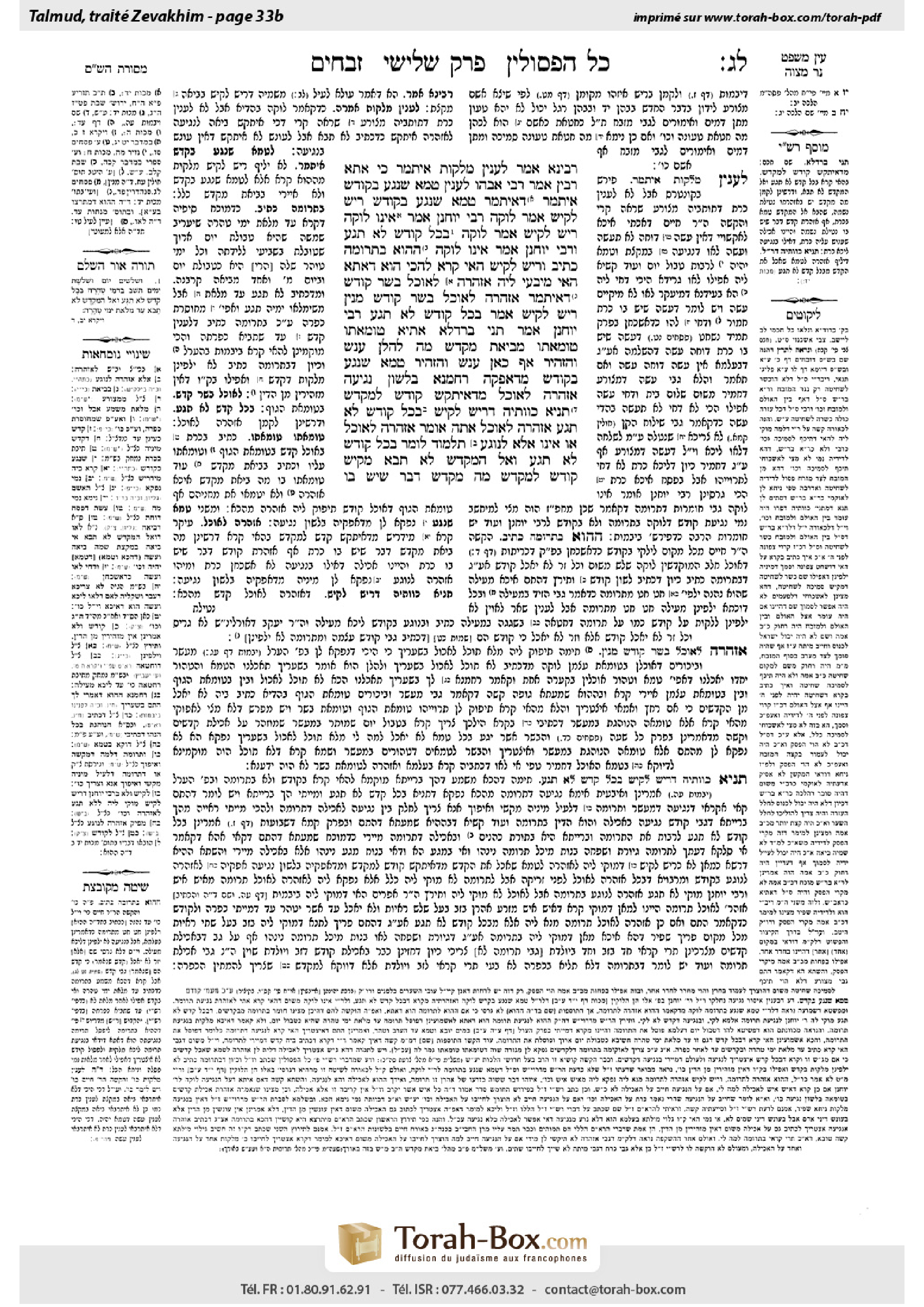
Zevachim 33b: Talmud study for Daf Yomi
Daf Yomi is the daily study of one Talmud folio. Explore 37 tractates with scans, Hebrew text, Sefaria English and AI-generated French translations where annotated.
Passage selection and English or AI-generated French translation are available where the scan has annotations. Daf Study is independent of Torah-Box and Sefaria.
Browse Zevachim · זבחים · All tractatesZevachim 33b text and translations
This page of Zevachim includes the Aramaic text, an English translation and an AI-generated French translation, alongside the scan above.
זבחים ל״ג ב · Aramaic and Hebrew text
רָבִינָא אָמַר: לְעִנְיַן מַלְקוֹת אִיתְּמַר.
כִּי אֲתָא רָבִין, אָמַר רַבִּי אֲבָהוּ: לְעִנְיַן טָמֵא שֶׁנָּגַע בַּקּוֹדֶשׁ אִיתְּמַר.
דְּאִיתְּמַר: טָמֵא שֶׁנָּגַע בְּקוֹדֶשׁ – רֵישׁ לָקִישׁ אָמַר: לוֹקֶה, רַבִּי יוֹחָנָן אָמַר: אֵינוֹ לוֹקֶה. רֵישׁ לָקִישׁ אָמַר לוֹקֶה – ״בְּכׇל קֹדֶשׁ לֹא תִגָּע״. וְרַבִּי יוֹחָנָן אָמַר אֵינוֹ לוֹקֶה – הָהוּא בִּתְרוּמָה כְּתִיב.
וְרֵישׁ לָקִישׁ – הַאי קְרָא לְהָכִי הוּא דַּאֲתָא?! הַאי מִיבְּעֵי לֵיהּ: אַזְהָרָה לְאוֹכֵל בְּשַׂר קוֹדֶשׁ! דְּאִיתְּמַר: אַזְהָרָה לָאוֹכֵל בְּשַׂר קוֹדֶשׁ מִנַּיִן? רֵישׁ לָקִישׁ אָמַר: ״בְּכׇל קֹדֶשׁ לֹא תִגָּע״.
רַבִּי יוֹחָנָן אָמַר: תָּנֵי בַּרְדְּלָא, אָתְיָא ״טוּמְאָתוֹ״–״טוּמְאָתוֹ״ מִבִּיאַת מִקְדָּשׁ; מָה לְהַלָּן עָנַשׁ וְהִזְהִיר, אַף כָּאן עָנַשׁ וְהִזְהִיר.
טָמֵא שֶׁנָּגַע בַּקּוֹדֶשׁ – מִדְּאַפְּקַהּ רַחֲמָנָא בִּלְשׁוֹן נְגִיעָה; אַזְהָרָה לָאוֹכֵל – מִדְּאִיתַּקַּשׁ קוֹדֶשׁ לְמִקְדָּשׁ.
תַּנְיָא כְּוָותֵיהּ דְּרֵישׁ לָקִישׁ: ״בְּכׇל קֹדֶשׁ לֹא תִגָּע״ – אַזְהָרָה לָאוֹכֵל. אַתָּה אוֹמֵר אַזְהָרָה לְאוֹכֵל; אוֹ אֵינוֹ אֶלָּא לַנּוֹגֵעַ?
תַּלְמוּד לוֹמַר: ״בְּכׇל קֹדֶשׁ לֹא תִגָּע וְאֶל הַמִּקְדָּשׁ לֹא תָבֹא״ – מַקִּישׁ קוֹדֶשׁ לְמִקְדָּשׁ; מָה מִקְדָּשׁ – דָּבָר שֶׁיֵּשׁ בּוֹ
Zevachim 33b · English translation
The Gemara returns to Ulla’s statement in the name of Reish Lakish (32b) that an impure individual who inserted his hand into the Temple courtyard is flogged, as partial entry is considered entry. An objection was then raised from the case of the leper, where he is not liable to be punished with karet for partial entry, and Ulla offered one answer. Ravina says that there is another answer: It was stated only with regard to lashes, teaching that one is flogged for partially entering the courtyard while ritually impure. Reish Lakish agrees that there is no punishment of karet for partial entry as there is for a full entry.
When Ravin came from Eretz Yisrael to Babylonia, he said that Rabbi Abbahu says that the statement of Reish Lakish with regard to this verse was stated with regard to a ritually impure individual who touched sacrificial food, and not with regard to partial entry into the courtyard, as Ulla had said.
This is as it was stated: There is an amoraic dispute with regard to an impure person who touched sacrificial food. Reish Lakish says: He is flogged. Rabbi Yoḥanan says: He is not flogged. The Gemara elaborates. Reish Lakish says: He is flogged, as it is written: “Every consecrated item she shall not touch” (Leviticus 12:4). And Rabbi Yoḥanan says: He is not flogged, as that verse is written with regard to touching the portion of the produce designated for the priest [teruma].
The Gemara asks: But does Reish Lakish actually hold that this verse comes to teach this halakha? He requires this verse to teach a prohibition for a ritually impure person who eats sacrificial meat. As it was stated: From where is the prohibition for a ritually impure person who eats sacrificial meat derived? Reish Lakish says it is derived from the verse: “Every consecrated item she shall not touch,” which the Gemara will explain is referring to eating.
Rabbi Yoḥanan says: The Sage Bardela teaches that this prohibition is derived from a verbal analogy of the term “his impurity [tumato]” written with regard to one who eats sacrificial meat while impure (Leviticus 7:20), and the term “his impurity [tumato]” written with regard to one who enters the Temple while impure (Numbers 19:13). Just as there, with regard to entering the Temple while impure, the Torah prescribed the punishment of karet and also explicitly prohibited doing so, so too here, with regard to eating sacrificial meat while impure, the Torah prescribed the punishment of karet and also explicitly prohibited doing so. Clearly, Reish Lakish understood this verse as referring to eating sacrificial meat, not merely touching it.
The Gemara answers: Reish Lakish holds that both can be derived from Leviticus 12:4. The prohibition with regard to a ritually impure individual who touched sacrificial food is derived from the fact that the Merciful One expressed this prohibition with a term of touching, while the prohibition with regard to one who eats sacrificial food while impure is derived from the fact that the Torah juxtaposed the prohibition of eating sacrificial food while impure to the prohibition of entering the Temple while impure in the verse: “Every consecrated item she shall not touch, and to the Temple she shall not come” (Leviticus 12:4).
The Gemara comments: It is taught in a baraita in accordance with the opinion of Reish Lakish. It is written: “Every consecrated item she shall not touch”; this is a prohibition for an impure person who eats sacrificial food. Do you say that it is a prohibition for an impure person who eats sacrificial food, or perhaps it is only a prohibition for an impure person who touches sacrificial food?
The verse states: “Every consecrated item she shall not touch, and to the Temple she shall not come” (Leviticus 12:4). The verse juxtaposes the matter pertaining to sacrificial food to the matter of entering the Temple while ritually impure. Just as entering the Temple is a matter that entails a punishment that involves
Zevachim 33b · Traduction française (IA)
La Guemara revient à la déclaration d’Oulla au nom de Rech Lakich (32b), selon laquelle un individu impur qui introduit sa main dans la cour du Temple est passible de flagellation, car une entrée partielle est considérée comme une entrée. Une objection avait alors été soulevée à partir du cas du lépreux, qui n’est pas passible de karet pour une entrée partielle, et Oulla avait proposé une réponse. Ravina dit qu’il existe une autre réponse : cette déclaration ne concerne que la flagellation et enseigne qu’on est flagellé pour être entré partiellement dans la cour alors qu’on est rituellement impur. Rech Lakich convient qu’une entrée partielle n’entraîne pas la peine de karet, contrairement à une entrée complète.
Lorsque Ravin vint d’Erets Israël en Babylonie, il rapporta que Rabbi Abbahou disait que la déclaration de Rech Lakich concernant ce verset portait sur un individu rituellement impur qui avait touché un aliment consacré, et non sur une entrée partielle dans la cour, comme l’avait dit Oulla.
C’est ce qui fut enseigné : il existe une controverse entre amoraïm au sujet d’une personne impure qui a touché un aliment consacré. Rech Lakich dit : Elle est passible de flagellation. Rabbi Yoḥanan dit : Elle n’est pas passible de flagellation. La Guemara développe. Rech Lakich dit qu’elle est passible de flagellation, car il est écrit : « Elle ne touchera aucun objet consacré » (Lévitique 12:4). Rabbi Yoḥanan dit qu’elle n’est pas passible de flagellation, car ce verset est écrit au sujet du contact avec la part de la récolte réservée au prêtre [terouma].
La Guemara demande : Mais Rech Lakich estime-t-il réellement que ce verset vient enseigner cette halakha ? Il a besoin de ce verset pour enseigner l’interdiction faite à une personne rituellement impure de consommer de la viande consacrée. En effet, il fut enseigné : d’où déduit-on l’interdiction faite à une personne rituellement impure de consommer de la viande consacrée ? Rech Lakich dit qu’elle se déduit du verset : « Elle ne touchera aucun objet consacré », que la Guemara expliquera comme faisant référence à la consommation.
Rabbi Yoḥanan dit : Le Sage Bardela enseigne que cette interdiction se déduit d’une analogie verbale entre le terme « son impureté [tumato] », écrit à propos de celui qui consomme de la viande consacrée en état d’impureté (Lévitique 7:20), et le terme « son impureté [tumato] », écrit à propos de celui qui entre dans le Temple en état d’impureté (Nombres 19:13). De même que, dans le cas de l’entrée dans le Temple en état d’impureté, la Torah a prescrit la peine de karet et a également explicitement interdit cet acte, de même, dans le cas de la consommation de viande consacrée en état d’impureté, la Torah a prescrit la peine de karet et a également explicitement interdit cet acte. Il est donc clair que Rech Lakich comprenait ce verset comme faisant référence à la consommation de viande consacrée, et non au simple fait d’y toucher.
La Guemara répond : Rech Lakich estime que les deux interdictions peuvent être déduites de Lévitique 12:4. L’interdiction concernant un individu rituellement impur qui a touché un aliment consacré se déduit du fait que le Miséricordieux a formulé cette interdiction au moyen d’un terme désignant le contact. L’interdiction concernant celui qui consomme un aliment consacré en état d’impureté se déduit du fait que la Torah a juxtaposé l’interdiction de consommer un aliment consacré en état d’impureté à celle d’entrer dans le Temple en état d’impureté, dans le verset : « Elle ne touchera aucun objet consacré et elle ne viendra pas au Temple » (Lévitique 12:4).
La Guemara fait remarquer : une baraïta est enseignée conformément à l’opinion de Rech Lakich. Il est écrit : « Elle ne touchera aucun objet consacré » ; cela interdit à une personne impure de consommer de la viande consacrée. Dis-tu qu’il s’agit d’une interdiction faite à une personne impure de consommer de la viande consacrée, ou peut-être s’agit-il seulement d’une interdiction faite à une personne impure de toucher de la viande consacrée ?
Le verset dit : « Elle ne touchera aucun objet consacré et elle ne viendra pas au Temple » (Lévitique 12:4). Le verset juxtapose ce qui concerne les aliments consacrés à ce qui concerne l’entrée dans le Temple en état d’impureté rituelle. De même que l’entrée dans le Temple est une question qui entraîne une peine impliquant
Traduction française générée par IA à partir de l’édition anglaise de Sefaria. Vérifie toujours un passage avec le texte source.
Text from Sefaria: William Davidson Edition - Vocalized Aramaic (CC BY NC); William Davidson Edition - English (CC BY NC).