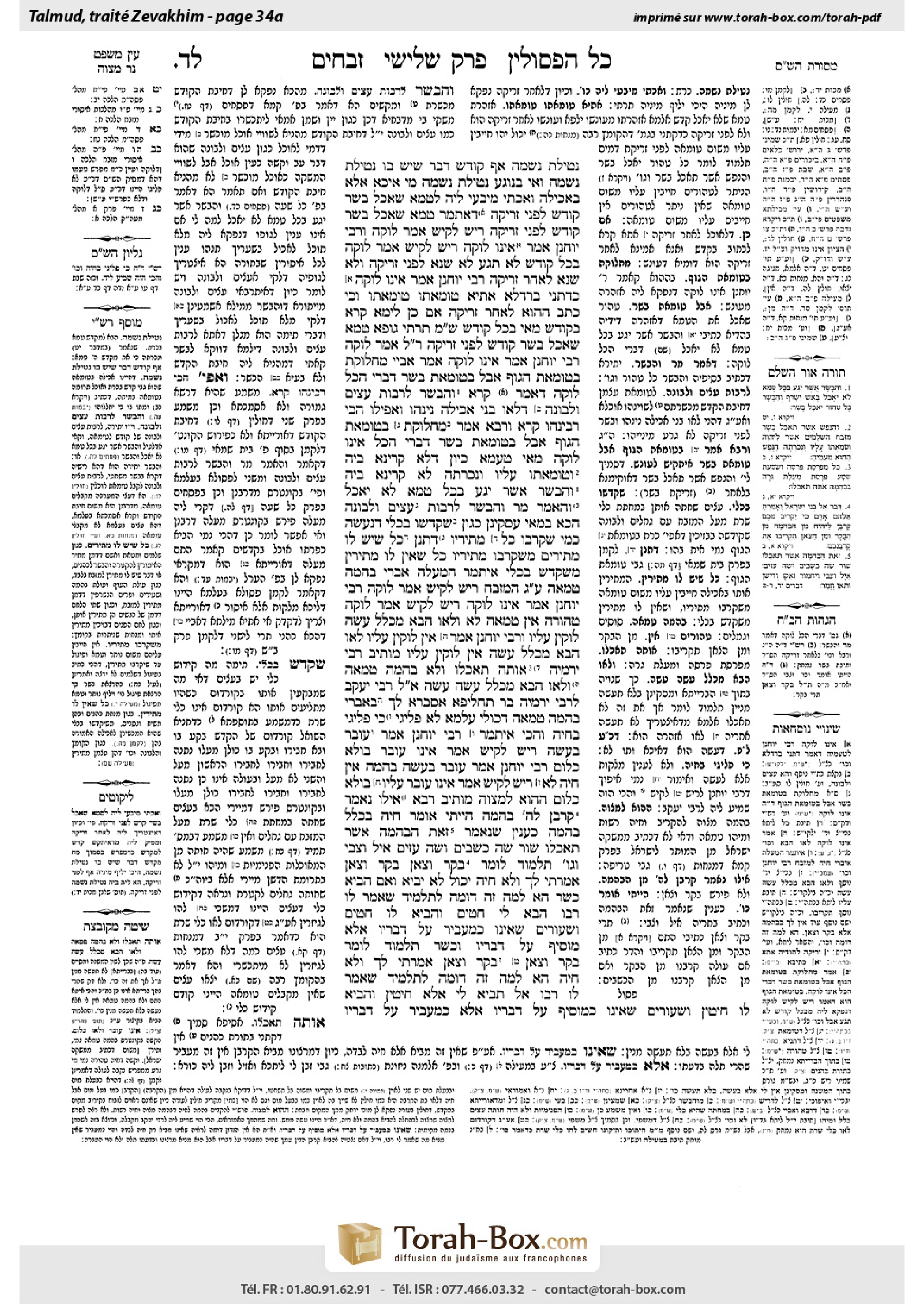
Zevachim 34a: Talmud study for Daf Yomi
Daf Yomi is the daily study of one Talmud folio. Explore 37 tractates with scans, Hebrew text, Sefaria English and AI-generated French translations where annotated.
Passage selection and English or AI-generated French translation are available where the scan has annotations. Daf Study is independent of Torah-Box and Sefaria.
Browse Zevachim · זבחים · All tractatesZevachim 34a text and translations
This page of Zevachim includes the Aramaic text, an English translation and an AI-generated French translation, alongside the scan above.
זבחים ל״ד א · Aramaic and Hebrew text
נְטִילַת נְשָׁמָה, אַף קוֹדֶשׁ – דָּבָר שֶׁיֵּשׁ בּוֹ נְטִילַת נְשָׁמָה. וְאִי בְּנוֹגֵעַ – נְטִילַת נְשָׁמָה מִי אִיכָּא?! אֶלָּא בַּאֲכִילָה.
וְאַכַּתִּי מִיבְּעֵי לֵיהּ לְטָמֵא שֶׁאָכַל בְּשַׂר קוֹדֶשׁ לִפְנֵי זְרִיקָה! דְּאִתְּמַר: טָמֵא שֶׁאָכַל בְּשַׂר קוֹדֶשׁ לִפְנֵי זְרִיקָה – רֵישׁ לָקִישׁ אָמַר: לוֹקֶה, וְרַבִּי יוֹחָנָן אָמַר: אֵינוֹ לוֹקֶה.
רֵישׁ לָקִישׁ אָמַר לוֹקֶה – ״בְּכׇל קֹדֶשׁ לֹא תִגָּע״, לָא שְׁנָא לִפְנֵי זְרִיקָה וְלָא שְׁנָא לְאַחַר זְרִיקָה. רַבִּי יוֹחָנָן אָמַר אֵינוֹ לוֹקֶה – כִּדְתָנֵי בַּרְדְּלָא: אָתְיָא ״טוּמְאָתוֹ״–״טוּמְאָתוֹ״, וְכִי כְּתַב הָהוּא – לְאַחַר זְרִיקָה.
אִם כֵּן, לֵימָא קְרָא ״בְּקֹדֶשׁ״; מַאי ״בְּכׇל קֹדֶשׁ״? שְׁמַע מִינַּהּ תַּרְתֵּי.
גּוּפָא – טָמֵא שֶׁאָכַל בְּשַׂר קוֹדֶשׁ לִפְנֵי זְרִיקָה, רֵישׁ לָקִישׁ אָמַר: לוֹקֶה, רַבִּי יוֹחָנָן אָמַר: אֵינוֹ לוֹקֶה. אָמַר אַבָּיֵי: מַחְלוֹקֶת בְּטוּמְאַת הַגּוּף, אֲבָל בְּטוּמְאַת בָּשָׂר – דִּבְרֵי הַכֹּל לוֹקֶה.
דְּאָמַר קְרָא: ״וְהַבָּשָׂר״ – לְרַבּוֹת עֵצִים וּלְבוֹנָה דְּלָאו בְּנֵי אֲכִילָה נִינְהוּ, וַאֲפִילּוּ הָכִי רַבִּינְהוּ קְרָא.
וְרָבָא אָמַר: מַחְלוֹקֶת בְּטוּמְאַת הַגּוּף, אֲבָל בְּטוּמְאַת בָּשָׂר – דִּבְרֵי הַכֹּל אֵינוֹ לוֹקֶה. מַאי טַעְמָא? כֵּיוָן דְּלָא קָרֵינָא בֵּיהּ ״וְטוּמְאָתוֹ עָלָיו וְנִכְרְתָה״, לָא קָרֵינָא בֵּיהּ ״וְהַבָּשָׂר אֲשֶׁר יִגַּע בְּכׇל טָמֵא לֹא יֵאָכֵל״.
וְהָאָמַר מָר: ״וְהַבָּשָׂר״ – לְרַבּוֹת עֵצִים וּלְבוֹנָה!
הָכָא בְּמַאי עָסְקִינַן – כְּגוֹן שֶׁקָּדְשׁוּ בִּכְלִי, דְּנַעֲשָׂה כְּמִי שֶׁקָּרְבוּ כָּל מַתִּירָיו.
דִּתְנַן: כֹּל שֶׁיֵּשׁ לוֹ מַתִּירִים – מִשֶּׁקָּרְבוּ מַתִּירָיו. כֹּל שֶׁאֵין לוֹ מַתִּירִין – מִשֶּׁקָּדַשׁ בִּכְלִי.
אִיתְּמַר: הַמַּעֲלֶה אֵבְרֵי בְּהֵמָה טְמֵאָה עַל גַּבֵּי הַמִּזְבֵּחַ – רֵישׁ לָקִישׁ אָמַר: לוֹקֶה, רַבִּי יוֹחָנָן אָמַר: אֵינוֹ לוֹקֶה. רֵישׁ לָקִישׁ אָמַר לוֹקֶה – טְהוֹרָה אִין, טְמֵאָה לָא, וְלָאו הַבָּא מִכְּלַל עֲשֵׂה לוֹקִין עָלָיו. וְרַבִּי יוֹחָנָן אָמַר אֵין לוֹקִין עָלָיו – לָאו הַבָּא מִכְּלַל עֲשֵׂה אֵין לוֹקִין עָלָיו.
מוֹתֵיב רַבִּי יִרְמְיָה: ״אֹתָהּ תֹּאכֵלוּ״ – וְלֹא בְּהֵמָה טְמֵאָה; וְלָאו הַבָּא מִכְּלַל עֲשֵׂה, עֲשֵׂה.
אֲמַר לֵיהּ רַבִּי יַעֲקֹב לְרַבִּי יִרְמְיָה בַּר תַּחְלִיפָא, אַסְבְּרַהּ לָךְ: בְּאֵבְרֵי בְּהֵמָה טְמֵאָה – דְּכוּלֵּי עָלְמָא לָא פְּלִיגִי. כִּי פְלִיגִי – בְּחַיָּה; וְהָכִי אִיתְּמַר: רַבִּי יוֹחָנָן אָמַר: עוֹבֵר בַּעֲשֵׂה, רֵישׁ לָקִישׁ אָמַר: אֵינוֹ עוֹבֵר בִּוְלֹא כְּלוּם.
רַבִּי יוֹחָנָן אָמַר עוֹבֵר בַּעֲשֵׂה – בְּהֵמָה אִין, חַיָּה לָא. רֵישׁ לָקִישׁ אָמַר אֵינוֹ עוֹבֵר עָלָיו בִּוְלֹא כְּלוּם – הָהוּא לְמִצְוָה.
מוֹתֵיב רָבָא: אִילּוּ נֶאֱמַר ״קׇרְבָּן לַה׳ בְּהֵמָה״ – הָיִיתִי אוֹמֵר: חַיָּה בִּכְלַל בְּהֵמָה, כְּעִנְיָן שֶׁנֶּאֱמַר: ״זֹאת הַבְּהֵמָה אֲשֶׁר תֹּאכֵלוּ שׁוֹר שֵׂה כְשָׂבִים וְשֵׂה עִזִּים אַיָּל וּצְבִי וְגוֹ׳״. תַּלְמוּד לוֹמַר: ״בָּקָר וָצֹאן״ – בָּקָר וָצֹאן אָמַרְתִּי לְךָ, וְלֹא חַיָּה.
יָכוֹל לֹא יָבִיא, וְאִם הֵבִיא כָּשֵׁר? הָא לְמָה זֶה דּוֹמֶה – לְתַלְמִיד שֶׁאָמַר לוֹ רַבּוֹ ״הָבֵא לִי חִטִּים״, וְהֵבִיא לוֹ חִטִּים וּשְׂעוֹרִים, שֶׁאֵינוֹ כְּמַעֲבִיר עַל דְּבָרָיו אֶלָּא מוֹסִיף עַל דְּבָרָיו, וְכָשֵׁר.
תַּלְמוּד לוֹמַר: ״בָּקָר וָצֹאן״ – בָּקָר וָצֹאן אָמַרְתִּי לְךָ, וְלֹא חַיָּה. הָא לְמָה זֶה דּוֹמֶה? לְתַלְמִיד שֶׁאָמַר לוֹ רַבּוֹ ״אַל תָּבִיא לִי אֶלָּא חִיטִּין״, וְהֵבִיא לוֹ חִיטִּין וּשְׂעוֹרִים, שֶׁאֵינוֹ כְּמוֹסִיף עַל דְּבָרָיו אֶלָּא כְּמַעֲבִיר עַל דְּבָרָיו,
Zevachim 34a · English translation
the taking of a life, i.e., karet, so too, the matter pertaining to sacrificial food entails a punishment that involves the taking of a life. The Gemara explains: And if the prohibition is with regard to touching sacrificial food, is there a punishment that entails the taking of a life? Rather, the prohibition is with regard to eating.
The Gemara asks: But this verse is still necessary for Reish Lakish to teach the halakha of a ritually impure person who ate sacrificial meat before the sprinkling of the blood of the offering on the altar, when the meat is not yet permitted. As it was stated: With regard to an impure individual who ate sacrificial meat before the sprinkling of the blood, Reish Lakish says: He is flogged for doing so, and Rabbi Yoḥanan says: He is not flogged.
Reish Lakish says: He is flogged, as it is written: “Every consecrated item she shall not touch,” without limiting the prohibition to a specific time, indicating that it is no different if one eats the sacrificial meat prior to sprinkling the blood, and it is no different if one does so after sprinkling the blood. Rabbi Yoḥanan says: He is not flogged, as the Sage Bardela teaches that the prohibition is derived by means of the verbal analogy cited before, as the verse states “his impurity” with regard to an impure person who eats sacrificial food, and states “his impurity” with regard to an impure person entering the Temple. And when “his impurity” is written, it is with regard to partaking of sacrificial meat after the sprinkling of the blood (see Leviticus 7:20).
The Gemara answers for Reish Lakish: If so, that the verse was referring only to partaking of sacrificial meat after the sprinkling of the blood, let the verse say: A consecrated item she shall not touch. What is the reason for using the phrase “every consecrated item”? Conclude two conclusions from it, i.e., it also includes not eating sacrificial meat before the sprinkling of the blood.
§ The Gemara discusses the matter itself: With regard to an impure individual who ate sacrificial meat before the sprinkling of the blood, Reish Lakish says: He is flogged for doing so, and Rabbi Yoḥanan says: He is not flogged. Abaye says: This dispute applies with regard to a case of impurity of the body of the one who eats the meat, but with regard to impurity of the flesh itself, i.e., if the sacrificial meat was ritually impure, all agree that he is flogged.
This is as the verse states: “And the flesh that touches any impure item shall not be eaten; it shall be burned with fire; and the flesh, every one that is pure may eat the flesh” (Leviticus 7:19). The Sages derived that the extra term “and the flesh” serves to include wood and frankincense, which are not fit for consumption, and even so the verse included them as being susceptible to impurity, and one who eats them while he is impure is flogged. Therefore, sacrificial meat before the sprinkling of the blood, which is fit for consumption, is certainly included in the prohibition.
And Rava says: This dispute applies with regard to a case of impurity of the body, but with regard to impurity of the meat all agree that he is not flogged. What is the reason? Since one does not apply to meat before the sprinkling of the blood the verse: “But the soul that eats of the flesh of the sacrifice of peace offerings of the Lord, having his impurity upon him, that soul shall be cut off from his people” (Leviticus 7:20), which is referring to meat after the sprinkling of the blood, so too, one does not apply to it the prohibition: “And the flesh that touches any impure item shall not be eaten” (Leviticus 7:19).
The Gemara challenges the statement of Rava: But doesn’t the Master say that the term “and the flesh” serves to include wood and frankincense that became impure as items that are forbidden to be eaten, despite the fact that they are not fit for consumption? Certainly, then, sacrificial flesh before the sprinkling of the blood should also be included in the category of items forbidden to be eaten.
The Gemara answers: What are we dealing with here, that one would be liable for eating wood and frankincense that are impure? It is a case where the wood and frankincense were sanctified in a vessel, and the reason for the liability is that they are then considered like an item for which all of its permitting factors were sacrificed, such as flesh after the sprinkling of the blood, and only then is one liable for eating it while impure.
This is as we learned in a mishna (Me’ila 10a): With regard to anything that has permitting factors, i.e., rites that must be performed or items that must be sacrificed before the meat of the offering may be eaten, such as the meat of an offering that is permitted to be eaten by the sprinkling of the blood; one is liable for eating it while impure from the time that its permitting factors were sacrificed. With regard to anything that does not have permitting factors, such as the handful removed from a meal offering and the frankincense, which themselves render the rest of the meal offering permitted for consumption, one is liable for eating it while impure from the time it is sanctified in a vessel.
§ It was stated: In the case of one who offers up the limbs of a non-kosher animal upon the altar, Reish Lakish says: He is flogged for doing so, while Rabbi Yoḥanan says: He is not flogged. The Gemara explains the logic for each opinion: Reish Lakish says that he is flogged, because there is a positive mitzva to sacrifice an offering from the herd and the flock (see Leviticus 1:2), which are kosher animals. Therefore, it can be inferred that a kosher animal, yes, one may sacrifice, but a non-kosher animal one may not sacrifice, and one who transgresses a prohibition that stems from a positive mitzva is flogged for it. And Rabbi Yoḥanan says: One is not flogged for it, as one who transgresses a prohibition that stems from a positive mitzva is not flogged for it.
Rabbi Yirmeya raises an objection to the opinion of Reish Lakish from a baraita cited in Torat Kohanim: “Whatsoever parts the hoof, and is wholly cloven-footed, and chews the cud, among the beasts, that may you eat” (Leviticus 11:3). One can infer: But you may not eat a non-kosher animal; and a prohibition that stems from a positive mitzva has the status of a positive mitzva.
Rabbi Ya’akov said to Rabbi Yirmeya bar Taḥlifa: I will explain it to you: With regard to one who sacrifices the limbs of a non-kosher animal upon the altar, everyone agrees that he is not flogged, as he violates only a positive mitzva. When they disagree, it is with regard to one who sacrifices a kosher undomesticated animal on the altar, and it was stated like this: Rabbi Yoḥanan says: He transgresses a positive mitzva. Reish Lakish says: He does not transgress anything.
The Gemara explains their reasoning: Rabbi Yoḥanan says: He transgresses a positive mitzva, since the Torah commanded that a domesticated animal, yes, should be sacrificed, from which it can be inferred that an undomesticated animal may not be sacrificed, and a prohibition that stems from a positive mitzva has the status of a positive mitzva. Reish Lakish says: He does not transgress anything, since that verse which instructs one to sacrifice offerings from the herd and the flock is referring to the optimal manner of fulfilling the mitzva, but if he sacrificed an undomesticated animal, he has not transgressed the mitzva.
Rava raised an objection from a baraita: Had the verse (Leviticus 1:2) stated only: When any man of you brings an offering to the Lord, animals [behema], I would say that even an undomesticated animal is included in the category of an animal [behema], like that which is stated: “These are the animals [behema] that you may eat: The ox, the sheep, and the goat, the deer, and the gazelle, and the fallow deer, and the wild goat, and the oryx, and the aurochs, and the mountain sheep” (Deuteronomy 14:4–5), and, for example, the deer and gazelle are undomesticated animals. Therefore, the verse states: “From animals, from the cattle and from the flock” (Leviticus 1:2), which indicates that God says: I have told you to bring offerings from the cattle and the flock, but not an undomesticated animal.
One might have thought that one should not bring an undomesticated animal ab initio, but if one did bring it, it is valid, and to what is this comparable? To a student whose teacher says to him: Bring me wheat, and the student brought him wheat and barley. In this case, it is not as though the student is disobeying the statement of the teacher; rather, he is merely adding to his statement, and that should be valid.
Therefore, the verse states again: “From the cattle” (Leviticus 1:3), and: “From the flock” (Leviticus 1:10), to reiterate that God says: I have told you to bring offerings from the cattle and the flock, but not an undomesticated animal. To what is this comparable? To a student whose teacher told him: Bring me only wheat, and the student brought him wheat and barley. It is not as though the student is adding to the statement of the teacher; rather, it is as though he is disobeying his statement, since his teacher instructed him to bring only wheat. Consequently, one who sacrifices an undomesticated animal does not merely add to a mitzva of the Torah, but also violates a prohibition,
Zevachim 34a · Traduction française (IA)
la prise d’une vie, c’est-à-dire le karet ; de même, la question de la nourriture consacrée entraîne une peine qui implique la prise d’une vie. La Guemara explique : Mais si l’interdit porte sur le fait de toucher de la nourriture consacrée, y a-t-il une peine qui implique la prise d’une vie ? Il faut donc plutôt comprendre que l’interdit porte sur le fait d’en manger.
La Guemara demande : Mais ce verset est encore nécessaire pour enseigner, selon Reish Lakish, la halakha concernant une personne rituellement impure qui a mangé de la viande consacrée avant l’aspersion du sang de l’offrande sur l’autel, alors que la viande n’est pas encore permise. En effet, il a été dit : au sujet d’un individu impur qui a mangé de la viande consacrée avant l’aspersion du sang, Reish Lakish dit qu’il reçoit la flagellation, tandis que Rabbi Yoḥanan dit qu’il ne la reçoit pas.
Reish Lakish dit qu’il reçoit la flagellation, car il est écrit : « Toute chose consacrée, elle ne la touchera pas », sans que l’interdit soit limité à un moment particulier. Cela indique qu’il n’y a pas de différence entre manger la viande consacrée avant l’aspersion du sang et la manger après celle-ci. Rabbi Yoḥanan dit qu’il ne reçoit pas la flagellation, car le Sage Bardela enseigne que l’interdit se déduit au moyen de l’analogie verbale citée précédemment : le verset emploie l’expression « son impureté » au sujet d’une personne impure qui mange de la nourriture consacrée, et l’expression « son impureté » au sujet d’une personne impure qui entre dans le Temple. Or, lorsque l’expression « son impureté » est employée, elle concerne la consommation de viande consacrée après l’aspersion du sang (voir Lévitique 7:20).
La Guemara répond en faveur de Reish Lakish : Si le verset ne concernait que la consommation de viande consacrée après l’aspersion du sang, qu’il dise : « Une chose consacrée, elle ne la touchera pas. » Pourquoi employer l’expression « toute chose consacrée » ? Il faut en tirer deux conclusions, c’est-à-dire en déduire également l’interdiction de manger de la viande consacrée avant l’aspersion du sang.
§ La Guemara examine la question elle-même : au sujet d’un individu impur qui a mangé de la viande consacrée avant l’aspersion du sang, Reish Lakish dit qu’il reçoit la flagellation, tandis que Rabbi Yoḥanan dit qu’il ne la reçoit pas. Abaye dit : cette controverse concerne le cas où l’impureté touche le corps de celui qui mange la viande ; mais si c’est la viande elle-même qui est impure, c’est-à-dire si la viande consacrée est rituellement impure, tous conviennent qu’il reçoit la flagellation.
C’est ce qu’indique le verset : « La chair qui touche une chose impure ne sera pas mangée ; elle sera brûlée au feu. Quant à la chair, toute personne pure pourra en manger » (Lévitique 7:19). Les Sages ont déduit que le terme supplémentaire « et la chair » sert à inclure le bois et l’encens, qui ne sont pas propres à la consommation ; malgré cela, le verset les inclut parmi les éléments susceptibles de contracter l’impureté, et celui qui les mange alors qu’il est impur reçoit la flagellation. Par conséquent, la viande consacrée avant l’aspersion du sang, qui est propre à la consommation, est à plus forte raison incluse dans l’interdit.
Rava dit : cette controverse concerne le cas où l’impureté touche le corps ; mais si c’est la viande elle-même qui est impure, tous conviennent qu’il ne reçoit pas la flagellation. Pour quelle raison ? Puisqu’on n’applique pas à la viande consommée avant l’aspersion du sang le verset : « Mais la personne qui mange de la chair du sacrifice de paix de l’Éternel, alors qu’elle porte son impureté, cette personne sera retranchée de son peuple » (Lévitique 7:20), qui concerne la viande après l’aspersion du sang, on ne lui applique pas non plus l’interdit : « La chair qui touche une chose impure ne sera pas mangée » (Lévitique 7:19).
La Guemara conteste la déclaration de Rava : Mais le Maître ne dit-il pas que l’expression « et la chair » sert à inclure le bois et l’encens devenus impurs parmi les éléments dont la consommation est interdite, bien qu’ils ne soient pas propres à être consommés ? À plus forte raison, la chair consacrée avant l’aspersion du sang devrait-elle aussi être incluse dans la catégorie des éléments dont la consommation est interdite.
La Guemara répond : De quel cas s’agit-il ici, où l’on est passible pour avoir mangé du bois et de l’encens impurs ? Il s’agit du cas où le bois et l’encens ont été sanctifiés dans un ustensile. La raison pour laquelle on est passible est qu’ils sont alors considérés comme un élément dont tous les facteurs qui en autorisent la consommation ont été accomplis, à l’instar de la viande après l’aspersion du sang. Ce n’est qu’alors que l’on est passible pour l’avoir mangé en état d’impureté.
C’est ce que nous avons appris dans une Michna (Meïla 10a) : pour tout élément qui possède des facteurs d’autorisation, c’est-à-dire des rites qui doivent être accomplis ou des éléments qui doivent être offerts avant que la viande de l’offrande puisse être mangée — par exemple, la viande d’une offrande dont la consommation est autorisée par l’aspersion du sang —, on est passible si on le mange en état d’impureté à partir du moment où ses facteurs d’autorisation ont été accomplis. Pour tout élément qui ne possède pas de facteurs d’autorisation, comme la poignée prélevée d’une offrande végétale et l’encens, qui rendent eux-mêmes le reste de l’offrande végétale propre à la consommation, on est passible si on le mange en état d’impureté dès le moment où il est sanctifié dans un ustensile.
§ Il a été dit : dans le cas de celui qui offre sur l’autel les membres d’un animal non casher, Reish Lakish dit qu’il reçoit la flagellation, tandis que Rabbi Yoḥanan dit qu’il ne la reçoit pas. La Guemara explique le raisonnement de chacun : Reish Lakish dit qu’il reçoit la flagellation, car il existe une mitsva positive d’offrir un sacrifice provenant du gros ou du petit bétail (voir Lévitique 1:2), qui sont des animaux casher. On peut donc en déduire qu’on peut offrir un animal casher, mais non un animal non casher ; celui qui transgresse un interdit découlant d’une mitsva positive reçoit la flagellation. Rabbi Yoḥanan dit, lui, qu’on ne reçoit pas la flagellation pour cela, car celui qui transgresse un interdit découlant d’une mitsva positive ne reçoit pas la flagellation.
Rabbi Yirmeya soulève une objection contre l’opinion de Reish Lakish à partir d’une baraïta citée dans Torat Kohanim : « Tout animal qui a le sabot fendu et entièrement divisé, et qui rumine, parmi les animaux, vous pourrez le manger » (Lévitique 11:3). On peut en déduire : mais vous ne pouvez pas manger un animal non casher ; or un interdit découlant d’une mitsva positive a le statut d’une mitsva positive.
Rabbi Ya’akov dit à Rabbi Yirmeya bar Taḥlifa : Je vais te l’expliquer. En ce qui concerne celui qui offre sur l’autel les membres d’un animal non casher, tous conviennent qu’il ne reçoit pas la flagellation, car il ne transgresse qu’une mitsva positive. Leur désaccord porte sur celui qui offre sur l’autel un animal sauvage casher. La discussion a été formulée ainsi : Rabbi Yoḥanan dit qu’il transgresse une mitsva positive ; Reish Lakish dit qu’il ne transgresse rien.
La Guemara explique leur raisonnement : Rabbi Yoḥanan dit qu’il transgresse une mitsva positive, puisque la Torah a ordonné d’offrir un animal domestique ; on peut en déduire qu’un animal sauvage ne peut pas être offert, et un interdit découlant d’une mitsva positive a le statut d’une mitsva positive. Reish Lakish dit qu’il ne transgresse rien, puisque le verset qui ordonne d’offrir des sacrifices provenant du gros ou du petit bétail indique la manière optimale d’accomplir la mitsva ; s’il a offert un animal sauvage, il n’a pas transgressé la mitsva.
Rava soulève une objection à partir d’une baraïta : Si le verset (Lévitique 1:2) disait seulement : « Si quelqu’un d’entre vous apporte une offrande à l’Éternel, des animaux [behema] », je dirais qu’un animal sauvage est lui aussi inclus dans la catégorie des animaux [behema], comme dans ce qui est écrit : « Voici les animaux [behema] que vous pouvez manger : le bœuf, le mouton et la chèvre, le cerf, la gazelle, le daim, le bouquetin, le chamois, l’aurochs et le mouflon » (Deutéronome 14:4–5) ; le cerf et la gazelle, par exemple, sont des animaux sauvages. C’est pourquoi le verset dit : « Parmi les animaux, parmi le gros bétail et parmi le petit bétail » (Lévitique 1:2), ce qui indique que Dieu dit : Je vous ai dit d’apporter des offrandes provenant du gros et du petit bétail, mais pas d’un animal sauvage.
On aurait pu penser qu’on ne doit pas apporter d’animal sauvage a priori, mais que si quelqu’un en a apporté un, l’offrande est valide. À quoi cela ressemble-t-il ? À un élève dont le maître dit : « Apporte-moi du blé », et qui lui apporte du blé et de l’orge. Dans ce cas, l’élève ne désobéit pas à son maître ; il ne fait qu’ajouter à ce qu’il lui a demandé, et cela devrait être valide.
C’est pourquoi le verset répète : « Du gros bétail » (Lévitique 1:3) et : « Du petit bétail » (Lévitique 1:10), pour réitérer que Dieu dit : Je vous ai dit d’apporter des offrandes provenant du gros et du petit bétail, mais pas d’un animal sauvage. À quoi cela ressemble-t-il ? À un élève dont le maître dit : « Apporte-moi uniquement du blé », et qui lui apporte du blé et de l’orge. L’élève n’ajoute pas simplement quelque chose à la demande de son maître ; c’est comme s’il lui désobéissait, puisque son maître lui a demandé d’apporter uniquement du blé. Par conséquent, celui qui offre un animal sauvage ne se contente pas d’ajouter quelque chose à une mitsva de la Torah, mais transgresse aussi un interdit,
Traduction française générée par IA à partir de l’édition anglaise de Sefaria. Vérifie toujours un passage avec le texte source.
Text from Sefaria: William Davidson Edition - Vocalized Aramaic (CC BY NC); William Davidson Edition - English (CC BY NC).