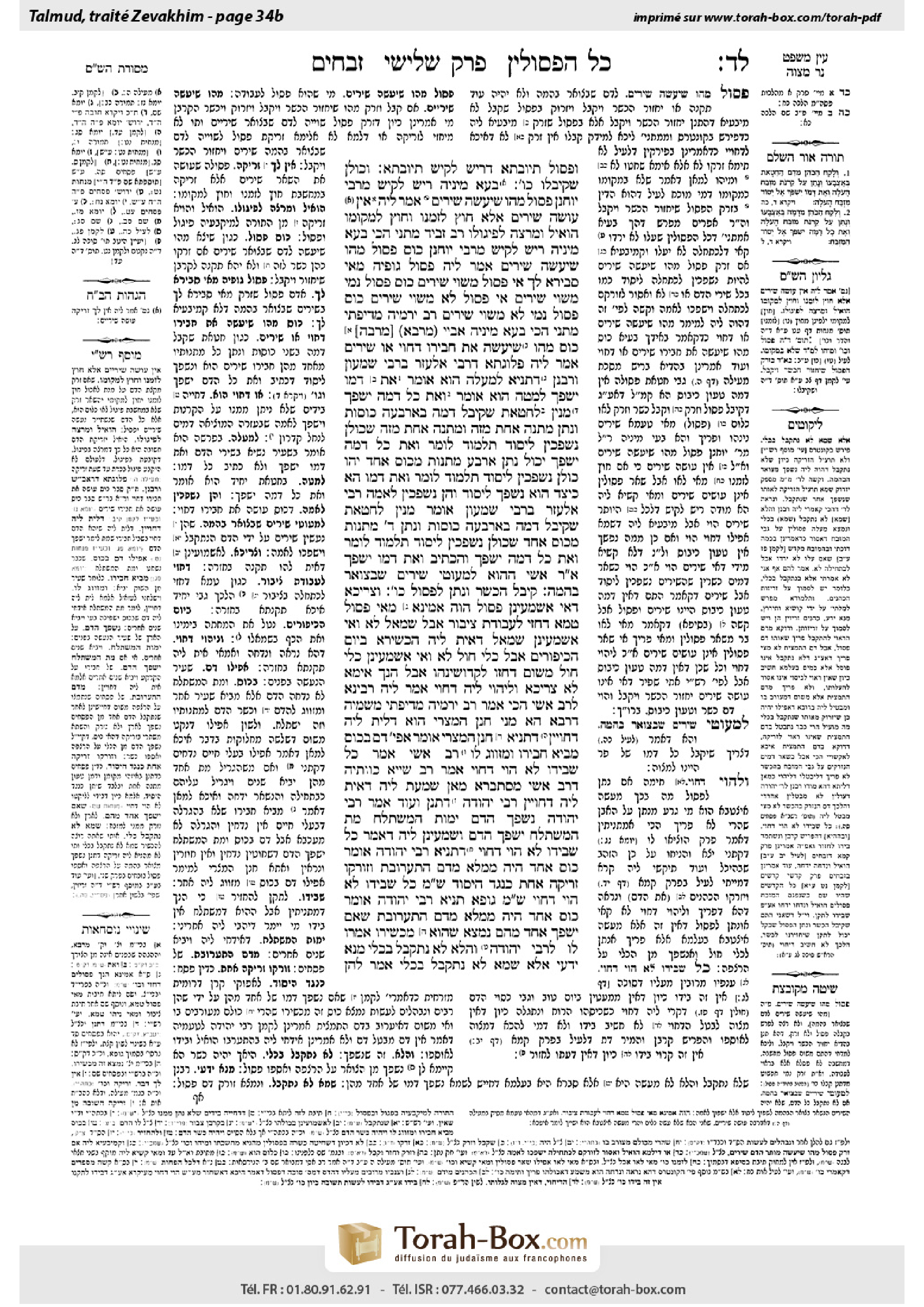
Zevachim 34b: Talmud study for Daf Yomi
Daf Yomi is the daily study of one Talmud folio. Explore 37 tractates with scans, Hebrew text, Sefaria English and AI-generated French translations where annotated.
Passage selection and English or AI-generated French translation are available where the scan has annotations. Daf Study is independent of Torah-Box and Sefaria.
Browse Zevachim · זבחים · All tractatesZevachim 34b text and translations
This page of Zevachim includes the Aramaic text, an English translation and an AI-generated French translation, alongside the scan above.
זבחים ל״ד ב · Aramaic and Hebrew text
וּפָסוּל. תְּיוּבְתָּא דְּרֵישׁ לָקִישׁ! תְּיוּבְתָּא.
וְכוּלָּן שֶׁקִּיבְּלוּ כּוּ׳. בְּעָא מִינֵּיהּ רֵישׁ לָקִישׁ מֵרַבִּי יוֹחָנָן: פָּסוּל – מַהוּ שֶׁיַּעֲשֶׂה שִׁירַיִם?
אֲמַר לֵיהּ: אֵין עוֹשֶׂה שִׁירַיִם אֶלָּא חוּץ לִזְמַנּוֹ וְחוּץ לִמְקוֹמוֹ, הוֹאִיל וּמְרַצֶּה לְפִיגּוּלוֹ.
רַב זְבִיד מַתְנֵי הָכִי – בְּעָא מִינֵּיהּ רֵישׁ לָקִישׁ מֵרַבִּי יוֹחָנָן: כּוֹס פָּסוּל, מַהוּ שֶׁיַּעֲשֶׂה שִׁירַיִם? אֲמַר לֵיהּ: פָּסוּל גּוּפֵיהּ מַאי סְבִירָא לָךְ? אִי פָּסוּל מְשַׁוֵּי שִׁירַיִם – כּוֹס פָּסוּל נָמֵי מְשַׁוֵּי שִׁירַיִם. אִי פָּסוּל לָא מְשַׁוֵּי שִׁירַיִם – כּוֹס פָּסוּל נָמֵי לָא מְשַׁוֵּי שִׁירַיִם.
רַב יִרְמְיָה מִדִּיפְתִּי מַתְנֵי הָכִי – בְּעָא מִינֵּיהּ אַבָּיֵי (מֵרָבָא) [מֵרַבָּה]: כּוֹס, מַהוּ שֶׁיַּעֲשֶׂה אֶת חֲבֵירוֹ דָּחוּי אוֹ שִׁירַיִם?
אֲמַר לֵיהּ: פְּלוּגְתָּא דְּרַבִּי אֶלְעָזָר בְּרַבִּי שִׁמְעוֹן וְרַבָּנַן. דְּתַנְיָא, לְמַעְלָה הוּא אוֹמֵר: ״אֶת דָּמוֹ יִשְׁפֹּךְ״, לְמַטָּה הוּא אוֹמֵר: ״וְאֶת כׇּל דָּמָהּ יִשְׁפֹּךְ״.
מִנַּיִן לְחַטָּאת שֶׁקִּיבֵּל דָּמָהּ בְּאַרְבָּעָה כּוֹסוֹת, וְנָתַן מַתָּנָה אַחַת מִזֶּה וּמַתָּנָה אַחַת מִזֶּה – שֶׁכּוּלָּן נִשְׁפָּכִין לַיְסוֹד? תַּלְמוּד לוֹמַר: ״וְאֶת כׇּל דָּמָהּ יִשְׁפֹּךְ״.
יָכוֹל נָתַן אַרְבַּע מַתָּנוֹת מִכּוֹס אֶחָד, יְהוּ כּוּלָּן נִשְׁפָּכִין לַיְסוֹד? תַּלְמוּד לוֹמַר: ״וְאֶת דָּמוֹ״. הָא כֵּיצַד? הוּא נִשְׁפָּךְ לַיְסוֹד, וְהֵן נִשְׁפָּכִין לָאַמָּה.
רַבִּי אֶלְעָזָר בְּרַבִּי שִׁמְעוֹן אוֹמֵר: מִנַּיִן לְחַטָּאת שֶׁקִּיבֵּל דָּמָה בְּאַרְבָּעָה כּוֹסוֹת וְנָתַן אַרְבַּע מַתָּנוֹת מִכּוֹס אֶחָד, שֶׁכּוּלָּן נִשְׁפָּכִין לַיְסוֹד? תַּלְמוּד לוֹמַר: ״וְאֶת כׇּל דָּמָהּ יִשְׁפֹּךְ״. וְהָכְתִיב: ״וְאֶת דָּמוֹ יִשְׁפֹּךְ״! אָמַר רַב אָשֵׁי: הָהוּא לְמַעוֹטֵי שִׁירַיִם שֶׁבְּצַוַּאר בְּהֵמָה.
קִיבֵּל הַכָּשֵׁר וְנָתַן לַפָּסוּל כּוּ׳.
וּצְרִיכָא; דְּאִי אַשְׁמְעִינַן פָּסוּל, הֲוָה אָמֵינָא: מַאי ״פָּסוּל״ – טָמֵא, דַּחֲזֵי לַעֲבוֹדַת צִיבּוּר; אֲבָל שְׂמֹאל – לָא.
וְאִי אַשְׁמְעִינַן שְׂמֹאל – דְּאִית לֵיהּ הֶכְשֵׁירָא בְּיוֹם הַכִּיפּוּרִים; אֲבָל כְּלֵי חוֹל – לָא.
וְאִי אַשְׁמְעִינַן כְּלֵי חוֹל – מִשּׁוּם דַּחֲזוּ לְקַדּוֹשִׁינְהוּ; אֲבָל הָנָךְ – אֵימָא לָא. צְרִיכָא.
וְלֶיהֱוֵי לֵיהּ דָּחוּי! אֲמַר לֵיהּ רָבִינָא לְרַב אָשֵׁי, הָכִי אָמַר רַב יִרְמְיָה מִדִּיפְתִּי מִשְּׁמֵיהּ דְּרָבָא: הָא מַנִּי – חָנָן הַמִּצְרִי הוּא, דְּלֵית לֵיהּ דְּחוּיִין.
דְּתַנְיָא, חָנָן הַמִּצְרִי אוֹמֵר: אֲפִילּוּ דָּם בַּכּוֹס, מֵבִיא חֲבֵירוֹ וּמְזַוֵּוג לוֹ.
רַב אָשֵׁי אָמַר: כֹּל שֶׁבְּיָדוֹ – לָא הָוֵי דָּחוּי.
אָמַר רַב שַׁיָּיא: כְּוָותֵיהּ דְּרַב אָשֵׁי מִסְתַּבְּרָא. מַאן שָׁמְעַתְּ לֵיהּ דְּאִית לֵיהּ דְּחוּיִין – רַבִּי יְהוּדָה; דִּתְנַן, וְעוֹד אָמַר רַבִּי יְהוּדָה: נִשְׁפַּךְ הַדָּם – יָמוּת הַמִּשְׁתַּלֵּחַ, מֵת הַמִּשְׁתַּלֵּחַ – יִשָּׁפֵךְ הַדָּם;
וְשָׁמְעִינַן לֵיהּ דְּאָמַר: כֹּל שֶׁבְּיָדוֹ – לָא הָוֵי דָּחוּי. דְּתַנְיָא, רַבִּי יְהוּדָה אוֹמֵר: כּוֹס אֶחָד הָיָה מְמַלֵּא מִדַּם הַתַּעֲרוֹבֶת, וְזוֹרְקוֹ זְרִיקָה אַחַת כְּנֶגֶד הַיְסוֹד. שְׁמַע מִינַּהּ: כֹּל שֶׁבְּיָדוֹ – לָא הָוֵי דָּחוּי! שְׁמַע מִינַּהּ.
גּוּפָא – תַּנְיָא, רַבִּי יְהוּדָה אוֹמֵר: כּוֹס אֶחָד הָיָה מְמַלֵּא מִדַּם הַתַּעֲרוֹבֶת, שֶׁאִם יִשָּׁפֵךְ אֶחָד מֵהֶם – נִמְצָא שֶׁהוּא מַכְשִׁירוֹ. אָמְרוּ לוֹ לְרַבִּי יְהוּדָה: וַהֲלֹא לֹא נִתְקַבֵּל בִּכְלִי! מְנָא יָדְעִי? אֶלָּא שֶׁמָּא לֹא נִתְקַבֵּל בִּכְלִי! אָמַר לָהֶן:
Zevachim 34b · English translation
and the offering is therefore disqualified. The Gemara concludes: The refutation of the opinion of Reish Lakish is indeed a conclusive refutation.
§ The mishna teaches: And with regard to all of them, in a case where they collected the blood with the intent to offer it beyond its designated time or outside its designated area, if there is blood of the soul that remains in the animal, the priest fit for Temple service should again collect the blood and sprinkle it on the altar. Reish Lakish asked Rabbi Yoḥanan: If an individual unfit for Temple service presented the blood, what is the halakha with regard to the blood that remains in the animal? Does the fact that he presented some blood render the rest of it a remainder and no longer fit to be presented, or perhaps the presenting performed by an unfit individual is not considered valid, and therefore a priest fit for Temple service may present the blood again?
Rabbi Yoḥanan said to him: An invalid presenting does not render the rest of the blood a remainder unless it is a case where a priest fit for Temple service presented the blood with the intent to offer it beyond its designated time or outside its designated area, since it is only in that case that the presenting of the blood effects acceptance, i.e., it is considered a valid presenting, with regard to rendering the offering piggul, i.e., an offering that was sacrificed with the intent to consume it after its designated time.
Rav Zevid teaches the matter in this way: Reish Lakish asked Rabbi Yoḥanan: Concerning a cup of disqualified blood, e.g., one which had been taken out of the Temple courtyard and was then nevertheless presented on the altar, what is the halakha with regard to it rendering the remaining blood a remainder and unfit to be presented? Rabbi Yoḥanan said to him: In the case of an unfit individual who himself presented the blood, what do you hold to be the halakha? If an unfit individual who presented the blood renders the remaining blood a remainder, then a cup of disqualified blood should also render the remaining blood a remainder. If an unfit individual does not render the remaining blood a remainder, then a cup of disqualified blood should also not render the remaining blood a remainder.
Rav Yirmeya of Difti teaches the discussion this way: Abaye asked Rabba: If the blood was collected in more than one cup and the presenting of the blood on the corners of the altar was performed with one cup, what is the halakha? Does the cup render the blood of the other cup rejected, and it is therefore poured into the drain running through the Temple courtyard, or does it render it a remainder, which is poured on the base of the altar?
Rabba said to him: This is a dispute between Rabbi Elazar, son of Rabbi Shimon, and the Rabbis. As it is taught in a baraita with regard to the remainder of the blood of the external sin offering: In the verse above, discussing the sin offering of a Nasi, it states: “And he shall pour its blood out at the base of the altar of the burnt offering” (Leviticus 4:25). In the verse below, discussing the sin offering of an individual, it states: “And he shall pour all its blood out at the base of the altar” (Leviticus 4:30).
The discrepancy between the first verse and the second verse, which contains the additional term “all,” is explained as follows: From where is it derived with regard to a sin offering which the priest collected its blood in four cups and placed one placement of blood onto the altar from this cup, and one placement of blood from that cup, and likewise for all four corners of the altar, that the remainder of blood from all the cups are poured out onto the base of the altar? The verse states: “And he shall pour all its blood.”
One might have thought that if he placed four placements of blood of the sin offering from one cup, the blood in all the rest of the cups should be poured onto the base of the altar. Therefore, the verse states: “And he shall pour its blood,” and not all of its blood. How so? Only that blood in the cup from which blood was properly presented on the altar is poured onto the base of the altar, and the rest of the cups of blood are rejected and are poured into the Temple courtyard drain.
The baraita continues: Rabbi Elazar, son of Rabbi Shimon, says: From where is it derived with regard to a sin offering which the priest collected its blood in four cups and then placed four placements from one cup, that the blood from all the cups are poured out onto the base of the altar? The verse states: “And he shall pour all its blood.” The Gemara asks: But isn’t it written: “And he shall pour its blood,” which indicates that not all of the blood is poured? Rav Ashi said: That verse serves to exclude the remainder that is in the throat of the animal that was never collected in a vessel to be presented, which is not poured onto the base of the altar but into the Temple courtyard drain.
§ The mishna discussed three similar cases: If the priest fit for Temple service collected the blood in a vessel and gave the vessel to an unfit person, that person should return it to the fit priest. If the priest collected the blood in a vessel in his right hand and moved it to his left hand, he should return it to his right hand. If the priest collected the blood in a sacred vessel and placed it in a non-sacred vessel, he should return the blood to a sacred vessel.
The Gemara comments: And it was necessary to mention all of these cases, as had the mishna taught us only the case where he gave the blood to an unfit individual, I would say: What does the term: Unfit, mean? It means an impure priest, who is not completely unfit, as he is fit for communal service in the Temple when the priests or the entire community are impure, and that is why the blood is not disqualified; but if the priest moved the blood to his left hand, which under no circumstances may be used to perform the rite of collecting and carrying the blood, it is no longer valid.
And had the mishna taught us only with regard to moving the blood to his left hand that he should return it to his right hand and present it, one would assume that the reason is that the left hand has validity on Yom Kippur, since the High Priest carries the spoon of incense with his left hand, but if he poured the blood into a non-sacred vessel then it is not valid.
And had the mishna taught us only with regard to a non-sacred vessel that the blood is not disqualified, one could suggest that perhaps it is because the vessels are suitable to be consecrated, but with regard to these, i.e., an unfit individual and the left hand, which have no possibility of becoming fit for service, say that the blood does not remain valid. Therefore, it is necessary for all of the cases to be mentioned.
§ The Gemara questions the actual halakha: But let the blood be considered rejected when placed in the hand of the unfit individual, the left hand, or the non-sacred vessel. Ravina said to Rav Ashi: This is what Rav Yirmeya of Difti says in the name of Rava: In accordance with whose opinion is this mishna? It is in accordance with the opinion of Ḥanan the Egyptian, who does not subscribe to the halakha of rejection, but holds that a sacrifice that was rejected temporarily is not rejected entirely.
This is as it is taught in a baraita: Ḥanan the Egyptian says: In the event that the scapegoat of Yom Kippur was lost, even if the blood of its partner that is sacrificed to God has already been collected in the cup, the blood is not rejected, but rather he brings another scapegoat as its counterpart, and pairs it with the goat that has already been slaughtered, and the blood is sprinkled.
Rav Ashi says that there is another explanation to the mishna: Anything that is in his power to rectify is not considered rejected, as in these cases where he can simply return the blood to its proper place.
Rav Shaya said: It is reasonable to explain the mishna in accordance with the opinion of Rav Ashi, as whom have you heard who accepts the reasoning of rejection? It is Rabbi Yehuda, as we learned in a mishna (Yoma 62a): And furthermore, Rabbi Yehuda said: If the blood of the goat sacrificed to God spilled from the cup before it was sprinkled, the scapegoat is left to die. Similarly, if the scapegoat died, the blood of the goat sacrificed to God should be spilled, and two other goats are used. Consequently, Rabbi Yehuda holds that the scapegoat, or in the opposite case, the blood of the goat to be sacrificed to God, is totally rejected.
And yet, we have heard that Rabbi Yehuda says: Anything that is in his power to rectify is not rejected. As it is taught in a baraita: Rabbi Yehuda says: A priest would fill one cup with blood of the many Paschal offerings brought that day that was now mixed together on the floor and then sprinkle it with a single sprinkling against the base of the altar. Conclude from the baraita that Rabbi Yehuda holds that although the blood originally spilled from the cup, anything that is in his power to rectify is not rejected. The Gemara affirms: Conclude from it that it is so.
§ The Gemara discusses the matter itself: It is taught in a baraita: Rabbi Yehuda says: A priest would fill one cup with the mixed blood, so that if one of the cups with the collected blood of one of the Paschal offerings were to spill, it would be found that this cup of the mixed blood that was sprinkled would render the sacrifice valid. The Rabbis said to Rabbi Yehuda: But the mixed blood was not collected in a vessel. The Gemara asks: From where do the Rabbis know that the blood was not collected in a vessel? Perhaps it was collected and it spilled out. Rather, this is what they are saying: Perhaps it was not collected in a vessel. Rabbi Yehuda said to them:
Zevachim 34b · Traduction française (IA)
et l’offrande est donc invalidée. La Guemara conclut : la réfutation de l’opinion de Reish Lakish est effectivement concluante.
§ La Michna enseigne : Dans tous ces cas, si le sang a été recueilli avec l’intention de l’offrir après le temps prescrit ou en dehors de l’aire prescrite, et qu’il reste dans l’animal du sang de vie, un prêtre apte au service du Temple doit recueillir de nouveau le sang et l’asperger sur l’autel. Reish Lakish demanda à Rabbi Yoḥanan : Si une personne inapte au service du Temple a présenté le sang, quelle est la halakha concernant le sang qui reste dans l’animal ? Le fait qu’elle ait présenté une partie du sang rend-il le reste résiduel et désormais impropre à être présenté, ou bien la présentation effectuée par une personne inapte n’est-elle pas considérée comme valide, de sorte qu’un prêtre apte au service du Temple peut présenter de nouveau le sang ?
Rabbi Yoḥanan lui dit : Une présentation invalide ne rend pas le reste du sang résiduel, sauf si un prêtre apte au service du Temple a présenté le sang avec l’intention de l’offrir après le temps prescrit ou en dehors de l’aire prescrite. En effet, c’est uniquement dans ce cas que la présentation du sang produit l’acceptation, c’est-à-dire qu’elle est considérée comme une présentation valide pour rendre l’offrande piggoul, autrement dit une offrande sacrifiée avec l’intention d’en consommer après le temps prescrit.
Rav Zevid rapporte cette discussion de la manière suivante : Reish Lakish demanda à Rabbi Yoḥanan : Concernant une coupe de sang invalidé, par exemple du sang qui a été sorti de la cour du Temple puis néanmoins présenté sur l’autel, quelle est la halakha quant à sa capacité à rendre le sang restant résiduel et impropre à être présenté ? Rabbi Yoḥanan lui dit : Dans le cas où une personne inapte a elle-même présenté le sang, quelle halakha tiens-tu pour applicable ? Si la présentation par une personne inapte rend le sang restant résiduel, alors une coupe de sang invalidé devrait, elle aussi, rendre le sang restant résiduel. Si la présentation par une personne inapte ne rend pas le sang restant résiduel, alors une coupe de sang invalidé ne devrait pas non plus le rendre résiduel.
Rav Yirmeya de Difti rapporte la discussion ainsi : Abaye demanda à Rabba : Si le sang a été recueilli dans plusieurs coupes et que la présentation du sang sur les cornes de l’autel a été effectuée avec l’une des coupes, quelle est la halakha ? Cette coupe rend-elle le sang de l’autre coupe rejeté, de sorte qu’il doit être versé dans le canal d’évacuation qui traverse la cour du Temple, ou le rend-elle résiduel, auquel cas il est versé sur le soubassement de l’autel ?
Rabba lui dit : C’est une controverse entre Rabbi Elazar, fils de Rabbi Shimon, et les Rabbins. En effet, il est enseigné dans une baraïta au sujet du reste du sang du sacrifice expiatoire extérieur : dans le verset précédent, qui traite du sacrifice expiatoire d’un nassi, il est dit : « Il versera son sang au pied de l’autel de l’holocauste » (Lévitique 4, 25). Dans le verset suivant, qui traite du sacrifice expiatoire d’un particulier, il est dit : « Il versera tout son sang au pied de l’autel » (Lévitique 4, 30).
La différence entre le premier verset et le second, qui comporte le terme supplémentaire « tout », s’explique ainsi : D’où déduit-on que, pour un sacrifice expiatoire dont le prêtre a recueilli le sang dans quatre coupes, puis a fait une aspersion sur l’autel avec cette coupe, une aspersion avec cette autre coupe, et ainsi de suite aux quatre cornes de l’autel, le reste du sang de toutes les coupes est versé au pied de l’autel ? Le verset dit : « Il versera tout son sang. »
On aurait pu penser que, s’il a fait les quatre aspersions du sang du sacrifice expiatoire avec une seule coupe, le sang de toutes les autres coupes doit être versé au pied de l’autel. Le verset dit donc : « Il versera son sang », et non tout son sang. Comment faut-il comprendre cela ? Seul le sang de la coupe à partir de laquelle le sang a été correctement présenté sur l’autel est versé au pied de l’autel ; le sang des autres coupes est rejeté et versé dans le canal d’évacuation de la cour du Temple.
La baraïta poursuit : Rabbi Elazar, fils de Rabbi Shimon, dit : D’où déduit-on que, pour un sacrifice expiatoire dont le prêtre a recueilli le sang dans quatre coupes, puis a fait les quatre aspersions avec une seule coupe, le sang de toutes les coupes est versé au pied de l’autel ? Le verset dit : « Il versera tout son sang. » La Guemara demande : Mais n’est-il pas écrit : « Il versera son sang », ce qui indique que tout le sang n’est pas versé ? Rav Ashi dit : Ce verset exclut le reste du sang qui se trouve dans la gorge de l’animal et qui n’a jamais été recueilli dans un récipient en vue d’être présenté ; ce sang n’est pas versé au pied de l’autel, mais dans le canal d’évacuation de la cour du Temple.
§ La Michna a traité trois cas semblables : si le prêtre apte au service du Temple a recueilli le sang dans un récipient et l’a remis à une personne inapte, celle-ci doit le rendre au prêtre apte. Si le prêtre a recueilli le sang dans un récipient de la main droite et l’a transféré dans sa main gauche, il doit le remettre dans sa main droite. Si le prêtre a recueilli le sang dans un récipient sacré et l’a placé dans un récipient profane, il doit remettre le sang dans un récipient sacré.
La Guemara fait remarquer qu’il était nécessaire de mentionner tous ces cas. En effet, si la Michna nous avait enseigné seulement le cas où il a remis le sang à une personne inapte, j’aurais dit : Que signifie le terme « inapte » ? Il désigne un prêtre impur, qui n’est pas totalement inapte, puisqu’il peut accomplir le service collectif dans le Temple lorsque les prêtres ou toute la communauté sont impurs ; c’est pourquoi le sang n’est pas invalidé. Mais si le prêtre a transféré le sang dans sa main gauche, qui ne peut en aucun cas servir à recueillir et à transporter le sang, celui-ci n’est plus valide.
Et si la Michna nous avait enseigné uniquement le cas où le sang est transféré dans la main gauche, en précisant qu’il faut le remettre dans la main droite et le présenter, on aurait supposé que la raison en est que la main gauche est valable à Yom Kippour, puisque le Grand Prêtre porte la cuiller d’encens de la main gauche. Mais s’il a versé le sang dans un récipient profane, le sang n’est pas valide.
Et si la Michna nous avait enseigné uniquement le cas du récipient profane, en disant que le sang n’est pas invalidé, on aurait pu suggérer que c’est peut-être parce que les récipients peuvent être consacrés ; mais pour les autres cas, c’est-à-dire celui d’une personne inapte et celui de la main gauche, qui ne peuvent en aucun cas devenir aptes au service, on aurait dit que le sang ne reste pas valide. Il était donc nécessaire de mentionner tous les cas.
§ La Guemara s’interroge sur la halakha proprement dite : Mais le sang ne devrait-il pas être considéré comme rejeté lorsqu’il est placé dans la main de la personne inapte, dans la main gauche ou dans le récipient profane ? Ravina dit à Rav Ashi : Voici ce que Rav Yirmeya de Difti dit au nom de Rava : Selon l’opinion de qui cette Michna a-t-elle été formulée ? Selon celle de Ḥanan l’Égyptien, qui n’admet pas la halakha du rejet et soutient qu’un sacrifice temporairement rejeté ne l’est pas définitivement.
C’est ce qui est enseigné dans une baraïta : Ḥanan l’Égyptien dit : Si le bouc émissaire de Yom Kippour a été perdu, même si le sang de son compagnon, qui est sacrifié pour Dieu, a déjà été recueilli dans la coupe, le sang n’est pas rejeté. Au contraire, on amène un autre bouc pour le remplacer, on l’associe au bouc qui a déjà été égorgé, et l’on asperge le sang.
Rav Ashi donne une autre explication de la Michna : Tout ce qu’il est possible de réparer n’est pas considéré comme rejeté, comme dans ces cas où il peut simplement remettre le sang à sa place appropriée.
Rav Shaya dit : Il est raisonnable d’expliquer la Michna conformément à l’opinion de Rav Ashi, car qui d’autre avez-vous entendu admettre le principe du rejet ? Rabbi Yehuda, comme nous l’avons appris dans une Michna (Yoma 62a) : De plus, Rabbi Yehuda a dit : Si le sang du bouc sacrifié pour Dieu s’est répandu hors de la coupe avant d’être aspergé, le bouc émissaire est laissé pour mourir. De même, si le bouc émissaire est mort, le sang du bouc sacrifié pour Dieu doit être versé, et deux autres boucs sont utilisés. Par conséquent, Rabbi Yehuda considère que le bouc émissaire — ou, dans le cas inverse, le sang du bouc destiné à être sacrifié pour Dieu — est totalement rejeté.
Et pourtant, nous avons entendu Rabbi Yehuda dire : Tout ce qu’il est possible de réparer n’est pas rejeté. En effet, il est enseigné dans une baraïta : Rabbi Yehuda dit : Un prêtre remplissait une coupe du sang des nombreux sacrifices de Pessaḥ apportés ce jour-là, désormais mêlé sur le sol, puis faisait avec ce sang une unique aspersion contre le soubassement de l’autel. Déduis de la baraïta que, selon Rabbi Yehuda, bien que le sang se soit d’abord répandu hors de la coupe, tout ce qu’il est possible de réparer n’est pas rejeté. La Guemara confirme : Déduis-en qu’il en est bien ainsi.
§ La Guemara examine la question elle-même : Il est enseigné dans une baraïta : Rabbi Yehuda dit : Un prêtre remplissait une coupe du sang mélangé, afin que, si l’une des coupes contenant le sang recueilli d’un des sacrifices de Pessaḥ se renversait, cette coupe de sang mélangé, dont le contenu était aspergé, rende le sacrifice valide. Les Rabbins dirent à Rabbi Yehuda : Mais le sang mélangé n’a pas été recueilli dans un récipient. La Guemara demande : D’où les Rabbins savent-ils que le sang n’a pas été recueilli dans un récipient ? Peut-être a-t-il été recueilli, puis s’est-il répandu. Ils veulent plutôt dire ceci : Peut-être n’a-t-il pas été recueilli dans un récipient. Rabbi Yehuda leur dit :
Traduction française générée par IA à partir de l’édition anglaise de Sefaria. Vérifie toujours un passage avec le texte source.
Text from Sefaria: William Davidson Edition - Vocalized Aramaic (CC BY NC); William Davidson Edition - English (CC BY NC).