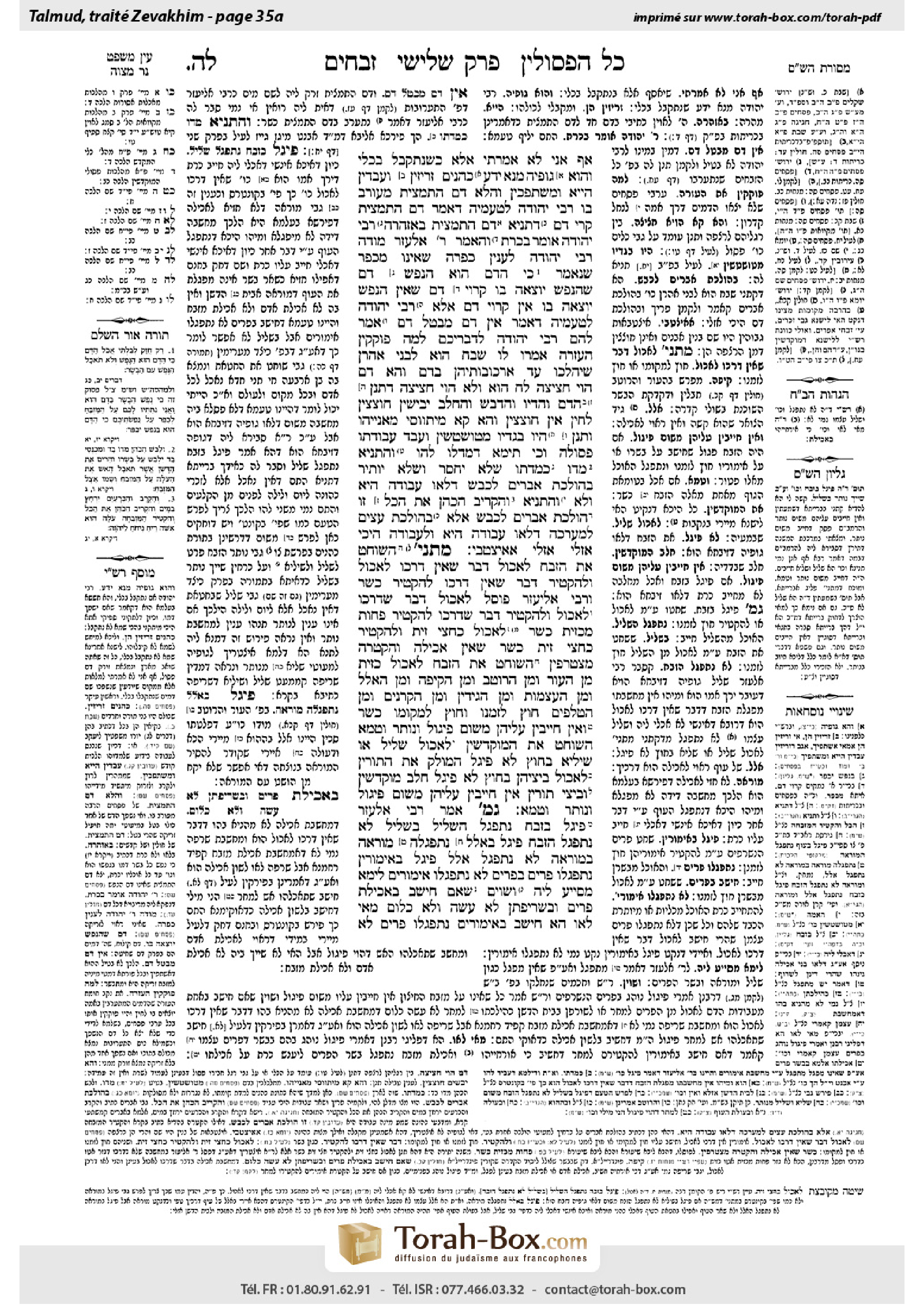
Zevachim 35a: Talmud study for Daf Yomi
Daf Yomi is the daily study of one Talmud folio. Explore 37 tractates with scans, Hebrew text, Sefaria English and AI-generated French translations where annotated.
Passage selection and English or AI-generated French translation are available where the scan has annotations. Daf Study is independent of Torah-Box and Sefaria.
Browse Zevachim · זבחים · All tractatesZevachim 35a text and translations
This page of Zevachim includes the Aramaic text, an English translation and an AI-generated French translation, alongside the scan above.
זבחים ל״ה א · Aramaic and Hebrew text
אַף אֲנִי לֹא אָמַרְתִּי אֶלָּא כְּשֶׁנִּתְקַבֵּל בִּכְלִי. וְהוּא גּוּפֵיהּ מְנָא יָדַע? כֹּהֲנִים זְרִיזִין, וְעָבְדִין הַיָּיא וּמִשְׁתַּפְכִין.
וַהֲלֹא דַּם הַתַּמְצִית מְעוֹרָב בּוֹ! רַבִּי יְהוּדָה לְטַעְמֵיהּ, דְּאָמַר: דַּם הַתַּמְצִית קָרוּי דָּם.
דְּתַנְיָא: דַּם הַתַּמְצִית – בְּאַזְהָרָה. רַבִּי יְהוּדָה אוֹמֵר: בְּכָרֵת.
וְהָאָמַר רַבִּי אֶלְעָזָר: מוֹדֶה רַבִּי יְהוּדָה לְעִנְיַן כַּפָּרָה שֶׁאֵינוֹ מְכַפֵּר, שֶׁנֶּאֱמַר: ״כִּי הַדָּם הוּא הַנָּפֶשׁ״ –
דָּם שֶׁהַנֶּפֶשׁ יוֹצְאָה בּוֹ קָרוּי דָּם, שֶׁאֵין הַנֶּפֶשׁ יוֹצְאָה בּוֹ אֵין קָרוּי דָּם!
אֶלָּא רַבִּי יְהוּדָה לְטַעְמֵיהּ, דְּאָמַר: אֵין דָּם מְבַטֵּל דָּם.
אָמַר לָהֶם רַבִּי יְהוּדָה: לְדִבְרֵיכֶם, לָמָּה פּוֹקְקִין הָעֲזָרָה? אָמְרוּ לוֹ: שֶׁבַח הוּא לִבְנֵי אַהֲרֹן שֶׁיְּהַלְּכוּ עַד אַרְכוּבּוֹתֵיהֶן בַּדָּם.
וְהָא דָּם הָוֵי חֲצִיצָה! לַח הוּא, וְלָא הָוֵי חֲצִיצָה. דִּתְנַן: הַדָּם וְהַדְּיוֹ וְהַדְּבַשׁ וְהֶחָלָב – יְבֵישִׁין חוֹצְצִין, לַחִין אֵין חוֹצְצִין.
וְהָא קָא מִיתַּוְּוסִי מָאנַיְיהוּ, וּתְנַן: הָיוּ בְּגָדָיו מְטוּשְׁטָשִׁין וְעָבַד – עֲבוֹדָתוֹ פְּסוּלָה! וְכִי תֵּימָא דִּמְדַלּוּ לְהוּ, וְהָתַנְיָא: ״מִדּוֹ״ – כְּמִדָּתוֹ, שֶׁלֹּא יְחַסֵּר וְשֶׁלֹּא יוֹתִיר! בְּהוֹלָכַת אֵבָרִים לַכֶּבֶשׁ, דְּלָאו עֲבוֹדָה הִיא.
וְלָא?! וְהָתַנְיָא: ״וְהִקְרִיב הַכֹּהֵן אֶת הַכֹּל״ – זוֹ הוֹלָכַת אֵבָרִים לַכֶּבֶשׁ! אֶלָּא בְּהוֹלָכַת עֵצִים לַמַּעֲרָכָה, דְּלָאו עֲבוֹדָה הִיא. וְלַעֲבוֹדָה הֵיכִי אָזְלִי? אָזְלִי אַאִיצְטְבֵי.
מַתְנִי׳ הַשּׁוֹחֵט אֶת הַזֶּבַח לֶאֱכוֹל דָּבָר שֶׁאֵין דַּרְכּוֹ לֶאֱכוֹל, וּלְהַקְטִיר דָּבָר שֶׁאֵין דַּרְכּוֹ לְהַקְטִיר – כָּשֵׁר. וְרַבִּי אֱלִיעֶזֶר פּוֹסֵל.
לֶאֱכוֹל דָּבָר שֶׁדַּרְכּוֹ לֶאֱכוֹל, וּלְהַקְטִיר דָּבָר שֶׁדַּרְכּוֹ לְהַקְטִיר – פָּחוֹת מִכְּזַיִת; כָּשֵׁר. לֶאֱכוֹל כַּחֲצִי זַיִת וּלְהַקְטִיר כַּחֲצִי זַיִת – כָּשֵׁר, שֶׁאֵין אֲכִילָה וְהַקְטָרָה מִצְטָרְפִין.
הַשּׁוֹחֵט אֶת הַזֶּבַח לֶאֱכוֹל כְּזַיִת מִן הָעוֹר, וּמִן הָרוֹטֶב, וּמִן הַקֵּיפֶה, וּמִן הָאָלָל, וּמִן הַעֲצָמוֹת, וּמִן הַגִּידִין, וּמִן הַקְּרָנַיִם, וּמִן הַטְּלָפַיִם – חוּץ לִזְמַנּוֹ וְחוּץ לִמְקוֹמוֹ; כָּשֵׁר, וְאֵין חַיָּיבִין עֲלֵיהֶן מִשּׁוּם פִּיגּוּל וְנוֹתָר וְטָמֵא.
הַשּׁוֹחֵט אֶת הַמּוּקְדָּשִׁין לֶאֱכוֹל שְׁלִיל אוֹ שִׁילְיָא בַּחוּץ – לֹא פִּיגֵּל. הַמּוֹלֵק אֶת הַתּוֹרִין לֶאֱכוֹל בֵּיצֵיהֶן בַּחוּץ – לֹא פִּיגֵּל.
חֲלֵב מוּקְדָּשִׁין וּבֵיצֵי תוֹרִין – אֵין חַיָּיבִין עֲלֵיהֶן מִשּׁוּם פִּיגּוּל וְנוֹתָר וְטָמֵא.
גְּמָ׳ אָמַר רַבִּי אֶלְעָזָר: פִּיגֵּל בַּזֶּבַח – נִתְפַּגֵּל הַשְּׁלִיל. בַּשְּׁלִיל – לֹא נִתְפַּגֵּל הַזֶּבַח. פִּיגֵּל בָּאָלָל – נִתְפַּגְּלָה מוּרְאָה. בַּמּוּרְאָה – לֹא נִתְפַּגֵּל אָלָל.
פִּיגֵּל בָּאֵימוּרִין – נִתְפַּגְּלוּ פָּרִים. בַּפָּרִים – לֹא נִתְפַּגְּלוּ אֵימוּרִים.
לֵימָא מְסַיַּיע לֵיהּ: וְשָׁוִים שֶׁאִם חִישֵּׁב בַּאֲכִילַת פָּרִים וּבִשְׂרֵיפָתָן – לֹא עָשָׂה וְלֹא כְלוּם. מַאי, לָאו הָא חִישֵּׁב בָּאֵימוּרִים – נִתְפַּגְּלוּ פָּרִים? לָא;
Zevachim 35a · English translation
I too said that the blood should be sprinkled only when it was collected in a vessel. The Gemara asks: But he, Rabbi Yehuda, himself, from where did he know if the blood was indeed collected? The Gemara answers: He relies on the fact that priests are vigilant, and perform their service properly and collect all of the blood. But they work swiftly, and the blood therefore spills from the cup.
The Gemara asks: But isn’t blood of exudate, which is unfit to be sprinkled upon the altar, mixed with the blood of the soul on the floor? The Gemara answers: Rabbi Yehuda conforms to his standard line of reasoning, as he says that blood of exudate is considered blood.
This is as it is taught in a baraita: Blood of exudate is subject to a prohibition, and one who consumes it receives lashes. This is not as severe as consuming blood of the soul, the blood that spurts out of an animal as it is being slaughtered, for which one is liable to receive karet. Rabbi Yehuda says: One who consumes blood of exudate is liable to receive karet, as this blood is treated as proper blood.
The Gemara challenges this answer: But doesn’t Rabbi Elazar say that Rabbi Yehuda concedes with regard to atonement that presenting blood of exudate does not effect atonement, as it is stated: “For the soul of the flesh is in the blood; and I have given it to you upon the altar to make atonement for your souls; for it is the blood that makes atonement by reason of the soul” (Leviticus 17:11).
This verse indicates that blood with which the soul leaves the animal, i.e., that spurts immediately upon slaughter, is called blood; but blood with which the soul does not leave the animal, i.e., blood of exudate, is not called blood. If so, even according to Rabbi Yehuda, blood of exudate is unfit for presenting upon the altar, and collecting blood from the floor should therefore be ineffective.
Rather, Rabbi Yehuda conforms to his line of reasoning, as he says: Blood does not nullify blood. Therefore, the blood in the cup that is fit for sprinkling on the altar is not nullified by the blood of exudate, and the entire mixture may be sprinkled on the altar.
The Gemara cites the continuation of the baraita: Rabbi Yehuda said to the Rabbis: According to your statement that the mixed blood on the floor may not be used, why do they plug the drain of the Temple courtyard on Passover eve and not allow the blood to flow out through it? The Rabbis said to him: It is a source of praise for the sons of Aaron that they should walk in blood up to their ankles, thereby demonstrating their love for the Temple service.
The Gemara challenges: But the blood is an interposition between the feet of the priests and the floor of the Temple, and this should invalidate the service. The Gemara explains: The blood is moist and is therefore not an interposition, as we learned in a baraita: With regard to blood, ink, honey, and milk, when they are dry they interpose, but when they are moist they do not interpose.
The Gemara asks further: But don’t their garments become soiled? And we learned in a baraita: If a priest’s garments were soiled and he performed a Temple rite while wearing them, his rite is disqualified. And if you would say that they raised their garments so that they would stay clean, but isn’t it taught in a baraita: “And the priest shall put on his linen garment [middo vad]” (Leviticus 6:3). The term middo, literally, his measure, teaches that his garment must be according to his measure [kemiddato], i.e., that it should not be too short and that it should not be too long. If the priest raises his garment, it will no longer be exactly his size. The Gemara answers that the priests would walk in the blood only while carrying the sacrificial limbs to the ramp of the altar, which is not actually a rite, but only preparation for a rite.
The Gemara asks: And is it not one of the rites? But isn’t it taught in a baraita: “And the priest shall bring it all and burn it upon the altar” (Leviticus 1:13); this is referring to the carrying of the limbs to the ramp? Rather, the priests would walk in the blood only while carrying wood to the arrangement of wood on the altar, which is not a rite. The Gemara asks: But if the floor of the Temple was full of blood; how did they walk to perform the actual rites without soiling their garments? The Gemara answers: They would walk on platforms raised above the floor, so that the blood would not reach their garments.
MISHNA: In the case of one who slaughters an offering with the intent to eat, beyond its designated time or outside its designated area, an item whose typical manner is such that one does not partake of it, e.g., the portions of the offering consumed on the altar, or with the intent to burn, beyond its designated time or outside its designated area, an item whose typical manner is such that one does not burn it on the altar, e.g., the meat of the offering, the offering is fit, and Rabbi Eliezer deems it unfit.
One who slaughters an offering with the intent to eat, beyond its designated time or outside its designated area, an item whose typical manner is such that one does partake of it, or with the intent to burn, beyond its designated time or outside its designated area, an item whose typical manner is such that one does burn it on the altar, but his intent was to partake or burn less than an olive-bulk, the offering is fit. If his intent was to eat half an olive-bulk and to burn half an olive-bulk beyond its designated time or outside its designated area, the offering is fit, because eating and burning do not join together.
In the case of one who slaughters an offering with the intent to eat, beyond its designated time or outside its designated area, an olive-bulk from the hide, or from the gravy, or from the spices that amass at the bottom of the pot together with small amounts of meat, or from a tendon in the neck, or from the bones, or from the tendons, or from the horns, or from the hooves, the offering is fit and one is not liable to receive karet for it, neither due to the prohibition of piggul, if the sacrificial rites were performed with the intent to partake of the offering beyond its designated time, nor due to the prohibition of leftover meat beyond the designated time, nor due to the prohibition against partaking of the meat while ritually impure.
In the case of one who slaughters sacrificial female animals with the intent to eat the fetus of those animals or their placenta outside the designated area, he has not rendered the offering piggul. Likewise, in the case of one who pinches doves, i.e., slaughters them for sacrifice by cutting the napes of their necks with his fingernail, with the intent to eat their eggs that are still in their bodies outside the designated area, he has not rendered the offering piggul. This is because the fetus, the placenta, and the eggs are not considered part of the body of the animal or the bird.
For the same reason, one who consumes the milk of sacrificial female animals or the eggs of doves is not liable to receive karet for it, neither due to the prohibition of piggul, nor due to the prohibition of notar, nor due to the prohibition against partaking of the meat while ritually impure.
GEMARA: Rabbi Elazar says: If one renders an offering piggul by slaughtering it with the intent to partake of it beyond its designated time, its fetus is rendered piggul as well, and one who eats it is liable to receive karet. But if he intended to partake of the fetus beyond its designated time, the offering has not been rendered piggul. Likewise, if he rendered a bird offering piggul by having intent to partake of a tendon in the neck, which is edible, beyond its designated time, then the crop of the bird is rendered piggul as well, although it is not considered an item that is usually eaten, since there are people who eat it. But if he intended to partake of the crop beyond its designated time, then a tendon in the neck is not rendered piggul.
If he rendered the offering piggul, i.e., had improper intent by intending to burn the sacrificial portions that are consumed on the altar beyond their designated time, then the rest of the bulls are rendered piggul. Therefore, if one partakes of their meat, he is liable to receive karet due to the prohibition of piggul. But if he intended to partake of the rest of the bulls beyond their designated time, since piggul does not apply to them, as they are not destined to be consumed on the altar or to be eaten, the sacrificial portions that are consumed on the altar are not rendered piggul.
The Gemara suggests: Let us say that the following baraita supports the opinion of Rabbi Elazar: And even those who hold that piggul applies to the bulls that are burned agree that if he intended to partake of the bulls or to burn them beyond their designated time he did not do anything. This is because these bulls are not eaten or burned on the altar, and intentions can render an offering piggul only in the cases of offerings that are eaten or burned on the altar. The Gemara infers: What, is it not possible to infer that if he intended with regard to the sacrificial portions of the bulls that are consumed on the altar to burn them beyond their designated time, the bulls are rendered piggul, which is in accordance with the statement of Rabbi Elazar? The Gemara rejects this: No,
Zevachim 35a · Traduction française (IA)
Moi aussi, j’ai dit que le sang ne devait être aspergé que s’il avait été recueilli dans un récipient. La Guemara demande : Mais lui, Rabbi Yehouda, comment savait-il que le sang avait effectivement été recueilli ? La Guemara répond : Il se fie au fait que les prêtres sont vigilants, accomplissent leur service correctement et recueillent tout le sang. Mais ils travaillent rapidement, et le sang se répand donc hors de la coupe.
La Guemara demande : Mais le sang d’écoulement, impropre à être aspergé sur l’autel, n’est-il pas mêlé au sang vital qui se trouve sur le sol ? La Guemara répond : Rabbi Yehouda suit sa ligne de raisonnement habituelle, car il considère le sang d’écoulement comme du sang.
C’est ce qui est enseigné dans une baraïta : le sang d’écoulement fait l’objet d’une interdiction, et celui qui en consomme reçoit la flagellation. Cette faute n’est pas aussi grave que la consommation du sang vital, le sang qui jaillit de l’animal lors de l’abattage rituel, pour laquelle on est passible de karet. Rabbi Yehouda dit : Celui qui consomme du sang d’écoulement est passible de karet, car ce sang est considéré comme du sang à part entière.
La Guemara conteste cette réponse : Mais Rabbi Elazar ne dit-il pas que Rabbi Yehouda reconnaît, en matière d’expiation, que la présentation du sang d’écoulement n’opère pas l’expiation, comme il est dit : « Car l’âme de la chair est dans le sang ; et je vous l’ai donné sur l’autel pour faire expiation pour vos âmes ; car c’est le sang qui fait expiation en raison de l’âme » (Lévitique 17:11) ?
Ce verset indique que le sang par lequel l’âme quitte l’animal, c’est-à-dire celui qui jaillit immédiatement lors de l’abattage rituel, est appelé sang ; mais le sang par lequel l’âme ne quitte pas l’animal, c’est-à-dire le sang d’écoulement, n’est pas appelé sang. Dès lors, même selon Rabbi Yehouda, le sang d’écoulement ne peut être présenté sur l’autel, et recueillir le sang sur le sol devrait donc être sans effet.
Au contraire, Rabbi Yehouda suit sa ligne de raisonnement habituelle, car il dit : le sang n’annule pas le sang. Par conséquent, le sang contenu dans la coupe, qui peut être aspergé sur l’autel, n’est pas annulé par le sang d’écoulement, et l’ensemble du mélange peut être aspergé sur l’autel.
La Guemara cite la suite de la baraïta : Rabbi Yehouda dit aux Sages : Selon votre opinion, si le sang mêlé sur le sol ne peut pas être utilisé, pourquoi bouchent-ils le conduit de la cour du Temple la veille de Pessa’h et ne laissent-ils pas le sang s’écouler par là ? Les Sages lui répondirent : C’est à la gloire des fils d’Aaron qu’ils marchent dans le sang jusqu’aux chevilles, témoignant ainsi de leur amour pour le service du Temple.
La Guemara objecte : Mais le sang forme une interposition entre les pieds des prêtres et le sol du Temple, ce qui devrait invalider le service. La Guemara explique : Le sang est humide et ne forme donc pas d’interposition, comme nous l’avons appris dans une baraïta : le sang, l’encre, le miel et le lait forment une interposition lorsqu’ils sont secs, mais pas lorsqu’ils sont humides.
La Guemara demande encore : Mais leurs vêtements ne se salissent-ils pas ? Or, nous avons appris dans une baraïta : si les vêtements d’un prêtre étaient souillés et qu’il accomplissait un rite du Temple en les portant, ce rite est invalide. Et si l’on disait qu’ils relevaient leurs vêtements pour les garder propres, n’est-il pas enseigné dans une baraïta : « Le prêtre revêtira sa tunique de lin [middo vad] » (Lévitique 6:3) ? Le terme middo, littéralement « sa mesure », enseigne que son vêtement doit être à sa mesure [kemiddato], c’est-à-dire qu’il ne doit être ni trop court ni trop long. Si le prêtre relève son vêtement, celui-ci ne sera plus exactement à sa taille. La Guemara répond que les prêtres ne marchaient dans le sang que lorsqu’ils portaient les membres du sacrifice vers la rampe de l’autel, ce qui n’est pas à proprement parler un rite, mais seulement sa préparation.
La Guemara demande : Mais n’est-ce pas l’un des rites ? N’est-il pas enseigné dans une baraïta : « Le prêtre apportera le tout et le brûlera sur l’autel » (Lévitique 1:13) ? Cela fait référence au transport des membres jusqu’à la rampe. Au contraire, les prêtres ne marchaient dans le sang que lorsqu’ils portaient du bois vers le bûcher de l’autel, ce qui n’est pas un rite. La Guemara demande : Mais si le sol du Temple était couvert de sang, comment pouvaient-ils se déplacer pour accomplir les rites proprement dits sans salir leurs vêtements ? La Guemara répond : Ils marchaient sur des passerelles surélevées, de sorte que le sang n’atteigne pas leurs vêtements.
Michna : Dans le cas de celui qui égorge un sacrifice avec l’intention de consommer, après le temps fixé ou hors de l’endroit fixé, un élément qui n’est habituellement pas consommé, par exemple les parts du sacrifice consumées sur l’autel, ou avec l’intention de brûler, après le temps fixé ou hors de l’endroit fixé, un élément qui n’est habituellement pas brûlé sur l’autel, par exemple la viande du sacrifice, le sacrifice est valide, mais Rabbi Eliezer le considère comme invalide.
Celui qui égorge un sacrifice avec l’intention de consommer, après le temps fixé ou hors de l’endroit fixé, un élément qui est habituellement consommé, ou avec l’intention de brûler, après le temps fixé ou hors de l’endroit fixé, un élément qui est habituellement brûlé sur l’autel, mais avec l’intention d’en consommer ou d’en brûler moins que le volume d’une olive, laisse le sacrifice valide. S’il a l’intention d’en consommer la moitié d’un volume d’olive et d’en brûler l’autre moitié après le temps fixé ou hors de l’endroit fixé, le sacrifice est valide, car consommation et combustion ne s’additionnent pas.
Dans le cas de celui qui égorge un sacrifice avec l’intention de consommer, après le temps fixé ou hors de l’endroit fixé, un volume d’olive de la peau, du jus de cuisson, des épices qui s’accumulent au fond de la marmite avec de petites quantités de viande, d’un tendon du cou, des os, des tendons, des cornes ou des sabots, le sacrifice est valide et l’on n’est pas passible de karet à ce titre, ni en raison de l’interdiction du piggoul, si les rites sacrificiels ont été accomplis avec l’intention de consommer le sacrifice après le temps fixé, ni en raison de l’interdiction de la viande restante après le temps fixé, ni en raison de l’interdiction de consommer la viande en état d’impureté rituelle.
Dans le cas de celui qui égorge des femelles destinées au sacrifice avec l’intention de consommer leur fœtus ou leur placenta hors de l’endroit fixé, il ne rend pas le sacrifice piggoul. De même, celui qui pince des colombes, c’est-à-dire les met à mort pour le sacrifice en leur coupant la nuque avec son ongle, avec l’intention de consommer leurs œufs encore dans leur corps hors de l’endroit fixé, ne rend pas le sacrifice piggoul. En effet, le fœtus, le placenta et les œufs ne sont pas considérés comme faisant partie du corps de l’animal ou de l’oiseau.
Pour la même raison, celui qui consomme le lait de femelles destinées au sacrifice ou les œufs de colombes n’est pas passible de karet à ce titre, ni en raison de l’interdiction du piggoul, ni de celle du notar, ni de l’interdiction de consommer la viande en état d’impureté rituelle.
Guemara : Rabbi Elazar dit : Si quelqu’un rend un sacrifice piggoul en l’égorgeant avec l’intention de le consommer après le temps fixé, son fœtus devient lui aussi piggoul, et celui qui le mange est passible de karet. Mais s’il a eu l’intention de consommer le fœtus après le temps fixé, le sacrifice n’est pas devenu piggoul. De même, s’il a rendu un sacrifice d’oiseau piggoul en ayant l’intention de consommer après le temps fixé un tendon du cou, qui est comestible, le jabot de l’oiseau devient lui aussi piggoul, bien qu’il ne soit pas considéré comme un élément habituellement consommé, puisque certaines personnes le mangent. Mais s’il a eu l’intention de consommer le jabot après le temps fixé, le tendon du cou ne devient pas piggoul.
S’il a rendu le sacrifice piggoul, c’est-à-dire s’il a eu une intention impropre en voulant brûler après le temps fixé les parts sacrificielles consumées sur l’autel, le reste des taureaux devient lui aussi piggoul. Par conséquent, si quelqu’un consomme leur viande, il est passible de karet en raison de l’interdiction du piggoul. Mais s’il a eu l’intention de consommer le reste des taureaux après le temps fixé, les parts sacrificielles consumées sur l’autel ne deviennent pas piggoul, car le piggoul ne s’applique pas à ces taureaux, puisqu’ils ne sont destinés ni à être consumés sur l’autel ni à être mangés.
La Guemara propose : Disons que la baraïta suivante étaye l’opinion de Rabbi Elazar : même ceux qui soutiennent que le piggoul s’applique aux taureaux qui sont brûlés reconnaissent que, s’il a eu l’intention de consommer ces taureaux ou de les brûler après le temps fixé, il n’a rien fait. En effet, ces taureaux ne sont ni mangés ni brûlés sur l’autel, et les intentions ne peuvent rendre un sacrifice piggoul que dans le cas de sacrifices qui sont mangés ou brûlés sur l’autel. La Guemara déduit : N’est-il pas possible d’en inférer que, s’il a eu l’intention de brûler après le temps fixé les parts sacrificielles des taureaux qui sont consumées sur l’autel, les taureaux deviennent piggoul, conformément à l’affirmation de Rabbi Elazar ? La Guemara rejette cette déduction : Non,
Traduction française générée par IA à partir de l’édition anglaise de Sefaria. Vérifie toujours un passage avec le texte source.
Text from Sefaria: William Davidson Edition - Vocalized Aramaic (CC BY NC); William Davidson Edition - English (CC BY NC).