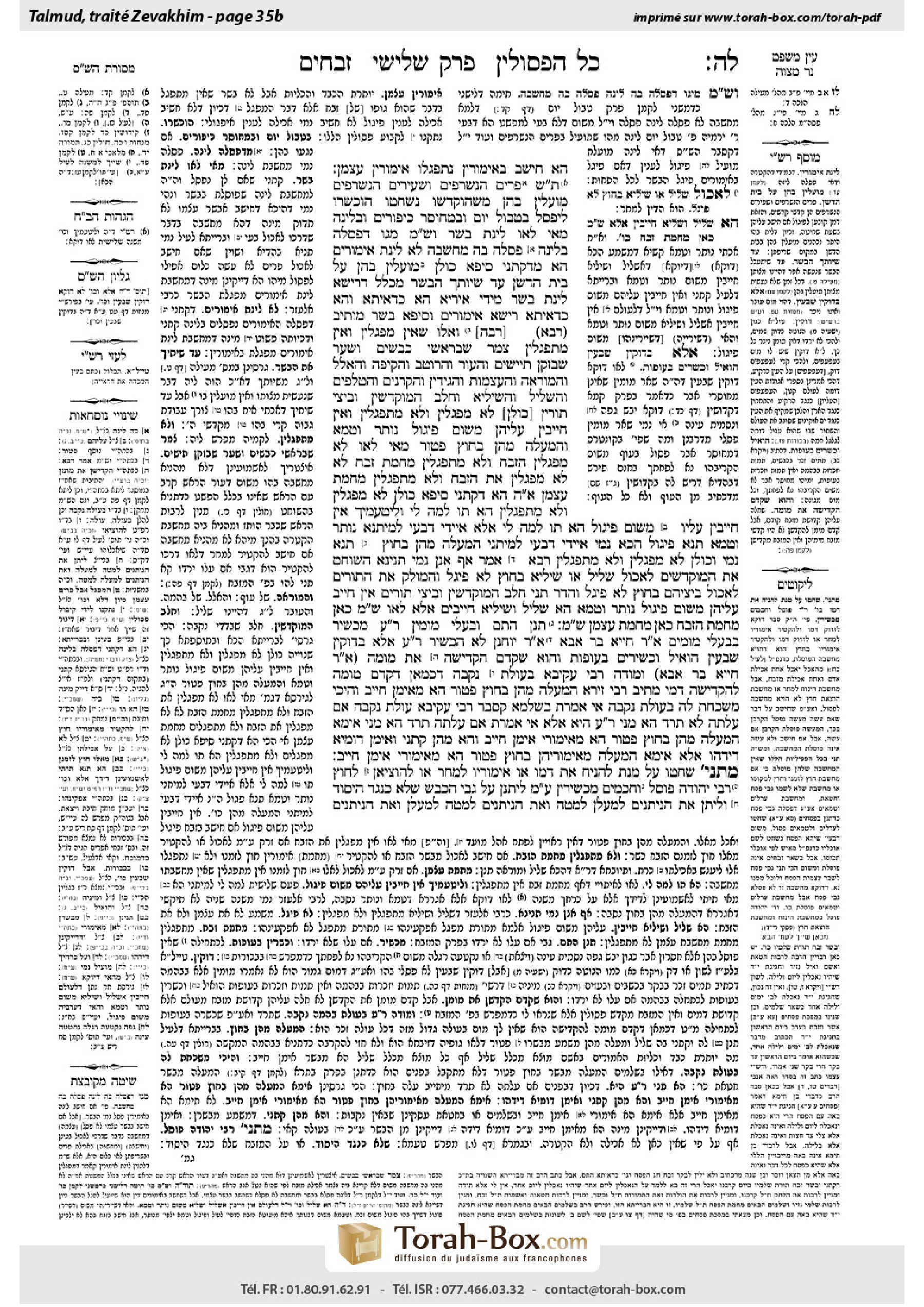
Zevachim 35b: Talmud study for Daf Yomi
Daf Yomi is the daily study of one Talmud folio. Explore 37 tractates with scans, Hebrew text, Sefaria English and AI-generated French translations where annotated.
Passage selection and English or AI-generated French translation are available where the scan has annotations. Daf Study is independent of Torah-Box and Sefaria.
Browse Zevachim · זבחים · All tractatesZevachim 35b text and translations
This page of Zevachim includes the Aramaic text, an English translation and an AI-generated French translation, alongside the scan above.
זבחים ל״ה ב · Aramaic and Hebrew text
הָא חִישֵּׁב בָּאֵימוּרִין – נִתְפַּגְּלוּ אֵימוּרִין עַצְמָן.
תָּא שְׁמַע: פָּרִים הַנִּשְׂרָפִים וּשְׂעִירִים הַנִּשְׂרָפִים – מוֹעֲלִין בָּהֶן מִשֶּׁהוּקְדְּשׁוּ. נִשְׁחֲטוּ – הוּכְשְׁרוּ לִיפָּסֵל בִּטְבוּל יוֹם וּבִמְחוּסַּר כִּיפּוּרִים וּבְלִינָה.
מַאי, לָאו לִינַת בָּשָׂר – וּשְׁמַע מִינַּהּ: מִגּוֹ דְּפָסְלָה בְּלִינָה, פָּסְלָה בָּהּ מַחְשָׁבָה?
לָא; לִינַת אֵימוּרִים. הָא מִדְּקָתָנֵי סֵיפָא: כּוּלָּן מוֹעֲלִין בָּהֶן עַל בֵּית הַדֶּשֶׁן עַד שֶׁיּוּתַּךְ הַבָּשָׂר – מִכְּלָל דְּרֵישָׁא לִינַת בָּשָׂר! מִידֵּי אִירְיָא?! הָא כִּדְאִיתַהּ וְהָא כִּדְאִיתַהּ; רֵישָׁא אֵימוּרִים, וְסֵיפָא בָּשָׂר.
מוֹתֵיב (רָבָא) [רַבָּה]: וְאֵלּוּ שֶׁאֵין מְפַגְּלִין וְאֵין מִתְפַּגְּלִין: צֶמֶר שֶׁבְּרָאשֵׁי כְבָשִׂים, וּשְׂעַר שֶׁבִּזְקַן תְּיָישִׁים, וְהָעוֹר, וְהָרוֹטֶב, וְהַקֵּיפֶה, וְהָאָלָל, וְהַמּוּרְאָה, וְהָעֲצָמוֹת, וְהַגִּידִין, וְהַקְּרָנַיִם, וְהַטְּלָפַיִם, וְהַשְּׁלִיל, וְהַשִּׁילְיָא, וַחֲלֵב הַמּוּקְדָּשִׁין, וּבֵיצֵי תוֹרִין.
[כּוּלָּן] לֹא מְפַגְּלִין וְלֹא מִתְפַּגְּלִין; וְאֵין חַיָּיבִין עֲלֵיהֶן מִשּׁוּם פִּיגּוּל, נוֹתָר וְטָמֵא; וְהַמַּעֲלֶה מֵהֶן בַּחוּץ – פָּטוּר.
מַאי, לָאו לֹא מְפַגְּלִין הַזֶּבַח, וְלֹא מִתְפַּגְּלִין מֵחֲמַת זֶבַח?
לָא; לֹא מְפַגְּלִין אֶת הַזֶּבַח, וְלֹא מִתְפַּגְּלִין מֵחֲמַת עַצְמָן. אִי הָכִי, הָא דְּקָתָנֵי סֵיפָא: כּוּלָּן לֹא מְפַגְּלִין וְלֹא מִתְפַּגְּלִין – הָא תּוּ לְמָה לִי?
וְלִיטַעְמָיךְ, אֵין חַיָּיבִין עָלָיו מִשּׁוּם פִּיגּוּל – הָא תּוּ לְמָה לִי? אֶלָּא אַיְּידֵי דְבָעֵי לְמִיתְנָא נוֹתָר וְטָמֵא, תְּנָא פִּיגּוּל;
הָכָא נָמֵי, אַיְּידֵי דְבָעֵי לְמִיתְנֵי: הַמַּעֲלֶה מֵהֶן בַּחוּץ, תְּנָא נָמֵי: וְכוּלָּן לֹא מְפַגְּלִין וְלֹא מִתְפַּגְּלִין.
רָבָא אָמַר, אַף אֲנַן נָמֵי תְּנֵינָא: הַשּׁוֹחֵט אֶת הַמּוּקְדָּשִׁים לֶאֱכוֹל שְׁלִיל אוֹ שִׁילְיָא בַּחוּץ – לֹא פִּיגֵּל, וְהַמּוֹלֵק אֶת הַתּוֹרִים לֶאֱכוֹל בֵּיצֵיהֶם בַּחוּץ – לֹא פִּיגֵּל;
וַהֲדַר תָּנֵי: חֲלֵב הַמּוּקְדָּשִׁין וּבֵיצֵי תוֹרִים – אֵין חַיָּיב עֲלֵיהֶן מִשּׁוּם פִּיגּוּל, נוֹתָר וְטָמֵא; הָא שְׁלִיל וְשִׁילְיָא – חַיָּיבִים!
אֶלָּא לָאו שְׁמַע מִינַּהּ: כָּאן מֵחֲמַת הַזֶּבַח, כָּאן מֵחֲמַת עַצְמָן? שְׁמַע מִינַּהּ.
תְּנַן הָתָם: וּבַעֲלֵי מוּמִין; רַבִּי עֲקִיבָא מַכְשִׁיר בְּבַעֲלֵי מוּמִים.
אָמַר רַבִּי חִיָּיא בַּר אַבָּא אָמַר רַבִּי יוֹחָנָן: לֹא הִכְשִׁיר רַבִּי עֲקִיבָא אֶלָּא בְּדוּקִּין שֶׁבָּעַיִן, הוֹאִיל וּכְשֵׁירִים בְּעוֹפוֹת. וְהוּא שֶׁקָּדַם הֶקְדֵּישָׁהּ אֶת מוּמָהּ.
אָמַר רַבִּי חִיָּיא בַּר אַבָּא: וּמוֹדֶה רַבִּי עֲקִיבָא בְּעוֹלַת נְקֵבָה, דִּכְמַאן דִּקְדַם מוּמָהּ לְהֶקְדֵּישָׁהּ דָּמֵי.
מֵתִיב רַבִּי זֵירָא: הַמַּעֲלֶה מֵהֶן בַּחוּץ – פָּטוּר. הָא מֵאִימָּן – חַיָּיב; וְהֵיכִי מַשְׁכַּחַתְּ לַהּ? בְּעוֹלַת נְקֵבָה.
אִי אָמְרַתְּ בִּשְׁלָמָא קָסָבַר רַבִּי עֲקִיבָא עוֹלַת נְקֵבָה אִם עָלְתָה לֹא תֵּרֵד, הָא מַנִּי – רַבִּי עֲקִיבָא הִיא. אֶלָּא אִי אָמְרַתְּ אִם עָלְתָה תֵּרֵד, הָא מַנִּי?
אֵימָא: הַמַּעֲלֶה מֵהֶן בַּחוּץ – פָּטוּר, הָא מֵאֵימוּרֵי אִימָּן – חַיָּיב.
וְהָא ״מֵהֶן״ קָתָנֵי – וְאִימָּן דּוּמְיָא דִּידְהוּ! אֶלָּא אֵימָא: הַמַּעֲלֶה מֵאֵימוּרֵיהֶן בַּחוּץ – פָּטוּר, הָא מֵאֵימוּרֵי אִימָּן – חַיָּיב.
מַתְנִי׳ שְׁחָטוֹ עַל מְנָת לְהַנִּיחַ אֶת דָּמוֹ אוֹ אֵימוּרָיו לְמָחָר, אוֹ לְהוֹצִיאָן לַחוּץ – רַבִּי יְהוּדָה פּוֹסֵל וַחֲכָמִים מַכְשִׁירִין. עַל מְנָת לִיתְּנָן עַל גַּבֵּי הַכֶּבֶשׁ; שֶׁלֹּא כְּנֶגֶד הַיְסוֹד; וְלִיתֵּן אֶת הַנִּיתָּנִים לְמַעְלָן – לְמַטָּה; וְאֶת הַנִּיתָּנִים לְמַטָּה – לְמַעְלָן; וְאֶת הַנִּיתָּנִים
Zevachim 35b · English translation
derive instead as follows: But if he intended, with regard to the sacrificial portions of the bulls, to burn them beyond their designated time, the sacrificial portions themselves are rendered piggul, and one is liable to receive karet for eating them. The flesh of the bulls is never rendered piggul.
The Gemara suggests: Come and hear a proof from a mishna (Me’ila 9a): In the case of the bulls that are burned and the goats that are burned, one who derives benefit from them is liable for misuse of consecrated property from the time that they were consecrated. Once they were slaughtered, they are susceptible to being rendered disqualified for sacrifice through contact with one who immersed that day, and through contact with one who has not yet brought an atonement offering, and through being left overnight without the requirements of the offering having been fulfilled.
The Gemara derives: What, is it not referring to the flesh being left overnight, which would render it not valid? And conclude from the mishna that since the flesh is rendered disqualified by being left overnight, the flesh is also rendered disqualified by the intention to burn the sacrificial portions the next day, i.e., it is subject to piggul, which is in accordance with the statement of Rabbi Elazar.
The Gemara responds: No, it is referring to leaving overnight the sacrificial portions of the offering, not the flesh. Likewise, only the sacrificial portions are rendered piggul by intent to eat them after their designated time. The Gemara asks: But from the fact that the latter clause teaches: One who derives benefit from all of them by the place of the ashes where they are burned is liable for misuse of consecrated property until the flesh is completely scorched, it may be inferred that the first clause of the mishna is also referring to the flesh being left overnight. The Gemara answers: Are the cases comparable? This case is as it is, and that case is as it is. The first clause is referring to the sacrificial portions that are consumed on the altar, and the latter clause is referring to the flesh.
Rabba raises an objection to the opinion of Rabbi Elazar from a baraita: And these are portions of the offering that do not render an offering piggul, and they do not become piggul: The wool that is on the head of the lambs, the hair that is in the beard of the goats, the hide, the gravy, the spices that amass at the bottom of the pot together with small amounts of meat, a tendon in the neck, the crop, the bones, the tendons, the horns, the hooves, the fetus, the placenta, the milk of sacrificial animals, and the eggs of doves.
The baraita continues: All of these do not render other items piggul in the case of intent to consume them after their designated time, and they are not rendered piggul, and one is not liable to receive karet for them, neither due to the prohibition of piggul, nor the prohibition of notar, nor the prohibition against partaking of the meat while ritually impure. And one who offers up one of these outside the Temple is exempt, since they are not fit to be sacrificed on the altar.
Rabba explains: What, does the baraita not mean that all of these items do not render the offering piggul if one intends to partake of them beyond the designated time, and they are also not rendered piggul due to the rest of the offering having been rendered piggul? This includes the fetus and placenta, and is therefore not in accordance with the statement of Rabbi Elazar that the rest of the offering does render them piggul.
The Gemara responds: No, it means that they do not render the offering piggul, and they are not rendered piggul due to themselves if one had intent to partake of them beyond the designated time. But such intent with regard to the offering can render them piggul. The Gemara asks: If so, concerning that which is taught in the latter clause: All of these do not render other items piggul and they are not rendered piggul, why do I also need this? Doesn’t it teach that they are not rendered piggul due to the rest of the offering?
The Gemara answers: And according to your reasoning that the additional statement is necessary, then with regard to that which it says a third time: One is not liable to receive karet for them due to the prohibition of piggul, why do I also need this? Rather, the third statement does not teach an additional halakha, but since the tanna wants to teach that one is not liable to receive karet due to violating the prohibition of notar and the prohibition against partaking of the meat while ritually impure, he taught the halakha with regard to piggul as well.
Here too, it can be explained similarly: Since the tanna wants to teach the halakha that one who offers up one of these items outside the Temple is exempt, he also taught: And all of these do not render other items piggul and they are not rendered piggul. It may be that the rest of the offering does in fact render them piggul, as Rabbi Elazar stated.
Rava says: We learn in accordance with the statement of Rabbi Elazar in the mishna as well: One who slaughters sacrificial female animals with the intent to eat the fetus of those animals or their placenta outside their designated area has not rendered the offering piggul. And one who pinches doves, i.e., slaughters them for sacrifice by cutting the napes of their necks with his fingernail, with the intent to eat their eggs that are still in their bodies outside their designated area, has not rendered the offering piggul.
And then it is taught: One who consumes the milk of sacrificial female animals or the eggs of doves is not liable to receive karet for it due to the prohibition of piggul, nor due to the prohibition of notar, nor due to the prohibition against partaking of the meat while ritually impure. But it can be inferred that one who partakes of the fetus or placenta, which are not mentioned, is liable to receive karet due to the prohibition of piggul.
Rather, isn’t it correct to conclude from the mishna that here, they are rendered piggul due to the offering, and there, due to themselves, i.e., if he had improper intent concerning them, then they are not rendered piggul. The Gemara affirms: Conclude from the mishna that it is so.
§ The baraita cited by Rabba is now discussed in a different context: We learned in a mishna there (84a) that if disqualified offerings are nevertheless brought upon the altar, they are removed, and blemished animals are also included in this halakha. Rabbi Akiva deems blemished animals fit, and if they were brought upon the altar they are not removed.
Rabbi Ḥiyya bar Abba says that Rabbi Yoḥanan says: Rabbi Akiva deemed fit only an animal with a blemish on the cornea of the eye and similar blemishes that are not noticeable, since they are valid in the case of birds. And in addition, this is the halakha provided that its consecration preceded its blemish, i.e., when the animal was consecrated it was still entirely fit.
Rabbi Ḥiyya bar Abba says: And Rabbi Akiva concedes with regard to a female burnt offering that was brought upon the altar that since a burnt offering may be only a male animal, it is comparable to a case where its blemish preceded its consecration, since the disqualifying factor was there from the outset. Therefore, if it was brought upon the altar it must be removed.
Rabbi Zeira raises an objection to this from the baraita cited by Rabba: One who offers up one of these outside the Temple is exempt, as they are not fit to be sacrificed on the altar. But it can be inferred that if he were to sacrifice from the flesh of the mother of one of these outside the Temple, he would be liable. And how can you find these circumstances? It is only in the case of a female burnt offering. This is because with regard to a peace offering, which may also be from a female animal, its flesh is not burned on the altar but is eaten. Therefore, there would be no liability for sacrificing it outside the Temple.
Rabbi Zeira explains his objection: Granted, if you say that Rabbi Akiva holds with regard to a female burnt offering that if it ascended onto the altar it does not descend, in accordance with whose opinion is this baraita? It is that of Rabbi Akiva. This is because one is liable for sacrificing any offering outside the Temple that may be sacrificed on the altar, including one that was brought upon the altar inappropriately but is not removed. But if you say that with regard to a female burnt offering if it ascended the altar it must descend, and it entirely lacks the status of an offering fit to be sacrificed on the altar, in accordance with whose opinion is this baraita?
The Gemara answers: Say that the inference should be as follows: One who offers up one of those items outside the Temple is exempt, but if he sacrificed from the sacrificial portions of the mother of one of these, he is liable. This halakha can apply to both a sin offering and a peace offering, for which a female may be brought and whose sacrificial portions are burned on the altar.
The Gemara challenges: But the baraita teaches this halakha with the term: Of one of these, indicating that it is referring to one who sacrifices the flesh, and not the sacrificial portions alone. And the case of their mother is similar to that of them, and is therefore referring to sacrificing the flesh of the mother outside the Temple, and not the sacrificial portions. Rather, say as follows: One who offers up part of their sacrificial portions outside the Temple is exempt, but one who offered up some of the sacrificial portions of the mother of one of these is liable.
MISHNA: If one slaughters the animal in order to leave its blood or its sacrificial portions for the next day, or to remove them outside the designated area, but not in order to sacrifice them the next day, Rabbi Yehuda deems the offering unfit, and the Rabbis deem it fit. In the case of one who slaughters the animal in order to place the blood upon the ramp or on the wall of the altar that is not opposite the base of the altar, or in order to place the blood that is to be placed above the red line below the red line, or to place the blood that is to be placed below the red line above the red line, or the blood that is to be placed
Zevachim 35b · Traduction française (IA)
Il faut plutôt établir la déduction ainsi : si quelqu’un avait l’intention, au sujet des portions sacrificielles des taureaux, de les brûler après le délai qui leur est assigné, ces portions elles-mêmes deviennent piggul, et celui qui les consomme est passible de karet. La viande des taureaux, elle, ne devient jamais piggul.
La Guemara propose : Écoutons une preuve tirée d’une Michna (Meïla 9a) : dans le cas des taureaux et des boucs destinés à être brûlés, celui qui en tire profit est passible pour usage illicite de biens consacrés dès le moment où ils ont été consacrés. Une fois abattus, ils peuvent être disqualifiés pour le sacrifice par le contact d’une personne qui s’est immergée ce jour-là, par celui d’une personne qui n’a pas encore apporté son sacrifice expiatoire, ainsi que s’ils sont laissés toute la nuit sans que les exigences de l’offrande aient été satisfaites.
La Guemara déduit : N’est-ce pas de la viande laissée toute la nuit qu’il est question, ce qui la rendrait invalide ? Conclus donc de la Michna que, puisque la viande est disqualifiée lorsqu’elle est laissée toute la nuit, elle est également disqualifiée si l’on a l’intention de brûler les portions sacrificielles le lendemain, c’est-à-dire qu’elle est susceptible de devenir piggul, conformément à l’avis de Rabbi Elazar.
La Guemara répond : Non, il s’agit des portions sacrificielles de l’offrande laissées toute la nuit, et non de la viande. De même, seules les portions sacrificielles deviennent piggul si l’on a l’intention de les consommer après le délai qui leur est assigné. La Guemara demande : Mais puisque la dernière partie enseigne que celui qui tire profit de toutes ces choses à l’emplacement des cendres où elles sont brûlées est passible pour usage illicite de biens consacrés jusqu’à ce que la viande soit entièrement consumée par le feu, on peut en déduire que la première partie de la Michna parle elle aussi de viande laissée toute la nuit. La Guemara répond : Les deux cas sont-ils comparables ? Chaque cas est distinct : la première partie parle des portions sacrificielles consumées sur l’autel, et la dernière partie parle de la viande.
Rabba soulève une objection à l’avis de Rabbi Elazar à partir d’une baraïta : Voici les parties de l’offrande qui ne rendent pas une offrande piggul et qui ne deviennent pas piggul : la laine qui se trouve sur la tête des agneaux, les poils de la barbe des boucs, la peau, le jus de cuisson, les épices qui s’accumulent au fond de la marmite avec de petites quantités de viande, un tendon du cou, le jabot, les os, les tendons, les cornes, les sabots, le fœtus, le placenta, le lait des animaux consacrés et les œufs de colombes.
La baraïta poursuit : Aucun de ces éléments ne rend d’autres éléments piggul si l’on a l’intention de les consommer après le délai qui leur est assigné ; ils ne deviennent pas non plus piggul et l’on n’est pas passible de karet à leur égard, ni au titre de l’interdiction de piggul, ni de celle de notar, ni de l’interdiction de consommer la viande en état d’impureté rituelle. Celui qui en offre un à l’extérieur du Temple est exempt, car ces éléments ne peuvent pas être offerts sur l’autel.
Rabba explique : La baraïta ne signifie-t-elle pas que tous ces éléments ne rendent pas l’offrande piggul si l’on a l’intention de les consommer après le délai qui leur est assigné, et qu’ils ne deviennent pas non plus piggul du fait que le reste de l’offrande est devenu piggul ? Cela inclut le fœtus et le placenta, et contredit donc l’avis de Rabbi Elazar selon lequel le reste de l’offrande les rend effectivement piggul.
La Guemara répond : Non, cela signifie qu’ils ne rendent pas l’offrande piggul et qu’ils ne deviennent pas piggul de leur propre fait si l’on a eu l’intention de les consommer après le délai qui leur est assigné. En revanche, une telle intention concernant l’offrande peut les rendre piggul. La Guemara demande : Si c’est ainsi, pourquoi ai-je besoin de ce qui est enseigné dans la dernière partie : aucun de ces éléments ne rend d’autres éléments piggul et aucun ne devient piggul ? Cela n’enseigne-t-il pas qu’ils ne deviennent pas piggul du fait du reste de l’offrande ?
La Guemara répond : Selon ton raisonnement, si cette précision supplémentaire était nécessaire, pourquoi ai-je besoin de ce qui est énoncé une troisième fois : on n’est pas passible de karet à leur égard au titre de l’interdiction de piggul ? Cette troisième affirmation n’enseigne pas une halakha supplémentaire ; mais puisque le tanna veut enseigner qu’on n’est pas passible de karet pour avoir enfreint l’interdiction de notar et celle de consommer la viande en état d’impureté rituelle, il a également enseigné la halakha concernant piggul.
Ici aussi, on peut expliquer de la même manière : puisque le tanna veut enseigner la halakha selon laquelle celui qui offre l’un de ces éléments à l’extérieur du Temple est exempt, il a également enseigné que tous ces éléments ne rendent pas d’autres éléments piggul et ne deviennent pas piggul. Il se peut que le reste de l’offrande les rende effectivement piggul, comme l’a déclaré Rabbi Elazar.
Rava dit : Nous apprenons également dans la Michna conformément à l’avis de Rabbi Elazar : celui qui abat des femelles consacrées avec l’intention de consommer leur fœtus ou leur placenta hors de la zone prescrite ne rend pas l’offrande piggul. De même, celui qui pince des colombes, c’est-à-dire qui les abat pour le sacrifice en leur coupant la nuque avec l’ongle, avec l’intention de consommer les œufs encore dans leur corps hors de la zone prescrite, ne rend pas l’offrande piggul.
Puis il est enseigné : celui qui consomme le lait de femelles consacrées ou les œufs de colombes n’est pas passible de karet à ce titre, ni au titre de l’interdiction de piggul, ni de celle de notar, ni de l’interdiction de consommer la viande en état d’impureté rituelle. Mais on peut en déduire que celui qui consomme le fœtus ou le placenta, qui ne sont pas mentionnés, est passible de karet au titre de l’interdiction de piggul.
N’est-il pas plutôt juste de conclure de la Michna que, dans un cas, ils deviennent piggul du fait de l’offrande, tandis que dans l’autre, ils ne deviennent pas piggul de leur propre fait, c’est-à-dire que si l’on a eu une intention incorrecte à leur sujet, ils ne deviennent pas piggul ? La Guemara confirme : conclus de la Michna qu’il en est bien ainsi.
§ La baraïta citée par Rabba est maintenant examinée dans un autre contexte : nous avons appris dans une Michna (84a) que si des offrandes disqualifiées sont néanmoins déposées sur l’autel, elles en sont retirées ; les animaux présentant un défaut sont également visés par cette halakha. Rabbi Akiva juge aptes les animaux présentant un défaut, et s’ils ont été déposés sur l’autel, ils n’en sont pas retirés.
Rabbi Ḥiyya bar Abba dit au nom de Rabbi Yoḥanan : Rabbi Akiva a jugé aptes uniquement les animaux présentant un défaut à la cornée de l’œil, ainsi que des défauts similaires qui ne sont pas visibles, puisqu’ils sont valides dans le cas des oiseaux. De plus, cette halakha ne s’applique que si la consécration de l’animal a précédé son défaut, c’est-à-dire qu’au moment de sa consécration, il était encore entièrement apte.
Rabbi Ḥiyya bar Abba dit : Rabbi Akiva reconnaît, au sujet d’une holocauste femelle déposée sur l’autel, que puisqu’un holocauste ne peut être qu’un animal mâle, cela équivaut à un cas où le défaut a précédé la consécration, car le facteur disqualifiant était présent dès le départ. Par conséquent, si elle a été déposée sur l’autel, elle doit en être retirée.
Rabbi Zeira soulève une objection à partir de la baraïta citée par Rabba : celui qui offre l’un de ces éléments à l’extérieur du Temple est exempt, car ils ne peuvent pas être offerts sur l’autel. Mais on peut en déduire que s’il offrait à l’extérieur du Temple une partie de la chair de la mère de l’un de ces éléments, il serait passible. Or, comment trouver un tel cas ? Uniquement celui d’une holocauste femelle. En effet, dans le cas d’une offrande de paix, qui peut également être une femelle, la viande n’est pas brûlée sur l’autel, mais mangée. Il n’y aurait donc pas de responsabilité pour l’avoir offerte à l’extérieur du Temple.
Rabbi Zeira explique son objection : il est certes possible de dire que, selon Rabbi Akiva, si une holocauste femelle est montée sur l’autel, elle n’en descend pas ; dans ce cas, de quelle opinion cette baraïta relève-t-elle ? De celle de Rabbi Akiva. En effet, on est passible pour avoir offert à l’extérieur du Temple toute offrande qui peut être offerte sur l’autel, y compris celle qui y a été déposée de manière irrégulière mais qui n’en est pas retirée. Mais si tu dis que, dans le cas d’une holocauste femelle, si elle est montée sur l’autel, elle doit en descendre, et qu’elle n’a absolument pas le statut d’une offrande apte à être offerte sur l’autel, de quelle opinion cette baraïta relève-t-elle ?
La Guemara répond : Comprends l’inférence ainsi : celui qui offre l’un de ces éléments à l’extérieur du Temple est exempt, mais s’il offrait des portions sacrificielles de la mère de l’un d’eux, il serait passible. Cette halakha peut s’appliquer aussi bien à un sacrifice expiatoire qu’à une offrande de paix, car une femelle peut être apportée dans ces deux cas et leurs portions sacrificielles sont brûlées sur l’autel.
La Guemara objecte : Mais la baraïta enseigne cette halakha en employant l’expression « l’un de ces éléments », ce qui indique qu’il s’agit de celui qui offre la viande, et non des seules portions sacrificielles. Et le cas de leur mère est semblable au leur ; il s’agit donc d’offrir la viande de la mère à l’extérieur du Temple, et non ses seules portions sacrificielles. Il faut plutôt dire ainsi : celui qui offre une partie de leurs portions sacrificielles à l’extérieur du Temple est exempt, tandis que celui qui offre certaines portions sacrificielles de la mère de l’un d’eux est passible.
MICHNA : Si quelqu’un abat l’animal avec l’intention de laisser son sang ou ses portions sacrificielles jusqu’au lendemain, ou de les faire sortir de la zone prescrite, mais sans avoir l’intention de les sacrifier le lendemain, Rabbi Yehuda juge l’offrande invalide, tandis que les Sages la jugent valide. Dans le cas de celui qui abat l’animal avec l’intention de placer le sang sur la rampe ou sur une face de l’autel qui ne fait pas face à sa base, ou de placer sous la ligne rouge le sang qui doit être placé au-dessus de cette ligne, ou de placer au-dessus de la ligne rouge le sang qui doit être placé au-dessous, ou le sang qui doit être placé
Traduction française générée par IA à partir de l’édition anglaise de Sefaria. Vérifie toujours un passage avec le texte source.
Text from Sefaria: William Davidson Edition - Vocalized Aramaic (CC BY NC); William Davidson Edition - English (CC BY NC).