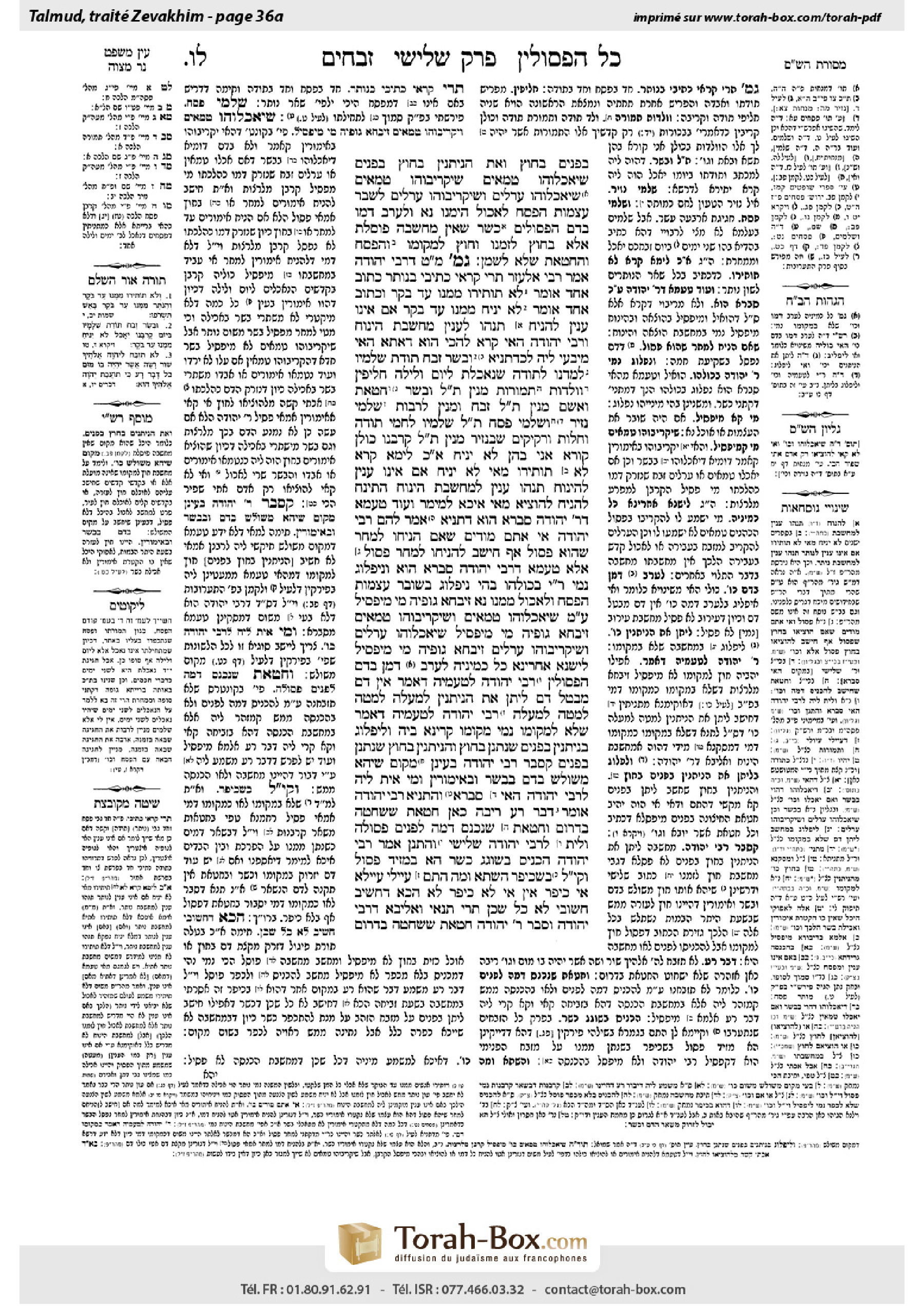
Zevachim 36a: Talmud study for Daf Yomi
Daf Yomi is the daily study of one Talmud folio. Explore 37 tractates with scans, Hebrew text, Sefaria English and AI-generated French translations where annotated.
Passage selection and English or AI-generated French translation are available where the scan has annotations. Daf Study is independent of Torah-Box and Sefaria.
Browse Zevachim · זבחים · All tractatesZevachim 36a text and translations
This page of Zevachim includes the Aramaic text, an English translation and an AI-generated French translation, alongside the scan above.
זבחים ל״ו א · Aramaic and Hebrew text
בִּפְנִים – בַּחוּץ; וְאֶת הַנִּיתָּנִין בַּחוּץ – בִּפְנִים; שֶׁיֹּאכְלוּהוּ טְמֵאִים; שֶׁיַּקְרִיבוּהוּ טְמֵאִים; שֶׁיֹּאכְלוּהוּ עֲרֵלִים; וְשֶׁיַּקְרִיבוּהוּ עֲרֵלִים; לְשַׁבֵּר עַצְמוֹת הַפֶּסַח; לֶאֱכוֹל הֵימֶנּוּ נָא; וּלְעָרֵב דָּמוֹ בְּדַם הַפְּסוּלִים – כָּשֵׁר.
שֶׁאֵין מַחְשָׁבָה פּוֹסֶלֶת אֶלָּא בְּחוּץ לִזְמַנּוֹ וְחוּץ לִמְקוֹמוֹ, וְהַפֶּסַח וְהַחַטָּאת שֶׁלֹּא לִשְׁמָן.
גְּמָ׳ מַאי טַעְמָא דְּרַבִּי יְהוּדָה? אָמַר רַבִּי אֶלְעָזָר: תְּרֵי קְרָאֵי כְּתִיבִי בְּנוֹתָר; כָּתוּב אֶחָד אוֹמֵר: ״לֹא תוֹתִירוּ מִמֶּנּוּ עַד בֹּקֶר״, וְכָתוּב אֶחָד אוֹמֵר: ״לֹא יַנִּיחַ מִמֶּנּוּ עַד בֹּקֶר״; אִם אֵינוֹ עִנְיָן לְהִנִּיחַ, תְּנֵהוּ לְעִנְיַן מַחְשֶׁבֶת הִינּוּחַ.
וְרַבִּי יְהוּדָה – הַאי קְרָא לְהָכִי הוּא דַּאֲתָא?! הַאי מִיבְּעֵי לֵיהּ לְכִדְתַנְיָא: ״וּבְשַׂר זֶבַח תּוֹדַת שְׁלָמָיו״ – לָמַדְנוּ לְתוֹדָה שֶׁנֶּאֱכֶלֶת לְיוֹם וָלַיְלָה.
חֲלִיפִין, וְולָדוֹת, תְּמוּרוֹת – מִנַּיִן? תַּלְמוּד לוֹמַר: ״וּבְשַׂר״. חַטָּאת וְאָשָׁם מִנַּיִן? תַּלְמוּד לוֹמַר: ״זֶבַח״.
וּמִנַּיִן לְרַבּוֹת שַׁלְמֵי נָזִיר וְשַׁלְמֵי פֶסַח? תַּלְמוּד לוֹמַר: ״שְׁלָמָיו״. לַחְמֵי תוֹדָה, וְחַלּוֹת וּרְקִיקִים שֶׁבְּנָזִיר – מִנַּיִן? תַּלְמוּד לוֹמַר: ״קׇרְבָּנוֹ״ – כּוּלָּן קוֹרֵא אֲנִי בָּהֶן ״לֹא יַנִּיחַ״.
אִם כֵּן, לֵימָא קְרָא: ״לֹא תוֹתִירוּ״, מַאי ״לֹא יַנִּיחַ״? אִם אֵינוֹ עִנְיָן לְהִינּוּחַ, תְּנֵהוּ עִנְיָן לְמַחְשֶׁבֶת הִינּוּחַ.
הָתִינַח לְהָנִיחַ, לְהוֹצִיא מַאי אִיכָּא לְמֵימַר?
וְעוֹד, טַעְמָא דְּרַבִּי יְהוּדָה סְבָרָא הוּא! דְּתַנְיָא, אָמַר לָהֶם רַבִּי יְהוּדָה: אִי אַתֶּם מוֹדִים שֶׁאִם הִנִּיחוֹ לְמָחָר – שֶׁהוּא פָּסוּל? אַף חִישֵּׁב לְהַנִּיחוֹ לְמָחָר – פָּסוּל. אֶלָּא טַעְמָא דְּרַבִּי יְהוּדָה סְבָרָא הוּא?! וְנִיפְלוֹג נָמֵי רַבִּי יְהוּדָה בְּכוּלְּהוּ!
בְּהֵי נִיפְלוֹג? בְּשׁוֹבֵר עַצְמוֹת הַפֶּסַח וְלֶאֱכוֹל מִמֶּנּוּ נָא – זִיבְחָא גּוּפֵיהּ מִי מִיפְּסִיל?!
עַל מְנָת שֶׁיֹּאכְלוּהוּ טְמֵאִים וְשֶׁיַּקְרִיבוּהוּ טְמֵאִים – זִיבְחָא גּוּפֵיהּ מִי מִיפְּסִיל?! שֶׁיֹּאכְלוּהוּ עֲרֵלִים וְשֶׁיַּקְרִיבוּהוּ עֲרֵלִים – זִיבְחָא גּוּפֵיהּ מִי מִיפְּסִיל?! לִישָּׁנָא אַחֲרִינָא: כֹּל כְּמִינֵּיהּ?!
לְעָרֵב דָּמָן בְּדַם הַפְּסוּלִין – רַבִּי יְהוּדָה לְטַעְמֵיהּ, דְּאָמַר: אֵין דָּם מְבַטֵּל דָּם. לִיתֵּן אֶת הַנִּיתָּנִין לְמַעְלָה לְמַטָּה, לְמַטָּה לְמַעְלָה – רַבִּי יְהוּדָה לְטַעְמֵיהּ, דְּאָמַר: שֶׁלֹּא לִמְקוֹמוֹ נָמֵי מְקוֹמוֹ קָרֵינָא בֵּיהּ.
וְלִיפְלוֹג בַּנִּיתָּנִין בִּפְנִים שֶׁנְּתָנָן בַּחוּץ, וְהַנִּיתָּנִין בַּחוּץ שֶׁנְּתָנָן בִּפְנִים!
קָסָבַר רַבִּי יְהוּדָה: בָּעֵינַן מְקוֹם שֶׁיְּהֵא מְשׁוּלָּשׁ – בְּדָם, בְּבָשָׂר וּבְאֵימוּרִין.
וּמִי אִית לֵיהּ לְרַבִּי יְהוּדָה הַאי סְבָרָא?! וְהָתַנְיָא, רַבִּי יְהוּדָה אוֹמֵר: ״דָּבָר רָע״ – רִיבָּה כָּאן חַטָּאת שֶׁשְּׁחָטָהּ בַּדָּרוֹם וְחַטָּאת שֶׁנִּכְנַס דָּמָהּ לִפְנִים, פְּסוּלָה.
וְלֵית לְרַבִּי יְהוּדָה שְׁלִישִׁי?! וְהָתְנַן, אָמַר רַבִּי יְהוּדָה: הִכְנִיס בְּשׁוֹגֵג – כָּשֵׁר. הָא בְּמֵזִיד – פָּסוּל; וְקַיְימָא לַן בְּשֶׁכִּיפֵּר.
הַשְׁתָּא וּמָה הָתָם (עָיְילִי עָיְילָא) [דְּעַיּוֹלֵי עַיְּילֵיהּ], אִי כִּיפֵּר אִין אִי לֹא כִּיפֵּר לָא; הָכָא דְּחַשֵּׁיב חַשּׁוֹבֵי, לֹא כׇּל שֶׁכֵּן?! תְּרֵי תַּנָּאֵי וְאַלִּיבָּא דְּרַבִּי יְהוּדָה.
וְסָבַר רַבִּי יְהוּדָה: חַטָּאת שֶׁשְּׁחָטָהּ בַּדָּרוֹם –
Zevachim 36a · English translation
inside the Sanctuary outside the Sanctuary, or the blood that is to be placed outside the Sanctuary inside the Sanctuary; and likewise, if he slaughtered the animal with the intent that ritually impure people will partake of it, or that ritually impure people will sacrifice it, or that uncircumcised people will partake of it, or that uncircumcised people will sacrifice it; and likewise, with regard to the Paschal offering, if he had intent during the slaughter to break the bones of the Paschal offering, or to eat from the meat of the Paschal offering partially roasted, or to mix the blood of an offering with the blood of unfit offerings, in all these cases, although he intended to perform one of these prohibited acts, some of which would render the offering unfit, the offering is fit.
The reason is that intent does not render the offering unfit except in cases of intent to eat or to burn the offering beyond its designated time and outside its designated area, and in addition, the Paschal offering and the sin offering are disqualified by intent to sacrifice them not for their sake.
GEMARA: The Gemara asks: What is the reasoning of Rabbi Yehuda, who deems the offering unfit if there was intent to leave it over until the next day or to take it out of its designated area? Rabbi Elazar said: There are two verses that are written with regard to notar. One verse states: “You shall let nothing of it remain until the morning, and that which remains of it until the morning you shall burn with fire” (Exodus 12:10), and one verse states: “He shall not leave any of it until the morning” (Leviticus 7:15). If the additional verse is not necessary for the matter of the prohibition against leaving it overnight, which is already mentioned by the first verse, apply it to the matter of intent of leaving it overnight, which would therefore be prohibited as well.
The Gemara asks: But according to the opinion of Rabbi Yehuda, does this verse come to teach this idea? This verse is necessary for him to derive that which is taught in a baraita: The verse states: “And the flesh of the sacrifice of his peace offerings for thanksgiving shall be eaten on the day of his offering; he shall not leave any of it until the morning” (Leviticus 7:15). From the words: “And the flesh of the sacrifice of his peace offerings for thanksgiving,” we learned with regard to a thanks offering that it is eaten for a day and a night.
With regard to animals exchanged for thanks offerings, and the offspring of thanks offerings, and the substitutes of thanks offerings, from where is it derived that they too are eaten for only a day and a night? The verse states: “And the flesh [uvesar],” and the additional “and” includes them. With regard to a sin offering and a guilt offering, from where is it derived that they are eaten for only a day and a night? The verse states: “Sacrifice,” to include other types of offerings.
The baraita continues: And from where is it derived to include the peace offering of a nazirite, i.e., the ram that a nazirite brings at the close of his term of naziriteship, and the peace offering of Passover? The verse therefore states: “His peace offerings,” in the plural. With regard to the loaves of the thanks offering, and the loaves and wafers that are part of the offering brought by a nazirite, from where is it derived that they are eaten for only a day and a night? The verse states: “His offering.” With regard to all of them I will read the phrase “He shall not leave any of it until the morning” as being applicable. Evidently, this verse is necessary to teach numerous halakhot concerning the allotted time to partake of offerings.
The Gemara answers: If so, let the verse state: And you shall let nothing of it remain until the morning, as stated in the other verse. What is indicated by the phrase “He shall not leave any of it”? If it is not necessary for the matter of the prohibition against leaving it overnight, apply it to the matter of intent to leave it overnight.
The Gemara now questions the source cited by Rabbi Elazar: This works out well to explain the opinion of Rabbi Yehuda with regard to one who had intent to leave the sacrificial portions overnight. But with regard to disqualifying the offering due to one who had intent to remove them from the Temple, what can be said to explain the source of Rabbi Yehuda, as it cannot be derived from these verses?
And furthermore, the statement of Rabbi Elazar can be questioned, as the rationale of Rabbi Yehuda is based on logical reasoning and is not derived from a verse. This is as it is taught in a baraita: Rabbi Yehuda said to the Rabbis: Do you not concede that if he left it over until the next day that it is disqualified? So too, if he intended to leave it over until the next day it is disqualified. Clearly, Rabbi Yehuda bases his opinion on logical reasoning, as he equates intent with action. The Gemara asks: Rather, is the rationale of Rabbi Yehuda based on logical reasoning and not derived from the verse? But if so, Rabbi Yehuda should also disagree with regard to all of the other cases in the mishna due to the same reasoning.
The Gemara rejects this: With regard to which case should Rabbi Yehuda disagree? Should he disagree with regard to one who slaughters the offering with intent to break the bones of the Paschal offering, or with intent to partake of the Paschal offering while it is partially roasted? Even had he actually realized such intent, would the offering itself thereby be disqualified? It presumably would not, as the presenting of the blood effects acceptance.
Likewise, if a rite was performed on the condition that ritually impure individuals will partake of it, or that ritually impure individuals will sacrifice it, i.e., burn the sacrificial portions on the altar, would the offering itself be disqualified if such actions occurred? Likewise, if it was done with the intent that uncircumcised individuals will partake of it, or that uncircumcised individuals will sacrifice it, would the offering itself be disqualified if this occurred? The Gemara presents another version of this question: Is it in his power to execute these actions that are contingent upon the will of others?
With regard to a case where one had intent to mix their blood with the blood of unfit offerings, where Rabbi Yehuda also does not disagree with the ruling of the mishna that the offering is valid, he conforms to his line of reasoning, as he says: Blood does not nullify blood. Therefore, even if one would actually mix the two types of blood, it would not be disqualified. Likewise, in cases where one had intent to place the blood that is to be placed above the red line below the red line, or those that are to be placed below the red line above the red line, Rabbi Yehuda conforms to his line of reasoning, as he says: Blood that was not placed in its proper place on the altar is also considered to be placed in its proper place, and it effects acceptance of the offering.
The Gemara suggests: And let him disagree with regard to a case of blood that is to be placed inside the Sanctuary that was placed outside, and blood that is to be placed outside the Sanctuary that was placed inside, as the verse explicitly states that an external sin offering whose blood was sprinkled inside is disqualified (see Leviticus 6:23).
The Gemara explains: Rabbi Yehuda holds that in order to disqualify an offering with the intent to perform a rite outside its designated area, we require that the intended place have threefold functionality, i.e., for the presenting of the blood, for the eating of the meat, and for the burning of the sacrificial portions on the altar, which is true only of the area outside the Temple courtyard, which was valid for these three activities during an era in which it was permitted to sacrifice offerings on private altars. Therefore, intent to present the blood in the Sanctuary, which lacks these three elements, does not disqualify the offering, as the meat and sacrificial portions are never eaten or burned there.
The Gemara asks: And does Rabbi Yehuda accept this reasoning that it must be a place of threefold functionality? But isn’t it taught in a baraita: Rabbi Yehuda says that the verse states: “You shall not sacrifice to the Lord your God an ox, or a sheep, that has a blemish, even any evil thing” (Deuteronomy 17:1). The verse included here a sin offering that one slaughtered in the south and not on the northern side of the Temple courtyard as required, and likewise a sin offering whose blood entered inside, i.e., it was slaughtered with the intent that its blood would be brought inside the Sanctuary, that they are disqualified. This indicates that an offering slaughtered with improper intent with regard to a place that lacks threefold functionality nevertheless renders the offering not valid.
The Gemara responds: And does Rabbi Yehuda not accept the requirement of a place of three functions? But didn’t we learn in a mishna (82a) that Rabbi Yehuda said: If he brought the blood into the Sanctuary unwittingly, the blood remains fit for presenting, from which it may be inferred: But if he brought it in intentionally, it is unfit. And we maintain that Rabbi Yehuda deems it unfit only where one actually effected atonement, i.e., he presented the blood on the inner altar.
Now, it stands to reason that if there, where one actually brought the blood inside, only if he effected atonement, yes, it is unfit, but if he did not effect atonement it is not unfit, then here, where he merely thought to bring it inside, all the more so is it not clear that it should be valid? The Gemara answers: There are two tanna’im, and they disagree with regard to the opinion of Rabbi Yehuda concerning a place with threefold functionality.
The Gemara asks: And does Rabbi Yehuda hold that with regard to a sin offering that one slaughtered in the south,
Zevachim 36a · Traduction française (IA)
à l’intérieur du Sanctuaire, alors que le sang devait être placé à l’extérieur du Sanctuaire, ou le sang qui devait être placé à l’extérieur du Sanctuaire, à l’intérieur du Sanctuaire ; de même, s’il a égorgé l’animal avec l’intention que des personnes rituellement impures en consomment la viande, ou qu’elles en brûlent les parties sacrificielles, ou que des personnes incirconcises en consomment la viande, ou qu’elles en brûlent les parties sacrificielles ; de même encore, concernant l’offrande pascale, s’il a eu, au moment de l’égorgement, l’intention de briser les os de l’offrande pascale, de manger de sa viande alors qu’elle était partiellement rôtie, ou de mélanger le sang d’une offrande à celui d’offrandes impropres, dans tous ces cas, bien qu’il ait eu l’intention d’accomplir l’un de ces actes interdits, dont certains rendraient l’offrande impropre, celle-ci reste valide.
La raison en est que l’intention ne rend l’offrande impropre que lorsqu’il s’agit de manger ou de brûler l’offrande après le délai qui lui est assigné ou hors de l’endroit qui lui est assigné ; en outre, l’offrande pascale et le sacrifice expiatoire sont disqualifiés si l’on a l’intention de les offrir pour une autre raison que celle pour laquelle ils sont destinés.
GUEMARA : La Guemara demande : Quel est le raisonnement de Rabbi Yehouda, qui déclare l’offrande impropre si l’on a eu l’intention de la laisser jusqu’au lendemain ou de la sortir de l’endroit qui lui est assigné ? Rabbi Elazar a dit : Deux versets sont écrits au sujet du notar. L’un dit : « Vous n’en laisserez rien jusqu’au matin, et ce qui en restera jusqu’au matin, vous le brûlerez par le feu » (Exode 12, 10) ; l’autre dit : « Il n’en laissera rien jusqu’au matin » (Lévitique 7, 15). Si ce verset supplémentaire n’est pas nécessaire pour interdire de laisser l’offrande jusqu’au lendemain, puisque le premier verset l’interdit déjà, applique-le à l’intention de la laisser jusqu’au lendemain, qui serait donc également interdite.
La Guemara demande : Mais, selon l’opinion de Rabbi Yehouda, ce verset vient-il enseigner cette idée ? Il lui est nécessaire pour déduire ce qui est enseigné dans une baraïta : le verset dit : « La chair du sacrifice de ses sacrifices de paix d’action de grâce sera mangée le jour de son offrande ; il n’en laissera rien jusqu’au matin » (Lévitique 7, 15). Des mots « la chair du sacrifice de ses sacrifices de paix d’action de grâce », nous avons appris, au sujet de l’offrande de remerciement, qu’elle se mange pendant un jour et une nuit.
Concernant les animaux échangés contre des offrandes de remerciement, les descendants des offrandes de remerciement et les substituts des offrandes de remerciement, d’où déduit-on qu’eux aussi ne se mangent que pendant un jour et une nuit ? Le verset dit : « Et la chair » [uvesar] ; le « et » supplémentaire les inclut. Concernant le sacrifice expiatoire et le sacrifice de culpabilité, d’où déduit-on qu’ils ne se mangent que pendant un jour et une nuit ? Le verset dit : « sacrifice », pour inclure d’autres types d’offrandes.
La baraïta poursuit : Et d’où déduit-on qu’il faut inclure le sacrifice de paix du nazir, c’est-à-dire le bélier qu’un nazir apporte à la fin de sa période de naziréat, ainsi que le sacrifice de paix de Pessa’h ? Le verset dit donc : « ses sacrifices de paix », au pluriel. Concernant les pains de l’offrande de remerciement, ainsi que les pains et les galettes qui font partie de l’offrande apportée par un nazir, d’où déduit-on qu’ils ne se mangent que pendant un jour et une nuit ? Le verset dit : « son offrande ». Pour tous ces éléments, on peut appliquer la formule « Il n’en laissera rien jusqu’au matin ». Il est donc évident que ce verset est nécessaire pour enseigner de nombreuses halakhot sur la durée autorisée pour consommer les offrandes.
La Guemara répond : Si tel était le cas, que le verset dise : « Vous n’en laisserez rien jusqu’au matin », comme dans l’autre verset. Que signifie la formule « Il n’en laissera rien » ? Si elle n’est pas nécessaire pour interdire de laisser l’offrande jusqu’au lendemain, applique-la à l’intention de la laisser jusqu’au lendemain.
La Guemara remet à présent en question la source citée par Rabbi Elazar : cela explique bien l’opinion de Rabbi Yehouda concernant celui qui a eu l’intention de laisser les parties sacrificielles jusqu’au lendemain. Mais, pour ce qui est de disqualifier l’offrande parce qu’on a eu l’intention de les sortir du Temple, comment expliquer la source de Rabbi Yehouda, puisque cela ne peut être déduit de ces versets ?
De plus, on peut contester l’énoncé de Rabbi Elazar, car le raisonnement de Rabbi Yehouda est fondé sur une déduction logique et non sur un verset. C’est ce qui est enseigné dans une baraïta : Rabbi Yehouda dit aux Sages : « Ne reconnaissez-vous pas que si quelqu’un l’a laissée jusqu’au lendemain, elle est disqualifiée ? De même, si quelqu’un a eu l’intention de la laisser jusqu’au lendemain, elle est disqualifiée. » Il est clair que Rabbi Yehouda fonde son opinion sur une déduction logique, puisqu’il assimile l’intention à l’acte. La Guemara demande : Le raisonnement de Rabbi Yehouda serait-il donc fondé sur une déduction logique et non sur le verset ? Mais si tel était le cas, Rabbi Yehouda devrait également contester tous les autres cas de la Michna, pour le même motif.
La Guemara rejette cette hypothèse : dans quel cas Rabbi Yehouda devrait-il contester ? Devrait-il contester le cas de celui qui égorge l’offrande avec l’intention de briser les os de l’offrande pascale, ou avec l’intention de manger l’offrande pascale alors qu’elle est partiellement rôtie ? Même s’il avait effectivement réalisé cette intention, l’offrande elle-même serait-elle ainsi disqualifiée ? Vraisemblablement non, puisque la présentation du sang rend l’offrande acceptable.
De même, si un rite a été accompli avec l’intention que des personnes rituellement impures consomment l’offrande ou la sacrifient, c’est-à-dire brûlent les parties sacrificielles sur l’autel, l’offrande elle-même serait-elle disqualifiée si ces actes avaient eu lieu ? De même, si le rite a été accompli avec l’intention que des personnes incirconcises consomment l’offrande ou la sacrifient, l’offrande elle-même serait-elle disqualifiée si cela avait eu lieu ? La Guemara présente une autre version de la question : est-il en son pouvoir d’accomplir ces actes, qui dépendent de la volonté d’autrui ?
Dans le cas où quelqu’un a eu l’intention de mélanger le sang de l’offrande à celui d’offrandes impropres, et où Rabbi Yehouda ne conteste pas non plus la décision de la Michna selon laquelle l’offrande est valide, il reste fidèle à son raisonnement, car il dit : « Le sang n’annule pas le sang. » Par conséquent, même si l’on mélangeait effectivement les deux types de sang, l’offrande ne serait pas disqualifiée. De même, dans les cas où quelqu’un a eu l’intention de placer sous la ligne rouge le sang qui doit être placé au-dessus de cette ligne, ou au-dessus de la ligne rouge celui qui doit être placé au-dessous, Rabbi Yehouda reste fidèle à son raisonnement, car il dit : « Le sang qui n’a pas été placé à l’endroit approprié sur l’autel est également considéré comme y ayant été placé » ; il rend ainsi l’offrande acceptable.
La Guemara suggère : Qu’il conteste donc le cas du sang qui doit être placé à l’intérieur du Sanctuaire et qui a été placé à l’extérieur, ainsi que celui du sang qui doit être placé à l’extérieur du Sanctuaire et qui a été placé à l’intérieur, puisque le verset déclare explicitement qu’un sacrifice expiatoire externe dont le sang a été aspergé à l’intérieur est disqualifié (voir Lévitique 6, 23).
La Guemara explique : Rabbi Yehouda estime que, pour disqualifier une offrande en raison de l’intention d’accomplir un rite hors de l’endroit qui lui est assigné, l’endroit envisagé doit avoir une triple fonction, c’est-à-dire servir à la présentation du sang, à la consommation de la viande et à la combustion des parties sacrificielles sur l’autel. Seul l’espace situé à l’extérieur de la cour du Temple répond à ces trois critères, car ces trois activités y étaient autorisées à l’époque où l’on pouvait offrir des sacrifices sur des autels privés. Par conséquent, l’intention de présenter le sang dans le Sanctuaire, qui ne réunit pas ces trois conditions, ne disqualifie pas l’offrande, puisque la viande n’y est jamais consommée et que les parties sacrificielles n’y sont jamais brûlées.
La Guemara demande : Rabbi Yehouda accepte-t-il ce raisonnement, selon lequel il doit s’agir d’un endroit ayant une triple fonction ? Mais n’est-il pas enseigné dans une baraïta que Rabbi Yehouda dit que le verset énonce : « Tu ne sacrifieras pas à l’Éternel ton Dieu un bœuf ou un mouton ayant un défaut, ni quoi que ce soit de malfaisant » (Deutéronome 17, 1). Le verset inclut ici le cas d’un sacrifice expiatoire égorgé au sud, et non du côté nord de la cour du Temple, comme cela est requis ; il inclut également le cas d’un sacrifice expiatoire dont le sang est entré à l’intérieur, c’est-à-dire égorgé avec l’intention que son sang soit apporté dans le Sanctuaire. Ces sacrifices sont disqualifiés. Cela indique qu’une offrande égorgée avec une intention incorrecte concernant un endroit qui n’a pas de triple fonction est néanmoins rendue invalide.
La Guemara répond : Rabbi Yehouda n’accepterait-il pas l’exigence d’un endroit ayant trois fonctions ? Mais n’avons-nous pas appris dans une Michna (82a) que Rabbi Yehouda a dit : « Si quelqu’un a apporté le sang dans le Sanctuaire par inadvertance, le sang reste valide pour la présentation » ; on peut en déduire que s’il l’y a apporté intentionnellement, il est impropre. Et nous tenons pour établi que Rabbi Yehouda ne le déclare impropre que lorsque quelqu’un a effectivement obtenu l’expiation, c’est-à-dire qu’il a présenté le sang sur l’autel intérieur.
Or, il est logique que si, dans ce cas où quelqu’un a effectivement apporté le sang à l’intérieur, le sang n’est impropre que s’il a obtenu l’expiation, mais que s’il ne l’a pas obtenue, il n’est pas impropre, alors, dans le cas présent, où il a seulement pensé à l’apporter à l’intérieur, il devrait à plus forte raison être évident que l’offrande reste valide. La Guemara répond : il y a deux tannaïm, qui divergent sur l’opinion de Rabbi Yehouda concernant un endroit ayant une triple fonction.
La Guemara demande : Rabbi Yehouda estime-t-il qu’au sujet d’un sacrifice expiatoire égorgé au sud,
Traduction française générée par IA à partir de l’édition anglaise de Sefaria. Vérifie toujours un passage avec le texte source.
Text from Sefaria: William Davidson Edition - Vocalized Aramaic (CC BY NC); William Davidson Edition - English (CC BY NC).