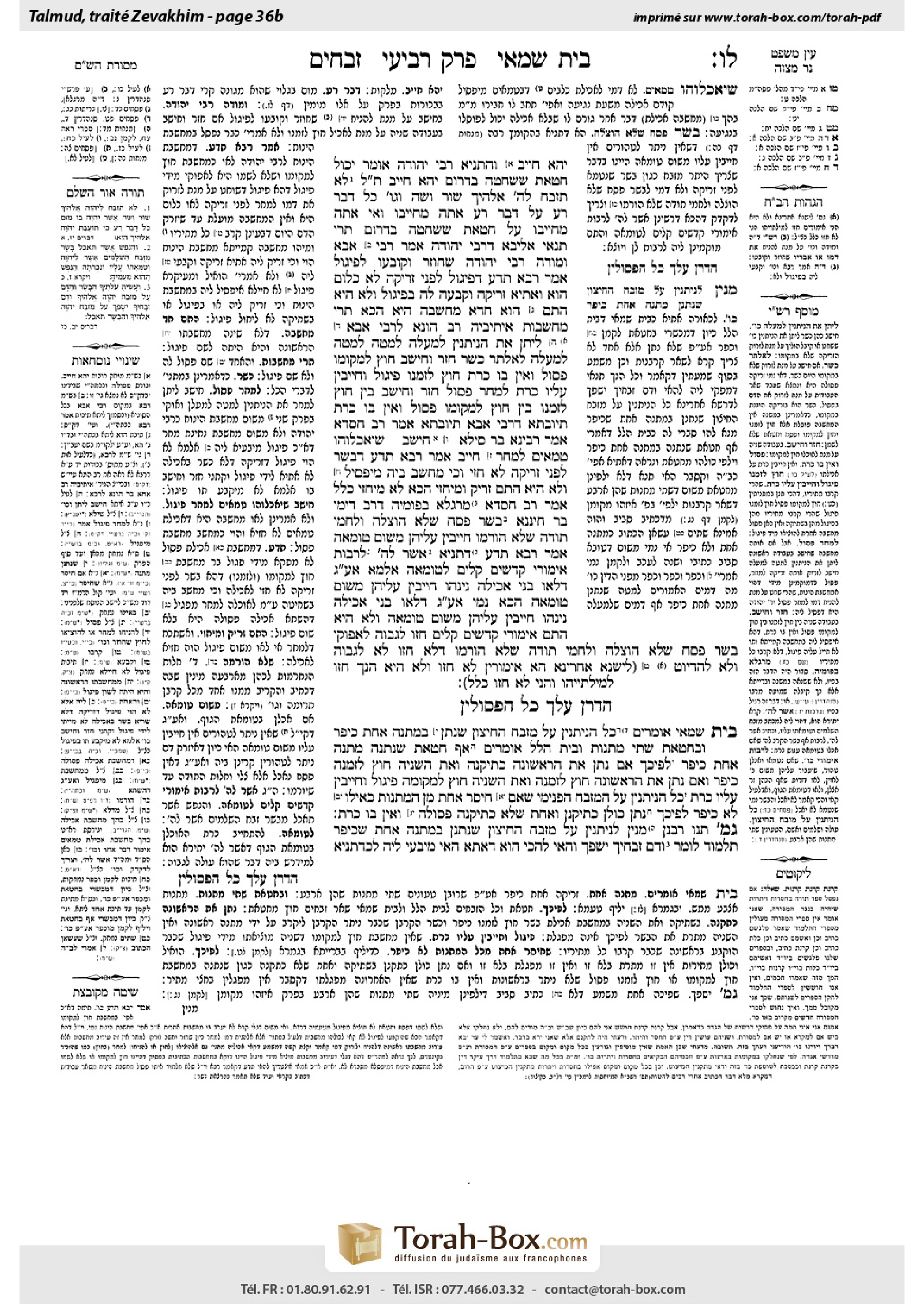
Zevachim 36b: Talmud study for Daf Yomi
Daf Yomi is the daily study of one Talmud folio. Explore 37 tractates with scans, Hebrew text, Sefaria English and AI-generated French translations where annotated.
Passage selection and English or AI-generated French translation are available where the scan has annotations. Daf Study is independent of Torah-Box and Sefaria.
Browse Zevachim · זבחים · All tractatesZevachim 36b text and translations
This page of Zevachim includes the Aramaic text, an English translation and an AI-generated French translation, alongside the scan above.
זבחים ל״ו ב · Aramaic and Hebrew text
יְהֵא חַיָּיב?!
וְהָתַנְיָא, רַבִּי יְהוּדָה אוֹמֵר: יָכוֹל חַטָּאת שֶׁשְּׁחָטָהּ בַּדָּרוֹם – יְהֵא חַיָּיב? תַּלְמוּד לוֹמַר: ״לֹא תִזְבַּח לַה׳ אֱלֹהֶיךָ שׁוֹר וָשֶׂה וְגוֹ׳ כֹּל דָּבָר רָע״ – עַל דָּבָר רָע אַתָּה מְחַיְּיבוֹ, וְאִי אַתָּה מְחַיְּיבוֹ עַל חַטָּאת שֶׁשְּׁחָטָהּ בַּדָּרוֹם! תְּרֵי תַּנָּאֵי אַלִּיבָּא דְּרַבִּי יְהוּדָה.
אָמַר רַבִּי אַבָּא: וּמוֹדֶה רַבִּי יְהוּדָה, שֶׁחוֹזֵר וְקוֹבְעוֹ לְפִיגּוּל.
אָמַר רָבָא: תִּדַּע – דְּפִיגּוּל לִפְנֵי זְרִיקָה לָא כְּלוּם הוּא, וְאָתְיָא זְרִיקָה וְקָבְעָה לַהּ בְּפִיגּוּל.
וְלָא הִיא; הָתָם הוּא חֲדָא מַחְשָׁבָה הִיא, הָכָא תְּרֵי מַחְשָׁבוֹת.
אֵיתִיבֵיהּ רַב הוּנָא לְרַבִּי אַבָּא: לִיתֵּן אֶת הַנִּיתָּנִין לְמַעְלָה לְמַטָּה, לְמַטָּה לְמַעְלָה; לְאַלְתַּר – כָּשֵׁר. חָזַר וְחִישֵּׁב חוּץ לִמְקוֹמוֹ – פָּסוּל, וְאֵין בּוֹ כָּרֵת. חוּץ לִזְמַנּוֹ – פִּיגּוּל, וְחַיָּיבִין עָלָיו כָּרֵת.
לְמָחָר – פָּסוּל. חָזַר וְחִישֵּׁב בֵּין חוּץ לִזְמַנּוֹ בֵּין חוּץ לִמְקוֹמוֹ – פָּסוּל, וְאֵין בּוֹ כָּרֵת. תְּיוּבְתָּא דְּרַבִּי אַבָּא! תְּיוּבְתָּא.
אָמַר רַב חִסְדָּא אָמַר רָבִינָא בַּר סֵילָא: חִישֵּׁב שֶׁיֹּאכְלוּהוּ טְמֵאִים לְמָחָר – חַיָּיב. אָמַר רָבָא: תִּדַּע, דְּבָשָׂר לִפְנֵי זְרִיקָה לָא חֲזֵי, וְכִי מְחַשֵּׁב בֵּיהּ – מִיפְּסִיל.
וְלָא הִיא; הָתָם זָרֵיק וּמִיחֲזֵי, הָכָא לָא מִיחְזֵי כְּלָל.
אָמַר רַב חִסְדָּא, מַרְגְּלָא בְּפוּמֵּיהּ דְּרַב דִּימִי בַּר חִינָּנָא: בְּשַׂר פֶּסַח שֶׁלֹּא הוּצְלָה, וְלַחְמֵי תוֹדָה שֶׁלֹּא הוּרְמוּ – חַיָּיבִין עֲלֵיהֶן מִשּׁוּם טוּמְאָה.
אָמַר רָבָא: תִּדַּע, דְּתַנְיָא: ״אֲשֶׁר לַה׳״ – לְרַבּוֹת אֵימוּרֵי קָדָשִׁים קַלִּים לְטוּמְאָה.
אַלְמָא אַף עַל גַּב דְּלָאו בְּנֵי אֲכִילָה נִינְהוּ – חַיָּיבִין עֲלֵיהֶן מִשּׁוּם טוּמְאָה; הָכָא נָמֵי, אַף עַל גַּב דְּלָאו בְּנֵי אֲכִילָה נִינְהוּ – חַיָּיבִין עֲלֵיהֶן מִשּׁוּם טוּמְאָה.
וְלָא הִיא; הָתָם – אֵימוּרֵי קָדָשִׁים קַלִּים חֲזוּ לְגָבוֹהַּ; לְאַפּוֹקֵי בְּשַׂר פֶּסַח שֶׁלֹּא הוּצְלָה וְלַחְמֵי תוֹדָה שֶׁלֹּא הוּרְמוּ – דְּלָא חֲזוּ לָא לְגָבוֹהַּ וְלָא לְהֶדְיוֹט.
לִישָּׁנָא אַחֲרִינָא: הָא אֵימוּרִין לָא חֲזוּ! וְלָא הִיא; הָנָךְ חֲזוּ לְמִילְּתַיְיהוּ, וְהָנֵי לָא חֲזוּ כְּלָל.
הֲדַרַן עֲלָךְ כׇּל הַפְּסוּלִין
מַתְנִי׳ בֵּית שַׁמַּאי אוֹמְרִים: כׇּל הַנִּיתָּנִין עַל מִזְבֵּחַ הַחִיצוֹן, שֶׁנָּתַן בְּמַתָּנָה אַחַת – כִּיפֵּר. וּבְחַטָּאת – שְׁתֵּי מַתָּנוֹת. וּבֵית הִלֵּל אוֹמְרִים: אַף חַטָּאת שֶׁנְּתָנָהּ מַתָּנָה אַחַת – כִּיפֵּר.
לְפִיכָךְ אִם נָתַן אֶת הָרִאשׁוֹנָה כְּתִיקְנָהּ וְאֶת הַשְּׁנִיָּה חוּץ לִזְמַנָּהּ – כִּיפֵּר.
וְאִם נָתַן אֶת הָרִאשׁוֹנָה חוּץ לִזְמַנָּהּ וְאֶת הַשְּׁנִיָּה חוּץ לִמְקוֹמָהּ – פִּיגּוּל, וְחַיָּיבִין עָלָיו כָּרֵת.
כׇּל הַנִּיתָּנִין עַל הַמִּזְבֵּחַ הַפְּנִימִי – שֶׁאִם חִיסֵּר אַחַת מִן הַמַּתָּנוֹת, כְּאִילּוּ לֹא כִּיפֵּר. לְפִיכָךְ, נָתַן כּוּלָּן כְּתִיקְנָן וְאַחַת שֶׁלֹּא כְּתִיקְנָהּ – פְּסוּלָה, וְאֵין בּוֹ כָּרֵת.
גְּמָ׳ תָּנוּ רַבָּנַן: מִנַּיִן לַנִּיתָּנִין עַל מִזְבֵּחַ הַחִיצוֹן, שֶׁנְּתָנָן בְּמַתָּנָה אַחַת – שֶׁכִּיפֵּר? תַּלְמוּד לוֹמַר: ״וְדַם זְבָחֶיךָ יִשָּׁפֵךְ״. וְהַאי לְהָכִי הוּא דַּאֲתָא?! הַאי מִיבְּעֵי לֵיהּ לְכִדְתַנְיָא:
Zevachim 36b · English translation
the slaughterer would be liable to receive lashes?
But isn’t it taught in a baraita: Rabbi Yehuda says: One might have thought that with regard to a sin offering that one slaughtered in the south, he would be liable for it. Therefore, the verse states: “You shall not sacrifice to the Lord your God an ox, or a sheep, that has a blemish, even any evil thing” (Deuteronomy 17:1), to teach that for slaughtering an evil thing, such as a blemished offering, you deem him liable to receive lashes, but you do not deem him liable for a sin offering that he slaughtered in the south. The Gemara answers: Here too, there are two tanna’im, and they disagree with regard to the opinion of Rabbi Yehuda.
§ Rabbi Abba says: Although Rabbi Yehuda says that an offering is rendered not valid if it was slaughtered with the intent that its blood would be left over until the next day, Rabbi Yehuda concedes that if the priest subsequently collected, conveyed, or presented the blood with the intent to sacrifice or partake of the offering beyond its designated time, he then establishes the offering as piggul. The intent to leave it overnight does not prevent it from being rendered piggul, in contrast to intent to sacrifice or partake of it outside its designated area, or performing a sacrificial rite of the Paschal offering or a sin offering not for its own sake, which do prevent the offering from subsequently being rendered piggul (see 29b).
Rava says: Know that this is so, as intent to sprinkle the blood the next day, which renders an offering piggul and which inherently includes the intent to leave the blood over until the next day so that he can then sprinkle it, is nothing before the sprinkling of the blood. And his intent during the slaughter to sprinkle the blood the next day does not render the offering piggul until the blood is sprinkled, and then the sprinkling of the blood comes and establishes the offering as piggul. Clearly, the intent to leave the blood over until the next day does not prevent the offering from subsequently being rendered piggul.
The Gemara rejects Rava’s proof: But it is not so that this is a valid proof, as there, with regard to standard piggul intent, it is one intent that is established with the sprinkling of the blood. By contrast, here, where he initially had intent to leave the blood until the next day and subsequently had intent to sprinkle it beyond its designated time, there are two separate intents. Therefore, since an improper intent already exists, the offering cannot thereafter be rendered piggul.
Rav Huna raised an objection to Rabbi Abba from a baraita: If one slaughtered an offering with the intent to place the blood that is to be placed above the red line below the red line, or to place the blood that is to be placed below the red line above the red line, and he had intent to do so immediately, i.e., on the same day, then it is valid, as such intent does not disqualify the offering. If he then had intent to sacrifice the offering outside its designated area, it is disqualified, but there is no liability to receive karet for it. If he had intent to sacrifice it beyond its designated time, then it is rendered piggul, and one is liable to receive karet for it.
The baraita continues: If one had intent to place the blood that is to be placed above the red line below the red line or vice versa the next day, then it is disqualified, due to his intent to leave it overnight, in accordance with the statement of Rabbi Yehuda. In this case, if he then had intent to sacrifice the same offering either beyond its designated time or outside its designated area, it is disqualified, and there is no liability to receive karet for it. Evidently, intent to leave it overnight prevents the offering from subsequently being rendered piggul. The Gemara concludes: The refutation of the opinion of Rabbi Abba is indeed a conclusive refutation.
§ Rav Ḥisda says that Ravina bar Sila says: If one slaughtered an offering with intent that impure individuals would eat the meat of the offering the next day, one is liable to receive karet due the prohibition of piggul. Although impure individuals are not fit to partake of the meat, this is nevertheless considered intent to partake of it beyond its designated time. Rava says: Know that this is so, as meat prior to the sprinkling of the blood is not fit to be eaten, and when one has improper intent with regard to it, it is disqualified. Clearly, intent to partake of a forbidden item beyond its designated time renders the offering piggul.
The Gemara rejects Rava’s proof: But it is not so, as there, with regard to standard piggul intent, he sprinkles the blood, and the meat is rendered fit to be eaten the next day. By contrast, here, it is not rendered fit to be eaten by impure individuals at all. Therefore, such intent is not considered significant intent to consume the meat after its designated time.
Rav Ḥisda says that Rav Dimi bar Ḥinnana was wont to say the following halakha: With regard to the meat of a Paschal offering that was not roasted, and the loaves of a thanks offering from which the priests’ portion was not separated, although it is prohibited for them to be eaten, nevertheless one is liable to receive karet due to violating the prohibition against eating them in a state of impurity.
Rava said: Know that this is so, as it is taught in a baraita: The verse states: “But the soul that eats of the flesh of the sacrifice of peace offerings that pertain to the Lord, having his impurity upon him, that soul shall be cut off from his people” (Leviticus 7:20). The added words “that pertain to the Lord” serve to include the sacrificial portions of offerings of lesser sanctity with regard to impurity, teaching that one who partakes of them while impure is liable to receive karet.
Apparently, even though they are not fit for consumption, one is liable to receive karet due to violating the prohibition against eating them in ritual impurity. Here too, with regard to the meat of a Paschal offering that was not roasted, and the loaves of a thanks offering from which the priests’ portion was not separated, even though they are not fit to be eaten, one is liable to receive karet due to violating the prohibition against eating them in impurity.
The Gemara rejects Rava’s proof: But it is not so, as there, the sacrificial portions of offerings of lesser sanctity that are burned on the altar are at least fit for the Most High, i.e., for the consumption of the altar, and therefore one is liable to receive karet for eating them while ritually impure. This is to the exclusion of the meat of a Paschal offering that was not roasted and the loaves of a thanks offering from which the priests’ portion was not separated, which are not fit at all, not for the Most High, and not for an ordinary person.
The Gemara presents another version of the proof and its rejection: But the sacrificial portions are not fit, and yet one is liable if he consumes them while impure. The Gemara responds: But it is not so, since these sacrificial portions are fit for their matters, and these, i.e., the meat of a Paschal offering that was not roasted and the loaves of a thanks offering from which the priests’ portion was not separated, are not fit at all.
MISHNA: Beit Shammai say: With regard to all the offerings whose blood is to be placed on the external altar, even those that require that the blood be sprinkled on two opposite corners of the altar so that it will run down each of its four sides, in a case where the priest placed the blood on the altar with only one placement, he facilitated atonement. And in the case of a sin offering, which requires four placements, one on each of the four corners of the altar, at least two placements are necessary to facilitate atonement. And Beit Hillel say: Even with regard to a sin offering, in a case where the priest placed the blood with one placement, he facilitated atonement after the fact.
Therefore, since the priest facilitates atonement with one placement in all cases other than a sin offering according to Beit Shammai, and even in the case of a sin offering according to Beit Hillel, if he placed the first placement in its proper manner, and the second with the intent to eat the offering beyond its designated time, he facilitated atonement. Since the second placement is not indispensable with regard to achieving atonement, improper intent while performing that rite does not invalidate the offering.
And based on the same reasoning, if he placed the first placement with the intent to eat the offering beyond its designated time and he placed the second placement with the intent to eat the offering outside its designated area, the second of which does not render an offering piggul, the offering is piggul, an offering disqualified by improper intention, and one is liable to receive excision from the World-to-Come [karet] for its consumption. This is because the intent that accompanied the second placement does not supersede the piggul status of the offering.
All this applies to those offerings whose blood is to be placed on the external altar. But with regard to all the offerings whose blood is to be placed on the inner altar, if the priest omitted even one of the placements, it is as though he did not facilitate atonement. Therefore, if he placed all the placements in their proper manner, and one placement in an improper manner, i.e., with the intent to eat the offering beyond its designated time, the offering is disqualified, as it is lacking one placement; but there is no liability for karet for one who partakes of the offering, as the improper intention related to only part of the blood that renders the offering permitted for consumption, and an offering becomes piggul only when the improper intention relates to the entire portion of the offering that renders it permitted for consumption.
GEMARA: The Sages taught in a baraita: From where is it derived with regard to those offerings whose blood is placed on the external altar, that if the priest placed the blood with one placement, he facilitated atonement? The verse states: “And the blood of your offerings shall be poured upon the altar of the Lord your God” (Deuteronomy 12:27), indicating that a single pouring of blood suffices. The Gemara asks: But does this verse come to teach this halakha? That verse is necessary for that which is taught in another baraita discussing a different matter:
Zevachim 36b · Traduction française (IA)
Le sacrificateur serait-il passible de flagellation ?
Mais n’est-il pas enseigné dans une baraïta : Rabbi Yehouda dit : On aurait pu penser que celui qui abat un sacrifice expiatoire au sud serait passible de flagellation. C’est pourquoi le verset dit : « Tu ne sacrifieras pas au Seigneur ton Dieu un bœuf ou un mouton qui ait une tare, ni aucune chose mauvaise » (Deutéronome 17,1), pour enseigner que celui qui abat une chose mauvaise, telle qu’une offrande présentant une tare, est passible de flagellation, mais que celui qui abat un sacrifice expiatoire au sud ne l’est pas. La Guemara répond : Ici aussi, il y a deux tannaïm, qui sont en désaccord sur l’opinion de Rabbi Yehouda.
§ Rabbi Abba dit : Bien que Rabbi Yehouda affirme qu’une offrande est invalidée si elle a été abattue avec l’intention de laisser son sang jusqu’au lendemain, Rabbi Yehouda reconnaît que si le prêtre recueille, transporte ou présente ensuite le sang avec l’intention de sacrifier l’offrande ou d’en consommer la chair après le délai prescrit, il rend alors l’offrande piggoul. L’intention de laisser le sang toute la nuit n’empêche pas que l’offrande devienne ensuite piggoul, contrairement à l’intention de la sacrifier ou d’en consommer la chair hors de l’endroit prescrit, ou à l’accomplissement d’un rite sacrificiel de l’offrande pascale ou d’un sacrifice expiatoire sans le faire pour lui-même, qui empêchent que l’offrande devienne ensuite piggoul (voir 29b).
Rava dit : Sache que c’est bien ainsi, car l’intention d’asperger le sang le lendemain, qui rend une offrande piggoul et implique nécessairement l’intention de laisser le sang jusqu’au lendemain afin de pouvoir alors l’asperger, n’a aucun effet avant l’aspersion du sang. L’intention d’asperger le sang le lendemain qu’il a eue pendant l’abattage ne rend l’offrande piggoul qu’une fois le sang aspergé ; alors, l’aspersion du sang vient rendre l’offrande piggoul. Il est donc clair que l’intention de laisser le sang jusqu’au lendemain n’empêche pas que l’offrande devienne ensuite piggoul.
La Guemara rejette la preuve de Rava : Mais cette preuve n’est pas valable, car là, dans le cas de l’intention ordinaire de piggoul, il s’agit d’une seule intention, qui prend effet avec l’aspersion du sang. En revanche, ici, où il a d’abord eu l’intention de laisser le sang jusqu’au lendemain, puis celle de l’asperger après le délai prescrit, il s’agit de deux intentions distinctes. Par conséquent, puisqu’une intention incorrecte est déjà présente, l’offrande ne peut ensuite devenir piggoul.
Rav Houna soulève une objection contre Rabbi Abba à partir d’une baraïta : Si quelqu’un abat une offrande avec l’intention de placer sous la ligne rouge le sang qui doit être placé au-dessus de cette ligne, ou de placer au-dessus de la ligne rouge le sang qui doit être placé en dessous, et qu’il a l’intention de le faire immédiatement, c’est-à-dire le jour même, l’offrande est valide, car une telle intention ne l’invalide pas. S’il a ensuite l’intention de sacrifier l’offrande hors de l’endroit prescrit, elle est invalidée, mais il n’est pas passible de retranchement pour cela. S’il a l’intention de la sacrifier après le délai prescrit, elle devient piggoul, et il est passible de retranchement pour l’avoir consommée.
La baraïta poursuit : Si quelqu’un a l’intention de placer le lendemain sous la ligne rouge le sang qui doit être placé au-dessus, ou inversement, l’offrande est invalidée en raison de son intention de laisser le sang toute la nuit, conformément à l’opinion de Rabbi Yehouda. Dans ce cas, s’il a ensuite l’intention de sacrifier la même offrande soit après le délai prescrit, soit hors de l’endroit prescrit, elle est invalidée, et il n’est pas passible de retranchement pour l’avoir consommée. Il apparaît donc que l’intention de la laisser toute la nuit empêche que l’offrande devienne ensuite piggoul. La Guemara conclut : La réfutation de l’opinion de Rabbi Abba est bel et bien concluante.
§ Rav Hisda dit que Ravina bar Sila dit : Si quelqu’un abat une offrande avec l’intention que des personnes impures en consomment la chair le lendemain, il est passible de retranchement pour avoir enfreint l’interdiction relative au piggoul. Bien que des personnes impures ne soient pas aptes à consommer cette chair, cela est néanmoins considéré comme une intention d’en consommer après le délai prescrit. Rava dit : Sache que c’est bien ainsi, car la chair n’est pas propre à la consommation avant l’aspersion du sang ; si quelqu’un a à son égard une intention incorrecte, l’offrande est invalidée. Il est donc clair que l’intention de consommer un aliment interdit après le délai prescrit rend l’offrande piggoul.
La Guemara rejette la preuve de Rava : Mais il n’en est pas ainsi, car là, dans le cas de l’intention ordinaire de piggoul, le sang est aspergé et la chair devient propre à la consommation le lendemain. En revanche, ici, elle ne devient jamais propre à la consommation par des personnes impures. Une telle intention n’est donc pas considérée comme une véritable intention de consommer la chair après le délai qui lui est prescrit.
Rav Hisda dit que Rav Dimi bar Hinnana avait coutume d’énoncer la halakha suivante : S’agissant de la chair d’une offrande pascale qui n’a pas été rôtie et des pains d’une offrande de remerciement dont la part des prêtres n’a pas été séparée, bien qu’il soit interdit de les consommer, on est néanmoins passible de retranchement pour avoir enfreint l’interdiction de les consommer en état d’impureté.
Rava dit : Sache que c’est bien ainsi, car une baraïta enseigne : Le verset dit : « Mais la personne qui mange de la chair du sacrifice de paix qui appartient au Seigneur, alors qu’elle porte son impureté, cette personne sera retranchée de son peuple » (Lévitique 7,20). Les mots ajoutés « qui appartient au Seigneur » servent à inclure, en ce qui concerne l’impureté, les parties sacrificielles des offrandes de moindre sainteté, et enseignent que celui qui en consomme alors qu’il est impur est passible de retranchement.
Il apparaît donc que, même si ces aliments ne sont pas propres à la consommation, on est passible de retranchement pour avoir enfreint l’interdiction de les consommer en état d’impureté rituelle. De même ici, s’agissant de la chair d’une offrande pascale qui n’a pas été rôtie et des pains d’une offrande de remerciement dont la part des prêtres n’a pas été séparée, bien qu’ils ne soient pas propres à la consommation, on est passible de retranchement pour avoir enfreint l’interdiction de les consommer en état d’impureté.
La Guemara rejette la preuve de Rava : Mais il n’en est pas ainsi, car là, les parties sacrificielles des offrandes de moindre sainteté qui sont brûlées sur l’autel sont au moins propres au Très-Haut, c’est-à-dire à être consumées sur l’autel ; c’est pourquoi on est passible de retranchement si on les consomme en état d’impureté rituelle. Cela exclut la chair d’une offrande pascale qui n’a pas été rôtie et les pains d’une offrande de remerciement dont la part des prêtres n’a pas été séparée, qui ne sont propres à rien : ni au Très-Haut ni à une personne ordinaire.
La Guemara présente une autre version de la preuve et de son rejet : Mais les parties sacrificielles ne sont pas propres à la consommation, et pourtant celui qui en consomme alors qu’il est impur est passible de retranchement. La Guemara répond : Mais il n’en est pas ainsi, car ces parties sacrificielles sont propres à ce qui leur est destiné, tandis que celles-ci, c’est-à-dire la chair d’une offrande pascale qui n’a pas été rôtie et les pains d’une offrande de remerciement dont la part des prêtres n’a pas été séparée, ne sont propres à rien.
Michna : Beit Chammaï disent : Pour toutes les offrandes dont le sang doit être placé sur l’autel extérieur, même celles qui exigent que le sang soit aspergé sur deux coins opposés de l’autel, de sorte qu’il s’écoule le long de ses quatre côtés, si le prêtre ne place le sang sur l’autel qu’une seule fois, il permet l’expiation. Dans le cas d’un sacrifice expiatoire, qui exige quatre placements, un sur chacun des quatre coins de l’autel, au moins deux placements sont nécessaires pour permettre l’expiation. Beit Hillel disent : Même dans le cas d’un sacrifice expiatoire, si le prêtre ne place le sang qu’une seule fois, il permet l’expiation a posteriori.
Par conséquent, puisque, selon Beit Chammaï, le prêtre permet l’expiation par un seul placement dans tous les cas sauf celui d’un sacrifice expiatoire, et même dans le cas d’un sacrifice expiatoire selon Beit Hillel, s’il a effectué le premier placement comme il se doit, puis le second avec l’intention de consommer l’offrande après le délai prescrit, il a permis l’expiation. Puisque le second placement n’est pas indispensable pour obtenir l’expiation, l’intention incorrecte qui accompagne l’accomplissement de ce rite n’invalide pas l’offrande.
Et selon le même raisonnement, s’il a effectué le premier placement avec l’intention de consommer l’offrande après le délai prescrit et le second avec l’intention de la consommer hors de l’endroit prescrit, intention qui, elle, ne rend pas l’offrande piggoul, l’offrande est piggoul, c’est-à-dire invalidée par une intention incorrecte, et celui qui la consomme est passible de retranchement [karet]. En effet, l’intention qui accompagnait le second placement ne supplante pas le statut de piggoul de l’offrande.
Tout cela concerne les offrandes dont le sang doit être placé sur l’autel extérieur. Mais pour toutes les offrandes dont le sang doit être placé sur l’autel intérieur, si le prêtre omet ne serait-ce qu’un placement, c’est comme s’il n’avait pas permis l’expiation. Par conséquent, s’il a effectué tous les placements comme il se doit, sauf un qu’il a effectué de manière incorrecte, c’est-à-dire avec l’intention de consommer l’offrande après le délai prescrit, l’offrande est invalidée, car il manque un placement ; toutefois, celui qui la consomme n’est pas passible de retranchement, car l’intention incorrecte ne concernait qu’une partie du sang qui rend l’offrande permise à la consommation, et une offrande ne devient piggoul que lorsque l’intention incorrecte porte sur toute la partie qui la rend permise à la consommation.
Guemara : Les Sages ont enseigné dans une baraïta : D’où déduit-on, au sujet des offrandes dont le sang est placé sur l’autel extérieur, que si le prêtre ne place le sang qu’une seule fois, il permet l’expiation ? Le verset dit : « Et le sang de vos sacrifices sera répandu sur l’autel du Seigneur votre Dieu » (Deutéronome 12,27), ce qui indique qu’une seule aspersion de sang suffit. La Guemara demande : Mais ce verset vient-il enseigner cette halakha ? Ce verset est nécessaire pour établir ce qui est enseigné dans une autre baraïta à propos d’un autre sujet :
Traduction française générée par IA à partir de l’édition anglaise de Sefaria. Vérifie toujours un passage avec le texte source.
Text from Sefaria: William Davidson Edition - Vocalized Aramaic (CC BY NC); William Davidson Edition - English (CC BY NC).