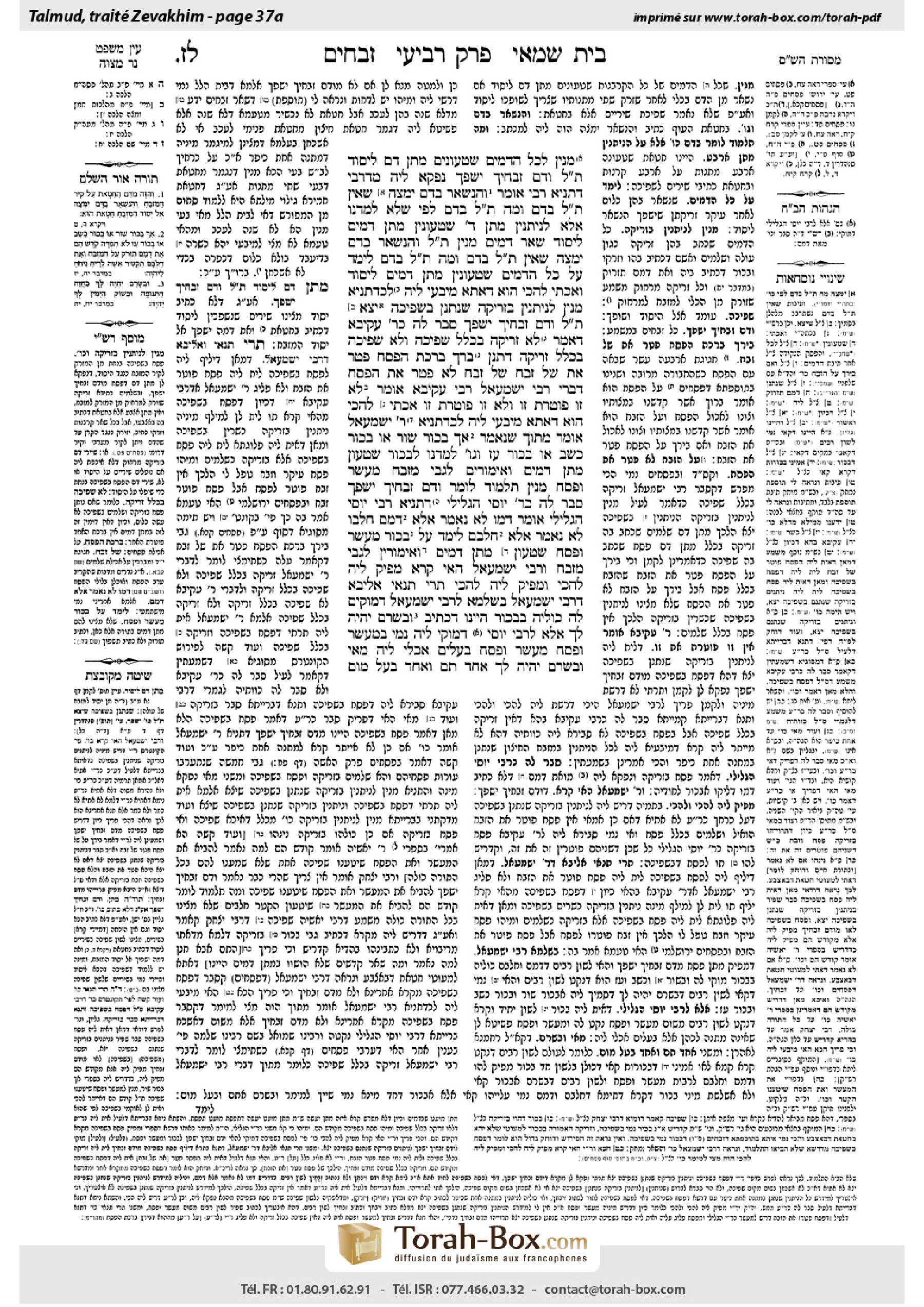
Zevachim 37a: Talmud study for Daf Yomi
Daf Yomi is the daily study of one Talmud folio. Explore 37 tractates with scans, Hebrew text, Sefaria English and AI-generated French translations where annotated.
Passage selection and English or AI-generated French translation are available where the scan has annotations. Daf Study is independent of Torah-Box and Sefaria.
Browse Zevachim · זבחים · All tractatesZevachim 37a text and translations
This page of Zevachim includes the Aramaic text, an English translation and an AI-generated French translation, alongside the scan above.
זבחים ל״ז א · Aramaic and Hebrew text
מִנַּיִן לְכׇל הַדָּמִים שֶׁטְּעוּנִים מַתַּן דָּם לַיְסוֹד? תַּלְמוּד לוֹמַר: ״וְדַם זְבָחֶיךָ יִשָּׁפֵךְ״. נָפְקָא לֵיהּ מִדְּרַבִּי – דְּתַנְיָא, רַבִּי אוֹמֵר: ״וְהַנִּשְׁאָר בַּדָּם יִמָּצֵה״ – שֶׁאֵין תַּלְמוּד לוֹמַר ״בַּדָּם״; וּמָה תַּלְמוּד לוֹמַר ״בַּדָּם״?
לְפִי שֶׁלֹּא לָמַדְנוּ אֶלָּא לַנִּיתָּנִין מַתַּן אַרְבַּע – שֶׁטְּעוּנִין מַתַּן דָּמִים לַיְסוֹד; שְׁאָר דָּמִים מִנַּיִן? תַּלְמוּד לוֹמַר: ״וְהַנִּשְׁאָר בַּדָּם יִמָּצֵה״ – שֶׁאֵין תַּלְמוּד לוֹמַר ״בַּדָּם״; וּמָה תַּלְמוּד לוֹמַר ״בַּדָּם״? לִימֵּד עַל כׇּל הַדָּמִים, שֶׁטְּעוּנִין מַתַּן דָּמִים לַיְסוֹד.
וְאַכַּתִּי לְהָכִי הוּא דְּאָתָא?! מִיבְּעֵי לֵיהּ לְכִדְתַנְיָא: מִנַּיִן לַנִּיתָּנִין בִּזְרִיקָה שֶׁנְּתָנָן בִּשְׁפִיכָה – יָצָא? תַּלְמוּד לוֹמַר: ״וְדַם זְבָחֶיךָ יִשָּׁפֵךְ״.
סָבַר לַהּ כְּרַבִּי עֲקִיבָא, דְּאָמַר: לֹא זְרִיקָה בִּכְלַל שְׁפִיכָה, וְלֹא שְׁפִיכָה בִּכְלַל זְרִיקָה.
דִּתְנַן: בֵּרַךְ בִּרְכַּת הַפֶּסַח – פָּטַר אֶת שֶׁל זֶבַח.
שֶׁל זֶבַח – לֹא פָּטַר אֶת הַפֶּסַח. דִּבְרֵי רַבִּי יִשְׁמָעֵאל.
רַבִּי עֲקִיבָא אוֹמֵר: לֹא זוֹ פּוֹטֶרֶת זוֹ, וְלֹא זוֹ פּוֹטֶרֶת זוֹ.
אַכַּתִּי לְהָכִי הוּא דַּאֲתָא?! מִיבְּעֵי לֵיהּ לְכִדְתַנְיָא, רַבִּי יִשְׁמָעֵאל אוֹמֵר: מִתּוֹךְ שֶׁנֶּאֱמַר ״אַךְ בְּכוֹר שׁוֹר אוֹ בְכוֹר כֶּשֶׂב אוֹ בְכוֹר עֵז וְגוֹ׳״ – לָמַדְנוּ לִבְכוֹר, שֶׁטָּעוּן מַתַּן דָּמִים וְאֵימוּרִים לְגַבֵּי מִזְבֵּחַ. מַעֲשֵׂר וּפֶסַח מִנַּיִן? תַּלְמוּד לוֹמַר: ״וְדַם זְבָחֶיךָ יִשָּׁפֵךְ״.
סָבַר לַהּ כְּרַבִּי יוֹסֵי הַגְּלִילִי.
דְּתַנְיָא, רַבִּי יוֹסֵי הַגְּלִילִי אוֹמֵר: ״דָּמוֹ״ לֹא נֶאֱמַר, אֶלָּא ״דָּמָם״; ״חֶלְבּוֹ״ לֹא נֶאֱמַר, אֶלָּא ״חֶלְבָּם״; לִימֵּד עַל בְּכוֹר, מַעֲשֵׂר וּפֶסַח, שֶׁטָּעוּן מַתַּן דָּמִים וְאֵימוּרִין לְגַבֵּי מִזְבֵּחַ.
וְרַבִּי יִשְׁמָעֵאל – הַאי קְרָא, מַפֵּיק לֵיהּ לְהָכִי וּמַפֵּיק לֵיהּ לְהָכִי?! תְּרֵי תַּנָּאֵי אַלִּיבָּא דְּרַבִּי יִשְׁמָעֵאל.
בִּשְׁלָמָא לְרַבִּי יִשְׁמָעֵאל, דְּמוֹקֵים לֵהּ כּוּלֵּיהּ בִּבְכוֹר – הַיְינוּ דִּכְתִיב: ״וּבְשָׂרָם יִהְיֶה לָּךְ״.
אֶלָּא לְרַבִּי יוֹסֵי, דְּמוֹקֵי לֵיהּ נָמֵי בְּמַעֲשֵׂר וָפֶסַח – מַעֲשֵׂר וָפֶסַח בְּעָלִים אָכְלִי לֵיהּ; מַאי ״וּבְשָׂרָם יִהְיֶה לָּךְ״? אֶחָד תָּם וְאֶחָד בַּעַל מוּם;
Zevachim 37a · English translation
From where is it derived that all the blood that is left over from an offering after the requisite placement requires placement of blood on the base of the altar? The verse states: “And the blood of your offerings shall be poured upon the altar of the Lord your God” (Deuteronomy 12:27). The Gemara answers: The tanna of the first baraita derives this from the verse cited by Rabbi Yehuda HaNasi, as it is taught in a baraita: Rabbi Yehuda HaNasi says with regard to a verse discussing a bird sin offering: “And the rest of the blood shall be squeezed out at the base of the altar; it is a sin offering” (Leviticus 5:9). As there is no need for the verse to state “of the blood,” because the entire verse is talking about the blood, what is the meaning when the verse states “of the blood”?
The baraita continues: Since we have learned only about those offerings whose blood is placed on the altar with four placements, i.e., outer sin offerings, that they require placement of the leftover blood on the base of the altar, from where is it derived that the same applies to the leftover blood of all the other offerings? The verse states: “And the rest of the blood shall be squeezed out at the base of the altar; it is a sin offering” (Leviticus 5:9). Since there is no need for the verse to state “of the blood,” because the entire verse is talking about the blood, what is the meaning when the verse states “of the blood”? This teaches that all the leftover blood from all the offerings requires placement of blood on the base of the altar.
The Gemara asks: But still, does this verse, Deuteronomy 12:27, come to teach this halakha, that if a priest placed the blood with one placement, he facilitated atonement? That verse is necessary for that which is taught in a baraita: From where is it derived with regard to those offerings whose blood is supposed to be placed by means of sprinkling from a certain distance from the altar, that if the priest placed the blood by pouring it from up close he has fulfilled his obligation? The verse states: “And the blood of your offerings shall be poured upon the altar of the Lord your God” (Deuteronomy 12:27).
The Gemara answers that the ruling in this baraita is in accordance with the opinion of Rabbi Yishmael, while the tanna of the earlier baraita holds in accordance with the opinion of Rabbi Akiva, who says: Sprinkling is not included in pouring, and similarly pouring is not included in sprinkling. Rather, these are separate actions performed under different circumstances, and one does not fulfill his obligation to sprinkle the blood by pouring it. Therefore, the verse is available to him to teach that if a priest placed the blood with one placement, he facilitated atonement.
The Gemara demonstrates that this is the opinion of Rabbi Akiva: This is as we learned in a mishna (Pesaḥim 121a): If one recited the blessing over the Paschal offering, which is: Who sanctified us with His mitzvot and commanded us to eat the Paschal offering, he has also exempted himself from reciting a blessing over the Festival peace offering, i.e., the peace offering that is eaten together with the Paschal offering. The blessing for the Festival peace offering of the fourteenth of Nisan is: Who sanctified us with His mitzvot and commanded us to eat the offering.
If he recited the blessing over the Festival offering, he has not exempted himself from reciting a blessing over the Paschal offering. This is the statement of Rabbi Yishmael. Rabbi Yishmael’s reasoning is based on the halakha that the blood of the Paschal offering is poured, while the blood of the Festival offering is sprinkled. He maintains that sprinkling is included in the more general category of pouring, and therefore the blessing over the Paschal offering includes the Festival offering. Pouring is not included in the more limited category of sprinkling, and therefore reciting the blessing over the Festival offering does not exempt one from reciting a blessing over the Paschal offering.
The mishna continues: Rabbi Akiva says: This blessing does not exempt one from reciting a blessing over that one, and that blessing does not exempt one from reciting a blessing over this one. Sprinkling is not included in pouring, and pouring is not included in sprinkling. Therefore, there is a separate blessing for each offering.
The Gemara asks: Still, does this verse, Deuteronomy 12:27, come to teach this halakha, that if a priest placed the blood with one placement he facilitated atonement? That verse is necessary for that which is taught in a baraita: Rabbi Yishmael says: Since it is stated: “But the firstborn of a bull, or the firstborn of a sheep, or the firstborn of a goat, you shall not redeem; they are sacred. You shall sprinkle their blood upon the altar and shall burn their fat for an offering made by fire, for an aroma pleasing to the Lord” (Numbers 18:17), we learned with regard to a firstborn animal, which must be given to a priest to be offered on the altar in the Temple, that it requires placement of its blood and sacrificial portions on the altar. From where is it derived that the same applies to an animal tithe offering and a Paschal offering? The verse states: “And the blood of your offerings shall be poured upon the altar of the Lord your God” (Deuteronomy 12:27). This verse teaches that all offerings require placement of their blood on the altar.
The Gemara answers that the tanna of the earlier baraita, who derives from Deuteronomy 12:27 the halakha that if a priest placed the blood with one placement he facilitated atonement, holds in accordance with the opinion of Rabbi Yosei HaGelili. Rabbi Yosei HaGelili maintains that the halakha that the blood and sacrificial parts of an animal tithe offering and a Paschal offering must be placed on the altar is derived from the aforementioned verse concerning a firstborn animal: “You shall sprinkle their blood upon the altar and shall burn their fat for an offering made by fire, for an aroma pleasing to the Lord” (Numbers 18:17).
This is as it is taught in a baraita, that Rabbi Yosei HaGelili says: It is not stated in this verse: Its blood, but rather: “Their blood.” Similarly, it is not stated: Its fat, but rather: “Their fat.” The plural form teaches with regard to the firstborn animal, which is mentioned explicitly in the verse, as well as with regard to the animal tithe offering and the Paschal offering, which have a level of sanctity similar to that of a firstborn animal, that each requires placement of the blood and sacrificial portions on the altar.
The Gemara asks: But does Rabbi Yishmael derive one halakha from this verse and then derive another halakha from this same verse? It was stated earlier that Rabbi Yishmael derives from the verse “And the blood of your offerings shall be poured” that sprinkling is included in pouring, and yet here he derives from that same verse that the blood of an animal tithe offering and that of a Paschal offering must be presented on the altar. The Gemara answers: These are the opinions of two tanna’im, each of whom expressed his opinion in accordance with the opinion of Rabbi Yishmael.
The Gemara raises a question with regard to the disagreement about the interpretation of Numbers 18:17. Granted, according to the opinion of Rabbi Yishmael, who interprets the entire verse as referring to a firstborn animal, and according to whom the plural form in the verse is referring to three such firstborns, that of a bull, that of a sheep, and that of a goat, this explains that which is written immediately afterward: “And their meat shall be yours” (Numbers 18:18), in the plural, i.e., the meat of these firstborn animals shall be eaten by the priests.
But according to the opinion of Rabbi Yosei, who interprets this verse as referring also to an animal tithe offering and a Paschal offering, there is a difficulty, as an animal tithe offering and a Paschal offering are eaten by their owners, not by the priests. If so, what is the meaning of the phrase “and their meat shall be yours”? The Gemara answers that the plural term “their meat,” is referring not to an animal tithe offering or a Paschal offering, but to different types of firstborns, i.e., both an unblemished animal, whose blood is poured on the altar, and a blemished one, which is not brought as an offering on the altar.
Zevachim 37a · Traduction française (IA)
D’où déduit-on que tout le sang restant d’une offrande, après les aspersions requises, doit être versé à la base de l’autel ? Le verset dit : « Le sang de tes sacrifices sera répandu sur l’autel de l’Éternel, ton Dieu » (Deutéronome 12:27). La Guemara répond : Le tanna de la première baraïta déduit cette halakha du verset cité par Rabbi Yehuda HaNasi, comme il est enseigné dans une baraïta : Rabbi Yehuda HaNasi dit, à propos d’un verset concernant un sacrifice expiatoire d’oiseau : « Le reste du sang sera pressé à la base de l’autel ; c’est un sacrifice expiatoire » (Lévitique 5:9). Il n’était pas nécessaire que le verset dise « du sang », puisque tout le verset parle du sang. Que signifie donc l’expression « du sang » ?
La baraïta poursuit : Nous avons seulement appris que les offrandes dont le sang est placé sur l’autel en quatre aspersions, c’est-à-dire les sacrifices expiatoires extérieurs, exigent que le sang restant soit versé à la base de l’autel. D’où déduit-on qu’il en va de même pour le sang restant de toutes les autres offrandes ? Le verset dit : « Le reste du sang sera pressé à la base de l’autel ; c’est un sacrifice expiatoire » (Lévitique 5:9). Il n’était pas nécessaire que le verset dise « du sang », puisque tout le verset parle du sang. Que signifie donc l’expression « du sang » ? Cela enseigne que tout le sang restant de toutes les offrandes doit être versé à la base de l’autel.
La Guemara demande : Mais le verset de Deutéronome 12:27 vient-il enseigner cette halakha, selon laquelle, si un prêtre a placé le sang en une seule aspersion, il a rendu l’expiation possible ? Ce verset est nécessaire pour enseigner ce qui est enseigné dans une baraïta : D’où déduit-on que, pour les offrandes dont le sang doit être aspergé à une certaine distance de l’autel, si le prêtre a placé le sang en le versant de près, il s’est acquitté de son obligation ? Le verset dit : « Le sang de tes sacrifices sera répandu sur l’autel de l’Éternel, ton Dieu » (Deutéronome 12:27).
La Guemara répond que la règle énoncée dans cette baraïta suit l’opinion de Rabbi Yishmael, tandis que le tanna de la baraïta précédente suit celle de Rabbi Akiva, qui dit : L’aspersion n’est pas incluse dans le versement, et, de même, le versement n’est pas inclus dans l’aspersion. Ce sont plutôt des actes distincts, accomplis dans des circonstances différentes ; on ne s’acquitte donc pas de l’obligation d’asperger le sang en le versant. Le verset est ainsi disponible pour lui enseigner que, si un prêtre a placé le sang en une seule aspersion, il a rendu l’expiation possible.
La Guemara montre qu’il s’agit de l’opinion de Rabbi Akiva. C’est ce que nous avons appris dans une Michna (Pessaḥim 121a) : Si quelqu’un a récité la bénédiction sur le sacrifice pascal — « Qui nous a sanctifiés par Ses mitsvot et nous a ordonné de manger le sacrifice pascal » —, il s’est également acquitté de l’obligation de réciter une bénédiction sur le sacrifice de paix de fête, c’est-à-dire le sacrifice de paix consommé avec le sacrifice pascal. La bénédiction sur le sacrifice de paix offert le quatorze Nissan est : « Qui nous a sanctifiés par Ses mitsvot et nous a ordonné de manger le sacrifice. »
S’il a récité la bénédiction sur l’offrande de fête, il ne s’est pas acquitté de l’obligation de réciter une bénédiction sur le sacrifice pascal. Telle est l’opinion de Rabbi Yishmael. Son raisonnement repose sur la halakha selon laquelle le sang du sacrifice pascal est versé, tandis que le sang de l’offrande de fête est aspergé. Il considère que l’aspersion est incluse dans la catégorie plus générale du versement ; par conséquent, la bénédiction sur le sacrifice pascal couvre aussi l’offrande de fête. En revanche, le versement n’est pas inclus dans la catégorie plus restreinte de l’aspersion ; par conséquent, réciter la bénédiction sur l’offrande de fête ne dispense pas de réciter une bénédiction sur le sacrifice pascal.
La Michna poursuit : Rabbi Akiva dit : Cette bénédiction ne dispense pas de réciter une bénédiction sur l’autre, et cette autre bénédiction ne dispense pas de réciter une bénédiction sur celle-ci. L’aspersion n’est pas incluse dans le versement, et le versement n’est pas inclus dans l’aspersion. Il faut donc réciter une bénédiction distincte pour chaque offrande.
La Guemara demande : Mais le verset de Deutéronome 12:27 vient-il enseigner cette halakha, selon laquelle, si un prêtre a placé le sang en une seule aspersion, il a rendu l’expiation possible ? Ce verset est nécessaire pour enseigner ce qui est enseigné dans une baraïta : Rabbi Yishmael dit : Puisqu’il est écrit : « Mais le premier-né d’un taureau, le premier-né d’un mouton ou le premier-né d’une chèvre, tu ne le rachèteras pas ; ils sont saints. Tu aspergeras leur sang sur l’autel et tu brûleras leur graisse en offrande consumée par le feu, en odeur agréable à l’Éternel » (Nombres 18:17), nous avons appris que le premier-né d’un animal, qui doit être remis à un prêtre pour être offert sur l’autel du Temple, exige que son sang et ses parties sacrificielles soient placés sur l’autel. D’où déduit-on qu’il en va de même pour l’offrande de dîme animale et le sacrifice pascal ? Le verset dit : « Le sang de tes sacrifices sera répandu sur l’autel de l’Éternel, ton Dieu » (Deutéronome 12:27). Ce verset enseigne que toutes les offrandes exigent que leur sang soit placé sur l’autel.
La Guemara répond que le tanna de la baraïta précédente, qui déduit de Deutéronome 12:27 la halakha selon laquelle, si un prêtre a placé le sang en une seule aspersion, il a rendu l’expiation possible, suit l’opinion de Rabbi Yosei HaGelili. Selon lui, la halakha exigeant que le sang et les parties sacrificielles de l’offrande de dîme animale et du sacrifice pascal soient placés sur l’autel se déduit du verset déjà cité concernant le premier-né d’un animal : « Tu aspergeras leur sang sur l’autel et tu brûleras leur graisse en offrande consumée par le feu, en odeur agréable à l’Éternel » (Nombres 18:17).
C’est ce qui est enseigné dans une baraïta, où Rabbi Yosei HaGelili dit : Dans ce verset, il n’est pas écrit « son sang », mais « leur sang ». De même, il n’est pas écrit « sa graisse », mais « leur graisse ». Le pluriel enseigne que cette règle s’applique aussi bien au premier-né d’un animal, explicitement mentionné dans le verset, qu’à l’offrande de dîme animale et au sacrifice pascal, dont le degré de sainteté est semblable à celui d’un premier-né : chacun exige que son sang et ses parties sacrificielles soient placés sur l’autel.
La Guemara demande : Mais Rabbi Yishmael déduit-il une halakha de ce verset, puis une autre halakha de ce même verset ? Il a été dit précédemment que Rabbi Yishmael déduit du verset « Le sang de tes sacrifices sera répandu » que l’aspersion est incluse dans le versement, alors qu’ici, il déduit de ce même verset que le sang de l’offrande de dîme animale et celui du sacrifice pascal doivent être présentés sur l’autel. La Guemara répond : Ce sont les opinions de deux tannaïm, dont chacun a exprimé son opinion conformément à celle de Rabbi Yishmael.
La Guemara soulève une question au sujet du désaccord sur l’interprétation de Nombres 18:17. Il est compréhensible que, selon Rabbi Yishmael, qui interprète tout le verset comme se rapportant au premier-né d’un animal et pour qui le pluriel du verset renvoie aux premiers-nés de trois espèces — taureau, mouton et chèvre —, cela explique la suite immédiate : « Et leur viande sera à toi » (Nombres 18:18), au pluriel, c’est-à-dire que la viande de ces premiers-nés sera consommée par les prêtres.
Mais selon Rabbi Yosei, qui interprète ce verset comme se rapportant également à l’offrande de dîme animale et au sacrifice pascal, une difficulté se pose : l’offrande de dîme animale et le sacrifice pascal sont consommés par leurs propriétaires, et non par les prêtres. Que signifie alors l’expression « et leur viande sera à toi » ? La Guemara répond que l’expression au pluriel « leur viande » ne renvoie ni à l’offrande de dîme animale ni au sacrifice pascal, mais aux différentes catégories de premiers-nés : ceux qui sont sans défaut, dont le sang est versé sur l’autel, et ceux qui sont atteints d’un défaut, qui ne sont pas apportés comme offrandes sur l’autel.
Traduction française générée par IA à partir de l’édition anglaise de Sefaria. Vérifie toujours un passage avec le texte source.
Text from Sefaria: William Davidson Edition - Vocalized Aramaic (CC BY NC); William Davidson Edition - English (CC BY NC).