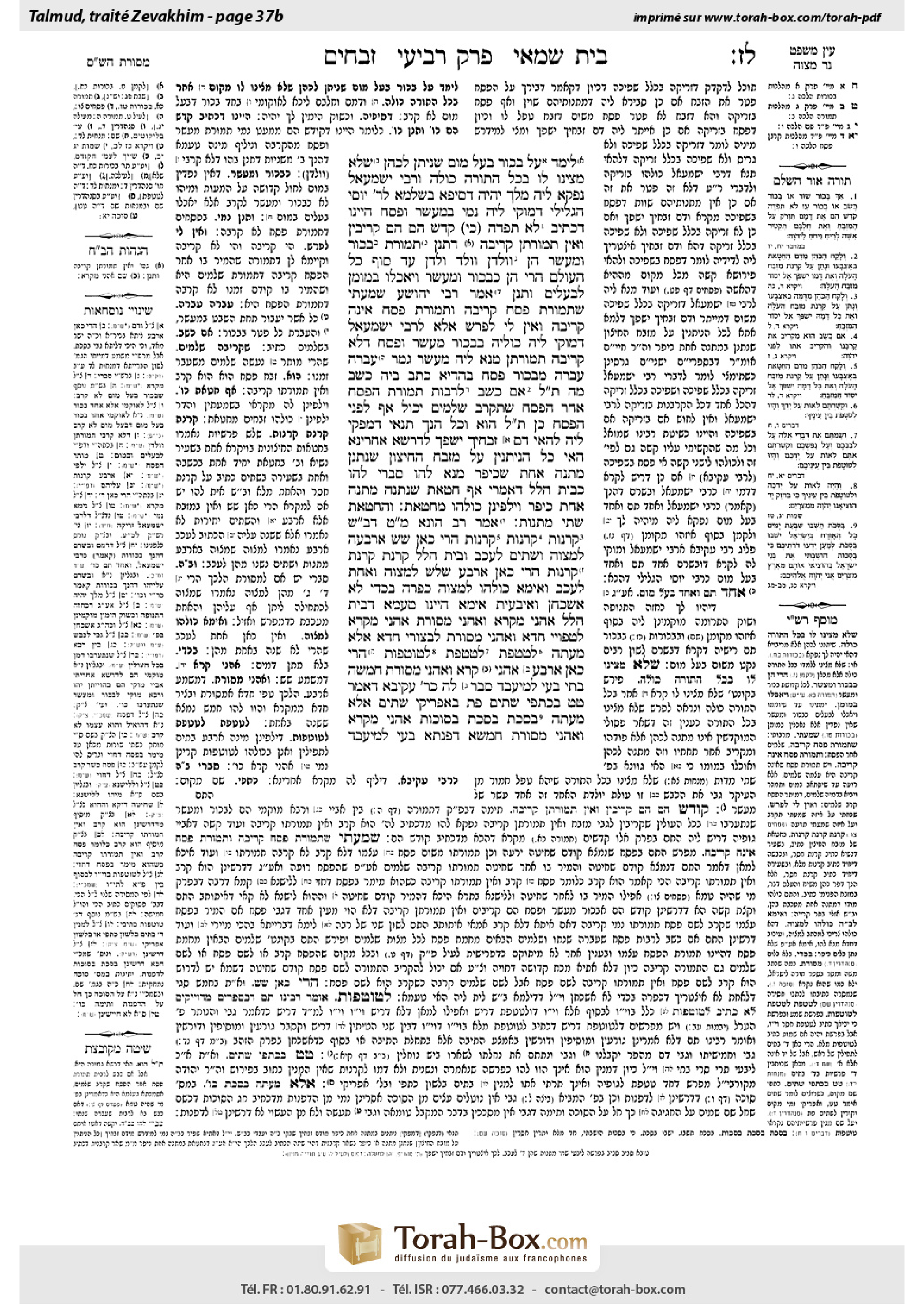
Zevachim 37b: Talmud study for Daf Yomi
Daf Yomi is the daily study of one Talmud folio. Explore 37 tractates with scans, Hebrew text, Sefaria English and AI-generated French translations where annotated.
Passage selection and English or AI-generated French translation are available where the scan has annotations. Daf Study is independent of Torah-Box and Sefaria.
Browse Zevachim · זבחים · All tractatesZevachim 37b text and translations
This page of Zevachim includes the Aramaic text, an English translation and an AI-generated French translation, alongside the scan above.
זבחים ל״ז ב · Aramaic and Hebrew text
לִימֵּד עַל בְּכוֹר בַּעַל מוּם, שֶׁנִּיתָּן לַכֹּהֵן. שֶׁלֹּא מָצִינוּ לוֹ בְּכׇל הַתּוֹרָה כּוּלָּהּ.
וְרַבִּי יִשְׁמָעֵאל – נָפְקָא לֵיהּ מִ״לְּךָ יִהְיֶה״ דְּסֵיפָא.
בִּשְׁלָמָא לְרַבִּי יוֹסֵי הַגְּלִילִי, דְּמוֹקֵי לֵיהּ נָמֵי בְּמַעֲשֵׂר וָפֶסַח; הַיְינוּ דִּכְתִיב: ״לֹא תִפְדֶּה כִּי קֹדֶשׁ הֵם״ – הֵם קְרֵיבִין, וְאֵין תְּמוּרָתָן קְרֵיבָה.
דִּתְנַן: תְּמוּרַת בְּכוֹר וּמַעֲשֵׂר – הֵן וּוְלָדָן וּוְלַד וְלָדָן עַד סוֹף כׇּל הָעוֹלָם, הֲרֵי הֵן כִּבְכוֹר וּמַעֲשֵׂר, וְיֹאכְלוּ בְּמוּמָן לַבְּעָלִים.
וּתְנַן, אָמַר רַבִּי יְהוֹשֻׁעַ: שָׁמַעְתִּי שֶׁתְּמוּרַת פֶּסַח קְרֵיבָה, וּתְמוּרַת פֶּסַח אֵינָהּ קְרֵיבָה, וְאֵין לִי לְפָרֵשׁ.
אֶלָּא לְרַבִּי יִשְׁמָעֵאל, דְּמוֹקֵי לֵיהּ כּוּלֵּיהּ בִּבְכוֹר; מַעֲשֵׂר וָפֶסַח דְּלָא קְרֵיבָה תְּמוּרָתָן, מְנָא לֵיהּ? מַעֲשֵׂר גָּמַר ״עֲבָרָה״–״עֲבָרָה״ מִבְּכוֹר.
פֶּסַח – בְּהֶדְיָא כְּתִב בֵּיהּ כֶּשֶׂב; מָה תַּלְמוּד לוֹמַר ״אִם כֶּשֶׂב״ – לְרַבּוֹת תְּמוּרַת הַפֶּסַח אַחַר הַפֶּסַח, שֶׁתִּקְרַב שְׁלָמִים. יָכוֹל אַף לִפְנֵי הַפֶּסַח כֵּן? תַּלְמוּד לוֹמַר ״הוּא״.
וְכֹל הָנָךְ תַּנָּאֵי דְּמַפְּקִי לֵיהּ לְהַאי ״דַּם זְבָחֶיךָ יִשָּׁפֵךְ״ לִדְרָשָׁא אַחֲרִינָא – הַאי כׇּל הַנִּיתָּנִין עַל מִזְבֵּחַ הַחִיצוֹן שֶׁנְּתָנָן מַתָּנָה אַחַת שֶׁכִּיפֵּר, מְנָא לְהוּ? סָבְרִי לְהוּ כְּבֵית הִלֵּל, דְּאָמְרִי: אַף חַטָּאת שֶׁנְּתָנָהּ מַתָּנָה אַחַת – כִּיפֵּר; וְיָלְפִינַן כּוּלְּהוּ מֵחַטָּאת.
וְהַחַטָּאת שְׁתֵּי מַתָּנוֹת. אָמַר רַב הוּנָא: מַאי טַעְמָא דְּבֵית שַׁמַּאי?
״קַרְנוֹת״, ״קַרְנוֹת״, ״קַרְנוֹת״ – הֲרֵי כָּאן שֵׁשׁ; אַרְבָּעָה לְמִצְוָה וּשְׁתַּיִם לְעַכֵּב.
וּבֵית הִלֵּל: ״קַרְנַת״, ״קַרְנַת״, ״קַרְנוֹת״ – הֲרֵי כָּאן אַרְבַּע; שָׁלֹשׁ לְמִצְוָה, אַחַת לְעַכֵּב.
וְאֵימָא כּוּלְּהוּ לְמִצְוָה! כַּפָּרָה בִּכְדִי לָא אַשְׁכְּחַן.
וְאִיבָּעֵית אֵימָא, הַיְינוּ טַעְמָא דְּבֵית הִלֵּל: אַהֲנִי מִקְרָא, וְאַהְנִי מָסוֹרֶת; אַהֲנִי מִקְרָא – לְטַפּוֹיֵי חֲדָא, וְאַהֲנַי מָסוֹרֶת – לְבַצּוֹרֵי חֲדָא.
אֶלָּא מֵעַתָּה, ״לְטֹטֶפֶת״, ״לְטֹטֶפֶת״, ״לְטוֹטָפוֹת״ – הֲרֵי כָּאן אַרְבַּע; אַהֲנִי קְרָא וְאַהֲנַי מָסוֹרֶת – חַמְשָׁה בָּתֵּי בָּעֵי לְמִיעְבַּד!
סָבַר לַהּ כְּרַבִּי עֲקִיבָא, דְּאָמַר: ״טַט״ בְּכַתְפִּי שְׁתַּיִם, ״פַּת״ בְּאַפְרִיקִי שְׁתַּיִם.
אֶלָּא מֵעַתָּה, ״בְּסֻכַּת״, ״בְּסֻכַּת״, ״בַּסּוּכּוֹת״ – אַהֲנִי מִקְרָא וְאַהֲנַי מָסוֹרֶת, חֲמֵשׁ דַּפְנָתָא בָּעֵי לְמִיעְבַּד!
Zevachim 37b · English translation
This verse teaches that a blemished firstborn is given to a priest as a gift, and that he may eat its meat. This is a novel concept, as we have not found in the entire Torah another halakha similar to it, where a blemished offering is given to the priests for consumption.
The Gemara asks: And according to Rabbi Yishmael, who interprets this verse differently, from where does he derive this halakha that a blemished firstborn is given to a priest? The Gemara answers: He derives it from the phrase: “As the breast of waving and as the right thigh, it shall be yours” (Numbers 18:18), which is the latter clause of that same verse. The repetition of the phrase “shall be yours” serves to teach that even the meat of a blemished firstborn shall be eaten by the priests.
§ The Gemara raises another question: Granted, according to the opinion of Rabbi Yosei HaGelili, who interprets the verse as referring also to an animal tithe offering and a Paschal offering, this is as it is written in the same verse: “You shall not redeem; they are sacred” (Numbers 18:17). The word “they” indicates that only they are sacrificed on the altar, but their substitutes are not sacrificed. In general, if one substitutes a non-sacred animal for one designated as an offering, both the original and the substitute are considered to be consecrated, and they are therefore sacrificed. But if one substitutes a non-sacred animal for a firstborn, an animal tithe offering, or a Paschal offering, the substitute is not sacrificed.
This is as we learned in a mishna (Temura 21a): With regard to the substitute of a firstborn and of an animal tithe offering, both they, the substitutes themselves, and their offspring, and the offspring of their offspring, forever, i.e., for all future generations, are as the firstborn and the animal tithe offering, respectively, and therefore they are eaten in their blemished state by the owners; but unlike the firstborn and the animal tithe offering themselves, they are not sacrificed on the altar.
And likewise with regard to the substitute of a Paschal offering, we learned in a mishna (Pesaḥim 96b) that Rabbi Yehoshua says: I have heard two rulings from my teachers: One ruling was that the substitute of a Paschal offering is sacrificed as a peace offering after Passover, and another ruling was that the substitute of a Paschal offering is not offered as a peace offering after Passover; and I cannot explain these apparently contradictory rulings, as I do not remember the circumstances to which each ruling applies. And as will be explained, if the substitution took place after the sacrifice of the Paschal offering, the animal is sacrificed, as it is considered the substitute of a peace offering, whereas if the substitution occurred before the sacrifice of the Paschal offering, it is not sacrificed, as it is the substitute of a Paschal offering. This indicates that the substitute of a Paschal offering is not sacrificed, just like the substitute of a firstborn is not sacrificed.
But according to the opinion of Rabbi Yishmael, who interprets the entire verse as dealing with a firstborn, from where does he derive the halakha that the substitute of an animal tithe offering and of a Paschal offering are not sacrificed? The Gemara answers: With regard to an animal tithe offering, he derives this by means of a verbal analogy between the terms passing, and passing written with regard to a firstborn. Concerning a firstborn it is stated: “And you shall pass [veha’avarta] to the Lord all that opens the womb” (Exodus 13:12), and concerning an animal tithe it is stated: “Of whatever passes [ya’avor] under the rod” (Leviticus 27:32). From this verbal analogy it may be derived that just as the substitute of a firstborn is not sacrificed, so too, the substitute of an animal tithe offering is not sacrificed.
With regard to the Paschal offering, this halakha is not derived through a verbal analogy, but rather this halakha is explicitly written concerning it. The verse referring to peace offerings states: “If he offers a lamb for his offering” (Leviticus 3:7). The Torah could simply have stated: A lamb, and proceed from there to teach the halakhot of a lamb peace offering. If so, what is the meaning when the verse states: “If he offers a lamb”? This serves to include the substitute of a Paschal offering that was substituted after the sacrifice of the Paschal offering, teaching that it is sacrificed as a peace offering, since the Paschal offering has the status of a peace offering after that time. One might have thought that even before the sacrifice of the Paschal offering the same should apply, i.e., that the substitute of a Paschal offering is sacrificed as a peace offering. Therefore, the verse states with regard to the Paschal offering: “It is the sacrifice of the Lord’s Passover” (Exodus 12:27), which indicates that it, the Paschal offering itself, is sacrificed, but its substitute is not sacrificed.
The Gemara asks: And as for all those tanna’im who derive a different exposition from this verse: “And the blood of your offerings shall be poured” (Deuteronomy 12:27), this halakha that is recorded in the mishna, that with regard to all the offerings whose blood is to be placed on the external altar, in a case where the priest placed the blood on the altar with one placement, he facilitated atonement, from where do they derive this? The Gemara answers: Those tanna’im hold in accordance with the opinion of Beit Hillel, who say: Even with regard to a sin offering, in a case where the priest placed the blood with one placement, he facilitated atonement after the fact. And they derive the halakha applying to all the other offerings from that which applies to a sin offering.
§ The mishna teaches that Beit Shammai maintain that in the case of a sin offering, which requires four placements, at least two placements are necessary to facilitate atonement, whereas Beit Hillel hold that even in the case of a sin offering one placement suffices. Rav Huna said: What is the reasoning for the opinion of Beit Shammai?
He explains: The verse states: “And the priest shall take of the blood of the sin offering with his finger, and put it upon the corners of the altar” (Leviticus 4:25). Subsequently, the verse states: “The priest shall take of its blood with his finger, and put it on the corners of the altar” (Leviticus 4:30), and an additional verse states: “The priest shall take of the blood of the sin offering with his finger, and put it on the corners of the altar” (Leviticus 4:34). As the minimum amount justifying the use of the plural form, i.e., in the word “corners,” is two, one may conclude that there are six references to the corners of the altar here. Four of them are mentioned for a mitzva, meaning that the priest should place the blood on all four corners of the altar ab initio, and the other two are mentioned to invalidate the offering if he did not present the blood on at least two corners.
The Gemara asks: And what is the reasoning for the opinion of Beit Hillel? The Gemara answers: The matter should be understood according to the written consonantal text, i.e., the way in which the words are actually spelled. The word “corners” is written plene, i.e., with a vav, in one of the verses, which means that it must be read in the plural form. In the other two verses, “corners” and “corners” are written deficient, i.e., without a vav, in a way that can be vocalized in the singular form, i.e., as karnat. Therefore, there are four references to corners here. Three of these references are written to indicate the placements of blood are performed only as a mitzva, i.e., they are performed ab initio, and the remaining one is written to indicate that its absence invalidates the offering, i.e., the offering is not valid if the blood was not placed against at least one corner of the altar.
The Gemara asks: But according to this explanation of Beit Hillel, why not say that all of them are written for the mitzva and none are to invalidate, i.e., that the blood must be presented on all four corners ab initio, but the offering atones after the fact even if the blood was not presented at all? The Gemara rejects this possibility: We have not found anywhere in the Torah an example of an offering in which atonement can be achieved with no placement of the blood.
And if you wish, say instead that this is the reason of Beit Hillel: The vocalized text of the Torah, i.e., the way in which the words of the Torah are pronounced based on the tradition of what vowels the words contain, is effective in determining how the verses are to be expounded. And likewise, the consonantal text of the Torah, i.e., the way in which the words are actually written, is also effective in determining how the verses are to be expounded. The Gemara elaborates: The vocalized text is effective in adding one more corner and the consonantal text is effective in subtracting one corner. Consequently, the verse is interpreted as referring to five corners, four of which are necessary for the mitzva ab initio, and one of which is indispensable after the fact.
The Gemara asks: But if that is so, that this is the proper manner of expounding the verses, consider the case of the phylacteries of the head, about which it is stated: “And for frontlets [totafot] between your eyes” (Exodus 13:16), and: “They shall be for frontlets [totafot] between your eyes” (Deuteronomy 6:8), and subsequently: “They shall be for frontlets [totafot] between your eyes” (Deuteronomy 11:18). The word totafot is written once in plene form, i.e., with a vav, indicating the plural form, and twice in a deficient form, i.e., without a vav, indicating the singular. Accordingly, there are four frontlets here, and from here the Sages derive that the phylacteries of the head consist of four compartments, which together form a cube. Why not say that the vocalized text, read in the plural, is effective, i.e., that it requires six compartments, and likewise, the consonantal text, read in the singular, is effective, i.e., it requires four compartments, and therefore one should be required to prepare five compartments for the phylacteries of the head?
The Gemara answers that Beit Hillel hold in accordance with the opinion of Rabbi Akiva, who says that the requirement to have four compartments in the phylacteries of the head is not derived from the number of times that the word totafot is mentioned, but rather from an exposition of the word totafot itself: Tot in the Katpi language means two, and pat in the Afriki language means two, for a total of four.
The Gemara raises another objection to this method of exposition: If that is so, consider the case of a sukka, about which it is stated: “In sukkot [basukkot] shall you reside seven days; all that are homeborn in Israel shall reside in sukkot [basukkot]. So that your future generations will know that I caused the children of Israel to reside in sukkot [basukkot] when I took them out of the land of Egypt: I am the Lord your God” (Leviticus 23:42–43). Two instances of the word basukkot are written in a deficient manner, i.e., without a vav, indicating the singular, and one instance is written in plene form, i.e., with a vav, indicating the plural form. The Sages derived from here that a sukka must have four walls. Why not say that the vocalized text, read in the plural, is effective, requiring six walls, and likewise, the consonantal text, read in the singular, is effective, requiring four walls, and therefore one should be required to build a sukka with five walls?
Zevachim 37b · Traduction française (IA)
Ce verset enseigne qu’un premier-né atteint d’un défaut est donné à un prêtre à titre de don, et que celui-ci peut en manger la viande. Il s’agit d’une notion nouvelle, car on ne trouve dans toute la Torah aucune autre halakha semblable, selon laquelle une offrande atteinte d’un défaut serait donnée aux prêtres pour être consommée.
La Guemara demande : Et selon Rabbi Yishmael, qui interprète ce verset autrement, de quelle source déduit-il cette halakha selon laquelle un premier-né atteint d’un défaut est donné à un prêtre ? La Guemara répond : Il la déduit de l’expression « comme la poitrine offerte par balancement et comme la cuisse droite, cela vous appartiendra » (Nombres 18:18), qui constitue la dernière partie de ce même verset. La répétition de l’expression « cela vous appartiendra » enseigne que même la viande d’un premier-né atteint d’un défaut doit être consommée par les prêtres.
§ La Guemara soulève une autre question : Certes, selon l’opinion de Rabbi Yosei HaGelili, qui interprète le verset comme faisant également référence à l’offrande de dîme animale et à l’offrande pascale, cela s’accorde avec ce qui est écrit dans le même verset : « Tu ne le rachèteras pas ; ils sont consacrés » (Nombres 18:17). Le mot « ils » indique que seuls ces animaux sont sacrifiés sur l’autel, mais pas leurs substituts. En règle générale, si l’on substitue un animal non consacré à un animal désigné comme offrande, l’animal initial et son substitut sont tous deux considérés comme consacrés et sont donc sacrifiés. Mais si l’on substitue un animal non consacré à un premier-né, à une offrande de dîme animale ou à une offrande pascale, le substitut n’est pas sacrifié.
C’est ce que nous avons appris dans une Michna (Temoura 21a) : concernant le substitut d’un premier-né et celui d’une offrande de dîme animale, ces substituts eux-mêmes, leur descendance et la descendance de leur descendance, à jamais, c’est-à-dire pour toutes les générations futures, ont respectivement le statut du premier-né et de l’offrande de dîme animale ; ils sont donc consommés par leurs propriétaires lorsqu’ils sont atteints d’un défaut. Toutefois, contrairement aux premiers-nés et aux offrandes de dîme animale eux-mêmes, ils ne sont pas sacrifiés sur l’autel.
De même, au sujet du substitut d’une offrande pascale, nous avons appris dans une Michna (Pessa'him 96b) que Rabbi Yehoshua dit : « J’ai entendu de mes maîtres deux décisions : selon l’une, le substitut d’une offrande pascale est sacrifié comme offrande de paix après Pessa'h ; selon l’autre, il n’est pas offert comme offrande de paix après Pessa'h. Je ne peux pas expliquer ces décisions apparemment contradictoires, car je ne me souviens pas des circonstances auxquelles chacune s’applique. » Comme cela sera expliqué, si la substitution a eu lieu après le sacrifice de l’offrande pascale, l’animal est sacrifié, puisqu’il est considéré comme le substitut d’une offrande de paix ; en revanche, si la substitution a eu lieu avant le sacrifice de l’offrande pascale, il n’est pas sacrifié, puisqu’il est le substitut d’une offrande pascale. Cela indique que le substitut d’une offrande pascale n’est pas sacrifié, tout comme le substitut d’un premier-né ne l’est pas.
Mais selon l’opinion de Rabbi Yishmael, qui interprète tout le verset comme portant sur un premier-né, de quelle source déduit-il la halakha selon laquelle le substitut d’une offrande de dîme animale et celui d’une offrande pascale ne sont pas sacrifiés ? La Guemara répond : Pour l’offrande de dîme animale, il déduit cette halakha au moyen d’une analogie verbale entre les termes « passer » et « passer », employés à propos d’un premier-né. Concernant un premier-né, il est dit : « Tu feras passer [veha’avarta] au Seigneur tout premier-né qui ouvre la matrice » (Exode 13:12), et concernant la dîme animale, il est dit : « De tout ce qui passe [ya’avor] sous le bâton » (Lévitique 27:32). Cette analogie verbale permet de déduire que, de même que le substitut d’un premier-né n’est pas sacrifié, le substitut d’une offrande de dîme animale ne l’est pas non plus.
Concernant l’offrande pascale, cette halakha ne se déduit pas au moyen d’une analogie verbale : elle y est explicitement énoncée. Le verset relatif aux offrandes de paix dit : « Si quelqu’un offre un agneau pour son offrande » (Lévitique 3:7). La Torah aurait pu simplement dire : « un agneau », puis exposer les halakhot de l’offrande de paix d’un agneau. Quel est donc le sens des mots « si quelqu’un offre un agneau » ? Ils incluent le substitut d’une offrande pascale qui a été remplacée après le sacrifice de l’offrande pascale, et enseignent qu’il est sacrifié comme offrande de paix, puisque l’offrande pascale a le statut d’une offrande de paix après cette période. On aurait pu penser qu’il en va de même même avant le sacrifice de l’offrande pascale, c’est-à-dire que le substitut d’une offrande pascale est sacrifié comme offrande de paix. C’est pourquoi le verset dit au sujet de l’offrande pascale : « C’est le sacrifice de la Pâque du Seigneur » (Exode 12:27), ce qui indique que c’est elle, l’offrande pascale elle-même, qui est sacrifiée, mais pas son substitut.
La Guemara demande : Et tous ces tannaïm qui déduisent de ce verset une autre interprétation — « Le sang de tes offrandes sera répandu » (Deutéronome 12:27) — de quelle source déduisent-ils la halakha énoncée dans la Michna, selon laquelle, pour toutes les offrandes dont le sang doit être appliqué sur l’autel extérieur, si le prêtre n’a appliqué le sang qu’une seule fois sur l’autel, il a obtenu l’expiation ? La Guemara répond : Ces tannaïm suivent l’opinion de Beit Hillel, qui disent que même pour un sacrifice expiatoire, si le prêtre a appliqué le sang une seule fois, il a obtenu l’expiation a posteriori. Ils déduisent de la règle applicable au sacrifice expiatoire celle qui s’applique à toutes les autres offrandes.
§ La Michna enseigne que Beit Shammaï considèrent que, dans le cas d’un sacrifice expiatoire qui requiert quatre applications, au moins deux applications sont nécessaires pour obtenir l’expiation, tandis que Beit Hillel estiment qu’une seule application suffit, même pour un sacrifice expiatoire. Rav Houna dit : Quelle est la raison de l’opinion de Beit Shammaï ?
Il explique : Le verset dit : « Le prêtre prendra du sang du sacrifice expiatoire avec son doigt et en mettra sur les cornes de l’autel » (Lévitique 4:25). Plus loin, le verset dit : « Le prêtre prendra de son sang avec son doigt et en mettra sur les cornes de l’autel » (Lévitique 4:30), et un autre verset dit : « Le prêtre prendra du sang du sacrifice expiatoire avec son doigt et en mettra sur les cornes de l’autel » (Lévitique 4:34). Puisque le pluriel, dans le mot « cornes », suppose un minimum de deux, on peut conclure que six mentions des cornes de l’autel figurent ici. Quatre sont prescrites au titre de la mitsva, c’est-à-dire que le prêtre doit appliquer le sang sur les quatre cornes de l’autel a priori ; les deux autres servent à invalider l’offrande si le sang n’a pas été appliqué sur au moins deux cornes.
La Guemara demande : Et quelle est la raison de l’opinion de Beit Hillel ? La Guemara répond : Il faut interpréter le texte consonantique, c’est-à-dire la manière dont les mots sont effectivement écrits. Dans l’un des versets, le mot « cornes » est écrit sous sa forme pleine, avec un vav, ce qui signifie qu’il doit être lu au pluriel. Dans les deux autres versets, les mots « cornes » sont écrits sous leur forme défective, sans vav, de sorte qu’ils peuvent être vocalisés au singulier, c’est-à-dire karnat. Il y a donc ici quatre mentions des cornes. Trois de ces mentions indiquent que les applications du sang sont requises au titre de la mitsva, c’est-à-dire qu’elles doivent être effectuées a priori ; la dernière indique que leur omission invalide l’offrande, autrement dit, que l’offrande n’est pas valide si le sang n’a pas été appliqué contre au moins une corne de l’autel.
La Guemara demande : Mais selon cette explication de Beit Hillel, pourquoi ne pas dire que toutes ces mentions sont là au titre de la mitsva et qu’aucune ne sert à invalider ? Autrement dit, le sang doit être appliqué sur les quatre cornes a priori, mais l’offrande procure l’expiation a posteriori même si le sang n’a été appliqué nulle part. La Guemara écarte cette possibilité : On ne trouve nulle part dans la Torah d’exemple d’une offrande qui procure l’expiation sans aucune application de sang.
Ou, si tu préfères, dis que voici la raison de Beit Hillel : le texte vocalisé de la Torah, c’est-à-dire la manière dont les mots de la Torah se prononcent selon la tradition des voyelles qu’ils comportent, permet lui aussi de déterminer comment interpréter les versets. De même, le texte consonantique de la Torah, c’est-à-dire la manière dont les mots sont effectivement écrits, permet lui aussi de déterminer comment interpréter les versets. La Guemara précise : le texte vocalisé permet d’ajouter une corne, et le texte consonantique permet d’en retrancher une. Par conséquent, le verset est interprété comme faisant référence à cinq cornes : quatre sont requises au titre de la mitsva a priori, et une est indispensable a posteriori.
La Guemara demande : Mais si tel est le cas, et que c’est ainsi qu’il convient d’interpréter les versets, considérons le cas des téfilines de la tête, au sujet desquelles il est dit : « Et comme frontaux [totafot] entre tes yeux » (Exode 13:16), puis : « Elles seront comme frontaux [totafot] entre tes yeux » (Deutéronome 6:8), et ensuite : « Elles seront comme frontaux [totafot] entre tes yeux » (Deutéronome 11:18). Le mot totafot est écrit une fois sous sa forme pleine, avec un vav, indiquant le pluriel, et deux fois sous sa forme défective, sans vav, indiquant le singulier. Il y aurait donc ici quatre frontaux ; c’est de là que les Sages déduisent que les téfilines de la tête comportent quatre compartiments, réunis en un cube. Pourquoi ne pas dire que le texte vocalisé, lu au pluriel, s’applique et exige six compartiments, et que le texte consonantique, lu au singulier, s’applique également et exige quatre compartiments, de sorte qu’il faudrait confectionner cinq compartiments pour les téfilines de la tête ?
La Guemara répond que Beit Hillel suivent l’opinion de Rabbi Akiva, qui dit que l’exigence de quatre compartiments dans les téfilines de la tête ne se déduit pas du nombre d’occurrences du mot totafot, mais de l’interprétation du mot totafot lui-même : tot signifie « deux » dans la langue katpi, et pat signifie « deux » dans la langue africaine, soit un total de quatre.
La Guemara soulève une autre objection contre cette méthode d’interprétation : Si tel est le cas, considérons le cas de la soukka, au sujet de laquelle il est dit : « Dans des soukkot [basukkot], vous demeurerez sept jours ; tous les habitants d’Israël demeureront dans des soukkot [basukkot], afin que les générations futures sachent que j’ai fait demeurer les enfants d’Israël dans des soukkot [basukkot] lorsque je les ai fait sortir du pays d’Égypte : Je suis le Seigneur votre Dieu » (Lévitique 23:42–43). Deux occurrences du mot basukkot sont écrites sous une forme défective, sans vav, indiquant le singulier, et une occurrence est écrite sous la forme pleine, avec un vav, indiquant le pluriel. Les Sages en ont déduit qu’une soukka doit avoir quatre parois. Pourquoi ne pas dire que le texte vocalisé, lu au pluriel, s’applique et exige six parois, tandis que le texte consonantique, lu au singulier, s’applique également et en exige quatre, de sorte qu’il faudrait construire une soukka à cinq parois ?
Traduction française générée par IA à partir de l’édition anglaise de Sefaria. Vérifie toujours un passage avec le texte source.
Text from Sefaria: William Davidson Edition - Vocalized Aramaic (CC BY NC); William Davidson Edition - English (CC BY NC).