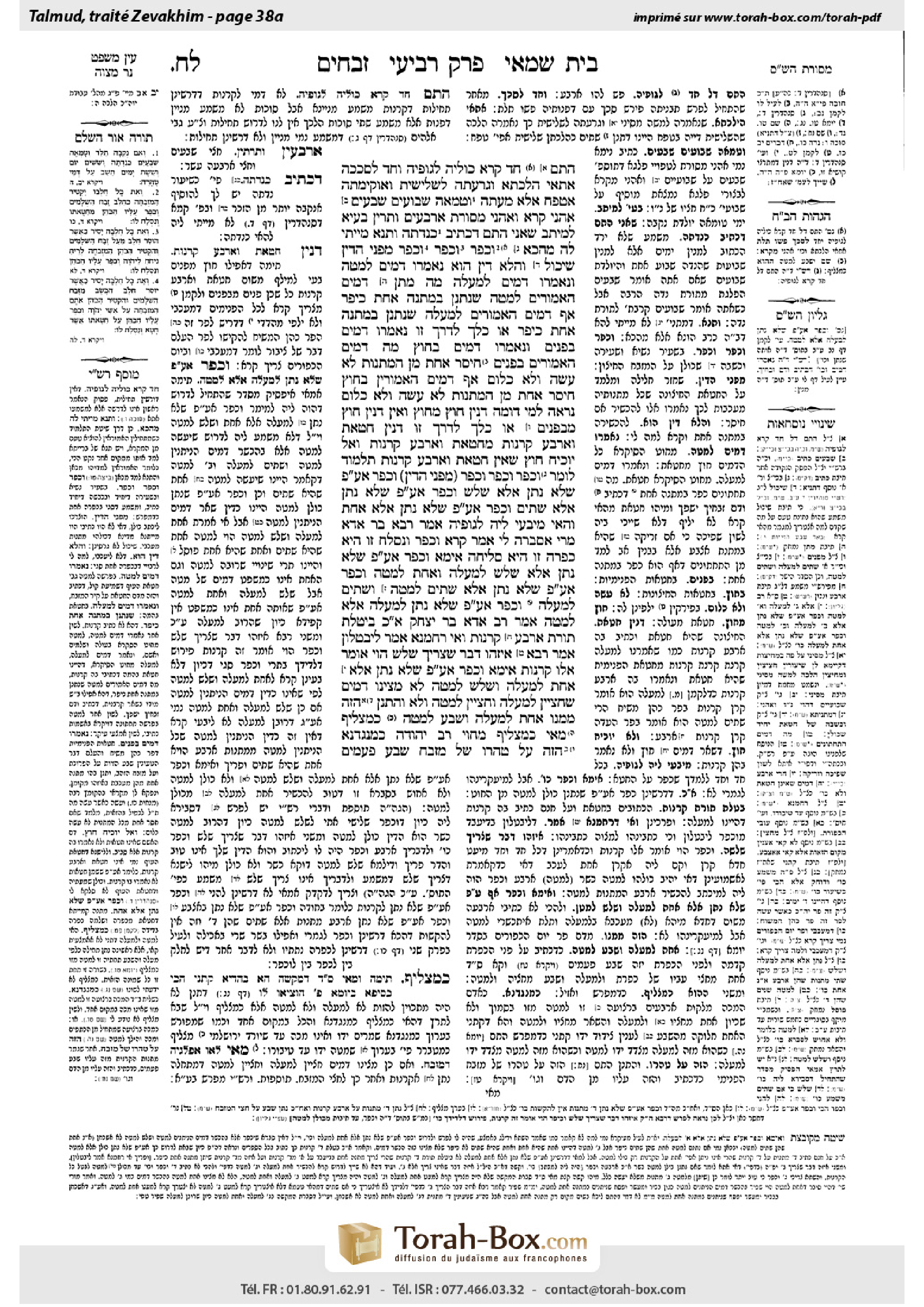
Zevachim 38a: Talmud study for Daf Yomi
Daf Yomi is the daily study of one Talmud folio. Explore 37 tractates with scans, Hebrew text, Sefaria English and AI-generated French translations where annotated.
Passage selection and English or AI-generated French translation are available where the scan has annotations. Daf Study is independent of Torah-Box and Sefaria.
Browse Zevachim · זבחים · All tractatesZevachim 38a text and translations
This page of Zevachim includes the Aramaic text, an English translation and an AI-generated French translation, alongside the scan above.
זבחים ל״ח א · Aramaic and Hebrew text
הָתָם חַד קְרָא – כּוּלֵּיהּ לְגוּפֵיהּ, וְחַד – לִסְכָכָה; אֲתַאי הִלְכְתָא, וּגְרַעְתַּהּ לִשְׁלִישִׁית וְאוֹקֵימְתַּהּ אַטֶּפַח.
אֶלָּא מֵעַתָּה, ״וְטָמְאָה שְׁבֻעַיִם״ – ״שִׁבְעִים״; אַהֲנִי קְרָא וְאַהֲנַי מָסוֹרֶת – אַרְבְּעִים וּתְרֵין בָּעֲיָא לְמֵיתַב!
שָׁאנֵי הָתָם, דִּכְתִיב ״כְּנִדָּתָהּ״.
וְתַנָּא מַיְיתֵי לַהּ מֵהָכָא: ״וְכִפֶּר״ ״וְכִפֶּר״ ״וְכִפֶּר״ – מִפְּנֵי הַדִּין.
שֶׁיָּכוֹל וַהֲלֹא דִּין הוּא: נֶאֶמְרוּ דָּמִים לְמַטָּה, וְנֶאֶמְרוּ דָּמִים לְמַעְלָה; מָה מַתַּן דָּמִים הָאֲמוּרִים לְמַטָּה – שֶׁנְּתָנָן בְּמַתָּנָה אַחַת, כִּיפֵּר; אַף דָּמִים הָאֲמוּרִים לְמַעְלָה – שֶׁנְּתָנָן בְּמַתָּנָה אַחַת, כִּיפֵּר.
אוֹ כְּלָךְ לְדֶרֶךְ זוֹ: נֶאֶמְרוּ דָּמִים בִּפְנִים, וְנֶאֶמְרוּ דָּמִים בַּחוּץ; מָה דָּמִים הָאֲמוּרִים בִּפְנִים – חִיסֵּר אַחַת מִן הַמַּתָּנוֹת, לֹא עָשָׂה וְלֹא כְּלוּם; אַף דָּמִים הָאֲמוּרִין בַּחוּץ – חִיסֵּר אַחַת מִן הַמַּתָּנוֹת, לֹא עָשָׂה וְלֹא כְלוּם.
נִרְאֶה לְמִי דּוֹמֶה. דָּנִין חוּץ מִחוּץ, וְאֵין דָּנִין חוּץ מִבִּפְנִים; אוֹ כַּלֵּךְ לְדֶרֶךְ זוֹ – דָּנִין חַטָּאת וְאַרְבַּע קְרָנוֹת, מֵחַטָּאת וְאַרְבַּע קְרָנוֹת; וְאַל יוֹכִיחַ חוּץ – שֶׁאֵין חַטָּאת וְאַרְבַּע קְרָנוֹת?
תַּלְמוּד לוֹמַר: ״וְכִפֶּר״ ״וְכִפֶּר״ ״וְכִפֶּר״ (מִפְּנֵי הַדִּין); ״וְכִפֶּר״ – אַף עַל פִּי שֶׁלֹּא נָתַן אֶלָּא שָׁלֹשׁ, ״וְכִפֶּר״ – אַף עַל פִּי שֶׁלֹּא נָתַן אֶלָּא שְׁתַּיִם, ״וְכִפֶּר״ – אַף עַל פִּי שֶׁלֹּא נָתַן אֶלָּא אַחַת.
וְהַאי מִיבְּעֵי לֵיהּ לְגוּפֵיהּ! אָמַר רָבָא: בַּר אַדָּא מָרִי אַסְבְּרַהּ לִי – אָמַר קְרָא: ״וְכִפֶּר... וְנִסְלַח״ – זוֹ הִיא כַּפָּרָה זוֹ הִיא סְלִיחָה.
אֵימָא ״וְכִפֶּר״ – אַף עַל פִּי שֶׁלֹּא נָתַן אֶלָּא שָׁלֹשׁ לְמַעְלָה וְאַחַת לְמַטָּה, ״וְכִפֶּר״ – אַף עַל פִּי שֶׁלֹּא נָתַן אֶלָּא שְׁתַּיִם לְמַטָּה וּשְׁתַּיִם לְמַעְלָה, ״וְכִפֶּר״ – אַף עַל פִּי שֶׁלֹּא נָתַן לְמַעְלָה אֶלָּא לְמַטָּה!
אָמַר רַב אַדָּא בַּר יִצְחָק: אִם כֵּן, בִּיטַּלְתָּ תּוֹרַת אַרְבַּע קְרָנוֹת. וְאִי רַחֲמָנָא אָמַר, לִיבַּטְלוּן!
אָמַר רָבָא: אֵיזֶהוּ דָּבָר שֶׁצָּרִיךְ שָׁלֹשׁ? הֱוֵי אוֹמֵר: אֵלּוּ קְרָנוֹת.
אֵימָא: ״וְכִפֶּר״ – אַף עַל פִּי שֶׁלֹּא נָתַן אֶלָּא אַחַת לְמַעְלָה וְשָׁלֹשׁ לְמַטָּה!
לֹא מָצִינוּ דָּמִים שֶׁחֶצְיָין לְמַעְלָה וְחֶצְיָין לְמַטָּה. וְלָא?! וְהָתְנַן: הִזָּה מִמֶּנּוּ אַחַת לְמַעְלָה וְשֶׁבַע לְמַטָּה!
כְּמַצְלִיף. מַאי כְּמַצְלִיף? מַחְוֵי רַב יְהוּדָה: כִּמְנַגְּדָנָא.
הִזָּה עַל טׇהֳרוֹ שֶׁל מִזְבֵּחַ שֶׁבַע פְּעָמִים.
Zevachim 38a · English translation
The Gemara answers: There, one of the five indicated by the verse is needed entirely for the mitzva itself, i.e., to teach the basic halakha that one must dwell in a sukka. And another one of the five is needed to teach that a sukka, as is indicated by its name, must have a covering [sekhakha]. Accordingly, there are three left, alluding to the requirement that a sukka must have three walls. The Gemara adds that the halakha transmitted to Moses from Sinai comes and reduces the size of the third wall, teaching that it need not be complete, and sets its minimum length at only one handbreadth.
The Gemara raises yet another objection: If that is so, that both the vocalized and the consonantal texts are taken into account, consider the case of a woman who gives birth to a female child. Concerning this woman the verse states: “But if she bear a female child, then she shall be impure two weeks [shevu’ayim], as in her menstruation” (Leviticus 12:5). The way that the word is written allows it to be read as shivim, seventy. Why not say that the vocalized text of the Torah is effective, teaching us that the woman is ritually impure for fourteen days, and the consonantal text is also effective, teaching us that she is impure for seventy days, and, therefore, she should be required to sit in a state of ritual impurity for forty-two days, which is the halfway point between fourteen and seventy days?
The Gemara answers: There it is different, and the consonantal text is disregarded entirely, as it is written: “As in her menstruation,” and a menstruating woman is impure for one week. Evidently, the verse is speaking in terms of weeks, and is not alluding to the number seventy at all.
§ The Gemara further analyzes the opinion of Beit Hillel that even in the case of a sin offering, if the priest placed the blood on the altar with one placement, he facilitated atonement. And a tanna cites proof for this from here, as it was taught in a baraita: The verse states with regard to the sin offering brought by a king: “And the priest shall make atonement for him” (Leviticus 4:26), and with regard to the goat brought as a sin offering by an ordinary person: “And the priest shall make atonement for him” (Leviticus 4:31), and with regard to the sheep brought as a sin offering by an ordinary person: “And the priest shall make atonement for him” (Leviticus 4:35). The repetition of this term is due to a logical inference.
As one might have thought to say: Could this not be derived through logical inference as follows: It is stated that blood is placed below the red line, and it is stated that blood is placed above the red line. Just as with regard to the blood concerning which it is stated that it is placed below the red line, when the priest placed it on the altar with one placement he facilitated atonement, so too, with regard to the blood concerning which it is stated that it is placed above the red line, when the priest placed it on the altar with one placement he facilitated atonement.
Or perhaps, go this way, turning away from the previous explanation and toward this explanation: It is stated that blood is presented on the inner altar, i.e., with regard to a sin offering of the community or of the High Priest; the blood of these offerings is sprinkled on the incense altar that is inside the Sanctuary. And it is stated that blood is presented on the external altar, i.e., with regard to the sin offering of an ordinary person, which is offered on the outer altar that is in the courtyard. Just as with regard to the blood concerning which it is stated that it is presented on the inner altar, if the priest omitted one of the placements he has done nothing, i.e., the offering is not valid, so too, with regard to the blood concerning which it is stated that it is presented on the external altar, if the priest omitted one of the placements he has done nothing.
The Gemara analyzes the two possibilities: Let us see to which of the two cases the blood of an animal sin offering is more similar. It can be claimed: We derive a halakha stated with regard to the external altar from a halakha stated with regard to the external altar, but we do not derive a halakha stated with regard to the external altar from a halakha stated with regard to the inner altar. Or, go this way: We derive a halakha stated with regard to a sin offering whose blood is to be placed on the four corners of the altar from a halakha stated with regard to a sin offering whose blood is to be placed on the four corners of the altar. But a sin offering consisting of a bird, which is not a sin offering whose blood is to be placed on the four corners of the altar, cannot serve as proof to the halakha concerning an animal sin offering, whose blood is to be placed on the four corners of the altar.
Since both of the above inferences are reasonable, neither can serve as the source of the halakha. Therefore, the verse states: “And the priest shall make atonement,” “And the priest shall make atonement,” “And the priest shall make atonement,” for a total of three times. The verses are interpreted as follows: “And the priest shall make atonement,” even if he placed only three placements. Subsequently: “And the priest shall make atonement,” even if he placed only two placements, and then: “And the priest shall make atonement,” even if he placed only one placement. This interpretation is the source of Beit Hillel’s opinion.
The Gemara challenges: But each of these verses is necessary for itself, to teach that atonement is achieved for each of the sins through its respective sin offering. Rava said: Bar Adda Mari explained this matter to me: The verse states with regard to each of these sin offerings: “And the priest shall make atonement…and he shall be forgiven” (Leviticus 4:26, 31, 35). This is atonement and this is forgiveness; they are one and the same. Since it would have sufficed to say: “And he shall be forgiven,” the superfluous mentions of the phrase: “And the priest shall make atonement,” serve to teach that the priest facilitates atonement even if he has not performed all the placements.
The Gemara asks: But even if these phrases are superfluous, do they necessarily indicate that a priest who omitted placements has nevertheless facilitated atonement? Why not say that these phrases serve to teach that if the priest placed all the placements he facilitated atonement even if the placements were placed in the wrong place? And expound the verses as follows: “And the priest shall make atonement,” even if he placed the blood on the altar with only three placements above, on the corners of the altar, and one below, on the lower portion of the altar; “And the priest shall make atonement,” even if he placed the blood with only two placements above and two below; “And the priest shall make atonement,” even if he did not place the blood above at all, but only below.
Rav Adda bar Yitzḥak says: If so, that the priest facilitates atonement even if he placed all the placements below, you have abolished the requirement of four corners that is stated with regard to the sin offering (see, e.g., Leviticus 4:34), as the four corners are on the upper portion of the altar. The Gemara is puzzled by Rav Adda bar Yitzḥak’s claim: But if the Merciful One states that this is so, let this requirement be abolished.
As Rav Adda bar Yitzḥak’s claim was rejected, Rava said there is a different reason why the previous claim cannot be accepted: What is the item that requires three repetitions of “and the priest shall make atonement,” i.e., to what are these verses referring? You must say that these are the corners of the altar. The Torah must teach that the priest facilitates atonement even if he did not place the blood on three of the four corners. But in order for the verses to teach that all four placements can be placed below, the phrase “and the priest shall make atonement” would have to be written four times.
The Gemara asks further: Even so, it is possible to interpret the three repetitions of the phrase “and the priest shall make atonement” as referring to the location of the placements, without abolishing the requirement of corners, as one can say: “And the priest shall make atonement,” even though he placed the blood on the altar with only three placements above and one below; “And the priest shall make atonement,” even though he placed the blood with only two placements above and two below; “And the priest shall make atonement,” even though he placed the blood with only one placement above and three below.
The Gemara answers: This entire line of inquiry can be rejected, as we do not find a case involving blood, half of which is placed above the red line and half of which is placed below it. One either places all the blood on the lower half of the altar, as in the case of most offerings, or all of it on the upper half of the altar, as in the case of sin offerings. The Gemara asks: And is there really no case of that sort? But didn’t we learn in a mishna (Yoma 53b): The High Priest took the blood of the bull into the Holy of Holies and sprinkled from the blood one time upward and then seven times downward? Apparently, part of the blood of an offering can be sprinkled upward, toward the upper part of the Ark Cover, and part can be placed downward, toward the lower part of the Ark Cover.
The Gemara rejects this: That is not a case where half the blood is sprinkled upward and half is sprinkled downward. Instead, that sprinkling was like a matzlif. The Gemara explains: What is the meaning of like a matzlif? Rav Yehuda demonstrated with his hand; it means like one who whips. One who whips another does not strike repeatedly in one place but directs one lash beneath the other.
The Gemara further asks: And is there really no case of that sort? But didn’t we learn in a mishna (Yoma 58b) about the Yom Kippur service: After the High Priest sprinkled blood on the four corners of the incense altar, he sprinkled blood seven times on tohoro of the altar.
Zevachim 38a · Traduction française (IA)
La Guemara répond : Dans ce cas, l’un des cinq éléments indiqués par le verset est entièrement nécessaire à la mitsva elle-même, c’est-à-dire qu’il enseigne la halakha fondamentale selon laquelle on doit résider dans une soukka. Un autre de ces cinq éléments est nécessaire pour enseigner qu’une soukka, comme son nom l’indique, doit avoir une couverture [sekhakha]. Il en reste donc trois, qui font allusion à l’exigence selon laquelle une soukka doit avoir trois parois. La Guemara ajoute que la halakha transmise à Moïse au Sinaï vient réduire la taille de la troisième paroi : elle enseigne que celle-ci n’a pas besoin d’être complète et que sa longueur minimale n’est que d’un téfaḥ.
La Guemara soulève encore une objection : si tel est le cas, si l’on tient compte à la fois du texte vocalisé et du texte consonantique, considérons le cas d’une femme qui donne naissance à une fille. À son sujet, le verset énonce : « Mais si elle met au monde une fille, elle sera impure deux semaines [shevu’ayim], comme au temps de sa menstruation » (Lévitique 12, 5). La manière dont le mot est écrit permet de le lire shivim, « soixante-dix ». Pourquoi ne pas dire que le texte vocalisé de la Torah fait autorité et nous enseigne que la femme est rituellement impure pendant quatorze jours, tandis que le texte consonantique fait également autorité et nous enseigne qu’elle est impure pendant soixante-dix jours ; par conséquent, elle devrait être tenue de rester en état d’impureté rituelle pendant quarante-deux jours, soit le point médian entre quatorze et soixante-dix jours ?
La Guemara répond : Là, le cas est différent et le texte consonantique est entièrement écarté, car il est écrit : « comme au temps de sa menstruation », et une femme menstruée est impure pendant une semaine. Il ressort que le verset parle en termes de semaines et ne fait nullement allusion au nombre soixante-dix.
§ La Guemara analyse davantage l’opinion de Beit Hillel, selon laquelle, même dans le cas d’un sacrifice expiatoire, si le prêtre a appliqué le sang sur l’autel en une seule application, il a facilité l’expiation. Un tanna en apporte ici la preuve, comme il a été enseigné dans une baraïta : Au sujet du sacrifice expiatoire offert par un roi, le verset dit : « Et le prêtre fera expiation pour lui » (Lévitique 4, 26) ; au sujet du bouc offert en sacrifice expiatoire par un particulier, il dit : « Et le prêtre fera expiation pour lui » (Lévitique 4, 31) ; et au sujet de la brebis offerte en sacrifice expiatoire par un particulier, il dit : « Et le prêtre fera expiation pour lui » (Lévitique 4, 35). La répétition de cette expression s’explique par un raisonnement logique.
On aurait pu penser à déduire la règle par le raisonnement logique suivant : il est dit que le sang est appliqué au-dessous de la ligne rouge, et il est dit que le sang est appliqué au-dessus de la ligne rouge. De même que, pour le sang dont il est dit qu’il est appliqué au-dessous de la ligne rouge, le prêtre a facilité l’expiation en l’appliquant sur l’autel en une seule application, de même, pour le sang dont il est dit qu’il est appliqué au-dessus de la ligne rouge, le prêtre a facilité l’expiation en l’appliquant sur l’autel en une seule application.
Ou peut-être faut-il suivre cette voie, en s’écartant de l’explication précédente pour adopter celle-ci : il est dit que le sang est présenté sur l’autel intérieur, c’est-à-dire à propos du sacrifice expiatoire de la communauté ou du grand prêtre ; le sang de ces sacrifices est aspergé sur l’autel des parfums, à l’intérieur du Sanctuaire. Et il est dit que le sang est présenté sur l’autel extérieur, c’est-à-dire à propos du sacrifice expiatoire d’un particulier, offert sur l’autel extérieur qui se trouve dans le parvis. De même que, pour le sang dont il est dit qu’il est présenté sur l’autel intérieur, si le prêtre omet l’une des applications, il n’a rien fait, c’est-à-dire que le sacrifice n’est pas valide, de même, pour le sang dont il est dit qu’il est présenté sur l’autel extérieur, si le prêtre omet l’une des applications, il n’a rien fait.
La Guemara examine ces deux possibilités : voyons de quel cas le sang d’un sacrifice expiatoire animal est le plus proche. On peut soutenir qu’on déduit une halakha concernant l’autel extérieur d’une halakha concernant l’autel extérieur, mais qu’on ne déduit pas une halakha concernant l’autel extérieur d’une halakha concernant l’autel intérieur. Ou bien, suivons cette voie : on déduit une halakha concernant un sacrifice expiatoire dont le sang doit être appliqué aux quatre angles de l’autel d’une halakha concernant un sacrifice expiatoire dont le sang doit être appliqué aux quatre angles de l’autel. Mais un sacrifice expiatoire offert sous la forme d’un oiseau, dont le sang n’est pas appliqué aux quatre angles de l’autel, ne peut servir de preuve pour la halakha concernant un sacrifice expiatoire animal, dont le sang doit être appliqué aux quatre angles de l’autel.
Puisque ces deux déductions sont toutes deux plausibles, aucune ne peut servir de source à la halakha. Le verset répète donc trois fois : « Et le prêtre fera expiation. » Les versets s’interprètent ainsi : « Et le prêtre fera expiation », même s’il n’a fait que trois applications. Puis : « Et le prêtre fera expiation », même s’il n’a fait que deux applications. Enfin : « Et le prêtre fera expiation », même s’il n’a fait qu’une seule application. Cette interprétation est la source de l’opinion de Beit Hillel.
La Guemara objecte : mais chacun de ces versets est nécessaire en lui-même, afin d’enseigner que l’expiation est obtenue pour chacun des péchés grâce au sacrifice expiatoire qui lui correspond. Rava dit : Bar Adda Mari m’a expliqué cette question : au sujet de chacun de ces sacrifices expiatoires, le verset dit : « Et le prêtre fera expiation… et il lui sera pardonné » (Lévitique 4, 26, 31, 35). « Expiation » et « pardon », c’est une seule et même chose. Puisqu’il aurait suffi de dire : « Et il lui sera pardonné », les mentions superflues de l’expression « Et le prêtre fera expiation » enseignent que le prêtre facilite l’expiation même s’il n’a pas effectué toutes les applications.
La Guemara demande : mais même si ces expressions sont superflues, indiquent-elles nécessairement qu’un prêtre qui a omis des applications a malgré tout facilité l’expiation ? Pourquoi ne pas dire qu’elles enseignent que, si le prêtre a effectué toutes les applications, il a facilité l’expiation même si celles-ci ont été faites au mauvais endroit ? On interpréterait alors les versets ainsi : « Et le prêtre fera expiation », même s’il n’a appliqué le sang sur l’autel qu’en trois applications au-dessus, sur les angles de l’autel, et une en dessous, sur la partie inférieure de l’autel ; « Et le prêtre fera expiation », même s’il n’a appliqué le sang qu’en deux applications au-dessus et deux en dessous ; « Et le prêtre fera expiation », même s’il n’a pas du tout appliqué le sang au-dessus, mais seulement en dessous.
Rav Adda bar Yitzḥak dit : dans ce cas, si le prêtre facilite l’expiation même lorsqu’il a fait toutes les applications en dessous, vous avez supprimé l’exigence des quatre angles énoncée à propos du sacrifice expiatoire (voir, par exemple, Lévitique 4, 34), puisque les quatre angles se trouvent dans la partie supérieure de l’autel. La Guemara s’étonne de l’argument de Rav Adda bar Yitzḥak : mais si le Miséricordieux a énoncé que telle est la règle, qu’on supprime cette exigence.
L’argument de Rav Adda bar Yitzḥak ayant été rejeté, Rava donne une autre raison pour laquelle l’affirmation précédente ne peut être admise : à quoi se rapportent les trois répétitions de « et le prêtre fera expiation » ? Il faut dire qu’elles désignent les angles de l’autel. La Torah doit donc enseigner que le prêtre facilite l’expiation même s’il n’a pas appliqué le sang sur trois des quatre angles. Mais pour que les versets enseignent que les quatre applications peuvent toutes être faites en dessous, l’expression « et le prêtre fera expiation » devrait apparaître quatre fois.
La Guemara demande encore : malgré cela, on peut interpréter les trois répétitions de l’expression « et le prêtre fera expiation » comme portant sur l’emplacement des applications, sans supprimer l’exigence des angles, en disant : « Et le prêtre fera expiation », bien qu’il n’ait appliqué le sang sur l’autel qu’en trois applications au-dessus et une en dessous ; « Et le prêtre fera expiation », bien qu’il ait appliqué le sang en deux applications au-dessus et deux en dessous ; « Et le prêtre fera expiation », bien qu’il n’ait fait qu’une seule application au-dessus et trois en dessous.
La Guemara répond : tout ce raisonnement peut être écarté, car nous ne trouvons pas de cas où la moitié du sang est appliquée au-dessus de la ligne rouge et l’autre moitié en dessous. On applique soit tout le sang sur la moitié inférieure de l’autel, comme pour la plupart des sacrifices, soit tout le sang sur sa moitié supérieure, comme pour les sacrifices expiatoires. La Guemara demande : n’existe-t-il vraiment aucun cas de ce genre ? N’avons-nous pas appris dans une Michna (Yoma 53b) que le grand prêtre prenait le sang du taureau dans le Saint des saints et aspergeait du sang une fois vers le haut, puis sept fois vers le bas ? Il semble qu’une partie du sang d’un sacrifice puisse être aspergée vers le haut, en direction de la partie supérieure du couvercle de l’Arche, et une autre partie vers le bas, en direction de sa partie inférieure.
La Guemara rejette cette réponse : ce n’est pas un cas où la moitié du sang est aspergée vers le haut et l’autre moitié vers le bas. Cette aspersion était plutôt faite comme un matzlif. La Guemara explique : que signifie « comme un matzlif » ? Rav Yehuda le montra de la main : cela signifie comme quelqu’un qui fouette. Celui qui fouette une autre personne ne frappe pas plusieurs fois au même endroit, mais porte chaque coup sous le précédent.
La Guemara demande encore : n’existe-t-il vraiment aucun cas de ce genre ? N’avons-nous pas appris dans une Michna (Yoma 58b), au sujet du service de Yom Kippour, qu’après avoir aspergé le sang sur les quatre angles de l’autel des parfums, le grand prêtre aspergeait le sang sept fois sur le tohoro de l’autel ?
Traduction française générée par IA à partir de l’édition anglaise de Sefaria. Vérifie toujours un passage avec le texte source.
Text from Sefaria: William Davidson Edition - Vocalized Aramaic (CC BY NC); William Davidson Edition - English (CC BY NC).